
Features
Towards necessary exercise in discursive disentanglement?

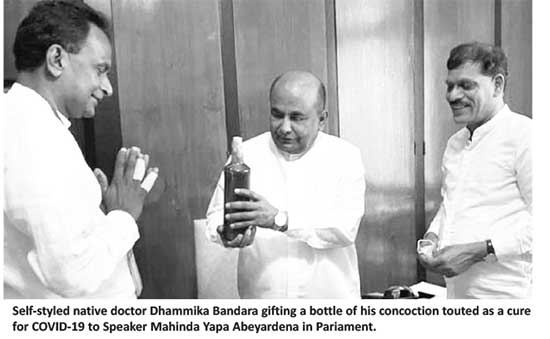
(Prof. Sasanka Perera’s recent speech as guest speaker to the National Academy of Sciences)
In present times, there is an intriguing, but at times seemingly dangerous entanglement between science, belief and state policy or government action. This kind of phenomena range from the government’s sudden ban of Glyphosate in 2015; the state sponsorship of a conference on the air power of the mythical king Ravana to the layers of stories surrounding the advent of what is now popularly known as the Dammika Peniya. These are merely three well-known phenomena from a whole series of such phenomena in the country with varying impacts on social life, politics and commerce. As a collective of occurrences with their own structure of associated events, these phenomena have not been reckoned with seriously. We have not carefully reflected upon them and asked ourselves why they are more evident now, and what their broader consequences and reasons for manifestation might be. As a result, we do not have credible sociological explanations for these phenomena that goes beyond popular rhetoric. These phenomena are seemingly dangerous too, because many of them defy what we might think of as commonsense and leads in the direction of collective chaos and counter-productive action on the part of the state. And in this journey, ‘science’ is one of the most obvious casualties.
To me, all this points to a contradictory entanglement involving science, belief, and state policy when ideally such contradictory entanglements should not take place. By ‘science’ I do not merely mean the vast systems of knowledge that originated in the west, which now have global hegemony including in our country. Instead, science is any system of knowledge “concerned with the physical world” and phenomena emanating from this world along with formal “observations and systematic experimentation.”i In other words, a “science involves a pursuit of knowledge” that covers “general truths” as well as “the operations of fundamental laws.”ii In this sense, Ayurveda, Unnani, present day engineering, allopathic medicine or any other system of formal knowledge are mostly matters of science though the bases for their fundamentals would vary considerably from the more dominant post-enlightenment sciences to much older systems of knowledge.
Similarly, by ‘belief’, I mean not only matters of faith rooted in religion and tradition but also contemporary beliefs that are created by the repetitive circulation of ideas across media whether they are based on fact and science or not. Often, these ideas address contemporary issues and politics though they might be camouflaged in a rhetoric of the past, resort to specific conventions, and identity politics. And these associations are quite important today given the propensity for fake news and the enhanced ability of people to accept these ideas easily without being formally countered.
In the same sense, ‘state policy’ and actions linked to such policies are expected to be based on formal legal principles and empirical facts, and ideally should have nothing to do with matters of faith or untested assumptions and should benefit the polity.
Generally, I consider science, belief, and state policy to be independent discourses with their own epistemological routes and purposes though there will be close and necessary interactions among these such as between science and state policy. At other times, as we are seeing now, this association can be between belief and state policy where science might be eclipsed.
My intention today is to simply place in context three recent phenomena of this kind that are structurally very similar but contextually very different, which I think would explain to some extent how this amalgamation of discourses function, and the ways in which their politics manifest. As far as I am concerned, what I have to say today are simply preliminary thoughts about which I would like to think further and theorize.
Phenomenon 1: Glyphosate Ban
The use of the weedicide glyphosate was banned by presidential order in 2015. In a paper published in the same year, Jayasumana, Gunatilake and Siribaddana note that people in areas where kidney disease has become endemic have been exposed to multiple heavy metals and glyphosate.iii Their conclusion as far as I could see as a non-expert, was very vague, which amounted to the following observation: “Although we could not localize a single nephrotoxin as the culprit” “multiple heavy metals and glyphosates may play a role in the pathogenesis.”iv This is one of several public articulations related to this matter that has some semblance of what I may call scientific noise, but clearly inconclusive.
The ban was quite sudden and was implemented following on the heels of intense lobbying by Member of Parliament and Presidential Advisor, Reverend Athuraliye Rathana. He argued along with his supporters that this chemical caused chronic kidney disease of unknown etiology (CKDu) in the North Central and Uva Provinces. But what is clear is no reliable and specific scientific evidence was offered by him or the President’s Office as the basis for the ban. In this overall process, it does not seem that the Registrar of Pesticides; Fertilizer Secretariat; Medical Research Institute and Tea Research Institute, all of whom could have presented valuable and more formal input into the decision were consulted. It almost seems that the ban found its genesis in the popular belief that chemicals are bad.
The fact that there is considerable prevalence of kidney disease in parts of the country is a fact, which needs to be more rigorously studied to work out its causes. Personally, I am not a supporter of excessive use of chemicals for anything including agriculture, and to the extent possible, I have made changes in my personal lifestyle to address this anxiety. But that kind of personal, emotional or popular anxieties cannot be the foundation for state level decision-making, particularly if the government and the people both subscribe to the idea of commercial agriculture and the eradication of hunger.
The consequences of the ban have been substantial in monetary terms. It caused production costs to increase substantially and the industry, particularly the tea sector, incurred losses up to 10-20 billion rupees annually while the ban lasted. Though the ban was eventually partially lifted, even at that time, no credible and conclusive data supporting the ban existed. So, it appears, that the ban was solely based on a popular and largely correct general belief of the negative impacts of chemicals, tempered by political rhetoric emanating from matters of faith and popular beliefs. I am sure we can all agree, while we can entertain popular beliefs or even conspiracy theories among people, if they are injected into broader politics and formation of state policy, that would have serious consequences as this event has shown. Part of the problem here is not only the undue credence given to freely circulating popular notions without situating them in the context of formal and reliable knowledge, information and science, but the ability of popular political leaders to convert untested ideas into practices of state policy and action without facing consequences.
Phenomenon 2: The State’s Embrace of Ravana
People of my generation will know that Ravana and his flying machine were merely elements in an interesting story in our youth while in some parts of the country specific local stories linked to this myth circulated. Unlike India and elsewhere in South Asia and in the east right up to Bali, there is no evidence of Ramayana performances which may have included a dramatization of the Ravana narrative in Sinhala cultural lore. But this situation has dramatically changed in recent times where Ravana’s popularity has rapidly increased among a cross section of the people, while his name and alleged historicity have also been openly embraced by the state.
By 2019, the story of Ravana had been directly appropriated by the Sri Lankan state and engrossed in a highly superficial but allegedly scientific discourse on aviation. In July 2019, Civil Aviation Authority of Sri Lankan organized a “conference of civil aviation experts, historians, archaeologists, scientists and geologists” in Katunayake.v The Authority’s Vice Chairman at the time, Shashi Danatunge told Indian media, “King Ravana was a genius. He was the first person to fly. He was an aviator. This is not mythology; it’s a fact. There needs to be a detailed research on this. In the next five years, we will prove this.”vi He further noted, “they had irrefutable facts to prove that Ravana was the pioneer and the first to fly using an aircraft.”vii The conference’s main conclusion was “that Ravana first flew from Sri Lanka to today’s India 5,000 years ago and came back.”viii Many conference participants in their own peculiar wisdom, dismissed the powerful stories narrating Ravana’s kidnapping of Lord Rama’s wife Sita, as a mere “Indian version.”ix For them, this was not possible because Ravana was a noble king.”x
Intriguingly, one part of the myth cluster became a fact while another became fiction based simply on nothing more concrete than emotional and nationalist appeal. The ideas expressed in public on this matter were not private articulations of individuals. Particularly the Vice Chairman of Civil Aviation was speaking as a representative of a state agency. Also, the general conclusions of the conference and the acceptance of the Ravana story as historical fact could simply not be entrained by formal historiography and archaeology.
By 2020, the same agency took its sense of scientificity of these claims even further by launching a research project looking for evidence of Ravana’s flying and his “aviation routes.”xi The theme of the project was, “King Ravana and the ancient domination of aerial routes now lost.”xii Towards this, the Civil Aviation Authority placed advertisements in national newspapers asking people to send in evidence they may have. The purported scientific objective and the reason for the Civil Aviation Authority’ central involvement in this state-sponsored effort was explained as follows: 1) Because the Civil Aviation Authority was “the main aviation regulatory authority in Sri Lanka,” it was the most logical entity to host such and effort, and 2) Because “there are multiple stories over the years about Ravana flying aircrafts and covering these routes” there was a necessity “to study this matter.”xiii
Though there are seemingly rational and seemingly scientific ‘noises’ in this episode, the entire exercise is enveloped in taking myth as fact, and that too, with the direct participation of the state.
Phenomenon 3: The Advent of the Dammika Peniya
Now we come to the advent of the Dammika Peniya which is formally known as ‘ශ්රී වීර භද්රධම්ම කොරෝනා නිවාරණ ප්රතිශක්ති ජීව පානය’ (Shri Vira Bhdradhamma Corona Nivaranana Prathishakthi Jiva Panaya). According to its inventor, Mr Dammika Bandara, the formula for the syrup was given to him by Goddess Kali in a dream. This is a crucial point in which the genesis of this syrup differs from the more formal discourses of knowledge in Ayurveda and Sinhala medicine, within which this claim is located.
It was a claim protected by rhetoric of local medical superiority, power of ancient knowledge and very loud articulations of cultural and political nationalism. But certain things need to be understood clearly. Even within the structure of faith and belief in Sinhala culture, goddess Kali, the alleged ultimate progenitor of the syrup is not known for healing. She is seen more as a powerful deity but with considerable destructive potential. More typically associated with healing is goddess Pattini. So, the claim seems to be out of place even in the context of conventional Sinhala myth and belief. Second, though Ayurveda and Sinhala medicine have associations with faith and ritual, the bulk of their formal discourses on medicine are based on experimentation, repetitive practice and fine-tuning and formally scripted knowledge or that which is handed over word of mouth across generations. My maternal grandfather wrote two books in the early 1970s after he had retired from his Ayurvedic practice and teaching. The first was called Rasayana saha Vajikarana (රසායන සහ වාජිකරණ) in which he presented a specific body of knowledge already known to his field, but with fine-tuning offered by his own practice and studies. The second, called Avinishchitha Aushada (අවිනිශ්චිත ඖෂධ) was very different. It dealt with a series of plants whose medical utility was unknown or unsure. In it, he dealt with the unknown, based on both generations of institutionalized uncertainty as well as conjecture on his part, but based on his long years of practice and observation. Both these point to the nature of the scientific discourse of contemporary Ayurveda.
Compared to this kind of background, Mr Bandara offers a set of contradictions. He is not a medical practitioner, but a mason by profession who runs a small Kali shrine in his neighborhood. However, his claim over having invented a treatment for Corona received massive publicity via media outlets supportive of the state and unreserved public support from numerous local and national political leaders including the Minister of Health and the Speaker of Parliament all of whom consumed the concoction in public along with some of their colleagues. This does not tantamount to formal state support as in the other two cases. But such open adulation and support by senior members of the government is a public performance of confidence for an untested medication with a dubious claim. These actions played a major role in ensuring large numbers of people flocking to Mr Bandara’s house in Kegalle in search of this ‘miracle’ drug – in the midst of a pandemic. This is not a general condemnation of traditional medicine. In the 1950s, the establishment of the Ayurvedic Research Institute was to offer traditional medicine a sound research and dissemination base and bring it on par with formal understanding of science. But Dammika Peniya has no such provenance; it simply came from a dream according to its inventor himself, and such provenance simply cannot be the basis for its public adulation by political leaders. Most criticisms of the concoction and its provenance were vociferously put down in public as acts of anti-nationalism and lack of respect for traditional culture. A dubious study involving several colleagues of the Wathupitiwala Hospital and a handful of test cases had taken place though it is not clear to me if this exercise even had ethical clearance. A committee consisting of medical professionals has now been appointed to undertake a clinical study of the concoction using acceptable clinical trial criteria and practices. Its results have not yet been published.
What does all this mean?
All these three incidents have several obvious things in common:
the core notions in all stories are based on popular assumptions and untested ideas;
they all have powerful political and state support directly or indirectly;
their main arguments are governed by belief whether tempered by faith or by the mere repetition of mass circulating non-facts; and
in all cases, science in the formal sense – from allopathic medicine, Ayurveda and natural sciences to archaeology and history – have been dispelled even though such input could have more sensibly impacted these discourses if they were formally made available.
Moreover, the public manifestation and power of these discourses became possible due to the very clear inability of the public services directly associated with these contexts to be guided by formally collected data and scientific conclusions and their inability to advise their political Masters, and withstand the pressures of political interference. Such political interference is obviously not based on advice from subject experts or from a clear political vision, but from short-term political agendas for popular mobilization. This main conditionality allowed these unstable claims to become part of national politics and in some cases become policy or in the very least lead to actions sanctioned by the state.
But how does one explain the massive public support especially for the last two incidents. I have noticed for many years that people in our country, and particularly the Sinhalas seem to have a desperate urge to be part of grand historical claims and narratives. But I have not yet been able to gather adequate data or theorize what might be going on. But one can tentatively make some observations. The rediscovery of Ravana and brining him from the pages of myth and epic narrative of the Ramayana to state-sponsored formal discourses of populist and non-empirical historicization, and therefore formal reiteration of myth itself shows the urge to control what might be thought of as a popular and powerful narrative of the past. The way in which Sinhalas have reinvented Ravana over the last decade or so is not only as an aviator, but also as an engineer, medical expert, inventor, scientist and scholar. And this is done within an idiom of nationalist discourse that insists a pre-Vijayan and wholly Sri Lankan civilization once existed in which Ravana is a central attraction. These claims also assert this civilization was somehow superior to the cultural landscape across the ocean in the rest of South Asia. This seems to me to be more like what anthropologists would call millenarian mythmaking where Ravana appears at least in part as a millenarian hero. Generally, millenarian stories, beliefs and heroes have to do with delivering a society from danger, introduction of new ideas and technologies to ensure the safety of a collective, and so on. Such stories generally manifest in times of crisis. In the case of the Ravana story, the preoccupation is to recreate an important place for Lanka in the broader political history of South Asia in the context of a politically unstable present.
Even the story of the Dammika Peniya has some of these millenarian features. After all, it was presented as a very local remedy for COVID 19 based on a lost Sri Lankan body of scientific knowledge delivered directly by a goddess in a dream. And that too at a time when people were desperate to be safe and keen to protect their livelihoods from the vagaries of Corona virus at a time the state’s effort at controlling it appeared to be faltering. The Peniya seemed to be a sign of miraculous deliverance from the island’s past glory emerging in the midst of its chaotic present.
To end this preliminary sketch let me refer to a final comment. It seems to me, these kinds of stories emerge in times of crises – be these emotional, social, or political crises. This is not unique to Sri Lanka, and can also be seen in many other parts of the world in structurally similar circumstances. These stories have their genesis in realms of conjecture. I am not objecting to the deployment of conjecture as such. Most good ideas in all our disciplines would often begin with conjecture. As we know, the philosophy of science has shown us the importance of “assumptions, foundations, methods” and “implications of science.”xiv Reflections in philosophy of science also indicate the efforts to distinguish between what is considered science and what is thought of as non-science.xv It is in the latter domain where untested conjecture would generally be located until they can be given a basis in science or dispelled.
In this general context, it seems to me, these stories allow people to be part of a more powerful and often a winning idea of history and hyper-real present even though that domain of belief might have very little or nothing to do with lived reality as such. Partly, these can also be seen as coping mechanisms in difficult and turbulent times. But these are clearly not remedies for very real socio-political or public health issues that can be utilized brazenly by the state as long as their core ideas remain in domains of belief and conjecture.
The collective failure that typifies our situation is the inability of many people to understand this commonsense and as a result, become dangerously entangled in the internal logic of these stories, which have no external empirical foundations except for the real-life calamities some of them might generate. It is also likely our political leaders consciously and deliberately promote these stories and phenomena to divert people’s attention from evolving crises.
In this situation, I find it unfortunate that Sri Lankan social sciences have not yet spent the time to collect these stories and study them more carefully in their border social and political contexts and offer a more coherent, empirically-based, and nuanced theoretical explanation.
(Sasanka Perera is a trained anthropologist and is a professor at South Asian University in New Delhi. This is the text of a guest lecture delivered at the Induction Ceremony of the National Academy of Sciences of Sri Lanka on 22 January 2021)



by Dr Gotabhya Ranasinghe
Senior Consultant Cardiologist
National Hospital Sri Lanka
When we sought a meeting with Hon Dr. Ramesh Pathirana, Minister of Health, he graciously cleared his busy schedule to accommodate us. Renowned for his attentive listening and deep understanding, Minister Pathirana is dedicated to advancing the health sector. His openness and transparency exemplify the qualities of an exemplary politician and minister.
Dr. Palitha Mahipala, the current Health Secretary, demonstrates both commendable enthusiasm and unwavering support. This combination of attributes makes him a highly compatible colleague for the esteemed Minister of Health.
Our discussion centered on a project that has been in the works for the past 30 years, one that no other minister had managed to advance.
Minister Pathirana, however, recognized the project’s significance and its potential to revolutionize care for heart patients.
The project involves the construction of a state-of-the-art facility at the premises of the National Hospital Colombo. The project’s location within the premises of the National Hospital underscores its importance and relevance to the healthcare infrastructure of the nation.
This facility will include a cardiology building and a tertiary care center, equipped with the latest technology to handle and treat all types of heart-related conditions and surgeries.
Securing funding was a major milestone for this initiative. Minister Pathirana successfully obtained approval for a $40 billion loan from the Asian Development Bank. With the funding in place, the foundation stone is scheduled to be laid in September this year, and construction will begin in January 2025.
This project guarantees a consistent and uninterrupted supply of stents and related medications for heart patients. As a result, patients will have timely access to essential medical supplies during their treatment and recovery. By securing these critical resources, the project aims to enhance patient outcomes, minimize treatment delays, and maintain the highest standards of cardiac care.
Upon its fruition, this monumental building will serve as a beacon of hope and healing, symbolizing the unwavering dedication to improving patient outcomes and fostering a healthier society.We anticipate a future marked by significant progress and positive outcomes in Sri Lanka’s cardiovascular treatment landscape within the foreseeable timeframe.

by Fr. Emmanuel Fernando, OMI
Jesuit Fr. Aloysius Pieris (affectionately called Fr. Aloy) celebrated his 90th birthday on April 9, 2024 and I, as the editor of our Oblate Journal, THE MISSIONARY OBLATE had gone to press by that time. Immediately I decided to publish an article, appreciating the untiring selfless services he continues to offer for inter-Faith dialogue, the renewal of the Catholic Church, his concern for the poor and the suffering Sri Lankan masses and to me, the present writer.
It was in 1988, when I was appointed Director of the Oblate Scholastics at Ampitiya by the then Oblate Provincial Fr. Anselm Silva, that I came to know Fr. Aloy more closely. Knowing well his expertise in matters spiritual, theological, Indological and pastoral, and with the collaborative spirit of my companion-formators, our Oblate Scholastics were sent to Tulana, the Research and Encounter Centre, Kelaniya, of which he is the Founder-Director, for ‘exposure-programmes’ on matters spiritual, biblical, theological and pastoral. Some of these dimensions according to my view and that of my companion-formators, were not available at the National Seminary, Ampitiya.
Ever since that time, our Oblate formators/ accompaniers at the Oblate Scholasticate, Ampitiya , have continued to send our Oblate Scholastics to Tulana Centre for deepening their insights and convictions regarding matters needed to serve the people in today’s context. Fr. Aloy also had tried very enthusiastically with the Oblate team headed by Frs. Oswald Firth and Clement Waidyasekara to begin a Theologate, directed by the Religious Congregations in Sri Lanka, for the contextual formation/ accompaniment of their members. It should very well be a desired goal of the Leaders / Provincials of the Religious Congregations.
Besides being a formator/accompanier at the Oblate Scholasticate, I was entrusted also with the task of editing and publishing our Oblate journal, ‘The Missionary Oblate’. To maintain the quality of the journal I continue to depend on Fr. Aloy for his thought-provoking and stimulating articles on Biblical Spirituality, Biblical Theology and Ecclesiology. I am very grateful to him for his generous assistance. Of late, his writings on renewal of the Church, initiated by Pope St. John XX111 and continued by Pope Francis through the Synodal path, published in our Oblate journal, enable our readers to focus their attention also on the needed renewal in the Catholic Church in Sri Lanka. Fr. Aloy appreciated very much the Synodal path adopted by the Jesuit Pope Francis for the renewal of the Church, rooted very much on prayerful discernment. In my Religious and presbyteral life, Fr.Aloy continues to be my spiritual animator / guide and ongoing formator / acccompanier.
Fr. Aloysius Pieris, BA Hons (Lond), LPh (SHC, India), STL (PFT, Naples), PhD (SLU/VC), ThD (Tilburg), D.Ltt (KU), has been one of the eminent Asian theologians well recognized internationally and one who has lectured and held visiting chairs in many universities both in the West and in the East. Many members of Religious Congregations from Asian countries have benefited from his lectures and guidance in the East Asian Pastoral Institute (EAPI) in Manila, Philippines. He had been a Theologian consulted by the Federation of Asian Bishops’ Conferences for many years. During his professorship at the Gregorian University in Rome, he was called to be a member of a special group of advisers on other religions consulted by Pope Paul VI.
Fr. Aloy is the author of more than 30 books and well over 500 Research Papers. Some of his books and articles have been translated and published in several countries. Among those books, one can find the following: 1) The Genesis of an Asian Theology of Liberation (An Autobiographical Excursus on the Art of Theologising in Asia, 2) An Asian Theology of Liberation, 3) Providential Timeliness of Vatican 11 (a long-overdue halt to a scandalous millennium, 4) Give Vatican 11 a chance, 5) Leadership in the Church, 6) Relishing our faith in working for justice (Themes for study and discussion), 7) A Message meant mainly, not exclusively for Jesuits (Background information necessary for helping Francis renew the Church), 8) Lent in Lanka (Reflections and Resolutions, 9) Love meets wisdom (A Christian Experience of Buddhism, 10) Fire and Water 11) God’s Reign for God’s poor, 12) Our Unhiddden Agenda (How we Jesuits work, pray and form our men). He is also the Editor of two journals, Vagdevi, Journal of Religious Reflection and Dialogue, New Series.
Fr. Aloy has a BA in Pali and Sanskrit from the University of London and a Ph.D in Buddhist Philosophy from the University of Sri Lankan, Vidyodaya Campus. On Nov. 23, 2019, he was awarded the prestigious honorary Doctorate of Literature (D.Litt) by the Chancellor of the University of Kelaniya, the Most Venerable Welamitiyawe Dharmakirthi Sri Kusala Dhamma Thera.
Fr. Aloy continues to be a promoter of Gospel values and virtues. Justice as a constitutive dimension of love and social concern for the downtrodden masses are very much noted in his life and work. He had very much appreciated the commitment of the late Fr. Joseph (Joe) Fernando, the National Director of the Social and Economic Centre (SEDEC) for the poor.
In Sri Lanka, a few religious Congregations – the Good Shepherd Sisters, the Christian Brothers, the Marist Brothers and the Oblates – have invited him to animate their members especially during their Provincial Congresses, Chapters and International Conferences. The mainline Christian Churches also have sought his advice and followed his seminars. I, for one, regret very much, that the Sri Lankan authorities of the Catholic Church –today’s Hierarchy—- have not sought Fr.
Aloy’s expertise for the renewal of the Catholic Church in Sri Lanka and thus have not benefited from the immense store of wisdom and insight that he can offer to our local Church while the Sri Lankan bishops who governed the Catholic church in the immediate aftermath of the Second Vatican Council (Edmund Fernando OMI, Anthony de Saram, Leo Nanayakkara OSB, Frank Marcus Fernando, Paul Perera,) visited him and consulted him on many matters. Among the Tamil Bishops, Bishop Rayappu Joseph was keeping close contact with him and Bishop J. Deogupillai hosted him and his team visiting him after the horrible Black July massacre of Tamils.
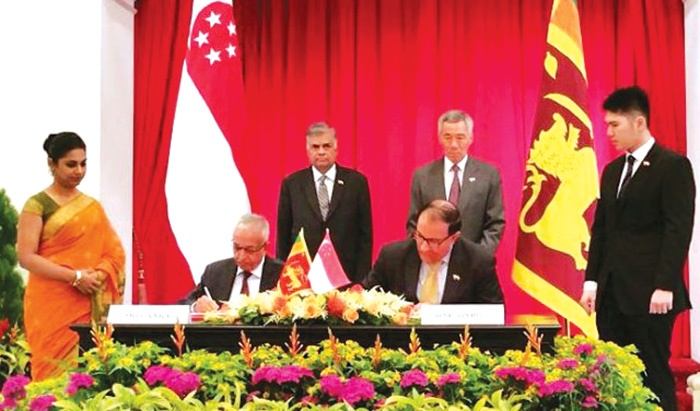
Sri Lanka-Singapore Free Trade Agreement
By Gomi Senadhira
senadhiragomi@gmail.com
“You might tell fairy tales, but the progress of a country cannot be achieved through such narratives. A country cannot be developed by making false promises. The country moved backward because of the electoral promises made by political parties throughout time. We have witnessed that the ultimate result of this is the country becoming bankrupt. Unfortunately, many segments of the population have not come to realize this yet.” – President Ranil Wickremesinghe, 2024 Budget speech
Any Sri Lankan would agree with the above words of President Wickremesinghe on the false promises our politicians and officials make and the fairy tales they narrate which bankrupted this country. So, to understand this, let’s look at one such fairy tale with lots of false promises; Ranil Wickremesinghe’s greatest achievement in the area of international trade and investment promotion during the Yahapalana period, Sri Lanka-Singapore Free Trade Agreement (SLSFTA).
It is appropriate and timely to do it now as Finance Minister Wickremesinghe has just presented to parliament a bill on the National Policy on Economic Transformation which includes the establishment of an Office for International Trade and the Sri Lanka Institute of Economics and International Trade.
Was SLSFTA a “Cleverly negotiated Free Trade Agreement” as stated by the (former) Minister of Development Strategies and International Trade Malik Samarawickrama during the Parliamentary Debate on the SLSFTA in July 2018, or a colossal blunder covered up with lies, false promises, and fairy tales? After SLSFTA was signed there were a number of fairy tales published on this agreement by the Ministry of Development Strategies and International, Institute of Policy Studies, and others.
However, for this article, I would like to limit my comments to the speech by Minister Samarawickrama during the Parliamentary Debate, and the two most important areas in the agreement which were covered up with lies, fairy tales, and false promises, namely: revenue loss for Sri Lanka and Investment from Singapore. On the other important area, “Waste products dumping” I do not want to comment here as I have written extensively on the issue.
1. The revenue loss
During the Parliamentary Debate in July 2018, Minister Samarawickrama stated “…. let me reiterate that this FTA with Singapore has been very cleverly negotiated by us…. The liberalisation programme under this FTA has been carefully designed to have the least impact on domestic industry and revenue collection. We have included all revenue sensitive items in the negative list of items which will not be subject to removal of tariff. Therefore, 97.8% revenue from Customs duty is protected. Our tariff liberalisation will take place over a period of 12-15 years! In fact, the revenue earned through tariffs on goods imported from Singapore last year was Rs. 35 billion.
The revenue loss for over the next 15 years due to the FTA is only Rs. 733 million– which when annualised, on average, is just Rs. 51 million. That is just 0.14% per year! So anyone who claims the Singapore FTA causes revenue loss to the Government cannot do basic arithmetic! Mr. Speaker, in conclusion, I call on my fellow members of this House – don’t mislead the public with baseless criticism that is not grounded in facts. Don’t look at petty politics and use these issues for your own political survival.”
I was surprised to read the minister’s speech because an article published in January 2018 in “The Straits Times“, based on information released by the Singaporean Negotiators stated, “…. With the FTA, tariff savings for Singapore exports are estimated to hit $10 million annually“.
As the annual tariff savings (that is the revenue loss for Sri Lanka) calculated by the Singaporean Negotiators, Singaporean $ 10 million (Sri Lankan rupees 1,200 million in 2018) was way above the rupees’ 733 million revenue loss for 15 years estimated by the Sri Lankan negotiators, it was clear to any observer that one of the parties to the agreement had not done the basic arithmetic!
Six years later, according to a report published by “The Morning” newspaper, speaking at the Committee on Public Finance (COPF) on 7th May 2024, Mr Samarawickrama’s chief trade negotiator K.J. Weerasinghehad had admitted “…. that forecasted revenue loss for the Government of Sri Lanka through the Singapore FTA is Rs. 450 million in 2023 and Rs. 1.3 billion in 2024.”
If these numbers are correct, as tariff liberalisation under the SLSFTA has just started, we will pass Rs 2 billion very soon. Then, the question is how Sri Lanka’s trade negotiators made such a colossal blunder. Didn’t they do their basic arithmetic? If they didn’t know how to do basic arithmetic they should have at least done their basic readings. For example, the headline of the article published in The Straits Times in January 2018 was “Singapore, Sri Lanka sign FTA, annual savings of $10m expected”.
Anyway, as Sri Lanka’s chief negotiator reiterated at the COPF meeting that “…. since 99% of the tariffs in Singapore have zero rates of duty, Sri Lanka has agreed on 80% tariff liberalisation over a period of 15 years while expecting Singapore investments to address the imbalance in trade,” let’s turn towards investment.
Investment from Singapore
In July 2018, speaking during the Parliamentary Debate on the FTA this is what Minister Malik Samarawickrama stated on investment from Singapore, “Already, thanks to this FTA, in just the past two-and-a-half months since the agreement came into effect we have received a proposal from Singapore for investment amounting to $ 14.8 billion in an oil refinery for export of petroleum products. In addition, we have proposals for a steel manufacturing plant for exports ($ 1 billion investment), flour milling plant ($ 50 million), sugar refinery ($ 200 million). This adds up to more than $ 16.05 billion in the pipeline on these projects alone.
And all of these projects will create thousands of more jobs for our people. In principle approval has already been granted by the BOI and the investors are awaiting the release of land the environmental approvals to commence the project.
I request the Opposition and those with vested interests to change their narrow-minded thinking and join us to develop our country. We must always look at what is best for the whole community, not just the few who may oppose. We owe it to our people to courageously take decisions that will change their lives for the better.”
According to the media report I quoted earlier, speaking at the Committee on Public Finance (COPF) Chief Negotiator Weerasinghe has admitted that Sri Lanka was not happy with overall Singapore investments that have come in the past few years in return for the trade liberalisation under the Singapore-Sri Lanka Free Trade Agreement. He has added that between 2021 and 2023 the total investment from Singapore had been around $162 million!
What happened to those projects worth $16 billion negotiated, thanks to the SLSFTA, in just the two-and-a-half months after the agreement came into effect and approved by the BOI? I do not know about the steel manufacturing plant for exports ($ 1 billion investment), flour milling plant ($ 50 million) and sugar refinery ($ 200 million).
However, story of the multibillion-dollar investment in the Petroleum Refinery unfolded in a manner that would qualify it as the best fairy tale with false promises presented by our politicians and the officials, prior to 2019 elections.
Though many Sri Lankans got to know, through the media which repeatedly highlighted a plethora of issues surrounding the project and the questionable credentials of the Singaporean investor, the construction work on the Mirrijiwela Oil Refinery along with the cement factory began on the24th of March 2019 with a bang and Minister Ranil Wickremesinghe and his ministers along with the foreign and local dignitaries laid the foundation stones.
That was few months before the 2019 Presidential elections. Inaugurating the construction work Prime Minister Ranil Wickremesinghe said the projects will create thousands of job opportunities in the area and surrounding districts.
The oil refinery, which was to be built over 200 acres of land, with the capacity to refine 200,000 barrels of crude oil per day, was to generate US$7 billion of exports and create 1,500 direct and 3,000 indirect jobs. The construction of the refinery was to be completed in 44 months. Four years later, in August 2023 the Cabinet of Ministers approved the proposal presented by President Ranil Wickremesinghe to cancel the agreement with the investors of the refinery as the project has not been implemented! Can they explain to the country how much money was wasted to produce that fairy tale?
It is obvious that the President, ministers, and officials had made huge blunders and had deliberately misled the public and the parliament on the revenue loss and potential investment from SLSFTA with fairy tales and false promises.
As the president himself said, a country cannot be developed by making false promises or with fairy tales and these false promises and fairy tales had bankrupted the country. “Unfortunately, many segments of the population have not come to realize this yet”.
(The writer, a specialist and an activist on trade and development issues . )



US sports envoys to Lanka to champion youth development

Rahuman questions sudden cancellation of leave of CEB employees


