
News
The Caspian Sea is set to fall by 9 metres or more this century – an ecocide is imminent

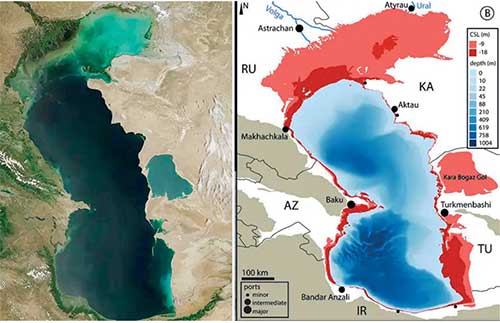
The Moderate Resolution Imaging Spectroradiometer (MODIS) on NASA’s Terra satellite captured this natural-color image of the Caspian Sea, left, on June 4, 2010. The map on the right shows the impact of Caspian Sea level projections of -30 feet and -60 feet at the end of the 21st century. Red regions fall dry.(NASA image by Jeff Schmaltz, MODIS Rapid Response Team / Map by Prange, M., Wilke, T. & Wesselingh, F.P. The other side of sea level change.)
Imagine you are on the coast, looking out to sea. In front of you lies 100 metres of barren sand that looks like a beach at low tide with gentle waves beyond. And yet there are no tides.
This is what we found when we visited the small harbour of Liman, on the Caspian Sea coast of Azerbaijan. The Caspian is actually a lake, the largest in the world and it is experiencing a devastating decline in its water level that is about to accelerate. By the end of the century the Caspian Sea will be nine metres to 18 metres lower. That’s a depth considerably taller than most houses.
It means the lake will lose at least 25 per cent of its former size, uncovering 93,000 sq km of dry land. If that new land were a country, it would be the size of Portugal.
As we found in our new research, the crisis may well result in an ecocide as devastating as the one in the Aral Sea, a few hundred kilometres to the east. The Caspian’s surface is already dropping by 7 cm every year, a trend likely to increase.
In five years, it might be about 40 cm lower than today and in ten years almost one metre lower. Maritime countries worldwide are coming to terms with one metre or so of sea level rise by the end of the century. The Caspian Sea faces a drop of that size — except it will happen within a decade.
Climate change is the culprit. The Caspian Sea waters are isolated, its surface is already around 28 metres below global oceans. Its level is the product of how much water is flowing in from rivers, mostly the mighty Volga to the north, how much it rains and how much evaporates away.
At the end of the century, the Volga and other northern rivers will still be there. However, a projected temperature rise of about 3? to 4? in the region will drive evaporation through the roof.
Future misery despite past crises
The Caspian Sea has a history of violent rises and falls. In Derbent, on the Caucasus coast of Russia, submerged ancient city walls testify to how low the sea was in medieval times. Around 10,000 years ago, the Caspian was about 100 metres lower. A few thousand years before that it was about 50 metres higher than today and even overspilled into the Black Sea.
Yet people who lived beside the sea were able to overcome the swings. No human infrastructure was around to be destroyed and many animal species simply moved up and down with the sea levels, as they had done over the past 2 million years or so. But this time is different. The fall will affect the Caspian’s unique and already stressed animal and plant life, along with human societies along the coasts.
In some areas, the coastline is about to retract hundreds of metres a year or more. Can you imagine building new piers and harbours that fast? By the time they are ready, the sea will have moved kilometres or tens of kilometres further away. Coastal promenades will soon be landlocked. The beaches of today will be the sand ridges stranded in barren plains of tomorrow.
The drop will also affect lowland rivers and deltas around the Caspian Sea. Once-fertile plains will become too dry for watermelon and rice farming to continue.
Unique Caspian life in peril
The town of Ramsar, on the Iranian coast, gave its name to a global wetland convention. But as the sea recedes, the town is becoming landlocked and the surrounding wetlands will be gone within decades.
The shallower “shelves” of the northern and eastern Caspian are major food supplies for fish and birds, yet the entire northern and eastern shelves will transform in dry barren lands. This will devastate fish species, the Caspian seal and a richness of molluscs and crustaceans species unique to the sea.
These Caspian inhabitants have already suffered badly in the past century from pollution, poaching and invasive species. About 99 per cent of Caspian seal pups are raised on the winter ice of the north Caspian. Yet both the winter ice and indeed the whole north Caspian will disappear.
Remaining biodiversity hotspots in depths between 50 metres and 150 metres will be affected as rivers dump nutrients into the deeper central basins combined with rising temperatures. This will decrease oxygen levels and developing ecological dead zones could affect the remaining refuges of Caspian species. A genuine ecocide is around the corner.
The situation cries for action, but possibilities are limited. Rising global CO2 levels, the main driver of climate conditions causing the Caspian crisis, can only be dealt with global agreements. In Soviet times, large scale water diversions from Siberian rivers were proposed to deal with the shrinking Aral Sea to the east. But such large works — in the case of the Caspian Sea, a canal from the Black Sea might be considered — come with huge ecological and geopolitical risks.
Yet action is necessary to safeguard the Caspian Sea’s unique plants and animals and the livelihood of the people who live around it. The stranded small harbour in Liman is further from the sea every year. If no action is taken, it will be left alone in more than one way.
(The Conversation)




The U.S. Embassy in Colombo welcomed the U.S. Sports Envoys to Sri Lanka, former National Basketball Association (NBA) and Women’s National Basketball Association (WNBA) players Stephen Howard and Astou Ndiaye, from June 8 through 14.
The Public Diplomacy section of the U.S. Embassy said that it would launch a weeklong basketball program intended to harness the unifying power of sports, made possible through collaboration with Foundation of Goodness and IImpact Hoop Lab.
While in Sri Lanka, Howard and Ndiaye, both retired professional basketball players, will conduct a weeklong program, Hoops for Hope: Bridging Borders through Basketball. The Sports Envoys will lead basketball clinics and exhibition matches and engage in leadership sessions in Colombo and Southern Province for youth aged 14-18 from Northern, Uva, Eastern and Western Provinces, offering skills and leadership training both on and off the court. The U.S. Envoys will also share their expertise with the Sri Lanka Basketball Federation, national coaches, and players, furthering the development of basketball in the country. Beyond the clinics, they will collaborate with Sri Lankan schoolchildren to take part in a community service project in the Colombo area.
“We are so proud to welcome Stephen and Astou as our Sports Envoys to Sri Lanka, to build on the strong people-to-people connections between the United States and Sri Lanka,” said U.S. Ambassador Julie Chung. “The lessons that will be shared by our Sports Envoys – communication, teamwork, resilience, inclusion, and conflict resolution – are essential for leadership development, community building, equality, and peace. The U.S. Sports Envoy program is a testament to our belief that sports can be a powerful tool in promoting peace and unity.”
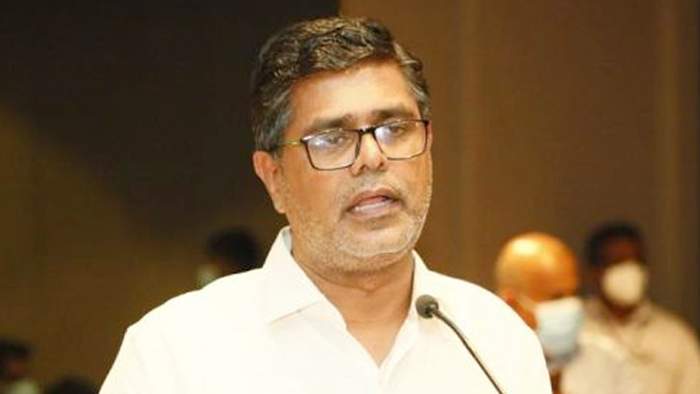
SJB Colombo District MP Mujibur Rahuman in parliament demanded to know from the government the reasons for CEB suspending the leave of all its employees until further notice from Thursday.
MP Rahuman said that the CEB has got an acting General Manager anew and the latter yesterday morning issued a circular suspending leave of all CEB employees with immediate effect until further notice.
“We demand that Minister Kanchana Wijesekera should explain this to the House. This circular was issued while this debate on the new Electricity Amendment Bill was pending. There are many who oppose this Bill. The Minister must tell parliament the reason for the urge to cancel the leave of CEB employees,” the MP said.However, Speaker Mahinda Yapa Abeywardena prevented Minister Wijesekera responding to the query and said that the matter raised by MP Rahuman was not relevant.
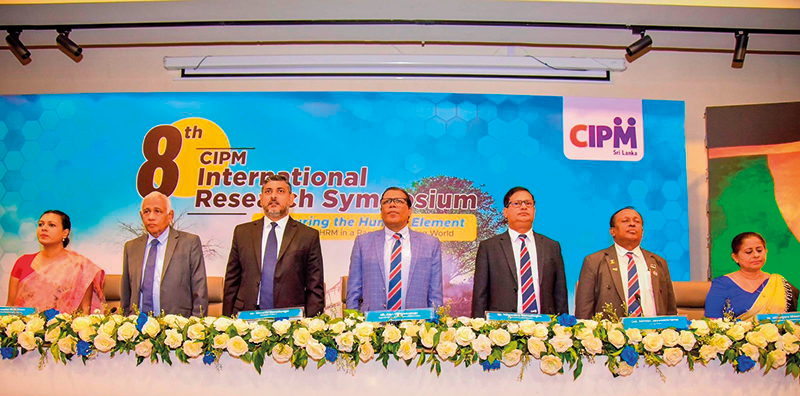
The Chartered Institute of Personnel Management (CIPM) successfully concluded the 8th Annual CIPM Symposium, which took place on 31st May 2024. Themed “Nurturing the Human Element—Redefining HRM in a Rapidly Changing World,” the symposium underscored the pivotal role of human resource management (HRM) in today’s dynamic global landscape. Since its inception in 1959, CIPM has been dedicated to advancing the HR profession through education, professional development, and advocacy, solidifying its position as Sri Lanka’s leading professional body for HRM.
Ken Vijayakumar, the President of the CIPM, graced the occasion as the chief guest. The symposium commenced with the welcome address by the Chairperson, Prof. Arosha Adikaram, followed by the Web Launch of the Symposium Proceedings and Abstract Book by the CIPM President. The event featured distinguished addresses, including a speech by Chief Guest Ken Vijayakumar, President of CIPM, and an address by Guest of Honor Shakthi Ranatunga, Chief Operating Officer of MAS Holdings Pvt. Ltd., Sri Lanka.
The symposium also featured an inspiring keynote address by Prof. Mario Fernando, Professor of Management and Director of the Centre for Cross Cultural Management (CCCM) at the University of Wollongong, Australia.
Vote of Thanks of the inauguration session was delivered by Dr. Dillanjani Weeratunga, Symposium Co-chair.
The symposium served as a comprehensive platform for researchers to present their findings across a wide range of critical topics in HRM. These included Cultural Diversity and Inclusion, Talent Development and Retention, Ethical Leadership and Corporate Social Responsibility, Adapting to Technological Advancements, Mental Health and Well-being at Work, Global Workforce Challenges, Employee Empowerment, and Reskilling and Upskilling.
The plenary session was led by Prof. Wasantha Rajapakse. Certificates were awarded to the best paper presenters during the valedictory session, followed by a vote of thanks delivered by Kamani Perera, Manager of Research and Development.
The annual symposium of CIPM was a truly inclusive event, attracting a diverse audience that spanned undergraduates, graduates, working professionals, research scholars and lecturers. This widespread interest highlights the symposium’s significance in the field of HRM, offering a unique opportunity for everyone to network and learn from scholarly brains.The CIPM International Research Symposium was sponsored by Hambantota International Port, Sri Lanka Institute of Information Technology (SLIIT), E B Creasy & Co. PLC, and Print Xcel Company.



US sports envoys to Lanka to champion youth development

Rahuman questions sudden cancellation of leave of CEB employees


