
Features
SRI LANKA’S ECONOMIC QUAGMIRE AND HOW MARGRET THATCHER SMASHED THE KEYNESIAN CONSENSUS

By Sanjeewa Jayaweera
For quite some time, experts in economics and finance not associated with any political party have been raising the red flag about the severe economic challenges that our country was facing. Unfortunately, the politicians have consistently ignored these challenges. Many in the
private sector believed that commonsense would prevail and necessary course correction will occur, and the ship will sail smoothly.
I recently reminded a few of my former colleagues about how some of them rebuked me (in a friendly manner) five years ago when I asked the regional team of a large multinational bank, “Will Sri Lanka default on foreign debt like Greece?” My colleagues felt that I was unnecessarily pessimistic, although I thought I was a realist. Fortunately for me, one of the regional team members came to my defence and said that the scenario was not so outrageous as “Sri
Lanka was not out of the woods.” That was five years ago.
Since then, a debilitating pandemic, along with a decision to reduce government revenue by around Rs. 600 billion due to various tax cuts has severely depleted government coffers. Moreover, the loss of foreign exchange earnings due to the country being closed for tourism
has been a body blow. I, however, contend that our inability, or should I say struggle to meet the repayment of foreign debt, was always ever-present. The pandemic has just fast-forwarded it. The challenge for a country with an annual deficit of around USD 8 billion in merchandise trade having to repay USD 23 billion between 2021-2025 was always tricky. Moreover, our ability to raise additional foreign currency debt has been severely constrained as international rating agencies have continuously downgraded our ability to repay the debt.
Many have spoken and written articles recommending that the Government (GOSL) seek assistance from the International Monetary Fund (IMF). To many, other than rabid socialists, it is the most sensible of options, not that there are too many available. The GOSL, on the other hand, has articulated to neither the public, the private sector or the international creditors how they intend to avoid a possible sovereign default immediately as well as going up to 2025 whilst also ensuring that there is sufficient foreign exchange to facilitate imports.
Keynesian economics
One can only assume that those reposed with economic strategy and management under President Gotabaya Rajapaksa are disciples of Keynesian economic theory. Keynesian economic theory was developed by the British economist John Maynard Keynes during the
1930s. Keynes advocated increased government expenditures and lower taxes to stimulate demand and pull the global economy out of the depression.
 Keynes argued that during periods of economic woe, the government should undertake deficit spending to make up for the decline in investment and boost consumer spending to stabilize aggregate demand. He rejected the idea that the economy would return to a natural state of equilibrium if left to market forces. Instead, he proposed that the government spend more money and cut taxes to turn a budget deficit, which would increase consumer demand, viz overall economic activity, and reduce unemployment. Thus, he believed the government was better positioned than market forces when creating a robust economy.
The critics of deficit spending say that if left unchecked, it could threaten economic growth. Too much debt could cause a government to raise taxes and even default on its debt. What’s more, the sale of government bonds could crowd out corporate and other private issuers, which might distort prices and interest rates in capital markets. Many who oppose Keynesian theories will now use Sri Lanka to illustrate how continuous deficit spending and funding with mountains
of debt will ultimately lead to economic disaster.
Modern Monetary Theory
A new school of economic thought called Modern Monetary Theory (MMT) has taken up the fight on behalf of Keynesian deficit spending. It is gaining influence, particularly on the left of the political spectrum. Proponents of MMT argue that as long as inflation is contained, a country with its own currency doesn’t need to worry about accumulating too much debt through deficit spending because it can always print more money to pay for it. This is precisely what our
Central Bank has been doing, one presumes at the behest of the GOSL.
How Margeret Thatcher smashed the Keynesian consensus
To understand what Margeret Thacher (MT) achieved in upending the Keynesian theory, one needs to understand the decade and a half before that. The 1960s and 70s was a time of unrivalled sociopolitical activism. In the USA, which had established itself as the leading superpower both from an economic and a military perspective, there were protests against the war in Vietnam whilst the civil rights movement gained significant traction after the death of Martin Luther King. Elsewhere particularly in western Europe, pop music, recreational drugs, a liberal view towards sex and the gay community gained wide acceptance. As a result, the 1960s is fondly referred to by many as the “swinging sixties!’
In the political arena, across the world, many socialist governments were voted into power. For example, in both the UK and West Germany, socialist governments held power for most of the 1960s and 1970s. These governments underpinned their political philosophy with the concept of the social welfare state and that capitalism was not desirable. However, the aftermath of the 1973 war between Israel and several middle eastern countries caused significant economic upheaval in many countries. The oil price increased by 400 per cent, and supply was constrained due to an embargo impacting the USA and Western European countries.
In the UK, a full-scale energy crisis loomed due to a combination of a limited supply of oil and an overtime ban by the coal miners to support a significant pay increase. As a result, the government declared a state of emergency. To conserve energy, industries were told to work only three days a week, and all national television stations were switched off at 10.30 p.m. In addition, students had to do their homework in the evenings by candlelight. The following year the conservative government paid the ultimate price by being rejected by the voters.
Emboldened trade unions resorting to industrial action caused many headaches to the government and a great deal of inconvenience to the public. In addition, due to rising inflation which peaked at 26 per cent, the unions demanded higher wages, resulting in higher unemployment as many companies were unable to afford such increases. It was indeed a vicious circle.
The despondency amongst the British public due to the poor economy and the actions of the militant trade unions is aptly summed up by the comments made by the then minister James
Callaghan. He warned his fellow Cabinet members in 1974 of the possibility of “a breakdown of democracy”, telling them: “If I were a young man, I would emigrate.” Ironically. he subsequently succeeded Harold Wilson as the Labour prime minister after the latter’s surprise resignation in April 1976.
The Labour government faced continuing economic difficulties with rising inflation, a balance of payments deficit arising from significant oil price increases, and a series of industrial disputes. Events came to a head in 1976 when markets began to lose confidence in the sterling. In September 1976, the government approached the IMF for a loan of US$3.9 billion, the largest ever requested from the fund. The IMF demanded significant cuts in public expenditure as a condition for the loan, which the government accepted.
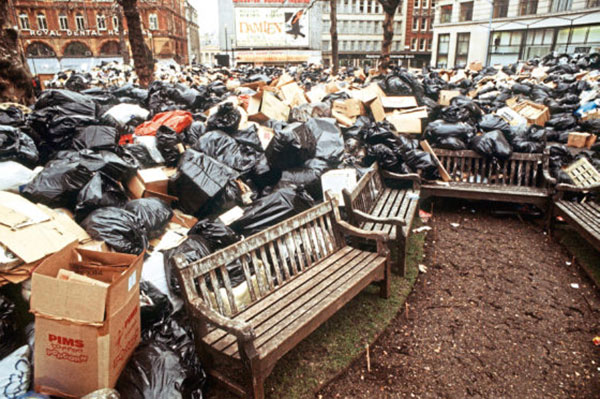
But life in the UK got worse a few years later when, in 1978, a wage dispute between Labour Prime Minister James Callaghan and the trade unions culminated in the Winter of discontent. Streets were lined with litter, some dead went unburied, and parents rushed to
feed their ill children in hospital as everyone from rubbish collectors to gravediggers and nurses went out on strike.
In May 1979, the public, fed up with the inability of the Labour government to curb the militant trade unions and bring down inflation, voted in the conservative party led by Margaret Thatcher (MT), with a parliamentary majority of 43 seats.
MT brought about many radical changes to British economic policy. The pillars on which she built her economic policies were:
* Reduce inflation through reduced money supply growth
*Reduce the budget deficit by initially increasing taxes and reducing public expenditure
*Privatize state-owned enterprises
*Deregulate the financial industry
*Bust the trade unions.
There is no doubt that she did achieve her objectives. She remained the PM for 12 years, and the conservative party was the ruling party for 17 long years. However, the initial years under MT were extremely tough for the British people. There was significant unemployment as her policy of increasing interest rates meant that many companies went into liquidation. I recall watching the one-minute segment on national TV every evening where the number of closed companies and how many were made redundant along with cumulative figures were announced.
In March 1981, as many as 364 eminent British economists published a letter condemning her plans to hike taxes even as her monetarist attack on inflation plunged the economy ever deeper into recession. However, MT stood firm. She famously said, “The lady’s not for turning ” in her speech to the Conservative Party Conference on 10 October 1980. It is considered a defining speech in Thatcher’s political development. As a result, she gained the nickname “Iron Lady”,
and it was widely believed that she had more “balls” than any of her male colleagues in the cabinet!
There is no doubt that her economic policies upended the Keynesian theory of governments spending money and lowering taxes to increase aggregate demand. Along with Ronald Regan, the President of the USA, she led a renaissance of conservative politics that relegated socialist parties for nearly two decades.
Space constraints prevent me from going into details of the main initiatives that underpinned her economic policies. However, I wish to share two of them as I believe these are imperatives for Sri Lanka in the current context.
Privatization of State-Owned
Enterprises
Under MT, the government aggressively sold off key industries that the British government had owned. Early in her term, she sold off British Aerospace and Cable & Wireless, followed later on by British Telecom, Britoil, British Gas, and Jaguar. In her third term, British Airways, British Petroleum (or BP), British Steel, Rolls Royce, and electric and water companies were privatized as well.
Many of those companies have gone on to be successful private firms. In addition, fans of the effort note that it freed up a great deal of money in the 1980s, preventing further spending cuts or tax increases and creating competitive telecommunications and fuel sectors.
Union busting
One of MT’s most heated political battles came in 1984 when the miner’s union struck work. Earlier in Thatcher’s term, in 1981, the miners almost struck, but the government immediately gave in and offered concessions. Thatcher spent the ensuing years plotting to make sure
that this never happened again by changing trade union laws, stockpiling coal to blunt the impact of a strike on consumers and even having MI5 agents infiltrate the miner’s unions.
So when the miners struck in 1984, she was ready. After nearly a year, the miners returned to work without any concessions from the government. As a result, the National Union of Miners, which just 10 years earlier had toppled the Conservative government of Edward Heath, was permanently weakened. Smashing the unions meant more when they dominated every facet of economic and political life.
Will Sri Lanka adopt Margret Thatcher’s prescription?
I lived in the UK from 1975 onwards and experienced first-hand most of what I described in the preceding paragraphs. In 1979 when MT was elected to power, I was 20-years old and very much a committed socialist. I was, in fact, the General Secretary of the Student Union
for two years. However, I took to heart the famous quote, “Not to be a socialist at twenty is proof of want of heart; to be one at thirty is proof that you have no head.”
In my opinion, there is no doubt that if we genuinely want to come out of the economic quagmire that we are in, we all will need to undergo significant hardships and sacrifices. Unfortunately, that is the price we will have to pay for the extravagant lifestyle the country has enjoyed for several decades.
The pain would have been far less had corrective decisions been taken several years ago. However, we have elected successive governments who have failed to take tough decisions as
appeasing the public, trade unions, and other vested parties have taken precedence.
An example that I wish to cite in support of my above comment is that we have hardly been subjected to any power cuts in the last two decades. Whenever there was insufficient hydropower or the coal power plant broke down, the government got the CEB to generate
expensive thermal power. This was done to prevent any inconvenience to the public but at a significant cost. The CEB did not even levy a special surcharge to recover part of the additional cost. I am pretty confident that electricity prices have not been increased for the last five years.
About a decade ago, I regularly travelled to India as the company I worked for established a subsidiary company in New Delhi. It was difficult for the accountant of that company and me to go through the financial records on the system as every few minutes; there was a power outage
or a power cut. There were long power cuts during the summer months in India and Pakistan, lasting more than six hours a day. However, in Sri Lanka, despite the perilous state of the economy, we enjoyed uninterrupted power.
About 80 per cent of government revenue is spent on paying public sector salaries. In 2015 the Yahapalana government granted salary increments of Rs. 10,000 per month to public servants. The present government gave 100,000 jobs to unemployed graduates, and the state also employed a further 35,000 who had not passed ordinary level exams. Just imagine the cost being borne by taxpayers to fund a bloated and highly inefficient public sector.
I wish to share a couple of examples with the readers so that they can understand my frustration with the public sector.
In 2002 or 2003, when as the Chief Financial Officer, I offered permanent employment at the largest conglomerate in the country to a trainee graduate working under the “Tharuna Aruna” scheme, he told me “, Sir, I prefer to work as a government teacher in Mahiyangana as there is no work pressure and also, I am guaranteed a pension!” Unfortunately, that was the limit of his ambitions which successive governments have inculcated in our people.
In 1984, I went to the Inland Revenue to represent the company I was working for an enquiry. When I approached the officer concerned, I realized that she had forgotten that an enquiry had been scheduled. I was asked to sit while she desperately rang the bell for the peon to bring the file. The guy was seated only 50 feet away but pretended not to hear! The lady was embarrassed and asked me whether I could go and find the file. I lost my temper and
told her that she’d better find the file herself. Finally, she said she would re-fix the hearing, but we had still not heard from her one year later when I went back to the UK.
That we need to restructure and privatize most state enterprises that are losing significant amounts of money as was done by MT in the UK is a given. To do that, the government needs to “bust” the trade unions. The public will need to undergo certain hardships as industrial action will disrupt our life. But, in my opinion, the sacrifice will be well worth it. At least we will leave a better place for our children.
The industrial action resorted to by health workers as well as the principals and teachers is absolutely deplorable. Furthermore, the cancellation of the East Container Terminal to be awarded to India and Japan and the reported grant of salary increments amounting to Rs. 9 billion for a year to CEB staff reflect how the GOSL is caving in to unreasonable demands made by trade unions.
Margaret Thatcher, from 1979 onwards, showcased to the British people and the world at large what can be achieved by strong, determined and courageous leadership. A quote of hers that our political leaders will do well to remember “If you set out to be liked, you would be prepared to compromise on anything at any time, and you would achieve nothing.”



by Dr Gotabhya Ranasinghe
Senior Consultant Cardiologist
National Hospital Sri Lanka
When we sought a meeting with Hon Dr. Ramesh Pathirana, Minister of Health, he graciously cleared his busy schedule to accommodate us. Renowned for his attentive listening and deep understanding, Minister Pathirana is dedicated to advancing the health sector. His openness and transparency exemplify the qualities of an exemplary politician and minister.
Dr. Palitha Mahipala, the current Health Secretary, demonstrates both commendable enthusiasm and unwavering support. This combination of attributes makes him a highly compatible colleague for the esteemed Minister of Health.
Our discussion centered on a project that has been in the works for the past 30 years, one that no other minister had managed to advance.
Minister Pathirana, however, recognized the project’s significance and its potential to revolutionize care for heart patients.
The project involves the construction of a state-of-the-art facility at the premises of the National Hospital Colombo. The project’s location within the premises of the National Hospital underscores its importance and relevance to the healthcare infrastructure of the nation.
This facility will include a cardiology building and a tertiary care center, equipped with the latest technology to handle and treat all types of heart-related conditions and surgeries.
Securing funding was a major milestone for this initiative. Minister Pathirana successfully obtained approval for a $40 billion loan from the Asian Development Bank. With the funding in place, the foundation stone is scheduled to be laid in September this year, and construction will begin in January 2025.
This project guarantees a consistent and uninterrupted supply of stents and related medications for heart patients. As a result, patients will have timely access to essential medical supplies during their treatment and recovery. By securing these critical resources, the project aims to enhance patient outcomes, minimize treatment delays, and maintain the highest standards of cardiac care.
Upon its fruition, this monumental building will serve as a beacon of hope and healing, symbolizing the unwavering dedication to improving patient outcomes and fostering a healthier society.We anticipate a future marked by significant progress and positive outcomes in Sri Lanka’s cardiovascular treatment landscape within the foreseeable timeframe.

by Fr. Emmanuel Fernando, OMI
Jesuit Fr. Aloysius Pieris (affectionately called Fr. Aloy) celebrated his 90th birthday on April 9, 2024 and I, as the editor of our Oblate Journal, THE MISSIONARY OBLATE had gone to press by that time. Immediately I decided to publish an article, appreciating the untiring selfless services he continues to offer for inter-Faith dialogue, the renewal of the Catholic Church, his concern for the poor and the suffering Sri Lankan masses and to me, the present writer.
It was in 1988, when I was appointed Director of the Oblate Scholastics at Ampitiya by the then Oblate Provincial Fr. Anselm Silva, that I came to know Fr. Aloy more closely. Knowing well his expertise in matters spiritual, theological, Indological and pastoral, and with the collaborative spirit of my companion-formators, our Oblate Scholastics were sent to Tulana, the Research and Encounter Centre, Kelaniya, of which he is the Founder-Director, for ‘exposure-programmes’ on matters spiritual, biblical, theological and pastoral. Some of these dimensions according to my view and that of my companion-formators, were not available at the National Seminary, Ampitiya.
Ever since that time, our Oblate formators/ accompaniers at the Oblate Scholasticate, Ampitiya , have continued to send our Oblate Scholastics to Tulana Centre for deepening their insights and convictions regarding matters needed to serve the people in today’s context. Fr. Aloy also had tried very enthusiastically with the Oblate team headed by Frs. Oswald Firth and Clement Waidyasekara to begin a Theologate, directed by the Religious Congregations in Sri Lanka, for the contextual formation/ accompaniment of their members. It should very well be a desired goal of the Leaders / Provincials of the Religious Congregations.
Besides being a formator/accompanier at the Oblate Scholasticate, I was entrusted also with the task of editing and publishing our Oblate journal, ‘The Missionary Oblate’. To maintain the quality of the journal I continue to depend on Fr. Aloy for his thought-provoking and stimulating articles on Biblical Spirituality, Biblical Theology and Ecclesiology. I am very grateful to him for his generous assistance. Of late, his writings on renewal of the Church, initiated by Pope St. John XX111 and continued by Pope Francis through the Synodal path, published in our Oblate journal, enable our readers to focus their attention also on the needed renewal in the Catholic Church in Sri Lanka. Fr. Aloy appreciated very much the Synodal path adopted by the Jesuit Pope Francis for the renewal of the Church, rooted very much on prayerful discernment. In my Religious and presbyteral life, Fr.Aloy continues to be my spiritual animator / guide and ongoing formator / acccompanier.
Fr. Aloysius Pieris, BA Hons (Lond), LPh (SHC, India), STL (PFT, Naples), PhD (SLU/VC), ThD (Tilburg), D.Ltt (KU), has been one of the eminent Asian theologians well recognized internationally and one who has lectured and held visiting chairs in many universities both in the West and in the East. Many members of Religious Congregations from Asian countries have benefited from his lectures and guidance in the East Asian Pastoral Institute (EAPI) in Manila, Philippines. He had been a Theologian consulted by the Federation of Asian Bishops’ Conferences for many years. During his professorship at the Gregorian University in Rome, he was called to be a member of a special group of advisers on other religions consulted by Pope Paul VI.
Fr. Aloy is the author of more than 30 books and well over 500 Research Papers. Some of his books and articles have been translated and published in several countries. Among those books, one can find the following: 1) The Genesis of an Asian Theology of Liberation (An Autobiographical Excursus on the Art of Theologising in Asia, 2) An Asian Theology of Liberation, 3) Providential Timeliness of Vatican 11 (a long-overdue halt to a scandalous millennium, 4) Give Vatican 11 a chance, 5) Leadership in the Church, 6) Relishing our faith in working for justice (Themes for study and discussion), 7) A Message meant mainly, not exclusively for Jesuits (Background information necessary for helping Francis renew the Church), 8) Lent in Lanka (Reflections and Resolutions, 9) Love meets wisdom (A Christian Experience of Buddhism, 10) Fire and Water 11) God’s Reign for God’s poor, 12) Our Unhiddden Agenda (How we Jesuits work, pray and form our men). He is also the Editor of two journals, Vagdevi, Journal of Religious Reflection and Dialogue, New Series.
Fr. Aloy has a BA in Pali and Sanskrit from the University of London and a Ph.D in Buddhist Philosophy from the University of Sri Lankan, Vidyodaya Campus. On Nov. 23, 2019, he was awarded the prestigious honorary Doctorate of Literature (D.Litt) by the Chancellor of the University of Kelaniya, the Most Venerable Welamitiyawe Dharmakirthi Sri Kusala Dhamma Thera.
Fr. Aloy continues to be a promoter of Gospel values and virtues. Justice as a constitutive dimension of love and social concern for the downtrodden masses are very much noted in his life and work. He had very much appreciated the commitment of the late Fr. Joseph (Joe) Fernando, the National Director of the Social and Economic Centre (SEDEC) for the poor.
In Sri Lanka, a few religious Congregations – the Good Shepherd Sisters, the Christian Brothers, the Marist Brothers and the Oblates – have invited him to animate their members especially during their Provincial Congresses, Chapters and International Conferences. The mainline Christian Churches also have sought his advice and followed his seminars. I, for one, regret very much, that the Sri Lankan authorities of the Catholic Church –today’s Hierarchy—- have not sought Fr.
Aloy’s expertise for the renewal of the Catholic Church in Sri Lanka and thus have not benefited from the immense store of wisdom and insight that he can offer to our local Church while the Sri Lankan bishops who governed the Catholic church in the immediate aftermath of the Second Vatican Council (Edmund Fernando OMI, Anthony de Saram, Leo Nanayakkara OSB, Frank Marcus Fernando, Paul Perera,) visited him and consulted him on many matters. Among the Tamil Bishops, Bishop Rayappu Joseph was keeping close contact with him and Bishop J. Deogupillai hosted him and his team visiting him after the horrible Black July massacre of Tamils.
Sri Lanka-Singapore Free Trade Agreement
By Gomi Senadhira
senadhiragomi@gmail.com
“You might tell fairy tales, but the progress of a country cannot be achieved through such narratives. A country cannot be developed by making false promises. The country moved backward because of the electoral promises made by political parties throughout time. We have witnessed that the ultimate result of this is the country becoming bankrupt. Unfortunately, many segments of the population have not come to realize this yet.” – President Ranil Wickremesinghe, 2024 Budget speech
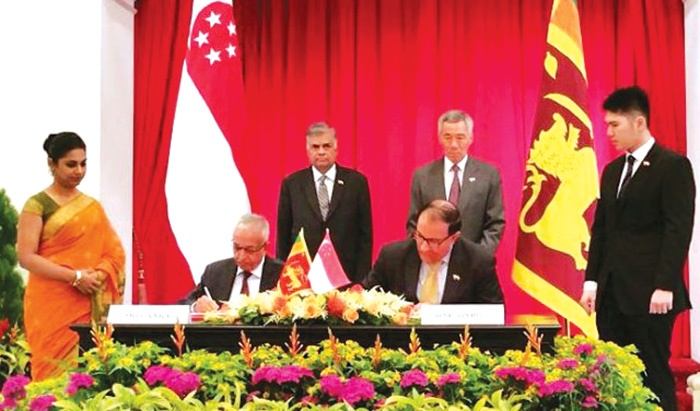
Any Sri Lankan would agree with the above words of President Wickremesinghe on the false promises our politicians and officials make and the fairy tales they narrate which bankrupted this country. So, to understand this, let’s look at one such fairy tale with lots of false promises; Ranil Wickremesinghe’s greatest achievement in the area of international trade and investment promotion during the Yahapalana period, Sri Lanka-Singapore Free Trade Agreement (SLSFTA).
It is appropriate and timely to do it now as Finance Minister Wickremesinghe has just presented to parliament a bill on the National Policy on Economic Transformation which includes the establishment of an Office for International Trade and the Sri Lanka Institute of Economics and International Trade.
Was SLSFTA a “Cleverly negotiated Free Trade Agreement” as stated by the (former) Minister of Development Strategies and International Trade Malik Samarawickrama during the Parliamentary Debate on the SLSFTA in July 2018, or a colossal blunder covered up with lies, false promises, and fairy tales? After SLSFTA was signed there were a number of fairy tales published on this agreement by the Ministry of Development Strategies and International, Institute of Policy Studies, and others.
However, for this article, I would like to limit my comments to the speech by Minister Samarawickrama during the Parliamentary Debate, and the two most important areas in the agreement which were covered up with lies, fairy tales, and false promises, namely: revenue loss for Sri Lanka and Investment from Singapore. On the other important area, “Waste products dumping” I do not want to comment here as I have written extensively on the issue.
1. The revenue loss
During the Parliamentary Debate in July 2018, Minister Samarawickrama stated “…. let me reiterate that this FTA with Singapore has been very cleverly negotiated by us…. The liberalisation programme under this FTA has been carefully designed to have the least impact on domestic industry and revenue collection. We have included all revenue sensitive items in the negative list of items which will not be subject to removal of tariff. Therefore, 97.8% revenue from Customs duty is protected. Our tariff liberalisation will take place over a period of 12-15 years! In fact, the revenue earned through tariffs on goods imported from Singapore last year was Rs. 35 billion.
The revenue loss for over the next 15 years due to the FTA is only Rs. 733 million– which when annualised, on average, is just Rs. 51 million. That is just 0.14% per year! So anyone who claims the Singapore FTA causes revenue loss to the Government cannot do basic arithmetic! Mr. Speaker, in conclusion, I call on my fellow members of this House – don’t mislead the public with baseless criticism that is not grounded in facts. Don’t look at petty politics and use these issues for your own political survival.”
I was surprised to read the minister’s speech because an article published in January 2018 in “The Straits Times“, based on information released by the Singaporean Negotiators stated, “…. With the FTA, tariff savings for Singapore exports are estimated to hit $10 million annually“.
As the annual tariff savings (that is the revenue loss for Sri Lanka) calculated by the Singaporean Negotiators, Singaporean $ 10 million (Sri Lankan rupees 1,200 million in 2018) was way above the rupees’ 733 million revenue loss for 15 years estimated by the Sri Lankan negotiators, it was clear to any observer that one of the parties to the agreement had not done the basic arithmetic!
Six years later, according to a report published by “The Morning” newspaper, speaking at the Committee on Public Finance (COPF) on 7th May 2024, Mr Samarawickrama’s chief trade negotiator K.J. Weerasinghehad had admitted “…. that forecasted revenue loss for the Government of Sri Lanka through the Singapore FTA is Rs. 450 million in 2023 and Rs. 1.3 billion in 2024.”
If these numbers are correct, as tariff liberalisation under the SLSFTA has just started, we will pass Rs 2 billion very soon. Then, the question is how Sri Lanka’s trade negotiators made such a colossal blunder. Didn’t they do their basic arithmetic? If they didn’t know how to do basic arithmetic they should have at least done their basic readings. For example, the headline of the article published in The Straits Times in January 2018 was “Singapore, Sri Lanka sign FTA, annual savings of $10m expected”.
Anyway, as Sri Lanka’s chief negotiator reiterated at the COPF meeting that “…. since 99% of the tariffs in Singapore have zero rates of duty, Sri Lanka has agreed on 80% tariff liberalisation over a period of 15 years while expecting Singapore investments to address the imbalance in trade,” let’s turn towards investment.
Investment from Singapore
In July 2018, speaking during the Parliamentary Debate on the FTA this is what Minister Malik Samarawickrama stated on investment from Singapore, “Already, thanks to this FTA, in just the past two-and-a-half months since the agreement came into effect we have received a proposal from Singapore for investment amounting to $ 14.8 billion in an oil refinery for export of petroleum products. In addition, we have proposals for a steel manufacturing plant for exports ($ 1 billion investment), flour milling plant ($ 50 million), sugar refinery ($ 200 million). This adds up to more than $ 16.05 billion in the pipeline on these projects alone.
And all of these projects will create thousands of more jobs for our people. In principle approval has already been granted by the BOI and the investors are awaiting the release of land the environmental approvals to commence the project.
I request the Opposition and those with vested interests to change their narrow-minded thinking and join us to develop our country. We must always look at what is best for the whole community, not just the few who may oppose. We owe it to our people to courageously take decisions that will change their lives for the better.”
According to the media report I quoted earlier, speaking at the Committee on Public Finance (COPF) Chief Negotiator Weerasinghe has admitted that Sri Lanka was not happy with overall Singapore investments that have come in the past few years in return for the trade liberalisation under the Singapore-Sri Lanka Free Trade Agreement. He has added that between 2021 and 2023 the total investment from Singapore had been around $162 million!
What happened to those projects worth $16 billion negotiated, thanks to the SLSFTA, in just the two-and-a-half months after the agreement came into effect and approved by the BOI? I do not know about the steel manufacturing plant for exports ($ 1 billion investment), flour milling plant ($ 50 million) and sugar refinery ($ 200 million).
However, story of the multibillion-dollar investment in the Petroleum Refinery unfolded in a manner that would qualify it as the best fairy tale with false promises presented by our politicians and the officials, prior to 2019 elections.
Though many Sri Lankans got to know, through the media which repeatedly highlighted a plethora of issues surrounding the project and the questionable credentials of the Singaporean investor, the construction work on the Mirrijiwela Oil Refinery along with the cement factory began on the24th of March 2019 with a bang and Minister Ranil Wickremesinghe and his ministers along with the foreign and local dignitaries laid the foundation stones.
That was few months before the 2019 Presidential elections. Inaugurating the construction work Prime Minister Ranil Wickremesinghe said the projects will create thousands of job opportunities in the area and surrounding districts.
The oil refinery, which was to be built over 200 acres of land, with the capacity to refine 200,000 barrels of crude oil per day, was to generate US$7 billion of exports and create 1,500 direct and 3,000 indirect jobs. The construction of the refinery was to be completed in 44 months. Four years later, in August 2023 the Cabinet of Ministers approved the proposal presented by President Ranil Wickremesinghe to cancel the agreement with the investors of the refinery as the project has not been implemented! Can they explain to the country how much money was wasted to produce that fairy tale?
It is obvious that the President, ministers, and officials had made huge blunders and had deliberately misled the public and the parliament on the revenue loss and potential investment from SLSFTA with fairy tales and false promises.
As the president himself said, a country cannot be developed by making false promises or with fairy tales and these false promises and fairy tales had bankrupted the country. “Unfortunately, many segments of the population have not come to realize this yet”.
(The writer, a specialist and an activist on trade and development issues . )



US sports envoys to Lanka to champion youth development

Rahuman questions sudden cancellation of leave of CEB employees


