
Features
Singapore-Bangkok-Paris-London Etc.

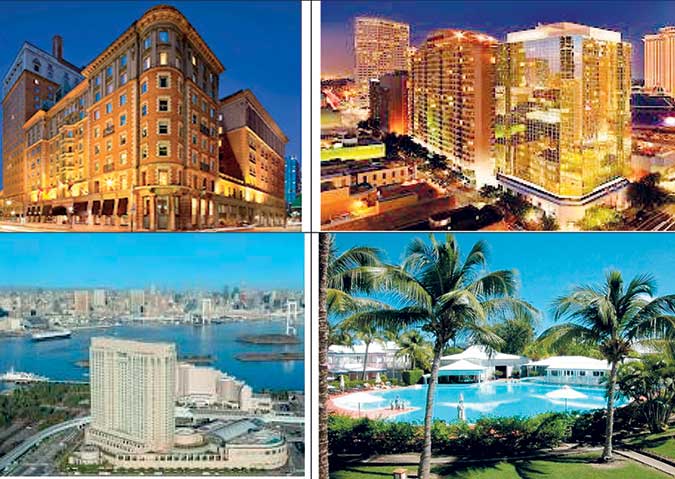
Globe trotting with Le Meridien: CONFESSIONS OF A GLOBAL GYPSY
Dr. Chandana (Chandi) Jayawardena DPhil
President – Chandi J. Associates Inc. Consulting, Canada
Founder & Administrator – Global Hospitality Forum
chandij@sympatico.ca
I am most thankful to Le Meridien hotel company for the invaluable exposure they provided me over the years. Le Meridien was very generous in developing my international hotel management career. During my two stints with them in the 1980s and in the 1990s, Le Meridien invested the time and funds to send me for training in France and job experiences in their five-star hotels in different countries.
Between 1986 and 2001, I stayed at over 20 Le Meridien Hotels in a dozen countries. In addition to being a Director of Food & Beverage, and General Manager, my other brief roles in these Le Meridien sponsored travels were: shadow general manager and management observer. I was also the quality assurance ‘mystery guest,’ or simply a guest observer during corporate sales trips, general manager conferences with Le Meridien corporate teams from Paris and London, and on holiday.
SINGAPORE
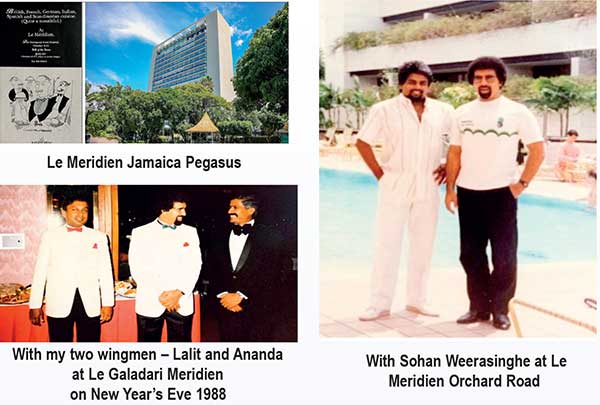
Soon after my first annual performance review as the Director of Food and Beverage of Le Galadari Meridien hotel in Colombo, my boss, the General Manager of the hotel – Jean Pierre Kaspar agreed to send me to Singapore for Le Meridien exposure. I knew that he saw some potential in me as a future international hotelier, although in the mid-1980s there were hardly any non-European expatriate managers with Le Meridien. Most of them were French.
My main assignment in Singapore was to be a Management Observer at Le Meridien in fashionable Orchard Road. Having spent two weeks at the nearby Goodwood Park Hotel in 1982, as the guest executive chef for a Sri Lankan food festival, I was familiar with Singapore. In 1987, I was amazed by how much Singapore had advanced in five years. I shadowed the Director of Food & Beverage of the hotel while being a silent observer at all meetings and events he attended. I spent some time at all their restaurants and special banquets.
I also spent some time observing their sister hotel – Le Meridien Changi located very close to my favourite airport in the world – Changi Airport. It was the first occasion that I was exposed to the management of an airport hotel. Most of the guests at this hotel stayed for short periods and the service offered had to be faster than city centre five-stars. As there was not much to see around the hotel, the few guests who stayed longer than one night usually took taxis to down town Singapore.
Compared to Colombo, Singapore had a much more active and modern night club scene being around two years ahead in nightclub trends compared to us. I wanted to duplicate some ideas as I was working on upgrading certain aspects of Colombo 2000 night club. Towards the end of my assignment there I invited the lead singer and the manager of our main band, Sohan Weerasinghe, to join me in Singapore. Our wives joined us and spent most of their time shopping while Sohan and I visited many night clubs and also recruited a Singaporean female singer to perform at Colombo 2000 on a limited engagement.
BANGKOK
Prior to my wife and I travelling to Thailand in 1988 on a vacation, I arranged our stay and a short ‘unofficial’ guest observer period at Le Meridien Bangkok. By then I had realized that a lot can be learnt by simply observing different hotel operations, although many hoteliers did not do so. I was familiar with Bangkok. In 1979, Bangkok was the first city outside Sri Lanka that I visited, when I stayed at the then famous Hotel Narai. In 1993, through a personal contact, I arranged another guest observer period for myself at the Bangkok Hilton.
After spending time at the Grand Palace and visiting the Floating Markets by boat, our tour guide had arranged an after dinner ‘Bangkok by Night’ tour for us. “I will meet you at the hotel lobby in two hours. I will take you to a unique restaurant for dinner, before the ‘night’ tour,” he promised to keep us excited. We found Thai people to be very friendly and respectful. The only things we did not like about Bangkok were the traffic and the humidity. After a refreshing shower we were ready for our adventure evening in Bangkok.
During a 45-minute car ride, our guide, Narong was proud to talk about the restaurant to which he was taking us for dinner. “Tum Nak Thai is the largest restaurant in the world. It is in an eight-acre park just outside Bangkok. It is owned by a cousin of our king. You will love the food, service, entertainment and everything else! They serve 6,000 dinners every day!” he boasted. Narong was telling us the truth.
Sitting there and looking around the beautifully landscaped and well-lit gardens of Tum Nak Thai, I understood how they handled such a large operation. They basically had six identical restaurants and six satellite kitchens led by six managers, but with the same menu. What baffled me was how they were able to market the complex so successfully to ensure a full-house for every meal.
The tropical trees, flowers, water ponds and lighting in the gardens all enhanced the ambiance. Apart from the musicians and dancers we were well entertained also by the servers/runners. They moved at lightning speed while balancing heavy trays of food and beverage. They were on roller blades and used exclusive wooden corridors, making exciting sounds, as they acrobatically moved to our amazement.
PARIS
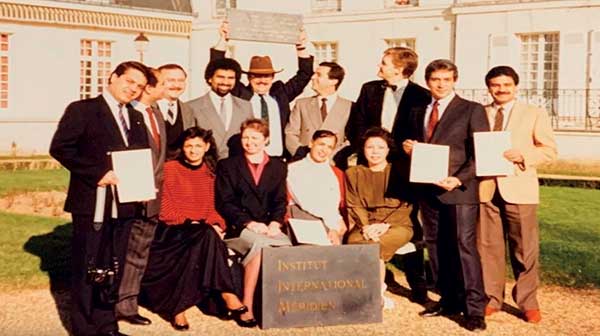
“Congratulations, Chandi! Le Meridien head office in Paris and the regional office for Asia in Singapore have approved my recommendation to send you to Institut International Meridien in France”, Mr. Jean Pierre Kaspar happily announced. It was soon after he had finished my second annual performance appraisal.
I knew that Le Meridien chose a dozen divisional heads from their hotels around the world for an advanced program at Le Institut, twice a year. It was called: ‘Séminaire de Meridien Management’. I also knew that chosen managers had the potential for promotion as General Managers in time to come. I was proud to be the first from Sri Lanka to be sent for that special hotel management, education program.
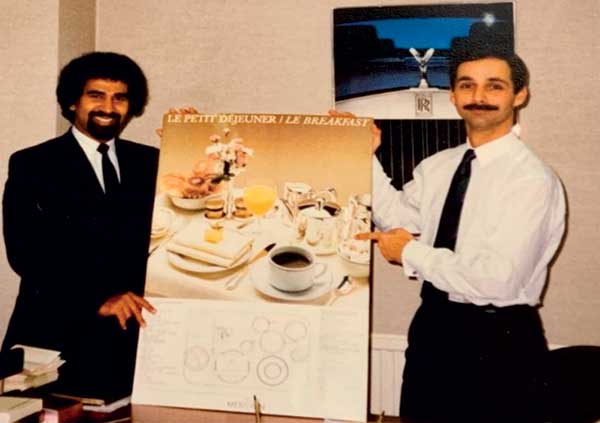
However, there was one thing that I did not know at that time: that Mr. Kaspar had spent something more than my total annual salary at Le Galadari Meridien, to educate me on the Le Meridien management concept in Paris and in Tours, where the main campus was located. After France, he had arranged for me to spend some time in London at Le Meridien Piccadilly, as a management observer. He did this by contacting a friend of his from France, who managed that hotel.
I arrived in Paris in the autumn of 1988, with great optimism. The 12 delegates were accommodated at the 1,000-room Le Meridien Montparnasse in
Air France established Le Meridien Hotels in 1972. The chain’s hotels initially offered accommodation mainly for Air France flight crews and passengers in their major airport hub cities around the world. The first Le Meridien property was a 1,000-room hotel in the heart of Paris, the Hotel Meridien Paris, today known as Le Méridien Etoile. Our welcome sessions with the President and senior Vice Presidents of the company were held at Le Méridien Etoile.
Born in Paris during an era of glamorous travel, Le Méridien Hotels & Resorts always celebrated cultures around the world through the distinctly European spirit of savouring the good life. Le Méridien’s engaging mid-century designed spaces coupled with chic signature programs putting a playful twist on art, coffee, sparkling cocktails, summer, family, and inspire creative-minded travellers to explore the world in style. I was happy to immerse myself in that unique hospitality culture.
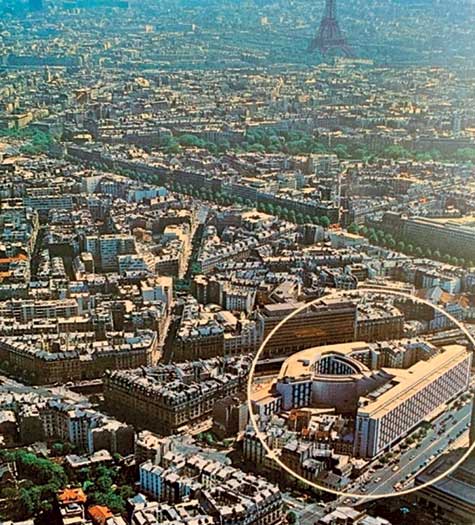 LE MERIDIEN INSTITUT IN TOURS
After a couple of days in Paris we were taken by train to Tours. The beautiful colours of the falling leaves made that two-hour ride very pleasant. During the training program, we all lived at Le Meridien Tours which was a smaller regional hotel. We all became good friends and kept in touch for years after our training. As a university town, Tours was a good location for our management studies.
Once a Gallic-Roman settlement, Tours possesses one of the largest amphitheatres of the Roman Empire, the Tours Amphitheatre. Tours is also a traditional gateway for exploring the chateaux of the Loire Valley region. Major landmarks include the Cathédrale Saint-Gatien, whose flamboyant Gothic facade is flanked by towers with 12th-century bases and Renaissance tops. In 1988, the population of Tours was around 130,000.
I simply loved that program at Le Institut. It did not cover much about hotel operations, but the professors covered in depth, hotel finance, hospitality marketing, psychology and organizational behaviour. Our French professors were knowledgeable, friendly and one of them also liked to join us in pranks.
We enhanced our knowledge of French cuisine, wines, cheeses, service and culture during our daily, extra-curricular activities. Every evening we visited a different winery and a different gourmet French restaurant. Every weekend we did tourist things — going on tours and visiting chateaux. While gaining valuable knowledge, we also gained too many calories! When my wife saw me in London, after my training in France, she was surprised. “Chandi, you have put on at least ten pounds during your time in France!” she said.
LONDON
When I arrived at Le Meriden Piccadilly in London I was warmly welcomed by the General Manager — Michel Novatin. He then entrusted the hotel’s Director of Food and Beverage — Olivier Louis — to look after me and fully expose me to his division. “I have heard great things about you from my boss — Jean Pierre Kaspar,” I said to Olivier. His response was, “Ah, I am a fan of Jean Pierre! I worked under him in my hometown – Paris — when I commenced my career as an apprentice in a pastry kitchen. He was the Food & Beverage Manager and he promoted me to the Food and Beverage Controller.”
Olivier then invited me to attend a celebration: “Come with me to a very special event with all the managers in my division,” he said. Like many five-star London hotels in the 1980s, their food and beverage operation maintained very high standards and proudly ran an operation which added value and prestige to the overall hotel product. However, the profits were in rooms. Le Meriden Piccadilly Hotel’s fine-dining French Restaurant ‘Oak Room’ had earned a Michelin star, an honour unique to a hotel restaurant at that time.
The managers were celebrating making 1% departmental profits in the Food and Beverage division, for the first time. Having done in-depth research on the Food and Beverage operations of all 16 five-star London hotels in 1984 for my master’s degree dissertation at the University of Surrey, I was not surprised by their low level of profits.
After sharing some champagne with me, the Executive Chef, Maître d’hôtel/Restaurant Managers, Olivier asked: “How about your Food and Beverage operation in Sri Lanka? In the midst of a civil war, do you make any departmental profits at all?” When I said, ‘Yes”, he was surprised, and was quick to ask me: “What percentage?”
When I said “30%”, there was pin-drop silence. The next day after having checked the group statistics, Olivier congratulated me. “Chandi, in your absence from Colombo, your team has made a record 31% Food and Beverage departmental profits for the past month!” Then he shook my hand and said, “I think that instead of you shadowing me, I should shadow you, to learn from you about making good profits!” We both laughed.
Olivier Louis was friendly, hard-working, smart and ambitious. I knew at once that he would do very well as an international hotelier. In 1996, after a 24-year career with Le Meridien in several hotels around the globe as the General Manager, Olivier left the company after it was sold by Air France to the largest British hotel company – Forte PLC. He then settled in Dubai, UAE, working for Kerzener International Limited – a leading international developer and operator of destination resorts, ultra-luxury hotels and residences and innovative entertainment and gaming experiences.
Today, Olivier is the Managing Director of two ultra-luxury iconic resorts owned by the royal family of UAE – One&Only Royal Mirage and The Palm. In 2016, he won the prestigious ‘Best Hotelier’ award at the 17th Worldwide Hospitality Awards event. I gained a lot by spending time with this legendary hotelier, during his mid-career, in 1988.
BACK IN COLOMBO
I was happy to be back in Colombo. I was also eager to share all that I had learned at the Institut International Meridien, as well as at the four Le Meriden hotels in France and England, with members of my team. Soon after my return we were busy with Christmas and New Year’s Eve events. I delivered a series of seminars based on my new learning after the festive season in early 1989.
Prior to my departure to Europe, Mr. Kaspar asked me to be ready for a promotional transfer to a Le Meridien hotel in another country as an expatriate Director of Food and Beverage, within a year. After two years of not filling this post, we decided to fill the vacancy of my deputy with a succession plan. I asked: “What type of person do you want me to hire?” Mr. Kaspar said: “I want someone just like Chandi!”
Before my trip to France, I recommended someone who was much better than me – Lalit De Silva — as my deputy. Lalit was three years older than I and a year senior to me at Ceylon Hotel School. Unlike me, he had won many academic, excellence awards including a two-year scholarship to West Germany.
Lalit was equally fluent in French and German, and spent most of his career specializing in Food and Beverage operations. At Le Galadari Meridien, Lalit understudied me, with the understanding that he would succeed me within a year. He was supported by our Banquet Manager – Ananda Warakawa.
MORE ADVENTURES WITH LE MERIDIEN
In 1994, as part of a cost-cutting measure, Air France sold its controlling interest in Meridien Hotels Inc., to the UK-based Forte PLC (my employer at that time). The French government wishing to keep Le Meridien French-owned, favoured a bid by Accor Hotels. However, with some support from the European Union, Forte was eventually successful in taking over Le Meridien. Having realized that Le Meridien maintained very high standards, Forte upgraded a selected few Forte Grand hotels and re-branded those as Le Meridien.
After Air France, the ownership of Le Meridien moved hands to five different companies – Forte in UK in 1994, Granada in UK (after a hostile takeover) in 1996, Nomura in Japan in 2001, Starwood in USA in 2005, and Marriott in USA in 2016. All five owners of Le Meridien in the post Air France era from 1994 to 2023, maintained the unique French style of Le Meridien.
In 1997, I was appointed as the General Manager of Le Meridien Jamaica Pegasus, the largest business hotel and the premier five-star hotel in the Jamaican capital city – Kingston. This hotel was previously a Forte Grand hotel and I led the re-branding to Le Meridien. In that process, the training I received at Institut International Meridien in 1988 became a great asset. For the next four years I stayed at many Le Meridien hotels for different purposes.
Prior to re-opening Jamaica Pegasus as Le Meridien, I took most members of my management team to Le Meridien New Orleans, USA, for a week. There, each of us shadowed our counterparts. After working very hard during the re-branding period, I spent a memorable, one-week holiday with my elder son, Marlon, at Le Meridien Guadalupe in the French West Indies. That hotel was a charming resort and was very different from all other Le Meridien hotels that I had experienced.
In 1998, when Marlon and I went to Japan in search of our martial art connections (Marlon earned his Karate black belt when he was 15), we stayed at Le Meridien Tokyo, which was the most expensive Le Meridien I experienced. I stayed at the Famous Le Royal Meridien King Edward Hotel in Toronto, Canada, a couple of times, attending general manager’s regional meetings and shadowing the General Manager. I was identified to become the General Manager of that great hotel in 1999, but to my chagrin, that did not materialize.
As an occasional visitor to corporate office in London, I continued to stay at a few Le Meridien Hotels there – Piccadilly, Westbury, Waldorf, Heathrow and Gatwick. During corporate sales trips to USA, I loved staying at Watergate Le Meridien in Washington D.C. and Le Parker Meridien in New York.
In October 1998, Le Meridien considered me as the hotel opening General Manager for Kathmandu, Nepal. When that project was delayed, Le Meridien was surprised when I requested two years of sabbatical leave to complete my doctoral studies. After some negotiation, they approved the leave with one condition – I have to accept any post they would offer me after the two years.
During that two-year period, Le Meridien continued with complimentary accommodation for me at Le Meridien Hotels when I travelled to attend academic conferences etc. in Georgetown (Guyana), London, Dubai and Toronto. In return, my wife (who was also a hotelier for some time) and I did comprehensive quality assurance mystery shopper assignments for my general manager colleagues of Le Meridien hotels in Dubai and Toronto.
After my two-year sabbatical leave, Le Meridien offered me a choice of two excellent posts – General Manager of a 750-room Le Meridien Hotel by the Red Sea, Egypt, or Regional Training Director for South Asia. By then I had decided to continue in academia, and settle with my family in Canada. Therefore, I did not accept either of the offers. I reluctantly left my favourite international hotel company. After 23 years, I remain friends with a few of my former Le Meridien colleagues.
In a world of standard operational international hotels, with its unique style and class, Le Meridien holds a special place in the world of hospitality and hoteliering. Given the generous support in my career development, Le Meridien also holds a very special place in my heart. Merci beaucoup, Le Méridien, and Monsieur Jean Pierre Kaspar!


by Dr Gotabhya Ranasinghe
Senior Consultant Cardiologist
National Hospital Sri Lanka
When we sought a meeting with Hon Dr. Ramesh Pathirana, Minister of Health, he graciously cleared his busy schedule to accommodate us. Renowned for his attentive listening and deep understanding, Minister Pathirana is dedicated to advancing the health sector. His openness and transparency exemplify the qualities of an exemplary politician and minister.
Dr. Palitha Mahipala, the current Health Secretary, demonstrates both commendable enthusiasm and unwavering support. This combination of attributes makes him a highly compatible colleague for the esteemed Minister of Health.
Our discussion centered on a project that has been in the works for the past 30 years, one that no other minister had managed to advance.
Minister Pathirana, however, recognized the project’s significance and its potential to revolutionize care for heart patients.
The project involves the construction of a state-of-the-art facility at the premises of the National Hospital Colombo. The project’s location within the premises of the National Hospital underscores its importance and relevance to the healthcare infrastructure of the nation.
This facility will include a cardiology building and a tertiary care center, equipped with the latest technology to handle and treat all types of heart-related conditions and surgeries.
Securing funding was a major milestone for this initiative. Minister Pathirana successfully obtained approval for a $40 billion loan from the Asian Development Bank. With the funding in place, the foundation stone is scheduled to be laid in September this year, and construction will begin in January 2025.
This project guarantees a consistent and uninterrupted supply of stents and related medications for heart patients. As a result, patients will have timely access to essential medical supplies during their treatment and recovery. By securing these critical resources, the project aims to enhance patient outcomes, minimize treatment delays, and maintain the highest standards of cardiac care.
Upon its fruition, this monumental building will serve as a beacon of hope and healing, symbolizing the unwavering dedication to improving patient outcomes and fostering a healthier society.We anticipate a future marked by significant progress and positive outcomes in Sri Lanka’s cardiovascular treatment landscape within the foreseeable timeframe.

by Fr. Emmanuel Fernando, OMI
Jesuit Fr. Aloysius Pieris (affectionately called Fr. Aloy) celebrated his 90th birthday on April 9, 2024 and I, as the editor of our Oblate Journal, THE MISSIONARY OBLATE had gone to press by that time. Immediately I decided to publish an article, appreciating the untiring selfless services he continues to offer for inter-Faith dialogue, the renewal of the Catholic Church, his concern for the poor and the suffering Sri Lankan masses and to me, the present writer.
It was in 1988, when I was appointed Director of the Oblate Scholastics at Ampitiya by the then Oblate Provincial Fr. Anselm Silva, that I came to know Fr. Aloy more closely. Knowing well his expertise in matters spiritual, theological, Indological and pastoral, and with the collaborative spirit of my companion-formators, our Oblate Scholastics were sent to Tulana, the Research and Encounter Centre, Kelaniya, of which he is the Founder-Director, for ‘exposure-programmes’ on matters spiritual, biblical, theological and pastoral. Some of these dimensions according to my view and that of my companion-formators, were not available at the National Seminary, Ampitiya.
Ever since that time, our Oblate formators/ accompaniers at the Oblate Scholasticate, Ampitiya , have continued to send our Oblate Scholastics to Tulana Centre for deepening their insights and convictions regarding matters needed to serve the people in today’s context. Fr. Aloy also had tried very enthusiastically with the Oblate team headed by Frs. Oswald Firth and Clement Waidyasekara to begin a Theologate, directed by the Religious Congregations in Sri Lanka, for the contextual formation/ accompaniment of their members. It should very well be a desired goal of the Leaders / Provincials of the Religious Congregations.
Besides being a formator/accompanier at the Oblate Scholasticate, I was entrusted also with the task of editing and publishing our Oblate journal, ‘The Missionary Oblate’. To maintain the quality of the journal I continue to depend on Fr. Aloy for his thought-provoking and stimulating articles on Biblical Spirituality, Biblical Theology and Ecclesiology. I am very grateful to him for his generous assistance. Of late, his writings on renewal of the Church, initiated by Pope St. John XX111 and continued by Pope Francis through the Synodal path, published in our Oblate journal, enable our readers to focus their attention also on the needed renewal in the Catholic Church in Sri Lanka. Fr. Aloy appreciated very much the Synodal path adopted by the Jesuit Pope Francis for the renewal of the Church, rooted very much on prayerful discernment. In my Religious and presbyteral life, Fr.Aloy continues to be my spiritual animator / guide and ongoing formator / acccompanier.
Fr. Aloysius Pieris, BA Hons (Lond), LPh (SHC, India), STL (PFT, Naples), PhD (SLU/VC), ThD (Tilburg), D.Ltt (KU), has been one of the eminent Asian theologians well recognized internationally and one who has lectured and held visiting chairs in many universities both in the West and in the East. Many members of Religious Congregations from Asian countries have benefited from his lectures and guidance in the East Asian Pastoral Institute (EAPI) in Manila, Philippines. He had been a Theologian consulted by the Federation of Asian Bishops’ Conferences for many years. During his professorship at the Gregorian University in Rome, he was called to be a member of a special group of advisers on other religions consulted by Pope Paul VI.
Fr. Aloy is the author of more than 30 books and well over 500 Research Papers. Some of his books and articles have been translated and published in several countries. Among those books, one can find the following: 1) The Genesis of an Asian Theology of Liberation (An Autobiographical Excursus on the Art of Theologising in Asia, 2) An Asian Theology of Liberation, 3) Providential Timeliness of Vatican 11 (a long-overdue halt to a scandalous millennium, 4) Give Vatican 11 a chance, 5) Leadership in the Church, 6) Relishing our faith in working for justice (Themes for study and discussion), 7) A Message meant mainly, not exclusively for Jesuits (Background information necessary for helping Francis renew the Church), 8) Lent in Lanka (Reflections and Resolutions, 9) Love meets wisdom (A Christian Experience of Buddhism, 10) Fire and Water 11) God’s Reign for God’s poor, 12) Our Unhiddden Agenda (How we Jesuits work, pray and form our men). He is also the Editor of two journals, Vagdevi, Journal of Religious Reflection and Dialogue, New Series.
Fr. Aloy has a BA in Pali and Sanskrit from the University of London and a Ph.D in Buddhist Philosophy from the University of Sri Lankan, Vidyodaya Campus. On Nov. 23, 2019, he was awarded the prestigious honorary Doctorate of Literature (D.Litt) by the Chancellor of the University of Kelaniya, the Most Venerable Welamitiyawe Dharmakirthi Sri Kusala Dhamma Thera.
Fr. Aloy continues to be a promoter of Gospel values and virtues. Justice as a constitutive dimension of love and social concern for the downtrodden masses are very much noted in his life and work. He had very much appreciated the commitment of the late Fr. Joseph (Joe) Fernando, the National Director of the Social and Economic Centre (SEDEC) for the poor.
In Sri Lanka, a few religious Congregations – the Good Shepherd Sisters, the Christian Brothers, the Marist Brothers and the Oblates – have invited him to animate their members especially during their Provincial Congresses, Chapters and International Conferences. The mainline Christian Churches also have sought his advice and followed his seminars. I, for one, regret very much, that the Sri Lankan authorities of the Catholic Church –today’s Hierarchy—- have not sought Fr.
Aloy’s expertise for the renewal of the Catholic Church in Sri Lanka and thus have not benefited from the immense store of wisdom and insight that he can offer to our local Church while the Sri Lankan bishops who governed the Catholic church in the immediate aftermath of the Second Vatican Council (Edmund Fernando OMI, Anthony de Saram, Leo Nanayakkara OSB, Frank Marcus Fernando, Paul Perera,) visited him and consulted him on many matters. Among the Tamil Bishops, Bishop Rayappu Joseph was keeping close contact with him and Bishop J. Deogupillai hosted him and his team visiting him after the horrible Black July massacre of Tamils.
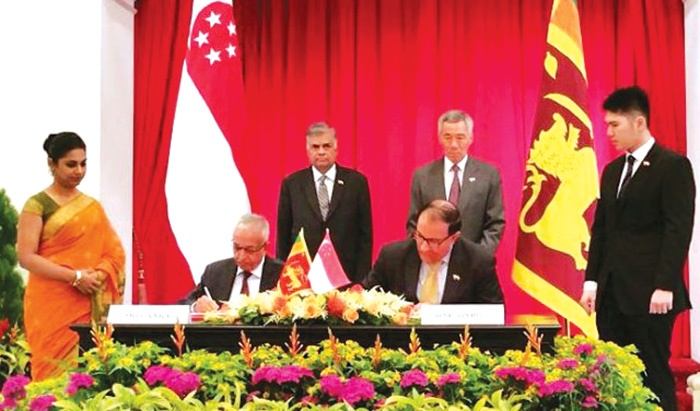
Sri Lanka-Singapore Free Trade Agreement
By Gomi Senadhira
senadhiragomi@gmail.com
“You might tell fairy tales, but the progress of a country cannot be achieved through such narratives. A country cannot be developed by making false promises. The country moved backward because of the electoral promises made by political parties throughout time. We have witnessed that the ultimate result of this is the country becoming bankrupt. Unfortunately, many segments of the population have not come to realize this yet.” – President Ranil Wickremesinghe, 2024 Budget speech
Any Sri Lankan would agree with the above words of President Wickremesinghe on the false promises our politicians and officials make and the fairy tales they narrate which bankrupted this country. So, to understand this, let’s look at one such fairy tale with lots of false promises; Ranil Wickremesinghe’s greatest achievement in the area of international trade and investment promotion during the Yahapalana period, Sri Lanka-Singapore Free Trade Agreement (SLSFTA).
It is appropriate and timely to do it now as Finance Minister Wickremesinghe has just presented to parliament a bill on the National Policy on Economic Transformation which includes the establishment of an Office for International Trade and the Sri Lanka Institute of Economics and International Trade.
Was SLSFTA a “Cleverly negotiated Free Trade Agreement” as stated by the (former) Minister of Development Strategies and International Trade Malik Samarawickrama during the Parliamentary Debate on the SLSFTA in July 2018, or a colossal blunder covered up with lies, false promises, and fairy tales? After SLSFTA was signed there were a number of fairy tales published on this agreement by the Ministry of Development Strategies and International, Institute of Policy Studies, and others.
However, for this article, I would like to limit my comments to the speech by Minister Samarawickrama during the Parliamentary Debate, and the two most important areas in the agreement which were covered up with lies, fairy tales, and false promises, namely: revenue loss for Sri Lanka and Investment from Singapore. On the other important area, “Waste products dumping” I do not want to comment here as I have written extensively on the issue.
1. The revenue loss
During the Parliamentary Debate in July 2018, Minister Samarawickrama stated “…. let me reiterate that this FTA with Singapore has been very cleverly negotiated by us…. The liberalisation programme under this FTA has been carefully designed to have the least impact on domestic industry and revenue collection. We have included all revenue sensitive items in the negative list of items which will not be subject to removal of tariff. Therefore, 97.8% revenue from Customs duty is protected. Our tariff liberalisation will take place over a period of 12-15 years! In fact, the revenue earned through tariffs on goods imported from Singapore last year was Rs. 35 billion.
The revenue loss for over the next 15 years due to the FTA is only Rs. 733 million– which when annualised, on average, is just Rs. 51 million. That is just 0.14% per year! So anyone who claims the Singapore FTA causes revenue loss to the Government cannot do basic arithmetic! Mr. Speaker, in conclusion, I call on my fellow members of this House – don’t mislead the public with baseless criticism that is not grounded in facts. Don’t look at petty politics and use these issues for your own political survival.”
I was surprised to read the minister’s speech because an article published in January 2018 in “The Straits Times“, based on information released by the Singaporean Negotiators stated, “…. With the FTA, tariff savings for Singapore exports are estimated to hit $10 million annually“.
As the annual tariff savings (that is the revenue loss for Sri Lanka) calculated by the Singaporean Negotiators, Singaporean $ 10 million (Sri Lankan rupees 1,200 million in 2018) was way above the rupees’ 733 million revenue loss for 15 years estimated by the Sri Lankan negotiators, it was clear to any observer that one of the parties to the agreement had not done the basic arithmetic!
Six years later, according to a report published by “The Morning” newspaper, speaking at the Committee on Public Finance (COPF) on 7th May 2024, Mr Samarawickrama’s chief trade negotiator K.J. Weerasinghehad had admitted “…. that forecasted revenue loss for the Government of Sri Lanka through the Singapore FTA is Rs. 450 million in 2023 and Rs. 1.3 billion in 2024.”
If these numbers are correct, as tariff liberalisation under the SLSFTA has just started, we will pass Rs 2 billion very soon. Then, the question is how Sri Lanka’s trade negotiators made such a colossal blunder. Didn’t they do their basic arithmetic? If they didn’t know how to do basic arithmetic they should have at least done their basic readings. For example, the headline of the article published in The Straits Times in January 2018 was “Singapore, Sri Lanka sign FTA, annual savings of $10m expected”.
Anyway, as Sri Lanka’s chief negotiator reiterated at the COPF meeting that “…. since 99% of the tariffs in Singapore have zero rates of duty, Sri Lanka has agreed on 80% tariff liberalisation over a period of 15 years while expecting Singapore investments to address the imbalance in trade,” let’s turn towards investment.
Investment from Singapore
In July 2018, speaking during the Parliamentary Debate on the FTA this is what Minister Malik Samarawickrama stated on investment from Singapore, “Already, thanks to this FTA, in just the past two-and-a-half months since the agreement came into effect we have received a proposal from Singapore for investment amounting to $ 14.8 billion in an oil refinery for export of petroleum products. In addition, we have proposals for a steel manufacturing plant for exports ($ 1 billion investment), flour milling plant ($ 50 million), sugar refinery ($ 200 million). This adds up to more than $ 16.05 billion in the pipeline on these projects alone.
And all of these projects will create thousands of more jobs for our people. In principle approval has already been granted by the BOI and the investors are awaiting the release of land the environmental approvals to commence the project.
I request the Opposition and those with vested interests to change their narrow-minded thinking and join us to develop our country. We must always look at what is best for the whole community, not just the few who may oppose. We owe it to our people to courageously take decisions that will change their lives for the better.”
According to the media report I quoted earlier, speaking at the Committee on Public Finance (COPF) Chief Negotiator Weerasinghe has admitted that Sri Lanka was not happy with overall Singapore investments that have come in the past few years in return for the trade liberalisation under the Singapore-Sri Lanka Free Trade Agreement. He has added that between 2021 and 2023 the total investment from Singapore had been around $162 million!
What happened to those projects worth $16 billion negotiated, thanks to the SLSFTA, in just the two-and-a-half months after the agreement came into effect and approved by the BOI? I do not know about the steel manufacturing plant for exports ($ 1 billion investment), flour milling plant ($ 50 million) and sugar refinery ($ 200 million).
However, story of the multibillion-dollar investment in the Petroleum Refinery unfolded in a manner that would qualify it as the best fairy tale with false promises presented by our politicians and the officials, prior to 2019 elections.
Though many Sri Lankans got to know, through the media which repeatedly highlighted a plethora of issues surrounding the project and the questionable credentials of the Singaporean investor, the construction work on the Mirrijiwela Oil Refinery along with the cement factory began on the24th of March 2019 with a bang and Minister Ranil Wickremesinghe and his ministers along with the foreign and local dignitaries laid the foundation stones.
That was few months before the 2019 Presidential elections. Inaugurating the construction work Prime Minister Ranil Wickremesinghe said the projects will create thousands of job opportunities in the area and surrounding districts.
The oil refinery, which was to be built over 200 acres of land, with the capacity to refine 200,000 barrels of crude oil per day, was to generate US$7 billion of exports and create 1,500 direct and 3,000 indirect jobs. The construction of the refinery was to be completed in 44 months. Four years later, in August 2023 the Cabinet of Ministers approved the proposal presented by President Ranil Wickremesinghe to cancel the agreement with the investors of the refinery as the project has not been implemented! Can they explain to the country how much money was wasted to produce that fairy tale?
It is obvious that the President, ministers, and officials had made huge blunders and had deliberately misled the public and the parliament on the revenue loss and potential investment from SLSFTA with fairy tales and false promises.
As the president himself said, a country cannot be developed by making false promises or with fairy tales and these false promises and fairy tales had bankrupted the country. “Unfortunately, many segments of the population have not come to realize this yet”.
(The writer, a specialist and an activist on trade and development issues . )



US sports envoys to Lanka to champion youth development

Rahuman questions sudden cancellation of leave of CEB employees


