
Features
S. A. Welgama – A man amongst men

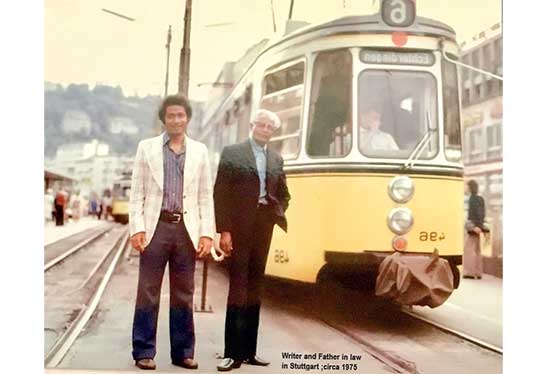
On the one hundred and tenth birth anniversary of my father-in -law S.A.Welgama I pen this tribute with much affection and pride.Affection as he was a second father to me and pride as he was a man amongst men;a man who stood tall and erect,a man unbowed ,unconquered and unsullied.Of him I could truthfully echo Marcus Aurelius, Emperor of Rome,”let men see,let them know a real man,a man who lives as he was meant to live”.
EARLY LIFE
He was born in the hamlet of Ovitigala,in the verdant county of Pasdun Korale,the county of five yojana (sixty kms in Vedic measure),created by Parakramabahu the Great,by draining the basin of Kalu Ganga.
His mother was fair and comely and taught in the village school ,and the father a farmer tilled his own land.SAW never forgot his roots and even at the height of his fame and wealth would often say,I’m the son of a poor farmer.This alone would have tagged him for greatness, for according to John Ruskin “the first test of a truly great man is his humility.”
The origins of the Welgama clan are shrouded in the mists of time.One school of thought says that they were the caretakers of the Welgama vehera in Kinniya ,Trincomalee.Grateful kings had donated land to them in distant South.The stupa was built by King Devanampiyatissa in the third century B.C.and remained unscathed till the end of the Polonnaruwa era.Even the Chola marauders,who razed all they saw ,left it alone as it was a place of worship for Hindu devotees as well,the Navatar Kovil.
Another school is of the view that they were soldiers in the service of the Sinhala kings as evidenced by their ge name Welgama Hewage.This is likely too as the Welgamas were tall and had a martial bearing.
They migrated to the villages of Ihala (upper) and Pahala (lower) Welgama villages separated by a fast flowing river.This could only be forded by a ferry ,until SAW persuaded a friendly minister of state to build a bridge.
SAW had his early schooling in the Ovitigala village.His heart was ,however not in books but in machines and motor vehicles.Many a day he played truant with his classmates,one of whom was to later become an eminent Buddhist monk and a mentor to me and my brother.When I was being screened as a prospective son -in-law ,he made enquiries, from his friend the Rev Kevitiyagala Dhammasidhi.The priest had categorically stated ,’Sir do not look any further,he is the best of the best’.My fate was sealed.
ENTREPRENEUR
While still a teenager he apprenticed himself to a local workshop and then came over to Colombo to gain further experience and skills.He had fifty cents in his pocket.The friend who accompanied him returned to the village after two days.But SAW soldiered on and joined the workshop of an English engineer.He worked long and hard and became a master of his trade and also earned the respect and goodwill of his employer,whose pet name for him was Pattison.
Being thrifty he regularly added his wages to a till which was well hidden.With his savings and some help he bought a car for the then princely sum of two thousand rupees ,and plied it for hire between Gampaha and Kaluthara.
As the war clouds gathered in the horizon in the late 1930s he sensed an opportunity in road haulage and this became his trademark.At one stage he owned and controlled over one hundred and fifty trucks and became a trusted agent of the colonial government;transporting goods to and from the Colombo harbour to the massive godowns built in anticipation of wartime food shortages.SAW and Sons became synonymous with road freight.With foresight he bought land at Panchikawatte,an emerging commercial hub for his headquarters.Later with the help of his son Nimal he extended this to a much larger holding.
A prized possession of his was the luxury tourist bus,which he imported when Mr J.R.Jayawardene inaugurated the push for tourism.This was used for family outings too and Kanthi and I remember vividly the visit to his estate with business associates.We also accompanied a group of visiting American cardiologists and spouses to Kandy.On the way ,the ladies started a singsong
to which we had to respond.My contribution was “My Bonnie lies over the ocean” which I had learnt at school.Our guide was a personable young man who later married a young French traveller and settled down in France.Although his fluency in English was not optimal Father saw in him the makings of a good escort.
Having reached the top of the greasy pole ,he knew the value of skills and hard work.He instilled these into the many young men he trained.They were accepted anywhere.The truck drivers employed by him needed two licences;one from the department of motor transport and one from him.He would personally conduct the driving test.In later years his son Mahinda assumed this role.
He had a fondness for new cars especially Mercedes.An exception to the run of Mercedes was the Holden Statesman which he purchased after the Non-Aligned Leaders conference in Colombo.When it was due for repainting,the original colour Salamanca red was not available in SriLanka.Kanthi and I shipped it from Brisbane where we were then living.
The first occasion we met was when he arrived at our house in his magnificent Mercedes.He was accompanied by his beautiful wife Beatrice and his eldest son Melvin.An imposing man dressed in an immaculate white sarong and shirt he was keen to meet the young lad who had been highly recommended as a prospective son in law.After the usual pleasantries ,I joined Melvin who became a close friend.SAW had been much moved that I too was dressed in sarong and shirt.
An interesting quirk of his was the insistence ,that all his vehicle registration numbers should end with the figure five.It’s likely that his birthday being on the fifth of April,this to him was an auspicious number.The denizens of Panchikawatte named him the ‘‘Agata Pahe Mudalali i.e the tycoon with number five at the end.”
Being a man of the soil ,land was at the core of his soul,and he invested in a rubber estate in Kahawatte and then a two hundred and fifty acre rubber plantation” the Deniston” in Mathugama.For the children he bought land in the most fashionable suburb in Colombo and also in Nuwara Eliya a block adjacent to the venerable Grand Hotel.Kanthi and I once spent a night at Deniston in the hilltop estate bungalow.He had arranged for us to be blessed with a ” thovil”, a devil dance ceremony to dispel any unseen hands harassing us; this went on all night.We were exhausted before the performers ,although their colourful costumes,masks,gyrations and the drumming held us spellbound.
About the same time as his rise, there was a group of Sinhala businessmen who too made their mark.They were all southerners who began their careers at the bottom of the pile.SAW and Nawaloka mudalali (H.D.Dharmadasa) were the unofficial leaders of this closely knit cluster.They too never forgot their roots and were all noted for their conviviality,philanthropy and vivacity.Two of their major projects were the Ranweta the gold fence around the Sri Maha Bodhiya and the first coronary care unit in Ceylon.The Sri Maha Bodhiya is the only living relic of the Buddha who attained enlightenment in the shade of the parent tree in BodhGaya.It is the oldest ,historically documented tree in the world.The coronary care unit was built at the instigation of Dr Ivor Obeysekare ,the first cardiologist of Ceylon and a former chief of mine.
SAW was a mover and shaker and associated with the highest in the land.J.R.Jayawardane the first executive president of SriLanka was a good friend and was an attesting witness at all the weddings of his children.He did have friends across the political spectrum including ,Maithripala Senanayake the benign deputy to Mrs Bandaranaike and Peter Kueneman,the sophisticated Cambridge educated leader of the Communist party.Though he “walked with Kings ,he did not lose the common touch” and was equally at home with the masses in villages and the busy bazaars of Colombo.
At the age of sixty five he handed over the control of the trucking company to his sons,but still supervised the estate.The weekly sojourn in the plantation became his greatest pleasure and relaxation.Meandering around ,he may have got to know every tree and shrub,hillock ,valley and stream and mingling with the Indian Tamil workers and villagers gave him a lot of satisfaction.The elder brother whom he adored,lived in a homestead and sharing the customary village fare with him at lunch gave him much gratification.The Sunday visit to the estate was a ritual he maintained till the last week of his life.The bracing air ,the soft breezes ,the solitude and the rural populace seemed to revitalize him.The work was challenging but less so because of his passion and enthusiasm for the land and the labour.
He epitomised Henry Wadsworth Longfellow’s words that “The heights by great men achieved and kept were not attained by sudden flight,but they while their companions slept,were toiling upward in the night.”
FAMILY
Unexpectedly,at the age of thirty three,he met a beautiful Kandyan teenager Beatrice Hidellarachchi.It was akin to Adam meeting Eve and was love at first sight.
Like John Milton,in “Paradise Lost”
“He saw grace in all her steps,
Heaven in her eyes,
In every gesture,dignity and love”
Beatrice being the cynosure of all eyes and adoration,delighted him ,and he encouraged her to dress herself in haut-monde finery.
It was a marriage made in heaven.and their happy partnership lasted till his passing away in 1990.
There were ten children in the family,five boys and five girls.He was a strict but adoring father.They were all brought up according to conventional Sinhala Buddhist values.Having missed out on a formal education,he made certain that they went to the highest ranking schools regardless of the denomination.For boys ,he chose S.Thomas’s College the famed school by the sea.Girls were admitted to the Holy Family Convent as he had the highest respect and admiration for the Catholic nuns and their discipline.But he also ensured that they got a Buddhist grounding through the Sunday school at the Vajiraramaya temple which was well known for its pious and erudite monks.
He would have loved for one or more of them to become doctors;instead he got two sons in law who achieved eminence in their specialties of medicine.However two sons became leading business men and chartered accountants.Another a prominent politician and one more a German trained gemologist.The youngest son Nalin was sent across to London ,while we were there, for further studies.
He did have reservations about girls attending universities ,but sent them to finishing schools where they became versed in social graces and upper class cultural rites.Later on he relented and permitted the youngest daughter Pradeepika to study at the Colombo Law school.
As he grew older he mellowed and relished having a drink with Mahinda and me.The faithful domestic Gamini brought his bottle of whiskey and he poured the pegs to all of of us himself.In our younger days we never imbibed with our elders.When he desired company ,he went to the Automobile Association or the Angler’s club.One night he spied us,the two eldest sons in law enjoying a drink in the confines of a car ,with our wives and sent us a round of drinks and a tray of devilled prawns which was a specialty of the AA.
He was a believer in rebirth and would say with conviction that Kanthi his second daughter was the reincarnation of his beloved mother,perhaps because she looked after him like a mother;and Nalin the youngest son,the reincarnation of his father.While on a trip to India ,he insisted on selecting Kanthi’s wedding saree himself ,while mother selected sarees for the other daughters.Kanthi’s saree was more expensive than all the others.
A special relationship too was with his second granddaughter Sadia.I reproduce what she wrote.
“He loved to put his dark arm against mine and tell me we were the same colour.We were.
He called me Podi Sriyani.( Loku Sriyani was his daughter).
He was a wonderfully patient and loving grandfather.He had a warm hug which made you feel loved and how I loved sitting on his lap.It felt like a very safe place to be.
He had a twinkle in his eye and always wore his hat.He had good taste and style.I had a feeling that he had some great stories to share ,but that I was too young to hear them…
He was magic.I still miss that magic.”
PHILANTHROPY
SAW was large hearted and munificent primarily to but not exclusively to his village ,villagers and less affluent relatives. A monk told us how ,even Beatrice was not aware of the monthly emoluments he dispensed to the needy.
The Diyapattugama junior school,now named S.A.Welgama junior school was given a large assembly hall.He built a new Stupa at the Ovitigala temple;Kanthi and I joined in this meritorious deed by gifting the “Chuda Manikya” the large crystal placed at its very top.Electricity was provided to the shrine and its environs.The Bodhi tree in the temple (the prathana ,i.e supplication,Bodhi) was brought by him from Bodhgaya.
After his passing away Beatrice built a maternity home in his memory in the village of Wettawe.This had been a cherished ambition of his.His own mother is said to have succumbed at childbirth,and he wanted the impoverished women of his village to have easy access to modern medical facilities.
SAW of course provided employment to hundreds of villagers at his establishments.
RETIREMENT.
In retirement he indulged in travel which he had long denied himself.He wanted to ” walk where he had never been and wonder at the beauty of this world”Kanthi and I were lucky that we were able to host him in Britain and also in USA.The long morning walks,the coach trips and the sundowners ,while the ladies cooked supper ,brought us closer in a way not conceivable before.He revelled in the sights and history of UK Germany and Switzerland and also Disneyland and Hawaii.One of the highlights was his visit to the Mercedes factory in Stuttgart.The automated production of his favourite cars enthralled him.Caravans enticed him,as did the miniature trains he rode in a fun park in Newcastle upon Tyne.He did not care much for shopping ,although Mother and Kanthi dragged him along,and grumble that he had become a ‘nattambi’,a carrier of goods.I feel however he secretly enjoyed seeing Beatrice buying apparel and wares unavailable in Ceylon at that time of austerity.For him ,all he wanted was a couple of hats.
The beauty of the Lake District,the Black Forest and Switzerland and the ancient cities of London Edinburgh and Freiburg fascinated him.
He was indeed a man for all seasons.
We rejoice in a life lived to the fullest and that we were blessed to be touched by this great man.
Kumar Gunawardane
Emeritus Consultant Cardiologist
The Townsville University Hospital.
I acknowledge the help of Ven Suriyagoda Siri Dhamma,Nimal and Mahinda Welgama and Sadia Samarasinghe.



by Dr Gotabhya Ranasinghe
Senior Consultant Cardiologist
National Hospital Sri Lanka
When we sought a meeting with Hon Dr. Ramesh Pathirana, Minister of Health, he graciously cleared his busy schedule to accommodate us. Renowned for his attentive listening and deep understanding, Minister Pathirana is dedicated to advancing the health sector. His openness and transparency exemplify the qualities of an exemplary politician and minister.
Dr. Palitha Mahipala, the current Health Secretary, demonstrates both commendable enthusiasm and unwavering support. This combination of attributes makes him a highly compatible colleague for the esteemed Minister of Health.
Our discussion centered on a project that has been in the works for the past 30 years, one that no other minister had managed to advance.
Minister Pathirana, however, recognized the project’s significance and its potential to revolutionize care for heart patients.
The project involves the construction of a state-of-the-art facility at the premises of the National Hospital Colombo. The project’s location within the premises of the National Hospital underscores its importance and relevance to the healthcare infrastructure of the nation.
This facility will include a cardiology building and a tertiary care center, equipped with the latest technology to handle and treat all types of heart-related conditions and surgeries.
Securing funding was a major milestone for this initiative. Minister Pathirana successfully obtained approval for a $40 billion loan from the Asian Development Bank. With the funding in place, the foundation stone is scheduled to be laid in September this year, and construction will begin in January 2025.
This project guarantees a consistent and uninterrupted supply of stents and related medications for heart patients. As a result, patients will have timely access to essential medical supplies during their treatment and recovery. By securing these critical resources, the project aims to enhance patient outcomes, minimize treatment delays, and maintain the highest standards of cardiac care.
Upon its fruition, this monumental building will serve as a beacon of hope and healing, symbolizing the unwavering dedication to improving patient outcomes and fostering a healthier society.We anticipate a future marked by significant progress and positive outcomes in Sri Lanka’s cardiovascular treatment landscape within the foreseeable timeframe.

by Fr. Emmanuel Fernando, OMI
Jesuit Fr. Aloysius Pieris (affectionately called Fr. Aloy) celebrated his 90th birthday on April 9, 2024 and I, as the editor of our Oblate Journal, THE MISSIONARY OBLATE had gone to press by that time. Immediately I decided to publish an article, appreciating the untiring selfless services he continues to offer for inter-Faith dialogue, the renewal of the Catholic Church, his concern for the poor and the suffering Sri Lankan masses and to me, the present writer.
It was in 1988, when I was appointed Director of the Oblate Scholastics at Ampitiya by the then Oblate Provincial Fr. Anselm Silva, that I came to know Fr. Aloy more closely. Knowing well his expertise in matters spiritual, theological, Indological and pastoral, and with the collaborative spirit of my companion-formators, our Oblate Scholastics were sent to Tulana, the Research and Encounter Centre, Kelaniya, of which he is the Founder-Director, for ‘exposure-programmes’ on matters spiritual, biblical, theological and pastoral. Some of these dimensions according to my view and that of my companion-formators, were not available at the National Seminary, Ampitiya.
Ever since that time, our Oblate formators/ accompaniers at the Oblate Scholasticate, Ampitiya , have continued to send our Oblate Scholastics to Tulana Centre for deepening their insights and convictions regarding matters needed to serve the people in today’s context. Fr. Aloy also had tried very enthusiastically with the Oblate team headed by Frs. Oswald Firth and Clement Waidyasekara to begin a Theologate, directed by the Religious Congregations in Sri Lanka, for the contextual formation/ accompaniment of their members. It should very well be a desired goal of the Leaders / Provincials of the Religious Congregations.
Besides being a formator/accompanier at the Oblate Scholasticate, I was entrusted also with the task of editing and publishing our Oblate journal, ‘The Missionary Oblate’. To maintain the quality of the journal I continue to depend on Fr. Aloy for his thought-provoking and stimulating articles on Biblical Spirituality, Biblical Theology and Ecclesiology. I am very grateful to him for his generous assistance. Of late, his writings on renewal of the Church, initiated by Pope St. John XX111 and continued by Pope Francis through the Synodal path, published in our Oblate journal, enable our readers to focus their attention also on the needed renewal in the Catholic Church in Sri Lanka. Fr. Aloy appreciated very much the Synodal path adopted by the Jesuit Pope Francis for the renewal of the Church, rooted very much on prayerful discernment. In my Religious and presbyteral life, Fr.Aloy continues to be my spiritual animator / guide and ongoing formator / acccompanier.
Fr. Aloysius Pieris, BA Hons (Lond), LPh (SHC, India), STL (PFT, Naples), PhD (SLU/VC), ThD (Tilburg), D.Ltt (KU), has been one of the eminent Asian theologians well recognized internationally and one who has lectured and held visiting chairs in many universities both in the West and in the East. Many members of Religious Congregations from Asian countries have benefited from his lectures and guidance in the East Asian Pastoral Institute (EAPI) in Manila, Philippines. He had been a Theologian consulted by the Federation of Asian Bishops’ Conferences for many years. During his professorship at the Gregorian University in Rome, he was called to be a member of a special group of advisers on other religions consulted by Pope Paul VI.
Fr. Aloy is the author of more than 30 books and well over 500 Research Papers. Some of his books and articles have been translated and published in several countries. Among those books, one can find the following: 1) The Genesis of an Asian Theology of Liberation (An Autobiographical Excursus on the Art of Theologising in Asia, 2) An Asian Theology of Liberation, 3) Providential Timeliness of Vatican 11 (a long-overdue halt to a scandalous millennium, 4) Give Vatican 11 a chance, 5) Leadership in the Church, 6) Relishing our faith in working for justice (Themes for study and discussion), 7) A Message meant mainly, not exclusively for Jesuits (Background information necessary for helping Francis renew the Church), 8) Lent in Lanka (Reflections and Resolutions, 9) Love meets wisdom (A Christian Experience of Buddhism, 10) Fire and Water 11) God’s Reign for God’s poor, 12) Our Unhiddden Agenda (How we Jesuits work, pray and form our men). He is also the Editor of two journals, Vagdevi, Journal of Religious Reflection and Dialogue, New Series.
Fr. Aloy has a BA in Pali and Sanskrit from the University of London and a Ph.D in Buddhist Philosophy from the University of Sri Lankan, Vidyodaya Campus. On Nov. 23, 2019, he was awarded the prestigious honorary Doctorate of Literature (D.Litt) by the Chancellor of the University of Kelaniya, the Most Venerable Welamitiyawe Dharmakirthi Sri Kusala Dhamma Thera.
Fr. Aloy continues to be a promoter of Gospel values and virtues. Justice as a constitutive dimension of love and social concern for the downtrodden masses are very much noted in his life and work. He had very much appreciated the commitment of the late Fr. Joseph (Joe) Fernando, the National Director of the Social and Economic Centre (SEDEC) for the poor.
In Sri Lanka, a few religious Congregations – the Good Shepherd Sisters, the Christian Brothers, the Marist Brothers and the Oblates – have invited him to animate their members especially during their Provincial Congresses, Chapters and International Conferences. The mainline Christian Churches also have sought his advice and followed his seminars. I, for one, regret very much, that the Sri Lankan authorities of the Catholic Church –today’s Hierarchy—- have not sought Fr.
Aloy’s expertise for the renewal of the Catholic Church in Sri Lanka and thus have not benefited from the immense store of wisdom and insight that he can offer to our local Church while the Sri Lankan bishops who governed the Catholic church in the immediate aftermath of the Second Vatican Council (Edmund Fernando OMI, Anthony de Saram, Leo Nanayakkara OSB, Frank Marcus Fernando, Paul Perera,) visited him and consulted him on many matters. Among the Tamil Bishops, Bishop Rayappu Joseph was keeping close contact with him and Bishop J. Deogupillai hosted him and his team visiting him after the horrible Black July massacre of Tamils.
Sri Lanka-Singapore Free Trade Agreement
By Gomi Senadhira
senadhiragomi@gmail.com
“You might tell fairy tales, but the progress of a country cannot be achieved through such narratives. A country cannot be developed by making false promises. The country moved backward because of the electoral promises made by political parties throughout time. We have witnessed that the ultimate result of this is the country becoming bankrupt. Unfortunately, many segments of the population have not come to realize this yet.” – President Ranil Wickremesinghe, 2024 Budget speech
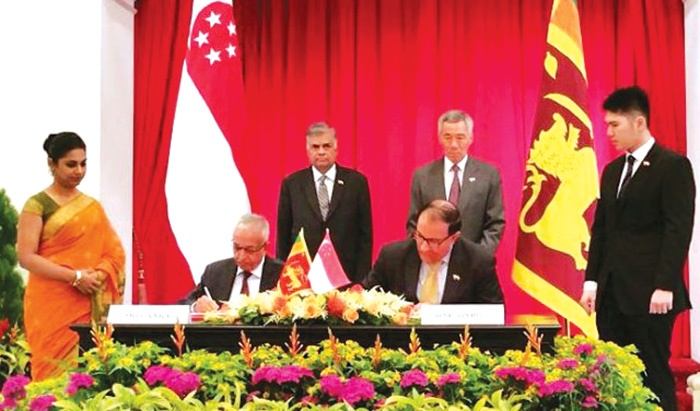
Any Sri Lankan would agree with the above words of President Wickremesinghe on the false promises our politicians and officials make and the fairy tales they narrate which bankrupted this country. So, to understand this, let’s look at one such fairy tale with lots of false promises; Ranil Wickremesinghe’s greatest achievement in the area of international trade and investment promotion during the Yahapalana period, Sri Lanka-Singapore Free Trade Agreement (SLSFTA).
It is appropriate and timely to do it now as Finance Minister Wickremesinghe has just presented to parliament a bill on the National Policy on Economic Transformation which includes the establishment of an Office for International Trade and the Sri Lanka Institute of Economics and International Trade.
Was SLSFTA a “Cleverly negotiated Free Trade Agreement” as stated by the (former) Minister of Development Strategies and International Trade Malik Samarawickrama during the Parliamentary Debate on the SLSFTA in July 2018, or a colossal blunder covered up with lies, false promises, and fairy tales? After SLSFTA was signed there were a number of fairy tales published on this agreement by the Ministry of Development Strategies and International, Institute of Policy Studies, and others.
However, for this article, I would like to limit my comments to the speech by Minister Samarawickrama during the Parliamentary Debate, and the two most important areas in the agreement which were covered up with lies, fairy tales, and false promises, namely: revenue loss for Sri Lanka and Investment from Singapore. On the other important area, “Waste products dumping” I do not want to comment here as I have written extensively on the issue.
1. The revenue loss
During the Parliamentary Debate in July 2018, Minister Samarawickrama stated “…. let me reiterate that this FTA with Singapore has been very cleverly negotiated by us…. The liberalisation programme under this FTA has been carefully designed to have the least impact on domestic industry and revenue collection. We have included all revenue sensitive items in the negative list of items which will not be subject to removal of tariff. Therefore, 97.8% revenue from Customs duty is protected. Our tariff liberalisation will take place over a period of 12-15 years! In fact, the revenue earned through tariffs on goods imported from Singapore last year was Rs. 35 billion.
The revenue loss for over the next 15 years due to the FTA is only Rs. 733 million– which when annualised, on average, is just Rs. 51 million. That is just 0.14% per year! So anyone who claims the Singapore FTA causes revenue loss to the Government cannot do basic arithmetic! Mr. Speaker, in conclusion, I call on my fellow members of this House – don’t mislead the public with baseless criticism that is not grounded in facts. Don’t look at petty politics and use these issues for your own political survival.”
I was surprised to read the minister’s speech because an article published in January 2018 in “The Straits Times“, based on information released by the Singaporean Negotiators stated, “…. With the FTA, tariff savings for Singapore exports are estimated to hit $10 million annually“.
As the annual tariff savings (that is the revenue loss for Sri Lanka) calculated by the Singaporean Negotiators, Singaporean $ 10 million (Sri Lankan rupees 1,200 million in 2018) was way above the rupees’ 733 million revenue loss for 15 years estimated by the Sri Lankan negotiators, it was clear to any observer that one of the parties to the agreement had not done the basic arithmetic!
Six years later, according to a report published by “The Morning” newspaper, speaking at the Committee on Public Finance (COPF) on 7th May 2024, Mr Samarawickrama’s chief trade negotiator K.J. Weerasinghehad had admitted “…. that forecasted revenue loss for the Government of Sri Lanka through the Singapore FTA is Rs. 450 million in 2023 and Rs. 1.3 billion in 2024.”
If these numbers are correct, as tariff liberalisation under the SLSFTA has just started, we will pass Rs 2 billion very soon. Then, the question is how Sri Lanka’s trade negotiators made such a colossal blunder. Didn’t they do their basic arithmetic? If they didn’t know how to do basic arithmetic they should have at least done their basic readings. For example, the headline of the article published in The Straits Times in January 2018 was “Singapore, Sri Lanka sign FTA, annual savings of $10m expected”.
Anyway, as Sri Lanka’s chief negotiator reiterated at the COPF meeting that “…. since 99% of the tariffs in Singapore have zero rates of duty, Sri Lanka has agreed on 80% tariff liberalisation over a period of 15 years while expecting Singapore investments to address the imbalance in trade,” let’s turn towards investment.
Investment from Singapore
In July 2018, speaking during the Parliamentary Debate on the FTA this is what Minister Malik Samarawickrama stated on investment from Singapore, “Already, thanks to this FTA, in just the past two-and-a-half months since the agreement came into effect we have received a proposal from Singapore for investment amounting to $ 14.8 billion in an oil refinery for export of petroleum products. In addition, we have proposals for a steel manufacturing plant for exports ($ 1 billion investment), flour milling plant ($ 50 million), sugar refinery ($ 200 million). This adds up to more than $ 16.05 billion in the pipeline on these projects alone.
And all of these projects will create thousands of more jobs for our people. In principle approval has already been granted by the BOI and the investors are awaiting the release of land the environmental approvals to commence the project.
I request the Opposition and those with vested interests to change their narrow-minded thinking and join us to develop our country. We must always look at what is best for the whole community, not just the few who may oppose. We owe it to our people to courageously take decisions that will change their lives for the better.”
According to the media report I quoted earlier, speaking at the Committee on Public Finance (COPF) Chief Negotiator Weerasinghe has admitted that Sri Lanka was not happy with overall Singapore investments that have come in the past few years in return for the trade liberalisation under the Singapore-Sri Lanka Free Trade Agreement. He has added that between 2021 and 2023 the total investment from Singapore had been around $162 million!
What happened to those projects worth $16 billion negotiated, thanks to the SLSFTA, in just the two-and-a-half months after the agreement came into effect and approved by the BOI? I do not know about the steel manufacturing plant for exports ($ 1 billion investment), flour milling plant ($ 50 million) and sugar refinery ($ 200 million).
However, story of the multibillion-dollar investment in the Petroleum Refinery unfolded in a manner that would qualify it as the best fairy tale with false promises presented by our politicians and the officials, prior to 2019 elections.
Though many Sri Lankans got to know, through the media which repeatedly highlighted a plethora of issues surrounding the project and the questionable credentials of the Singaporean investor, the construction work on the Mirrijiwela Oil Refinery along with the cement factory began on the24th of March 2019 with a bang and Minister Ranil Wickremesinghe and his ministers along with the foreign and local dignitaries laid the foundation stones.
That was few months before the 2019 Presidential elections. Inaugurating the construction work Prime Minister Ranil Wickremesinghe said the projects will create thousands of job opportunities in the area and surrounding districts.
The oil refinery, which was to be built over 200 acres of land, with the capacity to refine 200,000 barrels of crude oil per day, was to generate US$7 billion of exports and create 1,500 direct and 3,000 indirect jobs. The construction of the refinery was to be completed in 44 months. Four years later, in August 2023 the Cabinet of Ministers approved the proposal presented by President Ranil Wickremesinghe to cancel the agreement with the investors of the refinery as the project has not been implemented! Can they explain to the country how much money was wasted to produce that fairy tale?
It is obvious that the President, ministers, and officials had made huge blunders and had deliberately misled the public and the parliament on the revenue loss and potential investment from SLSFTA with fairy tales and false promises.
As the president himself said, a country cannot be developed by making false promises or with fairy tales and these false promises and fairy tales had bankrupted the country. “Unfortunately, many segments of the population have not come to realize this yet”.
(The writer, a specialist and an activist on trade and development issues . )



US sports envoys to Lanka to champion youth development

Rahuman questions sudden cancellation of leave of CEB employees


