
Features
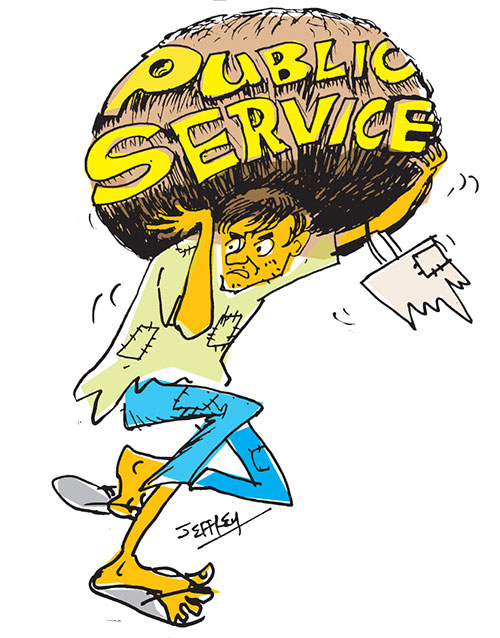
Prostituting public service

By Sonali Wijeratne
Once in a while, albeit at least a state minister tells the explicit truth. Dr. Nalaka Godahewa quoted in The Island of 06 August said: “There are over 1.4 million public sector workers. There are a large number of pensioners. Annually, we need about Rs 1.2 trillion to pay salaries and pensions. In 2020, our annual income was Rs 1.4 trillion. We are left with Rs 200 billion to provide health services, education, transport et al.” It is a fact that the annual public service wage and pension bill has surpassed the trillion-rupee mark for the first time in history with the budgetary outlay for both public sector salaries and pensions showing a significant rise from 2019 to date.
It is ironic that these extraordinary revelations are made in the context of the current government continuing to burden an already overstaffed top heavy public service of over one million with yet more massive injections of 150,000 public servants! This programme to offer jobs to 50,000 unemployed graduates and another 100,000 so called ‘poor’ applicants with educational qualifications below the GCE Ordinary Level was first mooted as a pre-election promise in 2019. However, the Chairman of the Elections Commission directed its postponement due to the declaration of the general election in 2019. The expectation of employment opportunities would no doubt have supported the poll in favour of the incumbent government which has now commenced the said programme without work study, or needs assessment, but presumably purely on the basis of amassing support for future victory at the elections! But where will such short term manoeuvrings, by politicians to keep themselves in power at the expense of the country’s steadily depleting resources, lead us the citizens of Sri Lanka?
The recruitment of unemployed graduates and others into the public service outside the required cadre cannot be healthy or useful when most of them find themselves in an overstaffed environment with little substantive work to do. The relative lack of challenging work occupations and inadequate training to go around leads to a gross misallocation of resources with a superfluous workforce engaged in repetitive replication of tasks. Sooner or later this huge multitude of public servants will find itself with no real opportunity, ideal or goal to make a worthwhile contribution. Their only recourse then is to latch on to the privileges of the public service such as security of employment, shorter work hours and extensive leave entitlement, pension and less work.
Many castigate the bloated public sector in Sri Lanka as generally lethargic, corrupt and parasitic. What else could one expect when politicians of every hue continuously use what was once an elite meritocracy as a job bank to get more votes for themselves to win in the short run to the next elections! Even the most enthusiastic, qualified youth selected to the public sector is bound to encounter demoralisation, and dissipation of his or her talents when faced with such self-defeating and destructive manner of recruitment often imbued with politicisation and nepotism to boot. We no longer have Permanent Secretaries heading Ministries which was the hallmark of the previous era of the Ceylon Civil Service. Even the Constitution was changed in the 1970s to facilitate all Secretaries of Ministries to be hand-picked for appointment and changed at will by the political authorities irrespective of their ability, seniority or official experience and qualifications! Therefore, in order to safeguard their prized privileges, position and perks of office, most Secretaries of Ministries are apt to take the easy way out by appeasing political authority and not taking a stand against irregularities.
Moreover, it is no surprise that in recent times, the government seems quick to placate a group of vociferous public servants in the education sector who take to the streets, howling vengeance on the State if their so-called demands for wage increase are not met without ascertaining whether there is a genuine justification or need for such a pay hike! It is a fact that these teachers wilfully neglect their helpless students in a crisis situation, virtually holding the people and government of this country to ransom and taking undue advantage of the pandemic situation by denying online education to innocent schoolchildren already bereft of a normal education. At the same time, they have become super spreaders of COVID-19 in public demonstrations disregarding all norms of curtailing the pandemic which is at its highest. All the while, it is a fact that after bringing formal online education to a standstill, they are engaging in the lucrative practice of private tuition online and earning a mint owing to increased demand for such services.
Since placating the teachers at any cost seems to be the intention of our politicians, even the simple fact whether there is any truth to the so called allegations of anomalous salary in the education sector is not the focus of the government or that giving an undue salary hike to teachers will upset the delicate equilibrium of the salary structure across the entire public sector and result in further anomalies and require an all-round increase of salaries to the entire public sector.
The previous so-called Yahapalana regime too had in turn feted the entire public service with more than 100 percent pension and salary increase between 2016 and 2020. It is now the turn of the present government, already saddled with a huge economic crisis replete with debt burden, intractable budget deficit and balance of payments woes, to promise another round of public sector salary increases with the next budget in November this year. Anything and everything to survive in power on the horns of the populist vote.
Such cynical callous disregard for economic imperatives seems designed to win the confidence of the masses in the short term in time for the next general and presidential elections. No matter that it may lead to galloping inflation when you feed the public service with paper money due to a myriad of problems facing one of Sri Lanka’s worst economic crises. The nature of government related services in public sector salary and pension expansions leading to rising recurrent expenditures is bound to increase aggregate demand without a commensurate increase in manufacture/supply. This will in turn result in an inflationary spiral owing to an increase in prices eroding the purchasing value of increased salaries and pensions. Once the aggrieved workers and unions start demonstrating for higher pay hikes on the streets, the government will no doubt start printing money amidst other short-term un-economic manoeuvres and accede to their various demands for yet another salary rise. The one million public sector is an all-important voter base for any prospective government. So, to hell with rational responsible governance and sound economic management for sustainable development since the deciding factor for politicians appears to be to stay in power at all costs.
The negative effects arising from unbridled increases in excessive public sector employment expenditure have not been met by reducing recurrent government expenditure by way of rationalizing or downsizing the swollen public sector employment or increasing revenue. Instead, we have nonsense solutions such as non-sustainable recourse to additional borrowings, reliance on futuristic outputs from capital expenditure on a profusion of urban beautification projects, construction of gymnasiums and non-tradable flyovers and the acceptance of unsolicited tenders sans competitive bidding processes.
The case for public service reform to tame the monster of a hugely rotund and moribund public service devouring the nation’s resources sans a worthy contribution has been ably argued by veteran Public Servant, Deshamanya K. H. J. Wijayadasa, former Secretary to the President of Sri Lanka as well as a host of management gurus in the media, journals and other forums. First on the list is the need for de-politicisation, downsising, closure of non-profit making state owned enterprises, ridding the State of over-institutionalisation, duplication of tasks, that has resulted in the lack of coherence and fragmentation, the sheer scale of lack of professional integrity, discipline, accountability and resultant corruption and nepotism.
But it is questionable whether such rationalization is of any value to the politicians in government or those awaiting to form government, whose appeasement, at any cost, of the valuable voter base of over one million public servants is vital to their victory at periodic elections.
Irrespective of political differences, in general one of the first requirements of a politician in charge of a ministry is to find out how much recruitment, whether necessary or not, could be made. Often, the politician in charge of a ministry will single out compliant officers who will do his bidding, even those instructions that flout regulations and go against the best interests of the country. He will then call these officers and give instructions directly ignoring the Head of Department under whom they serve. There are instances where even officers, against whom there are well evidenced serious disciplinary matters pending, will be treated with kid gloves by their political masters and senior officers as Secretaries of Ministries and allowed to continue in privileged status without any inquiry.
The sad truth is that in a land of Lotus Eaters, there are significant numbers of ordinary people, as well as the businessmen and academia, who will lick the feet of politicians to get whatever benefits, privileges, opportunities for themselves and their kith and kin. The so-called Advisors, Consultants, and the hierarchy of senior officialdom surrounding the political authority will rarely utter a word against the dictates of their political masters even in matters of professional subject matter since they wish to hold on to their comfortable posts and enjoy the perks and privileges of office. Despite the fact that the state has given them free education and training both locally and abroad, these so-called professionals are seen flocking like veritable servant boys in their droves, round political authorities often aiding and abetting in deal-making and commissions or leading them down the garden path of policy blunders and national catastrophes. This is apparent, where some have diverted from their own field of qualifications and training and become pseudo authorities on every other conceivable subject!
Some recent examples bear the truth to this parlous state of affairs. For instance, the drastic decision to stop import of chemical fertilisers and replace it overnight with organic fertilizer when the country does not have immediate capacity and supply to service the same. The purported reason of chemical fertilizer being a causative agent for Chronic Kidney Disease and Cancer remains unproven in the international scientific community. Nor have our local pundits adduced scientific evidence in proof of the supposed correlation between ingestion of chemical fertiliser through food leading to carcinoma. The decision has been supported by some sections of the medical fraternity, not the agricultural scientists and growers! Now the farmers are up in arms predicting a poor harvest with food security gone to the whims of unprofessional decision making and implementation.
When import duty for sugar was slashed last year, the benefit was passed neither to the consumer nor the government, which lost revenue to the tune of Rs 15.9 billion. But insider information on the proposed reduction of commodity levy duty from Rs 50 per kilogram to 0.25 cents per kilogram enabled one specially favoured M/s. Pyramid Wilmar Pvt. Ltd. to sell more than 2000 metric tons of sugar, imported under the Rs. 0.25 levy to state-owned Sathosa for an exorbitant price above Rs. 125, per kilogram. The State owned Sathosa then sold the sugar to the consumers at a reduced rate of approximately Rs. 85 per kilo. Therefore, Sathosa purchased sugar at a higher price and sold it at a lower price. It is apparent that this is either due to negligence or official blundering for the purpose of defrauding the state for enrichment of certain vested interests. It was pitiful to see the mandarins of the Finance Ministry making feeble apologies over the media for such blatant debacles.
The heat seems to have died down on Sri Lanka’s most destructive environmental disaster of the X–Press Pearl and the previous New Diamond ships affecting marine life, livelihood of fisher folk, and most importantly the coastal and oceanic environment of a small island state. Questions remain as to why the Sri Lanka Ports Authority allowed an already compromised leaking ship to enter the port of Colombo with tons of toxic substances. Investigations have revealed deleted email communications, and a general delay, inaction, malaise, on the part of a number of state regulatory organisations responsible for this sector. The removal of the politically appointed Chairman of the Sri Lanka Ports Authority does not seem to absolve the responsibility for this great national disaster which also rests on several marine environment, merchant shipping regulatory organisations in the public sector as well as its political leadership.
As for the performance of the public health sector, we are in the fourth wave of the pandemic reporting approximately 200 official deaths per day, many hundreds under wraps or undocumented, a dire warning from World Health Organization of a holocaust of deaths to come! The ‘Bubble Tourism’ and great economic resurgence expected to be ushered in by the new normal of carrying on ‘business as usual’ with all public servants requested to report to work on a daily basis now seems to have evaporated into nothingness! Thanks to the mayhem policy prescriptions of blowing hot and cold on regulating movement, the peniya (decoction) which received a temporary approval without adequate plan on bona fide data of COVID-19 spread, the relative absence of consistent implementation of restricting large crowd gatherings, inter district travel and Sinhala and Tamil New Year travel. Except for the still small voice of truth of the Sri Lanka Medical Council and a few upright academics, the pitch seems to be full of the blame game, some professionals casting cheap accusations of sabotage against other professionals for lack of data when all the while the truth is plain to see. Over 75 percent of approximately 8,000 deaths recorded due to COVID-19 are those above the age of 60 years with comorbidities such as high blood pressure, diabetes and kidney dysfunction. Why was this group not given priority in vaccination since the beginning of this year? Who is responsible for such manslaughter and criminal negligence? When the Sri Lanka Medical Council recommended a lockdown during the April New Year period, and subsequently, why was such informed recommendation rejected by the Government? When the admirable performance of the former Health Ministry Secretary, Dr. Anil Jasinghe showed a controlled management of the COVID-19 last year, why was a ‘push-up-and-kick-out’ strategy followed when he was moved as Secretary to an entirely different sector foreign to his medical training and experience as Environment?
The sad truth seems to be that behind every public servant stands the shadow and spectre of the politician. His is the desire for continued electoral victory, by hook or by crook, power and desire for personal wealth creation during term of office. The 1972 Constitution has ensured that the public service is at his disposal and command to achieve such objectives.
There are exceptions no doubt, but the brave and the honourable few who take a principled stand and try to work for the good of the country are invariably sidelined, undermined and ignored. These are the faceless public servants, quiet heroes and heroines who still serve and give their best, striving to make a difference for the better: They are those who trust in God and do their best for their fellow citizens despite all odds and being wearied and harried in the extreme! It is they who experience the ultimate bliss of certainty and quiet joy of knowing that come what may, their exertions have not been in vain and even in extremely limited and circumscribed circumstances and terrain, they have been able to deliver for the common good.
(The writer is a retired Public Servant with 34 years service as an executive in varying capacities in Colombo State Sector and Diplomatic Service.)



by Dr Gotabhya Ranasinghe
Senior Consultant Cardiologist
National Hospital Sri Lanka
When we sought a meeting with Hon Dr. Ramesh Pathirana, Minister of Health, he graciously cleared his busy schedule to accommodate us. Renowned for his attentive listening and deep understanding, Minister Pathirana is dedicated to advancing the health sector. His openness and transparency exemplify the qualities of an exemplary politician and minister.
Dr. Palitha Mahipala, the current Health Secretary, demonstrates both commendable enthusiasm and unwavering support. This combination of attributes makes him a highly compatible colleague for the esteemed Minister of Health.
Our discussion centered on a project that has been in the works for the past 30 years, one that no other minister had managed to advance.
Minister Pathirana, however, recognized the project’s significance and its potential to revolutionize care for heart patients.
The project involves the construction of a state-of-the-art facility at the premises of the National Hospital Colombo. The project’s location within the premises of the National Hospital underscores its importance and relevance to the healthcare infrastructure of the nation.
This facility will include a cardiology building and a tertiary care center, equipped with the latest technology to handle and treat all types of heart-related conditions and surgeries.
Securing funding was a major milestone for this initiative. Minister Pathirana successfully obtained approval for a $40 billion loan from the Asian Development Bank. With the funding in place, the foundation stone is scheduled to be laid in September this year, and construction will begin in January 2025.
This project guarantees a consistent and uninterrupted supply of stents and related medications for heart patients. As a result, patients will have timely access to essential medical supplies during their treatment and recovery. By securing these critical resources, the project aims to enhance patient outcomes, minimize treatment delays, and maintain the highest standards of cardiac care.
Upon its fruition, this monumental building will serve as a beacon of hope and healing, symbolizing the unwavering dedication to improving patient outcomes and fostering a healthier society.We anticipate a future marked by significant progress and positive outcomes in Sri Lanka’s cardiovascular treatment landscape within the foreseeable timeframe.

by Fr. Emmanuel Fernando, OMI
Jesuit Fr. Aloysius Pieris (affectionately called Fr. Aloy) celebrated his 90th birthday on April 9, 2024 and I, as the editor of our Oblate Journal, THE MISSIONARY OBLATE had gone to press by that time. Immediately I decided to publish an article, appreciating the untiring selfless services he continues to offer for inter-Faith dialogue, the renewal of the Catholic Church, his concern for the poor and the suffering Sri Lankan masses and to me, the present writer.
It was in 1988, when I was appointed Director of the Oblate Scholastics at Ampitiya by the then Oblate Provincial Fr. Anselm Silva, that I came to know Fr. Aloy more closely. Knowing well his expertise in matters spiritual, theological, Indological and pastoral, and with the collaborative spirit of my companion-formators, our Oblate Scholastics were sent to Tulana, the Research and Encounter Centre, Kelaniya, of which he is the Founder-Director, for ‘exposure-programmes’ on matters spiritual, biblical, theological and pastoral. Some of these dimensions according to my view and that of my companion-formators, were not available at the National Seminary, Ampitiya.
Ever since that time, our Oblate formators/ accompaniers at the Oblate Scholasticate, Ampitiya , have continued to send our Oblate Scholastics to Tulana Centre for deepening their insights and convictions regarding matters needed to serve the people in today’s context. Fr. Aloy also had tried very enthusiastically with the Oblate team headed by Frs. Oswald Firth and Clement Waidyasekara to begin a Theologate, directed by the Religious Congregations in Sri Lanka, for the contextual formation/ accompaniment of their members. It should very well be a desired goal of the Leaders / Provincials of the Religious Congregations.
Besides being a formator/accompanier at the Oblate Scholasticate, I was entrusted also with the task of editing and publishing our Oblate journal, ‘The Missionary Oblate’. To maintain the quality of the journal I continue to depend on Fr. Aloy for his thought-provoking and stimulating articles on Biblical Spirituality, Biblical Theology and Ecclesiology. I am very grateful to him for his generous assistance. Of late, his writings on renewal of the Church, initiated by Pope St. John XX111 and continued by Pope Francis through the Synodal path, published in our Oblate journal, enable our readers to focus their attention also on the needed renewal in the Catholic Church in Sri Lanka. Fr. Aloy appreciated very much the Synodal path adopted by the Jesuit Pope Francis for the renewal of the Church, rooted very much on prayerful discernment. In my Religious and presbyteral life, Fr.Aloy continues to be my spiritual animator / guide and ongoing formator / acccompanier.
Fr. Aloysius Pieris, BA Hons (Lond), LPh (SHC, India), STL (PFT, Naples), PhD (SLU/VC), ThD (Tilburg), D.Ltt (KU), has been one of the eminent Asian theologians well recognized internationally and one who has lectured and held visiting chairs in many universities both in the West and in the East. Many members of Religious Congregations from Asian countries have benefited from his lectures and guidance in the East Asian Pastoral Institute (EAPI) in Manila, Philippines. He had been a Theologian consulted by the Federation of Asian Bishops’ Conferences for many years. During his professorship at the Gregorian University in Rome, he was called to be a member of a special group of advisers on other religions consulted by Pope Paul VI.
Fr. Aloy is the author of more than 30 books and well over 500 Research Papers. Some of his books and articles have been translated and published in several countries. Among those books, one can find the following: 1) The Genesis of an Asian Theology of Liberation (An Autobiographical Excursus on the Art of Theologising in Asia, 2) An Asian Theology of Liberation, 3) Providential Timeliness of Vatican 11 (a long-overdue halt to a scandalous millennium, 4) Give Vatican 11 a chance, 5) Leadership in the Church, 6) Relishing our faith in working for justice (Themes for study and discussion), 7) A Message meant mainly, not exclusively for Jesuits (Background information necessary for helping Francis renew the Church), 8) Lent in Lanka (Reflections and Resolutions, 9) Love meets wisdom (A Christian Experience of Buddhism, 10) Fire and Water 11) God’s Reign for God’s poor, 12) Our Unhiddden Agenda (How we Jesuits work, pray and form our men). He is also the Editor of two journals, Vagdevi, Journal of Religious Reflection and Dialogue, New Series.
Fr. Aloy has a BA in Pali and Sanskrit from the University of London and a Ph.D in Buddhist Philosophy from the University of Sri Lankan, Vidyodaya Campus. On Nov. 23, 2019, he was awarded the prestigious honorary Doctorate of Literature (D.Litt) by the Chancellor of the University of Kelaniya, the Most Venerable Welamitiyawe Dharmakirthi Sri Kusala Dhamma Thera.
Fr. Aloy continues to be a promoter of Gospel values and virtues. Justice as a constitutive dimension of love and social concern for the downtrodden masses are very much noted in his life and work. He had very much appreciated the commitment of the late Fr. Joseph (Joe) Fernando, the National Director of the Social and Economic Centre (SEDEC) for the poor.
In Sri Lanka, a few religious Congregations – the Good Shepherd Sisters, the Christian Brothers, the Marist Brothers and the Oblates – have invited him to animate their members especially during their Provincial Congresses, Chapters and International Conferences. The mainline Christian Churches also have sought his advice and followed his seminars. I, for one, regret very much, that the Sri Lankan authorities of the Catholic Church –today’s Hierarchy—- have not sought Fr.
Aloy’s expertise for the renewal of the Catholic Church in Sri Lanka and thus have not benefited from the immense store of wisdom and insight that he can offer to our local Church while the Sri Lankan bishops who governed the Catholic church in the immediate aftermath of the Second Vatican Council (Edmund Fernando OMI, Anthony de Saram, Leo Nanayakkara OSB, Frank Marcus Fernando, Paul Perera,) visited him and consulted him on many matters. Among the Tamil Bishops, Bishop Rayappu Joseph was keeping close contact with him and Bishop J. Deogupillai hosted him and his team visiting him after the horrible Black July massacre of Tamils.
Sri Lanka-Singapore Free Trade Agreement
By Gomi Senadhira
senadhiragomi@gmail.com
“You might tell fairy tales, but the progress of a country cannot be achieved through such narratives. A country cannot be developed by making false promises. The country moved backward because of the electoral promises made by political parties throughout time. We have witnessed that the ultimate result of this is the country becoming bankrupt. Unfortunately, many segments of the population have not come to realize this yet.” – President Ranil Wickremesinghe, 2024 Budget speech
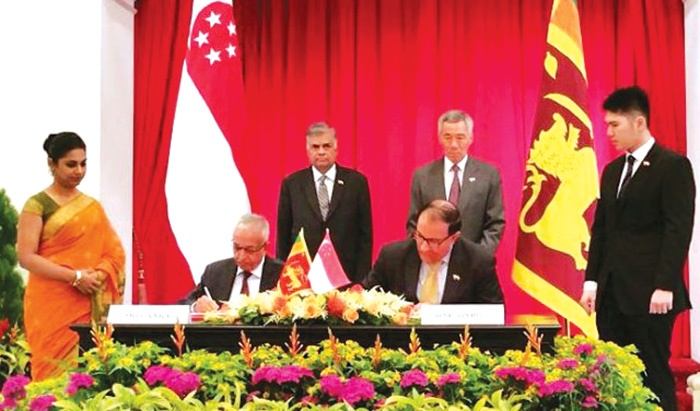
Any Sri Lankan would agree with the above words of President Wickremesinghe on the false promises our politicians and officials make and the fairy tales they narrate which bankrupted this country. So, to understand this, let’s look at one such fairy tale with lots of false promises; Ranil Wickremesinghe’s greatest achievement in the area of international trade and investment promotion during the Yahapalana period, Sri Lanka-Singapore Free Trade Agreement (SLSFTA).
It is appropriate and timely to do it now as Finance Minister Wickremesinghe has just presented to parliament a bill on the National Policy on Economic Transformation which includes the establishment of an Office for International Trade and the Sri Lanka Institute of Economics and International Trade.
Was SLSFTA a “Cleverly negotiated Free Trade Agreement” as stated by the (former) Minister of Development Strategies and International Trade Malik Samarawickrama during the Parliamentary Debate on the SLSFTA in July 2018, or a colossal blunder covered up with lies, false promises, and fairy tales? After SLSFTA was signed there were a number of fairy tales published on this agreement by the Ministry of Development Strategies and International, Institute of Policy Studies, and others.
However, for this article, I would like to limit my comments to the speech by Minister Samarawickrama during the Parliamentary Debate, and the two most important areas in the agreement which were covered up with lies, fairy tales, and false promises, namely: revenue loss for Sri Lanka and Investment from Singapore. On the other important area, “Waste products dumping” I do not want to comment here as I have written extensively on the issue.
1. The revenue loss
During the Parliamentary Debate in July 2018, Minister Samarawickrama stated “…. let me reiterate that this FTA with Singapore has been very cleverly negotiated by us…. The liberalisation programme under this FTA has been carefully designed to have the least impact on domestic industry and revenue collection. We have included all revenue sensitive items in the negative list of items which will not be subject to removal of tariff. Therefore, 97.8% revenue from Customs duty is protected. Our tariff liberalisation will take place over a period of 12-15 years! In fact, the revenue earned through tariffs on goods imported from Singapore last year was Rs. 35 billion.
The revenue loss for over the next 15 years due to the FTA is only Rs. 733 million– which when annualised, on average, is just Rs. 51 million. That is just 0.14% per year! So anyone who claims the Singapore FTA causes revenue loss to the Government cannot do basic arithmetic! Mr. Speaker, in conclusion, I call on my fellow members of this House – don’t mislead the public with baseless criticism that is not grounded in facts. Don’t look at petty politics and use these issues for your own political survival.”
I was surprised to read the minister’s speech because an article published in January 2018 in “The Straits Times“, based on information released by the Singaporean Negotiators stated, “…. With the FTA, tariff savings for Singapore exports are estimated to hit $10 million annually“.
As the annual tariff savings (that is the revenue loss for Sri Lanka) calculated by the Singaporean Negotiators, Singaporean $ 10 million (Sri Lankan rupees 1,200 million in 2018) was way above the rupees’ 733 million revenue loss for 15 years estimated by the Sri Lankan negotiators, it was clear to any observer that one of the parties to the agreement had not done the basic arithmetic!
Six years later, according to a report published by “The Morning” newspaper, speaking at the Committee on Public Finance (COPF) on 7th May 2024, Mr Samarawickrama’s chief trade negotiator K.J. Weerasinghehad had admitted “…. that forecasted revenue loss for the Government of Sri Lanka through the Singapore FTA is Rs. 450 million in 2023 and Rs. 1.3 billion in 2024.”
If these numbers are correct, as tariff liberalisation under the SLSFTA has just started, we will pass Rs 2 billion very soon. Then, the question is how Sri Lanka’s trade negotiators made such a colossal blunder. Didn’t they do their basic arithmetic? If they didn’t know how to do basic arithmetic they should have at least done their basic readings. For example, the headline of the article published in The Straits Times in January 2018 was “Singapore, Sri Lanka sign FTA, annual savings of $10m expected”.
Anyway, as Sri Lanka’s chief negotiator reiterated at the COPF meeting that “…. since 99% of the tariffs in Singapore have zero rates of duty, Sri Lanka has agreed on 80% tariff liberalisation over a period of 15 years while expecting Singapore investments to address the imbalance in trade,” let’s turn towards investment.
Investment from Singapore
In July 2018, speaking during the Parliamentary Debate on the FTA this is what Minister Malik Samarawickrama stated on investment from Singapore, “Already, thanks to this FTA, in just the past two-and-a-half months since the agreement came into effect we have received a proposal from Singapore for investment amounting to $ 14.8 billion in an oil refinery for export of petroleum products. In addition, we have proposals for a steel manufacturing plant for exports ($ 1 billion investment), flour milling plant ($ 50 million), sugar refinery ($ 200 million). This adds up to more than $ 16.05 billion in the pipeline on these projects alone.
And all of these projects will create thousands of more jobs for our people. In principle approval has already been granted by the BOI and the investors are awaiting the release of land the environmental approvals to commence the project.
I request the Opposition and those with vested interests to change their narrow-minded thinking and join us to develop our country. We must always look at what is best for the whole community, not just the few who may oppose. We owe it to our people to courageously take decisions that will change their lives for the better.”
According to the media report I quoted earlier, speaking at the Committee on Public Finance (COPF) Chief Negotiator Weerasinghe has admitted that Sri Lanka was not happy with overall Singapore investments that have come in the past few years in return for the trade liberalisation under the Singapore-Sri Lanka Free Trade Agreement. He has added that between 2021 and 2023 the total investment from Singapore had been around $162 million!
What happened to those projects worth $16 billion negotiated, thanks to the SLSFTA, in just the two-and-a-half months after the agreement came into effect and approved by the BOI? I do not know about the steel manufacturing plant for exports ($ 1 billion investment), flour milling plant ($ 50 million) and sugar refinery ($ 200 million).
However, story of the multibillion-dollar investment in the Petroleum Refinery unfolded in a manner that would qualify it as the best fairy tale with false promises presented by our politicians and the officials, prior to 2019 elections.
Though many Sri Lankans got to know, through the media which repeatedly highlighted a plethora of issues surrounding the project and the questionable credentials of the Singaporean investor, the construction work on the Mirrijiwela Oil Refinery along with the cement factory began on the24th of March 2019 with a bang and Minister Ranil Wickremesinghe and his ministers along with the foreign and local dignitaries laid the foundation stones.
That was few months before the 2019 Presidential elections. Inaugurating the construction work Prime Minister Ranil Wickremesinghe said the projects will create thousands of job opportunities in the area and surrounding districts.
The oil refinery, which was to be built over 200 acres of land, with the capacity to refine 200,000 barrels of crude oil per day, was to generate US$7 billion of exports and create 1,500 direct and 3,000 indirect jobs. The construction of the refinery was to be completed in 44 months. Four years later, in August 2023 the Cabinet of Ministers approved the proposal presented by President Ranil Wickremesinghe to cancel the agreement with the investors of the refinery as the project has not been implemented! Can they explain to the country how much money was wasted to produce that fairy tale?
It is obvious that the President, ministers, and officials had made huge blunders and had deliberately misled the public and the parliament on the revenue loss and potential investment from SLSFTA with fairy tales and false promises.
As the president himself said, a country cannot be developed by making false promises or with fairy tales and these false promises and fairy tales had bankrupted the country. “Unfortunately, many segments of the population have not come to realize this yet”.
(The writer, a specialist and an activist on trade and development issues . )



US sports envoys to Lanka to champion youth development

Rahuman questions sudden cancellation of leave of CEB employees


