
Features
BEYOND REASONABLE DOUBT?

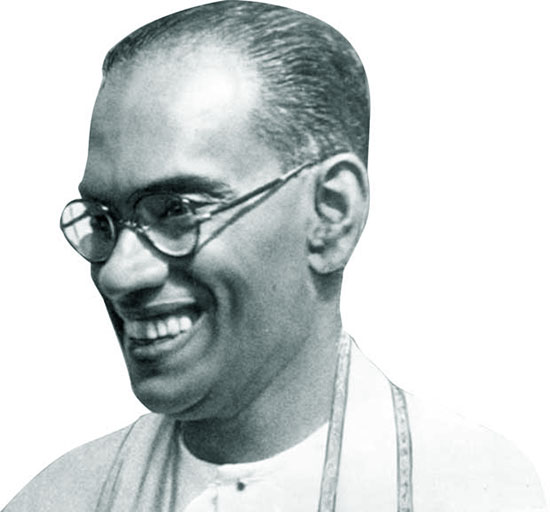
The killing of a Prime Minister
by Sanjiva Senanayake
(PART I)
Many people ‘know’ the conventional tale about the assassination of the Prime Minister of Ceylon, S.W.R.D. Bandaranaike, 62 years ago. However, they each have a slightly different take and theory about the facts, the reasons, the conspiracy theories and who ‘actually’ did it. Those then unborn or too young to have been aware of it at the time, have heard about it from older people. We have to assume that the intrinsic Lankan sense of rumour would have spiced up the details as time went by.
There is a common belief that the standards of general governance, integrity and legal processes were much higher back then, in Ceylon, than now. Bolstering this justifiable belief, adjudication was done by the Supreme Court (SC), the verdict was confirmed in the Court of Criminal Appeal and accepted by the Privy Council in London. Therefore, the predominant view continues to be that justice was served objectively and impartially.
However, there were many controversial interpretations and theories that circulated before, during and after the Bandaranaike trials. There were several aspects of the conduct of the trial and the actual evidence presented that raised questions about the guilt of the alleged assassin and, as a consequence, the guilt of the others.
Articles about those traumatic events of long ago have been published periodically, but they have progressively reverted to recounting and sometimes sensationalizing the standard version, and have not adequately addressed the many controversial questions.
This article focuses specifically on the alleged murderer and the most critical of the controversies, based on the ‘eye-witness’ evidence led at the SC trial – was Somarama proved to be the assassin beyond reasonable doubt? If there is any doubt, it opens up the possibility of a different, politically motivated conspiracy, especially since Bandaranaike was the Prime Minister during turbulent times.
THE STORY IN SUMMARY
The PM was shot several times with a revolver at his residence ‘Tintagel’ – 65, Rosmead Place – at around 10 am on September 25, 1959. Despite appearing to recover somewhat by evening following surgery, and even dictating a message to the nation from hospital, he died the next morning. The only thing Bandaranaike said about the identity of the gunman was that he was “a foolish man dressed in the robes of a monk”. This was the first major targeted political assassination in post-independence Ceylon, one that changed the future course of the country.
A Buddhist monk, Talduwe Somarama, was immediately arrested in the house, with a gun in hand, on suspicion of being the assailant. He was a hitherto low-profile Buddhist monk who was an eye specialist at the College of Indigenous Medicine in Rajagiriya.
After several days another monk, the politically powerful Mapitigama Buddharakkitha, was arrested in addition to several other individuals alleged to have assisted Buddharakkitha as part of a year-long conspiracy to kill Bandaranaike using Somarama as the assassin. Buddharakkitha, although only 38-years old, was the chief monk of the important Kelaniya Temple and, as the head of the Eksath Bhikkhu Peramuna (EBP), the most politically powerful monk in the country at the time. He was also headstrong, impulsive and confrontational – certainly not a pious monk. Although the EBP helped bring Bandaranaike to power in 1956, by 1959 Buddharakkitha was antagonistic toward the PM for being too ‘soft’ in pushing a more aggressive Sinhala Buddhist agenda. Buddharakkitha was aligned with the right-wing of the government and his antagonism toward the leftists (and vice versa) in the government was public knowledge.

After exhaustive investigations and a long trial in the SC, a special jury found both monks and H.P. Jayawardena, a close associate of Buddharakkitha, guilty of the conspiracy, and Somarama guilty of committing the murder, and all three were sentenced to death. The convictions were upheld in the Court of Criminal Appeal, but due to an inadvertent omission in intervening legislative change, Buddharakkitha and Jayawardena were sentenced to life in prison for conspiring to commit murder. An appeal to the Privy Council in London failed, and Somarama was subsequently executed.
There the matter rested and most people forgot about the details of the case with the passage of time. Other dramatic political events followed thereafter leading to an attempted coup d’etat on January 27, 1962 to overthrow the government of Bandaranaike’s widow. Resort to violence for political purposes became more prevalent from the 1970s, and targeted assassinations of political leaders more frequent.
Only two books have been written in English about the assassination; one by the late Justice A.C. Alles and the other by the late Lucian Weeramantry, who was Somarama’s counsel in the trial. It is surprising that more books and academic studies do not seem to have been published specifically about the assassination, an important event in our post-Independence history.
Justice Alles’ book provides a lot of relevant background material but, judging by assertions made and conclusions drawn, it appears to have been written on the assumption that the conspiracy allegedly planned by Buddharakkitha was true and the verdicts just, although he does refer to some questionable issues.
Weeramantry restricts himself to the procedures followed, the evidence led and the submissions made in the SC, to demonstrate that there was more than ‘reasonable doubt’ about the convictions. He argues that the prosecution of the case was politically influenced and not neutral.
It is a fascinating case with many twists and turns as well as contradictions. A critical reading of the above books is recommended to anyone who is interested in digging further into the unusual events specifically pertinent to the murder and trial. A deeper understanding of contemporary political and social developments also helps.
BACKGROUND IN BRIEF
Bandaranaike left the United National Party (UNP) in 1951 and formed the Sri Lanka Freedom Party (SLFP). His party lost badly at the next general election in March 1952 and it appeared that his political career was doomed. In the meantime, political pressures by Sinhalese and Buddhist groups for affirmative action had been intensifying since Independence to redress what was perceived as historical discrimination against them from colonial times. The UNP was rather indifferent to these forces but Bandaranaike decided to channel them and was supported strongly by the ‘pancha maha balavegaya’ consisting of Buddhist monks, Ayurveda practitioners, vernacular teachers, peasants and workers.
The SLFP then formed a coalition called the Mahajana Eksath Peramuna (MEP) with a leftist party headed by Philip Gunawardena and a small party
led by W. Dahanayake, to contest the general election of April 1956. A key election slogan was ‘Sinhala-Only in 24 hours’, a potent rallying cry that meant different things to different people. The UNP too adopted the slogan prior to the election when it realised its electoral potential, but its late volte-face lacked credibility and the MEP won by a landslide.
However, the very next year, Bandaranaike initiated discussions with Tamil political leaders to provide devolution of some powers through the establishment of Regional Councils and the so-called Bandaranaike-Chelvanayakam Pact was signed in July 1957. It was a compromise on both sides, which the PM likened to the Buddha’s Middle Way, but most of the politicians of the time were focused on short-term gains and not inclined to compromise for stability and longer-term progress. There were opposition and agitation from both sides and some avoidable incidents occurred in the process. Eventually, the pact was abrogated under severe pressure in April 1958, with the EBP too playing a major role.
The antagonistic posturing did not cease and this led to one week of intense conflict at the end of May, the so-called Sinhala-Tamil riots that left long-lasting social scars. The PM’s rule was seen as weak and indecisive in bringing the riots under control and the Governor General, Sir Oliver Goonetilleke, played a major role in quelling it.
Despite all this, Bandaranaike introduced the Tamil Language (Special Provisions) Act No. 28 of 1958 less than three months later in August 1958 as a compromise measure to accommodate Tamil demands regarding matters such as education, public service entrance examinations and the administration of the north and east. This too was criticized by extremists on both sides.
Ceylon in 1959, a decade after Independence but still looking for direction, was a hotbed of political turmoil. Agitations and strikes were rampant, with the constant interplay of all the emotion-rousing political forces of the time – urban vs. rural; westernized vs. nationalist; capitalist vs. socialist; Buddhist vs. Catholic; Sinhala vs. Tamil; rich vs. poor – trying to quickly carve pieces out of the emerging national pie. The old order was dying and a new one was being born.
In April 1959, Bandaranaike had a difference of opinion with the Inspector General of Police, Osmund de Silva and decided to replace him. The PM had been previously warned by various Buddhist leaders and MEP coalition partners in Parliament about a right-wing conspiracy to topple his administration with the involvement of the police and armed forces. Although Osmund de Silva was a Buddhist, all the senior Police officers next in line were not and, despite protests from within the Police, Bandaranaike decided to appoint M.W.F Abeykoon, an administrative officer from outside the Police service, angering several senior officers.
That was not all. The urban elites, more inclined to western lifestyles, accustomed to calling the shots politically and economically, and linguistically quite alienated from the masses, were becoming increasingly alarmed at the turn of events since the debacle in 1956 of their preferred political party, the UNP. The growing influence of more aggressive Sinhalese and Buddhist groups was causing concern among the established organizations and social groups.
There was an international dimension too. Despite the intense Cold War then raging, the Bandaranaike government had established diplomatic relations with the Soviet Union in December 1956 and signed an economic and technical cooperation agreement in 1958. The previous UNP government had recognized the People’s Republic of China in January 1950, supported China’s entry to the United Nations and entered into the historic Rubber-Rice barter agreement in 1952. The Bandaranaike government established full diplomatic relations with China in 1957.
The government’s plans to nationalize State-assisted private schools and foreign businesses such as the oil companies, and its decision in October 1957 to abrogate the Defence Pact with Britain and take back control of Trincomalee harbour and the RAF airbase at Katunayake, were all loud alarm bells.
By the latter half of 1959 the PM was into the fourth year of his five-year term, and already the coalition was fraying. The leftist faction, led by Philip Gunawardena, resigned from the government in April 1959 due to pressure from the coalition’s right wing regarding socialist measures such as the Paddy Lands Act, which included land reform. Strikes became more frequent and intense.
In this milieu, there were many disparate groups that could have had reasons to eliminate Bandaranaike, and perhaps get a bonus by pinning the blame on Buddharakkitha to neutralize a powerful, antagonistic group such as the EBP and the growing direct involvement of Buddhist monks in politics.
THE SHOOTING
Unlike today, firearms were not easily available and targeted political killings were extremely rare. The level of security considered necessary was quite basic and Bandaranaike himself was not keen on too many guards. Access to his residence was freely available during the morning to all and sundry. The shooting at close quarters happened on the verandah of the PM’s private residence with at least 30 people in the immediate vicinity.
Somarama was seated at one end of the outside verandah. There was another monk (Niwanthidiye Ananda) seated about 10 feet away from Somarama and more to the centre of the verandah, near the entrance to the corridor that led from the front porch into the interior of the house. Several others were standing around including a teacher named Gunaratne who was opposite Ananda.
The PM first spoke with Ananda and gave him some instructions. He then moved along the verandah toward Somarama and, as he bent and worshipped him in greeting, a gunshot was heard. Bandaranaike cried out in pain, turned and tried to run back into the house. Further shots were heard, and the PM was hit in the chest and abdomen. Altogether he was hit by four bullets, the first one glancing his left wrist and three entering his torso as he staggered into the house. Gunaratne, who should have had a clear view of the shooting, was also shot in the neck area by a fifth bullet as Bandaranaike stumbled past him to escape into the house along the central corridor.
In the utter confusion that followed, Somarama followed the PM into the house carrying a revolver and was then assaulted by several people who came from other parts of the house before he could say anything. In the melee the revolver went off once, the last bullet, but no one was hurt. The World War I vintage revolver, in rather poor condition, that had been used was recovered by the police.
Somarama’s version was that someone dressed in robes shot repeatedly at the PM from the garden just below the verandah, threw the revolver on to the verandah and then ran off toward the road. He then involuntarily picked up the gun and followed the PM into the house to hand it over to someone responsible.
In the meantime, PC Samarakoon, who was the sentry at the main gate, rushed to the house and shot at Somarama, injuring him in the thigh and groin area. The PM was sent to hospital by car and, soon after that, DIG Sidney de Zoysa, who had a prior appointment to meet the PM, arrived and took control of the chaotic situation. In fact, de Zoysa passed the PM’s car going toward the hospital on his way to the house, but didn’t realise the injured PM was in it. Some time after de Zoysa’s arrival, a bleeding Somarama in obvious pain was, for some inexplicable reason, despatched to the Harbour Police station on the other side of the city and detained there for around two hours before being taken to hospital where he underwent an operation to remove one of his testicles.
The firing of the first five bullets was rapid and probably took less than 10 seconds, since the PM was also moving away. The despatch of the PM by car and the arrival of Sidney de Zoysa would probably have happened within 10-15 minutes thereafter.
It seems, at first glance, to be a straightforward case. The alleged assailant, the weapon, the victim and witnesses were all readily available, and it happened in the heart of Colombo, in a narrow space, in broad daylight. On the face of it, only the motive and the possible involvement of others had to be discerned. But in political murders things are not always what they seem.
THE LEGAL PROCESS
Buddharakkitha and Jayawardena were arrested on October 14, 1959 and held in remand custody, along with Somarama. Following intensive investigations by the police, the magisterial inquiry started on December 14, 1959, less than three months after the murder, and went on until July 27, 1960. At the end of the almost seven month-long hearings, five people were named to stand trial in the SC.
1. Mapitigama Buddharakkitha thero
2. H.P. Jayawardena
3. Anura de Silva
4. Talduwe Somarama thero
5. Newton Perera
All the accused were to be charged with conspiracy to murder the PM, and the fourth with murder as well. The indictment read as follows:
That between the 25th of August, 1958, and the 26th of September, 1959, at Kelaniya, Wellampitiya, Rajagiriya, Colombo and other places within the jurisdiction of this Court, you did agree to commit or abet or act together with the common purpose of committing or abetting an offence, to wit, the murder of Solomon West Ridgeway Dias Bandaranaike, and that you are thereby guilty of the offence of conspiracy to commit or abet the said offence of murder, in consequence of which conspiracy the said offence of murder was committed, and that you have thereby committed an offence punishable under section 296 read with sections 113B and 102 of the Penal Code.
It specifically mentioned a date 13 months earlier (August 25, 1958) as the origin of the conspiracy. This was the date on which the PM, on the advice of senior technocrats of the Ministry of Finance, decided not to award a shipping contract to a company in which Buddharakkitha’s brother had a significant interest. The direct implication is that Buddharakkitha’s resentment due to this act was the trigger for a year-long conspiracy that led to the assassination.
The defence counsel made a request for a Special Jury at the start of the SC trial due to the highly politically-charged nature of the case. They requested that government employees should be excluded but, in the end, the Foreman of the English-speaking jury was a public servant. As a matter of interest, six members were Christians and the seventh was a Buddhist, and all were from Colombo. However, the integrity of the members of the jury was never questioned.
During the SC trial it became apparent that the third accused was an insignificant character and he was finally acquitted unanimously. It was not clear why he was charged at all, or placed ahead of the alleged murderer Somarama, if there was indisputable evidence against Somarama.
Newton Perera, a police officer, allegedly procured the revolver and ammunition used in the killing. He was also accused of training Somarama to shoot, but this was not established. He was subsequently found not guilty in the SC with the jury divided five to two.
The SC trial commenced seven months later, on February 22, 1961 before Justice T.S. Fernando, and went on till May 12, 1961. The government retained George Chitty QC, a prominent criminal defence lawyer from the private Bar, to lead the prosecution in the SC, by-passing the Attorney General’s Department. The Deputy Solicitor General, A.C.M. Ameer, who was the prosecutor in the Magistrate’s Court, resigned in protest.
There were criticisms that the prosecutor for the State focused more on getting judgements against the accused who were charged, rather than seeking the truth via a broader inquiry to get to the bottom of who actually killed the PM of the country, and why. Some of the defence counsel, including Phineas Quass QC, who came over from the UK to defend Buddharakkitha and Jayawardena, also alluded to this during the trial.
The prosecution did not call Gunaratne who was in a perfect position to see the shooting at close quarters. Neither did the prosecution call key witnesses DIG Sidney de Zoysa or any of the senior (Gazetted) police officers who investigated the case. De Zoysa was called instead by Weeramantry, Somarama’s counsel. There was a lot of evidence led by the prosecution that did not appear to have relevance. The government even paid to bring down a ‘witness’ from the UK (Bruno Perera), who only served to distract attention. He was reprimanded and fined by the Judge at the end of the trial.
The seven members of the Special Jury were the final arbiters of the judgement rather than the Judge. They would have had a tedious task in assessing the oral evidence, unravelling the many counsel’s interventions and addresses, absorbing the Judge’s directions on points of law, and then arriving at a decision in a short while. In those non-computerized days, the jury had to rely only on what they heard in the courts almost every day for 55 days and make a decision on a matter of life and death, without the advantage of printed transcripts of evidence. A total of 97 witnesses testified and the typed record of the proceedings ran into 3,536 pages.
(Note: typed transcripts of the day’s proceedings were, however, made available to the Judge and counsel the following day)
TO BE CONTINUED …..



by Dr Gotabhya Ranasinghe
Senior Consultant Cardiologist
National Hospital Sri Lanka
When we sought a meeting with Hon Dr. Ramesh Pathirana, Minister of Health, he graciously cleared his busy schedule to accommodate us. Renowned for his attentive listening and deep understanding, Minister Pathirana is dedicated to advancing the health sector. His openness and transparency exemplify the qualities of an exemplary politician and minister.
Dr. Palitha Mahipala, the current Health Secretary, demonstrates both commendable enthusiasm and unwavering support. This combination of attributes makes him a highly compatible colleague for the esteemed Minister of Health.
Our discussion centered on a project that has been in the works for the past 30 years, one that no other minister had managed to advance.
Minister Pathirana, however, recognized the project’s significance and its potential to revolutionize care for heart patients.
The project involves the construction of a state-of-the-art facility at the premises of the National Hospital Colombo. The project’s location within the premises of the National Hospital underscores its importance and relevance to the healthcare infrastructure of the nation.
This facility will include a cardiology building and a tertiary care center, equipped with the latest technology to handle and treat all types of heart-related conditions and surgeries.
Securing funding was a major milestone for this initiative. Minister Pathirana successfully obtained approval for a $40 billion loan from the Asian Development Bank. With the funding in place, the foundation stone is scheduled to be laid in September this year, and construction will begin in January 2025.
This project guarantees a consistent and uninterrupted supply of stents and related medications for heart patients. As a result, patients will have timely access to essential medical supplies during their treatment and recovery. By securing these critical resources, the project aims to enhance patient outcomes, minimize treatment delays, and maintain the highest standards of cardiac care.
Upon its fruition, this monumental building will serve as a beacon of hope and healing, symbolizing the unwavering dedication to improving patient outcomes and fostering a healthier society.We anticipate a future marked by significant progress and positive outcomes in Sri Lanka’s cardiovascular treatment landscape within the foreseeable timeframe.

by Fr. Emmanuel Fernando, OMI
Jesuit Fr. Aloysius Pieris (affectionately called Fr. Aloy) celebrated his 90th birthday on April 9, 2024 and I, as the editor of our Oblate Journal, THE MISSIONARY OBLATE had gone to press by that time. Immediately I decided to publish an article, appreciating the untiring selfless services he continues to offer for inter-Faith dialogue, the renewal of the Catholic Church, his concern for the poor and the suffering Sri Lankan masses and to me, the present writer.
It was in 1988, when I was appointed Director of the Oblate Scholastics at Ampitiya by the then Oblate Provincial Fr. Anselm Silva, that I came to know Fr. Aloy more closely. Knowing well his expertise in matters spiritual, theological, Indological and pastoral, and with the collaborative spirit of my companion-formators, our Oblate Scholastics were sent to Tulana, the Research and Encounter Centre, Kelaniya, of which he is the Founder-Director, for ‘exposure-programmes’ on matters spiritual, biblical, theological and pastoral. Some of these dimensions according to my view and that of my companion-formators, were not available at the National Seminary, Ampitiya.
Ever since that time, our Oblate formators/ accompaniers at the Oblate Scholasticate, Ampitiya , have continued to send our Oblate Scholastics to Tulana Centre for deepening their insights and convictions regarding matters needed to serve the people in today’s context. Fr. Aloy also had tried very enthusiastically with the Oblate team headed by Frs. Oswald Firth and Clement Waidyasekara to begin a Theologate, directed by the Religious Congregations in Sri Lanka, for the contextual formation/ accompaniment of their members. It should very well be a desired goal of the Leaders / Provincials of the Religious Congregations.
Besides being a formator/accompanier at the Oblate Scholasticate, I was entrusted also with the task of editing and publishing our Oblate journal, ‘The Missionary Oblate’. To maintain the quality of the journal I continue to depend on Fr. Aloy for his thought-provoking and stimulating articles on Biblical Spirituality, Biblical Theology and Ecclesiology. I am very grateful to him for his generous assistance. Of late, his writings on renewal of the Church, initiated by Pope St. John XX111 and continued by Pope Francis through the Synodal path, published in our Oblate journal, enable our readers to focus their attention also on the needed renewal in the Catholic Church in Sri Lanka. Fr. Aloy appreciated very much the Synodal path adopted by the Jesuit Pope Francis for the renewal of the Church, rooted very much on prayerful discernment. In my Religious and presbyteral life, Fr.Aloy continues to be my spiritual animator / guide and ongoing formator / acccompanier.
Fr. Aloysius Pieris, BA Hons (Lond), LPh (SHC, India), STL (PFT, Naples), PhD (SLU/VC), ThD (Tilburg), D.Ltt (KU), has been one of the eminent Asian theologians well recognized internationally and one who has lectured and held visiting chairs in many universities both in the West and in the East. Many members of Religious Congregations from Asian countries have benefited from his lectures and guidance in the East Asian Pastoral Institute (EAPI) in Manila, Philippines. He had been a Theologian consulted by the Federation of Asian Bishops’ Conferences for many years. During his professorship at the Gregorian University in Rome, he was called to be a member of a special group of advisers on other religions consulted by Pope Paul VI.
Fr. Aloy is the author of more than 30 books and well over 500 Research Papers. Some of his books and articles have been translated and published in several countries. Among those books, one can find the following: 1) The Genesis of an Asian Theology of Liberation (An Autobiographical Excursus on the Art of Theologising in Asia, 2) An Asian Theology of Liberation, 3) Providential Timeliness of Vatican 11 (a long-overdue halt to a scandalous millennium, 4) Give Vatican 11 a chance, 5) Leadership in the Church, 6) Relishing our faith in working for justice (Themes for study and discussion), 7) A Message meant mainly, not exclusively for Jesuits (Background information necessary for helping Francis renew the Church), 8) Lent in Lanka (Reflections and Resolutions, 9) Love meets wisdom (A Christian Experience of Buddhism, 10) Fire and Water 11) God’s Reign for God’s poor, 12) Our Unhiddden Agenda (How we Jesuits work, pray and form our men). He is also the Editor of two journals, Vagdevi, Journal of Religious Reflection and Dialogue, New Series.
Fr. Aloy has a BA in Pali and Sanskrit from the University of London and a Ph.D in Buddhist Philosophy from the University of Sri Lankan, Vidyodaya Campus. On Nov. 23, 2019, he was awarded the prestigious honorary Doctorate of Literature (D.Litt) by the Chancellor of the University of Kelaniya, the Most Venerable Welamitiyawe Dharmakirthi Sri Kusala Dhamma Thera.
Fr. Aloy continues to be a promoter of Gospel values and virtues. Justice as a constitutive dimension of love and social concern for the downtrodden masses are very much noted in his life and work. He had very much appreciated the commitment of the late Fr. Joseph (Joe) Fernando, the National Director of the Social and Economic Centre (SEDEC) for the poor.
In Sri Lanka, a few religious Congregations – the Good Shepherd Sisters, the Christian Brothers, the Marist Brothers and the Oblates – have invited him to animate their members especially during their Provincial Congresses, Chapters and International Conferences. The mainline Christian Churches also have sought his advice and followed his seminars. I, for one, regret very much, that the Sri Lankan authorities of the Catholic Church –today’s Hierarchy—- have not sought Fr.
Aloy’s expertise for the renewal of the Catholic Church in Sri Lanka and thus have not benefited from the immense store of wisdom and insight that he can offer to our local Church while the Sri Lankan bishops who governed the Catholic church in the immediate aftermath of the Second Vatican Council (Edmund Fernando OMI, Anthony de Saram, Leo Nanayakkara OSB, Frank Marcus Fernando, Paul Perera,) visited him and consulted him on many matters. Among the Tamil Bishops, Bishop Rayappu Joseph was keeping close contact with him and Bishop J. Deogupillai hosted him and his team visiting him after the horrible Black July massacre of Tamils.
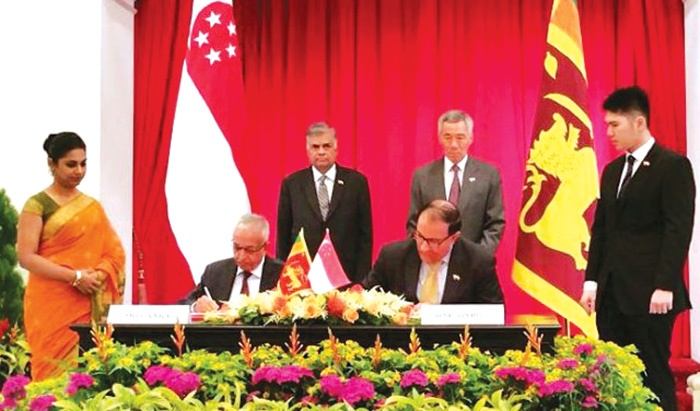
Sri Lanka-Singapore Free Trade Agreement
By Gomi Senadhira
senadhiragomi@gmail.com
“You might tell fairy tales, but the progress of a country cannot be achieved through such narratives. A country cannot be developed by making false promises. The country moved backward because of the electoral promises made by political parties throughout time. We have witnessed that the ultimate result of this is the country becoming bankrupt. Unfortunately, many segments of the population have not come to realize this yet.” – President Ranil Wickremesinghe, 2024 Budget speech
Any Sri Lankan would agree with the above words of President Wickremesinghe on the false promises our politicians and officials make and the fairy tales they narrate which bankrupted this country. So, to understand this, let’s look at one such fairy tale with lots of false promises; Ranil Wickremesinghe’s greatest achievement in the area of international trade and investment promotion during the Yahapalana period, Sri Lanka-Singapore Free Trade Agreement (SLSFTA).
It is appropriate and timely to do it now as Finance Minister Wickremesinghe has just presented to parliament a bill on the National Policy on Economic Transformation which includes the establishment of an Office for International Trade and the Sri Lanka Institute of Economics and International Trade.
Was SLSFTA a “Cleverly negotiated Free Trade Agreement” as stated by the (former) Minister of Development Strategies and International Trade Malik Samarawickrama during the Parliamentary Debate on the SLSFTA in July 2018, or a colossal blunder covered up with lies, false promises, and fairy tales? After SLSFTA was signed there were a number of fairy tales published on this agreement by the Ministry of Development Strategies and International, Institute of Policy Studies, and others.
However, for this article, I would like to limit my comments to the speech by Minister Samarawickrama during the Parliamentary Debate, and the two most important areas in the agreement which were covered up with lies, fairy tales, and false promises, namely: revenue loss for Sri Lanka and Investment from Singapore. On the other important area, “Waste products dumping” I do not want to comment here as I have written extensively on the issue.
1. The revenue loss
During the Parliamentary Debate in July 2018, Minister Samarawickrama stated “…. let me reiterate that this FTA with Singapore has been very cleverly negotiated by us…. The liberalisation programme under this FTA has been carefully designed to have the least impact on domestic industry and revenue collection. We have included all revenue sensitive items in the negative list of items which will not be subject to removal of tariff. Therefore, 97.8% revenue from Customs duty is protected. Our tariff liberalisation will take place over a period of 12-15 years! In fact, the revenue earned through tariffs on goods imported from Singapore last year was Rs. 35 billion.
The revenue loss for over the next 15 years due to the FTA is only Rs. 733 million– which when annualised, on average, is just Rs. 51 million. That is just 0.14% per year! So anyone who claims the Singapore FTA causes revenue loss to the Government cannot do basic arithmetic! Mr. Speaker, in conclusion, I call on my fellow members of this House – don’t mislead the public with baseless criticism that is not grounded in facts. Don’t look at petty politics and use these issues for your own political survival.”
I was surprised to read the minister’s speech because an article published in January 2018 in “The Straits Times“, based on information released by the Singaporean Negotiators stated, “…. With the FTA, tariff savings for Singapore exports are estimated to hit $10 million annually“.
As the annual tariff savings (that is the revenue loss for Sri Lanka) calculated by the Singaporean Negotiators, Singaporean $ 10 million (Sri Lankan rupees 1,200 million in 2018) was way above the rupees’ 733 million revenue loss for 15 years estimated by the Sri Lankan negotiators, it was clear to any observer that one of the parties to the agreement had not done the basic arithmetic!
Six years later, according to a report published by “The Morning” newspaper, speaking at the Committee on Public Finance (COPF) on 7th May 2024, Mr Samarawickrama’s chief trade negotiator K.J. Weerasinghehad had admitted “…. that forecasted revenue loss for the Government of Sri Lanka through the Singapore FTA is Rs. 450 million in 2023 and Rs. 1.3 billion in 2024.”
If these numbers are correct, as tariff liberalisation under the SLSFTA has just started, we will pass Rs 2 billion very soon. Then, the question is how Sri Lanka’s trade negotiators made such a colossal blunder. Didn’t they do their basic arithmetic? If they didn’t know how to do basic arithmetic they should have at least done their basic readings. For example, the headline of the article published in The Straits Times in January 2018 was “Singapore, Sri Lanka sign FTA, annual savings of $10m expected”.
Anyway, as Sri Lanka’s chief negotiator reiterated at the COPF meeting that “…. since 99% of the tariffs in Singapore have zero rates of duty, Sri Lanka has agreed on 80% tariff liberalisation over a period of 15 years while expecting Singapore investments to address the imbalance in trade,” let’s turn towards investment.
Investment from Singapore
In July 2018, speaking during the Parliamentary Debate on the FTA this is what Minister Malik Samarawickrama stated on investment from Singapore, “Already, thanks to this FTA, in just the past two-and-a-half months since the agreement came into effect we have received a proposal from Singapore for investment amounting to $ 14.8 billion in an oil refinery for export of petroleum products. In addition, we have proposals for a steel manufacturing plant for exports ($ 1 billion investment), flour milling plant ($ 50 million), sugar refinery ($ 200 million). This adds up to more than $ 16.05 billion in the pipeline on these projects alone.
And all of these projects will create thousands of more jobs for our people. In principle approval has already been granted by the BOI and the investors are awaiting the release of land the environmental approvals to commence the project.
I request the Opposition and those with vested interests to change their narrow-minded thinking and join us to develop our country. We must always look at what is best for the whole community, not just the few who may oppose. We owe it to our people to courageously take decisions that will change their lives for the better.”
According to the media report I quoted earlier, speaking at the Committee on Public Finance (COPF) Chief Negotiator Weerasinghe has admitted that Sri Lanka was not happy with overall Singapore investments that have come in the past few years in return for the trade liberalisation under the Singapore-Sri Lanka Free Trade Agreement. He has added that between 2021 and 2023 the total investment from Singapore had been around $162 million!
What happened to those projects worth $16 billion negotiated, thanks to the SLSFTA, in just the two-and-a-half months after the agreement came into effect and approved by the BOI? I do not know about the steel manufacturing plant for exports ($ 1 billion investment), flour milling plant ($ 50 million) and sugar refinery ($ 200 million).
However, story of the multibillion-dollar investment in the Petroleum Refinery unfolded in a manner that would qualify it as the best fairy tale with false promises presented by our politicians and the officials, prior to 2019 elections.
Though many Sri Lankans got to know, through the media which repeatedly highlighted a plethora of issues surrounding the project and the questionable credentials of the Singaporean investor, the construction work on the Mirrijiwela Oil Refinery along with the cement factory began on the24th of March 2019 with a bang and Minister Ranil Wickremesinghe and his ministers along with the foreign and local dignitaries laid the foundation stones.
That was few months before the 2019 Presidential elections. Inaugurating the construction work Prime Minister Ranil Wickremesinghe said the projects will create thousands of job opportunities in the area and surrounding districts.
The oil refinery, which was to be built over 200 acres of land, with the capacity to refine 200,000 barrels of crude oil per day, was to generate US$7 billion of exports and create 1,500 direct and 3,000 indirect jobs. The construction of the refinery was to be completed in 44 months. Four years later, in August 2023 the Cabinet of Ministers approved the proposal presented by President Ranil Wickremesinghe to cancel the agreement with the investors of the refinery as the project has not been implemented! Can they explain to the country how much money was wasted to produce that fairy tale?
It is obvious that the President, ministers, and officials had made huge blunders and had deliberately misled the public and the parliament on the revenue loss and potential investment from SLSFTA with fairy tales and false promises.
As the president himself said, a country cannot be developed by making false promises or with fairy tales and these false promises and fairy tales had bankrupted the country. “Unfortunately, many segments of the population have not come to realize this yet”.
(The writer, a specialist and an activist on trade and development issues . )



US sports envoys to Lanka to champion youth development

Rahuman questions sudden cancellation of leave of CEB employees


