
Features
Policeman cracks joke at Soulbury’s expense over game billiards

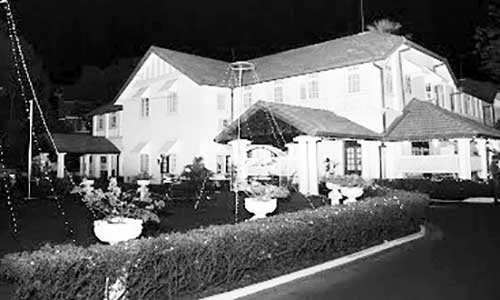
(Excerpted from Senior DIG (Rtd.) Edward Gunawardena’s memoirs)
Colombo Division was hectic, but it was good fun. All Three of us new ASPs, Brute Mahendran, Cosmo David and I were resident at the Officer’s Mess, Brownrigg Road. Today it is the Senior Officer’s Mess, Keppetipola Mawatha This is because during the JVP insurrection of 1971 the Inspectorate of the Police were equated to officer ranks of the armed services; and the Inspectors’ Mess became the Officers’ Mess. The Sergeants and Constables were also designated as Junior Officers and a Mess was established for them on Chaitya Road, Fort.
The Mess was housed in a substantial two storey building. It was in fact one complete unit of a C’ type twin bungalow. The ground floor consisted of two verandahs in the front and the rear, the ante room with a billiard table, a large dining room with a table for about twenty, the kitchen and pantry, outhouses for servants, a large garage and a stable for one horse.
The walls of the ante-room were studded with hunting trophies – heads of wild buffaloes, trunks of elephants, antlers of deer etc. Photographs of past Inspectors – General and group farewells to retiring Senior officers adorned the walls of the dining room. In a large antique glass almirah were silver trophies and other valuable silverware.
The heart of this entire set up was indeed the bar that was housed in a small room adjoining the dining room. A remarkable feature was that this bar was always well stocked with the best liquors and well patronized by the members. Other than on special occasions outsiders were seldom seen there. The main reason why it was well patronized was because all senior officers were encouraged to drink at the mess and not in other public places. There were no cash sales with transactions being strictly on credit.
The Mess Rules had to be strictly observed by all members. If the necessity arose the senior most officer present had the power to enforce discipline. Jamis, the Butler, also enjoyed certain powers even to the extent of cautioning errant officers and reporting them under the Mess Rules. A committee of officers was responsible for the day to day running of the mess, with the Hony. Secretary bearing most of the burden. In later years, at different times I held the offices of Hony. Secretary and President of the Mess.
Unlike today the Mess servants were paid on the profits made by the bar; and there were only three of them including the Butler. Nimalasena assisted Jamis whilst there was just one cook. Today an ASP has taken the place of the Butler while there are several sergeants and constables as bar tenders and kitchen staff. To cater to the needs of the times an eatery also functions within the Mess premises called Bobby’s restaurant. This modest food outlet has proved to be a boon to many officers.
Of a total of six rooms for residents one room was always kept vacant for officers from the outstations who visited the city for official purposes. Apart from the three of us, there was only one other resident member in 1958. He was a bachelor ASP who had come up from the rank of Sub-Inspector. An old Trinitian, T.B. Dhanapala was a fingerprint expert. His younger brothers were Ian who was with me at Marrs Hall in Peradeniya and Jayantha, an illustrious foreign service officer who brought honour to the country.
A visitor who came regularly to see TBD. was a Trinity friend of his, Col. John Halangoda. They were both excellent conversationalists. Whenever possible, it was with pleasure that I joined them in a chat. Sometimes we would talk for hours on Kandyan history, customs, the aristocracy, families and even the manner of cooking and special foods, sipping just one bottle of Beck’s beer!
Dhanapala was a man of erudition and culture. He epitomized the quality of men who joined the police as Sub-Inspectors at that time. Simple in his habits he was scrupulously honest. Once he confided in me how a multi-millionaire businessman who had even been officially honoured by the government had approached him when he was the Registrar of Finger Prints (RFP) to get his past criminal record destroyed. He had taken special precautions for the safety of these documents. It is ironical indeed that this man with a criminal record for stealing a brass garden tap as a collector for an old metal dealer reached the top of the business world. Dhanapala merely faded away. But he will be remembered as a man of honour.
Apart from being the focal point for official functions and social get-togethers, the Mess was the common meeting place for officers. With the Police grounds and the tennis courts situated in close proximity, this was the place where one could bathe, have a change of clothes etc. It was particularly well patronized during week-ends. It was common to see several officers and their guests play bridge and billiards or snooker.
Officers who regularly played bridge were C.C. Dissanayake, Bede Johnpulle, Jebanesan and Lionel Jirasinghe. R.E. Kitto who had been All-India and National sprint champion spent hours at the billiard table. The officers I remember who played with him were R.A. Stork and Royden Vanderwall.
Lord Soulbury the first Governor General had been an occasional visitor to the Mess as the guest of the Inspector-General. As related by Jamis the butler, the Governor-General had also been a keen billiards player. He had been quite proficient too; and like most others he had enjoyed a drink whilst playing. His preferred drink had been Gordon’s gin and tonic with a dash of bitters.
Soulbury’s usual opponent in billiards had been the young and brash Robert Ebenezer (RE) Kitto. The latter was such a free conversationalist, unafraid to use English slang, even the Queen’s representative had begun to enjoy his lively company. A story that went the rounds about Soulbury and Kitto is worth being repeated over and over again.
Playing a game, the former standing on his left leg had stretched his right leg on the green baize and prepared himself to play an intricate shot. Kitto who had downed several arracks had loudly remarked, ” Excuse me, Your Excellency, only three balls on the table”! Soulbury according to Jamis had laughed heartily and shaken hands with Kitto.
Those who did not play bridge or billiards also enjoyed themselves engaged in light conversation, relating jokes and often laughing loudly. The voice of Allen Flamer Caldera was loud and distinct. Frederick de Saram was a real live wire. He was for some reason or another also called. Kukul Saram. It was his daughter, Sirimanie, who married Lalith Athulathmudali.
In fact Kukul usually came with his wife and two daughters. Mrs. de Saram, I remember, was coaxed to play the piano for the husband to lead the singing. He had a baritone voice and his favourite songs were, “I’ve got a loverly bunch of coconuts”, and “Arapiya Lucia dora”. Allen Flamer Caldera’s daughter Jilska who was one of the finest women athletes of the time, also played the piano once in a while for her father and his friends to unwind. Jilska as I remember was a pleasant and beautiful girl.
Celebrating Christmas
There were two special days at the Mess during the Christmas Season. One was the day on which the carols were held on the Police grounds and the other was the Children’s Christmas party.
The Christmas Carols organized by DIG C.C. Dissanayake was an admirable event. The Police Band provided the music and representatives of all ranks including the women police dressed in uniform formed the choir. A remarkable feature was that the personnel of the band as well as the choristers were all not Christians. They belonged to all faiths and sang loudly and lustily.
Even at casual get-togethers Brute Mahendran, a Hindu, sang Christian ditties such as “Swing low sweet chariot” and “Steal Away” with a lot of feeling. The spirit of Christmas entered the lives of all at that time. Even after colonial values had rightfully faded away, it is a matter for satisfaction indeed to see that carols have today become a national cultural feature in the form of ‘Wesak Bakthi Gee’. There was a time when people spoke of Wesak Carols!
The singing of carols did not end on the Police Grounds. It was customary for the senior officers to walk across the grounds to the Mess. Wives and children also joined. And the carols continued with everybody around the piano. Of course, it did not take long for the carols to be replaced by the usual party songs. Fred de Saram, Allen Flamer Caldera, Leslie Abeysekera, Cossy Orr and Stanley Senanayake eventually led the singing to the immortal melodies of Sunil Santha & P.L.A. Somapala. Before breaking up for the evening everybody including the wives and children joined in the Baila singing and dancing.
The Childress’ Party.
The childrens’ Christmas party was the most important event in the annual year-end celebrations. It was a social event looked forward to by the families of all members. For the children of all ages up to 12-years, the event from 5 p.m. to 8 p.m. was three hours of screaming fun. The massive Christmas tree was an exceptionally large branch of pine brought from Nuwara Eliya. Decorated to especially suit the taste of children, attractive toys dangled from all parts of the tree. Different groups of officers and their wives organized games for the children. Numerous varieties of short eats, sweets and ice-cream all supplied by Elephant House were freely available.
The highlight of the childrens’ party was the arrival of Santa Claus sharp at 5 p.m. In fact it was his arrival that signaled the commencement of the proceedings. A remarkable feature of this party was that members and families irrespective of religion joined in the fun. Apart from Buddhists, Musafers, Bongsos and Mahendrans have also played the role of Santa Claus. Shelly Salvador was an officer who reveled playing this role over and over again.
It was the manner of arrival of Santa Claus that provided the kiddies party with the desired kick-start. Minutes before five the sound of jingle bells was heard in the distance. Children and adults awaited his arrival anxiously. Amidst the sound of crackers and the release of hundreds of balloons Santa emerged in his traditional dress.
The sensation was in Santa’s mode of transport. In my early years in the Police I have seen Santa arrive in decorated Jeeps, in a buggy cart, on horseback, on a bicycle , on a motorcycle with a side-car etc. I too was Santa once in the early sixties. My senior at St. Joseph’s Hubert Bagot who was the head of the Police Mounted Division had improvised for me a horse drawn chariot out of a bullock cart!
The annual officers sit-down dinner
This annual dinner which is also called the “First Aid Dinner” is the most important official social meeting for the gazetted officers in the calendar of events of the Senior Officers Mess. This dinner follows the commemoration parade of the St. John’s Ambulance Brigade which in Sri Lanka is made up almost entirely of the police. During my resident days at the Mess, the commandant of the St. John’s Ambulance brigade was Col. Dr. Rockwood. With the Queen as the patron, this was undoubtedly a prestigious honorary post.
In the fifties and sixties it was compulsory for all officers to attend this dinner. Mess dress had to be worn. This dress consisted of black vicuna trousers with overlaid black silk braids, white dress shirt and black bow, white waist-coat and a mini dress jacket. Black shoes, small black epaulets and miniature silver insignia and buttons completed the outfit.
All officers had to be present by 7.30 in the evening. Never have I seen late comers. The special guests, the Governor-General and the Prime Minister arrived by 7.40 p.m. piloted by police vehicles. The IGP and the DIGs who also arrived by 7.30 p.m. received the special guests. By the time they arrived all the officers had studied the table plan that was exhibited on the billiard table. At 8 O’Clock sharp the police band under the baton of Inspector Gerry Paul played “Roast Beef of Old England.” This was the dinner call.
The special guests who also included Col. Dr. Rockwood were all escorted to their respective seats by the IGP and the DIGs. All other officers occupied their seats in an orderly fashion. The dining table was long and extended beyond the rear doorway. A raised platform accommodated the rear end of the table. The table — cloth was of immaculate white and the cutlery, crockery, glasses and serviettes meticulously arranged.
Although the catering manager of Elephant House was present it was Jamis the butler with all his experience who with authority supervised the table arrangements. It was also under the supervision of Jamis that the Elephant House waiters filled the wine and water glasses. As for the IGP and the special guests, Jamis was in personal attendance.
The menu at this special dinner was perhaps the best that Elephant House could offer; and Elephant House was at that time the sole importer of meats, fruits and vegetables. The meats arrived as whole carcasses to be stored in the large cold rooms. I remember being introduced by my father, who was Assistant Manager at Fountain Cafe, to one Mr. Young an Englishman who was the butcher. His job was to carve the carcasses of cattle and sheep to parts. Elephant House also imported the choicest of hams, bacon, butter and cheese.
The menu in 1958, for example, served by Jamis and his liveried assistants, started with a shrimp cocktail followed by steaming Consomme Royale, the soup. The main courses that followed consisted of braised turkey and ham in cadjunut and early pea sauce; and baked seer in mayonnaise with lobster thermidor A desert of Knickerbocker Glory and cheese was followed by strong black coffee. Jamis was constantly on the move topping up the glasses with cognac, cherry brandy and creme de menthe.
The gavel that had been placed on the table in front of the IGP was indeed a rare piece of furniture. It was an exquisitely turned out wooden hammer. Sharp at 9.30 the IGP tapped the table thrice with this gavel and got up with a glass of cognac in his hand. The others too got up simultaneously with glasses in their hands for the evening’s first toast, ‘to the health and happiness of the Queen’.
This was followed with a toast to Ceylon. After these toasts, in an informal tone, the IGP announced, ‘Gentlemen you may smoke’. Many pulled out their own packs or cigarette cases while even the usual non-smokers too helped themselves from the silver cigarette boxes that were being taken round Once the IGP and the guests got up and moved to the ante room other officers too gradually followed.
The proceedings thereafter were informal with the Governor-General and Prime Minister chatting freely even with junior officers. The Probationary ASPS invariably had a special place. It was a part of their induction into the Senior Officer culture of the Ceylon Police with colonial values.
I wonder today whether this special mess function continues to exist. During the late seventies and eighties when I was in service I cannot recall attending a ‘First Aid Dinner’ Perhaps with the extraordinary police commitments during the years of the terrorist war this traditional event had to be done away with. Even if it has ceased to exist it is certainly not a matter for regret. Being an extravagant British Colonial legacy, wholly incompatible with the times, the demise of the ‘Police First Aid Dinner’ had to come sooner or later.



by Dr Gotabhya Ranasinghe
Senior Consultant Cardiologist
National Hospital Sri Lanka
When we sought a meeting with Hon Dr. Ramesh Pathirana, Minister of Health, he graciously cleared his busy schedule to accommodate us. Renowned for his attentive listening and deep understanding, Minister Pathirana is dedicated to advancing the health sector. His openness and transparency exemplify the qualities of an exemplary politician and minister.
Dr. Palitha Mahipala, the current Health Secretary, demonstrates both commendable enthusiasm and unwavering support. This combination of attributes makes him a highly compatible colleague for the esteemed Minister of Health.
Our discussion centered on a project that has been in the works for the past 30 years, one that no other minister had managed to advance.
Minister Pathirana, however, recognized the project’s significance and its potential to revolutionize care for heart patients.
The project involves the construction of a state-of-the-art facility at the premises of the National Hospital Colombo. The project’s location within the premises of the National Hospital underscores its importance and relevance to the healthcare infrastructure of the nation.
This facility will include a cardiology building and a tertiary care center, equipped with the latest technology to handle and treat all types of heart-related conditions and surgeries.
Securing funding was a major milestone for this initiative. Minister Pathirana successfully obtained approval for a $40 billion loan from the Asian Development Bank. With the funding in place, the foundation stone is scheduled to be laid in September this year, and construction will begin in January 2025.
This project guarantees a consistent and uninterrupted supply of stents and related medications for heart patients. As a result, patients will have timely access to essential medical supplies during their treatment and recovery. By securing these critical resources, the project aims to enhance patient outcomes, minimize treatment delays, and maintain the highest standards of cardiac care.
Upon its fruition, this monumental building will serve as a beacon of hope and healing, symbolizing the unwavering dedication to improving patient outcomes and fostering a healthier society.We anticipate a future marked by significant progress and positive outcomes in Sri Lanka’s cardiovascular treatment landscape within the foreseeable timeframe.

by Fr. Emmanuel Fernando, OMI
Jesuit Fr. Aloysius Pieris (affectionately called Fr. Aloy) celebrated his 90th birthday on April 9, 2024 and I, as the editor of our Oblate Journal, THE MISSIONARY OBLATE had gone to press by that time. Immediately I decided to publish an article, appreciating the untiring selfless services he continues to offer for inter-Faith dialogue, the renewal of the Catholic Church, his concern for the poor and the suffering Sri Lankan masses and to me, the present writer.
It was in 1988, when I was appointed Director of the Oblate Scholastics at Ampitiya by the then Oblate Provincial Fr. Anselm Silva, that I came to know Fr. Aloy more closely. Knowing well his expertise in matters spiritual, theological, Indological and pastoral, and with the collaborative spirit of my companion-formators, our Oblate Scholastics were sent to Tulana, the Research and Encounter Centre, Kelaniya, of which he is the Founder-Director, for ‘exposure-programmes’ on matters spiritual, biblical, theological and pastoral. Some of these dimensions according to my view and that of my companion-formators, were not available at the National Seminary, Ampitiya.
Ever since that time, our Oblate formators/ accompaniers at the Oblate Scholasticate, Ampitiya , have continued to send our Oblate Scholastics to Tulana Centre for deepening their insights and convictions regarding matters needed to serve the people in today’s context. Fr. Aloy also had tried very enthusiastically with the Oblate team headed by Frs. Oswald Firth and Clement Waidyasekara to begin a Theologate, directed by the Religious Congregations in Sri Lanka, for the contextual formation/ accompaniment of their members. It should very well be a desired goal of the Leaders / Provincials of the Religious Congregations.
Besides being a formator/accompanier at the Oblate Scholasticate, I was entrusted also with the task of editing and publishing our Oblate journal, ‘The Missionary Oblate’. To maintain the quality of the journal I continue to depend on Fr. Aloy for his thought-provoking and stimulating articles on Biblical Spirituality, Biblical Theology and Ecclesiology. I am very grateful to him for his generous assistance. Of late, his writings on renewal of the Church, initiated by Pope St. John XX111 and continued by Pope Francis through the Synodal path, published in our Oblate journal, enable our readers to focus their attention also on the needed renewal in the Catholic Church in Sri Lanka. Fr. Aloy appreciated very much the Synodal path adopted by the Jesuit Pope Francis for the renewal of the Church, rooted very much on prayerful discernment. In my Religious and presbyteral life, Fr.Aloy continues to be my spiritual animator / guide and ongoing formator / acccompanier.
Fr. Aloysius Pieris, BA Hons (Lond), LPh (SHC, India), STL (PFT, Naples), PhD (SLU/VC), ThD (Tilburg), D.Ltt (KU), has been one of the eminent Asian theologians well recognized internationally and one who has lectured and held visiting chairs in many universities both in the West and in the East. Many members of Religious Congregations from Asian countries have benefited from his lectures and guidance in the East Asian Pastoral Institute (EAPI) in Manila, Philippines. He had been a Theologian consulted by the Federation of Asian Bishops’ Conferences for many years. During his professorship at the Gregorian University in Rome, he was called to be a member of a special group of advisers on other religions consulted by Pope Paul VI.
Fr. Aloy is the author of more than 30 books and well over 500 Research Papers. Some of his books and articles have been translated and published in several countries. Among those books, one can find the following: 1) The Genesis of an Asian Theology of Liberation (An Autobiographical Excursus on the Art of Theologising in Asia, 2) An Asian Theology of Liberation, 3) Providential Timeliness of Vatican 11 (a long-overdue halt to a scandalous millennium, 4) Give Vatican 11 a chance, 5) Leadership in the Church, 6) Relishing our faith in working for justice (Themes for study and discussion), 7) A Message meant mainly, not exclusively for Jesuits (Background information necessary for helping Francis renew the Church), 8) Lent in Lanka (Reflections and Resolutions, 9) Love meets wisdom (A Christian Experience of Buddhism, 10) Fire and Water 11) God’s Reign for God’s poor, 12) Our Unhiddden Agenda (How we Jesuits work, pray and form our men). He is also the Editor of two journals, Vagdevi, Journal of Religious Reflection and Dialogue, New Series.
Fr. Aloy has a BA in Pali and Sanskrit from the University of London and a Ph.D in Buddhist Philosophy from the University of Sri Lankan, Vidyodaya Campus. On Nov. 23, 2019, he was awarded the prestigious honorary Doctorate of Literature (D.Litt) by the Chancellor of the University of Kelaniya, the Most Venerable Welamitiyawe Dharmakirthi Sri Kusala Dhamma Thera.
Fr. Aloy continues to be a promoter of Gospel values and virtues. Justice as a constitutive dimension of love and social concern for the downtrodden masses are very much noted in his life and work. He had very much appreciated the commitment of the late Fr. Joseph (Joe) Fernando, the National Director of the Social and Economic Centre (SEDEC) for the poor.
In Sri Lanka, a few religious Congregations – the Good Shepherd Sisters, the Christian Brothers, the Marist Brothers and the Oblates – have invited him to animate their members especially during their Provincial Congresses, Chapters and International Conferences. The mainline Christian Churches also have sought his advice and followed his seminars. I, for one, regret very much, that the Sri Lankan authorities of the Catholic Church –today’s Hierarchy—- have not sought Fr.
Aloy’s expertise for the renewal of the Catholic Church in Sri Lanka and thus have not benefited from the immense store of wisdom and insight that he can offer to our local Church while the Sri Lankan bishops who governed the Catholic church in the immediate aftermath of the Second Vatican Council (Edmund Fernando OMI, Anthony de Saram, Leo Nanayakkara OSB, Frank Marcus Fernando, Paul Perera,) visited him and consulted him on many matters. Among the Tamil Bishops, Bishop Rayappu Joseph was keeping close contact with him and Bishop J. Deogupillai hosted him and his team visiting him after the horrible Black July massacre of Tamils.
Sri Lanka-Singapore Free Trade Agreement
By Gomi Senadhira
senadhiragomi@gmail.com
“You might tell fairy tales, but the progress of a country cannot be achieved through such narratives. A country cannot be developed by making false promises. The country moved backward because of the electoral promises made by political parties throughout time. We have witnessed that the ultimate result of this is the country becoming bankrupt. Unfortunately, many segments of the population have not come to realize this yet.” – President Ranil Wickremesinghe, 2024 Budget speech
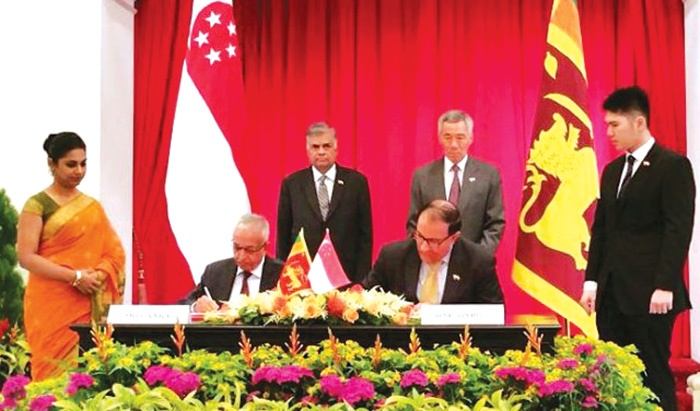
Any Sri Lankan would agree with the above words of President Wickremesinghe on the false promises our politicians and officials make and the fairy tales they narrate which bankrupted this country. So, to understand this, let’s look at one such fairy tale with lots of false promises; Ranil Wickremesinghe’s greatest achievement in the area of international trade and investment promotion during the Yahapalana period, Sri Lanka-Singapore Free Trade Agreement (SLSFTA).
It is appropriate and timely to do it now as Finance Minister Wickremesinghe has just presented to parliament a bill on the National Policy on Economic Transformation which includes the establishment of an Office for International Trade and the Sri Lanka Institute of Economics and International Trade.
Was SLSFTA a “Cleverly negotiated Free Trade Agreement” as stated by the (former) Minister of Development Strategies and International Trade Malik Samarawickrama during the Parliamentary Debate on the SLSFTA in July 2018, or a colossal blunder covered up with lies, false promises, and fairy tales? After SLSFTA was signed there were a number of fairy tales published on this agreement by the Ministry of Development Strategies and International, Institute of Policy Studies, and others.
However, for this article, I would like to limit my comments to the speech by Minister Samarawickrama during the Parliamentary Debate, and the two most important areas in the agreement which were covered up with lies, fairy tales, and false promises, namely: revenue loss for Sri Lanka and Investment from Singapore. On the other important area, “Waste products dumping” I do not want to comment here as I have written extensively on the issue.
1. The revenue loss
During the Parliamentary Debate in July 2018, Minister Samarawickrama stated “…. let me reiterate that this FTA with Singapore has been very cleverly negotiated by us…. The liberalisation programme under this FTA has been carefully designed to have the least impact on domestic industry and revenue collection. We have included all revenue sensitive items in the negative list of items which will not be subject to removal of tariff. Therefore, 97.8% revenue from Customs duty is protected. Our tariff liberalisation will take place over a period of 12-15 years! In fact, the revenue earned through tariffs on goods imported from Singapore last year was Rs. 35 billion.
The revenue loss for over the next 15 years due to the FTA is only Rs. 733 million– which when annualised, on average, is just Rs. 51 million. That is just 0.14% per year! So anyone who claims the Singapore FTA causes revenue loss to the Government cannot do basic arithmetic! Mr. Speaker, in conclusion, I call on my fellow members of this House – don’t mislead the public with baseless criticism that is not grounded in facts. Don’t look at petty politics and use these issues for your own political survival.”
I was surprised to read the minister’s speech because an article published in January 2018 in “The Straits Times“, based on information released by the Singaporean Negotiators stated, “…. With the FTA, tariff savings for Singapore exports are estimated to hit $10 million annually“.
As the annual tariff savings (that is the revenue loss for Sri Lanka) calculated by the Singaporean Negotiators, Singaporean $ 10 million (Sri Lankan rupees 1,200 million in 2018) was way above the rupees’ 733 million revenue loss for 15 years estimated by the Sri Lankan negotiators, it was clear to any observer that one of the parties to the agreement had not done the basic arithmetic!
Six years later, according to a report published by “The Morning” newspaper, speaking at the Committee on Public Finance (COPF) on 7th May 2024, Mr Samarawickrama’s chief trade negotiator K.J. Weerasinghehad had admitted “…. that forecasted revenue loss for the Government of Sri Lanka through the Singapore FTA is Rs. 450 million in 2023 and Rs. 1.3 billion in 2024.”
If these numbers are correct, as tariff liberalisation under the SLSFTA has just started, we will pass Rs 2 billion very soon. Then, the question is how Sri Lanka’s trade negotiators made such a colossal blunder. Didn’t they do their basic arithmetic? If they didn’t know how to do basic arithmetic they should have at least done their basic readings. For example, the headline of the article published in The Straits Times in January 2018 was “Singapore, Sri Lanka sign FTA, annual savings of $10m expected”.
Anyway, as Sri Lanka’s chief negotiator reiterated at the COPF meeting that “…. since 99% of the tariffs in Singapore have zero rates of duty, Sri Lanka has agreed on 80% tariff liberalisation over a period of 15 years while expecting Singapore investments to address the imbalance in trade,” let’s turn towards investment.
Investment from Singapore
In July 2018, speaking during the Parliamentary Debate on the FTA this is what Minister Malik Samarawickrama stated on investment from Singapore, “Already, thanks to this FTA, in just the past two-and-a-half months since the agreement came into effect we have received a proposal from Singapore for investment amounting to $ 14.8 billion in an oil refinery for export of petroleum products. In addition, we have proposals for a steel manufacturing plant for exports ($ 1 billion investment), flour milling plant ($ 50 million), sugar refinery ($ 200 million). This adds up to more than $ 16.05 billion in the pipeline on these projects alone.
And all of these projects will create thousands of more jobs for our people. In principle approval has already been granted by the BOI and the investors are awaiting the release of land the environmental approvals to commence the project.
I request the Opposition and those with vested interests to change their narrow-minded thinking and join us to develop our country. We must always look at what is best for the whole community, not just the few who may oppose. We owe it to our people to courageously take decisions that will change their lives for the better.”
According to the media report I quoted earlier, speaking at the Committee on Public Finance (COPF) Chief Negotiator Weerasinghe has admitted that Sri Lanka was not happy with overall Singapore investments that have come in the past few years in return for the trade liberalisation under the Singapore-Sri Lanka Free Trade Agreement. He has added that between 2021 and 2023 the total investment from Singapore had been around $162 million!
What happened to those projects worth $16 billion negotiated, thanks to the SLSFTA, in just the two-and-a-half months after the agreement came into effect and approved by the BOI? I do not know about the steel manufacturing plant for exports ($ 1 billion investment), flour milling plant ($ 50 million) and sugar refinery ($ 200 million).
However, story of the multibillion-dollar investment in the Petroleum Refinery unfolded in a manner that would qualify it as the best fairy tale with false promises presented by our politicians and the officials, prior to 2019 elections.
Though many Sri Lankans got to know, through the media which repeatedly highlighted a plethora of issues surrounding the project and the questionable credentials of the Singaporean investor, the construction work on the Mirrijiwela Oil Refinery along with the cement factory began on the24th of March 2019 with a bang and Minister Ranil Wickremesinghe and his ministers along with the foreign and local dignitaries laid the foundation stones.
That was few months before the 2019 Presidential elections. Inaugurating the construction work Prime Minister Ranil Wickremesinghe said the projects will create thousands of job opportunities in the area and surrounding districts.
The oil refinery, which was to be built over 200 acres of land, with the capacity to refine 200,000 barrels of crude oil per day, was to generate US$7 billion of exports and create 1,500 direct and 3,000 indirect jobs. The construction of the refinery was to be completed in 44 months. Four years later, in August 2023 the Cabinet of Ministers approved the proposal presented by President Ranil Wickremesinghe to cancel the agreement with the investors of the refinery as the project has not been implemented! Can they explain to the country how much money was wasted to produce that fairy tale?
It is obvious that the President, ministers, and officials had made huge blunders and had deliberately misled the public and the parliament on the revenue loss and potential investment from SLSFTA with fairy tales and false promises.
As the president himself said, a country cannot be developed by making false promises or with fairy tales and these false promises and fairy tales had bankrupted the country. “Unfortunately, many segments of the population have not come to realize this yet”.
(The writer, a specialist and an activist on trade and development issues . )



US sports envoys to Lanka to champion youth development

Rahuman questions sudden cancellation of leave of CEB employees


