
News
Place names say who we are: Nallur triumphs Nellore

by S. Ratnajeevan H. Hoole
The Perahera in Kandy was permitted even with artistes catching Covid. The Nallur Thiruvilla was banned. Our terrorizing police had parades at the temple for TV but shut down streets and diverted traffic although no one was worshiping. When robbers came two doors away (21.08.2021) during curfew, the police emergency number did not answer, and the normal number was hung up when I called. The police do not protect us. My Nellore is being robbed of its name and history.
Rick Grannis of UC Irvine found American racial populations being organized according to “who is down the street.” I address here the subtle fight over place names to suggest the dwellers’ caste. Nellore is the name of Nallur in early church records; streets correlate to caste and land price.
We see street segregation in the Tamil Hindu Epic Chilappathikaram Canto 5. Streets are reserved by caste having their “respective localities.” Jewellers, copper/iron mongers, cobblers, grain-sellers, et al., had their reservations – even mutton vendors, fishmongers, and prostitutes. These places in the city went by the name of Maruvurppakkam (the Other Village Side). In Pattinappakkam (Town Side) dwelt highly renowned great men.
Nellore was the seat of the Jaffna Kingdom of the Aryachakaravarthies. Chekarajacekaramalai says their lineage was Brahmin (I doubt it). Our royals naturally upheld agamic Hindu culture; particularly caste.
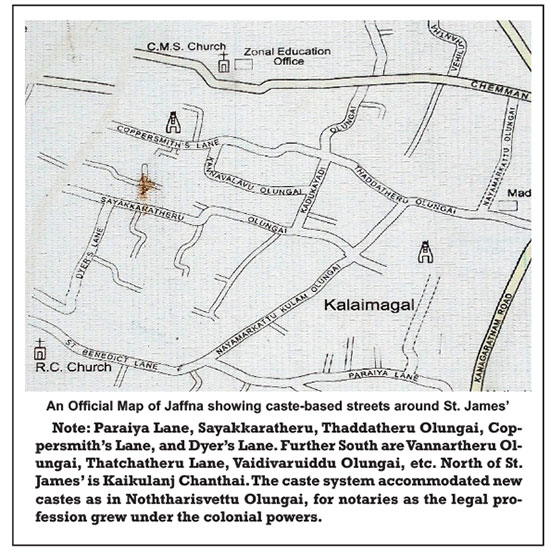
 Madurai’s practice was upheld in Nellore – see the street map from the Jaffna Public Library. The CMS St. James’ stands where the principal Hindu Temple stood at Nallur Centre. Guardian-temples stood in agamic fashion, namely Chattanaathar Kovil (North), a destroyed untraceable temple (West), Moothavinayagar Kovil (South) and Veyyilviluntha Pillaiyar Kovil (East). The map says what caste lived where. People who want a high-status buy into Vellala areas.
There is push back. For example, North of Chattanaathar Kovil is where the Kaikular of middling caste live (palace guards). It was called Kaikulanj Chanthai, now renamed Kalviankadu. This area North of the Palace was occupied by the Portuguese garrison. Many Kaikular show admixture: physical stature (like TELO’s Sri Sabaratnam), pink skin, and grey eyes which are now ascribed to Brahmin admixture and used by Kaikulas to make claims to Brahmin-ritual, like shorter periods of mourning.
The upper castes lived on the main roads within the circle of the guardian temples centred on CMS St. James’, called Changili Thoppu (King Changili’s Garden). People in the by-lanes were of lower castes – typically workers from the trades and musicians, whom the royals needed, and untouchables.
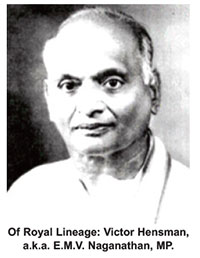
The Rev. John Hensman was the first Anglican priest from Jaffna. It is a shame that Dr. Victor Hensman (later Naganathan) of that family whose life we celebrated only on 15 Aug. 2021 through an international Zoom conference, abandoned that proud heritage and took on the name E.M.V. Naganathan, MP, SJV Chelvanayakam’s righthand.
The high-caste Circle stopped East of Veyyil Viluntha Pilllaiyar Kovil where Chemmany Road (leading to Chemmany) ends on the map. East of that is Nayanmaarkattu where field workers lived. The unnamed road at the top-right of the map was Nayanmaarkattu Veethi (becoming Aadiyapaatham Road) going to Thirunelveli Market. The short stretch of road from Kachcheri-Nallur Road towards the temple as Point Perdro curves toward Muththirai Chanthai was exclusively for Musicians, who could be heard practising their sweet music up to the mid-1960s. They have sold their lands to those seeking caste-upgrade by coming closer to the Nallur Temple.
Many new families have moved in buying land especially as the Christians left Nellore. Changili Thoppu where CMS St. James’ stands and the Palace stood, contains Muthirai Chanthai (Stamp Market, where stood a market to my times, and named so because the King’s tax collectors stamped in indication that taxes had been paid). That market is gone now so new-comers give away their late-coming status by calling it Muththirai Chanthi (Stamp Junction), although Church deeds refer to “Muththirai Chanthai.”
Chemmany Road
Chemmany Road, running by the old palace and central temple with the stretch of Point Pedro Road in front of the Palace entrance, was one of the most important roads. Fr. V. Perniola (The Catholic Church in Sri Lanka) makes occasional reference to the early church in Jaffna in Portuguese times. The early missionaries were Franciscans. King Changili martyred the first Franciscans and many Tamil saints, including his own son. The name Chemmany Road is commonly thought to have its etymology in chem (red) mani (stone, jewel). That, however, is far-fetched because there are no red stones or gems in the area. The likely etymology is chem (holy-red) munn (sand)-ee (the place that has red sand). Chemmany is the place where martyrs’ blood was spilt. As such, the church precincts and the Teachers’ Training College, with its associated Practising School, are hallowed grounds for Christians, RC and non-RC.
The Rev. Elijah Hoole married a girl from Nallur and the Hooles have lived on Chemmany Road for generations. Church deeds testify that our land belonged to my great-great grandmother “Mrs. E. Hoole.”
Nellore Temple History
St. James’s Church is built on the original Central Temple razed to the ground presumably in June 1619 when the Portuguese launched an expedition against Changili II. He took baptism in Goa before his beheading for his crimes, testifying “I would rather die a Christian Coolie than a Heathen King” and “uttering the sweet name of Jesus” (Queyroz, 690-1). His two Queens were preached to by Friar Antonio de Santa Maria (Queyroz 686ff); involving long debates about religious choices with the Queens showing appreciation for Christianity but not enough to convert – until one Queen is moved to ecstatic tears and gets baptised and preaches to the other who too converts. She donated the land where the central temple stood to the Church. On that spot was built a Roman Catholic chapel occupying the St. James’ altar and vestry, and a schoolhouse. Thus St. James’ turned 557 years old in June 2019 when it had Mary as part of its name (citing Roman Catholic historian Rev. Dr. Fr. J. E. Jeyaceelan), although the 200th anniversary recently celebrated was only of the Anglican Church.
Following replacement of the Central Temple by a Roman Chapel, historic documents refer to the Nellore Temple having been built by Chembaha Perumal. There is deliberate spinning between the razed temple and the new. The Wikipedia says, “According to the Yalpana Vaipava Malai, the temple was developed at the site in the 13th century by Buwaneka Bahu, a minister to the King of Kotte. Chembaha Perumal is credited with building the third Nallur Kandaswamy temple”. Where were the first and second? Other so-called encyclopedic sources say, “the Temple’s foundation was laid in 948 AD. … Due to invasion of foreigners, the temple had to be relocated several times in different places within [the] Nallur area.” Nonsense.
After 948 AD it was the time of the ardently Saivite Cholas, who never would have destroyed a Murugan Temple, and then of the Aryachakaravarthies who too promoted Saivism. So why did the temple have to be relocated several times within Nallur whereas those escaping invaders would have fled Nellore?
However, many writers blame Phillippe de Olivero – a Portuguese army commander – for destroying all Hindu temples in Jaffna in 1620. His expedition against Changili II was in 1618. So where was the Nallur temple he destroyed? Which? When? That account is doubtful. The actual destruction would have been in 1619 under de Olivero by when a Christian Chapel was already standing. That would have been where the original temple was. Stories of its relocation need clear proof of when and to where it was relocated.
The present-day Nellore Temple was really built (as a new temple, not rebuilt) when the Dutch allowed it. According to what I was taught in primary school and to India’s Jaffna Consul General’s web site, “It is believed that there was a shrine dedicated to an Islamic Sufi saint in the temple complex from 1734 to 1749 which was relocated in 1749 when the temple structure was built.”
Clearly the present temple stands on “The Other Village Side” in the Muslim quarter with bad connotations for caste. The original Nellore (Paddy Village, Chemmany to this day having paddy fields cultivated by Palla field workers) had to be rescued and made Nallur, the place of good people. The Muslims were pushed further West into Chonaka Theru.
What was done to the Sufis was exactly what the Portuguese did to the Hindus, and the LTTE did to the Muslims in Oct. 1990.
So the Nallur temple cannot be older than late Dutch rule – late in the Eighteenth Cent. when the Dutch began giving permission to build temples. (They never attacked Mosques because they contained no idols).
We see a lot of self-enhancing expansionist heritage history concerning Nallur. Wikipedia even claims, “Part of the original Shivalingam of the Nallur Kandaswamy Temple was located in the Vicarage [of St. James’] till 1995 when it was destroyed during the recapture of Jaffna by Sri Lanka armed forces. Nonsense. I lived in the vicarage from 1956 to 1967. There was no Sivalingam.
Battle for Nellore
St. James’ is the centre of Nellore made into Nallur to claim high caste status, although according to the map, several lower castes also live in Nellore outside the circle round St. James’.
The new temple stands where Muslims and traders ejected from there lived; technically on low-caste soil. It was Maruvurppakkam rather than central Nallur. Reclaiming Pattinapakkam is a long-term project in progress. For that, the temple area must expand East and Nayanmaarkattu expand West, thereby eliminating the real Nallur.
I have begun receiving letters addressed to Nayanmaarkattu Road rather than Chemmany Road. St. James’ up to 1975 or so was dominated by Vellalas, but now only about 3 families remain. The other castes to the east (Nayanmaarkattu) and south (Ariyalai) outside the circle around St. James’ dominate the church, even though the Hindus among them have stone-throwing and fisticuffs when there is Paraya-Palla love. With all Wardens today non-Vellalas, they have lumped our family with Nayamaarkattu for administrative purposes arguing that Changilithoppu is now part of Nayanmaarkattu. Likewise, Paraya Street now has disappeared into St. Benerdict’s Street. The North-South Nayanmaarkattu Olungai leading to Nayanmaarkattu is removed and now runs East-West to Kanaharatnam Road leading to Ariyalai. However, since the Provincial Department of Education has illegally encroached on the CMS Teachers’ Training College and Vellalas (or aspiring Vellalas) there will not use the Nayanmaarkattu Road as address in preference to Chemmany Road, obliterating that Chemmany Road address is uphill.
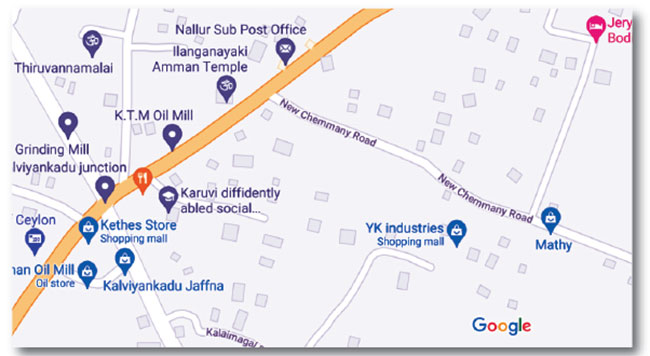
The attempt to replace “Chemmany Road” with the name “New Chemmany Road” elsewhere is ongoing. A road by this name is seen as having been started from Kaikulanj Chanthai. It does not even reach Chemmany. The Nallur sub-Post Office was within the circle by Chattanaathar Kovil. That has been moved to Kaikulanj Chanthai diminishing the claims of the original Nallur.
When I returned to Sri Lanka and was looking for land close to St. James’, my Hindu relations told me my Hindu cousin in new Nallur was selling his land. When I inquired, he denied it. My relations said he was untruthful. Three months later he had sold it to a Hindu. There is an ongoing attempt to call the temple area Siva Boomi. So meat-eating Christians are not welcome (although I am vegetarian when most Hindus re not). Even the strict king of Kannaki’s, Pandiyan Nedunj Chelian, permitted mutton-vendors and fishmongers; but not the Velllalas of Nallur Temple. Eating-houses are vegetarian. A meat-eating German Shepherd on Siva Boomi has been switched to vegetarian.
The real Nellore is vanishing. The usurper Nallur stands on sufi soil and is in bad hands.



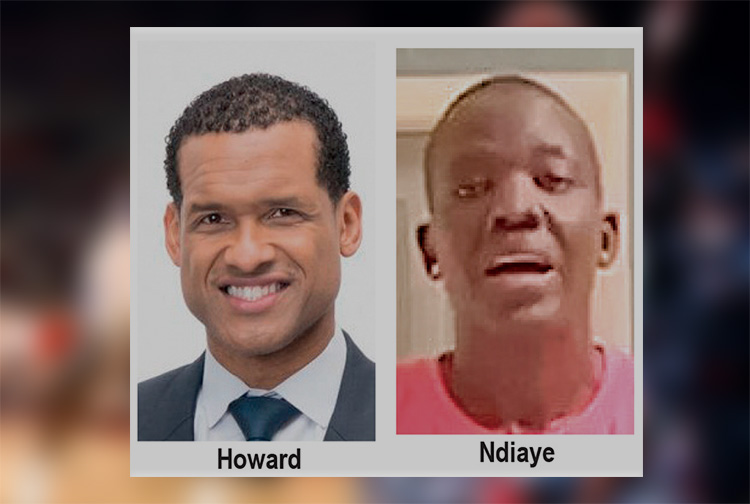
The U.S. Embassy in Colombo welcomed the U.S. Sports Envoys to Sri Lanka, former National Basketball Association (NBA) and Women’s National Basketball Association (WNBA) players Stephen Howard and Astou Ndiaye, from June 8 through 14.
The Public Diplomacy section of the U.S. Embassy said that it would launch a weeklong basketball program intended to harness the unifying power of sports, made possible through collaboration with Foundation of Goodness and IImpact Hoop Lab.
While in Sri Lanka, Howard and Ndiaye, both retired professional basketball players, will conduct a weeklong program, Hoops for Hope: Bridging Borders through Basketball. The Sports Envoys will lead basketball clinics and exhibition matches and engage in leadership sessions in Colombo and Southern Province for youth aged 14-18 from Northern, Uva, Eastern and Western Provinces, offering skills and leadership training both on and off the court. The U.S. Envoys will also share their expertise with the Sri Lanka Basketball Federation, national coaches, and players, furthering the development of basketball in the country. Beyond the clinics, they will collaborate with Sri Lankan schoolchildren to take part in a community service project in the Colombo area.
“We are so proud to welcome Stephen and Astou as our Sports Envoys to Sri Lanka, to build on the strong people-to-people connections between the United States and Sri Lanka,” said U.S. Ambassador Julie Chung. “The lessons that will be shared by our Sports Envoys – communication, teamwork, resilience, inclusion, and conflict resolution – are essential for leadership development, community building, equality, and peace. The U.S. Sports Envoy program is a testament to our belief that sports can be a powerful tool in promoting peace and unity.”
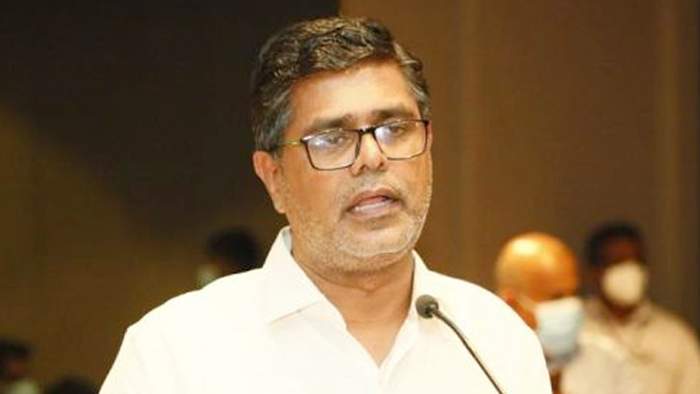
SJB Colombo District MP Mujibur Rahuman in parliament demanded to know from the government the reasons for CEB suspending the leave of all its employees until further notice from Thursday.
MP Rahuman said that the CEB has got an acting General Manager anew and the latter yesterday morning issued a circular suspending leave of all CEB employees with immediate effect until further notice.
“We demand that Minister Kanchana Wijesekera should explain this to the House. This circular was issued while this debate on the new Electricity Amendment Bill was pending. There are many who oppose this Bill. The Minister must tell parliament the reason for the urge to cancel the leave of CEB employees,” the MP said.However, Speaker Mahinda Yapa Abeywardena prevented Minister Wijesekera responding to the query and said that the matter raised by MP Rahuman was not relevant.
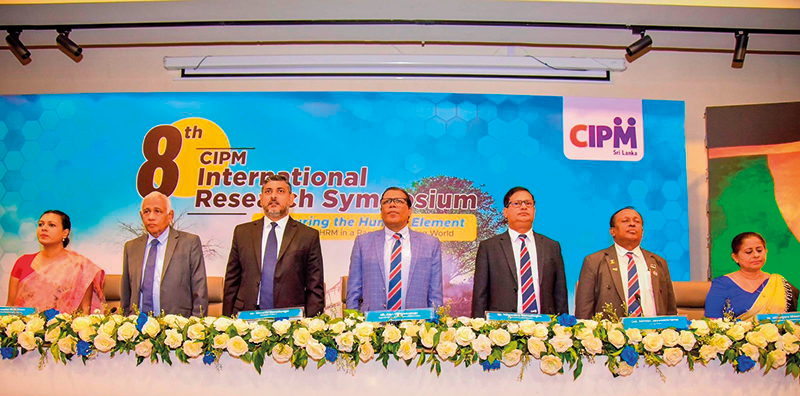
The Chartered Institute of Personnel Management (CIPM) successfully concluded the 8th Annual CIPM Symposium, which took place on 31st May 2024. Themed “Nurturing the Human Element—Redefining HRM in a Rapidly Changing World,” the symposium underscored the pivotal role of human resource management (HRM) in today’s dynamic global landscape. Since its inception in 1959, CIPM has been dedicated to advancing the HR profession through education, professional development, and advocacy, solidifying its position as Sri Lanka’s leading professional body for HRM.
Ken Vijayakumar, the President of the CIPM, graced the occasion as the chief guest. The symposium commenced with the welcome address by the Chairperson, Prof. Arosha Adikaram, followed by the Web Launch of the Symposium Proceedings and Abstract Book by the CIPM President. The event featured distinguished addresses, including a speech by Chief Guest Ken Vijayakumar, President of CIPM, and an address by Guest of Honor Shakthi Ranatunga, Chief Operating Officer of MAS Holdings Pvt. Ltd., Sri Lanka.
The symposium also featured an inspiring keynote address by Prof. Mario Fernando, Professor of Management and Director of the Centre for Cross Cultural Management (CCCM) at the University of Wollongong, Australia.
Vote of Thanks of the inauguration session was delivered by Dr. Dillanjani Weeratunga, Symposium Co-chair.
The symposium served as a comprehensive platform for researchers to present their findings across a wide range of critical topics in HRM. These included Cultural Diversity and Inclusion, Talent Development and Retention, Ethical Leadership and Corporate Social Responsibility, Adapting to Technological Advancements, Mental Health and Well-being at Work, Global Workforce Challenges, Employee Empowerment, and Reskilling and Upskilling.
The plenary session was led by Prof. Wasantha Rajapakse. Certificates were awarded to the best paper presenters during the valedictory session, followed by a vote of thanks delivered by Kamani Perera, Manager of Research and Development.
The annual symposium of CIPM was a truly inclusive event, attracting a diverse audience that spanned undergraduates, graduates, working professionals, research scholars and lecturers. This widespread interest highlights the symposium’s significance in the field of HRM, offering a unique opportunity for everyone to network and learn from scholarly brains.The CIPM International Research Symposium was sponsored by Hambantota International Port, Sri Lanka Institute of Information Technology (SLIIT), E B Creasy & Co. PLC, and Print Xcel Company.



US sports envoys to Lanka to champion youth development

Rahuman questions sudden cancellation of leave of CEB employees


