
Features
Non-aquatic birds and return to Thittawella

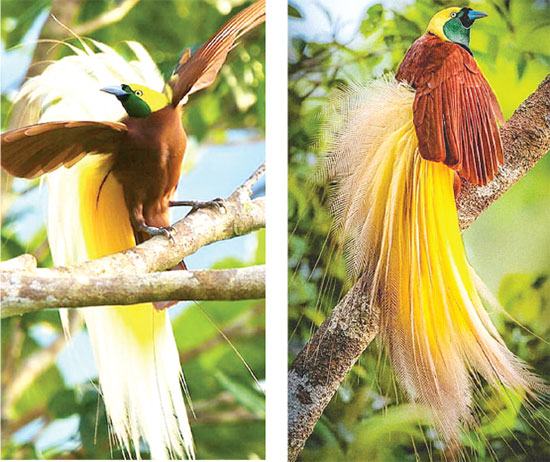
by Athula Dissanayake
(Continued from last week)
As I sat, small flocks of Indian crested tree swifts would fly to and fro overhead, uttering loud calls, “keek-ko, keek-ko…” as they hunted their insect prey. During the migrant season flocks of Eastern swallows descended on the tank skimming the surface as they flew gracefully, twisting and turning, while hunting insects. In the large trees bordering the tank I would occasionally catch a glimpse of a pair of the rare and magnificent black-backed yellow woodpecker, the largest of its tribe.
A common kingfisher would dart along the shore, uttering its shrill call. It would perch on a small rock that stood in the water and wait, sometimes bobbing its head and jerking its body and tail excitedly. On spotting a fish it would dive headlong into the water and return to the rock empty handed while uttering a loud “cheek, cheek, cheek” to voice its disappointment. After several attempts it would return to the perch with a silvery fish dangling in its bill, thump it on the rock a few times and then swallow it head first.

Its more terrestrial cousin, the white breasted kingfisher revealed its presence by its loud cascading call from a nearby tree. Largest of its kind, the gorgeous stork-billed kingfisher frequented the trees bordering the nearby stream, where it used to fish in the dappled sunlight.
Activity in daytime
In the morning the birds were active while feeding, walking and flying to different parts of the tank. As the morning wore off all activity gradually dwindled and by midday it came to a stop. As the birds rested in the midday heat, everything was still and quiet, and hardly a bird could be seen as it took shelter among the water plants. A gentle breeze stirred a few ripples in the water and swayed the floating lotus leaves. Occasionally a bird would preen or take a bath by splashing in the water.
A sleepy atmosphere prevailed, enhanced by the constant drone of the cicadas. A gentle popping sound would indicate a surfacing fish or a sudden splash would indicate one jumping out of water to avoid an underwater predator. The silence would at times be rudely broken by the loud ringing calls of a pair of serpent eagles soaring in the heavens on thermal currents.
Towards evening the activity became more pronounced and the teals, coots and jacanas came out into the open to feed. The tranquillity was broken by a chorus of calls emanating from aquatic birds resting among reeds and lotuses. The tank was particularly noisy during the breeding season, when it was full of water and the vegetation luxuriant.
Coots and jacanas were the noisiest of the lot. They could be seen running and chasing rivals and engaging in mock fights.. A pair of white breasted waterhens added to the chorus with their loud call “kapparakata puwak puwak” as they prepared to roost in a clump of bushes at the water’s edge.
As the evening gave way to dusk, the chorus gradually died down and silence reigned once more.
A purple heron, silhouetted against the setting sun, flew to its roosting place. Its rise and fall with each beat of the wings, was a most serene sight as we stood on the bund. It was a peaceful scene after most of the birds retired for the night and creatures of darkness gradually and silently took over.
Night herons, with their attractive white and blue-grey plumage and a ruby-red eye, took up their posts by the water’s edge as they prepared for a stint of night fishing. The silence was interrupted by whistling teal as they circled the tank, uttering their shrill calls before flying off into distant paddy fields for their nightly forage. A red-wattled lapwing would announce its annoyance at the presence of a predator by its piercing call “did you do it”.
Breeding season
All the birds looked their best during the breeding season, particularly the males who wore their bright nuptial plumage, such as the jacanas with jet black bellies and long tails, grebes with chestnut in the neck, cotton teals with glossy green on their backs, and pond herons and egrets with long streamers down the neck. A korawaka or white-breasted waterhen swimming among the lily pads, with its brood of fluffy black chicks, offered a most pleasing sight.
Once I saw a male coot climbing the back of a larger female in attempting to mate. Unable to bear the weight of both of them, the floating vegetation gave way and the couple sank in the water. It was quite a hilarious episode. The affair was promptly abandoned as they went about their different ways. However, I saw them making a successful attempt later in the evening.

15 years later
All things change with time. My two cousins grew up and went their different ways. I entered medical college to engage in a busy career and our visits to the Thittawella tank stopped abruptly. Thittawella receded deep into the past. It was 15 years later that I came to reside in Kurunegala again when I was posted there.
At Kurunegala, I found a partner and friend in Dr. R. Thalgahagoda, Consultant Rheumatologist, who was also interested in wildlife. I wasted no time in organizing a trip to Thittawella tank in an evening and soon found myself seated on a rock close to the bund accompanied by him. As I sat there after so many years, all those memories came flooding back, and it was intensely nostalgic. Birds were still there, and I was able to observe them even more closely with the aid of my new equipment, namely a small telescope. It brought out the beauty of the tank birds more vividly. Thus began phase two of my acquaintance with Thittawella tank.
One day Thal and I were seated as usual on the tank bund, relaxed and leisurely watching the abundant bird life around us. Dusk was approaching and a three-quarter moon rising in the sky above the hills in the east. A flock of whistling teal rose from the tank and flew up into the sky. It was the largest flock of whistling teal I have seen so far. They then kept on flying round and round the tank, calling incessantly for several minutes. As the dusk advanced and the moon rose higher, flooding the tank with a mellow silvery light, they kept on circling and whistling what sounded as sweet music to our ears as we watched them enthralled. That is a spectacle I would never forget.
Uncommon birds
With the aid of the telescope, I spotted one day a pair of birds I had missed in my boyhood. They were Indian waterhens or common moorhen walking on the lotus leaves. It was a beautiful bird, black in colour, with a yellow-tipped bill, a bright red shield on the forehead, and yellow legs. A white line ran along the flank, and the under-tail coverts were also white, contrasting with the glossy black of the rest of the plumage. While walking they frequently jerked the tail up. At times they would get into the water and swim like ducks and it was quite interesting observing their antics.
In the dry season, a considerable part of the tank bed is exposed. During such a time one evening we observed a few birds feeding quietly on the muddy surface, close to some bushes. They had a prominent white ring round the eye, which merged into a short strip just behind. The belly was white, the throat a rich chestnut brown and the back olive brown. They were probing the mud with their longish bills, which were slightly curved downwards.
We watched excitedly as we got our first sighting of an uncommon and rarely seen bird, the painted snipe. It was surprising to see such a shy and skulking bird feeding there out in the open, in full view of us for a long period of time. Meeting the unexpected is one of the joys of bird watching. In contrast to the normal pattern of birds, the female of this species is more distinctive and brighter in colour than the drab male. This is in keeping with their reversed role in domestic affairs as the male is encumbered with the duties of incubation and tending the young.
We also saw a solitary snipe, most probably a pintail snipe, walking along the margin of a puddle probing the mud with its long slender bill. It was quite undisturbed by our presence, and this was again unusual for a shy bird.
One evening, when we were seated on the bund of the tank, we were presented with a rare gem. A small quail-sized, rounded bird appeared from the edge of a reed bed and started walking briskly on its greenish yellow legs on the lotus leaves. It jerked the short tail as it went along. The under parts were barred blackish and white (as in most of its other relatives) and the upper parts were a yellowish brown, speckled and streaked with white. It was very actively catching insects as it walked. At times it darted a couple of feet up into the air, in the manner of a flycatcher, and landed back on the lotus leaves.

We watched it in good light at close range for about half an hour before it disappeared among the reeds. We took down all the details of its plumage and were in no doubt regarding its identity, namely a Baillon’s crake. In his Guide to the birds of Ceylon, G M Henry mentions that ” this small crake has been recorded from Sri Lanka only a few occasions in the last hundred years.” So we were absolutely delighted to have seen such a rare bird. As I stated earlier, one of the great joys of bird watching is that the most unexpected bird may be met with at the most unexpected place.
Another rare sighting we had was a Shahin falcon. It was flying above the tank towards Elephant Rock in the distance, where we later saw it on a number of occasions.
Finale
In 1995, I was transferred to Teaching Hospital at Karapitiya in Galle, while Thal was posted to General Hospital, Kandy. Both my cousins, who initially accompanied me to Thittawella tank, took to hotel business. Prasanna, the elder of the two, when working as an executive in a hotel at Kandalama near Dambulla, was in 1999 drowned along with six others, when a boat in which they were on a joy ride on Kandalama tank capsized. Nagitha now runs his own restaurant in Sydney.



by Dr Gotabhya Ranasinghe
Senior Consultant Cardiologist
National Hospital Sri Lanka
When we sought a meeting with Hon Dr. Ramesh Pathirana, Minister of Health, he graciously cleared his busy schedule to accommodate us. Renowned for his attentive listening and deep understanding, Minister Pathirana is dedicated to advancing the health sector. His openness and transparency exemplify the qualities of an exemplary politician and minister.
Dr. Palitha Mahipala, the current Health Secretary, demonstrates both commendable enthusiasm and unwavering support. This combination of attributes makes him a highly compatible colleague for the esteemed Minister of Health.
Our discussion centered on a project that has been in the works for the past 30 years, one that no other minister had managed to advance.
Minister Pathirana, however, recognized the project’s significance and its potential to revolutionize care for heart patients.
The project involves the construction of a state-of-the-art facility at the premises of the National Hospital Colombo. The project’s location within the premises of the National Hospital underscores its importance and relevance to the healthcare infrastructure of the nation.
This facility will include a cardiology building and a tertiary care center, equipped with the latest technology to handle and treat all types of heart-related conditions and surgeries.
Securing funding was a major milestone for this initiative. Minister Pathirana successfully obtained approval for a $40 billion loan from the Asian Development Bank. With the funding in place, the foundation stone is scheduled to be laid in September this year, and construction will begin in January 2025.
This project guarantees a consistent and uninterrupted supply of stents and related medications for heart patients. As a result, patients will have timely access to essential medical supplies during their treatment and recovery. By securing these critical resources, the project aims to enhance patient outcomes, minimize treatment delays, and maintain the highest standards of cardiac care.
Upon its fruition, this monumental building will serve as a beacon of hope and healing, symbolizing the unwavering dedication to improving patient outcomes and fostering a healthier society.We anticipate a future marked by significant progress and positive outcomes in Sri Lanka’s cardiovascular treatment landscape within the foreseeable timeframe.

by Fr. Emmanuel Fernando, OMI
Jesuit Fr. Aloysius Pieris (affectionately called Fr. Aloy) celebrated his 90th birthday on April 9, 2024 and I, as the editor of our Oblate Journal, THE MISSIONARY OBLATE had gone to press by that time. Immediately I decided to publish an article, appreciating the untiring selfless services he continues to offer for inter-Faith dialogue, the renewal of the Catholic Church, his concern for the poor and the suffering Sri Lankan masses and to me, the present writer.
It was in 1988, when I was appointed Director of the Oblate Scholastics at Ampitiya by the then Oblate Provincial Fr. Anselm Silva, that I came to know Fr. Aloy more closely. Knowing well his expertise in matters spiritual, theological, Indological and pastoral, and with the collaborative spirit of my companion-formators, our Oblate Scholastics were sent to Tulana, the Research and Encounter Centre, Kelaniya, of which he is the Founder-Director, for ‘exposure-programmes’ on matters spiritual, biblical, theological and pastoral. Some of these dimensions according to my view and that of my companion-formators, were not available at the National Seminary, Ampitiya.
Ever since that time, our Oblate formators/ accompaniers at the Oblate Scholasticate, Ampitiya , have continued to send our Oblate Scholastics to Tulana Centre for deepening their insights and convictions regarding matters needed to serve the people in today’s context. Fr. Aloy also had tried very enthusiastically with the Oblate team headed by Frs. Oswald Firth and Clement Waidyasekara to begin a Theologate, directed by the Religious Congregations in Sri Lanka, for the contextual formation/ accompaniment of their members. It should very well be a desired goal of the Leaders / Provincials of the Religious Congregations.
Besides being a formator/accompanier at the Oblate Scholasticate, I was entrusted also with the task of editing and publishing our Oblate journal, ‘The Missionary Oblate’. To maintain the quality of the journal I continue to depend on Fr. Aloy for his thought-provoking and stimulating articles on Biblical Spirituality, Biblical Theology and Ecclesiology. I am very grateful to him for his generous assistance. Of late, his writings on renewal of the Church, initiated by Pope St. John XX111 and continued by Pope Francis through the Synodal path, published in our Oblate journal, enable our readers to focus their attention also on the needed renewal in the Catholic Church in Sri Lanka. Fr. Aloy appreciated very much the Synodal path adopted by the Jesuit Pope Francis for the renewal of the Church, rooted very much on prayerful discernment. In my Religious and presbyteral life, Fr.Aloy continues to be my spiritual animator / guide and ongoing formator / acccompanier.
Fr. Aloysius Pieris, BA Hons (Lond), LPh (SHC, India), STL (PFT, Naples), PhD (SLU/VC), ThD (Tilburg), D.Ltt (KU), has been one of the eminent Asian theologians well recognized internationally and one who has lectured and held visiting chairs in many universities both in the West and in the East. Many members of Religious Congregations from Asian countries have benefited from his lectures and guidance in the East Asian Pastoral Institute (EAPI) in Manila, Philippines. He had been a Theologian consulted by the Federation of Asian Bishops’ Conferences for many years. During his professorship at the Gregorian University in Rome, he was called to be a member of a special group of advisers on other religions consulted by Pope Paul VI.
Fr. Aloy is the author of more than 30 books and well over 500 Research Papers. Some of his books and articles have been translated and published in several countries. Among those books, one can find the following: 1) The Genesis of an Asian Theology of Liberation (An Autobiographical Excursus on the Art of Theologising in Asia, 2) An Asian Theology of Liberation, 3) Providential Timeliness of Vatican 11 (a long-overdue halt to a scandalous millennium, 4) Give Vatican 11 a chance, 5) Leadership in the Church, 6) Relishing our faith in working for justice (Themes for study and discussion), 7) A Message meant mainly, not exclusively for Jesuits (Background information necessary for helping Francis renew the Church), 8) Lent in Lanka (Reflections and Resolutions, 9) Love meets wisdom (A Christian Experience of Buddhism, 10) Fire and Water 11) God’s Reign for God’s poor, 12) Our Unhiddden Agenda (How we Jesuits work, pray and form our men). He is also the Editor of two journals, Vagdevi, Journal of Religious Reflection and Dialogue, New Series.
Fr. Aloy has a BA in Pali and Sanskrit from the University of London and a Ph.D in Buddhist Philosophy from the University of Sri Lankan, Vidyodaya Campus. On Nov. 23, 2019, he was awarded the prestigious honorary Doctorate of Literature (D.Litt) by the Chancellor of the University of Kelaniya, the Most Venerable Welamitiyawe Dharmakirthi Sri Kusala Dhamma Thera.
Fr. Aloy continues to be a promoter of Gospel values and virtues. Justice as a constitutive dimension of love and social concern for the downtrodden masses are very much noted in his life and work. He had very much appreciated the commitment of the late Fr. Joseph (Joe) Fernando, the National Director of the Social and Economic Centre (SEDEC) for the poor.
In Sri Lanka, a few religious Congregations – the Good Shepherd Sisters, the Christian Brothers, the Marist Brothers and the Oblates – have invited him to animate their members especially during their Provincial Congresses, Chapters and International Conferences. The mainline Christian Churches also have sought his advice and followed his seminars. I, for one, regret very much, that the Sri Lankan authorities of the Catholic Church –today’s Hierarchy—- have not sought Fr.
Aloy’s expertise for the renewal of the Catholic Church in Sri Lanka and thus have not benefited from the immense store of wisdom and insight that he can offer to our local Church while the Sri Lankan bishops who governed the Catholic church in the immediate aftermath of the Second Vatican Council (Edmund Fernando OMI, Anthony de Saram, Leo Nanayakkara OSB, Frank Marcus Fernando, Paul Perera,) visited him and consulted him on many matters. Among the Tamil Bishops, Bishop Rayappu Joseph was keeping close contact with him and Bishop J. Deogupillai hosted him and his team visiting him after the horrible Black July massacre of Tamils.
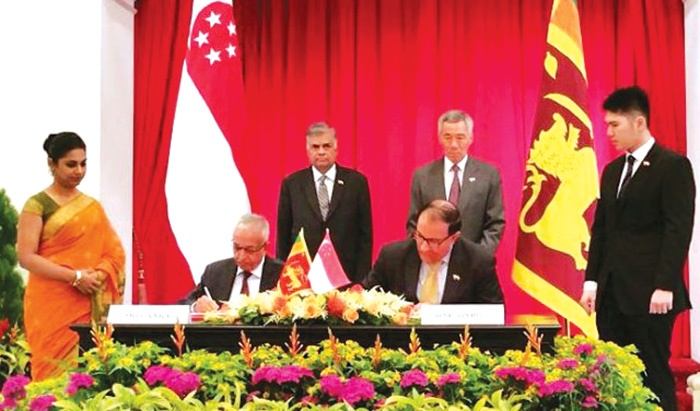
Sri Lanka-Singapore Free Trade Agreement
By Gomi Senadhira
senadhiragomi@gmail.com
“You might tell fairy tales, but the progress of a country cannot be achieved through such narratives. A country cannot be developed by making false promises. The country moved backward because of the electoral promises made by political parties throughout time. We have witnessed that the ultimate result of this is the country becoming bankrupt. Unfortunately, many segments of the population have not come to realize this yet.” – President Ranil Wickremesinghe, 2024 Budget speech
Any Sri Lankan would agree with the above words of President Wickremesinghe on the false promises our politicians and officials make and the fairy tales they narrate which bankrupted this country. So, to understand this, let’s look at one such fairy tale with lots of false promises; Ranil Wickremesinghe’s greatest achievement in the area of international trade and investment promotion during the Yahapalana period, Sri Lanka-Singapore Free Trade Agreement (SLSFTA).
It is appropriate and timely to do it now as Finance Minister Wickremesinghe has just presented to parliament a bill on the National Policy on Economic Transformation which includes the establishment of an Office for International Trade and the Sri Lanka Institute of Economics and International Trade.
Was SLSFTA a “Cleverly negotiated Free Trade Agreement” as stated by the (former) Minister of Development Strategies and International Trade Malik Samarawickrama during the Parliamentary Debate on the SLSFTA in July 2018, or a colossal blunder covered up with lies, false promises, and fairy tales? After SLSFTA was signed there were a number of fairy tales published on this agreement by the Ministry of Development Strategies and International, Institute of Policy Studies, and others.
However, for this article, I would like to limit my comments to the speech by Minister Samarawickrama during the Parliamentary Debate, and the two most important areas in the agreement which were covered up with lies, fairy tales, and false promises, namely: revenue loss for Sri Lanka and Investment from Singapore. On the other important area, “Waste products dumping” I do not want to comment here as I have written extensively on the issue.
1. The revenue loss
During the Parliamentary Debate in July 2018, Minister Samarawickrama stated “…. let me reiterate that this FTA with Singapore has been very cleverly negotiated by us…. The liberalisation programme under this FTA has been carefully designed to have the least impact on domestic industry and revenue collection. We have included all revenue sensitive items in the negative list of items which will not be subject to removal of tariff. Therefore, 97.8% revenue from Customs duty is protected. Our tariff liberalisation will take place over a period of 12-15 years! In fact, the revenue earned through tariffs on goods imported from Singapore last year was Rs. 35 billion.
The revenue loss for over the next 15 years due to the FTA is only Rs. 733 million– which when annualised, on average, is just Rs. 51 million. That is just 0.14% per year! So anyone who claims the Singapore FTA causes revenue loss to the Government cannot do basic arithmetic! Mr. Speaker, in conclusion, I call on my fellow members of this House – don’t mislead the public with baseless criticism that is not grounded in facts. Don’t look at petty politics and use these issues for your own political survival.”
I was surprised to read the minister’s speech because an article published in January 2018 in “The Straits Times“, based on information released by the Singaporean Negotiators stated, “…. With the FTA, tariff savings for Singapore exports are estimated to hit $10 million annually“.
As the annual tariff savings (that is the revenue loss for Sri Lanka) calculated by the Singaporean Negotiators, Singaporean $ 10 million (Sri Lankan rupees 1,200 million in 2018) was way above the rupees’ 733 million revenue loss for 15 years estimated by the Sri Lankan negotiators, it was clear to any observer that one of the parties to the agreement had not done the basic arithmetic!
Six years later, according to a report published by “The Morning” newspaper, speaking at the Committee on Public Finance (COPF) on 7th May 2024, Mr Samarawickrama’s chief trade negotiator K.J. Weerasinghehad had admitted “…. that forecasted revenue loss for the Government of Sri Lanka through the Singapore FTA is Rs. 450 million in 2023 and Rs. 1.3 billion in 2024.”
If these numbers are correct, as tariff liberalisation under the SLSFTA has just started, we will pass Rs 2 billion very soon. Then, the question is how Sri Lanka’s trade negotiators made such a colossal blunder. Didn’t they do their basic arithmetic? If they didn’t know how to do basic arithmetic they should have at least done their basic readings. For example, the headline of the article published in The Straits Times in January 2018 was “Singapore, Sri Lanka sign FTA, annual savings of $10m expected”.
Anyway, as Sri Lanka’s chief negotiator reiterated at the COPF meeting that “…. since 99% of the tariffs in Singapore have zero rates of duty, Sri Lanka has agreed on 80% tariff liberalisation over a period of 15 years while expecting Singapore investments to address the imbalance in trade,” let’s turn towards investment.
Investment from Singapore
In July 2018, speaking during the Parliamentary Debate on the FTA this is what Minister Malik Samarawickrama stated on investment from Singapore, “Already, thanks to this FTA, in just the past two-and-a-half months since the agreement came into effect we have received a proposal from Singapore for investment amounting to $ 14.8 billion in an oil refinery for export of petroleum products. In addition, we have proposals for a steel manufacturing plant for exports ($ 1 billion investment), flour milling plant ($ 50 million), sugar refinery ($ 200 million). This adds up to more than $ 16.05 billion in the pipeline on these projects alone.
And all of these projects will create thousands of more jobs for our people. In principle approval has already been granted by the BOI and the investors are awaiting the release of land the environmental approvals to commence the project.
I request the Opposition and those with vested interests to change their narrow-minded thinking and join us to develop our country. We must always look at what is best for the whole community, not just the few who may oppose. We owe it to our people to courageously take decisions that will change their lives for the better.”
According to the media report I quoted earlier, speaking at the Committee on Public Finance (COPF) Chief Negotiator Weerasinghe has admitted that Sri Lanka was not happy with overall Singapore investments that have come in the past few years in return for the trade liberalisation under the Singapore-Sri Lanka Free Trade Agreement. He has added that between 2021 and 2023 the total investment from Singapore had been around $162 million!
What happened to those projects worth $16 billion negotiated, thanks to the SLSFTA, in just the two-and-a-half months after the agreement came into effect and approved by the BOI? I do not know about the steel manufacturing plant for exports ($ 1 billion investment), flour milling plant ($ 50 million) and sugar refinery ($ 200 million).
However, story of the multibillion-dollar investment in the Petroleum Refinery unfolded in a manner that would qualify it as the best fairy tale with false promises presented by our politicians and the officials, prior to 2019 elections.
Though many Sri Lankans got to know, through the media which repeatedly highlighted a plethora of issues surrounding the project and the questionable credentials of the Singaporean investor, the construction work on the Mirrijiwela Oil Refinery along with the cement factory began on the24th of March 2019 with a bang and Minister Ranil Wickremesinghe and his ministers along with the foreign and local dignitaries laid the foundation stones.
That was few months before the 2019 Presidential elections. Inaugurating the construction work Prime Minister Ranil Wickremesinghe said the projects will create thousands of job opportunities in the area and surrounding districts.
The oil refinery, which was to be built over 200 acres of land, with the capacity to refine 200,000 barrels of crude oil per day, was to generate US$7 billion of exports and create 1,500 direct and 3,000 indirect jobs. The construction of the refinery was to be completed in 44 months. Four years later, in August 2023 the Cabinet of Ministers approved the proposal presented by President Ranil Wickremesinghe to cancel the agreement with the investors of the refinery as the project has not been implemented! Can they explain to the country how much money was wasted to produce that fairy tale?
It is obvious that the President, ministers, and officials had made huge blunders and had deliberately misled the public and the parliament on the revenue loss and potential investment from SLSFTA with fairy tales and false promises.
As the president himself said, a country cannot be developed by making false promises or with fairy tales and these false promises and fairy tales had bankrupted the country. “Unfortunately, many segments of the population have not come to realize this yet”.
(The writer, a specialist and an activist on trade and development issues . )



US sports envoys to Lanka to champion youth development

Rahuman questions sudden cancellation of leave of CEB employees


