
News
No scientific evidence to prove bone fragments are relics of Arahant Anula – archaeologists

By Saman Indrajith
There is no scientific evidence to prove that the recently-excavated bone fragments from an archaeology site at Mihintale monastery complex are relics of Arhant Anula Theri, according to senior archaeologists.
An exposition of the bone fragments was held at the Anula Devi stupa precincts on 20 Dec., and the organisers of the event claimed that they were relics of the Arahant Anlua Theri, who is considered the first Lankan female to be ordained by Theri Sanghamitta during the times of King Devanampiyatissa (247 BC-207 BC). They told the media that they would hold similar expositions across the country in 2023.
Director General of Archaeology Department Prof Anura Manatunga, contacted for comment, said that there was no scientific evidence to assign the bone fragments to any historical figure. “With resources available to us, we may be able to get a sample of these bone fragments dated in a foreign lab. That dating technique could give us the time period but not the name of the person. Even in that case, the dating labs usually give 100 years of margin of error for a single sample,” Prof Manatunga said.
“We have no authority over religious leaders’ statements. We found an inscription bearing early-Brahmi scripts rendering the phrase ‘Anula thisa pavvata vehera’ during the excavations. It could be considered an inscription denoting the name of the site. Several days back, a group of bhikkhus informed us that they wanted to conduct a religious ceremony near the site where the ancient stupa had been excavated by our archaeologists and asked whether the findings of excavation could be displayed there. We granted their request and displayed the bone fragments. Bhikkhus worshipped them and called on people to pay homage because they were the relics of Theri Anula. We had no control over their beliefs and religious fervor.”
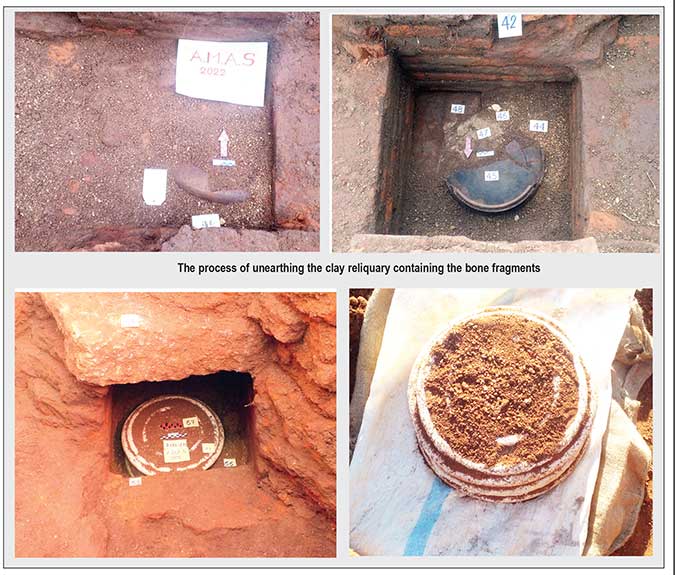
Archaeological Excavation Officer in charge of the site, AA Wijayarathna, said the bone fragment had been found in a clay reliquary among artefacts in the second phase of the site of ancient Anula Thisa stupa in the Mihintale complex. The site had been an earth mound determined to contain a stupa and the Archaeological Department commenced excavations on 26 Jan. 2022. The first phase ended in March but owing to the postponements caused by political upheavals and the resumption of the second phase was delayed till 26 Sept. “There is evidence of excavations carried out by unauthorised diggers, most probably treasure hunters from time to time,” he said, adding that scientific excavations had yielded an assortment of artefacts.
“Currently, the bone fragments are at the Excavation Data Analyzing Centre in the Anuradhapura branch of the Archaeology Department. It is better if we could send several samples for C-14 analysis abroad. The higher the number of samples zeroing in on a more accurate date is easy. “It is costly. In rupees the price for a single sample amounts to more than 500,000,” Wijayarathna said.
Scientific assertions would not be possible till the receipt of C-14 analysis report and other reports on typology of the artefacts. Once the ancient stupa was restored it would be conserved with the bone fragments being re-deposited there, he said.
Among the finds unearthed so far there were a reliquary of quartz crystal, clay reliquaries, metal artifacts including some items of jewelry, coins, a metal ringlet embedded in a piece of cloth and beads.
The area was declared a site of archaeological importance by the Archaeological Department in 1926. It is believed to be a part of a monastery complex in the Anuradhapura Period. Archaeologically verified and dated finds so far from the Anuladevi Cetiya site indicate that Queen Viharamahadevi built this temple in the Second Century BC. The Department of Archaeology has said: “It is believed that Queen Anula, who was ordained as the first Bhikkhuni in Sri Lanka resided together with her fellow bhikkhunis at this monastery. Artefacts such as the ruins of a dagoba, belonging to the early Anuradhapura Period, potsherds, beads, terracotta figurines and the remnants of building material had been discovered from this site.”


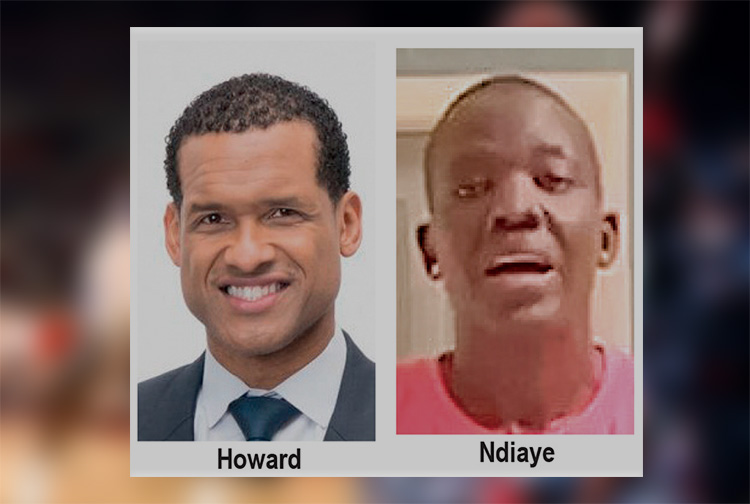
The U.S. Embassy in Colombo welcomed the U.S. Sports Envoys to Sri Lanka, former National Basketball Association (NBA) and Women’s National Basketball Association (WNBA) players Stephen Howard and Astou Ndiaye, from June 8 through 14.
The Public Diplomacy section of the U.S. Embassy said that it would launch a weeklong basketball program intended to harness the unifying power of sports, made possible through collaboration with Foundation of Goodness and IImpact Hoop Lab.
While in Sri Lanka, Howard and Ndiaye, both retired professional basketball players, will conduct a weeklong program, Hoops for Hope: Bridging Borders through Basketball. The Sports Envoys will lead basketball clinics and exhibition matches and engage in leadership sessions in Colombo and Southern Province for youth aged 14-18 from Northern, Uva, Eastern and Western Provinces, offering skills and leadership training both on and off the court. The U.S. Envoys will also share their expertise with the Sri Lanka Basketball Federation, national coaches, and players, furthering the development of basketball in the country. Beyond the clinics, they will collaborate with Sri Lankan schoolchildren to take part in a community service project in the Colombo area.
“We are so proud to welcome Stephen and Astou as our Sports Envoys to Sri Lanka, to build on the strong people-to-people connections between the United States and Sri Lanka,” said U.S. Ambassador Julie Chung. “The lessons that will be shared by our Sports Envoys – communication, teamwork, resilience, inclusion, and conflict resolution – are essential for leadership development, community building, equality, and peace. The U.S. Sports Envoy program is a testament to our belief that sports can be a powerful tool in promoting peace and unity.”
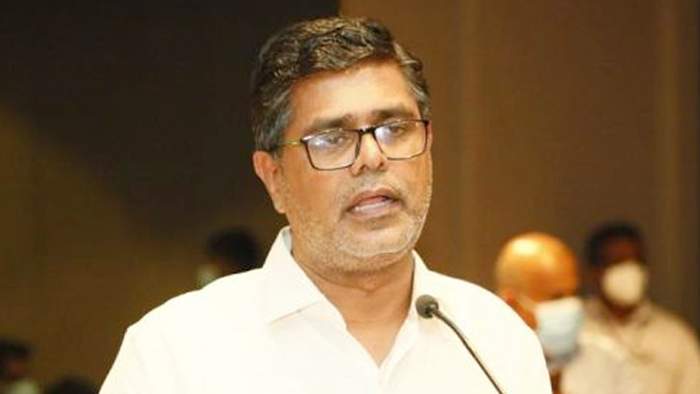
SJB Colombo District MP Mujibur Rahuman in parliament demanded to know from the government the reasons for CEB suspending the leave of all its employees until further notice from Thursday.
MP Rahuman said that the CEB has got an acting General Manager anew and the latter yesterday morning issued a circular suspending leave of all CEB employees with immediate effect until further notice.
“We demand that Minister Kanchana Wijesekera should explain this to the House. This circular was issued while this debate on the new Electricity Amendment Bill was pending. There are many who oppose this Bill. The Minister must tell parliament the reason for the urge to cancel the leave of CEB employees,” the MP said.However, Speaker Mahinda Yapa Abeywardena prevented Minister Wijesekera responding to the query and said that the matter raised by MP Rahuman was not relevant.
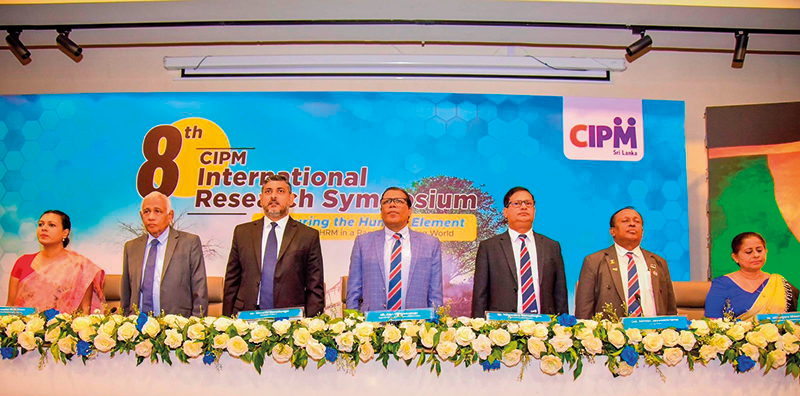
The Chartered Institute of Personnel Management (CIPM) successfully concluded the 8th Annual CIPM Symposium, which took place on 31st May 2024. Themed “Nurturing the Human Element—Redefining HRM in a Rapidly Changing World,” the symposium underscored the pivotal role of human resource management (HRM) in today’s dynamic global landscape. Since its inception in 1959, CIPM has been dedicated to advancing the HR profession through education, professional development, and advocacy, solidifying its position as Sri Lanka’s leading professional body for HRM.
Ken Vijayakumar, the President of the CIPM, graced the occasion as the chief guest. The symposium commenced with the welcome address by the Chairperson, Prof. Arosha Adikaram, followed by the Web Launch of the Symposium Proceedings and Abstract Book by the CIPM President. The event featured distinguished addresses, including a speech by Chief Guest Ken Vijayakumar, President of CIPM, and an address by Guest of Honor Shakthi Ranatunga, Chief Operating Officer of MAS Holdings Pvt. Ltd., Sri Lanka.
The symposium also featured an inspiring keynote address by Prof. Mario Fernando, Professor of Management and Director of the Centre for Cross Cultural Management (CCCM) at the University of Wollongong, Australia.
Vote of Thanks of the inauguration session was delivered by Dr. Dillanjani Weeratunga, Symposium Co-chair.
The symposium served as a comprehensive platform for researchers to present their findings across a wide range of critical topics in HRM. These included Cultural Diversity and Inclusion, Talent Development and Retention, Ethical Leadership and Corporate Social Responsibility, Adapting to Technological Advancements, Mental Health and Well-being at Work, Global Workforce Challenges, Employee Empowerment, and Reskilling and Upskilling.
The plenary session was led by Prof. Wasantha Rajapakse. Certificates were awarded to the best paper presenters during the valedictory session, followed by a vote of thanks delivered by Kamani Perera, Manager of Research and Development.
The annual symposium of CIPM was a truly inclusive event, attracting a diverse audience that spanned undergraduates, graduates, working professionals, research scholars and lecturers. This widespread interest highlights the symposium’s significance in the field of HRM, offering a unique opportunity for everyone to network and learn from scholarly brains.The CIPM International Research Symposium was sponsored by Hambantota International Port, Sri Lanka Institute of Information Technology (SLIIT), E B Creasy & Co. PLC, and Print Xcel Company.



US sports envoys to Lanka to champion youth development

Rahuman questions sudden cancellation of leave of CEB employees


