
Features
Nightmare in the sea off Kalpitiya and old-time resthouses

Excerpted from the authorized biography of Thilo Hoffmann
by Douglas B. Ranasinghe
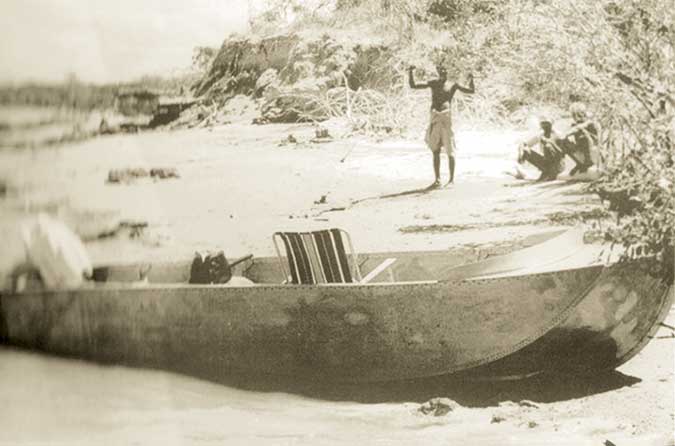
In the 1950s and 60s Thilo kept a flat-bottomed aluminium boat fitted with an outboard motor at the Baurs Red Mill property on the banks of the Kelani Ganga.During the north-east monsoon, trips were made to Mount Lavinia or Negombo on weekends. With a rough sea it was often difficult to negotiate the transition from the river to the sea, taking the breakers in the proper way and avoiding sandbanks both in and out of the estuary. During the south-west monsoon Negombo was reached through the Hamilton Canal and Negombo Lagoon.
On one occasion the boat was transported by lorry to Kalpitiya. From there very early in the morning Thilo, Mae and David Whittaker, who had built the vessel, left for Kollankanatta. There, in Wilpattu, by Portugal Bay, on a flat stretch of seashore overgrown with iluk, Thilo had a lease of one acre of land where he had wanted to build a bungalow. He later gave this up when, chiefly on his own proposal, the area was added to the Wilpattu National Park.
At this place they spent the morning exploring archaeological sites, and befriending a Sinhalese fisherman by the name of Alfred, pronounced ‘Alpred’. He tried to warn them of the up-coming wind, and urged them to return early to Kalpitiya.
The visitors did not understand him properly, and left only at mid-afternoon. By now the south-west wind had thrown up heavy waves. These pounded the boat mercilessly and nearly drowned the occupants in constant heavy spray. After an hour or more of trying they had to give up the intention of returning that day. Eventually, the night was spent, cold and uncomfortable, on a rocky shelf of the shore between Karuwalakuda and Vellamundel, about halfway back to Kalpitiya.
At dawn, on a mirror-smooth surface and in no time, they reached Kalpitiya. There the lorry and driver awaited their return. But the delay had caused a major alarm situation at Baurs and at Palugaswewa Estate, minutes short of a request for a police and aerial search operation.
In those days the islands and shores north of Kalpitiya, in Dutch and Portugal Bays, were uninhabited. (Thilo had proposed to extend the Wilpattu National Park westward to include this marine area and its two main islands.)
Only during the north-east monsoon would some coastal fishing camps be in use there, the catch being dried for easy transport to Kalpitiya at the end of the season. There were a few Catholic churches, at Pallugaturai for example. During the south-west monsoon the area is difficult, and was abandoned, the shallow water being rough and muddy. Today it is populated throughout, and both bays are astir with hundreds of noisy fishing boats.
Years later, in the 1970s, Kalpitiya was again the starting point of an adventure. Mr de Livera who owned Titus Stores, and whose father Thilo had known, maintained a fleet of small fishing trawlers there. He phoned to say that his captains had reported a mass movement of turtles in the sea west of the Kalpitiya Peninsula, and invited Thilo to join one of the ships. Thilo could not resist such an opportunity, and he drove up with his friend Guido Baumann.
They joined the boat which left around 4 p.m. that Saturday. It was a pleasant trip up Dutch Bay and out to sea south of Karaitivu Island. Pods of dolphins were basking in the setting sun.But as the evening and then night progressed a strong north-east wind came up and waves began to rock the small vessel. Thilo and Guido are bad sailors. The expedition turned into a nightmare for both. This was made worse by offers of food or a drink of arrack from time to time by the captain. Wireless phone calls from their host in Colombo who inquired about their well-being did not improve it!
At about 10 p.m. the engine was stopped, the crew had released a very large drift net, and the boat rode at one end of it until morning, pitching and tossing in the heavy waves in a screw-like motion. It was, says Thilo, probably the worst night either of them had ever spent. Guido lay on deck vomiting in the bitter cold. Thilo lay on a bench in the stinking, cockroach-infested hold, braced with his feet and elbows against being tossed into the bilge, his innermost parts seeming to erupt at each upward jolt.
At daybreak the net was hauled in. There were less than a dozen fish. The waves had abated and the boat peacefully chugged back to Kalpitiya. Not one turtle had been sighted.
Farther north on the West coast, Thilo explored the area which includes Devil’s Point, and the uninhabited twin islands of Iranativu, on the coast south of Pooneryn. The only building on the islands is a Catholic church, as on some other remote coasts and islands used by seasonal fishermen.
He was able to visit the Great and Little Basses off the South-West coast on two occasions, with Basil Gunasekera, the Navy chief. Thilo spent one night in each of the historic lighthouses, which are equipped and maintained like ships.
To get to these was itself an adventure: first by rowing boat from the beach at Kirinda to a Navy ship anchored in the bay, then in that vessel close to the Basses, again by rowing boat to the lighthouse, and then finally hauled up by a swivelling wooden crane, hand-operated by the two-man resident crew, to its base.
The transit can be quite tricky when the sea is rough, as it was both times. In the past it was possible to approach the lighthouses only during the short calm season in March-April, and the crews were then marooned for the best part of the year.
Resthouses
The government `resthouses’, set up by the British, formed a network throughout the island during Thilo’s early years, and generally provided good service to the traveling public. He remarks:They were usually run by a local authority, often the GA of the province, and were mostly pleasant buildings with clean and ample rooms. They often stood in fine locations, on a hill or a riverbank or the seashore.
Meals were varied and prescribed in detail by the authority. Prices were very moderate, less than Rs 10/- per day with meals. Generally the resthouse keepers were friendly, genial men, quite a few of them famous for food and service.
“I used resthouses freely, seldom staying in one of the few hotels, except at Kandy and Nuwara Eliya. Advance booking was then not necessary; when, rarely, one place was full you just drove to the next.
This happy state of affairs changed first gradually, then with increasing pace since the 1960s.
“Resthouses disappeared or became shabby and noisy pubs, even dens of vice. Buildings were put to other uses. Later some were rescued and re-appeared as cheap (not price-wise) and tastelessly over-decorated ‘hotels’ with surly personnel. The disappearance of the resthouse system as it still existed in the post-war period is regrettable.
“Among well known and frequented resthouses were those of Bentota, Belihuloya, Hambantota, Arugam Bay, Kalkudah, Vakarai, KKS, Jaffna, Polonnaruwa, Sigiriya, Pelmadulla and Negombo. Famous for seafood, especially fresh – not frozen –crab were the old resthouses at Negombo, Mannar and Jaffna.
“Some were romantic and picturesque beyond measure. The Kalkudah resthouse, covered with a thick thatch of cadjan over beautiful palmyra rafters, was situated beneath massive trees on the shore of a blue bay. Particularly charming was the resthouse at Elephant Pass. Built into the old Dutch fort, and with its large trees, it truly embellished, and stood out in, the bleak flatness of the shallow wetlands between the Chundikkulam and the Jaffna lagoons, through which runs the causeway connecting the Jaffna peninsula with the mainland.”
One late evening in the early 1950s Thilo and Mae arrived there and were assigned the last available room. During the night Mae was disturbed by a mysterious noise and movement in the room. Eventually Thilo closed the window and quiet returned. At breakfast Dr and Mrs H. A. Dirckze of Anuradhapura, who were also guests, casually informed them that the particular room was known to be haunted and thus shunned by visitors! Thilo thinks it was a bat.
The Elephant Pass fort and resthouse were severely damaged in 2000 during the battle with the LTTE. When they seized it they razed the structure to the ground. Not a trace remains of it today. The Portuguese fort at Pooneryn, too, had been badly damaged in the previous decade. Thilo, continues:
“These resthouses, just like the old temples, churches, villages and towns with their public buildings, fitted into the landscape like the key into a lock, exemplifying and accentuating the structure and atmosphere of the land. Today, unfortunately, most buildings, by themselves or collectively, are just blots on the landscape.
“Of course, not all resthouses were excellent. I remember the time at Kalpitiya when we had to flee from our rooms and spend the night in the car as the beds were teeming with bedbugs. At Matara and Weligama the beds were defective and the matresses bumpy, comparable to a potholed road. But on the whole resthouses were just right, and gave good value for money, which you can say for few hotels today.
“An unusual place was the resthouse on the Horton Plains, a very remote and lonely area in those days, especially in bad weather. It was accessible only on foot or horseback. The building had been put up in the late 19th century by Thomas Farr of North Cove Estate, Bogawantalawa as a hunting lodge. Farr was a famous ‘elk’ (sambhur) hunter. A fine stag would be chased over the plains by a pack of dogs, cornered and surrounded, then despatched by the hunter with a knife. This sport, called ‘running to hounds,’ was continued until the middle of the last century.
“The building then became a resthouse under the GA of Nuwara Eliya, and was mainly used by trout fishermen. In the 1970s Harold Peiris acquired it and named it Farr Inn. Still later the Ceylon Hotels Corporation took it over. Today it is a visitor centre of the Department of Wildlife Conservation. As a resthouse it never was a comfortable place. The beds were bumpy and damp, in an all-pervading cold and musty atmosphere.”
We might note here that in the early 20th century the open patanas of Uva formed the background of another peculiar British tradition: fox hunting. Not far from Gurutalawa the Erabedda Hunt had its clubhouse, stables and kennels. On horseback ladies and gentlemen in full dress, with topee (solar helmet), would chase ‘foxes’ (jackals), riding behind large packs of dogs. Today the old clubhouse is the bungalow of Mickelfield Farm, and the patanas are settled and cultivated. The jackals disappeared from the area long ago.
On and off road
Thilo has always been a fast driver, but he has never had a serious accident. In 1947 his first long drive with the new MG was a trip to Jaffna, around the Peninsula and back to Elephant Pass via Nakarkovil. A thrown-up stone had damaged the oil pipe of the car and it just managed to get to Anuradhapura at nightfall. There one of those tinkering jobs for which Ceylon was rightly famous was carried out, and made the return to Colombo possible.
After the MG TC and a Chevrolet cabriolet, Thilo owned an “uncomfortable” early Volkswagen Beetle, and subsequently various models of Peugeot cars. The first was a 403. He fitted this with a Swiss Motosacoche supercharger, which was engaged by pressing a button, and produced “a satisfying whine”. Many drivers of faster models of cars were surprised when it overtook them. Thereafter, he stuck to Peugeots, finding them eminently suitable for the rough conditions of use in Sri Lanka, with small adjustments, such as Koni shock-absorbers and protection against knocks from below. The last such car was a 504, which he bought in 1972, and drove till very recently.
Thilo also had a Land Rover Series I, maintained in fine condition like his other vehicles. It was specially outfitted for exploring in tough situations. There was a snorkel to the exhaust for deep water and, most important, a powerful winch. Axe, mammoties, strong 100-foot nylon ropes, katties, other tools, and spare parts were always on board.
Many times he found himself so immobilized in deep mud or sand that the chassis had to be dug out, and materials for the wheels to grip found and laid, before the jeep could be moved forward or back.Worst were the tracks created by the tall-wheeled bullock carts used in Eastern jungles and plains. In dry weather the ridge in the middle of the track became stone-hard. One had to drive with two wheels on this and the other two up across one of the ruts on either side. Sometimes the vehicle would slip sideways and lie on the ridge with all four wheels off the ground. There were only two options. If a strong tree was within reach of the rope the winch could be used. If not the middle and sides of the track had to be cut away in hours of dirty, hot, uncomfortable work.

When all else failed help had to be found, sometimes from great distances away. It needed up to 20 men or a tractor to get a truly struck jeep on to safe ground. Thilo recalls an incident where in the absence of men from the village a dozen strong women cheerfully came to the rescue. They were, of course, recompensed for their labour.In the late 1960s and 70s the villagers along the road to Wilpattu National Park used to flood the untarred road during the rainy season. This made it impossible to reach the Park in any kind of vehicle without their help, for which (from the few Park visitors) they collected a kind of toll!
Yet possibly the wildest drive Thilo undertook was in 1994 when he managed to coax his 18-year-old Peugeot 504 up from Arawa to the Uva Estate tea factory. Now demolished, this was one of the country’s most prominently visible buildings, at the abrupt northern end of the Madulsima mountain range, overlooking the wide valley of the Mahaweli.
The ascent is more than 3,000 feet over a distance of barely three miles. Had he got stuck on this incline, which he risked throughout, he would have had to abandon the car, as there was no turning back. His friend Guido Baumann preferred to walk – and was overtaken by a sturdy woman carrying a calf on her shoulders up that slope! Thilo embarked on this seemingly foolhardy adventure because, for decades, the official road map showed a motorable road there. (Reports about this and other errors brought no response from the Survey Department.)
During the insurgency of 1972 Thilo undertook some extensive trips. Never before or after was driving in the country so easy. Due to fear the roads were empty not only of vehicles, but also of people, and even cattle and dogs. He drove to Monaragala and explored the mountain range there. He also paid several visits to Palugaswewa Estate to support the Superintendent and staff during that difficult period.
In other countries
The Hoffmanns travelled mostly in Asia, apart from spending regular leave in Switzerland, at first once in four years, later two. The destinations preferred by them were India and Nepal, also Australia, Singapore, Hong Kong, Indonesia and Thailand. In Africa, they visited Egypt several times, and Namibia and Botswana once. On two occasions they flew to the Maldives, well before, in Thilo’s words, “an overbearing tourist industry destroyed its unique charms.”
Mae was greatly attracted by Bombay, with its bustling life and the shopping opportunities not only of Indian textiles and handmade articles, but also of antiques, jewellery, books and artifacts of copper, iron, brass and silver, which were often museum pieces. She was especially fascinated by the original ‘Chor Bazaar’ (‘Thieves’ Market’), with its hundreds of stalls in small by-roads and ancient buildings where second-hand goods of all kinds were heaped up for sale. Later, says Thilo, the stalls were turned into shops that became fashionable and air-conditioned, with prices going up accordingly, and the bazaar lost the genuine aura of a `thieves’ market’.
Thilo is a life member of the Bombay Natural History Society, which he visited on several occasions. He knew Salim Ali, the famous ornithologist, quite well and joined several excursions led by him, and a seminar at Periyar in Tamil Nadu. He also knew Ali’s famous colleague S. Dillon Ripley, from the USA.
For the centenary celebrations of the BNHS in 1976 the Hoffmanns arrived at Bombay airport around midnight. As a result of the stringent exchange control in Sri Lanka at the time they did not have a cent in their pockets! The Taj Mahal Hotel failed to send a car for them though they had ordered one. They were stranded at the airport, not even able to use a telephone. Someone took pity on them, advanced them the cost of a taxi, and they had a bed for the night.


by Dr Gotabhya Ranasinghe
Senior Consultant Cardiologist
National Hospital Sri Lanka
When we sought a meeting with Hon Dr. Ramesh Pathirana, Minister of Health, he graciously cleared his busy schedule to accommodate us. Renowned for his attentive listening and deep understanding, Minister Pathirana is dedicated to advancing the health sector. His openness and transparency exemplify the qualities of an exemplary politician and minister.
Dr. Palitha Mahipala, the current Health Secretary, demonstrates both commendable enthusiasm and unwavering support. This combination of attributes makes him a highly compatible colleague for the esteemed Minister of Health.
Our discussion centered on a project that has been in the works for the past 30 years, one that no other minister had managed to advance.
Minister Pathirana, however, recognized the project’s significance and its potential to revolutionize care for heart patients.
The project involves the construction of a state-of-the-art facility at the premises of the National Hospital Colombo. The project’s location within the premises of the National Hospital underscores its importance and relevance to the healthcare infrastructure of the nation.
This facility will include a cardiology building and a tertiary care center, equipped with the latest technology to handle and treat all types of heart-related conditions and surgeries.
Securing funding was a major milestone for this initiative. Minister Pathirana successfully obtained approval for a $40 billion loan from the Asian Development Bank. With the funding in place, the foundation stone is scheduled to be laid in September this year, and construction will begin in January 2025.
This project guarantees a consistent and uninterrupted supply of stents and related medications for heart patients. As a result, patients will have timely access to essential medical supplies during their treatment and recovery. By securing these critical resources, the project aims to enhance patient outcomes, minimize treatment delays, and maintain the highest standards of cardiac care.
Upon its fruition, this monumental building will serve as a beacon of hope and healing, symbolizing the unwavering dedication to improving patient outcomes and fostering a healthier society.We anticipate a future marked by significant progress and positive outcomes in Sri Lanka’s cardiovascular treatment landscape within the foreseeable timeframe.

by Fr. Emmanuel Fernando, OMI
Jesuit Fr. Aloysius Pieris (affectionately called Fr. Aloy) celebrated his 90th birthday on April 9, 2024 and I, as the editor of our Oblate Journal, THE MISSIONARY OBLATE had gone to press by that time. Immediately I decided to publish an article, appreciating the untiring selfless services he continues to offer for inter-Faith dialogue, the renewal of the Catholic Church, his concern for the poor and the suffering Sri Lankan masses and to me, the present writer.
It was in 1988, when I was appointed Director of the Oblate Scholastics at Ampitiya by the then Oblate Provincial Fr. Anselm Silva, that I came to know Fr. Aloy more closely. Knowing well his expertise in matters spiritual, theological, Indological and pastoral, and with the collaborative spirit of my companion-formators, our Oblate Scholastics were sent to Tulana, the Research and Encounter Centre, Kelaniya, of which he is the Founder-Director, for ‘exposure-programmes’ on matters spiritual, biblical, theological and pastoral. Some of these dimensions according to my view and that of my companion-formators, were not available at the National Seminary, Ampitiya.
Ever since that time, our Oblate formators/ accompaniers at the Oblate Scholasticate, Ampitiya , have continued to send our Oblate Scholastics to Tulana Centre for deepening their insights and convictions regarding matters needed to serve the people in today’s context. Fr. Aloy also had tried very enthusiastically with the Oblate team headed by Frs. Oswald Firth and Clement Waidyasekara to begin a Theologate, directed by the Religious Congregations in Sri Lanka, for the contextual formation/ accompaniment of their members. It should very well be a desired goal of the Leaders / Provincials of the Religious Congregations.
Besides being a formator/accompanier at the Oblate Scholasticate, I was entrusted also with the task of editing and publishing our Oblate journal, ‘The Missionary Oblate’. To maintain the quality of the journal I continue to depend on Fr. Aloy for his thought-provoking and stimulating articles on Biblical Spirituality, Biblical Theology and Ecclesiology. I am very grateful to him for his generous assistance. Of late, his writings on renewal of the Church, initiated by Pope St. John XX111 and continued by Pope Francis through the Synodal path, published in our Oblate journal, enable our readers to focus their attention also on the needed renewal in the Catholic Church in Sri Lanka. Fr. Aloy appreciated very much the Synodal path adopted by the Jesuit Pope Francis for the renewal of the Church, rooted very much on prayerful discernment. In my Religious and presbyteral life, Fr.Aloy continues to be my spiritual animator / guide and ongoing formator / acccompanier.
Fr. Aloysius Pieris, BA Hons (Lond), LPh (SHC, India), STL (PFT, Naples), PhD (SLU/VC), ThD (Tilburg), D.Ltt (KU), has been one of the eminent Asian theologians well recognized internationally and one who has lectured and held visiting chairs in many universities both in the West and in the East. Many members of Religious Congregations from Asian countries have benefited from his lectures and guidance in the East Asian Pastoral Institute (EAPI) in Manila, Philippines. He had been a Theologian consulted by the Federation of Asian Bishops’ Conferences for many years. During his professorship at the Gregorian University in Rome, he was called to be a member of a special group of advisers on other religions consulted by Pope Paul VI.
Fr. Aloy is the author of more than 30 books and well over 500 Research Papers. Some of his books and articles have been translated and published in several countries. Among those books, one can find the following: 1) The Genesis of an Asian Theology of Liberation (An Autobiographical Excursus on the Art of Theologising in Asia, 2) An Asian Theology of Liberation, 3) Providential Timeliness of Vatican 11 (a long-overdue halt to a scandalous millennium, 4) Give Vatican 11 a chance, 5) Leadership in the Church, 6) Relishing our faith in working for justice (Themes for study and discussion), 7) A Message meant mainly, not exclusively for Jesuits (Background information necessary for helping Francis renew the Church), 8) Lent in Lanka (Reflections and Resolutions, 9) Love meets wisdom (A Christian Experience of Buddhism, 10) Fire and Water 11) God’s Reign for God’s poor, 12) Our Unhiddden Agenda (How we Jesuits work, pray and form our men). He is also the Editor of two journals, Vagdevi, Journal of Religious Reflection and Dialogue, New Series.
Fr. Aloy has a BA in Pali and Sanskrit from the University of London and a Ph.D in Buddhist Philosophy from the University of Sri Lankan, Vidyodaya Campus. On Nov. 23, 2019, he was awarded the prestigious honorary Doctorate of Literature (D.Litt) by the Chancellor of the University of Kelaniya, the Most Venerable Welamitiyawe Dharmakirthi Sri Kusala Dhamma Thera.
Fr. Aloy continues to be a promoter of Gospel values and virtues. Justice as a constitutive dimension of love and social concern for the downtrodden masses are very much noted in his life and work. He had very much appreciated the commitment of the late Fr. Joseph (Joe) Fernando, the National Director of the Social and Economic Centre (SEDEC) for the poor.
In Sri Lanka, a few religious Congregations – the Good Shepherd Sisters, the Christian Brothers, the Marist Brothers and the Oblates – have invited him to animate their members especially during their Provincial Congresses, Chapters and International Conferences. The mainline Christian Churches also have sought his advice and followed his seminars. I, for one, regret very much, that the Sri Lankan authorities of the Catholic Church –today’s Hierarchy—- have not sought Fr.
Aloy’s expertise for the renewal of the Catholic Church in Sri Lanka and thus have not benefited from the immense store of wisdom and insight that he can offer to our local Church while the Sri Lankan bishops who governed the Catholic church in the immediate aftermath of the Second Vatican Council (Edmund Fernando OMI, Anthony de Saram, Leo Nanayakkara OSB, Frank Marcus Fernando, Paul Perera,) visited him and consulted him on many matters. Among the Tamil Bishops, Bishop Rayappu Joseph was keeping close contact with him and Bishop J. Deogupillai hosted him and his team visiting him after the horrible Black July massacre of Tamils.
Sri Lanka-Singapore Free Trade Agreement
By Gomi Senadhira
senadhiragomi@gmail.com
“You might tell fairy tales, but the progress of a country cannot be achieved through such narratives. A country cannot be developed by making false promises. The country moved backward because of the electoral promises made by political parties throughout time. We have witnessed that the ultimate result of this is the country becoming bankrupt. Unfortunately, many segments of the population have not come to realize this yet.” – President Ranil Wickremesinghe, 2024 Budget speech
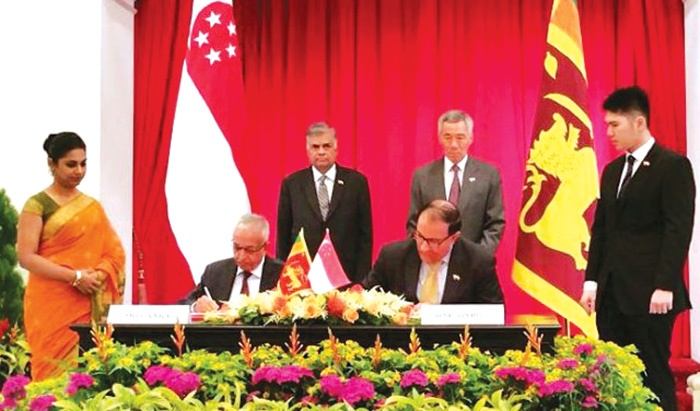
Any Sri Lankan would agree with the above words of President Wickremesinghe on the false promises our politicians and officials make and the fairy tales they narrate which bankrupted this country. So, to understand this, let’s look at one such fairy tale with lots of false promises; Ranil Wickremesinghe’s greatest achievement in the area of international trade and investment promotion during the Yahapalana period, Sri Lanka-Singapore Free Trade Agreement (SLSFTA).
It is appropriate and timely to do it now as Finance Minister Wickremesinghe has just presented to parliament a bill on the National Policy on Economic Transformation which includes the establishment of an Office for International Trade and the Sri Lanka Institute of Economics and International Trade.
Was SLSFTA a “Cleverly negotiated Free Trade Agreement” as stated by the (former) Minister of Development Strategies and International Trade Malik Samarawickrama during the Parliamentary Debate on the SLSFTA in July 2018, or a colossal blunder covered up with lies, false promises, and fairy tales? After SLSFTA was signed there were a number of fairy tales published on this agreement by the Ministry of Development Strategies and International, Institute of Policy Studies, and others.
However, for this article, I would like to limit my comments to the speech by Minister Samarawickrama during the Parliamentary Debate, and the two most important areas in the agreement which were covered up with lies, fairy tales, and false promises, namely: revenue loss for Sri Lanka and Investment from Singapore. On the other important area, “Waste products dumping” I do not want to comment here as I have written extensively on the issue.
1. The revenue loss
During the Parliamentary Debate in July 2018, Minister Samarawickrama stated “…. let me reiterate that this FTA with Singapore has been very cleverly negotiated by us…. The liberalisation programme under this FTA has been carefully designed to have the least impact on domestic industry and revenue collection. We have included all revenue sensitive items in the negative list of items which will not be subject to removal of tariff. Therefore, 97.8% revenue from Customs duty is protected. Our tariff liberalisation will take place over a period of 12-15 years! In fact, the revenue earned through tariffs on goods imported from Singapore last year was Rs. 35 billion.
The revenue loss for over the next 15 years due to the FTA is only Rs. 733 million– which when annualised, on average, is just Rs. 51 million. That is just 0.14% per year! So anyone who claims the Singapore FTA causes revenue loss to the Government cannot do basic arithmetic! Mr. Speaker, in conclusion, I call on my fellow members of this House – don’t mislead the public with baseless criticism that is not grounded in facts. Don’t look at petty politics and use these issues for your own political survival.”
I was surprised to read the minister’s speech because an article published in January 2018 in “The Straits Times“, based on information released by the Singaporean Negotiators stated, “…. With the FTA, tariff savings for Singapore exports are estimated to hit $10 million annually“.
As the annual tariff savings (that is the revenue loss for Sri Lanka) calculated by the Singaporean Negotiators, Singaporean $ 10 million (Sri Lankan rupees 1,200 million in 2018) was way above the rupees’ 733 million revenue loss for 15 years estimated by the Sri Lankan negotiators, it was clear to any observer that one of the parties to the agreement had not done the basic arithmetic!
Six years later, according to a report published by “The Morning” newspaper, speaking at the Committee on Public Finance (COPF) on 7th May 2024, Mr Samarawickrama’s chief trade negotiator K.J. Weerasinghehad had admitted “…. that forecasted revenue loss for the Government of Sri Lanka through the Singapore FTA is Rs. 450 million in 2023 and Rs. 1.3 billion in 2024.”
If these numbers are correct, as tariff liberalisation under the SLSFTA has just started, we will pass Rs 2 billion very soon. Then, the question is how Sri Lanka’s trade negotiators made such a colossal blunder. Didn’t they do their basic arithmetic? If they didn’t know how to do basic arithmetic they should have at least done their basic readings. For example, the headline of the article published in The Straits Times in January 2018 was “Singapore, Sri Lanka sign FTA, annual savings of $10m expected”.
Anyway, as Sri Lanka’s chief negotiator reiterated at the COPF meeting that “…. since 99% of the tariffs in Singapore have zero rates of duty, Sri Lanka has agreed on 80% tariff liberalisation over a period of 15 years while expecting Singapore investments to address the imbalance in trade,” let’s turn towards investment.
Investment from Singapore
In July 2018, speaking during the Parliamentary Debate on the FTA this is what Minister Malik Samarawickrama stated on investment from Singapore, “Already, thanks to this FTA, in just the past two-and-a-half months since the agreement came into effect we have received a proposal from Singapore for investment amounting to $ 14.8 billion in an oil refinery for export of petroleum products. In addition, we have proposals for a steel manufacturing plant for exports ($ 1 billion investment), flour milling plant ($ 50 million), sugar refinery ($ 200 million). This adds up to more than $ 16.05 billion in the pipeline on these projects alone.
And all of these projects will create thousands of more jobs for our people. In principle approval has already been granted by the BOI and the investors are awaiting the release of land the environmental approvals to commence the project.
I request the Opposition and those with vested interests to change their narrow-minded thinking and join us to develop our country. We must always look at what is best for the whole community, not just the few who may oppose. We owe it to our people to courageously take decisions that will change their lives for the better.”
According to the media report I quoted earlier, speaking at the Committee on Public Finance (COPF) Chief Negotiator Weerasinghe has admitted that Sri Lanka was not happy with overall Singapore investments that have come in the past few years in return for the trade liberalisation under the Singapore-Sri Lanka Free Trade Agreement. He has added that between 2021 and 2023 the total investment from Singapore had been around $162 million!
What happened to those projects worth $16 billion negotiated, thanks to the SLSFTA, in just the two-and-a-half months after the agreement came into effect and approved by the BOI? I do not know about the steel manufacturing plant for exports ($ 1 billion investment), flour milling plant ($ 50 million) and sugar refinery ($ 200 million).
However, story of the multibillion-dollar investment in the Petroleum Refinery unfolded in a manner that would qualify it as the best fairy tale with false promises presented by our politicians and the officials, prior to 2019 elections.
Though many Sri Lankans got to know, through the media which repeatedly highlighted a plethora of issues surrounding the project and the questionable credentials of the Singaporean investor, the construction work on the Mirrijiwela Oil Refinery along with the cement factory began on the24th of March 2019 with a bang and Minister Ranil Wickremesinghe and his ministers along with the foreign and local dignitaries laid the foundation stones.
That was few months before the 2019 Presidential elections. Inaugurating the construction work Prime Minister Ranil Wickremesinghe said the projects will create thousands of job opportunities in the area and surrounding districts.
The oil refinery, which was to be built over 200 acres of land, with the capacity to refine 200,000 barrels of crude oil per day, was to generate US$7 billion of exports and create 1,500 direct and 3,000 indirect jobs. The construction of the refinery was to be completed in 44 months. Four years later, in August 2023 the Cabinet of Ministers approved the proposal presented by President Ranil Wickremesinghe to cancel the agreement with the investors of the refinery as the project has not been implemented! Can they explain to the country how much money was wasted to produce that fairy tale?
It is obvious that the President, ministers, and officials had made huge blunders and had deliberately misled the public and the parliament on the revenue loss and potential investment from SLSFTA with fairy tales and false promises.
As the president himself said, a country cannot be developed by making false promises or with fairy tales and these false promises and fairy tales had bankrupted the country. “Unfortunately, many segments of the population have not come to realize this yet”.
(The writer, a specialist and an activist on trade and development issues . )



US sports envoys to Lanka to champion youth development

Rahuman questions sudden cancellation of leave of CEB employees


