
Features
Myth of unemployable arts graduates

(This is a response by a group of Sri Lankan university teachers to the audit report Propensity to tend education under the Arts stream and the unemployment of Arts Graduates.
Recently, the Committee on Public Accounts discussed a report prepared by the audit office, entitled “Propensity to tend education under the Arts stream and the unemployment of Arts Graduates.” The somewhat awkwardly titled report attempts to connect graduate unemployment to Arts Education at secondary and tertiary levels. The report is useful in that it locates some of the problems of tertiary education in a failing secondary educational system. The recommendations made in the report are also, for the most part, salutary. However, the assumptions that inform the body of the report, the material that it uses to come to conclusion regarding arts education, and the manner in which it is committed to undervaluing Arts Education, merits comment, especially in a policy environment where Arts Education is under attack. Arguably the manner in which it conceptualizes the role of education in society is limited and reflects all current policy making on the subject. We provide this analysis, therefore, to broaden the conversation driving the policy discourse regarding higher education in the country and to move it away from its current unhelpful preoccupation with employability. We argue in this response that to formulate policy on a narrowly defined understanding of “employability” is insufficient and does not adequately encompass areas in Humanities and Social Science higher education that require strengthening through reform and support. Currently, policies driven by “employability” are, in fact, negatively impacting Humanities and Social Science programmes within the university system.
The report usefully highlights a fundamental problem in our education system – the failing secondary schools – as impacting Arts Education in general. Using a range of data, the report is able to demonstrate how the system is fundamentally unequal and makes clear that the policy of free education is failing the most marginalized members and communities in our society. The report highlights the fact that many schools do not have resources to provide Advanced Level science education. And states also that many parents are not able to support Advanced Level science education due to their inability to provide funds for extra classes. Therefore, many who are economically marginalized are unable to pursue education in STEM subjects. The report also demonstrates that the provinces, where poverty is greatest, have the largest percentages of Arts students entering university.
In terms of the numbers taking up subjects for the Advanced Level examination, the largest percentage opt for the Arts stream. The report claims that students choose Arts subjects because they are “easy” and students can enter university quickly (through their first shy). The numbers of students that choose the Arts stream for the A-Levels have ranged between 40-50 percent in 2017/2018. Other than in the Western Province, where the numbers are slightly lower, (20-35%), all other provinces had close to 50% of all A-Level students follow Arts subjects (Audit report, pp14-21). Documenting how students who are compelled to attend under-resourced secondary schools have few choices with regards to their education, the report recommends that the education system address the inequality of access and provide all secondary school students the choice of pursing either a STEM focused education or one in Arts, Humanities and Social Sciences. We support this recommendation of the report. The report, however, fails to connect how the inequality that prevails in the school system and the inability to guarantee a good basic education for all, in turn limits the impact that higher education can make when no intervention specifically addresses this problem. The report then suggests that the graduates that the current system of Arts Education produces are unemployable and emphasizes the need to reduce the numbers that opt for the Arts stream. Such a reduction of numbers was planned through the introduction of the technology stream. However, the technology stream itself has its own problems, is insufficiently resourced and has not been a success in reducing the numbers choosing the Arts stream. Unfortunately, there is no recognition in the report that most students are being taught within a severely under-funded and under-resourced Arts stream and that strengthening Arts education itself would be an option that would result in Arts graduates with a higher quality Arts education.
The report is inadequately informed of what Arts education encompasses and the current state of tertiary Arts education in the country.
What is Arts Education?
While acknowledging the need for the Arts to enrich society, the report suggests that as a “developing country”, we have to emphasize economic growth and suggests that we cannot afford to spend resources (that could be spent on Science Technology Engineering Mathematics (STEM) education) on Arts education. Making reference to “literary men, actors, musicians and cinematographers and artists” as necessary for a society, the report states that we, as a developing country, must have a greater emphasis on growing the economy. It is unfortunate that the report’s authors consider the country to be undeserving of investment in the Arts and culture until economic development is achieved and also dissociates the Arts from engagement with economic activity. The lack of greater government support for the Arts is probably a reflection of this sensibility. Unfortunately, such shortsighted positions inform the report and much of education policy today. A vibrant society where the Arts and culture can thrive should be an aspiration that we should cultivate and share.
Arts Faculties also provide degrees in the social sciences, such as sociology, psychology, economics and geography, and in applied or “professional” fields such as education, archeology, and library sciences, as well as humanities subjects such as history, philosophy and literature, and modern and classical languages. Nowhere does the report name the wide variety of subjects that are categorized under Arts education or recognize the importance of such subjects. Other than pointing out in one instance that developed countries use their system of education to create “skilled persons”, while we in Sri Lanka create “academic persons,” the report only recognizes Arts subjects insofar as they are not Science Mathematics or Technology subjects. The skills and perspectives provided by the Humanities and Social Sciences (Arts subjects) are essential to a holistic understanding of any social problem, such as poverty or education, or even any “technical” problem, such as water scarcity. The ability to understand the philosophical and ideological bases of such problems, and identify the social, cultural, and human consequences of proposed solutions, is provided by the skillset cultivated by an Arts education. In fact, this is the very reason that multidisciplinary perspectives are frequently called upon for policy research. It is important then that we recognize the contribution that a good quality Arts education can offer to society. We as a country are suffering today from a lack of attention to the perspectives that social science and humanities education can provide. This is also why those with little or no exposure to the above fields feel qualified to drive policy in various sectors that have substantial social consequences. This situation does not bode well for our future.
As indicated in the quotation above where the Sri Lankan system is accused of producing “academic persons” as opposed to skilled individuals, the report assumes that academically-oriented programmes are somehow antithetical to programmes that provide employment-oriented “skills.” Such a perspective mischaracterizes both the nature of academic engagement and the essence of job-oriented training. A strong academic programme that focuses on critical thought, substantive engagement with course material, independent learning, good writing, presentation and debate skills, will enable graduates to think independently, express themselves and work towards creating meaningful change in whatever surrounding they find themselves in, including their jobs. An effective programme of this nature would simultaneously result in the development of English skills, “soft skills”, and IT skills as part of the curriculum. The World Bank loan funded AHEAD programme, currently being implemented across the university system, has integrated elements of such a perspective and Bank loan supported initiatives are no longer insisting—as they did in earlier cycles– that we carry out stand-alone programmes to cultivate English, IT and “soft skills.”
The contention of the report as stated earlier is that Arts education is the subject area into which the largest numbers of the country’s students flock, and is also the repository of the country’s poorest students. The report then sweepingly suggests that arts programmes draw “weak” students and are themselves “weak” and are of little societal value. This seems to be the preferred policy position with regards to Arts Education. The report notes that the Technology Stream was introduced with the goal of reducing the number of Arts students to less than 25 percent and increasing the number of students pursuing Maths, Science and Technology. The report establishes, however, that the demand for Arts subjects among the student population has increased despite government efforts to decrease the number. The report’s lack of interest in understanding what positive elements of Arts education might be attracting the large student numbers (other than perhaps the ability to become a lawyer) and what elements of Arts education are worth supporting and developing, is quite telling of its general devaluing of Arts education.
The report provides little insight into the content of Arts programmes that are offered by the Sri Lankan university system and its assessment of the efficacy of the programmes is limited to employment numbers provided by the UGC Tracer Study of 2016/17. The report also states that no statistical information is available on unemployed graduates although insights from the Unemployed Graduates Union were obtained. Its critique of the programmes is based on two criteria – the number of programme revisions that have been reported and the introduction of new programmes of study. Outside of the above criteria, the study does not recognize the many differences among Arts degree programmes. For one, not all Arts programmes are the same across the country’s university system. There are internal and external degree programs, three-year general arts degree programmes following different subject combinations and Study Stream degree programmes that offer specialization within a three-year period, and four-year honours degree programmes involving a research component. While the subject areas covered by Arts programmes are also diverse, the content of programmes across the many universities differ as well. Thus, Arts students demonstrate a wide and disparate range of abilities and skills. Addressing Arts Education as a non-disaggregated whole is unhelpful when analyzing the skills and capabilities of Arts graduates and numbers that refer only to programme review and the introduction of new programmes does not adequately capture the status of those programmes. Disaggregating between Arts programmes is essential in order to recognize and develop the new and evolving programmes and provide support for the areas that require reforms.
Arts Faculties currently cater to a large number of students and relative to other faculties, their student body is more diverse and are likely to have differing and greater challenges and require greater support in transitioning to university education. Their student to staff ratios are larger, they tend to offer a large number of degree programmes that are delivered in different language media, and their per student funding is lesser than for other degree programmes. This creates a number of unique difficulties for arts faculties. These problems require systematic investigation in order for universities to provide the type of enriching education that an arts graduate requires.
These concerns that plague arts education cause difficulties in giving the arts graduate the type of education that they require and deserve. In the Commission’s report, these complex problems are not adequately presented or discussed.
Arts Education and Employment.
We recognize that some students who follow an arts education may have difficulties in finding work. As the report points out these difficulties stem partly from the immense social and economic disparities that influence student educational pathways and subsequent employment paths. The report suggests a number of solutions through which employment related problems that Arts students face may be addressed. These solutions proposed in the report require aligning educational paths with employment paths, through coordination among educational and employment providing institutions and greater funding for secondary and tertiary education. We pose, however three issues that the report has failed to address in making this case:
1. Framing recommendations with a rigorous analysis of the labour/job markets and their forecasts. The report neglects to include analyses of the job market or forecasts of the labour force. It does not address national policy to attract and create jobs, which are consistent with national trends in human capital. In short, the report does not link jobs and employment to broader policies to create good quality jobs that are secure and safe to all employees (see for instance, ILO, 2004). As a result, how the report construes where graduates will be placed once they graduate is unclear. Such an analysis should now be sensitive to changes caused by the Covid 19 pandemic, which likely hit youth and women particularly hard (ILO, 2020). Problems of the employment of arts graduates are especially salient to youth and women.
2. Justifying the linkages between employment and university education. The report rests on the assumption that students who follow a university education will become an “economic good”, meaning that their education will be transformed into some tangible, national, and tradable good. Yet the nature of this good is unclear, particularly considering that the labour market is in flux (see Blenkinsopp, 2011). For instance, with the rise in automation, jobs themselves are transforming in all sectors (see Oliver, 2015, Rothwell & Rothwell, 2016). These trends are likely to drastically reduce the number of jobs available and change how work is carried out. Skillsets, particularly those that are narrowly defined and context-specific, which are relevant and desired today, may have no importance in years to come. Thus, an analysis of jobs specific skills training, required of young people for employment in the future, should begin with an analysis of job markets of the future. Whether providing these skills should be the primary role of universities and whether the country has the jobs required for such trained individuals are also questions that will need to be addressed.
3. The report also rests on the assumption that learning activities that specifically target narrowly defined soft skills and skills in ICT and English language will result in the economic good mentioned in #2. This assumption has no basis. For instance, a strong humanities or social science education can provide invaluable skills in thinking critically (see Fahim & Masouleh, 2012) that are very much relevant to jobs. Within the study of job-related competencies, conceptual and thinking skills that are adaptable across job contexts and Reinforce a desire and ability to learn for oneself are particularly important (Snow & Snell, 1993). Cultivating these types of foundational skills require a curriculum that is built on a gradual and sustained process of developing them (see Fahim & Masouleh, 2012) rather than one-off courses that teach students a narrow skill set.
Education, Work and Economic Development
For most university graduates, employment means to be employed in the government sector. When graduates report unemployment, they do not necessarily mean they are not engaged in other income-generating activities or a private sector job. (One of the reasons for unemployment noted in the report is to be waiting for a government job.) Defining a “job” as a government job alone may be understood as part of a cultivated culture of patronage and entitlement. Such a position also draws from a realization that the working conditions, job security, and benefits of a government position far outweigh those in the private sector, regardless of claims to creativity, job satisfaction, higher pay, etc. Additionally, most private sector jobs are only available in and around urban areas. The report recognizes many of these issues and recommends raising awareness on the benefits of private sector jobs among undergraduates and urges the government to address the working conditions in the private sector.
The report points out that the majority of unemployed Arts graduates are women, but does not explore the gendered reasons as to why university educated women may be unemployed or opt out of employment. The Labour Demand Survey of 2017 provides insights on this matter. According to the Survey results, employers expressed negative attitudes towards hiring women owing to their “family commitments,” “security concerns”, and “maternity leave.” Employers’ reluctance to accommodate women’s unpaid care responsibilities and fear of sexual harassment and violence point to yet another societal malaise that is not reducible to a factor of university education alone. Not only are women overburdened with care work and at risk of violence in society, employers neither recognize nor provide support to women to work despite these challenges. Recent discussions on the unpaid care economy and women’s unaccounted labour at home are relevant here.
Many women opt out of formal employment or engage in informal work to accommodate the demands of care work in the home. Additionally, workplace sexual harassment and risk of the same when traveling home late after work are factors that contribute to women’s low labour force participation. These issues must be taken into account to arrive at a complete picture of graduate unemployment.
The audit report highlights the fact that we, as a “developing country”, must concentrate on economic advancement. However, there is no acknowledgement that one of the factors that have directly impacted the Sri Lankan economy and continues to do so has been ethno religious conflict. Over 30 years of war, and after the end of the war increasing numbers of organized violent attacks against Muslims, and the Easter Sunday bombings carried out by Muslims channelling the rhetoric of global Islamic terrorism to respond to local problems have destroyed lives and livelihoods and decimated the Sri Lankan economy. There is no analysis of how universities could provide a space to imagine alternatives to conflict and hostility and how such alternatives can be nurtured.
Unfortunately, education institutions have so far served to produce, reproduce and sustain Sinhala-Buddhist hegemonic narratives and to glorify ‘Sinhala-Buddhist’ culture at the expense of the stories and the culture of the country’s minority communities. These political efforts to divide and pit communities against each other encounter little or no ideological resistance. It is ironic that policy makers choose to see no connection between the country’s long history of ethnoreligious conflict and the system of education. Instead of playing a vital role in building trust in the post-war context among our communities, the education system has served to perpetuate structural violence along class, gender, ethnic and other lines. It is time that policy makers and political leaders discuss the manner in which education will help nurture a polity that can imagine collective engagement that is not overdetermined by conflict.
No doubt education has to cater to the economic needs of society, but the world has come a long way since ‘development’ was reduced to the ‘economy’. Contemporary approaches to development are much broader with far-reaching goals and meanings beyond the economy. Education should be a vehicle for achieving larger social goals through the development of creative capabilities and peaceful co-existence, which could, in turn, facilitate realizing economic goals within a society that is not plagued by violence.
RECOMMENDATIONS
Addressing the problems that plague Arts education in Universities, will strengthen not only Arts education in the University system but education in general. By framing the problem more widely, we propose the following:
The Education System:
1. The salutary goals that were envisioned when a free education system was introduced to the country still remain relevant. The social transformation that education continues to promise to countless Sri Lankan citizens is currently under severe strain. Therefore it is important that the challenges to the free education system be recognized and addressed in a manner that strengthens its foundational principles of universality and equality of access.
2. Broaden the understanding of the problems of the education system. Employability—narrowly defined– should not be the only framework from which reform of education should be approached. Education as a democratic endeavor must be recognized and questions must be raised as to whether the education system succeeds in strengthening democracy.
3. Ensure that education at both the secondary and tertiary levels is designed to overturn ethno-religious tensions and prejudices related to class, caste gender, gender identity and sexual orientation.
4. Provide solutions to address the inequalities in access to secondary education options, and minimize disparities in resources, facilities, and teachers.
Arts Education:
5. Provide arts faculties with the option of having foundation courses that will better equip students to perform well in degree programmes.
6. Have a better understanding of the different Arts degree programmes in the country, conduct a holistic analysis of the problems facing arts education and provide support when needed and reform where needed.
7. Increase spending on Arts Education. Recognize the contribution that Humanities and Social Sciences can make to society and provide support for such programmes.
8. Recognize and support the unique environments of the Arts Faculties as arguably consisting of the most diverse student bodies and serving the largest number of under privileged students.
9. Resist the formulation of one- size-fits-all policies for the improvement of Humanities and Social Science Education.
Technology Stream:
10. Ensure that students are guided into such streams through provision of services at both secondary and tertiary levels.
11. Provide trained teachers for technology education, revisit curricula, and improve infrastructure facilities.
Employment and employment markets:
12. Look into the job requirement of the country and the policies in place for job creation.
13. Ensure laws are in place to provide the necessary support services for women to enter the labour force.
14. Provide greater state support for the Creative Arts (as a job creation strategy that will strengthen the economy).
15. Ensure that the benefits and work conditions in the private sector match those of the public sector and remain attractive to university graduates



by Dr Gotabhya Ranasinghe
Senior Consultant Cardiologist
National Hospital Sri Lanka
When we sought a meeting with Hon Dr. Ramesh Pathirana, Minister of Health, he graciously cleared his busy schedule to accommodate us. Renowned for his attentive listening and deep understanding, Minister Pathirana is dedicated to advancing the health sector. His openness and transparency exemplify the qualities of an exemplary politician and minister.
Dr. Palitha Mahipala, the current Health Secretary, demonstrates both commendable enthusiasm and unwavering support. This combination of attributes makes him a highly compatible colleague for the esteemed Minister of Health.
Our discussion centered on a project that has been in the works for the past 30 years, one that no other minister had managed to advance.
Minister Pathirana, however, recognized the project’s significance and its potential to revolutionize care for heart patients.
The project involves the construction of a state-of-the-art facility at the premises of the National Hospital Colombo. The project’s location within the premises of the National Hospital underscores its importance and relevance to the healthcare infrastructure of the nation.
This facility will include a cardiology building and a tertiary care center, equipped with the latest technology to handle and treat all types of heart-related conditions and surgeries.
Securing funding was a major milestone for this initiative. Minister Pathirana successfully obtained approval for a $40 billion loan from the Asian Development Bank. With the funding in place, the foundation stone is scheduled to be laid in September this year, and construction will begin in January 2025.
This project guarantees a consistent and uninterrupted supply of stents and related medications for heart patients. As a result, patients will have timely access to essential medical supplies during their treatment and recovery. By securing these critical resources, the project aims to enhance patient outcomes, minimize treatment delays, and maintain the highest standards of cardiac care.
Upon its fruition, this monumental building will serve as a beacon of hope and healing, symbolizing the unwavering dedication to improving patient outcomes and fostering a healthier society.We anticipate a future marked by significant progress and positive outcomes in Sri Lanka’s cardiovascular treatment landscape within the foreseeable timeframe.

by Fr. Emmanuel Fernando, OMI
Jesuit Fr. Aloysius Pieris (affectionately called Fr. Aloy) celebrated his 90th birthday on April 9, 2024 and I, as the editor of our Oblate Journal, THE MISSIONARY OBLATE had gone to press by that time. Immediately I decided to publish an article, appreciating the untiring selfless services he continues to offer for inter-Faith dialogue, the renewal of the Catholic Church, his concern for the poor and the suffering Sri Lankan masses and to me, the present writer.
It was in 1988, when I was appointed Director of the Oblate Scholastics at Ampitiya by the then Oblate Provincial Fr. Anselm Silva, that I came to know Fr. Aloy more closely. Knowing well his expertise in matters spiritual, theological, Indological and pastoral, and with the collaborative spirit of my companion-formators, our Oblate Scholastics were sent to Tulana, the Research and Encounter Centre, Kelaniya, of which he is the Founder-Director, for ‘exposure-programmes’ on matters spiritual, biblical, theological and pastoral. Some of these dimensions according to my view and that of my companion-formators, were not available at the National Seminary, Ampitiya.
Ever since that time, our Oblate formators/ accompaniers at the Oblate Scholasticate, Ampitiya , have continued to send our Oblate Scholastics to Tulana Centre for deepening their insights and convictions regarding matters needed to serve the people in today’s context. Fr. Aloy also had tried very enthusiastically with the Oblate team headed by Frs. Oswald Firth and Clement Waidyasekara to begin a Theologate, directed by the Religious Congregations in Sri Lanka, for the contextual formation/ accompaniment of their members. It should very well be a desired goal of the Leaders / Provincials of the Religious Congregations.
Besides being a formator/accompanier at the Oblate Scholasticate, I was entrusted also with the task of editing and publishing our Oblate journal, ‘The Missionary Oblate’. To maintain the quality of the journal I continue to depend on Fr. Aloy for his thought-provoking and stimulating articles on Biblical Spirituality, Biblical Theology and Ecclesiology. I am very grateful to him for his generous assistance. Of late, his writings on renewal of the Church, initiated by Pope St. John XX111 and continued by Pope Francis through the Synodal path, published in our Oblate journal, enable our readers to focus their attention also on the needed renewal in the Catholic Church in Sri Lanka. Fr. Aloy appreciated very much the Synodal path adopted by the Jesuit Pope Francis for the renewal of the Church, rooted very much on prayerful discernment. In my Religious and presbyteral life, Fr.Aloy continues to be my spiritual animator / guide and ongoing formator / acccompanier.
Fr. Aloysius Pieris, BA Hons (Lond), LPh (SHC, India), STL (PFT, Naples), PhD (SLU/VC), ThD (Tilburg), D.Ltt (KU), has been one of the eminent Asian theologians well recognized internationally and one who has lectured and held visiting chairs in many universities both in the West and in the East. Many members of Religious Congregations from Asian countries have benefited from his lectures and guidance in the East Asian Pastoral Institute (EAPI) in Manila, Philippines. He had been a Theologian consulted by the Federation of Asian Bishops’ Conferences for many years. During his professorship at the Gregorian University in Rome, he was called to be a member of a special group of advisers on other religions consulted by Pope Paul VI.
Fr. Aloy is the author of more than 30 books and well over 500 Research Papers. Some of his books and articles have been translated and published in several countries. Among those books, one can find the following: 1) The Genesis of an Asian Theology of Liberation (An Autobiographical Excursus on the Art of Theologising in Asia, 2) An Asian Theology of Liberation, 3) Providential Timeliness of Vatican 11 (a long-overdue halt to a scandalous millennium, 4) Give Vatican 11 a chance, 5) Leadership in the Church, 6) Relishing our faith in working for justice (Themes for study and discussion), 7) A Message meant mainly, not exclusively for Jesuits (Background information necessary for helping Francis renew the Church), 8) Lent in Lanka (Reflections and Resolutions, 9) Love meets wisdom (A Christian Experience of Buddhism, 10) Fire and Water 11) God’s Reign for God’s poor, 12) Our Unhiddden Agenda (How we Jesuits work, pray and form our men). He is also the Editor of two journals, Vagdevi, Journal of Religious Reflection and Dialogue, New Series.
Fr. Aloy has a BA in Pali and Sanskrit from the University of London and a Ph.D in Buddhist Philosophy from the University of Sri Lankan, Vidyodaya Campus. On Nov. 23, 2019, he was awarded the prestigious honorary Doctorate of Literature (D.Litt) by the Chancellor of the University of Kelaniya, the Most Venerable Welamitiyawe Dharmakirthi Sri Kusala Dhamma Thera.
Fr. Aloy continues to be a promoter of Gospel values and virtues. Justice as a constitutive dimension of love and social concern for the downtrodden masses are very much noted in his life and work. He had very much appreciated the commitment of the late Fr. Joseph (Joe) Fernando, the National Director of the Social and Economic Centre (SEDEC) for the poor.
In Sri Lanka, a few religious Congregations – the Good Shepherd Sisters, the Christian Brothers, the Marist Brothers and the Oblates – have invited him to animate their members especially during their Provincial Congresses, Chapters and International Conferences. The mainline Christian Churches also have sought his advice and followed his seminars. I, for one, regret very much, that the Sri Lankan authorities of the Catholic Church –today’s Hierarchy—- have not sought Fr.
Aloy’s expertise for the renewal of the Catholic Church in Sri Lanka and thus have not benefited from the immense store of wisdom and insight that he can offer to our local Church while the Sri Lankan bishops who governed the Catholic church in the immediate aftermath of the Second Vatican Council (Edmund Fernando OMI, Anthony de Saram, Leo Nanayakkara OSB, Frank Marcus Fernando, Paul Perera,) visited him and consulted him on many matters. Among the Tamil Bishops, Bishop Rayappu Joseph was keeping close contact with him and Bishop J. Deogupillai hosted him and his team visiting him after the horrible Black July massacre of Tamils.
Sri Lanka-Singapore Free Trade Agreement
By Gomi Senadhira
senadhiragomi@gmail.com
“You might tell fairy tales, but the progress of a country cannot be achieved through such narratives. A country cannot be developed by making false promises. The country moved backward because of the electoral promises made by political parties throughout time. We have witnessed that the ultimate result of this is the country becoming bankrupt. Unfortunately, many segments of the population have not come to realize this yet.” – President Ranil Wickremesinghe, 2024 Budget speech
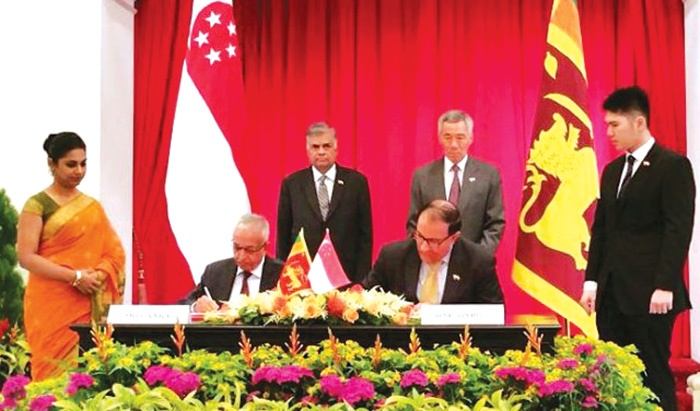
Any Sri Lankan would agree with the above words of President Wickremesinghe on the false promises our politicians and officials make and the fairy tales they narrate which bankrupted this country. So, to understand this, let’s look at one such fairy tale with lots of false promises; Ranil Wickremesinghe’s greatest achievement in the area of international trade and investment promotion during the Yahapalana period, Sri Lanka-Singapore Free Trade Agreement (SLSFTA).
It is appropriate and timely to do it now as Finance Minister Wickremesinghe has just presented to parliament a bill on the National Policy on Economic Transformation which includes the establishment of an Office for International Trade and the Sri Lanka Institute of Economics and International Trade.
Was SLSFTA a “Cleverly negotiated Free Trade Agreement” as stated by the (former) Minister of Development Strategies and International Trade Malik Samarawickrama during the Parliamentary Debate on the SLSFTA in July 2018, or a colossal blunder covered up with lies, false promises, and fairy tales? After SLSFTA was signed there were a number of fairy tales published on this agreement by the Ministry of Development Strategies and International, Institute of Policy Studies, and others.
However, for this article, I would like to limit my comments to the speech by Minister Samarawickrama during the Parliamentary Debate, and the two most important areas in the agreement which were covered up with lies, fairy tales, and false promises, namely: revenue loss for Sri Lanka and Investment from Singapore. On the other important area, “Waste products dumping” I do not want to comment here as I have written extensively on the issue.
1. The revenue loss
During the Parliamentary Debate in July 2018, Minister Samarawickrama stated “…. let me reiterate that this FTA with Singapore has been very cleverly negotiated by us…. The liberalisation programme under this FTA has been carefully designed to have the least impact on domestic industry and revenue collection. We have included all revenue sensitive items in the negative list of items which will not be subject to removal of tariff. Therefore, 97.8% revenue from Customs duty is protected. Our tariff liberalisation will take place over a period of 12-15 years! In fact, the revenue earned through tariffs on goods imported from Singapore last year was Rs. 35 billion.
The revenue loss for over the next 15 years due to the FTA is only Rs. 733 million– which when annualised, on average, is just Rs. 51 million. That is just 0.14% per year! So anyone who claims the Singapore FTA causes revenue loss to the Government cannot do basic arithmetic! Mr. Speaker, in conclusion, I call on my fellow members of this House – don’t mislead the public with baseless criticism that is not grounded in facts. Don’t look at petty politics and use these issues for your own political survival.”
I was surprised to read the minister’s speech because an article published in January 2018 in “The Straits Times“, based on information released by the Singaporean Negotiators stated, “…. With the FTA, tariff savings for Singapore exports are estimated to hit $10 million annually“.
As the annual tariff savings (that is the revenue loss for Sri Lanka) calculated by the Singaporean Negotiators, Singaporean $ 10 million (Sri Lankan rupees 1,200 million in 2018) was way above the rupees’ 733 million revenue loss for 15 years estimated by the Sri Lankan negotiators, it was clear to any observer that one of the parties to the agreement had not done the basic arithmetic!
Six years later, according to a report published by “The Morning” newspaper, speaking at the Committee on Public Finance (COPF) on 7th May 2024, Mr Samarawickrama’s chief trade negotiator K.J. Weerasinghehad had admitted “…. that forecasted revenue loss for the Government of Sri Lanka through the Singapore FTA is Rs. 450 million in 2023 and Rs. 1.3 billion in 2024.”
If these numbers are correct, as tariff liberalisation under the SLSFTA has just started, we will pass Rs 2 billion very soon. Then, the question is how Sri Lanka’s trade negotiators made such a colossal blunder. Didn’t they do their basic arithmetic? If they didn’t know how to do basic arithmetic they should have at least done their basic readings. For example, the headline of the article published in The Straits Times in January 2018 was “Singapore, Sri Lanka sign FTA, annual savings of $10m expected”.
Anyway, as Sri Lanka’s chief negotiator reiterated at the COPF meeting that “…. since 99% of the tariffs in Singapore have zero rates of duty, Sri Lanka has agreed on 80% tariff liberalisation over a period of 15 years while expecting Singapore investments to address the imbalance in trade,” let’s turn towards investment.
Investment from Singapore
In July 2018, speaking during the Parliamentary Debate on the FTA this is what Minister Malik Samarawickrama stated on investment from Singapore, “Already, thanks to this FTA, in just the past two-and-a-half months since the agreement came into effect we have received a proposal from Singapore for investment amounting to $ 14.8 billion in an oil refinery for export of petroleum products. In addition, we have proposals for a steel manufacturing plant for exports ($ 1 billion investment), flour milling plant ($ 50 million), sugar refinery ($ 200 million). This adds up to more than $ 16.05 billion in the pipeline on these projects alone.
And all of these projects will create thousands of more jobs for our people. In principle approval has already been granted by the BOI and the investors are awaiting the release of land the environmental approvals to commence the project.
I request the Opposition and those with vested interests to change their narrow-minded thinking and join us to develop our country. We must always look at what is best for the whole community, not just the few who may oppose. We owe it to our people to courageously take decisions that will change their lives for the better.”
According to the media report I quoted earlier, speaking at the Committee on Public Finance (COPF) Chief Negotiator Weerasinghe has admitted that Sri Lanka was not happy with overall Singapore investments that have come in the past few years in return for the trade liberalisation under the Singapore-Sri Lanka Free Trade Agreement. He has added that between 2021 and 2023 the total investment from Singapore had been around $162 million!
What happened to those projects worth $16 billion negotiated, thanks to the SLSFTA, in just the two-and-a-half months after the agreement came into effect and approved by the BOI? I do not know about the steel manufacturing plant for exports ($ 1 billion investment), flour milling plant ($ 50 million) and sugar refinery ($ 200 million).
However, story of the multibillion-dollar investment in the Petroleum Refinery unfolded in a manner that would qualify it as the best fairy tale with false promises presented by our politicians and the officials, prior to 2019 elections.
Though many Sri Lankans got to know, through the media which repeatedly highlighted a plethora of issues surrounding the project and the questionable credentials of the Singaporean investor, the construction work on the Mirrijiwela Oil Refinery along with the cement factory began on the24th of March 2019 with a bang and Minister Ranil Wickremesinghe and his ministers along with the foreign and local dignitaries laid the foundation stones.
That was few months before the 2019 Presidential elections. Inaugurating the construction work Prime Minister Ranil Wickremesinghe said the projects will create thousands of job opportunities in the area and surrounding districts.
The oil refinery, which was to be built over 200 acres of land, with the capacity to refine 200,000 barrels of crude oil per day, was to generate US$7 billion of exports and create 1,500 direct and 3,000 indirect jobs. The construction of the refinery was to be completed in 44 months. Four years later, in August 2023 the Cabinet of Ministers approved the proposal presented by President Ranil Wickremesinghe to cancel the agreement with the investors of the refinery as the project has not been implemented! Can they explain to the country how much money was wasted to produce that fairy tale?
It is obvious that the President, ministers, and officials had made huge blunders and had deliberately misled the public and the parliament on the revenue loss and potential investment from SLSFTA with fairy tales and false promises.
As the president himself said, a country cannot be developed by making false promises or with fairy tales and these false promises and fairy tales had bankrupted the country. “Unfortunately, many segments of the population have not come to realize this yet”.
(The writer, a specialist and an activist on trade and development issues . )



US sports envoys to Lanka to champion youth development

Rahuman questions sudden cancellation of leave of CEB employees


