
Features
I’ve witnessed a coup attempt before — and history bodes poorly for America’s future

by Alfred Mccoy, Tom Dispatch
As an eyewitness, I can recall the events of January 6th in Washington as if they were yesterday. The crowds of angry loyalists storming the building while overwhelmed security guards gave way. The slavishly loyal vice-president who would, the president hoped, restore him to power. The crush of media that seemed confused, almost overwhelmed, by the crowd’s fury. The waiter who announced that the bar had run out of drinks and would soon be closing…
Hold it! My old memory’s playing tricks on me again. That wasn’t the U.S. Capitol in January 2021. That was the Manila Hotel in the Philippines in July 1986. Still, the two events had enough similarities that perhaps I could be forgiven for mixing them up.
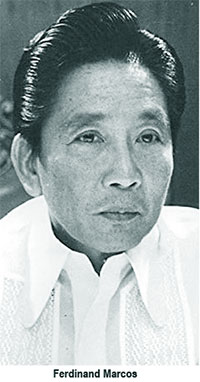
I’ve studied quite a number of coups in my day, yet the one I actually witnessed at the Manila Hotel remains my favorite, not just because the drinks kept coming, but for all it taught me about the damage a coup d’état, particularly a political coup, can do to any democracy. In February 1986, a million Filipinos thronged the streets of Manila to force dictator Ferdinand Marcos into exile. After long years of his corruption and callous indifference to the nation’s suffering, the crowds cheered their approval when Marcos finally flew off to Hawaii and his opponent in the recent presidential election restored democracy.
But Marcos had his hard-core loyalists. One Sunday afternoon, four months after his flight, they massed in a Manila park to call for the restoration of their beloved president. After speakers had whipped the crowd of 5,000 into a frenzy with — and yes, this should indeed sound familiar in 2021 — claims about a stolen election, thousands of ordinary Filipinos pushed past security guards and stormed into the nearby Manila Hotel, a storied symbol of their country’s history. Tipped off by one of the Filipino colonels plotting that coup, I was standing in the hotel’s entryway at 5:00 p.m. as the mob, fury written on their faces, surged past me.
For the next 24 hours, that hotel’s marbled lobby became the stage for an instructive political drama. From my table at the adjoining bar, I watched as armed warlords, ousted Marcos cronies, and several hundred disgruntled soldiers paraded through the lobby on their way to the luxury suites where the coup commanders had checked themselves in. Following in their wake were spies from every nation — Australian secret intelligence, American defense intelligence, and their Asian and European counterparts — themselves huddled in groups, whispering mysteriously, trying (just like me) to make sense of the bizarre spectacle unfolding around them.
 Later that same evening, Marcos’s former vice-president, the ever-loyal Arturo Tolentino, appeared at the head of the stairs flanked by a security detail to announce the formation of a “legitimate” new government authorized by Marcos who had reportedly called long-distance from Honolulu. As the vice president proclaimed himself acting president and read off the names of those to be in his cabinet, Filipino journalists huddling nearby scribbled notes. They were furiously trying to figure out whether there was a real coalition forming that could topple the country’s democracy. It was, however, just the usual suspects — Marcos cronies, leaders largely without followers.
By midnight, the party was pretty much over. Our waiter, after struggling for hours to maintain that famed hotel’s standard of five-star service, apologized to our table of foreign correspondents because the bar had been drunk dry and was closing. Sometime before dawn, the hotel turned off the air conditioning, transforming those executive suites into saunas and, in the process, flushing out the coup plotters, their hangers-on, and most of the soldiers.
All day long, on the city’s brassy talk-radio stations and in the coffee shops where insiders gathered to swap scuttlebutt, Marcos’s loyalists were roasted, even mocked. The troops that had rallied to his side were sentenced to 30 push-ups on the parade ground — a source of more mirth. For spies and correspondents alike, the whole thing seemed like a one-day wonder, barely worth writing home about.
But it wasn’t. Not by a long shot. A coterie of colonels deep inside the Defense Ministry, my source among them, had observed that comedic coup attempt all too carefully and concluded that it had actually been a near-miss.
A year later, I found myself standing in the middle of an eight-lane highway outside the city’s main military cantonment, Camp Aguinaldo, ducking bullets from rebel soldiers who had seized the base and watching as government Marines and dive bombers attacked. This time, however, those colonels had launched a genuine coup attempt. No drinks. No waiters. No wisecracks. Just a day of bombs and bullets that crushed the plotters, leaving the country’s military headquarters a smoking ruin.
Two years later, the same coup colonels were back again for another attempt, leading 3,000 rebel troops in a multipronged attack on a capital that trembled on the brink of surrender. As a cavalcade of rebel armor drove relentlessly toward the presidential palace with nothing in their way, American President George H.W. Bush took a call aboard Air Force One over the Atlantic about a desperate request from his Philippine counterpart and ordered a pair of U.S. Air Force jet fighters to make a low pass over the rebel tanks and trucks. They got the message: turn back or be bombed into extinction. And so Philippine democracy was allowed to survive for another 30 years.
Message from the Manila Hotel
The message for democracy offered from the Manila Hotel was clear — so clear, in fact, that it helps explain the meaning of tangled events in Washington more than 30 years later. Whether it’s a poor country like the Philippines or a superpower like the United States, democracy is a surprisingly fragile construct. Its worst enemy is often an ousted ex-president, angry over his humiliation and perfectly willing to destroy the constitutional order to regain power.
No matter how angry such an ex-president might be, however, his urge for a political coup can’t succeed without the help of raw force, whether from a mob, a disgruntled military, or some combination of the two. The Manila Hotel coup teaches us one other fundamental thing: that coups need not be carefully planned. Most start with a handful of conspirators plotting some symbolic attack meant to shake the constitutional order, while hoping to somehow stall the security services for a few critical hours — just long enough for events to cascade spontaneously into a desired government collapse.
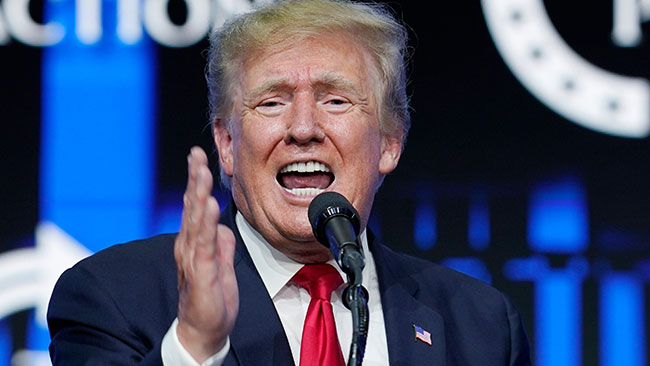
Whether in Manila or Washington, coup plotting usually starts right at the top. Just after the news networks announced that he had lost the election last November, Donald Trump launched a media blitz with spurious claims of “fraud on the American public,” firing off 300 tweets in the next two weeks loaded with false charges of irregularities and sparking loud, long protests by his loyalists at vote-counting centers in Michigan and Arizona.
When that response got little traction and Biden’s majority kept climbing, Trump began exploring three alternate routes, any of which might have led to a constitutional coup — manipulating the Justice Department to delegitimize the election, rigging the ratification of electoral votes in Congress, and the paramilitary (or military) option. At a White House meeting on December 18th, Michael Flynn, Trump’s former national security advisor, urged the president to “invoke martial law as part of his efforts to overturn the election” and accused his staff of “abandoning the president,” sparking “screaming matches” in the Oval Office.
By January 3, rumors and reports of Trump’s military option were circulating so credibly around Washington that all 10 living former defense secretaries — Dick Cheney, Donald Rumsfeld, and Mark Esper, among them — published a joint appeal to the armed forces to remain neutral in the ongoing dispute over the election’s integrity. Reminding the troops that “peaceful transfers of power… are hallmarks of our democracy,” they added that “efforts to involve the U.S. armed forces in resolving election disputes” would be “dangerous, unlawful, and unconstitutional.” They warned the troops that any “military officials who direct or carry out such measures would be… potentially facing criminal penalties.” In conclusion, they suggested to Trump’s secretary of defense and senior staff “in the strongest terms” that “they must…refrain from any political actions that undermine the results of the election.”
To legitimate his claims of fraud, according to the New York Times, the president also tried — on nine separate occasions in December and January — to force the Justice Department to take actions that would “undermine an election result.” In response, a mid-ranking Trump loyalist at Justice, a nonentity named Jeffrey Clark, began pressuring his boss, the attorney-general, to write Georgia officials claiming they had found “significant concerns that may have impacted the outcome of the election.” But at a three-hour White House meeting on January 3rd, Acting Attorney General Jeffrey Rosen balked at this evidence-free accusation. Trump promptly suggested that he could be replaced by that mid-ranking loyalist who could then send the fraud letter to Georgia. The president’s own top appointees at Justice, along with the White House counsel, immediately threatened to resign en masse, forcing Trump to give up on such an intervention at the state level.
Next, he shifted his constitutional maneuvering to Congress where, on January 6th, his doggedly loyal vice president, Mike Pence, would be presiding over the ratification of results from the Electoral College. In this dubious gambit, Trump was inspired by a bizarre constitutional theory advanced by former Chapman University law professor John Eastman — that the “Constitution assigns the power to the Vice President as the ultimate arbiter.”
In this scenario, Pence would unilaterally set aside electoral votes from seven states with “ongoing disputes” and announce that Trump had won a majority of the remaining electors — making him once again president. But the maneuver had no basis in law, so Pence, after scrambling desperately and unsuccessfully for a legal justification of some sort, eventually refused to play along.
A Political Coup
With the constitutional option closed, Trump opted for a political coup, rolling the dice with raw physical force, much as Marcos had done at the Manila Hotel. The first step was to form a crowd with some paramilitary muscle to stiffen the assault to come. On December 19th, Trump called on his hard-core followers to assemble in Washington, ready for violence, tweeting: “Big protest in D.C. on January 6th. Be there, will be wild!”
Almost immediately, the Internet’s right-wing chat boards lit up and indeed their paramilitaries, the Proud Boys and Three Percenters militia, turned up in Washington on the appointed day, ready to rumble. After President Trump roused the crowd at a rally near the White House with rhetoric about a stolen election, a mob of some 10,000 marched on the Capitol Building.
Starting at about 1:00 p.m., the sheer size of the crowd and strategic moves by the paramilitaries in their ranks broke through the undermanned lines of the Capitol Police, breaching the building’s first-floor windows at about 2:10 p.m. and allowing protesters to start pouring in. Once the rioters had accomplished the unimaginable and seized the Capitol, they were fresh out of plans, reduced to marching through the corridors hunting legislators and trashing offices.
At 2:24 p.m., President Trump tweeted: “Mike Pence didn’t have the courage to do what should have been done to protect our Country.” On the far-right social media site Parler, his supporters began messaging the crowd to get the vice president and force him to stop the election results. The mob rampaged through the marbled halls shouting “Hang Mike Pence.” Hunkered down inside the Capitol, Representative Adam Kinzinger (R-Illinois) tweeted: “This is a coup attempt.”
At 2:52 p.m., Representative Abigail Spanberger (D-Virginia), a former CIA agent, tweeted from inside the barricaded House chamber: “This is what we see in failing countries. This is what leads to the death of democracy.”
At 3:30 p.m., a small squad of military police arrived at the Capitol, woefully inadequate reinforcements for the overwhelmed Capitol Police. Ten minutes later, the D.C. Council announced that the Defense Department had denied the mayor’s request to mobilize the local National Guard. While the crowd fumbled and fulminated, some serious people were evidently slowing the military’s response for just the few critical hours needed for events to cascade into something, anything, that could shake the constitutional order and slow the ratification of Joe Biden’s election.
In nearby Maryland, Republican Governor Larry Hogan had immediately mobilized his state’s National Guard for the short drive to the Capitol while frantically phoning Acting Secretary of Defense Christopher Miller, who repeatedly refused him permission to send in the troops. Inside the Pentagon, Lieutenant General Charles Flynn, the brother of the same Michael Flynn who had been pushing Trump to declare martial law, was participating in what CNN called those “key January 6th phone calls” that refused permission for the Guard’s mobilization.
Following a phone call from the mayor of Washington and its police chief pleading for help, Secretary of the Army Ryan McCarthy “ran down the hall” of the Pentagon to get authorization for the Guard’s mobilization. After a crucial delay of 90 minutes, he finally called the Maryland governor, outside the regular chain of command, to authorize the Maryland Guard’s dispatch. Those would indeed be the first troops to arrive at the Capitol and would play a critical role in restoring order.
At about 4:30 p.m., Trump finally tweeted: “These are the things and events that happen when a sacred landslide election victory is so unceremoniously and viciously stripped away from great patriots who have been badly & unfairly treated for so long. Go home in love & peace.”
Ten minutes later, at 4:40 p.m., hundreds of riot personnel from the D.C. police, the FBI, and the Department of Homeland Security arrived, along with the Maryland Guard, to reinforce the Capitol Police. Within an hour, the protesters had been pushed out of the building and the Capitol was declared secure.
Just five days later, Dr. Fiona Hill, a senior Russia expert on the National Security Council under Trump, reviewed these events and concluded that President Trump had staged a coup “in slow motion… to keep himself in power.”
History’s Lessons
Beyond all the critical details of who did what and when, there were deeper historical forces at play, suggesting that Donald Trump’s urge for a political coup that would return him to power may be far from over. For the past 100 years, empires in decline have been roiled by coup attempts that sometimes have overturned constitutional orders. As their military reverses accumulate, their privileged economic position erodes, and social tensions mount, a succession of societies in the grip of a traumatic loss of global power have suffered coups, successful or not, including Great Britain, France, Portugal, Spain, the Soviet Union, and now the United States.
Britain’s plot was a bit fantastical. Amid the painful, protracted dissolution of their empire, Conservative leaders plotted with top generals in 1968 to oust leftist Labour Prime Minister Harold Wilson by capturing Heathrow airport, seizing the BBC and Buckingham Palace, and putting Lord Mountbatten in power as acting prime minister. Britain’s parliamentary tradition simply proved too strong, however, and key principals in the plot quickly backed out.
In April 1974, while Portugal was fighting and losing three bitter anticolonial wars in Africa, a Lisbon radio station played the country’s entry in that year’s Eurovision Song Contest (“After the Farewell”) just minutes before midnight on an evening that had been agreed upon. It was the signal to the military and their supporters to overthrow the entrenched conservative government of that moment, a success which became known as the “Carnation Revolution.”
However, the parallels between January 6th and the fall of France’s Fourth Republic in the late 1950s are perhaps the most telling. After liberating Paris from Nazi occupation in August 1944, General Charles de Gaulle headed an interim government for 18 months. He then quit in a dispute with the left, launching him into a decade of political intrigue against the new Fourth Republic, whose liberal constitution he despised.
By the mid-1950s, France was reeling from its recent defeat in Indochina, while the struggle against Muslim revolutionaries in its Algerian colony in North Africa turned ever more brutal, marked as it was by scandals over the widespread French use of torture. Amid that crisis of empire, an anti-elite, anti-intellectual, antisemitic politician named Pierre Poujade launched a populist movement that sent 56 members to parliament in 1956, including Jean-Marie Le Pen, later founder of the far-right National Front.
Meanwhile, a cabal of politicians and military commanders plotted a coup to return General de Gaulle to power, thinking he alone could save Algeria for France. After an army junta seized control of Algiers, the capital of that colony, in May 1958, paratroopers stationed there were sent to capture the French island of Corsica and to prepare to seize Paris should the legislature fail to install de Gaulle as prime minister.
As the country trembled on the brink of a coup, de Gaulle made his dramatic entry into Paris where he accepted the National Assembly’s offer to form a government, conditional upon the approval of a presidential-style constitution for a Fifth Republic. But when de Gaulle subsequently accepted the inevitability of Algeria’s independence, four top generals launched an abortive coup against him and then formed what they called the Secret Army Organization, or OAS. It would carry out terror attacks over the next four years, with 12,000 victims, while staging three unsuccessful assassination attempts against de Gaulle before its militants were killed or captured.
The Coup of 2024?
Just as the Filipino colonels spent five years launching a succession of escalating coups and those French generals spent four years trying to overthrow their government, so Trump’s Republicans are working with ferocious determination in the run-up to the 2022 and 2024 elections to ensure that their next constitutional coup succeeds. Indeed, if you look back on events over the past year through the prism of such historical precedents, you can see all the components for a future political coup falling into place.
No matter how improbable, discredited, or bizarre those election fraud claims are, Republican loyalists persist in endless ballot audits in Arizona, Wisconsin, Pennsylvania, Georgia, and Texas. Their purpose is not really to find more votes for Trump in the 2020 election, but to maintain at least the present level of rage among the one-third of all Americans and more than half of all Republicans who believe that Joe Biden’s presidency is fraudulent.
Since the 2020 election coincided with the new census, Republicans have been working, reports Vox news, to “gerrymander themselves into control of the House of Representatives.” Simultaneously, Republican legislators in 19 states have passed 33 laws making it more difficult for certain of their residents to vote. Driven by the white nationalist “replacement theory” that immigrants and people of color are diluting the pool of “real American” voters, Trump and his Republican loyalists are fighting for “ballot integrity” on the principle that all non-white votes are inherently illegitimate. As Trump put it on the stump in 2016:
“I think this will be the last election that the Republicans have a chance of winning because you’re going to have people flowing across the border, you’re going to have illegal immigrants coming in… and they’re going to be able to vote and once that all happens you can forget it. You’re not going to have one Republican vote.”
In case all that electoral manipulation fails and Trump needs more muscle for a future political coup, right-wing fighters like the Proud Boys are still rumbling away at rallies in Oregon, California, and elsewhere across America. Just as the Philippine government made military rebels do a risible 30 push-ups for the capital crime of armed rebellion, so federal courts have generally been handing out the most modest of penalties to rioters who attempted nothing less than the overthrow of U.S. constitutional democracy last January 6th.
Among the 600 rioters arrested as of August, dozens have been allowed to plead guilty to misdemeanors and only three had been sentenced to jail time, leaving most cases languishing in pretrial motions. Already Republicans like Senator Ted Cruz have rallied to their defense, writing the U.S. attorney general to complain about an “unequal administration of justice” with “harsher treatment” for Capitol defendants than those arrested in Black Lives Matter protests.
So, in 2024, as the continuing erosion of America’s global power creates a crisis of confidence among ordinary Americans, expect Donald Trump to be back, not as the slightly outrageous candidate of 2016 or even as the former president eager to occupy the White House again, but as a militant demagogue with thundering racialist rhetoric, backed by a revanchist Republican Party ready, with absolute moral certainty, to bar voters from the polls, toss ballots out, and litigate any loss until hell freezes over.
And if all that fails, the muscle will be ready for another violent march on Washington. Be prepared, the America we know is worsening by the month.



by Dr Gotabhya Ranasinghe
Senior Consultant Cardiologist
National Hospital Sri Lanka
When we sought a meeting with Hon Dr. Ramesh Pathirana, Minister of Health, he graciously cleared his busy schedule to accommodate us. Renowned for his attentive listening and deep understanding, Minister Pathirana is dedicated to advancing the health sector. His openness and transparency exemplify the qualities of an exemplary politician and minister.
Dr. Palitha Mahipala, the current Health Secretary, demonstrates both commendable enthusiasm and unwavering support. This combination of attributes makes him a highly compatible colleague for the esteemed Minister of Health.
Our discussion centered on a project that has been in the works for the past 30 years, one that no other minister had managed to advance.
Minister Pathirana, however, recognized the project’s significance and its potential to revolutionize care for heart patients.
The project involves the construction of a state-of-the-art facility at the premises of the National Hospital Colombo. The project’s location within the premises of the National Hospital underscores its importance and relevance to the healthcare infrastructure of the nation.
This facility will include a cardiology building and a tertiary care center, equipped with the latest technology to handle and treat all types of heart-related conditions and surgeries.
Securing funding was a major milestone for this initiative. Minister Pathirana successfully obtained approval for a $40 billion loan from the Asian Development Bank. With the funding in place, the foundation stone is scheduled to be laid in September this year, and construction will begin in January 2025.
This project guarantees a consistent and uninterrupted supply of stents and related medications for heart patients. As a result, patients will have timely access to essential medical supplies during their treatment and recovery. By securing these critical resources, the project aims to enhance patient outcomes, minimize treatment delays, and maintain the highest standards of cardiac care.
Upon its fruition, this monumental building will serve as a beacon of hope and healing, symbolizing the unwavering dedication to improving patient outcomes and fostering a healthier society.We anticipate a future marked by significant progress and positive outcomes in Sri Lanka’s cardiovascular treatment landscape within the foreseeable timeframe.

by Fr. Emmanuel Fernando, OMI
Jesuit Fr. Aloysius Pieris (affectionately called Fr. Aloy) celebrated his 90th birthday on April 9, 2024 and I, as the editor of our Oblate Journal, THE MISSIONARY OBLATE had gone to press by that time. Immediately I decided to publish an article, appreciating the untiring selfless services he continues to offer for inter-Faith dialogue, the renewal of the Catholic Church, his concern for the poor and the suffering Sri Lankan masses and to me, the present writer.
It was in 1988, when I was appointed Director of the Oblate Scholastics at Ampitiya by the then Oblate Provincial Fr. Anselm Silva, that I came to know Fr. Aloy more closely. Knowing well his expertise in matters spiritual, theological, Indological and pastoral, and with the collaborative spirit of my companion-formators, our Oblate Scholastics were sent to Tulana, the Research and Encounter Centre, Kelaniya, of which he is the Founder-Director, for ‘exposure-programmes’ on matters spiritual, biblical, theological and pastoral. Some of these dimensions according to my view and that of my companion-formators, were not available at the National Seminary, Ampitiya.
Ever since that time, our Oblate formators/ accompaniers at the Oblate Scholasticate, Ampitiya , have continued to send our Oblate Scholastics to Tulana Centre for deepening their insights and convictions regarding matters needed to serve the people in today’s context. Fr. Aloy also had tried very enthusiastically with the Oblate team headed by Frs. Oswald Firth and Clement Waidyasekara to begin a Theologate, directed by the Religious Congregations in Sri Lanka, for the contextual formation/ accompaniment of their members. It should very well be a desired goal of the Leaders / Provincials of the Religious Congregations.
Besides being a formator/accompanier at the Oblate Scholasticate, I was entrusted also with the task of editing and publishing our Oblate journal, ‘The Missionary Oblate’. To maintain the quality of the journal I continue to depend on Fr. Aloy for his thought-provoking and stimulating articles on Biblical Spirituality, Biblical Theology and Ecclesiology. I am very grateful to him for his generous assistance. Of late, his writings on renewal of the Church, initiated by Pope St. John XX111 and continued by Pope Francis through the Synodal path, published in our Oblate journal, enable our readers to focus their attention also on the needed renewal in the Catholic Church in Sri Lanka. Fr. Aloy appreciated very much the Synodal path adopted by the Jesuit Pope Francis for the renewal of the Church, rooted very much on prayerful discernment. In my Religious and presbyteral life, Fr.Aloy continues to be my spiritual animator / guide and ongoing formator / acccompanier.
Fr. Aloysius Pieris, BA Hons (Lond), LPh (SHC, India), STL (PFT, Naples), PhD (SLU/VC), ThD (Tilburg), D.Ltt (KU), has been one of the eminent Asian theologians well recognized internationally and one who has lectured and held visiting chairs in many universities both in the West and in the East. Many members of Religious Congregations from Asian countries have benefited from his lectures and guidance in the East Asian Pastoral Institute (EAPI) in Manila, Philippines. He had been a Theologian consulted by the Federation of Asian Bishops’ Conferences for many years. During his professorship at the Gregorian University in Rome, he was called to be a member of a special group of advisers on other religions consulted by Pope Paul VI.
Fr. Aloy is the author of more than 30 books and well over 500 Research Papers. Some of his books and articles have been translated and published in several countries. Among those books, one can find the following: 1) The Genesis of an Asian Theology of Liberation (An Autobiographical Excursus on the Art of Theologising in Asia, 2) An Asian Theology of Liberation, 3) Providential Timeliness of Vatican 11 (a long-overdue halt to a scandalous millennium, 4) Give Vatican 11 a chance, 5) Leadership in the Church, 6) Relishing our faith in working for justice (Themes for study and discussion), 7) A Message meant mainly, not exclusively for Jesuits (Background information necessary for helping Francis renew the Church), 8) Lent in Lanka (Reflections and Resolutions, 9) Love meets wisdom (A Christian Experience of Buddhism, 10) Fire and Water 11) God’s Reign for God’s poor, 12) Our Unhiddden Agenda (How we Jesuits work, pray and form our men). He is also the Editor of two journals, Vagdevi, Journal of Religious Reflection and Dialogue, New Series.
Fr. Aloy has a BA in Pali and Sanskrit from the University of London and a Ph.D in Buddhist Philosophy from the University of Sri Lankan, Vidyodaya Campus. On Nov. 23, 2019, he was awarded the prestigious honorary Doctorate of Literature (D.Litt) by the Chancellor of the University of Kelaniya, the Most Venerable Welamitiyawe Dharmakirthi Sri Kusala Dhamma Thera.
Fr. Aloy continues to be a promoter of Gospel values and virtues. Justice as a constitutive dimension of love and social concern for the downtrodden masses are very much noted in his life and work. He had very much appreciated the commitment of the late Fr. Joseph (Joe) Fernando, the National Director of the Social and Economic Centre (SEDEC) for the poor.
In Sri Lanka, a few religious Congregations – the Good Shepherd Sisters, the Christian Brothers, the Marist Brothers and the Oblates – have invited him to animate their members especially during their Provincial Congresses, Chapters and International Conferences. The mainline Christian Churches also have sought his advice and followed his seminars. I, for one, regret very much, that the Sri Lankan authorities of the Catholic Church –today’s Hierarchy—- have not sought Fr.
Aloy’s expertise for the renewal of the Catholic Church in Sri Lanka and thus have not benefited from the immense store of wisdom and insight that he can offer to our local Church while the Sri Lankan bishops who governed the Catholic church in the immediate aftermath of the Second Vatican Council (Edmund Fernando OMI, Anthony de Saram, Leo Nanayakkara OSB, Frank Marcus Fernando, Paul Perera,) visited him and consulted him on many matters. Among the Tamil Bishops, Bishop Rayappu Joseph was keeping close contact with him and Bishop J. Deogupillai hosted him and his team visiting him after the horrible Black July massacre of Tamils.
Sri Lanka-Singapore Free Trade Agreement
By Gomi Senadhira
senadhiragomi@gmail.com
“You might tell fairy tales, but the progress of a country cannot be achieved through such narratives. A country cannot be developed by making false promises. The country moved backward because of the electoral promises made by political parties throughout time. We have witnessed that the ultimate result of this is the country becoming bankrupt. Unfortunately, many segments of the population have not come to realize this yet.” – President Ranil Wickremesinghe, 2024 Budget speech
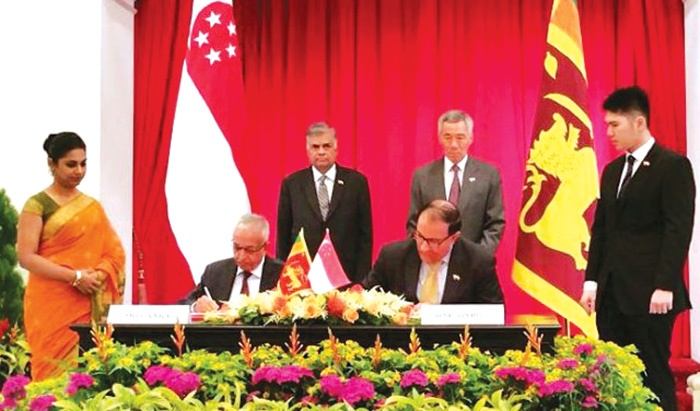
Any Sri Lankan would agree with the above words of President Wickremesinghe on the false promises our politicians and officials make and the fairy tales they narrate which bankrupted this country. So, to understand this, let’s look at one such fairy tale with lots of false promises; Ranil Wickremesinghe’s greatest achievement in the area of international trade and investment promotion during the Yahapalana period, Sri Lanka-Singapore Free Trade Agreement (SLSFTA).
It is appropriate and timely to do it now as Finance Minister Wickremesinghe has just presented to parliament a bill on the National Policy on Economic Transformation which includes the establishment of an Office for International Trade and the Sri Lanka Institute of Economics and International Trade.
Was SLSFTA a “Cleverly negotiated Free Trade Agreement” as stated by the (former) Minister of Development Strategies and International Trade Malik Samarawickrama during the Parliamentary Debate on the SLSFTA in July 2018, or a colossal blunder covered up with lies, false promises, and fairy tales? After SLSFTA was signed there were a number of fairy tales published on this agreement by the Ministry of Development Strategies and International, Institute of Policy Studies, and others.
However, for this article, I would like to limit my comments to the speech by Minister Samarawickrama during the Parliamentary Debate, and the two most important areas in the agreement which were covered up with lies, fairy tales, and false promises, namely: revenue loss for Sri Lanka and Investment from Singapore. On the other important area, “Waste products dumping” I do not want to comment here as I have written extensively on the issue.
1. The revenue loss
During the Parliamentary Debate in July 2018, Minister Samarawickrama stated “…. let me reiterate that this FTA with Singapore has been very cleverly negotiated by us…. The liberalisation programme under this FTA has been carefully designed to have the least impact on domestic industry and revenue collection. We have included all revenue sensitive items in the negative list of items which will not be subject to removal of tariff. Therefore, 97.8% revenue from Customs duty is protected. Our tariff liberalisation will take place over a period of 12-15 years! In fact, the revenue earned through tariffs on goods imported from Singapore last year was Rs. 35 billion.
The revenue loss for over the next 15 years due to the FTA is only Rs. 733 million– which when annualised, on average, is just Rs. 51 million. That is just 0.14% per year! So anyone who claims the Singapore FTA causes revenue loss to the Government cannot do basic arithmetic! Mr. Speaker, in conclusion, I call on my fellow members of this House – don’t mislead the public with baseless criticism that is not grounded in facts. Don’t look at petty politics and use these issues for your own political survival.”
I was surprised to read the minister’s speech because an article published in January 2018 in “The Straits Times“, based on information released by the Singaporean Negotiators stated, “…. With the FTA, tariff savings for Singapore exports are estimated to hit $10 million annually“.
As the annual tariff savings (that is the revenue loss for Sri Lanka) calculated by the Singaporean Negotiators, Singaporean $ 10 million (Sri Lankan rupees 1,200 million in 2018) was way above the rupees’ 733 million revenue loss for 15 years estimated by the Sri Lankan negotiators, it was clear to any observer that one of the parties to the agreement had not done the basic arithmetic!
Six years later, according to a report published by “The Morning” newspaper, speaking at the Committee on Public Finance (COPF) on 7th May 2024, Mr Samarawickrama’s chief trade negotiator K.J. Weerasinghehad had admitted “…. that forecasted revenue loss for the Government of Sri Lanka through the Singapore FTA is Rs. 450 million in 2023 and Rs. 1.3 billion in 2024.”
If these numbers are correct, as tariff liberalisation under the SLSFTA has just started, we will pass Rs 2 billion very soon. Then, the question is how Sri Lanka’s trade negotiators made such a colossal blunder. Didn’t they do their basic arithmetic? If they didn’t know how to do basic arithmetic they should have at least done their basic readings. For example, the headline of the article published in The Straits Times in January 2018 was “Singapore, Sri Lanka sign FTA, annual savings of $10m expected”.
Anyway, as Sri Lanka’s chief negotiator reiterated at the COPF meeting that “…. since 99% of the tariffs in Singapore have zero rates of duty, Sri Lanka has agreed on 80% tariff liberalisation over a period of 15 years while expecting Singapore investments to address the imbalance in trade,” let’s turn towards investment.
Investment from Singapore
In July 2018, speaking during the Parliamentary Debate on the FTA this is what Minister Malik Samarawickrama stated on investment from Singapore, “Already, thanks to this FTA, in just the past two-and-a-half months since the agreement came into effect we have received a proposal from Singapore for investment amounting to $ 14.8 billion in an oil refinery for export of petroleum products. In addition, we have proposals for a steel manufacturing plant for exports ($ 1 billion investment), flour milling plant ($ 50 million), sugar refinery ($ 200 million). This adds up to more than $ 16.05 billion in the pipeline on these projects alone.
And all of these projects will create thousands of more jobs for our people. In principle approval has already been granted by the BOI and the investors are awaiting the release of land the environmental approvals to commence the project.
I request the Opposition and those with vested interests to change their narrow-minded thinking and join us to develop our country. We must always look at what is best for the whole community, not just the few who may oppose. We owe it to our people to courageously take decisions that will change their lives for the better.”
According to the media report I quoted earlier, speaking at the Committee on Public Finance (COPF) Chief Negotiator Weerasinghe has admitted that Sri Lanka was not happy with overall Singapore investments that have come in the past few years in return for the trade liberalisation under the Singapore-Sri Lanka Free Trade Agreement. He has added that between 2021 and 2023 the total investment from Singapore had been around $162 million!
What happened to those projects worth $16 billion negotiated, thanks to the SLSFTA, in just the two-and-a-half months after the agreement came into effect and approved by the BOI? I do not know about the steel manufacturing plant for exports ($ 1 billion investment), flour milling plant ($ 50 million) and sugar refinery ($ 200 million).
However, story of the multibillion-dollar investment in the Petroleum Refinery unfolded in a manner that would qualify it as the best fairy tale with false promises presented by our politicians and the officials, prior to 2019 elections.
Though many Sri Lankans got to know, through the media which repeatedly highlighted a plethora of issues surrounding the project and the questionable credentials of the Singaporean investor, the construction work on the Mirrijiwela Oil Refinery along with the cement factory began on the24th of March 2019 with a bang and Minister Ranil Wickremesinghe and his ministers along with the foreign and local dignitaries laid the foundation stones.
That was few months before the 2019 Presidential elections. Inaugurating the construction work Prime Minister Ranil Wickremesinghe said the projects will create thousands of job opportunities in the area and surrounding districts.
The oil refinery, which was to be built over 200 acres of land, with the capacity to refine 200,000 barrels of crude oil per day, was to generate US$7 billion of exports and create 1,500 direct and 3,000 indirect jobs. The construction of the refinery was to be completed in 44 months. Four years later, in August 2023 the Cabinet of Ministers approved the proposal presented by President Ranil Wickremesinghe to cancel the agreement with the investors of the refinery as the project has not been implemented! Can they explain to the country how much money was wasted to produce that fairy tale?
It is obvious that the President, ministers, and officials had made huge blunders and had deliberately misled the public and the parliament on the revenue loss and potential investment from SLSFTA with fairy tales and false promises.
As the president himself said, a country cannot be developed by making false promises or with fairy tales and these false promises and fairy tales had bankrupted the country. “Unfortunately, many segments of the population have not come to realize this yet”.
(The writer, a specialist and an activist on trade and development issues . )



US sports envoys to Lanka to champion youth development

Rahuman questions sudden cancellation of leave of CEB employees


