
Features
Irrepressible Julia Margaret Cameron at peace in Bogawantalawa

By GEORGE BRAINE
Some years ago, my sister, BIL, and I drove to the Dimbula area, visiting Anglican churches and graveyards looking for evidence of our ancestors. At the quaint St. Mary’s church, Bogawantalawa, we found the grave of my grand uncle, Frank Wyndham Becher Braine, who died on March 9, 1879, at only 11 months. We may have been the first family members to visit his grave in more than a 100 years.
That graveyard is also the resting place of a husband and wife, Charles Hay and Julia Margaret Cameron. Julia, during and after her lifetime, has been described as “indefatigable”, “a centripetal force”, “a bully”, “queenly”, “a one-woman empire”, “infernal”, “hot to handle”, “omnipresent”, “a tigress”. She was “impatient and restive”, for whom “a single lifetime wasn’t enough”. Who was this remarkable Victorian?
Julia was born in Calcutta, in 1815, one of seven daughters of James Pattle of the Indian Civil Service. They belonged to the Anglo-Indian upper class, and were all sent to France – their mother Adeline Marie was of the French aristocracy – for their education. The sisters were well accomplished and known for their “charm, wit, and beauty”, and “unconventional behaviour and dress”: they conversed among themselves in Hindustani, even in England. They served curry. They all married well, four spouses being fellow Anglo-Indians in the civil service and military.
Julia lived at various times in England, France, back in India, South Africa, in India again, on the Isle of Wight, and finally in Ceylon. Travel to Cape Town in 1835 was for her health, after recovering from serious illnesses. Charles Hay Cameron, a distinguished legal scholar from Calcutta, was also in Cape Town, perhaps after a severe bout of malaria. They met, and married back in Calcutta in 1838. Charles was 20 years her senior. Together, they raised 11 children, five of their own and the rest adopted.
Julia’s introduction to London’s artistic and cultural milieu came in 1845, at her sister Sara Prinsep’s residence in Kensington. Sara conducted a salon at home where poets, artists, writers and philosophers such as Tennyson, Rossetti, the Brownings, Longfellow, Trollope, Darwin, Thackeray, Henry Taylor, du Maurier and Leighton were regular attendees. Julia’s “hero worship” of these luminaries began at that time.
“Dimbola”
In 1860, the Camerons moved to the Isle of Wight, to a home named “Dimbola”, obviously after Dimbula in Ceylon, where Charles Cameron had invested in vast coffee and rubber plantations. He had served on the Colebrooke-Cameron Commission (appointed in 1833) to assess the administration of Ceylon and make recommendations for administrative, financial, economic, and judicial reform. The poet Henry Taylor, a close friend of Julia, wrote that Charles had “a passionate love for the island [and] he never ceased to yearn after the island as his place of abode”.
Incidentally, an English planter, named Herbert Brett, known to my family, named his British home “Yakvilla”. He had once been the manager of Yakwila Estate, near Pannala in the NWP.
“Dimbola” had been purchased because it was next door to Tennyson’s home, and a private gate connected the two properties. Better known as Alfred Lord Tennyson, he had become Britain’s Poet Laureate by then. Julia and the poet addressed each other by their first names. When he refused to be vaccinated against smallpox, Julia supposedly went to his home and yelled at him: “You’re a coward, Alfred, a coward!”
Soon, the Cameron and Tennyson families began entertaining well-known visitors to the Poet Laureate with music, poetry readings, and amateur plays, creating an artistic ambience similar to that seen earlier at Sara Princep’s home in Kensington. in keeping with Julia’s personality, the activities could be indefatigable. “Mrs. Cameron seemed to be omnipresent—organising happy things, summoning one person and another, ordering all the day and long into the night, for of an evening came impromptu plays and waltzes in the wooden ballroom, and young partners dancing under the stars”, wrote Anne Thackeray, the novelist’s daughter. Even Julia’s generosity could be overwhelming. Henry Taylor expressed this best: “she keeps showering upon us her ‘barbaric pearls and gold,’—India shawls, turquoise bracelets, inlaid portfolios, ivory elephants”.
Photography
A turning point in Julia’s life came in 1863, when she was already 48. Charles was in Ceylon, and Julia was bored. A daughter gifted her a camera to keep her “amused”. A clumsy affair in those early days of photography, it consisted of two wooden boxes, bound in brass, one of which slid inside the other, with a single focus lens. The timber tripod was unwieldy. Images were recorded on a heavy, rectangular glass plate measuring 11 x 9 inches.
Julia took to photography with her usual energy and enthusiasm, converting a chicken coop to a studio. If the camera was clumsy, the process of photo development was even more complicated and challenging, with the use of chemicals – collodion, silver nitrate, potassium cyanide, gold chloride (even egg white was used) – and the need to work quickly. Julia’s hands and clothes are said to have become black and brown with the chemicals. The process was riven with trial and error.
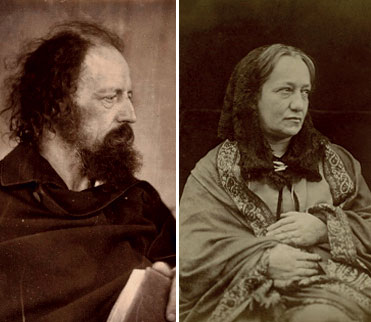
Julia managed to coerce illustrious visitors to Tennyson’s home to pose for her. They included Longfellow, Trollope, Darwin, John Herschel, Robert Browning, the painter George Watts, Thackeray, Carlyle, and Lewis Carrol, and Tennyson, of course. Her photograph of Tennyson is shown on this page. The men were photographed in pensive moods, intended to capture their “genius”. She also photographed women for their beauty, and children as “innocent, kind, and noble”, a prevailing Victorian notion.
Posing for a portrait was no easy task: the subject had to be within eight feet of the camera, and had to remain still for around 10 minutes. Julia chose not to use head supports. Here is a vivid description of a photographic session with Julia: “The studio, I remember, was very untidy and very uncomfortable. Mrs. Cameron put a crown on my head and posed me as the heroic queen. … The exposure began. A minute went over and I felt as if I must scream, another minute and the sensation was as if my eyes were coming out of my head … a fifth—but here I utterly broke down …” No wonder Tennyson called Julia’s sitters “victims”.
Showing sound business acumen, Julia copyrighted, published, exhibited and marketed her work. Harper’s Weekly, writing on a London exhibition in 1870, noted that “many art critics to go into raptures over [Julia’s] work as something beyond the range of ordinary photographic achievement”.
For the sake of brevity, I have focused on her portraits. She also photographed individuals and groups of people depicting allegories, religion, and literature; illustrations for Tennyson’s Idylls of the King being especially noteworthy. In Ceylon, her subjects were mainly ordinary people and plantation workers. Her career wasn’t long – only 12 years – and despite criticism of her work for technical imperfections and the numerous challenges she faced, Julia produced about 900 photographs. An incredible feat.
To Ceylon
From the early 1840s, Charles had bought up sprawling extents of land at Ceylon at bargain prices, and the 1850s and 60s were the best years for coffee. But in addition to being absentee landlords, the Camerons faced other problems: extremes of weather, a shortage of labour, transporting the coffee to Colombo on poor roads, incompetent managers, and the devastating coffee blight.
Charles was in poor health – “receiving visitors in his bedroom or walking about the garden reciting Homer and Virgil” – and had not worked since 1848, and the expenses of supporting a large family and their lifestyle at “Dimbola” had forced the Camerons to borrow heavily. In 1864, Charles admitted to being virtually “penniless”.
Charles was keen to move to Ceylon, but Julia was not. Attempting to change her mind, he wrote her a moving, lyrical description of his “Swiss cottage” bungalow and the surrounding plantations in Ceylon. In Ceylon, the cost of living would be cheaper, and he was confident that his health would improve. Later, Julia wrote that Charles’ passion for his Ceylon properties had “weakened his love for England”. Lord Overstone, their main creditor, was pressuring them to sell Rathoongodde (Rahathungoda), their plantation in the Deltota area managed by son Ewen.
Finally, Julia gave in partly because four of their sons were already in Ceylon. Charles’ health is said to have magically improved. In 1875, when she was 60 years old and Charles was 80, they left “Dimbola” for Ceylon, taking a maid, a cow, Julia’s photographic equipment, and two coffins, packed with china and glass. Henry Taylor noted that they had departed for Ceylon “to live and die” there, and that Charles had “never ceased to yearn after the island as his place of abode”.
Their son, Hardinge, the Governor’s private secretary, owned a bungalow on the river at Kalutara, on the western coast. Julia and Charles divided their time in Ceylon between Kalutara and their plantations in the hill country. Julia soon fell under Ceylon’s spell, writing that “the glorious beauty of the scenery — the primitive simplicity of the inhabitants and the charms of the climate all make me love Ceylon more and more”.
When the botanical painter Marianne North visited the Camerons at Kalutara, Julia went into a “fever of excitement” at having found a European subject. She dressed North up “in flowing draperies of cashmere wool” (despite the intense heat), with “spiky coconut branches running into [her] head” to be photographed. A remarkable photo taken by Julia shows North standing at her easel on the spacious verandah of the Kalutara house, with a bare-bodied “native” holding a clay pot over his shoulder.
Julia must have been busy during this period, because North noted that “the walls of the room were covered with magnificent photographs; others were tumbling about the tables, chairs, and floors”. But, only about 30 photographs from Julia’s Ceylon period have survived. The architect Ismeth Raheem, who has conducted extensive research on Julia, has stated that some photographs given to the Colombo Museum appear to be lost. No surprise there.
After a six month visit to England, Julia developed a dangerous chill (pneumonia?) upon her return to Ceylon. She died on 26 January 1879 at Glencairn Estate. Charles and four of her sons were with her. Her coffin was drawn by white bulls and also carried by plantation workers to St. Mary’s.
Back to the Braines
My great, great grandfather, Charles Joseph Braine, arrived in Ceylon in 1862, as the manager of Ceylon Company, which I believe is the predecessor of Ceylon Tea Plantations Company. By 1880, he is listed as the first owner of Abbotsleigh Estate in Hatton. (In contrast with Charles Cameron and Herbert Brett, who named their homes in England after plantations in Ceylon, Charles Joseph named his plantation in Ceylon after his property, Abbotsleigh, in England.)
The Camerons arrived in Ceylon in 1875. British planters, away from home and often stationed in remote plantations, socialised mainly at two locations: their clubs, and at church. I have no doubt that Charles Joseph Braine and the Camerons had met at the club, perhaps even during Charles’ previous visits to his plantations, and at church.
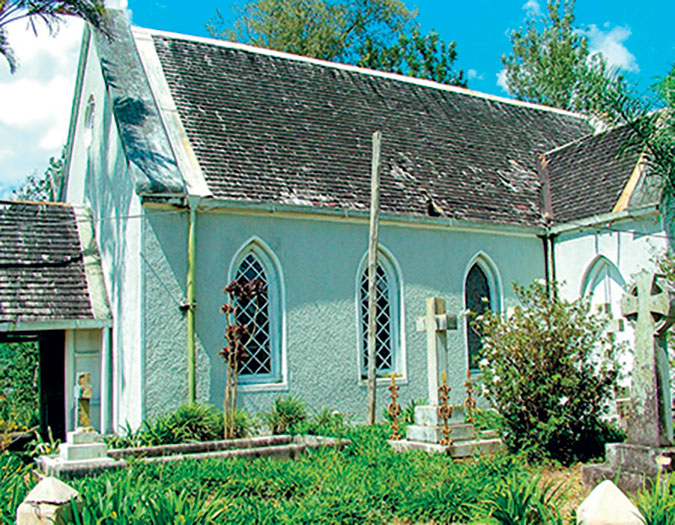
St. Mary’s Church, Bogawantalawa, was dedicated in 1877. Although Charles Cameron wasn’t religious and did not attend church, Julia did, traveling perhaps on horseback or bullock cart like the families of fellow planters. The Camerons gifted three stained glass windows to St. Mary’s, and that is obviously where Julia worshipped and wished to be buried.
Charles Joseph’s son, Charles Frederick Braine (my great grandfather) arrived in Ceylon in 1869, at 19 years of age, six years before the Camerons did, and worked at Meddecombra Estate in the Dimbula area. Later, he was the manager of the vast Wanarajah Estate. He, too, may have met Charles and later Julia Cameron. Braine must have worshipped at St. Mary’s, because, as I stated at the beginning of this article, his infant son was buried at St. Mary’s churchyard in March, 1879, only two months after Julia was buried there.
My grandfather, Charles Stanley, was born in Ceylon in 1874, and, as a child, is likely have met the Camerons, or at least Julia, at church. He had an angelic appearance in early photographs, and I like to imagine Julia tousling his hair! Hence, although no records exist, three generations of my ancestors are likely to have been acquainted with the Camerons, and perhaps worshipped alongside her at St. Mary’s.
The legacy of the Camerons
Julia Margaret Cameron is acknowledged now as one of the most important portraitists of the 19th century. Her work has been exhibited in important galleries and museums in the UK, the USA, Japan, and elsewhere. The photographer Stephen White, who calls Julia a “revered figure” in the history of photography, wrote in 2020 that an album of Julia’s photographs was valued at £3 million. Each of her prints are said to be worth about $50,000.
The Cameron home on the Isle of Wight, “Dimbola”, is now owned by the Julia Margaret Cameron Trust, and consists of a museum and galleries. It has a growing permanent collection of Julia’s photographs, and is dedicated to her life and work.
When I visited St. Mary’s Church in 2012, looking for evidence of my ancestors, the churchyard was covered in weeds. Stephen White, who visited St. Mary’s Church in 2017, lamented that the grave of “a woman whose photographs still stirred thousands with their beauty, and whose name was spoken with reverence by lovers of photography around Europe and the States” could be so “forlorn … unattended [and] unadorned”.
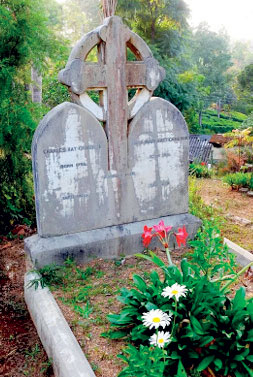
A photograph of the grave that accompanies his article indeed shows a neglected gravesite, the curb cracked. The more recent photo shown here, from the Thuppahi’s blog, shows a better maintained grave. Ismeth Raheem wrote that the house on Glencairn Estate where Julia died had been demolished in 2021.
While Julia is the better known of the Camerons, Charles made a lasting impact on Ceylon as a member of the Colebrooke-Cameron Commission, which, among other contributions, provided a uniform code of justice for the island. His on and off association with Ceylon was much longer, about 50 years at the time he died. A romantic at heart, he loved Ceylon with a passion.Recently, Ismeth Raheem and Dr. Martin Pieris have brought out a short film, “From the Isle of Wight to Ceylon”, based on substantial research on Julia’s life. Finally, in Sri Lanka, Julia Margaret Cameron appears to be receiving the recognition she fully deserves.


by Dr Gotabhya Ranasinghe
Senior Consultant Cardiologist
National Hospital Sri Lanka
When we sought a meeting with Hon Dr. Ramesh Pathirana, Minister of Health, he graciously cleared his busy schedule to accommodate us. Renowned for his attentive listening and deep understanding, Minister Pathirana is dedicated to advancing the health sector. His openness and transparency exemplify the qualities of an exemplary politician and minister.
Dr. Palitha Mahipala, the current Health Secretary, demonstrates both commendable enthusiasm and unwavering support. This combination of attributes makes him a highly compatible colleague for the esteemed Minister of Health.
Our discussion centered on a project that has been in the works for the past 30 years, one that no other minister had managed to advance.
Minister Pathirana, however, recognized the project’s significance and its potential to revolutionize care for heart patients.
The project involves the construction of a state-of-the-art facility at the premises of the National Hospital Colombo. The project’s location within the premises of the National Hospital underscores its importance and relevance to the healthcare infrastructure of the nation.
This facility will include a cardiology building and a tertiary care center, equipped with the latest technology to handle and treat all types of heart-related conditions and surgeries.
Securing funding was a major milestone for this initiative. Minister Pathirana successfully obtained approval for a $40 billion loan from the Asian Development Bank. With the funding in place, the foundation stone is scheduled to be laid in September this year, and construction will begin in January 2025.
This project guarantees a consistent and uninterrupted supply of stents and related medications for heart patients. As a result, patients will have timely access to essential medical supplies during their treatment and recovery. By securing these critical resources, the project aims to enhance patient outcomes, minimize treatment delays, and maintain the highest standards of cardiac care.
Upon its fruition, this monumental building will serve as a beacon of hope and healing, symbolizing the unwavering dedication to improving patient outcomes and fostering a healthier society.We anticipate a future marked by significant progress and positive outcomes in Sri Lanka’s cardiovascular treatment landscape within the foreseeable timeframe.

by Fr. Emmanuel Fernando, OMI
Jesuit Fr. Aloysius Pieris (affectionately called Fr. Aloy) celebrated his 90th birthday on April 9, 2024 and I, as the editor of our Oblate Journal, THE MISSIONARY OBLATE had gone to press by that time. Immediately I decided to publish an article, appreciating the untiring selfless services he continues to offer for inter-Faith dialogue, the renewal of the Catholic Church, his concern for the poor and the suffering Sri Lankan masses and to me, the present writer.
It was in 1988, when I was appointed Director of the Oblate Scholastics at Ampitiya by the then Oblate Provincial Fr. Anselm Silva, that I came to know Fr. Aloy more closely. Knowing well his expertise in matters spiritual, theological, Indological and pastoral, and with the collaborative spirit of my companion-formators, our Oblate Scholastics were sent to Tulana, the Research and Encounter Centre, Kelaniya, of which he is the Founder-Director, for ‘exposure-programmes’ on matters spiritual, biblical, theological and pastoral. Some of these dimensions according to my view and that of my companion-formators, were not available at the National Seminary, Ampitiya.
Ever since that time, our Oblate formators/ accompaniers at the Oblate Scholasticate, Ampitiya , have continued to send our Oblate Scholastics to Tulana Centre for deepening their insights and convictions regarding matters needed to serve the people in today’s context. Fr. Aloy also had tried very enthusiastically with the Oblate team headed by Frs. Oswald Firth and Clement Waidyasekara to begin a Theologate, directed by the Religious Congregations in Sri Lanka, for the contextual formation/ accompaniment of their members. It should very well be a desired goal of the Leaders / Provincials of the Religious Congregations.
Besides being a formator/accompanier at the Oblate Scholasticate, I was entrusted also with the task of editing and publishing our Oblate journal, ‘The Missionary Oblate’. To maintain the quality of the journal I continue to depend on Fr. Aloy for his thought-provoking and stimulating articles on Biblical Spirituality, Biblical Theology and Ecclesiology. I am very grateful to him for his generous assistance. Of late, his writings on renewal of the Church, initiated by Pope St. John XX111 and continued by Pope Francis through the Synodal path, published in our Oblate journal, enable our readers to focus their attention also on the needed renewal in the Catholic Church in Sri Lanka. Fr. Aloy appreciated very much the Synodal path adopted by the Jesuit Pope Francis for the renewal of the Church, rooted very much on prayerful discernment. In my Religious and presbyteral life, Fr.Aloy continues to be my spiritual animator / guide and ongoing formator / acccompanier.
Fr. Aloysius Pieris, BA Hons (Lond), LPh (SHC, India), STL (PFT, Naples), PhD (SLU/VC), ThD (Tilburg), D.Ltt (KU), has been one of the eminent Asian theologians well recognized internationally and one who has lectured and held visiting chairs in many universities both in the West and in the East. Many members of Religious Congregations from Asian countries have benefited from his lectures and guidance in the East Asian Pastoral Institute (EAPI) in Manila, Philippines. He had been a Theologian consulted by the Federation of Asian Bishops’ Conferences for many years. During his professorship at the Gregorian University in Rome, he was called to be a member of a special group of advisers on other religions consulted by Pope Paul VI.
Fr. Aloy is the author of more than 30 books and well over 500 Research Papers. Some of his books and articles have been translated and published in several countries. Among those books, one can find the following: 1) The Genesis of an Asian Theology of Liberation (An Autobiographical Excursus on the Art of Theologising in Asia, 2) An Asian Theology of Liberation, 3) Providential Timeliness of Vatican 11 (a long-overdue halt to a scandalous millennium, 4) Give Vatican 11 a chance, 5) Leadership in the Church, 6) Relishing our faith in working for justice (Themes for study and discussion), 7) A Message meant mainly, not exclusively for Jesuits (Background information necessary for helping Francis renew the Church), 8) Lent in Lanka (Reflections and Resolutions, 9) Love meets wisdom (A Christian Experience of Buddhism, 10) Fire and Water 11) God’s Reign for God’s poor, 12) Our Unhiddden Agenda (How we Jesuits work, pray and form our men). He is also the Editor of two journals, Vagdevi, Journal of Religious Reflection and Dialogue, New Series.
Fr. Aloy has a BA in Pali and Sanskrit from the University of London and a Ph.D in Buddhist Philosophy from the University of Sri Lankan, Vidyodaya Campus. On Nov. 23, 2019, he was awarded the prestigious honorary Doctorate of Literature (D.Litt) by the Chancellor of the University of Kelaniya, the Most Venerable Welamitiyawe Dharmakirthi Sri Kusala Dhamma Thera.
Fr. Aloy continues to be a promoter of Gospel values and virtues. Justice as a constitutive dimension of love and social concern for the downtrodden masses are very much noted in his life and work. He had very much appreciated the commitment of the late Fr. Joseph (Joe) Fernando, the National Director of the Social and Economic Centre (SEDEC) for the poor.
In Sri Lanka, a few religious Congregations – the Good Shepherd Sisters, the Christian Brothers, the Marist Brothers and the Oblates – have invited him to animate their members especially during their Provincial Congresses, Chapters and International Conferences. The mainline Christian Churches also have sought his advice and followed his seminars. I, for one, regret very much, that the Sri Lankan authorities of the Catholic Church –today’s Hierarchy—- have not sought Fr.
Aloy’s expertise for the renewal of the Catholic Church in Sri Lanka and thus have not benefited from the immense store of wisdom and insight that he can offer to our local Church while the Sri Lankan bishops who governed the Catholic church in the immediate aftermath of the Second Vatican Council (Edmund Fernando OMI, Anthony de Saram, Leo Nanayakkara OSB, Frank Marcus Fernando, Paul Perera,) visited him and consulted him on many matters. Among the Tamil Bishops, Bishop Rayappu Joseph was keeping close contact with him and Bishop J. Deogupillai hosted him and his team visiting him after the horrible Black July massacre of Tamils.
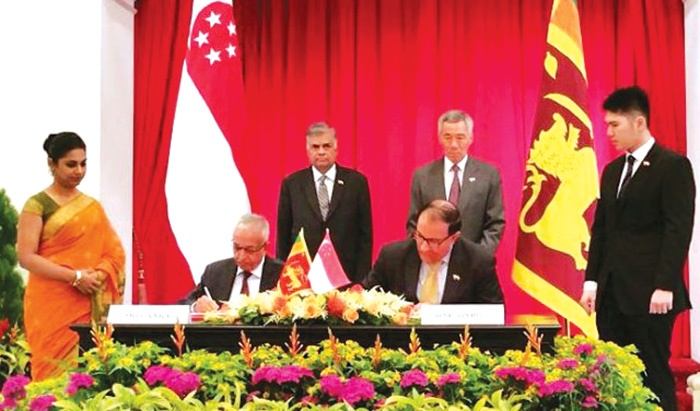
Sri Lanka-Singapore Free Trade Agreement
By Gomi Senadhira
senadhiragomi@gmail.com
“You might tell fairy tales, but the progress of a country cannot be achieved through such narratives. A country cannot be developed by making false promises. The country moved backward because of the electoral promises made by political parties throughout time. We have witnessed that the ultimate result of this is the country becoming bankrupt. Unfortunately, many segments of the population have not come to realize this yet.” – President Ranil Wickremesinghe, 2024 Budget speech
Any Sri Lankan would agree with the above words of President Wickremesinghe on the false promises our politicians and officials make and the fairy tales they narrate which bankrupted this country. So, to understand this, let’s look at one such fairy tale with lots of false promises; Ranil Wickremesinghe’s greatest achievement in the area of international trade and investment promotion during the Yahapalana period, Sri Lanka-Singapore Free Trade Agreement (SLSFTA).
It is appropriate and timely to do it now as Finance Minister Wickremesinghe has just presented to parliament a bill on the National Policy on Economic Transformation which includes the establishment of an Office for International Trade and the Sri Lanka Institute of Economics and International Trade.
Was SLSFTA a “Cleverly negotiated Free Trade Agreement” as stated by the (former) Minister of Development Strategies and International Trade Malik Samarawickrama during the Parliamentary Debate on the SLSFTA in July 2018, or a colossal blunder covered up with lies, false promises, and fairy tales? After SLSFTA was signed there were a number of fairy tales published on this agreement by the Ministry of Development Strategies and International, Institute of Policy Studies, and others.
However, for this article, I would like to limit my comments to the speech by Minister Samarawickrama during the Parliamentary Debate, and the two most important areas in the agreement which were covered up with lies, fairy tales, and false promises, namely: revenue loss for Sri Lanka and Investment from Singapore. On the other important area, “Waste products dumping” I do not want to comment here as I have written extensively on the issue.
1. The revenue loss
During the Parliamentary Debate in July 2018, Minister Samarawickrama stated “…. let me reiterate that this FTA with Singapore has been very cleverly negotiated by us…. The liberalisation programme under this FTA has been carefully designed to have the least impact on domestic industry and revenue collection. We have included all revenue sensitive items in the negative list of items which will not be subject to removal of tariff. Therefore, 97.8% revenue from Customs duty is protected. Our tariff liberalisation will take place over a period of 12-15 years! In fact, the revenue earned through tariffs on goods imported from Singapore last year was Rs. 35 billion.
The revenue loss for over the next 15 years due to the FTA is only Rs. 733 million– which when annualised, on average, is just Rs. 51 million. That is just 0.14% per year! So anyone who claims the Singapore FTA causes revenue loss to the Government cannot do basic arithmetic! Mr. Speaker, in conclusion, I call on my fellow members of this House – don’t mislead the public with baseless criticism that is not grounded in facts. Don’t look at petty politics and use these issues for your own political survival.”
I was surprised to read the minister’s speech because an article published in January 2018 in “The Straits Times“, based on information released by the Singaporean Negotiators stated, “…. With the FTA, tariff savings for Singapore exports are estimated to hit $10 million annually“.
As the annual tariff savings (that is the revenue loss for Sri Lanka) calculated by the Singaporean Negotiators, Singaporean $ 10 million (Sri Lankan rupees 1,200 million in 2018) was way above the rupees’ 733 million revenue loss for 15 years estimated by the Sri Lankan negotiators, it was clear to any observer that one of the parties to the agreement had not done the basic arithmetic!
Six years later, according to a report published by “The Morning” newspaper, speaking at the Committee on Public Finance (COPF) on 7th May 2024, Mr Samarawickrama’s chief trade negotiator K.J. Weerasinghehad had admitted “…. that forecasted revenue loss for the Government of Sri Lanka through the Singapore FTA is Rs. 450 million in 2023 and Rs. 1.3 billion in 2024.”
If these numbers are correct, as tariff liberalisation under the SLSFTA has just started, we will pass Rs 2 billion very soon. Then, the question is how Sri Lanka’s trade negotiators made such a colossal blunder. Didn’t they do their basic arithmetic? If they didn’t know how to do basic arithmetic they should have at least done their basic readings. For example, the headline of the article published in The Straits Times in January 2018 was “Singapore, Sri Lanka sign FTA, annual savings of $10m expected”.
Anyway, as Sri Lanka’s chief negotiator reiterated at the COPF meeting that “…. since 99% of the tariffs in Singapore have zero rates of duty, Sri Lanka has agreed on 80% tariff liberalisation over a period of 15 years while expecting Singapore investments to address the imbalance in trade,” let’s turn towards investment.
Investment from Singapore
In July 2018, speaking during the Parliamentary Debate on the FTA this is what Minister Malik Samarawickrama stated on investment from Singapore, “Already, thanks to this FTA, in just the past two-and-a-half months since the agreement came into effect we have received a proposal from Singapore for investment amounting to $ 14.8 billion in an oil refinery for export of petroleum products. In addition, we have proposals for a steel manufacturing plant for exports ($ 1 billion investment), flour milling plant ($ 50 million), sugar refinery ($ 200 million). This adds up to more than $ 16.05 billion in the pipeline on these projects alone.
And all of these projects will create thousands of more jobs for our people. In principle approval has already been granted by the BOI and the investors are awaiting the release of land the environmental approvals to commence the project.
I request the Opposition and those with vested interests to change their narrow-minded thinking and join us to develop our country. We must always look at what is best for the whole community, not just the few who may oppose. We owe it to our people to courageously take decisions that will change their lives for the better.”
According to the media report I quoted earlier, speaking at the Committee on Public Finance (COPF) Chief Negotiator Weerasinghe has admitted that Sri Lanka was not happy with overall Singapore investments that have come in the past few years in return for the trade liberalisation under the Singapore-Sri Lanka Free Trade Agreement. He has added that between 2021 and 2023 the total investment from Singapore had been around $162 million!
What happened to those projects worth $16 billion negotiated, thanks to the SLSFTA, in just the two-and-a-half months after the agreement came into effect and approved by the BOI? I do not know about the steel manufacturing plant for exports ($ 1 billion investment), flour milling plant ($ 50 million) and sugar refinery ($ 200 million).
However, story of the multibillion-dollar investment in the Petroleum Refinery unfolded in a manner that would qualify it as the best fairy tale with false promises presented by our politicians and the officials, prior to 2019 elections.
Though many Sri Lankans got to know, through the media which repeatedly highlighted a plethora of issues surrounding the project and the questionable credentials of the Singaporean investor, the construction work on the Mirrijiwela Oil Refinery along with the cement factory began on the24th of March 2019 with a bang and Minister Ranil Wickremesinghe and his ministers along with the foreign and local dignitaries laid the foundation stones.
That was few months before the 2019 Presidential elections. Inaugurating the construction work Prime Minister Ranil Wickremesinghe said the projects will create thousands of job opportunities in the area and surrounding districts.
The oil refinery, which was to be built over 200 acres of land, with the capacity to refine 200,000 barrels of crude oil per day, was to generate US$7 billion of exports and create 1,500 direct and 3,000 indirect jobs. The construction of the refinery was to be completed in 44 months. Four years later, in August 2023 the Cabinet of Ministers approved the proposal presented by President Ranil Wickremesinghe to cancel the agreement with the investors of the refinery as the project has not been implemented! Can they explain to the country how much money was wasted to produce that fairy tale?
It is obvious that the President, ministers, and officials had made huge blunders and had deliberately misled the public and the parliament on the revenue loss and potential investment from SLSFTA with fairy tales and false promises.
As the president himself said, a country cannot be developed by making false promises or with fairy tales and these false promises and fairy tales had bankrupted the country. “Unfortunately, many segments of the population have not come to realize this yet”.
(The writer, a specialist and an activist on trade and development issues . )



US sports envoys to Lanka to champion youth development

Rahuman questions sudden cancellation of leave of CEB employees


