
Features
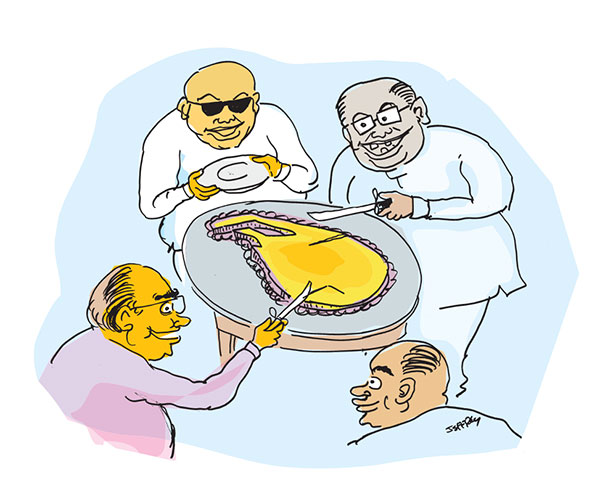
From kingpin to beggar on horseback!

By I. P. C. MENDIS
For “homo sapiens”, destiny is undoubtedly very much in charge and control in any aspect of life from the cradle to the grave, and very much so in the history of a country. In the context of the grave crisis we are facing today in Sri Lanka, it would indeed be opportune to reminisce into our journey down the slippery slope, particularly during the post-independence era. Many a conscience would certainly have gone pita-pat hearing our own icon, Sunil Perera, the veteran band leader, lamenting just before his unfortunate demise – “When I was attending school this was a Third World country, now when I am in the throes of death, it is still a Third World country” ! Did we have a Statesman worthy of that name in the mould of Lee Kwan Yew of Singapore or Mahathir Mohamed of Malaysia, who even attempted to put the country before party politics or self? The answer is an emphatic “NO’. If they did, a National Plan would have topped the priority list. Instead, we have had plans of varied hues baptized as Mid-Term Plans, Short-Term Plans, Crash Programmes, Integrated Programmes, etc., no doubt faithfully funded often by foreign aid. And that, too, has been faithfully and systematically squandered in various ways not excluding personal advancement.
We had the much-respected Hon. D.S. Senanayake who, despite lack of certificates to brandish, was able and well -equipped to lead a qualified team comprising practically all races. DSS is remembered undisputedly as the Father of the Nation for his contribution to the development of the country, agriculture in particular, holding together inter-racial amity. Notwithstanding the lack of paper qualifications, he could walk with kings without losing common touch. He was nattily attired in a tail coat and tie for the occasion, mingling with the British aristocracy. Even he did not see the merit in a national plan for organized continuity. However, our stock was held high internationally, and one of the hallmarks was the international acclaim for the then Finance Minister, JRJ’s plea at the San Francisco Conference after World War II, on behalf of Japan quoting the Buddha – “Hatred does not cease by hatred but by Love alone”. Japan to this day has it in its memory.
DSS’s son, Dudley Senanayake , who was recognised as the epitome of democracy having succeeded his father as Prime Minister , found to his dismay not very long to his first term, that a rather tumultuous environment, created by the Marxist movement via a hartal, was not his kettle of fish and decided to throw in the towel in the Westminster tradition with Sir John Kotelawela assuming control. Sir John started off with a bang and flair with welcome ceremonies, tamashas topping the precedence list, culminating in his being crowned as the King of Delft Island in the North. While D.S. Senanayake used to ride his horse (more for exercise) down Galle Face way sometimes in the mornings, Sir John too had similar inclinations and the “Laird of Kandawela” was often observed down Ratmalana way in majestic trot clad in jodphurs. He was known to be quite at home in the trappings of a Knight in shining armour given the opportunity. His breakfast table was open for a visitor who had any penchant for egg-hoppers and was famous for “off the cuff” remarks which were often eagerly used or mis-used by the Press to boost up their sales. It was during his tenure that a Non-Aligned conference was held in Bandung, Indonesia, and his pro-American stance did raise eye-brows earning him the sobriquet “Bandung Booruwa” here in Sri Lanka. His speech may have surprised even his own Advisers in terms of reports that trickled in. However, it did concern Jawaharlal Nehru who was provoked to inquire from him why he (Sir John) had not consulted him, in reply to which he had shot back – “Why should I – You do not consult me before you speak?” Indeed, he had the honour of receiving Queen Elizabeth II and Prince Phillp at the then Parliamentary premises (now Presidential Secretariat) at Galle Face. The Royal guests were ceremoniously led up the stairway outside in what was described as a very windy day. Sir John, who was quite at home with Royalty or commoner, had his favourite – veteran Lake House photographer Rienie Wijeratne – close by. Sir John had forgotten himself for a split second observing the majestic apparel being embarrassingly disturbed by the strong gust of wind and was reported to have whispered to photographer Rienzie W. – “Ganing yako ganing!”
He enjoyed seeing himself caricatured by Observer Cartoonist Aubrey Collette and one which had him depicted as a damsel before a mirror had been enlarged and hung in his office room at Transworks House when he was a Minister. That was the colourful Sir John Kotelawela – the author (clandestine) of “The Premier Stakes’ written when DSS had bequeathed the Premiership to son Dudley. He gracefully bowed out to Her Majesty’s country-side resort “Brogueswood” the purchase facilitated by his one-time arch rival, SWRDB in the release of scarce foreign exchange.
The Age of the Common Man
Then came the Pancha Maha Bala Vegaya, led by SWRDB – an Oxford product of no mean repute, who with all its perfectly good intentions ( as paved in the path to heaven ) was ham-strung by political, racial and trade union problems not totally unexpected from quarters that had hitherto been neglected and/or restrained in many ways. As a prelude, they gate-crashed into Parliament and occupied the Speaker’s chair. If that was not enough, vested interests within the camp which had been waiting long on the wings to capitalise on the victory became restless, conspiring against SWRDB who, to make a long story short, fell vicitim, paying with his life after only three years in office. He did make an attempt to draw up a national plan which died a natural death thereafter.
1959/60.
The era that followed with W. Dahanayake as the PM was a disaster. Parliamentary elections followed after a few months and Dudley Senanayake formed a minority government in March 1960 which was defeated in Parliament. The SLFP-led coalition won the July 1960 general election and Mrs Bandaranaike was sworn in as Prime Minister from the Senate and launched many people-friendly nationalist projects. The election campaign was bitterly fought and some of the slogans and propaganda were centred on Mrs Bandaranaike mostly targeting her inexperience (nothing more than a housewife) and lack of qualifications, while some of the foul-mouthed did not spare her from personal remarks (also insulting to women in general) unprintable in its content. She nevertheless proved herself to be a woman of steel leading the coalition to victory. Strangely, in next to no time she forged herself into the spotlight as the world’s first woman Prime Minister, fitting herself well and truly as an effective leader hobnobbing with some of the world’s greatest, particularly in the Non-Aligned Movement, earning respect. She carried herself well and proved to be a no-nonsense leader, much respected and feared no less. She maintained cordial relations with practically every national leader, particularly Indira Gandhi, so much so that she was picked to mediate on one of the Indo-China burning issues. She was able to solve to a great extent the Indian plantation labour issue. She mooted the idea of declaring the Indian Ocean a Zone of Peace.
The Non-Aligned conference held in Colombo was a feather in her cap. She had no personal agendas and while any other in her position would have accepted with both hands an invitation to attend the Commonwealth Prime Ministers’ Conference in London soon after taking office, she opted to stay back arranging for her Minister of Justice to represent her – a long shot from the great effort another VVIP of a different regime was said to have been made to cadge an invitation to attend the wedding of the Prince of Wales and Princess Diana. Mid-way in her term, she decided to coalesce with the Left but .some of her rightist members did not see eye to eye with the decision which ensured the defeat of the government on the Press Bill and subsequent disintegration of the coalition and the rise of a coalition of convenience in a seven-party outfit led by Dudley Seanayake, prominent among them being the TULF and the MEP which ruled for the full term.
Mrs B’s Second Term
Mrs Bandaranaike won the general elections in 1970 fortifying herself with a coalition winning a 2/3rd majority which helped her to declare Sri Lanka a Republic. In doing so, the two years spent on that effort was sought to be compensated by a similar addition to the five-year term in the new Constitution. Many an important activity was undertaken, but progress was hampered with the JVP uprising in 1971. This together with the LTTE problems aggravated the situation faced and if that was not enough bickering within the coalition camp began to surface and the coalition broke up in around 1976 resulting in the UNP-led by J.R. Jayawardene obtaining a 5/6th majority .
Executive Presidency
JRJ ensured the birth of a new Republican Constitution and the transformation into an Executive Presidency in which he was deemed to be the first Executive President. Many changes in the economic sphere were introduced, including liberalization of the economy. Development work was expanded, the most important being the accelerated Mahaweli development opening the floodgates for corruption not excluding duty –free facilities of one kind or another. In fact, reports had it that once JRJ had opined that commissions obtained were not bribes . The Mahaweli programme carried out mostly through aid programmes did bring many benefits but the liberalisation policy undermined local agricultural and industrial programmes. The shift in policy was so pro- American that it infuriated Indira Gandhi , which coupled with adverse personal remarks targeting Indira Gandi and son Rajiv, drove India to support in a very big way the LTTE which is well known. JRJ was succeeded by R. Premadasa who can be applauded for his foresight in embarking on the apparel industry which is now a foreign exchange winner. He was generally believed to have had some prejudice against professionals and his style of governance somehow infuriated the likes of Lalith Athulathmudali and Gamini Dissanayake who engineered an Impeachment motion. Premadasa bought time through a prorogation of Parliament and finally a settlement had been reached . He ruled till his unfortunate demise on 1st May 1993. His exit saw the rise of Chandrka Bandaranaike Kumaratunge mentioned earlier.
LTTE Enters the Fray
Prabhakaran entering the fray made successive governments to devote their time, energy , manpower/financial resources , at tremendous cost of development. Successive governments while confronting the LTTE and its cohorts, both foreign and local, had to keep the homefires burning while countering strong adverse political and international onslaughts aimed at discrediting the government and even acts of sabotage by word and deed. (“Alimankade / Pamankada, Kilinochchi/ Madawachchi, Baron’ s Cap, etc.). The ups and downs suffered need not be reiterated except to emphasise the genesis of borrowing and the easy way of further borrowing to settle the earlier borrowings. On the side of stupidity comes , inter alia, the surrender of a military platoon on a governmental fiat, only to be massacred in cold blood by the LTTE, the supply of arms to the LTTE to fight the IPKF, the so-called peace treaty with the LTTE which saw a fake surrender of arms and the “free–for –all” much later in Bond scams which had the blessings of the highest in the land. The Tamil diaspora was influential enough for the International community to ensure that there would be no assistance, financial or otherwise,. to Sri Lanka in the war with the LTTE. Consequently, the Rajapakse government had to resort to various other expensive methods, including borrowing at commercial interest rates to which the UNP led by Ranil Wickremesinghe responded by publicly declaring that they would not honour such obligations if and when they assume power. Measures such as the hedging deal and investments in Greek Bonds, Lotus Tower, Suryawewa Cricket stadium, Road Races, Magam Ruhuna International Conference Hall to name a few, did swell the already burdened debt trap. They added to the misery complemented with wastage and rampant corruption multiplying the woes haunting the government no less. The opportunity that came after the defeat of terrorism, was foolishly frittered away in a situation of mix-up of priorities necessitated by considerations other than national. Mahinda Rajapakse’s decision to seek re-election two years before ex,
Earlier, President Chadrika Bandaranaike’s tenure continued with the decorum hitherto displayed by her predecessors in office in all her dealings, maintaining her stature with the exception that she carried it a little too far in throwing manners to the wind being habitually unpunctual for appointments. Quite unruffled, she was reported to have kept Prince Charles kicking his heels at Temple Trees for quite a while. Indeed, she got away with it and also proved she could be quite out-spoken and frank on occasions. In fact, she appears to be quite popular with the media. She carried herself well despite certain shortcomings. By far, apart from the LTTE issue, the greatest challenge she had was the Tsunami debacle through which she sailed successfully.
Her successor Mahinda Rajapakse although not of the same mould of aristocratic origin, showed his mettle the way he handled the LTTE together with his brother Gotabaya R and the European messiahs that arrived to coax him to stop the onslaught against the LTTE. The usaual regalia was absent in receiving the latter, the location being in the rough and tumble of Embilipitya. They departed disappointed.
Yahapalan/Nawapalana
– The purpose of this Article is to reveal how the rating of the country has receded slowly but surely not only in terms of its financial obligations but also in its international standing, in regard to which the integrity, conduct, performance, management skills , results and general decorum do play their individual and collective roles. The recent history relating to the Yahapalana regime and the present outfit is fresh in the minds of the people and repetition would unnecessarily tax the time of the reader. As for Yahapalana, it is a story of manipulation, deceit, highway robbery (Bond scams, etc.,), intrigue, anti-nationalist and financial mis-management, the worst being security lapses culminating in the Easter Sunday debacle. Like Pontius Pilate,the bulk of its remains have projected itself by another name (SJB) in a bid to wash its hands off its sins and responsibility of everything they silently condoned.
The new regime (Nawapalanaya) of the SLPP combine led by President Gotabaya from which much was expected, has so far not lived up to expectations , burdened no less by the global epidemic and consequent world-wide financial and other consequences coupled with local financial constraints, demonstrations, demands and a host of insurmountable problems, some of which are of their own making. The country is virtually on the edge of a precipice notwithstanding outward show and rhetoric while opulence in some quarters in power are not invisible. Shamelessly now, they are running helter-skelter except to the IMF failing to realise that internationally even their personal and official standing, despite the protocol, are at a low ebb and not anywhere near what was in the past, particularly as a one-timeleader in the Non-Aligned Movement. Indeed, what a fall ? . It is no surprise that even a friend like China had reacted the way it did on the organic feriliser issue, now diplomatically seeking to recompense with 100,000 metric tons of rice commemorating 75-year of the Rubber/Rice Trade Agreement. The Chinese indeed are professionals – Sri Lankans pompous amateursp itifully transformed from Kingpin to beggar on Horseback !



by Dr Gotabhya Ranasinghe
Senior Consultant Cardiologist
National Hospital Sri Lanka
When we sought a meeting with Hon Dr. Ramesh Pathirana, Minister of Health, he graciously cleared his busy schedule to accommodate us. Renowned for his attentive listening and deep understanding, Minister Pathirana is dedicated to advancing the health sector. His openness and transparency exemplify the qualities of an exemplary politician and minister.
Dr. Palitha Mahipala, the current Health Secretary, demonstrates both commendable enthusiasm and unwavering support. This combination of attributes makes him a highly compatible colleague for the esteemed Minister of Health.
Our discussion centered on a project that has been in the works for the past 30 years, one that no other minister had managed to advance.
Minister Pathirana, however, recognized the project’s significance and its potential to revolutionize care for heart patients.
The project involves the construction of a state-of-the-art facility at the premises of the National Hospital Colombo. The project’s location within the premises of the National Hospital underscores its importance and relevance to the healthcare infrastructure of the nation.
This facility will include a cardiology building and a tertiary care center, equipped with the latest technology to handle and treat all types of heart-related conditions and surgeries.
Securing funding was a major milestone for this initiative. Minister Pathirana successfully obtained approval for a $40 billion loan from the Asian Development Bank. With the funding in place, the foundation stone is scheduled to be laid in September this year, and construction will begin in January 2025.
This project guarantees a consistent and uninterrupted supply of stents and related medications for heart patients. As a result, patients will have timely access to essential medical supplies during their treatment and recovery. By securing these critical resources, the project aims to enhance patient outcomes, minimize treatment delays, and maintain the highest standards of cardiac care.
Upon its fruition, this monumental building will serve as a beacon of hope and healing, symbolizing the unwavering dedication to improving patient outcomes and fostering a healthier society.We anticipate a future marked by significant progress and positive outcomes in Sri Lanka’s cardiovascular treatment landscape within the foreseeable timeframe.

by Fr. Emmanuel Fernando, OMI
Jesuit Fr. Aloysius Pieris (affectionately called Fr. Aloy) celebrated his 90th birthday on April 9, 2024 and I, as the editor of our Oblate Journal, THE MISSIONARY OBLATE had gone to press by that time. Immediately I decided to publish an article, appreciating the untiring selfless services he continues to offer for inter-Faith dialogue, the renewal of the Catholic Church, his concern for the poor and the suffering Sri Lankan masses and to me, the present writer.
It was in 1988, when I was appointed Director of the Oblate Scholastics at Ampitiya by the then Oblate Provincial Fr. Anselm Silva, that I came to know Fr. Aloy more closely. Knowing well his expertise in matters spiritual, theological, Indological and pastoral, and with the collaborative spirit of my companion-formators, our Oblate Scholastics were sent to Tulana, the Research and Encounter Centre, Kelaniya, of which he is the Founder-Director, for ‘exposure-programmes’ on matters spiritual, biblical, theological and pastoral. Some of these dimensions according to my view and that of my companion-formators, were not available at the National Seminary, Ampitiya.
Ever since that time, our Oblate formators/ accompaniers at the Oblate Scholasticate, Ampitiya , have continued to send our Oblate Scholastics to Tulana Centre for deepening their insights and convictions regarding matters needed to serve the people in today’s context. Fr. Aloy also had tried very enthusiastically with the Oblate team headed by Frs. Oswald Firth and Clement Waidyasekara to begin a Theologate, directed by the Religious Congregations in Sri Lanka, for the contextual formation/ accompaniment of their members. It should very well be a desired goal of the Leaders / Provincials of the Religious Congregations.
Besides being a formator/accompanier at the Oblate Scholasticate, I was entrusted also with the task of editing and publishing our Oblate journal, ‘The Missionary Oblate’. To maintain the quality of the journal I continue to depend on Fr. Aloy for his thought-provoking and stimulating articles on Biblical Spirituality, Biblical Theology and Ecclesiology. I am very grateful to him for his generous assistance. Of late, his writings on renewal of the Church, initiated by Pope St. John XX111 and continued by Pope Francis through the Synodal path, published in our Oblate journal, enable our readers to focus their attention also on the needed renewal in the Catholic Church in Sri Lanka. Fr. Aloy appreciated very much the Synodal path adopted by the Jesuit Pope Francis for the renewal of the Church, rooted very much on prayerful discernment. In my Religious and presbyteral life, Fr.Aloy continues to be my spiritual animator / guide and ongoing formator / acccompanier.
Fr. Aloysius Pieris, BA Hons (Lond), LPh (SHC, India), STL (PFT, Naples), PhD (SLU/VC), ThD (Tilburg), D.Ltt (KU), has been one of the eminent Asian theologians well recognized internationally and one who has lectured and held visiting chairs in many universities both in the West and in the East. Many members of Religious Congregations from Asian countries have benefited from his lectures and guidance in the East Asian Pastoral Institute (EAPI) in Manila, Philippines. He had been a Theologian consulted by the Federation of Asian Bishops’ Conferences for many years. During his professorship at the Gregorian University in Rome, he was called to be a member of a special group of advisers on other religions consulted by Pope Paul VI.
Fr. Aloy is the author of more than 30 books and well over 500 Research Papers. Some of his books and articles have been translated and published in several countries. Among those books, one can find the following: 1) The Genesis of an Asian Theology of Liberation (An Autobiographical Excursus on the Art of Theologising in Asia, 2) An Asian Theology of Liberation, 3) Providential Timeliness of Vatican 11 (a long-overdue halt to a scandalous millennium, 4) Give Vatican 11 a chance, 5) Leadership in the Church, 6) Relishing our faith in working for justice (Themes for study and discussion), 7) A Message meant mainly, not exclusively for Jesuits (Background information necessary for helping Francis renew the Church), 8) Lent in Lanka (Reflections and Resolutions, 9) Love meets wisdom (A Christian Experience of Buddhism, 10) Fire and Water 11) God’s Reign for God’s poor, 12) Our Unhiddden Agenda (How we Jesuits work, pray and form our men). He is also the Editor of two journals, Vagdevi, Journal of Religious Reflection and Dialogue, New Series.
Fr. Aloy has a BA in Pali and Sanskrit from the University of London and a Ph.D in Buddhist Philosophy from the University of Sri Lankan, Vidyodaya Campus. On Nov. 23, 2019, he was awarded the prestigious honorary Doctorate of Literature (D.Litt) by the Chancellor of the University of Kelaniya, the Most Venerable Welamitiyawe Dharmakirthi Sri Kusala Dhamma Thera.
Fr. Aloy continues to be a promoter of Gospel values and virtues. Justice as a constitutive dimension of love and social concern for the downtrodden masses are very much noted in his life and work. He had very much appreciated the commitment of the late Fr. Joseph (Joe) Fernando, the National Director of the Social and Economic Centre (SEDEC) for the poor.
In Sri Lanka, a few religious Congregations – the Good Shepherd Sisters, the Christian Brothers, the Marist Brothers and the Oblates – have invited him to animate their members especially during their Provincial Congresses, Chapters and International Conferences. The mainline Christian Churches also have sought his advice and followed his seminars. I, for one, regret very much, that the Sri Lankan authorities of the Catholic Church –today’s Hierarchy—- have not sought Fr.
Aloy’s expertise for the renewal of the Catholic Church in Sri Lanka and thus have not benefited from the immense store of wisdom and insight that he can offer to our local Church while the Sri Lankan bishops who governed the Catholic church in the immediate aftermath of the Second Vatican Council (Edmund Fernando OMI, Anthony de Saram, Leo Nanayakkara OSB, Frank Marcus Fernando, Paul Perera,) visited him and consulted him on many matters. Among the Tamil Bishops, Bishop Rayappu Joseph was keeping close contact with him and Bishop J. Deogupillai hosted him and his team visiting him after the horrible Black July massacre of Tamils.
Sri Lanka-Singapore Free Trade Agreement
By Gomi Senadhira
senadhiragomi@gmail.com
“You might tell fairy tales, but the progress of a country cannot be achieved through such narratives. A country cannot be developed by making false promises. The country moved backward because of the electoral promises made by political parties throughout time. We have witnessed that the ultimate result of this is the country becoming bankrupt. Unfortunately, many segments of the population have not come to realize this yet.” – President Ranil Wickremesinghe, 2024 Budget speech
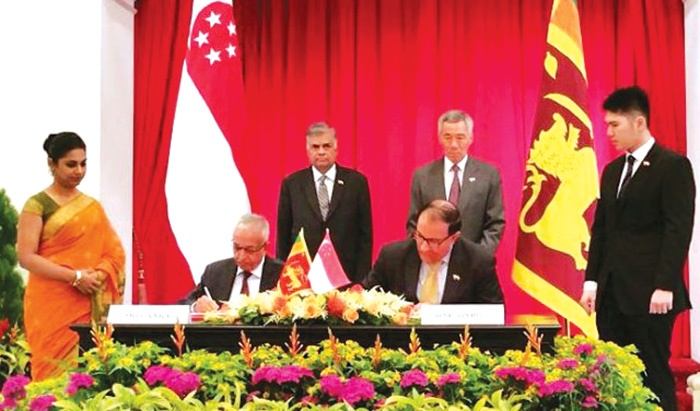
Any Sri Lankan would agree with the above words of President Wickremesinghe on the false promises our politicians and officials make and the fairy tales they narrate which bankrupted this country. So, to understand this, let’s look at one such fairy tale with lots of false promises; Ranil Wickremesinghe’s greatest achievement in the area of international trade and investment promotion during the Yahapalana period, Sri Lanka-Singapore Free Trade Agreement (SLSFTA).
It is appropriate and timely to do it now as Finance Minister Wickremesinghe has just presented to parliament a bill on the National Policy on Economic Transformation which includes the establishment of an Office for International Trade and the Sri Lanka Institute of Economics and International Trade.
Was SLSFTA a “Cleverly negotiated Free Trade Agreement” as stated by the (former) Minister of Development Strategies and International Trade Malik Samarawickrama during the Parliamentary Debate on the SLSFTA in July 2018, or a colossal blunder covered up with lies, false promises, and fairy tales? After SLSFTA was signed there were a number of fairy tales published on this agreement by the Ministry of Development Strategies and International, Institute of Policy Studies, and others.
However, for this article, I would like to limit my comments to the speech by Minister Samarawickrama during the Parliamentary Debate, and the two most important areas in the agreement which were covered up with lies, fairy tales, and false promises, namely: revenue loss for Sri Lanka and Investment from Singapore. On the other important area, “Waste products dumping” I do not want to comment here as I have written extensively on the issue.
1. The revenue loss
During the Parliamentary Debate in July 2018, Minister Samarawickrama stated “…. let me reiterate that this FTA with Singapore has been very cleverly negotiated by us…. The liberalisation programme under this FTA has been carefully designed to have the least impact on domestic industry and revenue collection. We have included all revenue sensitive items in the negative list of items which will not be subject to removal of tariff. Therefore, 97.8% revenue from Customs duty is protected. Our tariff liberalisation will take place over a period of 12-15 years! In fact, the revenue earned through tariffs on goods imported from Singapore last year was Rs. 35 billion.
The revenue loss for over the next 15 years due to the FTA is only Rs. 733 million– which when annualised, on average, is just Rs. 51 million. That is just 0.14% per year! So anyone who claims the Singapore FTA causes revenue loss to the Government cannot do basic arithmetic! Mr. Speaker, in conclusion, I call on my fellow members of this House – don’t mislead the public with baseless criticism that is not grounded in facts. Don’t look at petty politics and use these issues for your own political survival.”
I was surprised to read the minister’s speech because an article published in January 2018 in “The Straits Times“, based on information released by the Singaporean Negotiators stated, “…. With the FTA, tariff savings for Singapore exports are estimated to hit $10 million annually“.
As the annual tariff savings (that is the revenue loss for Sri Lanka) calculated by the Singaporean Negotiators, Singaporean $ 10 million (Sri Lankan rupees 1,200 million in 2018) was way above the rupees’ 733 million revenue loss for 15 years estimated by the Sri Lankan negotiators, it was clear to any observer that one of the parties to the agreement had not done the basic arithmetic!
Six years later, according to a report published by “The Morning” newspaper, speaking at the Committee on Public Finance (COPF) on 7th May 2024, Mr Samarawickrama’s chief trade negotiator K.J. Weerasinghehad had admitted “…. that forecasted revenue loss for the Government of Sri Lanka through the Singapore FTA is Rs. 450 million in 2023 and Rs. 1.3 billion in 2024.”
If these numbers are correct, as tariff liberalisation under the SLSFTA has just started, we will pass Rs 2 billion very soon. Then, the question is how Sri Lanka’s trade negotiators made such a colossal blunder. Didn’t they do their basic arithmetic? If they didn’t know how to do basic arithmetic they should have at least done their basic readings. For example, the headline of the article published in The Straits Times in January 2018 was “Singapore, Sri Lanka sign FTA, annual savings of $10m expected”.
Anyway, as Sri Lanka’s chief negotiator reiterated at the COPF meeting that “…. since 99% of the tariffs in Singapore have zero rates of duty, Sri Lanka has agreed on 80% tariff liberalisation over a period of 15 years while expecting Singapore investments to address the imbalance in trade,” let’s turn towards investment.
Investment from Singapore
In July 2018, speaking during the Parliamentary Debate on the FTA this is what Minister Malik Samarawickrama stated on investment from Singapore, “Already, thanks to this FTA, in just the past two-and-a-half months since the agreement came into effect we have received a proposal from Singapore for investment amounting to $ 14.8 billion in an oil refinery for export of petroleum products. In addition, we have proposals for a steel manufacturing plant for exports ($ 1 billion investment), flour milling plant ($ 50 million), sugar refinery ($ 200 million). This adds up to more than $ 16.05 billion in the pipeline on these projects alone.
And all of these projects will create thousands of more jobs for our people. In principle approval has already been granted by the BOI and the investors are awaiting the release of land the environmental approvals to commence the project.
I request the Opposition and those with vested interests to change their narrow-minded thinking and join us to develop our country. We must always look at what is best for the whole community, not just the few who may oppose. We owe it to our people to courageously take decisions that will change their lives for the better.”
According to the media report I quoted earlier, speaking at the Committee on Public Finance (COPF) Chief Negotiator Weerasinghe has admitted that Sri Lanka was not happy with overall Singapore investments that have come in the past few years in return for the trade liberalisation under the Singapore-Sri Lanka Free Trade Agreement. He has added that between 2021 and 2023 the total investment from Singapore had been around $162 million!
What happened to those projects worth $16 billion negotiated, thanks to the SLSFTA, in just the two-and-a-half months after the agreement came into effect and approved by the BOI? I do not know about the steel manufacturing plant for exports ($ 1 billion investment), flour milling plant ($ 50 million) and sugar refinery ($ 200 million).
However, story of the multibillion-dollar investment in the Petroleum Refinery unfolded in a manner that would qualify it as the best fairy tale with false promises presented by our politicians and the officials, prior to 2019 elections.
Though many Sri Lankans got to know, through the media which repeatedly highlighted a plethora of issues surrounding the project and the questionable credentials of the Singaporean investor, the construction work on the Mirrijiwela Oil Refinery along with the cement factory began on the24th of March 2019 with a bang and Minister Ranil Wickremesinghe and his ministers along with the foreign and local dignitaries laid the foundation stones.
That was few months before the 2019 Presidential elections. Inaugurating the construction work Prime Minister Ranil Wickremesinghe said the projects will create thousands of job opportunities in the area and surrounding districts.
The oil refinery, which was to be built over 200 acres of land, with the capacity to refine 200,000 barrels of crude oil per day, was to generate US$7 billion of exports and create 1,500 direct and 3,000 indirect jobs. The construction of the refinery was to be completed in 44 months. Four years later, in August 2023 the Cabinet of Ministers approved the proposal presented by President Ranil Wickremesinghe to cancel the agreement with the investors of the refinery as the project has not been implemented! Can they explain to the country how much money was wasted to produce that fairy tale?
It is obvious that the President, ministers, and officials had made huge blunders and had deliberately misled the public and the parliament on the revenue loss and potential investment from SLSFTA with fairy tales and false promises.
As the president himself said, a country cannot be developed by making false promises or with fairy tales and these false promises and fairy tales had bankrupted the country. “Unfortunately, many segments of the population have not come to realize this yet”.
(The writer, a specialist and an activist on trade and development issues . )



US sports envoys to Lanka to champion youth development

Rahuman questions sudden cancellation of leave of CEB employees


