
News
AG urged to set up new mechanism to monitor HR violations

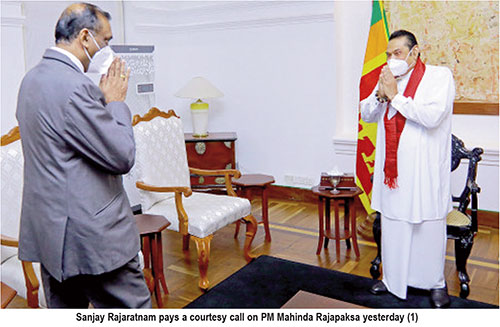
Sanjay Rajaratnam pays a courtesy call on PM Mahinda Rajapaksa yesterday (1)
The newly appointed Attorney General Sanjay Rajaratnam, PC, assumes duties at a critical time with the United Nations High Commissioner for Human Rights (UN-HCHR) having got the special mandate of the 46th session of the United Nations Human Rights Council (UN-HRC) in March this year to set up a special mechanism to monitor Sri Lanka’s alleged human rights violations and alleged war crimes during the final phase of the separatist war that ended in 2009, former PA National List MP M.M. Zuhair, PC says.
Zuhair, who served the AG’s department as a State Counsel and later as Senior State Counsel at a time it was comparatively smaller, said so in response to The Island query regarding the growing challenge on the human rights front.
Zuhair has sent us the following response to our queries: “The office of the Attorney General of Sri Lanka has a 137 year history, beginning from Sir Francis Fleming on 1st January 1884. The Attorney General carries with him unique responsibilities though the world outside sees him as exercising exclusive powers. He is the principal law officer of the State, legal adviser to the President of the Republic, the Speaker of Parliament and the executive, having specific Constitutional powers, duties and functions, advocate of the supremacy of the Constitution and the rule of law, having powers to initiate criminal proceedings and present indictments, the leader of the Bar with specified rights to be heard in all courts and defender of the State in civil proceedings. He is a member of the executive but functions independently of the executive in all legal matters, subject however to the jurisdiction of the Courts in specified issues.
The report of the High Commissioner for Human Rights has drawn special attention of the UN HRC to several significant matters relating to Sri Lanka. They include inter alia ‘reversal of Constitutional safeguards’, ‘majoritarian and exclusionary rhetoric, ‘new and exacerbated human rights concerns’, ‘impunity in emblematic cases’, etc. The UN HCHR has in the report taken a further step by requesting Member States, in addition to taking steps of referral of Sri Lanka to the International Criminal Court (ICC) to actively pursue “investigations and prosecution of international crimes committed by all parties in Sri Lanka before their own national courts, including under accepted principles of extraterritorial or universal jurisdiction” (emphasis mine).
The report also points out that “Member States can also apply targeted sanctions, such as asset freezes and travel bans against State officials and other actors credibly alleged to have committed or be responsible for grave human rights violations or abuses…” The addition of the two special procedures may be due to, the referral to ICC very likely being vetoed in the Security Council!
Another critical development is that a resolution is already before the United States Congress recommending the US to explore investigations and prosecutions pursuant to the recommendations of the UN HCHR. The proposed resolution is wide enough to pursue inter alia the two courses of actions referred to earlier at the Member State level of the US government. This would also encourage other traditional allies of the US to join hands with similar Member State level approvals, without recourse to any further UN HRC approval!
So the time has come for the new Attorney General Sanjay Rajaratnam PC to set up a special high level unit in the department to handle the man-made tsunami that will very likely rattle the country on the legal and economic fronts much sooner than the HRC process.
Amongst the matters in the UN HCHR’s list are the alleged “erosion of the judiciary and key institutions responsible for the promotion and protection of human rights; … policies that adversely affect the right to freedom of religion or belief; increased marginalization of persons belonging to the Tamil and Muslim communities; surveillance and intimidation of civil society; … arbitrary detentions”, etc.
Another matter is the need to address the undertaking given to repeal the Prevention of Terrorism (Temporary Provisions) Act (PTA) enacted in 1979 and replace same with a new law in line with accepted human rights norms. The controversial law itself provides for a maximum detention of 18 months, whereas a large number of persons arrested under the PTA over the Mawanella Buddha statue damaging case as well as over the Easter Sunday attacks have been kept in remand for over two years, in violation of the PTA’s maximum period of one and a half years, through a process arguably violative of the human rights of the suspects.
There are many persons in remand who could have been enlarged on bail with the consent of the Attorney General and against whom the alleged material is weak and insufficient for prosecution. There are still others who ought to have been discharged because they have had nothing to do with 21/4 attacks. The PTA provides in section 19, that the bail provisions of other written laws (excluding the Bail Act as provided in the Bail Act) will not be applicable only to persons convicted under the PTA. But suspects are not granted bail by Magistrates Court, in violation of the bail provisions in the Code of Criminal Procedure Act read with section 19 of the PTA itself, with Courts insisting on AG’s consent as required by another provision in the PTA, which is in conflict with section 19.
The UN HCHR could review likely human rights violations by the alleged unreasonable refusal of the Attorney General and the Courts to consent to bail in weak cases. These are areas that must be addressed forthwith by the Attorney General’s special unit to prevent officers and their families being adversely affected by Member States’ targeted actions, particularly because indictments are delayed, largely because of incomplete investigations!
Another matter that will require the immediate attention of the new Attorney General who counts over 34 years in the department is the continuing arrests of persons with alleged links to one suicide bomber or the other without any evidence of their being party to or in any way conspired, prepared, aided and/or abetted in the 21/4 attacks. Suicide bombers may have had links with persons of all communities for years before the Easter attacks. Those numbers can run into several thousands. But they do not become suspects in the 21/4 attacks by any legal yardstick merely because they had at some point crossed the future bombers. These arrests may be perceived as illegal arrests targeting the minorities.
The 48th Attorney General will certainly address the matters that come before him from the national interest perspective and not from any minoritarian angle! My interest is limited to securing justice within the rule of law for the country and for all its people.” (SF)



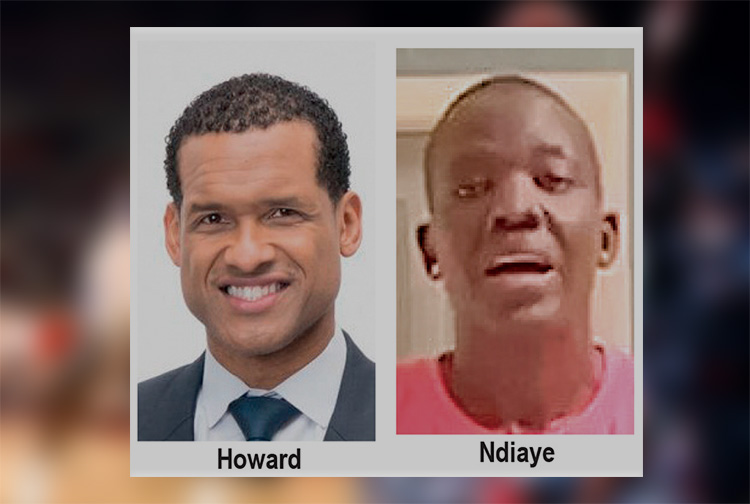
The U.S. Embassy in Colombo welcomed the U.S. Sports Envoys to Sri Lanka, former National Basketball Association (NBA) and Women’s National Basketball Association (WNBA) players Stephen Howard and Astou Ndiaye, from June 8 through 14.
The Public Diplomacy section of the U.S. Embassy said that it would launch a weeklong basketball program intended to harness the unifying power of sports, made possible through collaboration with Foundation of Goodness and IImpact Hoop Lab.
While in Sri Lanka, Howard and Ndiaye, both retired professional basketball players, will conduct a weeklong program, Hoops for Hope: Bridging Borders through Basketball. The Sports Envoys will lead basketball clinics and exhibition matches and engage in leadership sessions in Colombo and Southern Province for youth aged 14-18 from Northern, Uva, Eastern and Western Provinces, offering skills and leadership training both on and off the court. The U.S. Envoys will also share their expertise with the Sri Lanka Basketball Federation, national coaches, and players, furthering the development of basketball in the country. Beyond the clinics, they will collaborate with Sri Lankan schoolchildren to take part in a community service project in the Colombo area.
“We are so proud to welcome Stephen and Astou as our Sports Envoys to Sri Lanka, to build on the strong people-to-people connections between the United States and Sri Lanka,” said U.S. Ambassador Julie Chung. “The lessons that will be shared by our Sports Envoys – communication, teamwork, resilience, inclusion, and conflict resolution – are essential for leadership development, community building, equality, and peace. The U.S. Sports Envoy program is a testament to our belief that sports can be a powerful tool in promoting peace and unity.”
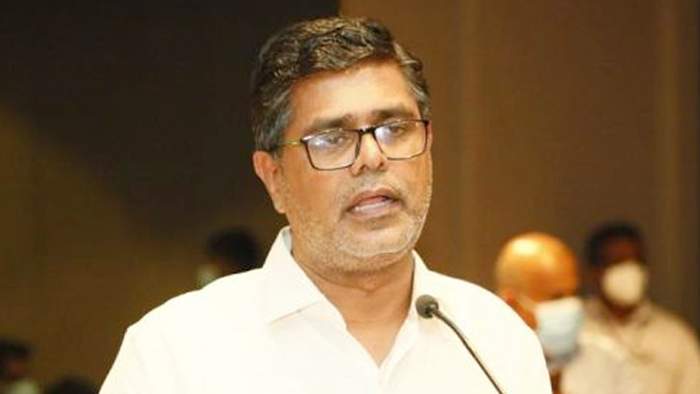
SJB Colombo District MP Mujibur Rahuman in parliament demanded to know from the government the reasons for CEB suspending the leave of all its employees until further notice from Thursday.
MP Rahuman said that the CEB has got an acting General Manager anew and the latter yesterday morning issued a circular suspending leave of all CEB employees with immediate effect until further notice.
“We demand that Minister Kanchana Wijesekera should explain this to the House. This circular was issued while this debate on the new Electricity Amendment Bill was pending. There are many who oppose this Bill. The Minister must tell parliament the reason for the urge to cancel the leave of CEB employees,” the MP said.However, Speaker Mahinda Yapa Abeywardena prevented Minister Wijesekera responding to the query and said that the matter raised by MP Rahuman was not relevant.
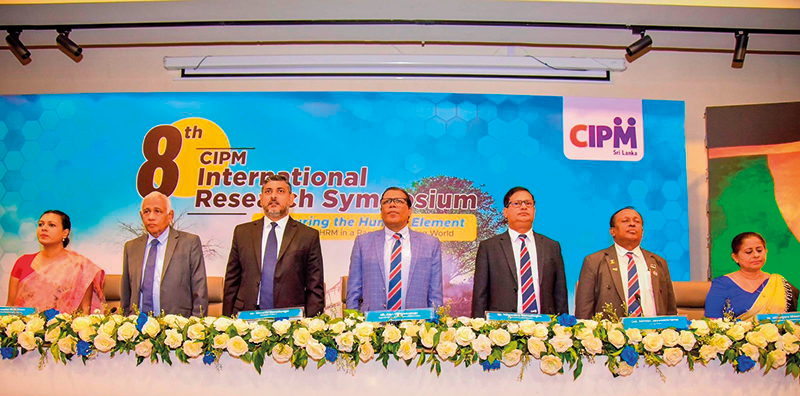
The Chartered Institute of Personnel Management (CIPM) successfully concluded the 8th Annual CIPM Symposium, which took place on 31st May 2024. Themed “Nurturing the Human Element—Redefining HRM in a Rapidly Changing World,” the symposium underscored the pivotal role of human resource management (HRM) in today’s dynamic global landscape. Since its inception in 1959, CIPM has been dedicated to advancing the HR profession through education, professional development, and advocacy, solidifying its position as Sri Lanka’s leading professional body for HRM.
Ken Vijayakumar, the President of the CIPM, graced the occasion as the chief guest. The symposium commenced with the welcome address by the Chairperson, Prof. Arosha Adikaram, followed by the Web Launch of the Symposium Proceedings and Abstract Book by the CIPM President. The event featured distinguished addresses, including a speech by Chief Guest Ken Vijayakumar, President of CIPM, and an address by Guest of Honor Shakthi Ranatunga, Chief Operating Officer of MAS Holdings Pvt. Ltd., Sri Lanka.
The symposium also featured an inspiring keynote address by Prof. Mario Fernando, Professor of Management and Director of the Centre for Cross Cultural Management (CCCM) at the University of Wollongong, Australia.
Vote of Thanks of the inauguration session was delivered by Dr. Dillanjani Weeratunga, Symposium Co-chair.
The symposium served as a comprehensive platform for researchers to present their findings across a wide range of critical topics in HRM. These included Cultural Diversity and Inclusion, Talent Development and Retention, Ethical Leadership and Corporate Social Responsibility, Adapting to Technological Advancements, Mental Health and Well-being at Work, Global Workforce Challenges, Employee Empowerment, and Reskilling and Upskilling.
The plenary session was led by Prof. Wasantha Rajapakse. Certificates were awarded to the best paper presenters during the valedictory session, followed by a vote of thanks delivered by Kamani Perera, Manager of Research and Development.
The annual symposium of CIPM was a truly inclusive event, attracting a diverse audience that spanned undergraduates, graduates, working professionals, research scholars and lecturers. This widespread interest highlights the symposium’s significance in the field of HRM, offering a unique opportunity for everyone to network and learn from scholarly brains.The CIPM International Research Symposium was sponsored by Hambantota International Port, Sri Lanka Institute of Information Technology (SLIIT), E B Creasy & Co. PLC, and Print Xcel Company.



US sports envoys to Lanka to champion youth development

Rahuman questions sudden cancellation of leave of CEB employees


