
Features
40th Death Anniversary of Justin Wijayawardhana: Reminiscences of a bygone socio-political milieu

By Dr Upul Wijayawardhana
It was 14th January 1982. I, together with my family, was making slow progress from Colombo to Matara in the pre-expressway era, when we heard on the car radio, the noon news bulletin of SLBC announcing the death of my father. There were no mobile phones then for me to receive the sad news from the family. My sister Mali, the only other medic in the family, very kindly undertook the onerous task of looking after our father in the intimate environs of our traditional family home ‘Wijaya Giri”‘ in Godagama rather than allowing him to wither away on a hospital bed. Having visited my father a few days earlier and persuaded Mali against active treatment in an inevitable situation, I was not surprised to learn the end of his multifaceted life but was sad that I could not be there, holding his hand that penned millions of words, when he left this world after decades of selfless service.
Standing at the foot of the bed and looking at his majestic face darkened by death, I thought to myself, “What have I done, compared to what you achieved in so many spheres?” I am still reading about his unmatchable achievements and learning more and more about him from others who write about him. has taken 40 long years for me to pen this tribute although my admiration of him has grown exponentially over the years. In fact, I wondered whether I could be tarnishing his image posthumously by referring to him as a politician because he had so many other significant achievements. I am doing so purposefully to emphasis that our country was once blessed with politicians whose mission was to serve.
First to represent the UNP from Matara District
Communism took root in the Matara district because the leader of the Communist Party Dr S A Wickramasinghe was from there and also a very caring general practitioner. In fact, my father started social service in the early 1930s with Dr Wickramasinghe, forming the Matara Youth Society with him as secretary and Dr Wickramasinghe as the president. Although they parted ways due to ideological differences, they remained friends, and Dr W was gracious enough to offer him the nomination from the Communist Party on more than one occasion. In spite of certainty of success, my father refused and stood by the UNP. The Matara branch of the UNP proposed him as the candidate for the 1952 and 1956 general elections, but the hierarchy of the UNP parachuted outsiders encouraging caste-based politics.
In 1960, the UNP high-command was forced to relent and my father successfully contested Matara seat becoming the first UNP MP for Matara and the first to do so from the whole district. He was chosen to propose the vote of thanks to the throne speech of the Dudley Senanayake government enabling him to demonstrate his much-recognised oratory in the parliament too. His old friend, Dr W retorted cynically from the Opposition benches, “My good friend has made an excellent speech, as usual, but it may well be the funeral oration of this government”, which was prophetic! Unfortunately, my father lost in July, the seat he gained in March. One reason for the loss was malicious stories spread by his opponents alleging he had said, that he needed to wash the seat in the parliament before sitting on it. I know well this was more hurtful to him than losing the election as he was one of the pioneers in the South to stand against caste divisions. In fact, in early 1940s, when caste discrimination was rampant in the South, he organised, as the Secretary of the Matara branch, a Sinhala New Year Celebration which commenced with many from different castes eating Kiri Bath, sitting on mats with the leader of the Sinhala Maha Sabha, S W R D Bandaranaike.
S W R D’s offer
The SLFP government people elected in 1956 with high hopes also started faltering. Sensing the imminent danger, SWRD started planning a revamp. He wanted to go to the UN to display his masterful oratory and reconstitute the Cabinet on his return. He sent an emissary to my father with the offer of appointment to the Senate as the Junior Minister of Education straightaway to be made the Minister with the planned reshuffle. According to my mother, who overheard the conversation, he did not take even a second to refuse the offer.
Betrayal by UNP
Undaunted by the loss, my father continued to teach and do social work. The crossover of C P De Silva caused Mahanama Samaraweera to be nominated the UNP candidate for Matara. J R Jayewardene persuaded my father to contest the Kamburupitiya seat saying, “Justin, don’t worry. Even if you lose, we will look after you. After all, there is the Senate”. My father lost, the UNP forgot the promises, but he enabled my cousin, Chandrakaumara and my brother, Ranjan to represent that constituency subsequently.
George Rajapaksa once told me, “The UNP does not know how to treat the faithful, the best example being your father. If he had done for us what he did for the UNP, we would place him on a high pedestal”.
Even during his era, my father perhaps was too soft and remained with the UNP till his death. Would any other person have refused such offers?
Maybe, to overcome their guilt, the UNP government issued a stamp in the memory of my father in 1990.
Teacher, par excellence
Born on 18 November 1904, Kotawila Withanage Don Charlis Justin Wijayawardhana attended the missionary school in the village before joining to St. Thomas College in Matara. Don Juvanis Wijayawardhana, a notary’s clerk, decided to send his son to Mahinda College, Galle in view of the brilliant performance of his son, Justin at the Junior School Certificate Examination. More than the easy success in the Cambridge Senior examination, what Mahinda College gave my father was the inspiration to fight for independence and the preservation of Buddhism. Though he could have got a more rewarding government position with his qualifications, he opted to be a teacher and joined Rahula College in Matara.
He contributed immensely to the upliftment of Rahula College by the renowned principal Mr D J Kumarage, to be one of the best schools in the country. Rahula was an assisted school, which meant only teachers’ salaries were paid by the government. To meet the increasing demand for admissions, my father went round with Mr Kumarage and persuaded philanthropists in the area to build four buildings which were ceremoniously opened by Prime Ministers DS, Dudley, Sir John and Sir Oliver, the Governor General.
In addition, he was in charge of Sinhala and English debating teams, Arts and Drama society. He wrote many plays for students to stage of which one stands out; Matara Batha, a comedy which was so hilarious, it is said that even Mr Kumarage, who seldom smiled, burst into laughter.
My father taught Buddhism, Sinhala and art. He taught me too and I managed to fail in art, the only subject that I have ever failed! After teaching and inspiring many generations of students, he retired in 1964 having devoted his entire teaching career to Rahula.
Social service
He was a live-wire of the co-operative movement and headed the village co-operative till a few years before his death. He masterminded village development projects like roads and culverts through the Village Development programme.
When Buddhism was threatened by a fanatic sect, Thapasa Nikaya and , defended Bhikkhus threatened by misguided villagers. With the support of Chandraratna Manawasinghe, who was on the editorial staff of Lankadeepa, my father was able to dispel the falsehoods, helping save Buddhism in Sri Lanka.
He reserved his best for Community Centres Praja Mandala, which were established in Matara and surrounding areas. They were the meeting places where villagers could listen to the radio for the very first time. He obtained radios from the government for these centres. Those huge primitive devices needed a massive aerial across the tallest of coconut trees to get a rattly short-wave reception and were powered by car batteries, needing a fortnightly replacement by the post office. When they got late, the radio fell silent and the whole village missed the ‘Radio bana’.
The crowning glory was the annual congress of Community Centres, which lasted a couple of days with many competitions; that was the only opportunity for people to display their talents, unlike today, when we have too many talent shows. One of the highlights was the Kavi Maduwa, the poet’s corner where reputed guest poets gave lectures, in addition to recitals. That was the biggest event in the cultural calendar of the South.
Pioneer translator and writer
A visit to India in the late 1930s changed my father’s life forever as he was able to meet the leaders of the Indian Independence Movement but the most important was his meeting Rabindranath Tagore, whose works he had already translated to Sinhala. He recalled with great fondness the unexpectedly long meeting wherein Tagore granted him permission to translate any of his works.
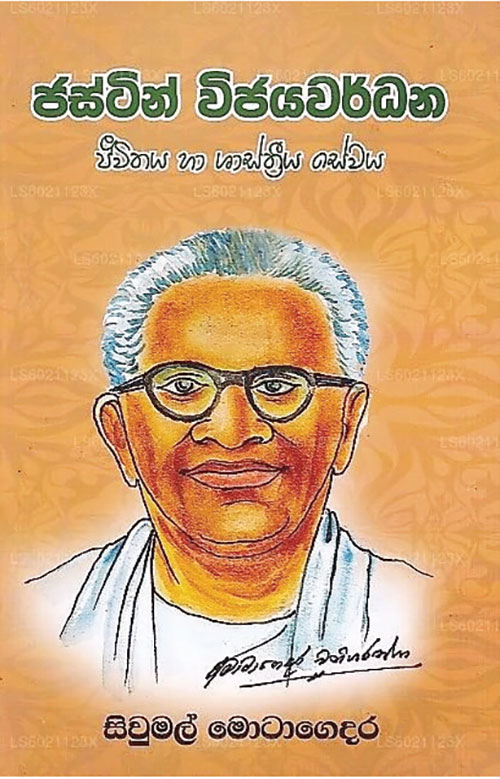
Sivumal Motagedara, who studied the life and literary works of my father for his research project for the M A degree from Colombo University, has published his dissertation “Justin Wijayawardhana: Jeewithya ha Sastriya Sevaya (Godage, ISBN 978-955-30-9644-9). He argues, very convincingly that it is a great injustice that Justin Wijayawardhana has not been accorded a much more prominent place in Sinhala literature and takes to task the academia for not doing so. He rates Justin Wijayawardhana as the pioneer translator who introduced the works not only of Eastern writers like Tagore but also Western writers like Leo Tolstoy, Hall Caine, Harriet Beecher Stowe, Walt Whitman and H G Wells to Sinhala readers. He also mentions Wijayawardhana’s ability to change the style of writing to fit the original for translation and contends that it is rare.
Perhaps, the main reason why my father’s writings have not received the attention it deserves is they were published in newspapers and magazines––not as books due to lack of facilities like agents for writers and the monopoly held by only a few publishers.
I know the great difficulties he had in getting his first book, “Nasthikara Puthraya”, the translation of Sir Hall Caine’s ‘The Prodigal Son’ published in 1964. He had to give up royalty for a tiny sum and the publisher did not even notify how many copies were sold!
Although he had many manuscripts ready, unfortunately, only two more books were published during his lifetime.
One was a translation of a book on the invasion of Tibet “Tibbethaye Bauddha Manava Sanharaya”, which was extensively used by the UNP during the 1965 election campaign. The other was “Tom Mamage Kutiya”, a translation Of Harriet Beecher Stowe’s masterpiece ‘Uncle Tom’s Cabin’, which was published by Marga in 1976.
The Ministry of Cultural Affairs, acceding to our request, published “Seeliyage Lokaya” in January 1983 to coincide with the first death anniversary and “Samawa Deema” in January 1984 to coincide with the second death anniversary. The latter, a collection of translations of ten short stories by Russian writers Leo Tolstoy, Maxim Gorky, Anton Chekhov and Hungarian writers Geza Gardonyi, Kalman Mikszath, Karoly Kisfaludy, was completed in September 1975 and dedicated to JRJ, the then leader of the Opposition. The dedication in my father’s handwriting, in his trademark violet ink, written with his beloved ‘Swan’ pen is reprinted in this book.
“Seeliyage Lokaya”
is an original work written in a novel genre. It is an exploration of village life, a synthesis of events and people in their respective villages of birth as seen by my parents. However, he has titled it ‘Seeliya’s world’, as he called my mother, Jinaseeli Jayawardana ‘Seeliya’ affectionately. The cover was drawn by my youngest brother Kamal. During one of my visits to President JRJ, when I presented a copy, he went through the chapter titles carefully and said “Upul, you must translate this to English as it is a mirror, showing the world what our village life is. It will be the opposite of ‘Grass for My Feet’ by J Vijayatunga”. I tried but, unfortunately, I do not seem to have inherited the translator gene!
The youngest of our six sisters, Champa is doing a tremendous job in keeping our father’s literary heritage going. She had been able to get “Nasthikara Putrya” and “Seeliyage Lokaya” republished. “Samawa Deema” has also been republished with a new title “Idama ha Thanhawa”. In addition, she has got the following in print: “Punarjeewanaya”, a translation of Leo Tolstoy’s ‘Resurrection, “Lo Pathala Keti Katha”, a collection of short stories by world famous authors including Tagore, Mulkraj Anand, Guy de Maupassant, Oscar Wild” and “Minis Angaharu Yuddaya”, a translation of H G Wells’ ‘War of the Worlds’.
‘Sai Baba: Man of Miracles’ by Howard Murphet was translated at the request of the Sai Baba Society, which was made in late 1974. Although my father finished the translation in a matter of two months, a unique achievement for a book running to 400 pages, it did not come out in print till a year after his death, in spite of Sai Baba’s blessings!
Matara C Justin Wijayawardhana started writing to Sinhala newspapers and magazines from his late teens and continued for six decades. In addition to articles on Buddhism and current affairs, there are many more translations that have been serialised. Champa is engaged in this monumental task of gathering them so that more books may be published.
Marriage
My father, who initially put service over marriage, changed his mind the moment he saw a new lady teacher who joined Rahula staff. The marriage of Justin Wijayawardhana and Jinaseeli Jayawardana from Ransegoda took place on 17 May 1940, during the biggest flood ever recorded in the Southern Province. We were under the impression that the bridegroom encountered the flooding on his way to the bride’s but two books by Hewamadduma brothers give a different story. The Hewamadduma family from Lenaduwa was one of the closest families to ours. Till his untimely death in 2013, Amare, the well-known administrator, historian and writer used to write regularly about my father. After that his younger brother Dharme has taken over. In Amare’s book “Amara Samara-1”, as well as his elder brother Upatissa’s book “Ma Dutu Maha Purushaya: Justin Wijayawardhana” give detailed accounts, as recounted by their father. Every time a flood occurred, their father Sinnno Appuhamy used to say, “This is nothing compared to the flooding when Wijayawardhana mahattaya got married” and had gone on to relate how my father directed the preparation of boats the previous evening and how they paddled the 15 miles in floodwaters and brought back the couple, disregarding all warnings, safely to Godagama at 3 am, the following day! Apparently, my father having settled the new bride in bed had gone immediately to help flood victims. That shows his character and that my mother was solidly behind him. By the way, Thilakasena Sahabandu, who was married to Hewamadduma sister Karuna, wrote a beautiful anthology of poems titled ‘Sevaye Suwanda (Fragrance of service) which helped a great deal in my father’s election victory.
Funeral
Unfortunately, what should have been Justin Wijayawardhana’s greatest legacy was not to be. Seeing how the poor got into difficulty with lavish funerals, he campaigned for simple funerals but his pleas fell on deaf ears. However, he ensured his funeral was simple and my mother did even better, ensuring that we handed over her body to the Galle Medical Faculty when she died on 24 February 1986.
Detailed written instructions were left about the funeral but true to his considered manner, he stated we could make changes if circumstances demanded. He also stated that if we felt bad for not spending on the funeral, to build a house for a poor family, which we did. The day after death, he was cremated in a coffin made from cheap wood and painted white, on a simple pyre made from locally collected wood. Though his voice was heard at almost every local funeral, he did not want funeral orations and as stipulated there was one anusasana. Although we did not inform any VIPs, Finance Minister Ronnie de Mel turned up and as he was representing the government, we allowed him to speak. The only thing beyond our control was the massive crowd.
As we watched, a great man who had rendered selfless service for almost eight decades, gradually turned into ashes. As requested, his ashes were thrown in Nilawala Ganga.
May he attain the supreme bliss of Nibbana!



by Dr Gotabhya Ranasinghe
Senior Consultant Cardiologist
National Hospital Sri Lanka
When we sought a meeting with Hon Dr. Ramesh Pathirana, Minister of Health, he graciously cleared his busy schedule to accommodate us. Renowned for his attentive listening and deep understanding, Minister Pathirana is dedicated to advancing the health sector. His openness and transparency exemplify the qualities of an exemplary politician and minister.
Dr. Palitha Mahipala, the current Health Secretary, demonstrates both commendable enthusiasm and unwavering support. This combination of attributes makes him a highly compatible colleague for the esteemed Minister of Health.
Our discussion centered on a project that has been in the works for the past 30 years, one that no other minister had managed to advance.
Minister Pathirana, however, recognized the project’s significance and its potential to revolutionize care for heart patients.
The project involves the construction of a state-of-the-art facility at the premises of the National Hospital Colombo. The project’s location within the premises of the National Hospital underscores its importance and relevance to the healthcare infrastructure of the nation.
This facility will include a cardiology building and a tertiary care center, equipped with the latest technology to handle and treat all types of heart-related conditions and surgeries.
Securing funding was a major milestone for this initiative. Minister Pathirana successfully obtained approval for a $40 billion loan from the Asian Development Bank. With the funding in place, the foundation stone is scheduled to be laid in September this year, and construction will begin in January 2025.
This project guarantees a consistent and uninterrupted supply of stents and related medications for heart patients. As a result, patients will have timely access to essential medical supplies during their treatment and recovery. By securing these critical resources, the project aims to enhance patient outcomes, minimize treatment delays, and maintain the highest standards of cardiac care.
Upon its fruition, this monumental building will serve as a beacon of hope and healing, symbolizing the unwavering dedication to improving patient outcomes and fostering a healthier society.We anticipate a future marked by significant progress and positive outcomes in Sri Lanka’s cardiovascular treatment landscape within the foreseeable timeframe.

by Fr. Emmanuel Fernando, OMI
Jesuit Fr. Aloysius Pieris (affectionately called Fr. Aloy) celebrated his 90th birthday on April 9, 2024 and I, as the editor of our Oblate Journal, THE MISSIONARY OBLATE had gone to press by that time. Immediately I decided to publish an article, appreciating the untiring selfless services he continues to offer for inter-Faith dialogue, the renewal of the Catholic Church, his concern for the poor and the suffering Sri Lankan masses and to me, the present writer.
It was in 1988, when I was appointed Director of the Oblate Scholastics at Ampitiya by the then Oblate Provincial Fr. Anselm Silva, that I came to know Fr. Aloy more closely. Knowing well his expertise in matters spiritual, theological, Indological and pastoral, and with the collaborative spirit of my companion-formators, our Oblate Scholastics were sent to Tulana, the Research and Encounter Centre, Kelaniya, of which he is the Founder-Director, for ‘exposure-programmes’ on matters spiritual, biblical, theological and pastoral. Some of these dimensions according to my view and that of my companion-formators, were not available at the National Seminary, Ampitiya.
Ever since that time, our Oblate formators/ accompaniers at the Oblate Scholasticate, Ampitiya , have continued to send our Oblate Scholastics to Tulana Centre for deepening their insights and convictions regarding matters needed to serve the people in today’s context. Fr. Aloy also had tried very enthusiastically with the Oblate team headed by Frs. Oswald Firth and Clement Waidyasekara to begin a Theologate, directed by the Religious Congregations in Sri Lanka, for the contextual formation/ accompaniment of their members. It should very well be a desired goal of the Leaders / Provincials of the Religious Congregations.
Besides being a formator/accompanier at the Oblate Scholasticate, I was entrusted also with the task of editing and publishing our Oblate journal, ‘The Missionary Oblate’. To maintain the quality of the journal I continue to depend on Fr. Aloy for his thought-provoking and stimulating articles on Biblical Spirituality, Biblical Theology and Ecclesiology. I am very grateful to him for his generous assistance. Of late, his writings on renewal of the Church, initiated by Pope St. John XX111 and continued by Pope Francis through the Synodal path, published in our Oblate journal, enable our readers to focus their attention also on the needed renewal in the Catholic Church in Sri Lanka. Fr. Aloy appreciated very much the Synodal path adopted by the Jesuit Pope Francis for the renewal of the Church, rooted very much on prayerful discernment. In my Religious and presbyteral life, Fr.Aloy continues to be my spiritual animator / guide and ongoing formator / acccompanier.
Fr. Aloysius Pieris, BA Hons (Lond), LPh (SHC, India), STL (PFT, Naples), PhD (SLU/VC), ThD (Tilburg), D.Ltt (KU), has been one of the eminent Asian theologians well recognized internationally and one who has lectured and held visiting chairs in many universities both in the West and in the East. Many members of Religious Congregations from Asian countries have benefited from his lectures and guidance in the East Asian Pastoral Institute (EAPI) in Manila, Philippines. He had been a Theologian consulted by the Federation of Asian Bishops’ Conferences for many years. During his professorship at the Gregorian University in Rome, he was called to be a member of a special group of advisers on other religions consulted by Pope Paul VI.
Fr. Aloy is the author of more than 30 books and well over 500 Research Papers. Some of his books and articles have been translated and published in several countries. Among those books, one can find the following: 1) The Genesis of an Asian Theology of Liberation (An Autobiographical Excursus on the Art of Theologising in Asia, 2) An Asian Theology of Liberation, 3) Providential Timeliness of Vatican 11 (a long-overdue halt to a scandalous millennium, 4) Give Vatican 11 a chance, 5) Leadership in the Church, 6) Relishing our faith in working for justice (Themes for study and discussion), 7) A Message meant mainly, not exclusively for Jesuits (Background information necessary for helping Francis renew the Church), 8) Lent in Lanka (Reflections and Resolutions, 9) Love meets wisdom (A Christian Experience of Buddhism, 10) Fire and Water 11) God’s Reign for God’s poor, 12) Our Unhiddden Agenda (How we Jesuits work, pray and form our men). He is also the Editor of two journals, Vagdevi, Journal of Religious Reflection and Dialogue, New Series.
Fr. Aloy has a BA in Pali and Sanskrit from the University of London and a Ph.D in Buddhist Philosophy from the University of Sri Lankan, Vidyodaya Campus. On Nov. 23, 2019, he was awarded the prestigious honorary Doctorate of Literature (D.Litt) by the Chancellor of the University of Kelaniya, the Most Venerable Welamitiyawe Dharmakirthi Sri Kusala Dhamma Thera.
Fr. Aloy continues to be a promoter of Gospel values and virtues. Justice as a constitutive dimension of love and social concern for the downtrodden masses are very much noted in his life and work. He had very much appreciated the commitment of the late Fr. Joseph (Joe) Fernando, the National Director of the Social and Economic Centre (SEDEC) for the poor.
In Sri Lanka, a few religious Congregations – the Good Shepherd Sisters, the Christian Brothers, the Marist Brothers and the Oblates – have invited him to animate their members especially during their Provincial Congresses, Chapters and International Conferences. The mainline Christian Churches also have sought his advice and followed his seminars. I, for one, regret very much, that the Sri Lankan authorities of the Catholic Church –today’s Hierarchy—- have not sought Fr.
Aloy’s expertise for the renewal of the Catholic Church in Sri Lanka and thus have not benefited from the immense store of wisdom and insight that he can offer to our local Church while the Sri Lankan bishops who governed the Catholic church in the immediate aftermath of the Second Vatican Council (Edmund Fernando OMI, Anthony de Saram, Leo Nanayakkara OSB, Frank Marcus Fernando, Paul Perera,) visited him and consulted him on many matters. Among the Tamil Bishops, Bishop Rayappu Joseph was keeping close contact with him and Bishop J. Deogupillai hosted him and his team visiting him after the horrible Black July massacre of Tamils.
Sri Lanka-Singapore Free Trade Agreement
By Gomi Senadhira
senadhiragomi@gmail.com
“You might tell fairy tales, but the progress of a country cannot be achieved through such narratives. A country cannot be developed by making false promises. The country moved backward because of the electoral promises made by political parties throughout time. We have witnessed that the ultimate result of this is the country becoming bankrupt. Unfortunately, many segments of the population have not come to realize this yet.” – President Ranil Wickremesinghe, 2024 Budget speech
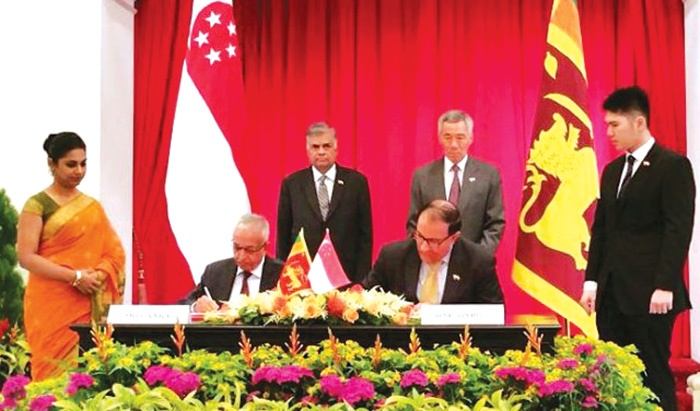
Any Sri Lankan would agree with the above words of President Wickremesinghe on the false promises our politicians and officials make and the fairy tales they narrate which bankrupted this country. So, to understand this, let’s look at one such fairy tale with lots of false promises; Ranil Wickremesinghe’s greatest achievement in the area of international trade and investment promotion during the Yahapalana period, Sri Lanka-Singapore Free Trade Agreement (SLSFTA).
It is appropriate and timely to do it now as Finance Minister Wickremesinghe has just presented to parliament a bill on the National Policy on Economic Transformation which includes the establishment of an Office for International Trade and the Sri Lanka Institute of Economics and International Trade.
Was SLSFTA a “Cleverly negotiated Free Trade Agreement” as stated by the (former) Minister of Development Strategies and International Trade Malik Samarawickrama during the Parliamentary Debate on the SLSFTA in July 2018, or a colossal blunder covered up with lies, false promises, and fairy tales? After SLSFTA was signed there were a number of fairy tales published on this agreement by the Ministry of Development Strategies and International, Institute of Policy Studies, and others.
However, for this article, I would like to limit my comments to the speech by Minister Samarawickrama during the Parliamentary Debate, and the two most important areas in the agreement which were covered up with lies, fairy tales, and false promises, namely: revenue loss for Sri Lanka and Investment from Singapore. On the other important area, “Waste products dumping” I do not want to comment here as I have written extensively on the issue.
1. The revenue loss
During the Parliamentary Debate in July 2018, Minister Samarawickrama stated “…. let me reiterate that this FTA with Singapore has been very cleverly negotiated by us…. The liberalisation programme under this FTA has been carefully designed to have the least impact on domestic industry and revenue collection. We have included all revenue sensitive items in the negative list of items which will not be subject to removal of tariff. Therefore, 97.8% revenue from Customs duty is protected. Our tariff liberalisation will take place over a period of 12-15 years! In fact, the revenue earned through tariffs on goods imported from Singapore last year was Rs. 35 billion.
The revenue loss for over the next 15 years due to the FTA is only Rs. 733 million– which when annualised, on average, is just Rs. 51 million. That is just 0.14% per year! So anyone who claims the Singapore FTA causes revenue loss to the Government cannot do basic arithmetic! Mr. Speaker, in conclusion, I call on my fellow members of this House – don’t mislead the public with baseless criticism that is not grounded in facts. Don’t look at petty politics and use these issues for your own political survival.”
I was surprised to read the minister’s speech because an article published in January 2018 in “The Straits Times“, based on information released by the Singaporean Negotiators stated, “…. With the FTA, tariff savings for Singapore exports are estimated to hit $10 million annually“.
As the annual tariff savings (that is the revenue loss for Sri Lanka) calculated by the Singaporean Negotiators, Singaporean $ 10 million (Sri Lankan rupees 1,200 million in 2018) was way above the rupees’ 733 million revenue loss for 15 years estimated by the Sri Lankan negotiators, it was clear to any observer that one of the parties to the agreement had not done the basic arithmetic!
Six years later, according to a report published by “The Morning” newspaper, speaking at the Committee on Public Finance (COPF) on 7th May 2024, Mr Samarawickrama’s chief trade negotiator K.J. Weerasinghehad had admitted “…. that forecasted revenue loss for the Government of Sri Lanka through the Singapore FTA is Rs. 450 million in 2023 and Rs. 1.3 billion in 2024.”
If these numbers are correct, as tariff liberalisation under the SLSFTA has just started, we will pass Rs 2 billion very soon. Then, the question is how Sri Lanka’s trade negotiators made such a colossal blunder. Didn’t they do their basic arithmetic? If they didn’t know how to do basic arithmetic they should have at least done their basic readings. For example, the headline of the article published in The Straits Times in January 2018 was “Singapore, Sri Lanka sign FTA, annual savings of $10m expected”.
Anyway, as Sri Lanka’s chief negotiator reiterated at the COPF meeting that “…. since 99% of the tariffs in Singapore have zero rates of duty, Sri Lanka has agreed on 80% tariff liberalisation over a period of 15 years while expecting Singapore investments to address the imbalance in trade,” let’s turn towards investment.
Investment from Singapore
In July 2018, speaking during the Parliamentary Debate on the FTA this is what Minister Malik Samarawickrama stated on investment from Singapore, “Already, thanks to this FTA, in just the past two-and-a-half months since the agreement came into effect we have received a proposal from Singapore for investment amounting to $ 14.8 billion in an oil refinery for export of petroleum products. In addition, we have proposals for a steel manufacturing plant for exports ($ 1 billion investment), flour milling plant ($ 50 million), sugar refinery ($ 200 million). This adds up to more than $ 16.05 billion in the pipeline on these projects alone.
And all of these projects will create thousands of more jobs for our people. In principle approval has already been granted by the BOI and the investors are awaiting the release of land the environmental approvals to commence the project.
I request the Opposition and those with vested interests to change their narrow-minded thinking and join us to develop our country. We must always look at what is best for the whole community, not just the few who may oppose. We owe it to our people to courageously take decisions that will change their lives for the better.”
According to the media report I quoted earlier, speaking at the Committee on Public Finance (COPF) Chief Negotiator Weerasinghe has admitted that Sri Lanka was not happy with overall Singapore investments that have come in the past few years in return for the trade liberalisation under the Singapore-Sri Lanka Free Trade Agreement. He has added that between 2021 and 2023 the total investment from Singapore had been around $162 million!
What happened to those projects worth $16 billion negotiated, thanks to the SLSFTA, in just the two-and-a-half months after the agreement came into effect and approved by the BOI? I do not know about the steel manufacturing plant for exports ($ 1 billion investment), flour milling plant ($ 50 million) and sugar refinery ($ 200 million).
However, story of the multibillion-dollar investment in the Petroleum Refinery unfolded in a manner that would qualify it as the best fairy tale with false promises presented by our politicians and the officials, prior to 2019 elections.
Though many Sri Lankans got to know, through the media which repeatedly highlighted a plethora of issues surrounding the project and the questionable credentials of the Singaporean investor, the construction work on the Mirrijiwela Oil Refinery along with the cement factory began on the24th of March 2019 with a bang and Minister Ranil Wickremesinghe and his ministers along with the foreign and local dignitaries laid the foundation stones.
That was few months before the 2019 Presidential elections. Inaugurating the construction work Prime Minister Ranil Wickremesinghe said the projects will create thousands of job opportunities in the area and surrounding districts.
The oil refinery, which was to be built over 200 acres of land, with the capacity to refine 200,000 barrels of crude oil per day, was to generate US$7 billion of exports and create 1,500 direct and 3,000 indirect jobs. The construction of the refinery was to be completed in 44 months. Four years later, in August 2023 the Cabinet of Ministers approved the proposal presented by President Ranil Wickremesinghe to cancel the agreement with the investors of the refinery as the project has not been implemented! Can they explain to the country how much money was wasted to produce that fairy tale?
It is obvious that the President, ministers, and officials had made huge blunders and had deliberately misled the public and the parliament on the revenue loss and potential investment from SLSFTA with fairy tales and false promises.
As the president himself said, a country cannot be developed by making false promises or with fairy tales and these false promises and fairy tales had bankrupted the country. “Unfortunately, many segments of the population have not come to realize this yet”.
(The writer, a specialist and an activist on trade and development issues . )



US sports envoys to Lanka to champion youth development

Rahuman questions sudden cancellation of leave of CEB employees


