Features
Wonderful Vienna

CONFESSIONS OF A GLOBAL GYPSY
By Dr. Chandana (Chandi) Jayawardena DPhil
President – Chandi J. Associates Inc. Consulting, Canada
Founder & Administrator – Global Hospitality Forum
chandij@sympatico.ca

We reached Austria on January 24, 1985, after a lengthy, strenuous train trip covering 12 countries. My wife and I were very happy to get a well-earned break from day and night train travelling in the midst of one of the worst European winters. After a long good night’s sleep, we were ready to explore a snow-covered Vienna. After our first visit to Austria, three years prior to that, Vienna had become one of our favourite cities.
Between their visits to our homes in Sri Lanka and England, and our visits to Austria, this was the sixth time we were spending a holiday with our dear Austrian friends, Biggi and Wolfgang Fernau. They had taken a week off to host us. Biggi was a beauty consultant for the Estée Lauder Companies and Wolfgang was an engineer running his own one-man lucrative business, specializing in repairs to historic buildings. They both managed to have a good balance of work and leisure and were world travellers which inspired me to do the same.
In 1985, out of the total Austrian population of 7.5 million, 20% or 1.5 million lived in Vienna. Life in Vienna is immersed in culture and the arts. It has a strong heritage for producing exceptional, classical music and theatre. The city is associated with some of the most monumental characters of the world of classical music, as well as visual art: Mozart, Beethoven and Klimt, to name but a few.
As our unofficial tour guide, Biggi stated, “We have planned to have meals with a few of our Viennese friends whom you met in 1982. We will also take you to visit tourist attractions as well as other places popular with locals. Would you like to see any of the many attractions you visited in Austria in 1982 again?” I said, “Yes, Schönbrunn Palace, once more, please.”
Our tour plan was modified, and we were taken the very next day to the 1,441-room Schönbrunn Palace. This is the main summer residence of the Habsburg Austrian dynasty, which was once one of the most prominent royal houses of Europe. To me, a trip to Vienna is not complete without a visit to Schönbrunn. Covered with snow, it was even more beautiful than before. We then had quick visits to the national opera house, national library, city hall and the famous Spanish riding school. We walked, passing some famous museums and music venues.


Viennese Coffee Houses
“Now it is time to have a light Austrian afternoon snack. How about Heiner Coffee Shop at Kärntner Strasse? Didn’t you like that place last time?”, Biggi asked. Another key feature contributing to the city’s well-being is the coffee culture. Viennese coffee houses are institutions, beloved by locals and tourists alike for providing a space to discuss the day’s events in a relaxed and quaint environment. Frequented by musicians, artists, intellectuals, and philosophers during the 19th century, they have developed a reputation for being cultural hubs where great minds gather and share concepts, ideas and creations.
L Heiner Coffee Shop is famous for their open sandwiches, apart from coffee and Austrian Torte. While seated there and waiting for our food and beverage, my wife asked, “What is the difference between a cake and torte?”, I explained to her that torte popular in Austria is a type of a rich chocolate cake made denser than the usual sponge cake. Wolf then gave an interesting mini lecture about the history of the famous Sachertorte which was created by pastry chef Franz Sacher in 1832, when he was only a 16-year-old kitchen apprentice. “There are two Viennese coffee shops claiming to be serving the Sachertorte made with the original recipe of Franz Sacher. Over the next few days, we will take you to both.” Wolf announced. He then said, “you should decide which version is better!”


In Search of the best Chocolate Cake in the world
As we came out of the coffee shop, we bumped into Chef Kapila Ratnayake and his wife Gayani. Kapila was five years my junior at the Ceylon Hotel School. A few years after I worked at Hotel Ceysands as the Executive Chef, Kapila held the same position. In 1985 Kapila and Gayani were living and working in Switzerland and they were on holiday in Vienna. “We came here mainly to taste the original Sachertorte at the famous pastry shop at the Sacher Hotel. Just now I ticked that box in my bucket list” Kapila told us. I became keener about our next two visits to the iconic, coffee shops, but had to patiently wait for two days.The Sachertorte and his other original recipes had made Franz Sacher world-famous and prosperous. He had operated several, top-level cafés and restaurants. The classic Sachertorte is made with two chocolate cake layers, apricot preserves and a shiny chocolate-glaze finish and served with Schlag (a non-sweet, light whipped cream). It is widely considered the best-known chocolate cake of all-time.
Demel, Vienna’s most famous pastry shop and chocolatery established in 1786 and the Sacher Hotel, established in 1876 by a branch of the same Sacher family, contested in courts who had the right to call their product the ‘genuine’ Sachertorte. The slight differences between the versions from the two establishments was in the placing of the apricot jam and a seal on top. After seven years of legal battles, the dispute was finally resolved in 1963. The courts had decided in favour of the Hotel Sacher. Both parties agreed that Hotel Sacher uses the term ‘The Original Sachertorte’ and Demel uses a triangular seal to differentiate.
We visited Demel (colloquially der Demel) for a mid-afternoon, light meal the next day. We noticed that Demel referred to their version of the torte as the ‘Ur-Sachertorte’ (the very first version!). While finishing our meal, Biggi told us that Demel has always been a popular location for the aristocracy and bourgeoisie, from the glorious days of the Astro-Hungarian empire. “When seasons changed and the air turned cold, it was expected of any trendy lady to stop by at Demel and order a hot chocolate” Biggi explained. She proceeded to order two hot chocolates for her and my wife, on a perfectly suited cold winter day.
To me as a hotelier, visiting the famous, five-star Sacher Hotel was memorable. The hotel was founded during the height of the Austro-Hungarian empire by the son of Franz Sacher and well-known restaurateur Eduard Sacher. As a former chef, tasting the original version of Sachertorte at the Café Sacher in the hotel was even more memorable. The reputation, traditions, ambiance, stories and simply the quality of products and service enhanced our enjoyable afternoon. Café Sacher is a must do experience for a tourist in Vienna.

Gastronomic Adventures in Vienna
After three days of mid-afternoon indulging in having the best, light meals at top Viennese cafés, Wolf and Biggi introduced us to a series of gourmet lunches and dinners with their friends. At the famous 22-room Gasthaus zum Roten Hahn in Vienna Woods by the Danube, we had a traditional Austrian feast. That included Germknödel (Popular Viennese yeast dumplings filled with plum butter).
On a Sunday afternoon Biggi announced, “Let’s go and enjoy Heuriger!” When we inquired about details, she explained that, “Heuriger is the Viennese word for a wine tavern serving the current year’s young wines.” We drove for 30 minutes to reach Perchtoldsdorf where many small, lovely, rustic wine growers’ wooden cabins were located. Trying the freshest wines directly from the makers was a refreshing experience. We loved their Apple Strudel, one of the most popular treats in any traditional Viennese café. This iconic dessert is considered by many to be the national dish of Austria, of which the recipe dates back to 1697 and survives today in a handwritten cookbook in the Vienna Town Hall Library. As recommended by Wolf, we had hot red wine with Apple Strudel.
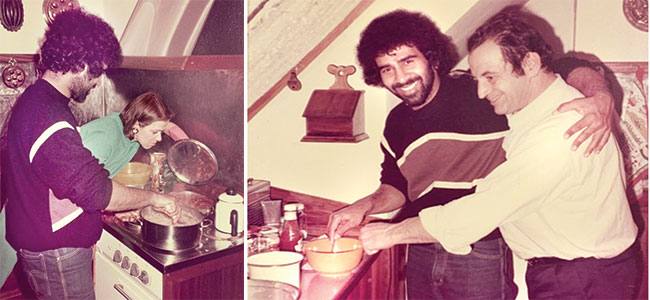
One evening, we were invited to a Fondue party at a friend’s house. After the party Wolf said, “Tomorrow, let’s try some non-Austrian, home-made dishes for dinner.” I offered to make a Sri Lankan dinner. “No, Chandi. Let’s cook something other than Sri Lankan food!” Biggi insisted. Knowing how much they liked Sri Lankan food, I was surprised. We then settled for an international menu including three Chinese dishes made by me, Hungarian Goulash made by Wolf and Czechoslovakian Green Salad and Potato Salad prepared by Biggi. To find the ingredients for my Chinese dishes I was taken to Naschmarkt – Vienna’s best-known market which had over 100 stands and restaurants with colourful, culinary offerings from around the world. We served Austrian wine and Ceylon tea with dinner. We had a nice time cooking, chatting, drinking and eating, while listing to classical Austrian music.

The next day, my mother-in-law travelled from London to join us in Vienna. After her arrival Biggi said, “Get ready. We will go to a restaurant to have a surprise dinner!” It was indeed a surprise. They took us to a very nice Sri Lankan restaurant in Vienna. “Time for Egg Hoppers and Lunu Miris!” Wolf joked. Colombo Hoppers was a well-established restaurant in Vienna.
Will continue in next week’s article:
HUNGARY-CZECOSLOVAKIA-LIECHTENSTEIN…