
Features
Will Ukraine adventure challenge USA’s global hegemony and trigger World War III?


by Chintaka Batawala and Mohamed Inthi Sameem
President Valdimir Putin’s adventure into Ukraine was supposed to be quick, lethal, and with clear objectives. Send Zelensky into oblivion, and install a pro-Moscow regime that won’t be clamoring for the moon such as a NATO alliance membership. In fact, President Putin was so confident about the competencies of his military machine and achieving his objectives in good time, that he even went on to highlight, perhaps out of tune with time, that it was the Soviet Red Army that overpowered the Germans during World War 2, and not the French or the British. (Reuters.com, May 2022)
But after 200 plus days of fighting, shelling, thousands of refugees, a new dimension in drone warfare, in conjunction with the largest military buildup witnessed in Europe since world war 2, there are more questions than answers as to where this is all headed. However, if there is fair bit of ambiguity as to military aspects of this conflict, then the geo – political facets are definitely clearer.
For starters, the traditional alliances that have been the norm for decades have been strengthened. Beijing and Tehran are backing Moscow without much ado. Moreover, the Iranian cooperation with Moscow in terms of the supply of Iranian drones to Russia and the reciprocal supply of advanced SU 35 jets to Iran have garnered much international press attention.
This conflict however, has put New Delhi in a precarious situation. On one side India has to play along as a member of the QUAD that is aligned with the USA, and Japan. On the flip side of this equation is the fact that India is also a member of BRICS, that is affiliated with China and Russia. Moreover, the historical alliance between India and the Soviet Union dating back to the cold war days is still a present tense. If the Indian Government’s official reaction was diplomatic at best, then the Indian media was certainly vociferous in highlighting that it was the USSR and not the Western block that came to India’s rescue when Pakistan launched an anti-India operation code named Genghis Khan in 1971, which resulted in the formation of a new independent state called Bangladesh. (WION wide angle, 2022)
For Washington as expected the time tested all weather western partners London, Paris, and Berlin have thrown in their support, albeit in a muted way. In normal times the most enthusiastic and high-volume support to Washington would have come from London. But because Great Britain is going through its own leadership fiasco the tone from London was hardly a whisper.
But as sure as politics makes strange bedfellows, the biggest surprises have been, the cold shouldering by UAE ‘s Mohamed bin Zayed (MBZ ) and Saudi Arabia ‘s Mohamed bin Salman (MBS) to President Biden request to increase oil output to make up for the Russian absence in the oil markets.
If this was not bad enough coming from traditionally strong Washington allies, the Gulf states tilting towards Putin has further frosted the traditional ionic type bonding between Riyadh and Washington; a bond that has been a done deal for decades. Presidents Biden’s Riyadh visit to request an increase in oil output elicited comparison to then Secretary of State Henry Kissinger’s visit to Saudi Arabia in November 1973, to request the then King Faisal bin Abdul Azeez (MBS ‘s uncle) to remove the oil embargo imposed after the Arab Israeli war of 1973. If Kissinger’s visit to the kingdom then was productive in some way as it set the tone for the Petro dollar, then Presidents Biden’s visit in 2022 to Riyadh with a fist bump greeting to the Saudi Crown Prince MBS, failed to live up to its expectations ( NBC news , July 2022)
Some experts do make a case that the West’s confrontation with Russia has brought the world within proximity to world War 3. ( Bill Ackman , CNBC May 2022 , Fiona Hill , Business Insider Sept 2022) . Whilst this statement may seem far-fetched at this time, it certainly has reasonable resonance. Rewind back to the reasons why World War 1 and World War 2 were so devastating was because, the major powers of the time got embroiled in a protracted military conflict, some by willful choice, like the Austro-Hungarian Empire and the others by Hobson’s choice like the Ottoman Islamic Empire. (World War I)
Granted we are not living in that sort of fragile coalition days, and there is some ease today due to the presence of a global authority in the United Nations to prevent the recurrence of a global conflict. However, with the prevalence of nuclear weapons among the major powers and who also happen to be the protagonists of this conflict, it seems petrifying to imagine the trajectory of such a global confrontation.
If the military aspect of this conflict is viewed as a localized war between Russia and Ukraine, the fact remains the West is collectively engaged in an Economic war with Russia, unprecedented in scale that would have been unimaginable just a few years ago. Moreover, the Economic consequences of this conflict are not going to fade away just like that. It is likely to create some structural fault lines in the global trade mechanism. If for the past 3 decades the key defining words for trade and commerce were Globalization and Economic liberalization, then certainly today the tide has turned towards economic nationalism and commercial decoupling.
The fall out risk of this conflict may not be nuclear, based on current dynamics but they are sky high especially for the global super power – the USA. The sanctions against Russia have been draconian as well as punitive such as the freezing of Central Bank assets and excluding Russian banks from the SWIFT network, a vital component in today’s financial architecture. The sanctions target the key vulnerabilities of the country’s economic engine; and in an era of globalised supply chains the sanctions effectively negate Russian access to technology and other related import inputs to the sectors in transportation, communication, and even port operations, all vital cogs for a country’s GDP growth. However, in an anti-climax of sorts Russia’s economic indices are holding better than expected. The GDP contraction for FY 2022 is expected to be 6 %, a better figure than the 15 % that was originally forecasted. (IMF, Economist Aug 2022)
Whilst the Western imposed sanctions had devastating effects on Iraq, and Libya, they have had only a limited impact on Russia. Perhaps this is due to Russia being a resource economy that is not fully integrated with the Global Economy. The Russian Economy is driven by commodity exports such as oil natural gas, nickel and aluminum which affords a certain cushion against western sanctions.
But perhaps the more important reason is , Russia is a permanent member of the UN security council and the veto power that accompanies it, allows Russia to challenge the western dominated security council resolutions on matters that goes against its interests.
Washington’s sanctions are well crafted with the required odds and evens, but there are glaring loopholes – the energy exception. If one of the primary goals was to reduce Russia’s oil revenue then the pragmatic strategy should have been to allow the free flow of oil into the markets and then simultaneously focus on a long-term solution to reduce the dependence on Russian oil. With plentiful supply the prices would stay within reason and thereby reduce energy driven inflationary pressures currently gripping Western Europe. But instead the sanctions strategists decided on an embargo which fell far short of the desired outcome.
The greatest challenge to the United States is that this Economic head on clash with Russia is being waged pretty much alone. This is because the European allies being fully aware of their Russia oil and gas dependency have been silent or reluctant partners at best to the path taken by Washington.
The USA is able to exert this sort of impact using the unique leverage status of the US Dollar. Because countries across the world have to use the US Dollar as the medium of international exchange even the threat to cut off them can cause Economic panic. More tangibly the US has the ability to impose sanctions on any country by leveraging on the long reach of the US Dollar even when the goods are not produced in the United States .To this effect just recently the US Dollar hit a two decade high prompting Barron’s to coin the caption, ‘The Green Back has gone ballistic’ ( Barron’s, Sept 2022)
However, that decades old phenomenon of the US Dollar as the de facto global currency may face its serious challenge yet. Fast growing and dynamic economies like Turkey, India, and the primary Petro dollar backer Saudi Arabia are seriously looking for alternatives to condense their dollar dependence.
The contrarian view of the Russia-Ukraine conflict is that it has highlighted something more than the ideological clash between the East and West, reminiscing upon the Roman and the Persian wars of antiquity from the annals of history. Putin has managed to carve out a softer and a romanticized persona for himself, despite the depiction in the western media as an unpredictable war monger. The old Boney M hit Ra Ra Rasputin from 1978, edited version of 2022 depicting Putin as the legendary monk during the days of the Russian Czar, has garnered over 200 thousand views on You Tube. But Putin’s touch of a genius moment was perhaps when he offered his personal jacket to the visiting leader of the UAE Mohamed Bin Zayed, who was feeling visibly uncomfortable in Moscow’s winter, portraying himself as a warm caring man. And it is this unpredictable persona of Putin is what prompts many to highlight the possibility of a World War 3 despite the remoteness’ of that likelihood, whilst eliciting comparisons to the chain of events that triggered World War I.
World war I started because of an accident of sorts triggered by a spark. That spark was the assassination of Arch Duke Francis Ferdinand, the heir to the Austro-Hungarian empire. But his assassin was successful only because of a single wrong turn taken by Ferdinand’s driver. On that eventful day in 1914 Ferdinand was on a motorcade in Sarajevo with little concern for Serb resentment to the Empires 1908 annexation of Bosnia- Herzegovina. The motorcade having run into incensed Serbian nationalists had decided to take an alternative route. But this crucial instruction to divert was not understood by Ferdinand’s Czech driver. As it panned out, Ferdinand’s car came into a grinding halt at a junction where the would-be Serbian assassin was hiding behind a tree. The rest is history. (First World war/ John, Keegan 1998, The Sleepwalkers -How Europe went to war in 1914, Christopher Clarke)
Whilst 2022 is certainly not 1914, accidental occurrences are always a probability. In the early stages of World War 1, the United States did not want to join the war, citing it as a conflict that is beyond the Atlantic Ocean. But the crucial trigger event was the sinking of the British Ocean liner the RMS Lusitania in mid Atlantic in May 1915 by a German U boat. The huge media outcry in the USA which followed, in turn forced US President Woodrow Wilson to declare war on the German centric Central powers. World War 1 which up until then had been a stalemate of sorts, tilted the balance in favour of Britain and France after the entry of the United States.
Whilst the Russian Ukraine conflict in 2022 may not have the requisite environment to trigger a global war as in 1914 , and President Putin is no arch duke Francis Ferdinand, it certainly has upset the delicate geo political balance that existed prior to this conflict. Furthermore, it has put globalization itself into a question mark which may result in further economic de coupling and eventual de globalization.
The most plausible result of the sanctions on Russia, is that Russia will be forced to join the China orbit. At present the 9th largest Economy in the world by nominal GDP (Wikipedia 2022), has been effectively removed from global economic matrices and supply chains. Joining the circle of the second largest Economy in nominal GDP makes business sense, the energy producer coming together with the energy consumer, creating this symbiotic relationship.
Moreover, if BRICS becomes BRICSS (as in BRICS +) with the inclusion of Saudi Arabia, it would give a tremendous boost to the BRICS economic forte as the major energy producer integrating with the energy consumers. If other possible contenders such as Turkey, Egypt and Iran who have all expressed their wish to join the BRICS, does materialize that may create a global economic conglomerate. BRICS represents 24 % of the global GDP, 41 % of the World population and 16 % of global trade. ( ,https:// brics2021.gov.in )
Unlike Western Europe and North America which share a common economic policy in free market enterprise and political ideology, the BRICS block is not at all a homogenous entity. In fact they are poles apart in political ideology and even monetary policy (example China and India) , but an expanded BRICS plus block with an economic objective will not only have the capacity but also the willingness to do something that has not been done before – be able to mount a monumental challenge to the hegemony of the US Dollar via a BRICS common currency .
In 1971 then US president Richard Nixon, took an unprecedented decision in removing the gold standard of the US Dollar which had been around since the Bretton Woods accord in 1944. This resulted in the US Dollar becoming a Fiat currency , decoupled from a physical store of value. But all that was to change in the aftermath of the Arab Israeli war of 1973 when Saudi Arabia’s ruler King Faisal bin Abdul Azeez imposed the Arab oil Embargo with the backing of other Arab oil producers. Then Secretary of State Henry Kissinger ‘s subsequent visit to Saudi Arabia resulted in the easing of the Arab oil embargo and the setting up of the structure and the functional aspects of the Petro dollar system. By 1974 this system was fully operational. ( The Rise of the Petro Dollar system – Dollars for Oil , Jerry Robinson 2012) . For the past 5 decades this equation held firm – the success of the Petro Dollar hinged upon the Saudi US relationship, energy for security principal.
But that delicate relationship between Washington and Riyadh is now under stress owing to the changes in the Global Economic system. In 1974 the Global Economic leaders were the USA & Western Europe, and China and India were not in that league. But today, China is a global powerhouse that is able to exert its influence on the others. The other not so prominent reason may be the BRICS driven reform agenda of the global financial system. The question remains as to whether the BRICS plus including Saudi Arabia will be able to de-dollarize the global financial system?
It is no secret that the BRICS members have wanted a greater autonomy to reflect their collective global economic position for a while now. The BRICS have collectively made a strong case for the inclusion of the China’s renminbi into the IMF’s SDR basket with the volume getting amplified year on year.
But the collective BRICS agenda for international financial system reform got a shot in the arm when Saudi Arabia’s Minister of Foreign Affairs Adel al Jubeir articulated that USA is one of its important partners along with China in the current global order. (CNBC International with Hadley Gamble, 2022) This statement was backed up by a memorandum of understanding between Arab oil company (formerly ARAMCO) and SINOPEC China, to address energy supply and demand details. In fairness to Saudi Arabia this statement should not be seen with a confrontational overtone but rather from a rationality point of view; it makes sense for Saudi Arabia to trade in the respective currencies of their major trading partners, China ‘s Yuan and Indian Rupee thereby circumventing the dollarization process in the trading process.
Whilst a military conflict between NATO and Russia is unlikely, it is always a remote possibility in similar fashion to how World war 1 started. President Vladimir Putin has certainly fired the salvo in driving a wedge between the traditional allies and upsetting the delicate geo political balances that existed prior to his invasion.
Whilst undoubtedly the USA is and will remain the global economic superpower and the leader of the free world for the foreseeable future, that take it for granted status quo that has been the norm for decades has now been dented. Putin knowingly or unknowingly has opened up the Pandora’s box to set in actions in motion to seriously challenge USA global hegemony and the long reach of the US Dollar. Decades ago, French President Charles De Gaul articulated about the exorbitant privileges of having the true global reserve currency. Well that state of affairs then, has been put into question as of 2022.
Whilst the Russia- Ukraine conflict may end in a military stalemate, the structural fault lines that it has created , the geo political issues that it has raised , the impact it has had on global trade mechanics and the questions it has raised about traditionally allied loyalties may serve as a litmus test for any future confrontations. This has to be looked at beneath this film of mundane reality, depth and seriousness.
—————————————————————————————————–
About the authors:
Mohamed Inthi Sameem (inthi_mohamed@yahoo.com) is a Financial markets specialist , counting over 15 years’ experience in the capacities of investment Strategist (Fund manager) , Head of Corporate Finance and investment Banking , Head of Research and delivery , Corporate & Management consultant (Zamil Group – Saudi Arabia )and Director Policy & surveillance (the Capital market authority – Securities and Exchange Commission – Sri Lanka ) , and Director Instrata capital , Bahrain (Kuwait investment Company)
He holds a BSc and MBA from the University of Houston Clear Lake – Houston Texas USA, and Certified Management Accountant (CMA) – high distinction (Australia )
Chintaka Batawala () is an international Relations Analyst based in Colombo, Sri Lanka .


by Dr Gotabhya Ranasinghe
Senior Consultant Cardiologist
National Hospital Sri Lanka
When we sought a meeting with Hon Dr. Ramesh Pathirana, Minister of Health, he graciously cleared his busy schedule to accommodate us. Renowned for his attentive listening and deep understanding, Minister Pathirana is dedicated to advancing the health sector. His openness and transparency exemplify the qualities of an exemplary politician and minister.
Dr. Palitha Mahipala, the current Health Secretary, demonstrates both commendable enthusiasm and unwavering support. This combination of attributes makes him a highly compatible colleague for the esteemed Minister of Health.
Our discussion centered on a project that has been in the works for the past 30 years, one that no other minister had managed to advance.
Minister Pathirana, however, recognized the project’s significance and its potential to revolutionize care for heart patients.
The project involves the construction of a state-of-the-art facility at the premises of the National Hospital Colombo. The project’s location within the premises of the National Hospital underscores its importance and relevance to the healthcare infrastructure of the nation.
This facility will include a cardiology building and a tertiary care center, equipped with the latest technology to handle and treat all types of heart-related conditions and surgeries.
Securing funding was a major milestone for this initiative. Minister Pathirana successfully obtained approval for a $40 billion loan from the Asian Development Bank. With the funding in place, the foundation stone is scheduled to be laid in September this year, and construction will begin in January 2025.
This project guarantees a consistent and uninterrupted supply of stents and related medications for heart patients. As a result, patients will have timely access to essential medical supplies during their treatment and recovery. By securing these critical resources, the project aims to enhance patient outcomes, minimize treatment delays, and maintain the highest standards of cardiac care.
Upon its fruition, this monumental building will serve as a beacon of hope and healing, symbolizing the unwavering dedication to improving patient outcomes and fostering a healthier society.We anticipate a future marked by significant progress and positive outcomes in Sri Lanka’s cardiovascular treatment landscape within the foreseeable timeframe.

by Fr. Emmanuel Fernando, OMI
Jesuit Fr. Aloysius Pieris (affectionately called Fr. Aloy) celebrated his 90th birthday on April 9, 2024 and I, as the editor of our Oblate Journal, THE MISSIONARY OBLATE had gone to press by that time. Immediately I decided to publish an article, appreciating the untiring selfless services he continues to offer for inter-Faith dialogue, the renewal of the Catholic Church, his concern for the poor and the suffering Sri Lankan masses and to me, the present writer.
It was in 1988, when I was appointed Director of the Oblate Scholastics at Ampitiya by the then Oblate Provincial Fr. Anselm Silva, that I came to know Fr. Aloy more closely. Knowing well his expertise in matters spiritual, theological, Indological and pastoral, and with the collaborative spirit of my companion-formators, our Oblate Scholastics were sent to Tulana, the Research and Encounter Centre, Kelaniya, of which he is the Founder-Director, for ‘exposure-programmes’ on matters spiritual, biblical, theological and pastoral. Some of these dimensions according to my view and that of my companion-formators, were not available at the National Seminary, Ampitiya.
Ever since that time, our Oblate formators/ accompaniers at the Oblate Scholasticate, Ampitiya , have continued to send our Oblate Scholastics to Tulana Centre for deepening their insights and convictions regarding matters needed to serve the people in today’s context. Fr. Aloy also had tried very enthusiastically with the Oblate team headed by Frs. Oswald Firth and Clement Waidyasekara to begin a Theologate, directed by the Religious Congregations in Sri Lanka, for the contextual formation/ accompaniment of their members. It should very well be a desired goal of the Leaders / Provincials of the Religious Congregations.
Besides being a formator/accompanier at the Oblate Scholasticate, I was entrusted also with the task of editing and publishing our Oblate journal, ‘The Missionary Oblate’. To maintain the quality of the journal I continue to depend on Fr. Aloy for his thought-provoking and stimulating articles on Biblical Spirituality, Biblical Theology and Ecclesiology. I am very grateful to him for his generous assistance. Of late, his writings on renewal of the Church, initiated by Pope St. John XX111 and continued by Pope Francis through the Synodal path, published in our Oblate journal, enable our readers to focus their attention also on the needed renewal in the Catholic Church in Sri Lanka. Fr. Aloy appreciated very much the Synodal path adopted by the Jesuit Pope Francis for the renewal of the Church, rooted very much on prayerful discernment. In my Religious and presbyteral life, Fr.Aloy continues to be my spiritual animator / guide and ongoing formator / acccompanier.
Fr. Aloysius Pieris, BA Hons (Lond), LPh (SHC, India), STL (PFT, Naples), PhD (SLU/VC), ThD (Tilburg), D.Ltt (KU), has been one of the eminent Asian theologians well recognized internationally and one who has lectured and held visiting chairs in many universities both in the West and in the East. Many members of Religious Congregations from Asian countries have benefited from his lectures and guidance in the East Asian Pastoral Institute (EAPI) in Manila, Philippines. He had been a Theologian consulted by the Federation of Asian Bishops’ Conferences for many years. During his professorship at the Gregorian University in Rome, he was called to be a member of a special group of advisers on other religions consulted by Pope Paul VI.
Fr. Aloy is the author of more than 30 books and well over 500 Research Papers. Some of his books and articles have been translated and published in several countries. Among those books, one can find the following: 1) The Genesis of an Asian Theology of Liberation (An Autobiographical Excursus on the Art of Theologising in Asia, 2) An Asian Theology of Liberation, 3) Providential Timeliness of Vatican 11 (a long-overdue halt to a scandalous millennium, 4) Give Vatican 11 a chance, 5) Leadership in the Church, 6) Relishing our faith in working for justice (Themes for study and discussion), 7) A Message meant mainly, not exclusively for Jesuits (Background information necessary for helping Francis renew the Church), 8) Lent in Lanka (Reflections and Resolutions, 9) Love meets wisdom (A Christian Experience of Buddhism, 10) Fire and Water 11) God’s Reign for God’s poor, 12) Our Unhiddden Agenda (How we Jesuits work, pray and form our men). He is also the Editor of two journals, Vagdevi, Journal of Religious Reflection and Dialogue, New Series.
Fr. Aloy has a BA in Pali and Sanskrit from the University of London and a Ph.D in Buddhist Philosophy from the University of Sri Lankan, Vidyodaya Campus. On Nov. 23, 2019, he was awarded the prestigious honorary Doctorate of Literature (D.Litt) by the Chancellor of the University of Kelaniya, the Most Venerable Welamitiyawe Dharmakirthi Sri Kusala Dhamma Thera.
Fr. Aloy continues to be a promoter of Gospel values and virtues. Justice as a constitutive dimension of love and social concern for the downtrodden masses are very much noted in his life and work. He had very much appreciated the commitment of the late Fr. Joseph (Joe) Fernando, the National Director of the Social and Economic Centre (SEDEC) for the poor.
In Sri Lanka, a few religious Congregations – the Good Shepherd Sisters, the Christian Brothers, the Marist Brothers and the Oblates – have invited him to animate their members especially during their Provincial Congresses, Chapters and International Conferences. The mainline Christian Churches also have sought his advice and followed his seminars. I, for one, regret very much, that the Sri Lankan authorities of the Catholic Church –today’s Hierarchy—- have not sought Fr.
Aloy’s expertise for the renewal of the Catholic Church in Sri Lanka and thus have not benefited from the immense store of wisdom and insight that he can offer to our local Church while the Sri Lankan bishops who governed the Catholic church in the immediate aftermath of the Second Vatican Council (Edmund Fernando OMI, Anthony de Saram, Leo Nanayakkara OSB, Frank Marcus Fernando, Paul Perera,) visited him and consulted him on many matters. Among the Tamil Bishops, Bishop Rayappu Joseph was keeping close contact with him and Bishop J. Deogupillai hosted him and his team visiting him after the horrible Black July massacre of Tamils.
Sri Lanka-Singapore Free Trade Agreement
By Gomi Senadhira
senadhiragomi@gmail.com
“You might tell fairy tales, but the progress of a country cannot be achieved through such narratives. A country cannot be developed by making false promises. The country moved backward because of the electoral promises made by political parties throughout time. We have witnessed that the ultimate result of this is the country becoming bankrupt. Unfortunately, many segments of the population have not come to realize this yet.” – President Ranil Wickremesinghe, 2024 Budget speech
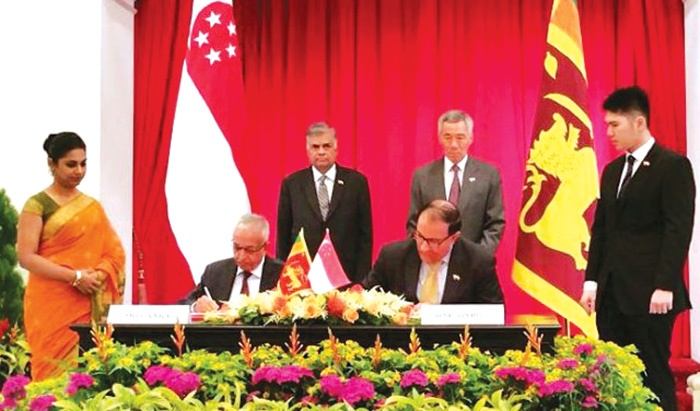
Any Sri Lankan would agree with the above words of President Wickremesinghe on the false promises our politicians and officials make and the fairy tales they narrate which bankrupted this country. So, to understand this, let’s look at one such fairy tale with lots of false promises; Ranil Wickremesinghe’s greatest achievement in the area of international trade and investment promotion during the Yahapalana period, Sri Lanka-Singapore Free Trade Agreement (SLSFTA).
It is appropriate and timely to do it now as Finance Minister Wickremesinghe has just presented to parliament a bill on the National Policy on Economic Transformation which includes the establishment of an Office for International Trade and the Sri Lanka Institute of Economics and International Trade.
Was SLSFTA a “Cleverly negotiated Free Trade Agreement” as stated by the (former) Minister of Development Strategies and International Trade Malik Samarawickrama during the Parliamentary Debate on the SLSFTA in July 2018, or a colossal blunder covered up with lies, false promises, and fairy tales? After SLSFTA was signed there were a number of fairy tales published on this agreement by the Ministry of Development Strategies and International, Institute of Policy Studies, and others.
However, for this article, I would like to limit my comments to the speech by Minister Samarawickrama during the Parliamentary Debate, and the two most important areas in the agreement which were covered up with lies, fairy tales, and false promises, namely: revenue loss for Sri Lanka and Investment from Singapore. On the other important area, “Waste products dumping” I do not want to comment here as I have written extensively on the issue.
1. The revenue loss
During the Parliamentary Debate in July 2018, Minister Samarawickrama stated “…. let me reiterate that this FTA with Singapore has been very cleverly negotiated by us…. The liberalisation programme under this FTA has been carefully designed to have the least impact on domestic industry and revenue collection. We have included all revenue sensitive items in the negative list of items which will not be subject to removal of tariff. Therefore, 97.8% revenue from Customs duty is protected. Our tariff liberalisation will take place over a period of 12-15 years! In fact, the revenue earned through tariffs on goods imported from Singapore last year was Rs. 35 billion.
The revenue loss for over the next 15 years due to the FTA is only Rs. 733 million– which when annualised, on average, is just Rs. 51 million. That is just 0.14% per year! So anyone who claims the Singapore FTA causes revenue loss to the Government cannot do basic arithmetic! Mr. Speaker, in conclusion, I call on my fellow members of this House – don’t mislead the public with baseless criticism that is not grounded in facts. Don’t look at petty politics and use these issues for your own political survival.”
I was surprised to read the minister’s speech because an article published in January 2018 in “The Straits Times“, based on information released by the Singaporean Negotiators stated, “…. With the FTA, tariff savings for Singapore exports are estimated to hit $10 million annually“.
As the annual tariff savings (that is the revenue loss for Sri Lanka) calculated by the Singaporean Negotiators, Singaporean $ 10 million (Sri Lankan rupees 1,200 million in 2018) was way above the rupees’ 733 million revenue loss for 15 years estimated by the Sri Lankan negotiators, it was clear to any observer that one of the parties to the agreement had not done the basic arithmetic!
Six years later, according to a report published by “The Morning” newspaper, speaking at the Committee on Public Finance (COPF) on 7th May 2024, Mr Samarawickrama’s chief trade negotiator K.J. Weerasinghehad had admitted “…. that forecasted revenue loss for the Government of Sri Lanka through the Singapore FTA is Rs. 450 million in 2023 and Rs. 1.3 billion in 2024.”
If these numbers are correct, as tariff liberalisation under the SLSFTA has just started, we will pass Rs 2 billion very soon. Then, the question is how Sri Lanka’s trade negotiators made such a colossal blunder. Didn’t they do their basic arithmetic? If they didn’t know how to do basic arithmetic they should have at least done their basic readings. For example, the headline of the article published in The Straits Times in January 2018 was “Singapore, Sri Lanka sign FTA, annual savings of $10m expected”.
Anyway, as Sri Lanka’s chief negotiator reiterated at the COPF meeting that “…. since 99% of the tariffs in Singapore have zero rates of duty, Sri Lanka has agreed on 80% tariff liberalisation over a period of 15 years while expecting Singapore investments to address the imbalance in trade,” let’s turn towards investment.
Investment from Singapore
In July 2018, speaking during the Parliamentary Debate on the FTA this is what Minister Malik Samarawickrama stated on investment from Singapore, “Already, thanks to this FTA, in just the past two-and-a-half months since the agreement came into effect we have received a proposal from Singapore for investment amounting to $ 14.8 billion in an oil refinery for export of petroleum products. In addition, we have proposals for a steel manufacturing plant for exports ($ 1 billion investment), flour milling plant ($ 50 million), sugar refinery ($ 200 million). This adds up to more than $ 16.05 billion in the pipeline on these projects alone.
And all of these projects will create thousands of more jobs for our people. In principle approval has already been granted by the BOI and the investors are awaiting the release of land the environmental approvals to commence the project.
I request the Opposition and those with vested interests to change their narrow-minded thinking and join us to develop our country. We must always look at what is best for the whole community, not just the few who may oppose. We owe it to our people to courageously take decisions that will change their lives for the better.”
According to the media report I quoted earlier, speaking at the Committee on Public Finance (COPF) Chief Negotiator Weerasinghe has admitted that Sri Lanka was not happy with overall Singapore investments that have come in the past few years in return for the trade liberalisation under the Singapore-Sri Lanka Free Trade Agreement. He has added that between 2021 and 2023 the total investment from Singapore had been around $162 million!
What happened to those projects worth $16 billion negotiated, thanks to the SLSFTA, in just the two-and-a-half months after the agreement came into effect and approved by the BOI? I do not know about the steel manufacturing plant for exports ($ 1 billion investment), flour milling plant ($ 50 million) and sugar refinery ($ 200 million).
However, story of the multibillion-dollar investment in the Petroleum Refinery unfolded in a manner that would qualify it as the best fairy tale with false promises presented by our politicians and the officials, prior to 2019 elections.
Though many Sri Lankans got to know, through the media which repeatedly highlighted a plethora of issues surrounding the project and the questionable credentials of the Singaporean investor, the construction work on the Mirrijiwela Oil Refinery along with the cement factory began on the24th of March 2019 with a bang and Minister Ranil Wickremesinghe and his ministers along with the foreign and local dignitaries laid the foundation stones.
That was few months before the 2019 Presidential elections. Inaugurating the construction work Prime Minister Ranil Wickremesinghe said the projects will create thousands of job opportunities in the area and surrounding districts.
The oil refinery, which was to be built over 200 acres of land, with the capacity to refine 200,000 barrels of crude oil per day, was to generate US$7 billion of exports and create 1,500 direct and 3,000 indirect jobs. The construction of the refinery was to be completed in 44 months. Four years later, in August 2023 the Cabinet of Ministers approved the proposal presented by President Ranil Wickremesinghe to cancel the agreement with the investors of the refinery as the project has not been implemented! Can they explain to the country how much money was wasted to produce that fairy tale?
It is obvious that the President, ministers, and officials had made huge blunders and had deliberately misled the public and the parliament on the revenue loss and potential investment from SLSFTA with fairy tales and false promises.
As the president himself said, a country cannot be developed by making false promises or with fairy tales and these false promises and fairy tales had bankrupted the country. “Unfortunately, many segments of the population have not come to realize this yet”.
(The writer, a specialist and an activist on trade and development issues . )



US sports envoys to Lanka to champion youth development

Rahuman questions sudden cancellation of leave of CEB employees


