Features
Wesley College Colombo – Celebrating 150 years of Excellence

by Dr Nihal D Amerasekera
Wesley College Colombo is celebrating its 150th Anniversary in March 2024 with a programme of events, projects and initiatives taking place at the school and other venues. The school is proud to be recognised as one of Sri Lanka’s leading and progressive institutions. Wesley provides a fine all-round education reflective of its long-held customs and traditions.
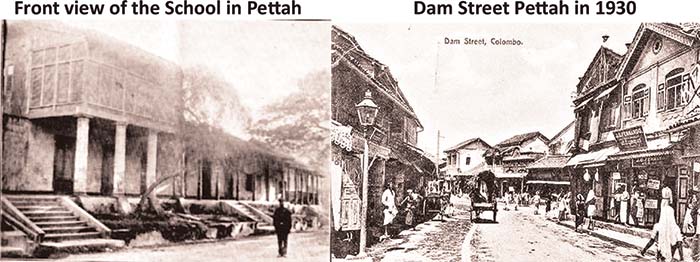
As I write this brief history I am ever reminded of the wisdom of Kahlil Gibran: “Yesterday is but today’s memory, and tomorrow is today’s dream.” This is an attempt to summarise the school’s long and tortuous journey from its lowly beginnings. Collating information belonging to three centuries is no mean task. On December 23, 1816, The chapel of the Wesleyan Mission House was opened for public worship in Dam Street, Pettah. There was a small school associated with the Mission House.
Its popularity grew and the student numbers increased. This early success led to its rapid expansion. With the vision and wisdom of Rev Daniel Henry Pereira, Wesley College was established on this site on March 2, 1874. The school then had around 100 students. Dam street in those days was quiet, dignified and respectable. Rev. Samuel Rowse Wilkin became its first Principal and Rev Pereira his deputy. By all accounts, together, they were impressive.
As Pettah rapidly became industrialised the school got lost in the urban sprawl. With the increasing noise, dust and grime of the area, the environment became less suitable for a school. The student numbers continued to grow and the space became too cramped and restrictive. It was around 1902 when Rev Henry Highfield , the Principal, decided it was time to move the school to better surroundings. In those distant days finding a suitable place for the new school was a monumental task and seemed like an impossible dream. He made a colossal effort to achieve this. The Rev Highfield made representations to the Methodist Mission in London for financial support. He cycled the length and breadth of the city and travelled the country calling for donations from his affluent past students and personal friends.
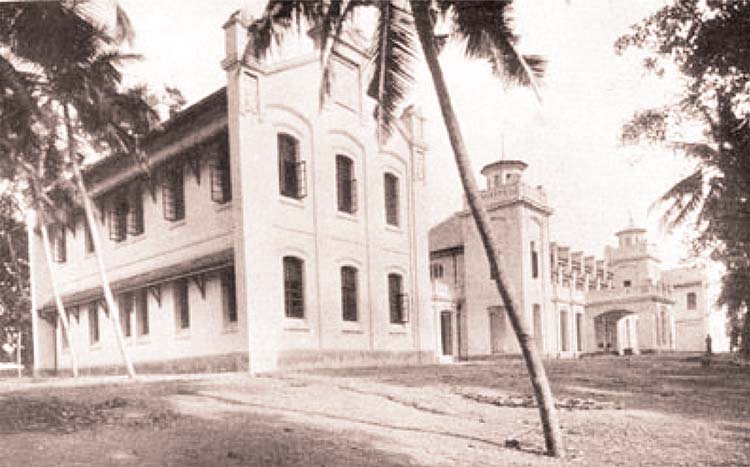
Wesley College in 1907
There was a substantial grant from London. With the money raised from local donations, Rev Highfield acquired five and a half acres of prime land at Karlsruhe Gardens to build the new Wesley College. The work began in 1905. Rev Highfield sought the help of the British Architect Edward Skinner and a handsome set of buildings were completed in 1907. This included dormitories for 100 boarders and science laboratories. The school with 639 students was opened in January 1907 with much pomp and pageantry. The Coronation Band played on as the Cadet Corp provided the guard of honour for the British Lieutenant Governor. When the school moved it took with it the spirit, culture and the ethos of Wesley College in Pettah.
The new school retained the motto “Ora et labora” (pay and work) introduced by Rev Arthur Shipham and the School Song composed by Mr H.J.V.I Ekanayake in 1889. These remained a rallying and unifying force and an important part of school life. The school crest introduced to the school in Pettah was later enhanced and altered by Rev John Dalby (1929-40). Rev. Albert Hutchinson (1925 – 1928) established the praepostor (prefect) system and the House System. Mr C.J Oorloff (1950-57) gave the primary school their own “Houses”. Rev P.T Cash’s wife Edith trained Wesley’s first choir in 1907, starting another noteworthy tradition of bringing music into the mainstream of Wesley life. It was Rev. P.T Cash who founded the Wesley College Scout Troop in 1917 and registered it as the 14th Colombo S.T.
Rev Henry Highfield is considered the father of the present school in Karlsruhe Gardens. A man of great determination, charisma and passion, he made a pioneering contribution to education in Ceylon, at the turn of the 20th Century. There are few Principals who have left a legacy that has profoundly and irreversibly changed the landscape of education in our Island. Wesley College has emerged from its quiet 19th-century grand traditions to embrace modernity. The fine original buildings still remain a tribute to Rev Highfield. This magnificent architectural masterpiece reflects the vision of a great man. After his dream was realised and Wesley became a successful institution, Rev Henry Highfield left for England for the final time in April 1925.
The seeds of decline and failure are almost always sown after periods of sustained success. The school progressed from strength to strength until the scourge of WW2. In a short period of time, 1940-44, we had the disruption of having three Principals in quick succession. Adding to our problems, in April 1942 the school buildings were taken over by the military. We lost much of our furniture and equipment in the process. The school was then exiled to Carey College and later to cadjan huts at Kitiyakkara in Campbell Place.
During those war years we lost many of our teaching staff. The student numbers reduced to a meagre 100. Our Principals’ steered the school through these difficult times until the buildings were returned to us at the end of 1945. Rev James Cartman then had the massive task of recruiting staff and getting the school into action again. His force of character helped to turn the school’s fortunes around and he did so with such resolve and dedication. During his principalship, Wesley College arose from the doldrum of the war years to become one of the best schools in the country. In grateful memory we have named our school library “The Cartman Library”.
This is a timely moment to express our gratitude to all our British Principals. They left the comfort of working in a rural Parish in Britain to be Missionaries in Ceylon. Life in Ceylon in those days was difficult. Medical facilities were rudimentary. Cyclical epidemics of Typhoid , Dysentery, Small pox and Cholera took their toll. Mrs. Highfield succumbed to typhoid fever.
To live as foreigners in a country struggling for independence could not have been easy. The achievements of our British Principals show their resilience and character. Many stories exist of their immense love for Wesley College and for the many students who were in their care. We are eternally grateful to the Methodist Missionary Society of Great Britain for sending us their best educationists. They have helped us in no small measure to enhance the stature of the school as one of the finest in the country. I must mention also the British Chaplains during my time at Wesley, Revs Wilfred Pile and Hugh Tattersall, both wonderfully kind people who provided the pastoral care immersing themselves fully in the life of the school.
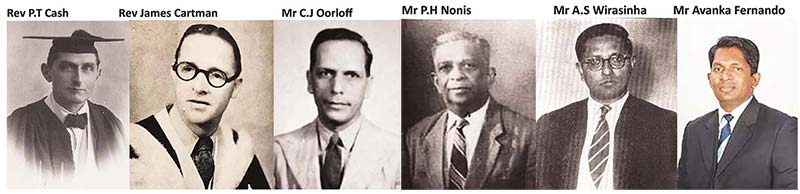

With the birth of a new nation after Independence in 1948, there was the inevitable surge of ultranationalism. The Government policy on education was switched to satisfy a country caught up in this nationalist fervour. During the Principalship of Mr C.J Oorloff in 1951 Wesley was made a Government Assisted School stifling his freedom to manage the school as before. Being a former Civil Servant, with his flair and intelligence he was able to guide Wesley into calmer waters. In 1961 the Government decided to take over all assisted schools.
Mr P.H Nonis (1957-61) had to make the drastic and radical decision for Wesley to become a private but non-fee levying school. This made our financial situation precarious. We had to sell the small park and staff flats to survive. The Welfare Board was established at this time to collect funds to run the school. During this period of perilous uncertainty Mr A.S Wirasinha (1962-83) was the Principal. With robust planning he steered the school through the rapids for a challenging 22 years. We value immensely his huge and impeccable personal effort.
Until the dawn of the new millennium, serious financial pressures sent the school into a spiral of decline. While the times were difficult mistakes have been made, for sure. Then the voices of dissent became loud and clear and the leadership came under close scrutiny. For many the prick of personal pride hurt deep within. This caused great worry and consternation to the past students, well-wishers and also to the Methodist Church. We were fortunate to have a succession of dedicated Principals to forge us forward.
Thankfully we had as Principal, Dr Shanti McLelland (2009-14). He secured success and prosperity to the school by his new management style of collaboration and cooperation with the Department of Education, the Old Boys Unions, the Methodist Church and the Board of Governors. He established economic stability and returned the school to the top of the league table again. We now have a young energetic Principal in Mr Avanka Fernando. The academic standards and sports are in the ascendancy. Wesley College is a much sought after institution of education. The current principal is an old boy of Wesley College and is well aware of the ethos, heritage and traditions of this great school.
As an institution the school remembers its Principals. Their names are prominently displayed on a board in the Great Hall. A school is only as good as its teachers. James Hilton In his literary masterpiece also made into a film, “Goodbye Mr. Chips”, he has a touching account of the dying Chips recalling the names of the pupils he had taught. I daresay that is bound to be a common trait amongst teachers. From its very inception Wesley College was largely influenced by the traditions, values and the spirit of British public schools. We are proud of our legendary and dedicated teachers. Many remained at Wesley all their professional lives and developed a close rapport with generations of students.
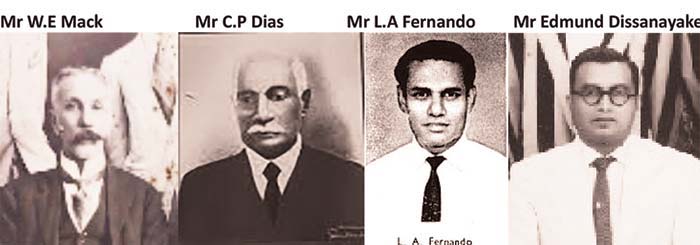
Those teachers are remembered with great fondness. Their photographs adorn the walls of the Great Hall. Students of every generation will have their own special teachers who have performed beyond the call of duty. Those from the Highfield era, Mr C.P Dias and Mr. W.E Mack among others are remembered for their loyalty and dedication. During my time at school in the 1950’s I feel immensely indebted to the colourful personality of Mr L.A Fernando and the doyen of cricket Mr Edmund Dissanayake. We remember all our teachers with affection and admiration. “Their names liveth forevermore”.
The success of a school is judged by the achievements of its alumni. Over the 150 years Wesley College have produced many who have achieved eminence and greatness in every walk of life from medicine, politics, security services, academia, education and high finance. The first Governor General of Ceylon is a product of Wesley as are three Air Vice Marshalls who have been entrusted with the security of the nation. The immense loyalty, affection and gratitude shown by the Old Boys Unions worldwide is an indication of their appreciation of the fine education they have received.
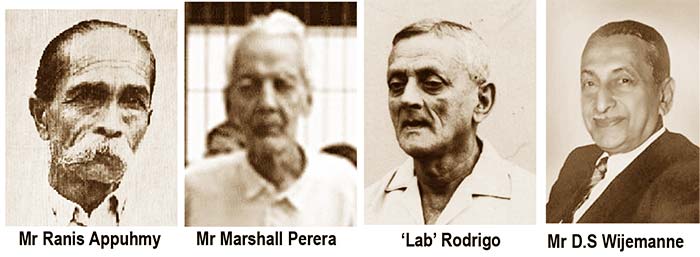
Every student who has been through the school gates will remember with affection and respect the many ancillary staff who have cared for the school buildings and the grounds while keeping the gardens neat and immaculate. During my time we had Ranis Appuhamy who rang the bell and the peon, Marshall, who did the errands. Each of them served the school for over 40 years. We recall with gratitude the laboratory staff and those who cared for Campbell Park. Wilbert the groundsman looked after the park and the pavilion with great dedication.
The boarding has been an integral part of the school since the days in Pettah. This provided a home away from home and a safe sanctuary for students. The excellent facilities have helped to make living and learning a great experience for boarders. I was a boarder 1952-58. The close-knit community helped to create lasting friendships. It fostered cultural diversity, independence, and self-reliance. The boarding prepared me for life beyond the school gates. More recently there has been a gradual decline in the popularity of boarding for students. After over a century of its existence, the school boarding closed its doors for the final time in 2019.
The birth of the school tuckshop is lost in the fog of time. There may have been a room or hall for the day boys to have their lunch from the days in Pettah. On personal communications it is my considered opinion that the tuckshop was first started after WW2 during the principalship of Rev Cartman. An entrepreneur and businessman Mr D.S Wijemanne was a former student of Wesley. He established the tuck shop adjacent to the hostel kitchen in a wooden shed with a corrugated metal roof. The “tuck” did brisk business during the school intervals. It was also a lifeline for the hungry boarders in the evenings. Mr Wijemanne fed several generations of Wesleyites until his demise in the early years of the new millennium.
During my years at school in the 1950’s there were 1200 students on the roll. As the population of the country increased the demand for education grew. Presently the numbers at school exceed 3000. These required more buildings and classrooms. The new Highfield Block was completed in 1959. The Labrooy Memorial Building, A.S Wirasinha building and the New Primary Block (Rev D.H Pereira Memorial Building) appeared in quick succession to accommodate the increasing numbers. The New Chapel is a place of refuge from the storms of school life. There is a new swimming pool. We have new feeder Primary Schools in Havelock Town and Tampola. Campbell Park belongs to the Colombo Municipal Council but is now on a long lease to Wesley College. The park remains our venue for all the major sports providing space for the pavilion and the OWSC (Old Weleyite Sports Club).
The school is immensely grateful to the many affiliated organisations for their support. Tradition has it that the Old Boys’ Union of the school was inaugurated on December 1, 1874, the year the school was founded. The Old Boys Unions of the school now active in almost every continent have united old boys worldwide. They have provided financial support to the school to tide over hard times and helped in the refurbishments needed to maintain the infrastructure in good repair. OWSC has been active since 1941. It is a place often dripping with nostalgia reigniting tight-knit friendships in the familiar surroundings of Campbell Park. There are many Wesley websites that ride the ether providing current information. There has been a whole galaxy of old boys who have been immensely loyal to the school. Although I am greatly tempted to mention the names of a few I will refrain from doing so as the list is far too long for this brief discourse.
I was a student at Wesley College 1950-62. I remember with great clarity and with some pain receiving six of the best from the Principal for my indiscretions. The sore bottom in no way has altered my love for the school. Throughout the centuries Wesley has stood for the freedom of the human spirit and the community of all her sons, to whatever race or religion they may belong. The Principal and staff stuck to their task to provide a fine education to all its students irrespective of their backgrounds and abilities.
Presently the school and the Wesley fraternity are a successful, busy and vibrant community. We can now look to the future with confidence. The support and loyalty of its alumni will be crucial to help and guide the school to be an educational institution worthy of its rich heritage. The school’s success will once again depend on the Principals and teachers for their dedication and devotion to prepare pupils for the rest of their lives. As always the onus will be on the students to learn and acquire the skills to be good and useful citizens of this wonderful world.
Writing the history, it becomes evident more than ever, that we live finite lives. As John Donne has said “No man is an island”. During our lives we are part of a family, a society and a community for which we have our affections and loyalty. It is for us to record history accurately and with respect. Everyone who has been associated with the school since its very inception has been an important part of our community. They will always be remembered with affection and warmth. Let the spark of history we leave behind enlighten others and light the flame to pass on into the future.