
Features
Village school reaches internet heaven and its irrigation tank gets new sluice gates

Experiences with dedicated officials worth commenting on
by Lokubanda Tillakaratne
My village Maradankalla is located six kilometres south off Anuradhapura-Trincomalee Road (A12) above Mahakanadarawa wewa, near Mihintale, in the North Central Province. But I have lived in Los Angeles for the past 43 years. During all these years, this village is where my heart has been.
Although the history of Maradankalla spans centuries, it was not on the map of the country until 1947 when its elders built the one-room school hoping the government would hear about it and step into support. Soon after it was built, the small wattle and daub schoolhouse got space for the village on the maps that came out later. In the same year, the Anuradhapura Madya Maha Vidyalaya was started 10 kilometres south of the Sacred City, under the Central College concept of the C.W. W. Kannangara era. It remains the jewel and the axis mundi of the provincial education. But as time passed, villagers realized this well-thought of Kannangara idea helped create an educational tribal system. That’s a story for another day.
The two tales I write about say how this small village in the backwoods of Anuradhapura District got connected to telephone landlines and internet to its school, got two new sluice gates and a new spillway for its irrigation tank which irrigates 60 acres of paddy lands. This is an ode to all those involved in these projects discussed here.
For A/GB/Maradankalla school, the telephone line is the instant highway to communication and the internet heaven which most city folks take for granted. The two new sluice gates will replace leaky sluices built probably in the dinosaur age.
Disparate and Separate,Supposedly Equal
Sadly, though, over the last few decades, some schools, a few kilometres from Maradankalla, lost their map space and disappeared into the hereafter. One such school is A/GB/Ihalagama, above Mahakanadarawa wewa. It is deserted now. Its crumbling buildings occupy an eerie landscape overgrown with brush. Now only the families of elephants come there daily for night classes!
Nevertheless, thanks to the untiring dedication of the teaching staff and resilience of parents, Maradankalla school still survives, like similar schools threatened with lack of modern facilities and difficulties, to keep up with well-equipped schools elsewhere. This school is still a magnet to 180 students from a few villages around it. Like its sister schools in similarly remote areas, it has precious talent and hidden gems. Every year, it sends a couple of students to city schools on 5th grade scholarship examination results. One such student, a resident of Maradankalla itself, just graduated from the Peradeniya Medical School. Another is a Law College graduate. Few more attend universities still as I write this. So, any epithet that the village school students lack potential is a myth and an outright insult.
This shows what failure and shame rural education had been on the part of all of us. In my reckoning, this misfortune was due to lukewarm Interest from the education authorities to highlight and address the systemic decay in education equality in village schools, and failure to provide an environment with new pedagogical ideas and improvements to arrest the degeneration and make these schools attractive and competitive. Retooling them to fight the draw of urban sprawl and slow down students from migrating to the city schools never found a footing here. This put parents at greater disadvantage and pressure, appallingly first with pervasive national disgrace of payoffs to school officials to get the child’s place in the city school, and other related costs.
On the other hand, Madya Maya Vidyalaya, of the same age as Maradankalla school, has over 4000 students, and is crowded to suffocation. As expected, it sends many scores of students every year to universities for higher studies. It is in the class of education royalty with the designation of ‘National School’ which is generally rewarded with, among other perks, a computer room of substantial size with internet facilities. A NASA regional Control Room comes to my mind.
But no one should get lulled into thinking that students in the schools in run-down sections of the cities get the short end of educational opportunities and second-hand treatment, too, and use it as defence to rationalize inequities students in village schools receive. Less than exemplary treatment of schools in poorer sections of the city is an injustice beyond comparison, and unacceptable. But in the village, I might add, patronized by herds of wild elephants on a nightly basis and staffed by stellar teachers, the level of educational assistance the kids there get is so bad, it is an unspeakable travesty and tragedy. One should not tell me otherwise. I know. Because I once lived through it!
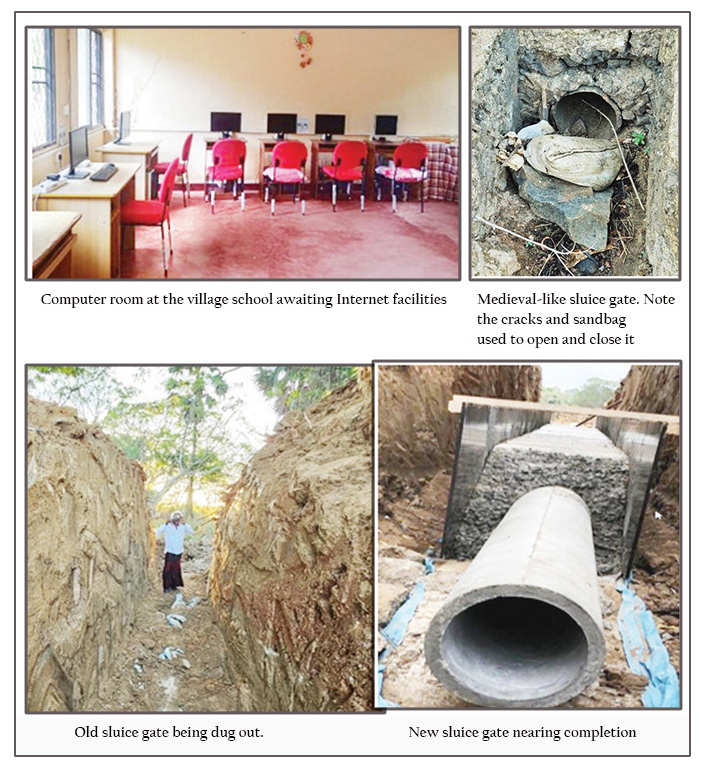
Until a few weeks ago, Maradankalla school had no phone landlines, therefore it was locked out of the Internet. But it has two working computers sitting in a converted classroom. Computer facilities elsewhere with every unit connected to the Internet and usually declared opened with pageantry by VIPs of the Machiavellian political nobility, in a room bristling with air-conditioning and so much care, to enter them one must remove shoes to prevent dust and detritus desecrating their holy environment.
Meanwhile, the principal of the village school sends his mandatory reports to the Kalaape (Zonal) office through his handphone, or while Gedara Yana Gaman through a copy. And faxing store in the town.For the principal in the city, it is so quotidian, it only takes him few keystrokes on his desktop computer: Disparate and separate but supposedly equal.
Homework or Looking for Landmines?
According to the Computer Literacy Survey for 2021 by the Department of Census and Statistics, North Central Province scored the lowest computer literacy rate in the country at 24.8% while the highest was reported, no surprise there, in the Western Province at 47.1%. Maradankalla feels the heat of this alarming disparity. It sits in the dead centre of the North Central Province.
When education policymakers send out fiat asking students to do homework using Internet on their handphones, they give little thought to these survey results. For convenience, these experts who devise education policies take them out of the equation. For them, the homework is for all students across the board, without caste or creed, in well-equipped schools and in schools with one or two working computers in a converted classroom.
Without land phone lines, a village school student has no access to the Internet, even if one is lucky enough to have a computer at home. These students use their parents’ flip phones, not the cool Samsung type others carry around with conceit. When the Education Lords ask these students to do homework and ZOOM classes by phone or at home at Maradankalla, it is akin to Marie Antoinette telling her subjects “Let them eat cake.”
During the COVID times, well, those few students who managed to have the out-of-production phones climbed the rocky outcrop by their village temple to do homework. They pointed the phones literally in all directions looking for good reception. The sad irony of this is that anyone who saw them would have mistaken them for looking for landmines using metal detectors! Meanwhile, our own Antoinettes and Antons of the policymaking fellowship carry beauties in the Rs. 200,000 range talking to their children attending foreign universities or working in embassies and consulates overseas. This is not hearsay or imagination. This is the reality.
After the Internet crept in as an educational tool, and not having it in Maradankalla school, for a long time I wanted to do something to mollify the burden dumped on its students and teachers by this ‘fair and modern educational atrocity.’ I spoke to the principal and decided to write to government officials and the private phone companies to see if they could help us to build the road to the Internet here. Sadly, after introducing Internet-based pedagogical practices, the education authorities seem to have not made any coordinated efforts to get village schools like Maradankalla connected to the wired telephone world.
In response to our appeals, the DIALOG phone company showed its heart and worth and stepped in. A couple of years ago, they built a giant tower about 400 metres from the school, hoping reception signals would improve. But the school was still out of luck as for some unknown reason, the signals were not strong enough to have a reliable and viable Internet connection to the school.
A Pensioner’s Crusade
Then, in 2018, I and my brother T. A. M. B. Thilakarathna, a retired special education teacher, took it upon us and wrote to SLT-MOBITEL in Anuradhapura for help to get a landline rolled out to the village. We knew it was a gargantuan task, probably a request that would easily end up in the waste-paper basket. That year when I came home on vacation, I also went to the Telecom office and repeated our request.
We knew the thought of rolling out six kilometres of coir rope was irrational and testing enough, thinking of a fibre-optic phone line even half that length connecting us to satellites many stratospheres above was beyond insane. But my brother, amiable, persistent and with an infectious smile at every turn, began to visit government offices in Anuradhapura looking for a solution to this problem. His milk-white fluffy beard resembling that of a Himalayan Rishi and matching moustache of a Ravana mirrored his determination for success. The unkept white band of hair in the back of his bald head danced like tail feathers of a messenger pigeon in flight.
Sure enough, as weeks and months passed behind him, the message he carried resonated enough, this unassuming retiree’s frequent visits to the telecom offices must have made its administrators’ hearts soften. They listened and decided to do something about his plight. Soon, the machinery of the bureaucracy came to life, loosened their joints and Maradankalla got the ticket to its wish – a phone landline to join the Internet.
(I must note with appreciation that our efforts on this project were boosted by the encouragement, advice and inordinate support we received from Themiya Hurulle, a patron with deep ancestral roots and affinity to the region.)
For a span of three weeks last month, the SLT-MOBITEL technicians and engineers worked on the construction of the phone lines. Showing his own hospitality and dedication, my brother spent a good portion of his monthly retirement deposit to buy food packets daily for about half a dozen workers.
Finally, the parents, their children and teachers got their desideratum granted. The school is now in the Internet brotherhood. I am paying its monthly Internet bills and my wife Niranjala, and daughter Mihiri have teamed up to design some ZOOM activities with the students. These gestures are not as grandiose as a parent buying a bus for a school, a new cricket pitch in the playground, all embarrassing and shameful but commonplace now in most schools in populous areas. But at least on paper, this school seems like it is on a level playing field on the Internet. A round-the-clock air-conditioned room with new computers will complete the curve. That is another educational infrastructure matter the school must work on.
Finally, my brother successfully persuaded 20 households out of 53 in the village to have landphone connections! He even paid half of some villagers’ application fees. That is evidence of how much interest these villagers have given a chance to better their lives.
Last month, when I came home with my family to Maradankalla on vacation, I found myself having to deal with another pressing problem in the village. This time it was another arm of the government bureaucracy.
Every time I come home on vacation, early in the next morning usually, almost as a ritual, we take a stroll on the tank bund in front of our home to listen to the songs of water birds, feel the warmth of the cold air blowing across the tank bed and watch the breathtaking sight of the morning sun radiating off dewy rice paddies spotted with peacocks pacing with glitter and swank.
However, on this day what we saw on the bund dampened our spirits. The two sluice gates, (horowwa) were mournfully open to the dry tank bed where sandbags covered their openings. They were cracked, and chunks of concrete were falling apart. Then at the end of Medieval-like Sluice gate. Note the cracks and sandbag used to open and close it.
The bund, the spillway had fallen apart due to shoddy construction and being part of an elephant crossing. I took 27 photos and decided to go and meet someone at the Provincial Irrigation Office about this potential calamity looming ahead in the coming Maha season.
Medieval-Age Sluice Gates Replaced
It is not an embellishment to say that villagers treat water in their irrigation tank as thicker than blood. How could one not agree?
Paddy cultivation is the only source of living for nearly all of these villagers.
So, I spoke to the village Govi Sanvidhana members, wrote a letter about this issue and with them went to Anuradhapura to meet the Provincial Irrigation Director Jayantha Herath and his area Engineering staff. I had little hope that day of turning the wheels of bureaucracy.
But the magnanimous response of the Director and his office was instant and remarkable. It proved their worth and being. The Provincial Irrigation leadership worked hard to get the sluice gates and spillway repaired. It went further and determined that the Provincial RDA with its expertise, ready machinery and labour would expeditiously finish the project before the Maha rains. They are working on the sluices and the spillway as I write this.
Other Attempts in the Past
In order to draw the attention of the government to the needs of the community, this is not the first time I have written to government officials.
In the early 1990s, President Premadasa decided to have an Udagama to be held in Mihintale. Immediately, word got out that villages in the vicinity of Mihintale were going to be linked to the electrical grid of the country as part of the celebrations. This news electrified the villagers in Maradankalla. Immediately, I wrote a letter to the then President and posted it hoping we might hit the jackpot. ‘What is there to lose,’ I thought at the time.
By writing the letter, I wanted to feel good about doing something, but never expected it would get anywhere. That is how these things usually work in big offices – if the letter didn’t get lost in transmission, there is a better chance it will get lost in translation. But the Good President made sure my letter ended up on the desk of the Electrical Engineering folks in Anuradhapura. Surprisingly, within weeks they came to Maradankalla looking for me. My brother met them, and the Engineer gave an update about the project that was going to follow. I won’t deny it, I was surprised and equally exhilarated to hear of this development.
Consequently, the villagers in and around Maradankalla got their illuminating moment. To optimize dwindling funding resources, we banded together to help out and cut trees along the route to clear space for the power lines. Although Maradankalla is eight kilometres from Udagama, now the home to the bustling Raja Rata University, it now has electricity. Life there with oil lamps and kerosene carts is long gone history. Unfortunately, President Premadasa’s untimely death prevented him from enjoying the Udagama and consequential fruits it brought to the area.
Allegory of the Stories
The allegory of these pleasant stories is if someone writes to the bureaucracy asking for help, not for personal but about an issue in your community, hold on to some hope. A godly person, and a mighty unusual one you didn’t know that existed sitting somewhere behind a desk in an office would read it. I am not naïve here to give a pass to all bureaucrats. But this official you write to is different – utterly decent, courteous and if you go to meet that person, he or she will shake your hand or close the palms together and say “Ayubowan,” offer you a seat and listen to your problem eagerly and earnestly as if it is that person’s own. He or she is sure to treat you like an equal and a friend, and in the middle of the conversation even offer you a cup of tea. That person is honourable and good, lives up to his or her responsibility and is kind enough to take up the issue and do something in their power.
Then villagers may not have to worry about Maha season water, thanks, in this case, to the Provincial Irrigation folks and Provincial RDA and its technicians and Engineer, or the folks who brought the Internet to their village school.
With the new sluice gates and the spillway, thankful Maradankalla villagers will be eager to start the Maha season work and look forward to the Yala season with water saved with air-tight sluice gates. With the Internet, village school students will have more ways to learn about homework assignments. Villagers will have the opportunity to listen to ubiquitous religious talks on YouTube and keep up with the Teledrama parade. These stories perhaps will no doubt become yesterday’s newspaper to many. But in my village, these are tales of life-changing moments, which they will talk about for many years to come. Each time the story is told, they will solemnly reminisce about the experience and thank those who made it happen.








by Dr Gotabhya Ranasinghe
Senior Consultant Cardiologist
National Hospital Sri Lanka
When we sought a meeting with Hon Dr. Ramesh Pathirana, Minister of Health, he graciously cleared his busy schedule to accommodate us. Renowned for his attentive listening and deep understanding, Minister Pathirana is dedicated to advancing the health sector. His openness and transparency exemplify the qualities of an exemplary politician and minister.
Dr. Palitha Mahipala, the current Health Secretary, demonstrates both commendable enthusiasm and unwavering support. This combination of attributes makes him a highly compatible colleague for the esteemed Minister of Health.
Our discussion centered on a project that has been in the works for the past 30 years, one that no other minister had managed to advance.
Minister Pathirana, however, recognized the project’s significance and its potential to revolutionize care for heart patients.
The project involves the construction of a state-of-the-art facility at the premises of the National Hospital Colombo. The project’s location within the premises of the National Hospital underscores its importance and relevance to the healthcare infrastructure of the nation.
This facility will include a cardiology building and a tertiary care center, equipped with the latest technology to handle and treat all types of heart-related conditions and surgeries.
Securing funding was a major milestone for this initiative. Minister Pathirana successfully obtained approval for a $40 billion loan from the Asian Development Bank. With the funding in place, the foundation stone is scheduled to be laid in September this year, and construction will begin in January 2025.
This project guarantees a consistent and uninterrupted supply of stents and related medications for heart patients. As a result, patients will have timely access to essential medical supplies during their treatment and recovery. By securing these critical resources, the project aims to enhance patient outcomes, minimize treatment delays, and maintain the highest standards of cardiac care.
Upon its fruition, this monumental building will serve as a beacon of hope and healing, symbolizing the unwavering dedication to improving patient outcomes and fostering a healthier society.We anticipate a future marked by significant progress and positive outcomes in Sri Lanka’s cardiovascular treatment landscape within the foreseeable timeframe.

by Fr. Emmanuel Fernando, OMI
Jesuit Fr. Aloysius Pieris (affectionately called Fr. Aloy) celebrated his 90th birthday on April 9, 2024 and I, as the editor of our Oblate Journal, THE MISSIONARY OBLATE had gone to press by that time. Immediately I decided to publish an article, appreciating the untiring selfless services he continues to offer for inter-Faith dialogue, the renewal of the Catholic Church, his concern for the poor and the suffering Sri Lankan masses and to me, the present writer.
It was in 1988, when I was appointed Director of the Oblate Scholastics at Ampitiya by the then Oblate Provincial Fr. Anselm Silva, that I came to know Fr. Aloy more closely. Knowing well his expertise in matters spiritual, theological, Indological and pastoral, and with the collaborative spirit of my companion-formators, our Oblate Scholastics were sent to Tulana, the Research and Encounter Centre, Kelaniya, of which he is the Founder-Director, for ‘exposure-programmes’ on matters spiritual, biblical, theological and pastoral. Some of these dimensions according to my view and that of my companion-formators, were not available at the National Seminary, Ampitiya.
Ever since that time, our Oblate formators/ accompaniers at the Oblate Scholasticate, Ampitiya , have continued to send our Oblate Scholastics to Tulana Centre for deepening their insights and convictions regarding matters needed to serve the people in today’s context. Fr. Aloy also had tried very enthusiastically with the Oblate team headed by Frs. Oswald Firth and Clement Waidyasekara to begin a Theologate, directed by the Religious Congregations in Sri Lanka, for the contextual formation/ accompaniment of their members. It should very well be a desired goal of the Leaders / Provincials of the Religious Congregations.
Besides being a formator/accompanier at the Oblate Scholasticate, I was entrusted also with the task of editing and publishing our Oblate journal, ‘The Missionary Oblate’. To maintain the quality of the journal I continue to depend on Fr. Aloy for his thought-provoking and stimulating articles on Biblical Spirituality, Biblical Theology and Ecclesiology. I am very grateful to him for his generous assistance. Of late, his writings on renewal of the Church, initiated by Pope St. John XX111 and continued by Pope Francis through the Synodal path, published in our Oblate journal, enable our readers to focus their attention also on the needed renewal in the Catholic Church in Sri Lanka. Fr. Aloy appreciated very much the Synodal path adopted by the Jesuit Pope Francis for the renewal of the Church, rooted very much on prayerful discernment. In my Religious and presbyteral life, Fr.Aloy continues to be my spiritual animator / guide and ongoing formator / acccompanier.
Fr. Aloysius Pieris, BA Hons (Lond), LPh (SHC, India), STL (PFT, Naples), PhD (SLU/VC), ThD (Tilburg), D.Ltt (KU), has been one of the eminent Asian theologians well recognized internationally and one who has lectured and held visiting chairs in many universities both in the West and in the East. Many members of Religious Congregations from Asian countries have benefited from his lectures and guidance in the East Asian Pastoral Institute (EAPI) in Manila, Philippines. He had been a Theologian consulted by the Federation of Asian Bishops’ Conferences for many years. During his professorship at the Gregorian University in Rome, he was called to be a member of a special group of advisers on other religions consulted by Pope Paul VI.
Fr. Aloy is the author of more than 30 books and well over 500 Research Papers. Some of his books and articles have been translated and published in several countries. Among those books, one can find the following: 1) The Genesis of an Asian Theology of Liberation (An Autobiographical Excursus on the Art of Theologising in Asia, 2) An Asian Theology of Liberation, 3) Providential Timeliness of Vatican 11 (a long-overdue halt to a scandalous millennium, 4) Give Vatican 11 a chance, 5) Leadership in the Church, 6) Relishing our faith in working for justice (Themes for study and discussion), 7) A Message meant mainly, not exclusively for Jesuits (Background information necessary for helping Francis renew the Church), 8) Lent in Lanka (Reflections and Resolutions, 9) Love meets wisdom (A Christian Experience of Buddhism, 10) Fire and Water 11) God’s Reign for God’s poor, 12) Our Unhiddden Agenda (How we Jesuits work, pray and form our men). He is also the Editor of two journals, Vagdevi, Journal of Religious Reflection and Dialogue, New Series.
Fr. Aloy has a BA in Pali and Sanskrit from the University of London and a Ph.D in Buddhist Philosophy from the University of Sri Lankan, Vidyodaya Campus. On Nov. 23, 2019, he was awarded the prestigious honorary Doctorate of Literature (D.Litt) by the Chancellor of the University of Kelaniya, the Most Venerable Welamitiyawe Dharmakirthi Sri Kusala Dhamma Thera.
Fr. Aloy continues to be a promoter of Gospel values and virtues. Justice as a constitutive dimension of love and social concern for the downtrodden masses are very much noted in his life and work. He had very much appreciated the commitment of the late Fr. Joseph (Joe) Fernando, the National Director of the Social and Economic Centre (SEDEC) for the poor.
In Sri Lanka, a few religious Congregations – the Good Shepherd Sisters, the Christian Brothers, the Marist Brothers and the Oblates – have invited him to animate their members especially during their Provincial Congresses, Chapters and International Conferences. The mainline Christian Churches also have sought his advice and followed his seminars. I, for one, regret very much, that the Sri Lankan authorities of the Catholic Church –today’s Hierarchy—- have not sought Fr.
Aloy’s expertise for the renewal of the Catholic Church in Sri Lanka and thus have not benefited from the immense store of wisdom and insight that he can offer to our local Church while the Sri Lankan bishops who governed the Catholic church in the immediate aftermath of the Second Vatican Council (Edmund Fernando OMI, Anthony de Saram, Leo Nanayakkara OSB, Frank Marcus Fernando, Paul Perera,) visited him and consulted him on many matters. Among the Tamil Bishops, Bishop Rayappu Joseph was keeping close contact with him and Bishop J. Deogupillai hosted him and his team visiting him after the horrible Black July massacre of Tamils.
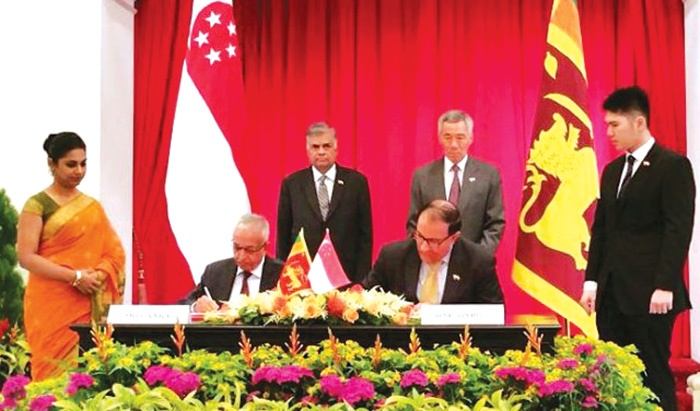
Sri Lanka-Singapore Free Trade Agreement
By Gomi Senadhira
senadhiragomi@gmail.com
“You might tell fairy tales, but the progress of a country cannot be achieved through such narratives. A country cannot be developed by making false promises. The country moved backward because of the electoral promises made by political parties throughout time. We have witnessed that the ultimate result of this is the country becoming bankrupt. Unfortunately, many segments of the population have not come to realize this yet.” – President Ranil Wickremesinghe, 2024 Budget speech
Any Sri Lankan would agree with the above words of President Wickremesinghe on the false promises our politicians and officials make and the fairy tales they narrate which bankrupted this country. So, to understand this, let’s look at one such fairy tale with lots of false promises; Ranil Wickremesinghe’s greatest achievement in the area of international trade and investment promotion during the Yahapalana period, Sri Lanka-Singapore Free Trade Agreement (SLSFTA).
It is appropriate and timely to do it now as Finance Minister Wickremesinghe has just presented to parliament a bill on the National Policy on Economic Transformation which includes the establishment of an Office for International Trade and the Sri Lanka Institute of Economics and International Trade.
Was SLSFTA a “Cleverly negotiated Free Trade Agreement” as stated by the (former) Minister of Development Strategies and International Trade Malik Samarawickrama during the Parliamentary Debate on the SLSFTA in July 2018, or a colossal blunder covered up with lies, false promises, and fairy tales? After SLSFTA was signed there were a number of fairy tales published on this agreement by the Ministry of Development Strategies and International, Institute of Policy Studies, and others.
However, for this article, I would like to limit my comments to the speech by Minister Samarawickrama during the Parliamentary Debate, and the two most important areas in the agreement which were covered up with lies, fairy tales, and false promises, namely: revenue loss for Sri Lanka and Investment from Singapore. On the other important area, “Waste products dumping” I do not want to comment here as I have written extensively on the issue.
1. The revenue loss
During the Parliamentary Debate in July 2018, Minister Samarawickrama stated “…. let me reiterate that this FTA with Singapore has been very cleverly negotiated by us…. The liberalisation programme under this FTA has been carefully designed to have the least impact on domestic industry and revenue collection. We have included all revenue sensitive items in the negative list of items which will not be subject to removal of tariff. Therefore, 97.8% revenue from Customs duty is protected. Our tariff liberalisation will take place over a period of 12-15 years! In fact, the revenue earned through tariffs on goods imported from Singapore last year was Rs. 35 billion.
The revenue loss for over the next 15 years due to the FTA is only Rs. 733 million– which when annualised, on average, is just Rs. 51 million. That is just 0.14% per year! So anyone who claims the Singapore FTA causes revenue loss to the Government cannot do basic arithmetic! Mr. Speaker, in conclusion, I call on my fellow members of this House – don’t mislead the public with baseless criticism that is not grounded in facts. Don’t look at petty politics and use these issues for your own political survival.”
I was surprised to read the minister’s speech because an article published in January 2018 in “The Straits Times“, based on information released by the Singaporean Negotiators stated, “…. With the FTA, tariff savings for Singapore exports are estimated to hit $10 million annually“.
As the annual tariff savings (that is the revenue loss for Sri Lanka) calculated by the Singaporean Negotiators, Singaporean $ 10 million (Sri Lankan rupees 1,200 million in 2018) was way above the rupees’ 733 million revenue loss for 15 years estimated by the Sri Lankan negotiators, it was clear to any observer that one of the parties to the agreement had not done the basic arithmetic!
Six years later, according to a report published by “The Morning” newspaper, speaking at the Committee on Public Finance (COPF) on 7th May 2024, Mr Samarawickrama’s chief trade negotiator K.J. Weerasinghehad had admitted “…. that forecasted revenue loss for the Government of Sri Lanka through the Singapore FTA is Rs. 450 million in 2023 and Rs. 1.3 billion in 2024.”
If these numbers are correct, as tariff liberalisation under the SLSFTA has just started, we will pass Rs 2 billion very soon. Then, the question is how Sri Lanka’s trade negotiators made such a colossal blunder. Didn’t they do their basic arithmetic? If they didn’t know how to do basic arithmetic they should have at least done their basic readings. For example, the headline of the article published in The Straits Times in January 2018 was “Singapore, Sri Lanka sign FTA, annual savings of $10m expected”.
Anyway, as Sri Lanka’s chief negotiator reiterated at the COPF meeting that “…. since 99% of the tariffs in Singapore have zero rates of duty, Sri Lanka has agreed on 80% tariff liberalisation over a period of 15 years while expecting Singapore investments to address the imbalance in trade,” let’s turn towards investment.
Investment from Singapore
In July 2018, speaking during the Parliamentary Debate on the FTA this is what Minister Malik Samarawickrama stated on investment from Singapore, “Already, thanks to this FTA, in just the past two-and-a-half months since the agreement came into effect we have received a proposal from Singapore for investment amounting to $ 14.8 billion in an oil refinery for export of petroleum products. In addition, we have proposals for a steel manufacturing plant for exports ($ 1 billion investment), flour milling plant ($ 50 million), sugar refinery ($ 200 million). This adds up to more than $ 16.05 billion in the pipeline on these projects alone.
And all of these projects will create thousands of more jobs for our people. In principle approval has already been granted by the BOI and the investors are awaiting the release of land the environmental approvals to commence the project.
I request the Opposition and those with vested interests to change their narrow-minded thinking and join us to develop our country. We must always look at what is best for the whole community, not just the few who may oppose. We owe it to our people to courageously take decisions that will change their lives for the better.”
According to the media report I quoted earlier, speaking at the Committee on Public Finance (COPF) Chief Negotiator Weerasinghe has admitted that Sri Lanka was not happy with overall Singapore investments that have come in the past few years in return for the trade liberalisation under the Singapore-Sri Lanka Free Trade Agreement. He has added that between 2021 and 2023 the total investment from Singapore had been around $162 million!
What happened to those projects worth $16 billion negotiated, thanks to the SLSFTA, in just the two-and-a-half months after the agreement came into effect and approved by the BOI? I do not know about the steel manufacturing plant for exports ($ 1 billion investment), flour milling plant ($ 50 million) and sugar refinery ($ 200 million).
However, story of the multibillion-dollar investment in the Petroleum Refinery unfolded in a manner that would qualify it as the best fairy tale with false promises presented by our politicians and the officials, prior to 2019 elections.
Though many Sri Lankans got to know, through the media which repeatedly highlighted a plethora of issues surrounding the project and the questionable credentials of the Singaporean investor, the construction work on the Mirrijiwela Oil Refinery along with the cement factory began on the24th of March 2019 with a bang and Minister Ranil Wickremesinghe and his ministers along with the foreign and local dignitaries laid the foundation stones.
That was few months before the 2019 Presidential elections. Inaugurating the construction work Prime Minister Ranil Wickremesinghe said the projects will create thousands of job opportunities in the area and surrounding districts.
The oil refinery, which was to be built over 200 acres of land, with the capacity to refine 200,000 barrels of crude oil per day, was to generate US$7 billion of exports and create 1,500 direct and 3,000 indirect jobs. The construction of the refinery was to be completed in 44 months. Four years later, in August 2023 the Cabinet of Ministers approved the proposal presented by President Ranil Wickremesinghe to cancel the agreement with the investors of the refinery as the project has not been implemented! Can they explain to the country how much money was wasted to produce that fairy tale?
It is obvious that the President, ministers, and officials had made huge blunders and had deliberately misled the public and the parliament on the revenue loss and potential investment from SLSFTA with fairy tales and false promises.
As the president himself said, a country cannot be developed by making false promises or with fairy tales and these false promises and fairy tales had bankrupted the country. “Unfortunately, many segments of the population have not come to realize this yet”.
(The writer, a specialist and an activist on trade and development issues . )



US sports envoys to Lanka to champion youth development

Rahuman questions sudden cancellation of leave of CEB employees


