Midweek Review
Vignettes of the Open-Air Theatre

by Prof. K. N. O. Dharmadasa
It is indisputably The Open-Air Theatre – the first of its kind in the country and the most well-known. There indeed are some other similar constructions, like the one at Vihara Maha Devi Park, Colombo. But when theatre lovers talk of ‘the Open-Air Theatre’, the reference is unmistakably to the Open-Air Theatre in the ‘University Park’, Peradeniya. Incidentally, the appellation ‘University Park’ was a creation of Sir Ivor Jennings, the Founder Vice Chancellor of the University. The area where the university buildings were located was known by this name. Sir Ivor was so enamoured of the site that he called it ‘one of the most beautiful environments in the world” (his autobiography The Road to Peradeniya,198). His Annual Reports usually had a sub-section titled ‘University Park’; he reported on the building programme and the landscaping, etc. Coming back to the Open-Air Theatre, which was constructed three years after he left in January 1955, undoubtedly adds to the beauty of the whole landscape – a good example of how a tastefully constructed structure which blends with the surroundings can enhance the natural beauty of a place.
The conception
The Open-Air Theatre was ceremonially declared open in early 1958. The first drama staged there was Sarchchandra’s epoch making Maname. As all theatre lovers know, the initial staging of Maname was on Nov. 3, 1956 at the Lionel Wendt Theatre in Colombo and nearly 100 performances would have taken place during the 15 or so months before it was staged at the newly constructed Open-Air Theatre in Peradeniya. Prof. Sarachchandra in his Memoirs, Pin Ethi Sarasavi Waramak Denne, (published in 1985) gives a detailed account of the founding of the Open-Air Theatre, which aptly bears his name today.
Maname had already been staged and the first accolade had come from an unusual quarter. Regi Siriwardene, a highly respected critic and journalist attached to the Lake House Group of Newspapers called it “the finest thing I have seen on the Sinhalese stage” (Ceylon Daily News, Nov. 5) Many shows followed in Colombo, Kandy and other cities and several other writers to the English newspapers showered praise on this remarkable achievement as exemplifying what the national theatrical form could be. But the Sinhalese newspapers remained silent for quite some time and Sarachchandra kept wondering why it was so. “Was it due to the habitual antipathy towards the University by most of the journalists or was it because they failed to understand what Maname signified?” But the breakthrough came eventually. Sri Chandraratne Manavasinghe, the highly respected writer and journalist attached to the editorial staff of the daily Lankadeepa, wrote a highly complimentary review of the play in his daily column Waga –Tuga and called it an Abhiranga (super-drama).
Sarachchandra with his vast experience in Oriental and Occidental theatre traditions, believed that “a super-performance of Maname could be done, not on a proscenium stage which was meant for staging naturalistic plays, but on a circular stage, (ranga madala)”. And he was on the lookout for such a place … amidst the hilly terrain of Peradeniya. He adds:
“Those days I was residing in one of the three bungalows on Sanghamitta Hill. While descending the hill and walking towards the Arts Block, I noticed a piece of land concave in shape, like a part of a broken clay pot. This was a terraced paddy field which had been abandoned and was overgrown with weeds. At the bottom of the land was a flat space. Although I had been passing that place daily it was only after I started thinking of an open-air theatre that it struck me as a suitable location for what is known as an Amphitheatre – an auditorium with a stage. The space at the bottom could be used as a stage and the audience could sit in the terraces” (p. 209)
Acoustics
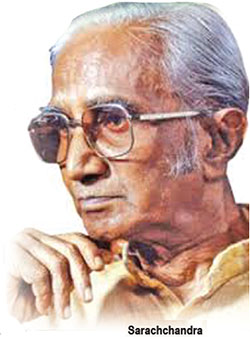

Now the problem was that of the logistics. At this time (1956-7) Sarachchandra was only a lecturer. He had no ‘clout’ to order officials in the administration. Of course, his fame and prestige were growing rapidly and by 1960 a special Chair of Sinhala was created for him, which was the first such occasion in the history of the University. But that is anticipating events. We resume the story of the construction of the OAT as narrated by Sarachchandra himself. Sarachchandra says:
“I had no power to give orders to the Works Department or to the Administrative Section. That could be done only by the Vice Chancellor or the Registrar. The expenses involved in constructing even an amphitheatre at the site I mentioned would be minimal. What had to be done was cutting and removing the weeds on the terraces, constructing in cement a circular stage at the bottom and putting up a cadjan shed behind it.” (pp. 210-11)
Now, the dilemma Sarachchandra was faced with was whether or not the Vice Chancellor would accept his proposal to construct an open-air theatre. Sarachchandra’s estimation of the Vice Chancellor Sir Nicholas Attygalle was not at all complimentary. “Like most people of the English-speaking upper class,” says Sarachchandra,
“He was completely devoid of any taste for the arts (kalaa vihiina). Although he was a Professor in the Faculty of Medicine before becoming Vice Chancellor, his range of knowledge was small (alpasruta). He did not have even a modicum of interest on theatre, literature, music, etc. I do not know whether he had read any other book outside the field of medicine.” (p.211).
For the present-day reader, I have to give an explanation. Without digressing too far it needs be noted that during the Attygalle phase of the University administration, there was a sharp division in the academic staff as pro-Attydalle and anti-Attygalle, and that was due largely to the dictatorial administrative style of the Vice Chancellor. It is clear where Sarachchandra stood in this division. In any case Prof. Attygalle had not displayed any interest in the arts. And the problem then was how to get the approval of a man like that for the construction of an open-air theatre. Then the miracle happened once again.
The Vice Chancellor came to know about Maname under fortuitous if not trivial circumstances. Continues Sarachchandra, “He came to know for the first time that a play named Maname had been created by a person named Sarachchandra, who was on his staff and that it was winning accolades in the country, from a group of lecturers who used to sit before his table daily, rumour-mongering and engaging in empty prattle. It was difficult for Mr. Attygalle, who had never seen a play, to understand what Maname was. He did not want to understand either. But because of the persuasions, he summoned me and asked me what this wondrous thing I had done was about which he had heard so much.” (p.211)
Sarachchandra now had to be humble. “I told him it was not a big miracle, but the production of a play. ‘Then why are they praising it so much’ he asked ‘and telling me I should see it somehow?” Next came the crucial question “Can it be shown in the University?” This created the opening Sarachchandra was looking for.
“I told him that there is no suitable theatre in the University where it could be shown. ‘But would it be possible,’ Then I asked, ‘whether such and such a place could be prepared for the purpose?’ He summoned the officers immediately and ordered them to construct without delay an open-air theatre on the site I had mentioned.” (p.211)
Sarachchandra then describes in humorous Sinhala how the officials set about their job and finished it in no time:
“The officers bent themselves double and treble, ran there, cut down the bush, pounded the ground, got a pretty circular stage made in cement, got a cadjan shed put up and created an amphitheatre in two or three days.” (p.211)
Sarachchandra’s narration about the opening of the Open-Air Theatre is quite informative, albeit with a touch of humour:
“On that day was presented the first ‘performance on orders’ (agnapita rangaya) of Maname before an audience which consisted of the Vice Chancellor, some members of the staff, Mr. Kilpatrick of the Rockefeller Foundation, the students and village folk coming from the neighbourhood. That was the day the Open-Air Theatre in Peradeniya was born. Maname came into being on 3rd November, 1956. It was performed in an ideal atmosphere, without damaging the traditional Nadagam style, at the Open-Air Theatre on a night of either February or March 1958 ((p. 212).
Mr. Kilpatrick referred to here is the Rockefeller Foundation representative who, after reading Sarachchandra’s well researched The Sinhalese Folk Play (1952) had granted him a travelling scholarship some years ago, to study theatre in any country he wished, which eventually enabled him to see the Japanese Kabuki giving him the clue to bring a traditional folk theatre on modern stage. Let us get back again to our discussion about the Peradeniya Open Air Theatre.
Improvements
During the early days the ‘seating’ terraces were levelled earth with trimmed grass. As the location, an abandoned paddy field with a running stream in the vicinity was damp the whole year round, it was a good breeding ground for leeches. During the days when plays were being performed, the leeches had a gala time. I myself remember my first experience of watching a play there, back in my first year 1959, Dayanada Gunawardena’s Parassa. There was a blood patch on my trousers and it was no easy task stopping the blood flow because it is said leeches inject their saliva, which prevents blood-clotting! Eventually, however, the terraces came to be constructed in granite and the leach population dwindled although one finds a stray leech climbing up one’s legs if one were to stand on the grass. Another casualty of the granite and cement intrusion was the lushly grown Tabubia Rosea tree which used to spread a carpet of light pink flowers on the terraces during the blooming season. Most probably its roots were suffocated by the cement construction.
The original Green Room, which was a cadjan shed as described by Sarachchandra, later came to be a Takaran shed with walls and roof made of galvanized sheets. It was painted in Green! Anyway, in the 1990s when I was the Chairman of the Arts Council, we managed to get a permanent Green Room constructed during the period 1991-92. I gratefully acknowledge the support we got from the Vice Chancellors Prof. Lakshman Jayatilaka and Prof. J. M. Gunadasa for these improvements. It was on March 24, 1993 that we named the theatre as Sarachchandra Elimahan Ranga Pitaya in honour of the man who had done so much for the Sri Lankan drama. I remember him attending the naming ceremony (again with a performance of Maname) and rising from his seat in the front row, facing the audience acknowledging the cheering of the massive crowd with hands clasped in Namaskara. He left us three years later on 16 August 1996.
An event highly significant in the annals of Sinhala theatre is the first staging of Sinhabahu on 31 August, 1961 at the Open-Air Theatre. There was a slight drizzle at the start of the performance which stopped after some time. I remember sitting on the damp grass watching the play on that memorable night. Fifty years later, on 28 November 2011, we were able to commemorate the Golden Jubilee of this play at the same venue, although we badly missed our beloved Guru. Special mention should be made of the patronage we received from the Vice Chancellor, Prof. S.B. Abeykoon, who made arrangements to show the play free of charge. Incidentally, he hails from Uda Peradeniya and has told us how as a child he had watched shows at the OAT seated on his father’s lap!
Drama Festivals
The most important annual event in the Open-Air Theatre was the Annual Drama Festival. In the good old days before the university calendar got disrupted, the Drama Festival was held in mid or the last week of January. This was the beginning of the third Term which consisted of 10 weeks of teaching and the examinations were scheduled for the last two weeks of March. January was selected because it was normally a dry period with no rains to disrupt the shows.
here would be a slight drizzle as the festival begins. Normally, the festival lasts seven or eight days and two invariable items would be Maname and later, Sinhabahu. when that university ‘term system’ got severely disrupted, the drama festivals came to be held in different periods, even during rainy seasons. One of the indelible memories I have of the OAT is of a show in the 1990s, when the packed audience sat there with rapt attention in the pouring rain.
When the festival is on, there is a festive atmosphere in the area. When the evening falls, people start gathering and various itinerant traders come, vendors of gram, peanuts, sara vita and even balloon vendors because sometimes parents come there with their children. I forgot to mention that this is not a mere university drama festival but a drama festival for the whole vicinity. People from Uda Peradeniya, Hidagala as well as other adjoining villages throng to the Open-Air Theatre during the festival.
Acid Test
There is a belief among theatre lovers in Sri Lanka that if a play could be staged at the Open-Air Theatre and come off unscathed that would be the best touchstone for ascertaining its success. It is difficult to explain the origins of this belief. With my experience from 1959 onwards, I can say that in those early days there was no unsuccessful play as such. It could be that all the plays staged there were good plays, carefully selected by the Arts Council, which managed the Annual Drama Festival. But in the 1970s, there were three unfortunate incidents, all of them involving plays by leading dramatists in the country, where the jeering by the crowd became unmanageable and the performances had to be abandoned. The first instance, if my memory is correct, was the play Sarana Siyot Se Putuni Hamba Yana by Henry Jayasena. The second, I think was Bak Maha Akunu by Dayananda Gunawardena. And the third was Cherry Watta by Somalatha Subasinghe. If my memory is correct, the failure of the first and the last mentioned, Sarana Siyot Se…and Cherry Watta were due to their lack of dramatic concentration and long spells of dialogue which tired the audience. In the case of Bak MahaAkunu what provoked the jeering was the over enthusiasm of the actor who played the role of the servant Jason. He got carried away in his diatribe against his master, the Mudalituma, who was making advances to his beloved Pabulina . He came on stage with sarong half tucked up, and uttered something that just fell short of a four-letter word and the audience protested immediately. The furore was uncontrollable and the show had to be abandoned. Possibly, these early experiences led to the belief that a show at the OAT is an acid test for the success for a play. At the same time, it needs be added that the two “failed” plays, Sarana Siyot Se and Cherry Watta were plays not quite suitable for an open-air theatre. But this leads to a theoretical problem which needs be addressed separately. The three incidents mentioned were sad occasions as all three dramatists involved were people dedicated to their vocation. Furthermore, Dayananda and Somalatha were respected alumni of the Peradeniya University.
It needs mention that that not all dramatists were prepared to take these judgments of the OAT audience lying down. I remember two incidents, both in the 1980s when the dramatists came on stage and challenged the jeering audience. One instance was when Namel Weeramuni, who was giving a performance of his Nettukkari, where he himself was playing a leading role. Incidentally, he himself is an alumnus of Peradeniya of the period when the OAT was constructed and he would have been thoroughly annoyed at this behaviour of the campus denizens of a later period. He came on stage in his costume and addressed the audience telling them that it was with great difficulty that anybody produces a drama and it should not be treated with such disrespect. Whoever did not like the play, could leave the audience allowing those who wished to stay back, watch the play. The shouting died down after some time and the play was resumed. The other incident involved Solomon Fonseka, who had won accolades all round for his star performance in Dayananda Gumawardena’s Nari Bena, some years back. Since then he had studied the art of theatre in a European university and obtained a Doctorate. This time he had produced his own play and was staging it in the OAT. For some reason which I forget, the audience became restive and started hooting. Solomon stopped the show, sent the other actors to the Green Room and addressed the audience in a defiant tone: “You fellows (umbala) call yourself educated. But what kind of education do you have if you are not civilized enough to behave yourself in a theatre? If someone does not like a play he can walk out and allow those who want to watch it, do so.” That worked. And the audience became quiet allowing the show to continue.
PS The reader would have noticed that I have refrained from using the trivial term “wala” which has come into much use in referring to this theatre. That is because it demeans the stature of this special theatre in our country.