Opinion
Vidya Jyothi Gemunu Silva: The Ancient and Modern man

By Capt G.A.Fernando,
(RCyAF, Air Ceylon, Air Lanka, Singapore Airlines, and SriLankan Airlines)
In April, 1971, not long after the JVP Insurgency started, I was amongst a large crowd of young men, gathered at the Government Services Grounds, on Parsons Road, Colombo, jostling with each other, as we waited to volunteer our services to the Royal Ceylon Air Force (RCyAF).
While waiting for our names to be called, we heard an officer yell out, “Stand back all of you, except for this boy [he said pointing at me], or I am going to shoot!” The voice belonged to Squadron Leader Rex Fernando, Commanding Officer Designate of the Volunteer Air Force Reserve. Not surprisingly, his order and threat had the desired effect, and everyone promptly stood back to give him ‘breathing space’.
My name was the first to be called. The next was that of Gemunu Silva. As we were the first two, Gemunu and I had time to sit and get to know each other. His first question to me was, “Are you a pilot?” When I said yes, he said that he was a Mechanical Engineer at the State Engineering Corporation (SEC), and that he had a Student Pilot’s Licence, although it had been “destroyed” by his mother who didn’t want him to fly! Thus began a friendship between us which lasted over 50 years, until his untimely demise on 2nd July, 2021.
After recruitment, we went our separate ways. Gemunu to Diyatalawa, and I was posted to China Bay for flight and ground training. A few months later, we met again at Diyatalawa for our passing-out parade, and were subsequently posted, together, at China Bay.
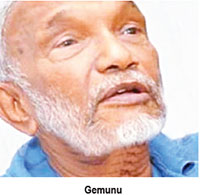

Gemunu was also widely read and could speak and hold the floor on any subject. I remember him telling me to hold on to my mechanical lever-motion wrist-watch because the new-fangled electronic digital watches, then in great demand, would soon be “a dime a dozen”.
Although not a qualified pilot as such, Gemunu’s passion for aviation burned strongly, so he never missed a chance to go flying with us. Even if it was to check the brakes of an aircraft that never left the ground! The process of speaking with the Air Traffic Control tower, starting up and taxiing out, would make his day.
In those days, TV had yet to arrive in Ceylon (as Sri Lanka then was), so, as movie buffs, we used our Air Force IDs to get us concessions at local cinemas. While in Colombo, on short breaks from China Bay, we would go from cinema to cinema, watching one movie after another, starting at the Savoy Cinema, Wellawatte, at 10.30 am, Majestic, in Bambalapitiya, for the 3.30 pm show, then the Liberty Cinema, at 6.30 pm, and finally the Empire (Slave Island) or Regal Cinema (Fort) for the late 9.30 pm show.
After I was demobilised and joined Air Ceylon, Gemunu continued to serve the RCyAF (which became the Sri Lanka Air Force, in 1972) as a Volunteer. But he and I kept in contact and ‘touched base’ off and on. He married his cousin and childhood sweetheart Swineetha. Because he was still with the Air Force, they had planned a ‘service wedding’. But, by the afternoon, before his wedding day, he still hadn’t engaged a band to play at the event. So, at the eleventh hour, I turned for assistance to Gamini ‘Gabo’ Peiris, drummer and leader of the popular band ‘Gabo and The Breakaways’, who in his ‘other job’ as a flight steward with Air Ceylon was by then a colleague of mine.
But when Gemunu and I arrived at Gabo’s home we learned that he and the band were ‘on holiday’. Wondering what to do next (I think I was more worried than Gemunu), while our bus was passing the Liberty cinema, Gemunu suggested that we should go watch a movie (which happened to be On a Clear Day You Can See Forever). Of course, by the time the movie ended, at 5.30 pm, we still hadn’t found a band to play at the next day’s wedding.
That was when I suddenly remembered my former neighbour and friend and Scout master from school, Nihal ‘Sam the Man’ Samarasinghe, another famous musician and bandleader in those days. Fortunately, after he made a few calls, Sam was able to find another upcoming band to play at short notice and thus saved Gemunu’s day. This episode was typical of Gemunu who took everything ‘on the bump’.
A few months later, the SLAF selected Gemunu Silva to study for an M.Sc. in Toulouse, the home of Airbus Industrie (as the company was then known) in the South of France. There he helped work out the algorithms for ‘fly-by-wire’ (FBW) aircraft. From what I’ve heard, it was a military project to which he was assigned, with the use of what was then the only hybrid computer in France. The research material thus gained was subsequently used in French fighter aircraft and, later still, the state-of-the-art Airbus A320 passenger airliner.
When Air Lanka was founded in 1979, Gemunu, now back in Sri Lanka, signed as one of the guarantors for my Boeing 707 training bond. Subsequently, I introduced him to the airline’s ‘flying Chairman’, Capt. S Rakkitha Wikramanayake, who was looking for aircraft maintenance engineers, but felt that Gemunu was “over-qualified”. To Gemunu’s credit, however, while in the SLAF he modified a fuel pump for the MiG-15 and 17 aircraft which prevented deterioration and fire in the engine after an inflight failure. He held the patent for that modification.
After Gemunu was finally ‘demobbed’ from the SLAF, he returned to the SEC where he would become the General Manager and, later still, Chairman (a post once held by the legendary engineer Dr. Deshabandu A.N.S. Kulasinghe). One of Gemunu’s many engineering accomplishments was changing the camber of the New Kelaniya Bridge, while traffic was on the move.
A long association with the Archaeological Department began when Gemunu Silva facilitated the use of a SLAF helicopter to place the crystal on the pinnacle of the Mihintale stupa which was being renovated by Dr Roland Silva, the Director of Archaeology, and his team.
Then the Temple of the Tooth Relic (Dalada Maligawa), in Kandy, began experiencing a problem. Monkeys, from the nearby Udawattakele Forest Reserve, used to play on the existing old roof and caused tiles to be shifted. When it rained, numerous leaks began, putting the Tooth Relic at risk. The solution was to build a canopy with gold-plated tiles, imported from Japan, over the existing temple roof. President Ranasinghe Premadasa’s ‘Sevana’ Foundation had promised to foot the bill in exchange for the honour of officially opening the finished project.
Amid objections to the modification from the Archaeological Department, the task was assigned to the SEC and Gemunu got involved. After the new canopy was built and the opening day drew near, it was discovered that the new structure was not steady and subject to swaying. One day, while wondering what to do about it, Gemunu discovered that there were a couple of holes, used as nests by resident pigeons, at the same level in the building adjacent to the golden roof. On investigation, he observed that there were metal beams inside the holes. So the canopy was duly welded to the beams, for additional support, and that stopped the swaying.
Then, there was the Maligawila Buddha Statue, in the Moneragala District. Carved out of limestone, with the head alone weighing some 50 tons, it was the tallest free-standing statue of its kind in Sri Lanka, and discovered in pieces in 1951 (presumably destroyed by treasure hunters). The project to restore it was abandoned by then SEC Chairman, Dr. Kulasinghe, in the mid-1970s. The challenge was subsequently taken up by Gemunu Silva in 1991, much to the satisfaction of President Premadasa.
Gemunu later mentioned that it was Dr Kulasinghe’s mentoring and guidance that gave him the confidence to embark on the project. And speaking of President Premadasa, when a colleague once asked Gemunu how he managed to get so close to the President, he replied that he didn’t get close to the President but the President got close to him!
When writing, or speaking of the late Gemunu Silva, it should not be forgotten that when the SLAF wanted to base their jet aircraft at the Sigiriya airport, and the Government followed up by proposing to build the next international airport there, Gemunu was involved with Dr Roland Silva, then Director General of the Central Cultural Fund, trying to stabilise the Rock, which was already chipping away, to prevent further damage from vibrations. So they appealed to President Chandrika Kumaratunga saying that jet operations at Sigiriya were not conducive to the future stability of the Sigiriya archaeological ‘treasure’. One option offered was to find another suitable site, so an RCyAF helicopter was assigned to the pair for two weeks in order to complete their survey. They found an ideal alternative within the Cultural Triangle on ‘crown land’ with no complications of land acquisition. But when a report was submitted, it never saw the light of day again!
In 1993, Gemunu became the youngest Vidya Jyothi awardee (for outstanding scientific and technological achievements) among greats like Geoffrey Bawa, Prof. E.O.E. Pereira, Prof. A.W. Mailvaganam, Sir Arthur C. Clarke, Dr. A.N.S. Kulasinghe and Dr. Ray Wijewardene. Gemunu remained the consultant engineer for the restoration of ancient stupas, such as the Jetavanarama, Abhayagiri, Mirisawetiya and Tissamaharama dagobas. Typical of the man’s ingenuity, all his mechanical restoration solutions were reversible.
After LTTE suicide bombers attacked the Dalada Maligawa, in 1998, Gemunu Silva participated in the repairs and renovation. He was also the Chairman of the Urban Development Authority (UDA) at one time. Gemunu worked at world heritage centres in Lumbini, Nepal and Bodh Gaya, India, and in 2013 he received the Engineering Heritage Award from the Institute of Engineers. This year Gemunu also became the first recipient of the Dr. Roland Silva Memorial Medal.
Gemunu always said that the best engineers were the ‘baases’ he worked with. As he (non-academically qualified but practically skilled senior workmen and artisans) told it, there was nothing a good chat and cup of plain tea and a cigarette couldn’t solve.
Of Gemunu, one could truly say he was “a man who walked with kings, and didn’t lose the common touch.”
To me, Gemunu was more a brother than a friend. I am glad that I was able to take him on a joy flight in a light aircraft about two years ago. Although his health was deteriorating, he was always in good spirits. The last time I spoke to him was to ask how the Ministry of Defence acquired the Akuregoda land on which the World War 2 Talangama transmitters were originally sited and then owned by the Department of Civil Aviation, only to be ‘handed over’ to the UDA.
Farewell my brother, may you achieve the supreme bliss of Nirvana!