Features
Vajira: a dance of a life

Sri Lanka’s prima ballerina, Vajira Chitrasena, 89 now, was conferred the Padma Shri one of India’s highest civilian honours on November 17. The award was in recognition of her unique contributions to enriching Indo-Sri Lanka relations through the promotion of dance and blending the art forms of both countries. On behalf of the Indian President, Vajira was presented the award by the High Commissioner of India in Sri Lanka, Gopal Baglay at a special Temple Trees ceremony at which Prime Minister Mahinda Rajapaksa was present.
Padma Shriin Sanskrit translates into ‘Noble one in Blossom.’
We celebrate the ‘Noble one of Sri Lanka’s dance’ through the eyes of generations of ‘Chitrasena women’ who keep her trailblazing tradition alive.
BY RANDIMA ATTYGALLE
‘Balletomanes who see the second program of the Chitrasena Ballet, which was presented at the Elizabethan Theatre last night will receive a shock, for there they will find the original of their beloved classical-romantic ballet ‘Swan Lake’. The various pas de deux, performed by Vajira as the Chief 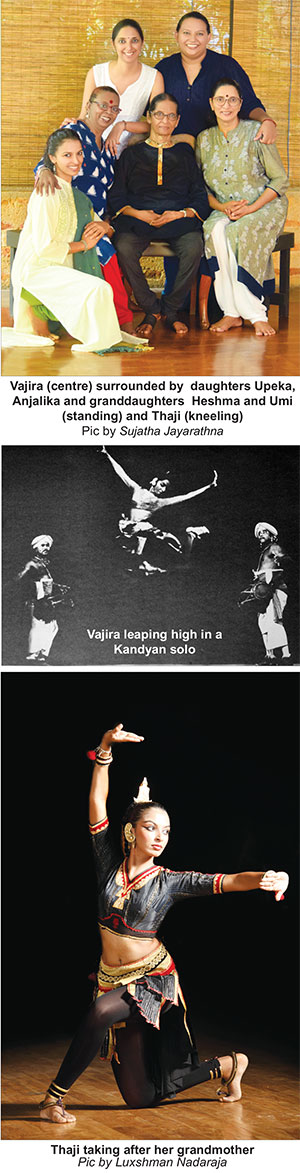

Be it the swan that connived to bring Nala and Damayanthi together or Maya in Chandalika or exploited Sisi in Karadiya, Vajira Chitrasena stole the show. The thunderous applause she received across the seas was an index that she had arrived earning a trademark for the ‘feminine’ Kandyan dance form.
The 15-year-old Vajira who was enrolled in Chitrasena’s dancing class by her mother would run away only to be dragged back by her mother who used to sew the costumes designed by Somabandu for Chitrasena productions. Vajira would once recollect in an interview with this writer: “I was mischievous and was least interested in pursuing dancing seriously and it was Chitrasena who made me think seriously about being a professional dancer.”
A match made in heaven for the dance, the Chitrasena-Vajira union mutually pushed the golden couple of Sri Lankan dance to greater heights. Since her debut through Pageant of Lanka in 1948 until her swan song Chandalika in 1996, with every step Vajira not only emerged a brand name and a cultural ambassador for Sri Lanka but also opened a career path for Sri Lankan women. Interestingly, many male dancers who have made a name for themselves today were also mentored by her. Although there were dancers such as Chandralekha before her, it was Vajira who broke away from the tradition of women donning the male costume on stage and introduced the fluidity and grace that made the female dance feminine.
Although traditionally a male dance tradition, Kandyan dance still enables liberty to evolve one’s own style, says Upeka Chitrasena, eldest daughter of Vajira. “My mother was never inhibited from jumping as high as my father did in her Kandyan dance performances. Although I danced behind them, (along with sister Anjalika) and later did all roles amma once did, I never copied my mother but evolved my own style to suit my personality. My parents never put us into a mould but gave us independence to carve a niche for ourselves.”
Upeka who is today a much sought teacher herself, candidly admits that although she follows her mother as a hard task master and strict disciplinarian, she cannot match her mother’s patience. “Amma could make anybody dance; such was her spirit. She simply would not give up. I don’t think I have that kind of perseverance,” she smiles.
Transformation came naturally to Vajira. She never had to “strive hard to adapt to new roles,” as she put it. By the time Karadiya hit the boards, Vajira was a seasoned dancer. She was also a teacher of dancing at Methodist College, Colombo by then. Starting with small scale ballets such as Kumudini and Nirasha, Vajira’s repertoire as a choreographer expanded with longer ballets such as Himakumari, Sepalika and Kindurangana. Together with Chitrasena, the couple created Kinkini Kolama for daughter Upeka.
Vajira was avant-garde in every sense. While creating avenues for the female dancer in this country at a time when there were no role models, she played multiple roles of the dancer, the choreographer and guru – passing the baton to her daughters and now her granddaughters. Far from being the traditional wife and mother, Vajira danced everyday along with Chitrasena. Upeka recollects her parents creating, rehearsing and traveling all the time when they were young. “I danced every day of my life and at the same time I was there for my three children. They admired their parents on stage, a unique opportunity for any child, and it is their judgment of what the two of us did that mattered most,” Vajira would once recollect.
From the 1940s, ever since Chitrasena and Vajira started creating their own genre together, the entire family along with their golayas have been in rehearsal. For them it will continue to be a journey of experimenting and discovering the possibilities of a ‘movement-language’ like no other notwithstanding the pandemic. “These are frustrating times for all of us and this honour from India comes as breath of fresh air and hope,” says Upeka who is overwhelmed by the messages of love and affection that have been pouring in from all corners of the world since the award was announced.
The Chitrasena family is no stranger to India. The connection dates back to patriarch Chitrasena given further impetus by Vajira and later by Upeka (through her association with Nrityagram- India’s first modern Gurukul for Indian classical dances) and now cemented further by the third generation that steers the Chitrasena Dance Company. Samhara where the Chitrasenas collaborated with the Odissi dancers of Nrityagram Dance Ensemble from Bangalore was a critical turning point for the ‘younger dancer company’ led by Vajira’s granddaughter Thaji (Thajithangani Dias- daughter of Anudatta). Samhara as they reflect enabled them to take traditional Kandyan dance to newer heights.
Vajira’s younger daughter Anjalika Chitrasena (Melvani), a dancer and a teacher herself, finds her mother’s indomitable strength as a woman of many roles to be the heartbeat of their dance school to date. “She led by example and whatever she created, she did through her own experiences; she was constantly watching, reading, absorbing and creating new things all the time.” Her brother Anudatta was only three months old when her parents went on their first tour to Russia in 1957, recollects Anjalika. “She was still lactating but she continued to do what she had to do – dance. That was the kind of strong woman she was.”
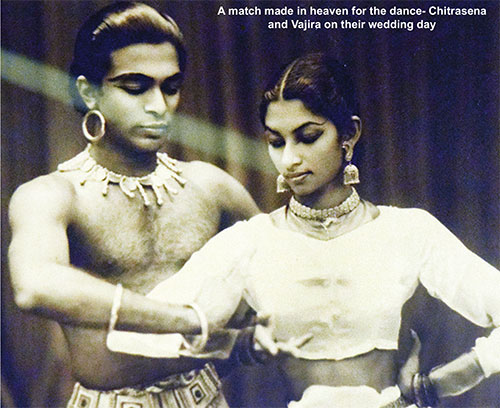

Creating magic was inevitable with her mother as the choreographer and her father as the Artistic Director, says Anjalika. “My father was a very dominant and difficult person, yet she respected him for all that he was; her Guru, her mentor and partner in crime! My father used to call her the blotting paper absorbing all he said and did – that’s how well she understood him.”
Vajira’s humility is exemplary says her daughter. “She treated all her dancers like her own children, looked after them, fed them and mentored them. My mother gave her life to the arts without expectation and she continues to do that.”
Heshma Wignaraja, Artistic Director of the Chitrasena Dance Company and daughter of Anjalika, is grateful that India has recognized the efforts of her grandmother whose career spanning over 70 years is one that is dedicated purely to the dance. “She learnt from the best and built a lifelong partnership with her Guru, Chitrasena, who initiated and established a very rich connection with India for our dance and our family. It is with his support and blessings that she blazed a new trail for all female dancers in this country- setting world standards in performing, teaching, creating and collaborating. And it must be so satisfying for her to receive this honour at nearly 90-years of age.”
Since the pandemic, a lot has changed for all performing artistes compelling them to deal with a new set of challenges says Heshma. “The ties we have with Nrityagram however, have taken deep roots. So we will somehow find ways to continue working together. We are waiting impatiently for the next meeting.”
Growing up watching her achchi has had the biggest impact on Heshma. An all-rounder, an unassuming prima ballerina, she was like a “magnet of sorts,” Heshma says. “Her approach to creating was the most simple and honest but her work ethic was relentless and therefore everything she did or touched truly turned into gold! I look forward to continue working with her.”


Vajira’s attention to detail and ‘never say die’ attitude makes her a wonder says granddaughter Umi (Umadanthi) Dias who administers the Kalayathanaya. “Looking back today, I know that whatever I have grasped from my grandmother unconsciously comes into play spontaneously and helps me immensely to deal with the work I do at the Kalayathanaya.”
Sharing her legendary grandmother’s flipside, Umi says that she is a master seamstress. “Even now at almost 90 years, we still go to achchi with all our alterations. She turns out wonderful clothing for my kids with little pieces of leftover fabric. And of course there is her love for exercise and keeping her body fine tuned. She will never take a break from her daily exercise routine even when we go on holiday.”
Vajira is a blissful great grandmother of four and Umi says that her love for all of them is boundless.
A role model for generations of women, Vajira Chitrasena never clamoured or sought personal glory. In her own words, “it just came my way and I accepted it neutrally.” What success is to this queen of the dance is reflected in the words of the famed Russian dancer Anna Pavlova: ‘to follow without halt, one aim; there is the secret of success. And success? I do not find it in the applause of the theatre. It lies rather in the satisfaction of accomplishment.’
(Photo credit: Chitrasena family archives, Luxshman Nadaraja, Sujatha Jayarathna & Indian High Commission in SL)