Features
Vaccine inequity and inconsistent public health measures spur virus mutations

‘Using the tools we already have to prevent transmission and save lives from Delta will also prevent transmission and save lives from Omicron for which enhanced surveillance, testing, sequencing and reporting is essential’- Dr. Palitha Abeykoon
Collaboration between nations to fight the pandemic is ‘inconsistent and not sustained’ – WHO
World Health Assembly gives the nod to draft a convention to strengthen pandemic prevention, preparedness and response
BY RANDIMA ATTYGALLE
With the reporting of the variant B.1.1.529, named ‘Omicron’, the earliest cases of which were detected from South Africa on November 9, several countries are now witnessing a fifth wave of the COVID pandemic. Designated by the World Health Organization (WHO) as a ‘variant of concern’ (VOC) given its large number of mutations, Omicron, as the preliminary evidence suggests potentially also has an increased transmissibility and an increased risk of reinfection compared to the other VOCs. However, there is as yet no direct evidence for increased transmissibility. The new variant has ‘caused a detrimental change in COVID-19 epidemiology,’ observes the WHO.


Dr. Abeykoon also noted that the well proven COVID-19 safety measures by the public should be strictly followed at this juncture of uncertainty. “The most important thing people can do is to reduce their risk of exposure to the virus,” said the consultant reiterating on the importance of wearing a mask, keeping physical distance, avoiding crowded spaces, keeping hands clean etc. “Collective public responsibility at this point cannot be understated nor undermined,” he noted.
The world has to commend the scientists and the political leadership of South Africa and Botswana for detecting the Omicron variant and for reporting it to the WHO immediately, observed Dr. Abeykoon who went on to note that it is the ethical behaviour expected from all nations in the event of a pandemic. WHO advices the use of a risk-based approach to adjust international travel measures in a timely manner, and report to WHO the application of time-limited measures affecting international travel and trade. “The world should not penalize Southern Africa for its prompt application of International Health Regulations and reporting the mutation. Sri Lanka thus far appears to have adopted the correct admixture of surveillance and international travel restrictions and must continue to be vigilant.”
The severity of the disease caused by Omicron too remains vague right now. However, preliminary data suggests that there are increasing rates of hospitalization in South Africa. But this may be due to increasing overall numbers of people becoming infected, rather than a result of specific infection with Omicron, according to the WHO. There is currently no information to suggest that symptoms associated with Omicron are different from those from other variants.
Although researchers are looking into the potential impact vaccines have on the new variant, WHO urges people to be vaccinated against the widely circulating variants. “We still have more questions than answers about the effect of Omicron on transmission, severity of disease, and the effectiveness of tests, therapeutics and vaccines,” pointed out Dr. Abeykoon.
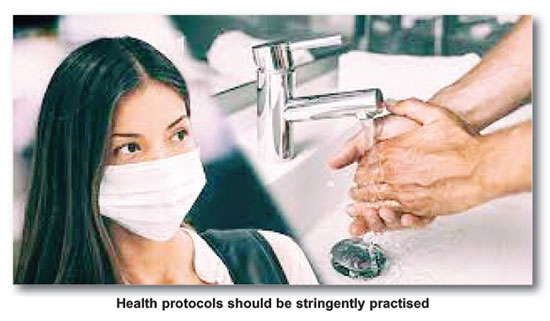

With the attention being shifted to the new variant, we should not forget that we are already dealing with a highly transmissible, dangerous Delta variant, which accounts for almost all cases globally, the WHO representative avers. “We will need another two weeks at least to generate adequate data on the Omicron variant to confirm its possibility of escaping the current vaccines and also infecting those with serious disease who have been already vaccinated.”
There is early evidence that reinfection with Omicron is taking place in some of the countries, even where people have been fully vaccinated. However, the vaccines seem to prevent serious disease and mortality. Dr. Abeykoon explains further: “we need to use the tools we already have to prevent transmission and save lives from Delta. And if we do that, we will also prevent transmission and save lives from Omicron – so enhancing surveillance, testing, sequencing and reporting is essential.” Although it is natural for countries to be concerned of the safety of their citizens against a variant that is not yet fully understood, “blunt, blanket measures that are not evidence-based or effective on their own” which are introduced by certain countries could only worsen inequities, Dr. Abeykoon observed.
The recent communiqué issued by the WHO Director-General’s Special Envoys notes that while several countries are witnessing a fifth wave of high transmission, others are recording their highest daily cases since the pandemic began. Low and middle-income countries where vaccination rates are often very low are seeing substantial numbers of deaths it says.
The trends are seen both in nations with adequate doses of vaccine, as well as in those with very tight supplies. Many of the latter are in Africa, where more than 97% of the population still haven’t been immunized. ‘These countries cannot get the vaccine they need because supply commitments from manufacturers are not coming through as planned. They can somehow get vaccines to their people but simply do not have enough doses to meet the need,’ the communiqué notes. ‘Insufficient preparation, insufficient investment, insufficient collaboration and insufficient learning’ are attributed for this by the WHO.
Although donations are offered to poor countries by the high-income nations, the commitments are generally ‘too haphazard to offer consistent and predictable support for countries in need’ WHO notes. It also observes that collaboration between nations in also ‘inconsistent and not sustained’. The communiqué further maintains that ‘as the fires of the pandemic flare up, the quality and predictability of response are hampered by suspicion and competition.’
Relative to most countries, including many in the developed world, Sri Lanka has handled the vaccination drive against COVID very successfully, Dr. Abeykoon said. “In the South East Asian region, Bhutan, the Maldives and Sri Lanka are at the top in terms of the percentage of vaccinations, particularly those over the age of 60 who are most vulnerable. We also need to gradually increase the numbers of children and adolescents who are vaccinated. While they will not fall seriously ill they could serve as the reservoirs of infection. Further, since schools have restarted there is a higher possibility for wider transmission of the virus among the school children.”
While many countries are giving vaccines to children, mostly over 12, China, Hong Kong, Japan and a few more are vaccinating children over five. “We have been vaccinating children over six (with Pfizer) with co-morbidities such as congenital heart diseases, thalassemia, cerebral palsies, genetic disorders, immune deficiencies, cancers etc. However, there is still no clear decision regarding the vaccination of young children between five and 16 without co- morbidities and the National Advisory Committee will mostly likely make a call soon.”
There is also a growing chorus of support among countries and leaders that a legally-binding agreement is essential for preparing better responses to disease outbreaks, epidemics and pandemics. WHO Special Envoys for COVID-19, urge leaders to act together ‘spurred on by the suffering provoked by this pandemic, to prevent a sequel before political attention lapses.’
A consensus decision aimed at protecting the world from future infectious diseases crises was agreed by the World Health Assembly a few days ago. The Assembly agreed to kick-start a global process to draft and negotiate a convention, agreement or other international instrument under the Constitution of the WHO to strengthen pandemic prevention, preparedness and response.
A universally-binding agreement that articulates a firmly agreed upon approach to equitable use and distribution of resources is not only morally correct, it is also the right thing to do from a public health point of view affirms the WHO. The Special Envoys call on national leaders and the WHO to make the agreement happen and to do it effectively, rapidly and on a sound, durable financial footing and perceive it as ‘a once-in-a-generation opportunity to insulate the world from the next inferno of infectious disease and build forward with better mechanisms that protect all future generations.’