
Life style
Upali Wijewardene: He reached for the stars

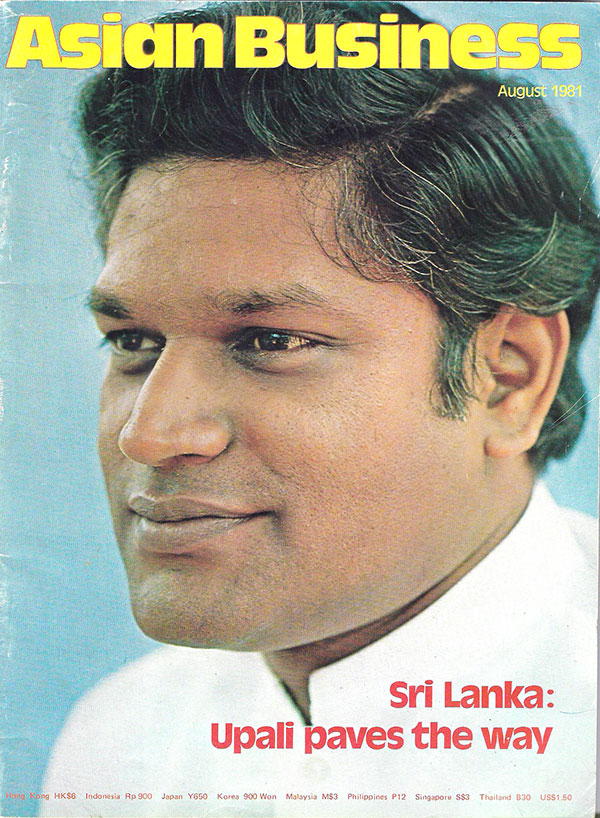
On a day like this 39 years ago on February 13, 1983, Sri Lanka’s much loved business leader, Upali Wijewardene, who captured the imagination of an entire nation vanished without trace in his Lear jet with five others on board. They were returning to Colombo from Malaysia where his Kandos chocolates had hit dizzy heights.
His disappearance engulfed the the region with shock and disbelief. US Orion surveillance aircraft, Soviet and Australian warships, Indonesian minesweepers, Indian airplanes, Malaysian patrol boats and Sri Lankan fishermen were all mobilized in search operations to no avail. ‘What if Upali lived? What really happened to Upali?’ continue to be yet unanswered questions.
If Upali Wijewardene was a sensation in life, he was elevated to a legend after he went missing just four days short of his 45th birthday.
Wild theories about his disappearance were floated around and Colombo’s children of the 80s were said to have devised a game called ‘Finding Upali’s Plane.’ A larger than life figure and a maverick who embraced life with such gusto had disappeared; but he continues to live in the heart of a nation.
The Sunday Island recaps the saga of its founder who was once dubbed ‘the ‘Quintessential Entrepreneur of Asia’ and ‘the man who would be President’
By Randima Attygalle
“My philosophy is to do what you know how to do well and from this I mean you must have the knowledge right all the way through…” reflected Philip Upali Wijewardene, or ‘PUW” as he was fondly called, in an interview with the Malaysian Business in December, 1981. In a technologically austere time, long before the digital revolution when a direct international call had to be ‘booked.’ Wijewardene plunged into chocolate-making, assembly of cars, newspaper publishing, aviation, plantations and much more. As was once documented, ‘the success story of Upali, is the story of how small Asian companies can grow into multinational corporations. It was a precursor of the coming of age of the ‘entrepreneurial Asian.’
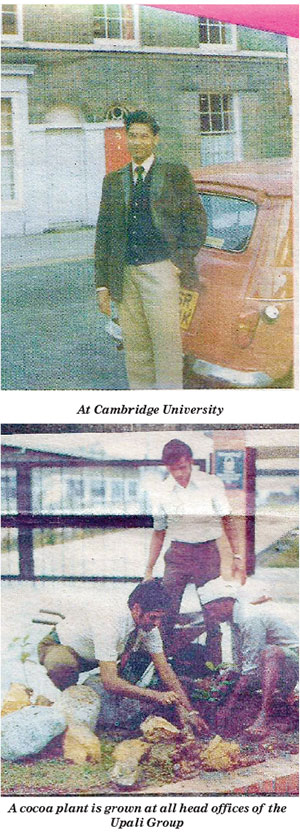
 Philip Upali Wijewardene was born on February 17, 1938 to Don Walter Wijewardene (from Sedawatta walauwa ) and Anula Kalyanawathi Wijesinghe (from Miriswatta Walauwa) at his famous paternal grandmother Helena Wijewardene’s mansion, Sri Ramya, in Colombo (where the present American Centre stands). Upali grew up amidst the affection of his two older sisters, Anoja and Kalyani and a bevy of cousins. He received his kindergarten education at Ladies’ College and later at Royal College, Colombo. When he turned 15, Upali was sent off to St. John’s School Leatherhead in England. Having read Economics at the University of Cambridge, the 21-year-old debonair Wijewardene returned home in 1959 and was recruited by Lever Brothers as a Management Trainee. The corporate rigours and an eternally irate boss left the young recruit drained in two years.
Having quit Levers in 1961, the blue-blooded Wijewardene did not fall back on his family wealth but sought his own fortune first with a friend’s ailing confectionery plant which he re-baptized as Delta and a few years later with Kandos – the brand promoted by Ceylon Chocolates Ltd. In 1970, with the demise of its founder Chairman, Senator Sarath Wijesinghe, his nephew Upali Wijewardene who was expanding his business empire took over the reins of that company.
True to Wijewardene’s philosophy: ‘plunge in and get on with it’, the expanding fully-fledged cocoa processing plants and factories in Malaysia, Singapore and Thailand enabled Kandos to be internationally present and rub shoulders with Nabisco, Mars, Cadbury and Hershey’s. At the time of his disappearance, Wijewardene claimed to be the only fully-integrated cocoa processor in Asia, with businesses ranging from growing cocoa to manufacturing cocoa-based consumer products. The cocoa tree which still adorns the Upali Group’s head office in Colombo and the taller tree which once stood at the door to his luxurious home in Pantai Hills in Kuala Lumpur, which he aptly named ‘Cocoa Hill’, says it all.
Following his uncle D.R. Wijewardene, the press baron, he went on to launch The Island and Divaina snubbing feasibility studies of foreign experts who warned him that the national newspaper market was already saturated. The exercise, as he alluded to the Insight magazine in May, 1981 five months ahead of its launch, was one of his ‘fun-projects’ but analysts say that political ambitions down the road were part of the story.
Just two months following the success of the newspaper, in an interview with a Malaysian business journal, Wijewardene gleefully remarked: “it must be a world record of some sort.” He went onto note that the newspaper’s popularity probably has more to do with editorial policy and style, adding tongue-in-cheek: “they said there was no market, but people must have got tired of reading gazettes!” As the founder editor of the Island, Vijitha Yapa once recalled, Wijewardene was “an editor’s ideal publisher who never interfered with the independence of the newspaper.”
 The present Managing Director and CEO of the Upali Group of Companies, Nimal Welgama recollects: “Upali was a man with tremendous energy which he employed in everything he did. He was mischievous, had a sense of fun and in the last lap of his life, not only gave of himself to his many private enterprises but also contributed his time and skill for public purposes; hence his period as Chairman and Director General of the Greater Colombo Economic Commission (GCEC), the predecessor of the Board of Investment (BOI).”
Having worked for the Upali Group as a young man, Welgama recounts his one-time boss ‘making waves in his own inimitable style.’ “He was ever conscious that his father died young and he did not expect to attain a venerable old age. At the time his life was so tragically snuffed out, he used to say that the accent is on enjoying”.
The emblem of the business group he set up – the blazing copper sun with a ‘U’ in the middle was a motif of Wijewardene’s own personality says the Upali Group’s CEO. “The warmth of his personality, like that of the sun, was felt by the many people he befriended. He was good to his employees, people who served him at various levels, and in return had not only their loyalty but their affection.”
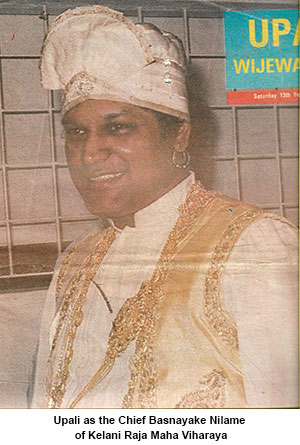
From steering a multinational to being the Chief Basnayake Nilame of the Kelani Raja Maha Vihara, Wijewardene donned many hats. His string of thoroughbreds and Labradors stole a large part of his heart. His beloved ‘Charlie’ is said to have kept a long vigil for months after he disappeared, waiting for his master who never returned.
“My late uncle Upali’s signature facet was his love for speed. This he applied in expanding his business empire. He bought a Lear jet and obtained a Red Passport as the Chairman of GCEC because he was a man for speed and a fast decision-maker. Even his other indulgences including his love for horse and car racing reflected this,” recollects nephew, Dhammika Attygalle who was 18 at the time of his uncle’s disappearance and is now a Director of the Upali Group of Companies.
Sporting his ‘Red and Gold Cross Slash’, Wijewardene’s Rasa Penang, Varron, Kandos-Man, General Atty, King of Zulu and Cornwall Garden shone at Royal Ascot, Singapore Derby and Perak Derby, ridden by none other than Lester Piggot. “One time Chairman of the Board of Stewards of the Sri Lanka Turf Club, he would even do a tarmac transfer to his helicopter and would make it to Nuwara Eliya, sometimes just minutes before races were to start.
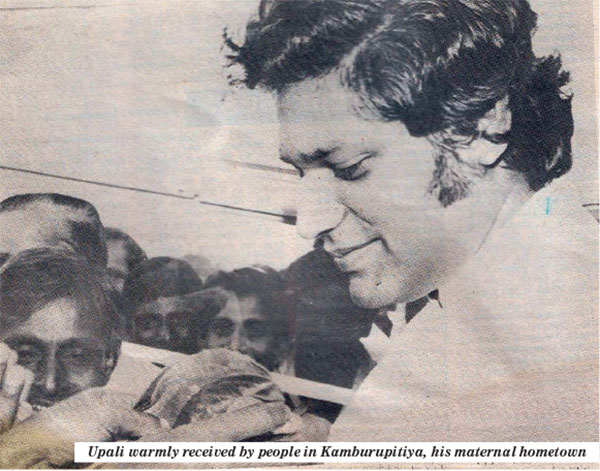
The luxury S-Class Mercedes Benz 116 which he imported from Malaysia was the first of its kind in Sri Lanka. Upali mama used to travel to Nuwara Eliya or Kamburupitiya (his maternal home town) after dinner to save time and to reach the destination fast,” recollects Attygalle who goes on to note that his late uncle initiated Ruhunu Udanaya Movement to develop his maternal home town Kamburupitiya from where he had ambitions of being elected to Parliament..
A fan of Victor Ratnayake, C.T.Fernando and Milton Perera, Wijewardene would also enjoy the country-western timbre of Jim Reeves, who as he had once conceded, ‘puts him in a pensive mood for thinking up new business schemes.’
Having built a global corporation which spanned several countries including Malaysia, Singapore and the USA in the 1970s and the early 80s in an era of snail mail, telegrams and pre-booked international calls when communicating with people abroad took weeks and travel overseas was expensive and a luxury, her late uncle’s confidence and ‘can do’ attitude inspired her, says niece Lakmini Wijesundera, Co-founder and CEO of IronOne Technologies and BoardPAC. “Today, we have instant communication access and the speed of business is fast-tracked. Asia and the South East Asian regions have comparably good infrastructure to perform. Therefore, the great strides and speed at which he operated despite the obstacles in a technologically-Spartan era is outstanding and stands out among the rest even by today’s standards,” says Wijesundera, a successful entrepreneur herself.
She further remarks that her uncle had his sights up high and was not discouraged by past benchmarks. Therefore, he was able to carve new paths and futures and created an impact in the minds and hearts of Lankans whom he inspired to ‘dream big.’ He hammered home the message that we didn’t necessarily have to be conservative in what we wished to attain.
“His focus on branding was unmatched,” reflects Wijesundera who points out that the Free Trade Zones and concepts of similar nature were supported and led by him to create a fresh economic future for Sri Lanka – models which were innovative then and sucessfully adopted by several other countries in the region.
Watching her Upali mama’s helicopter landing on the flat roof of his Thurstan Road residence was an unforgettable memory for young Lakmini and her siblings. “We were so excited to be part of this rare experience at that time,” she smiles adding that she recalls him to be full of life with a great sense of humour and always with a smile. Thirteen years old at the time her uncle vanished, Wijesundera who relished her mother’s stories about her brother ‘starting from scratch with great determination at a young age.’ She believes that her Upali mama personified the belief that anything is possible with the correct mindset- a mantra that she believes in today.
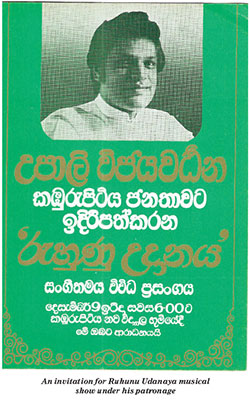
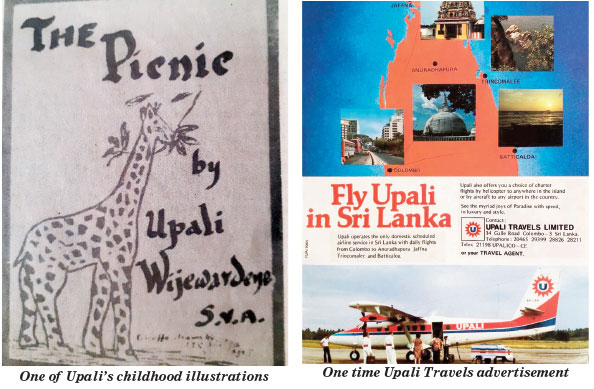
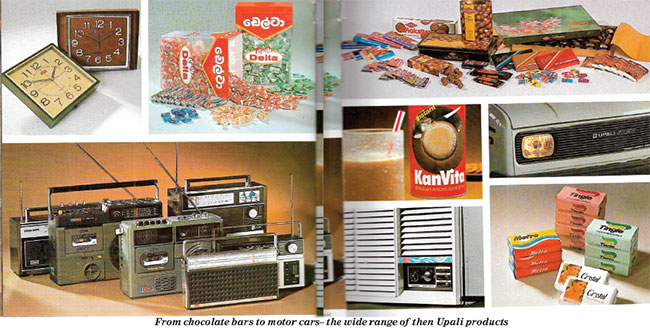
A man who would think big, Wijewardene would advance from Upali Fiat and UMC Mazda to ‘Upali Aviation’. – the only domestic flight which would bridge the North and the South. The halting of the operations of the Upali Airline was a double whammy to fellow Jaffna countrymen who not only saw the flight as a vehicle of better communication between Jaffna and Colombo but also its founder as a harbinger of hope who would have possibly bridged the economic disparity between North and South.
Describing Wijewardene as ‘Sri Lanka’s most colourful businessman who has made a fortune both at home and abroad’, Matt Miller in his article under the banner ‘The man who would be President’ documents in May, 1981, ‘now he is turning his abundant energies and resources to a new arena; politics.’ Noting that ‘Upali’s current passion for politics is matched only by his passion for racehorses,’ Miller goes onto write: “And now the 43-year-old commodities wizard has started what could be called Upali’s Third 20-Year-Plan: ‘The first 20 years were education,” he says, “the second business and the third politics.” He would “be willing”, he says with uncharacteristic restraint to become president of Sri Lanka someday.”
With his suave personality and witty repartee, Wijewardene was a darling of the press. Adorning cover pages of coveted international business journals, he still remains the only home-grown Sri Lankan entrepreneur owning a multi-national to have been featured in the prestigious Fortune magazine.
The present Editor of the Sunday Times, Sinha Ratnatunga, then a young journalist who was one of the close acquaintances of Wijewardene privy to the last moments of the tycoon recollects: “When Upali left for the airport around 6.30 p.m. that day, I left at the same time for Ana Seneviratne’s residence. He was then the High Commissioner for Sri Lanka in Kuala Lumpur. I was to stay there until I flew to join my father who was in Jakarta.
The High Commissioner was getting calls well past midnight and it was only in the morning I heard that Upali’s plane hadn’t arrived in Colombo. I was not particularly taken aback or overly concerned straightaway thinking it was typical of him to go off the beaten track as Upali could be so unconventional even in his planes. It was only by midday while at Genting Highlands watching the cable cars going about that I got that eerie feeling that the plane must be missing.”
As veteran journalist Ajith Samaranayake once commented, “politicians Sri Lanka had known before (included) poets, pundits, scholars, sportsmen, film stars and singers alike. Philip Upali Wijewardene, however, did not belong to any of these moulds. He was not moulded out of the common clay. He broke the mould and reshaped it closer to his heart’s desire.” In Wijewardene’s own words his image in the villages is of “an international businessman of whom they are proud… The villager identifies only with success and for the youth I am probably the culmination of their aspirations.”
On a personal note, although I was merely a child at the time of Mr. Wijewardene’s untimely demise, I was fortunate to have become a part of the legacy he left behind for Sri Lankan journalism. While Kandos chocolates, Delta toffees, his landmark home in Colombo and the resplendent Nuwara Eliya bungalow and its garden- (which often clinched the ‘Best Garden’ award during the April season) and his Lear jet were motifs I often associated with him as a young child, becoming part of his newspaper allowed me a vantage point to this towering personality.
One of my favourite research subjects, I often hear anecdotes about this trendsetter by my senior colleagues. My editor Manik de Silva who was Mr. Wijewardene’s first choice to edit The Island (which he has recounted under the title The job I didn’t take) has many stories I have savoured – particularly the one about the young Upali knowing he had got the Lever Brothers management trainee job when the sudda boss took him and his rival to the Galle Face Hotel to lunch to check out their table manners. “When my rival titled his soup bowl towards himself and not the other way, I knew I had the job,” Upali had said,
My other colleagues Zanita Careem and Anneston Weerasinghe who were recruited by Mr. Wijewardene more than 40 years ago remember him as a man of infectious charisma who would turn heads not just once but twice.
I’m only humbled to have clinched the award given in his name (Upali Wijewardene Feature Writer of the Year) multiple times – twice from a newspaper he founded. I’m indeed fortunate to have become part of the publication he founded 40 years ago as a platform for liberal expression without fear or favour.
Each time I hear the rustle of the wind blowing through the cocoa tree he planted in the Upali compound, and look at the splendid dome of St. Lucia’s Cathedral nearby towering overhead, I remember Elton John’s Candle in the wind he sang for Marylin Monroe.:
‘And I would have liked to have known you
But I was just a kid
Your candle burned out long before
Your legend ever did….’



Institute of Hospitality Sri Lanka
 The 32nd Annual General Meeting (AGM) of the UK-based Institute of Hospitality’s Sri Lanka Chapter was held recently at the Ramada Hotel Colombo,.The event provided an evening of camaraderie , reflection of the past and present achievements,setting new benchmarks for the future
The AGM had the presence of two distinguished guests, the Chief Guest Opposition Leader Sajith Premadasa, and the Guest of Honour British High Commissioner to Sri Lanka, Andrew Patrick. Their inspiring speeches were lauded by all hoteliers who were present at the occasion
A special thanks was extended to Robert Richardson, CEO of the Institute of Hospitality UK, along with his team, sponsors, committee members, and all attendees for making the event memorable.
Dr. Harsha Jayasingh, Past President of the Institute of Hospitality (UK) Sri Lanka Chapter, emphasised the Institute’s longstanding history and the strength of its Sri Lankan branch. “The Institute of Hospitality (IH) UK has a history of 86 years, and we are proud to be the Sri Lanka Branch. IH Sri Lanka is much stronger now with many members from all areas of the hospitality industry,” he stated.
Dr. Jayasingh highlighted the significant role of tourism in Sri Lanka’s economy,. He said tourism it is the third-largest source of revenue for the country. “Tourism accounts for about 13.3% of total foreign exchange earnings and employs 450,000 people directly and indirectly. The hospitality industry in this island of pearl holds tremendous potential for economic growth, job creations, and cultural exchange,” he added.
He also pointed out more women should be attracted to the industry and advocated for the use of technology in hospitality sector to attract the younger generation.
The newly appointed Chairman Ramesh Dassanayake spoke about the challenges faced by the industry, including the reluctance of youth to join the sector. . Dassanayake expressed concerns over the migration of staff between hotels and the overall ‘brain drain’ in the sector. ” We must maintain high standards in the hotel We must try to attract tourists to Sri Lanka, we must have with many facilities Hence, hotel schools and other professional institutions involved in skills development mustincrease their intakes,” he pointed out.
Chief Guest Sajith Premadasa emphasised the importance of eco tourism and said “We need to have an environmental policy related to tourism in place,” . .
The 32nd AGM of the Institute of Hospitality UK, Sri Lanka Chapter, was a testament to the strength and potential of Sri Lanka’s hospitality industry. The insights and commitments shared during the event set a new benchmark for the future.(ZC)


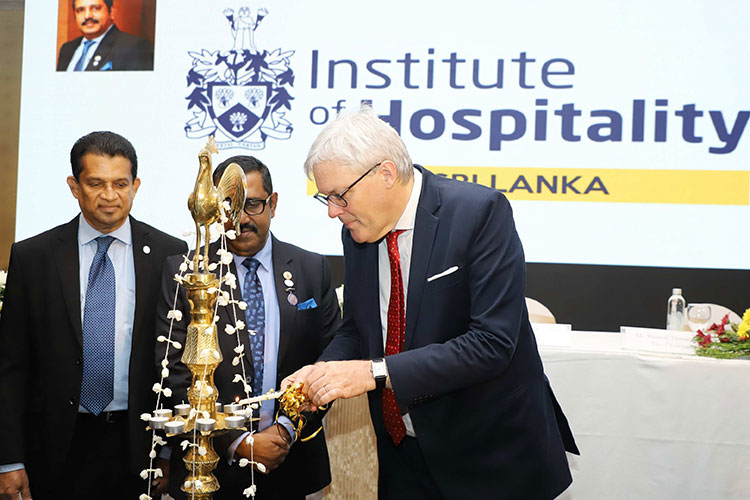
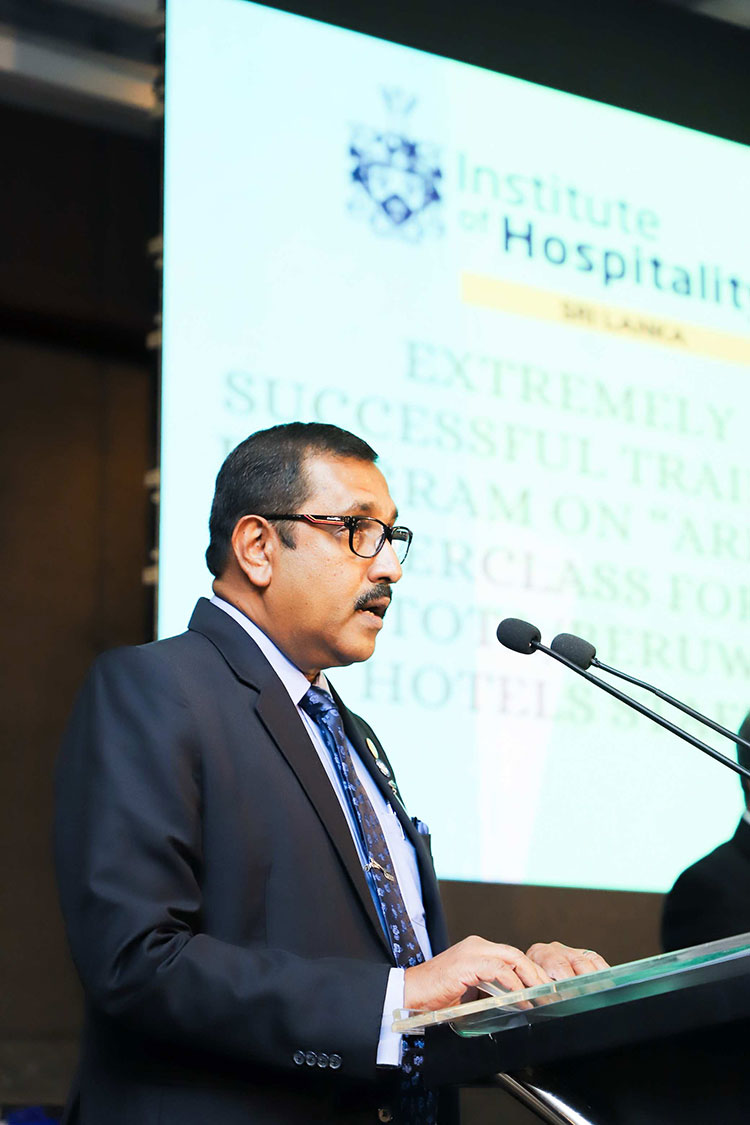

Pix by Thushara Attapathu
Life style
He recognizes human identity beyond boundaries of gender, race, nationality and religion.

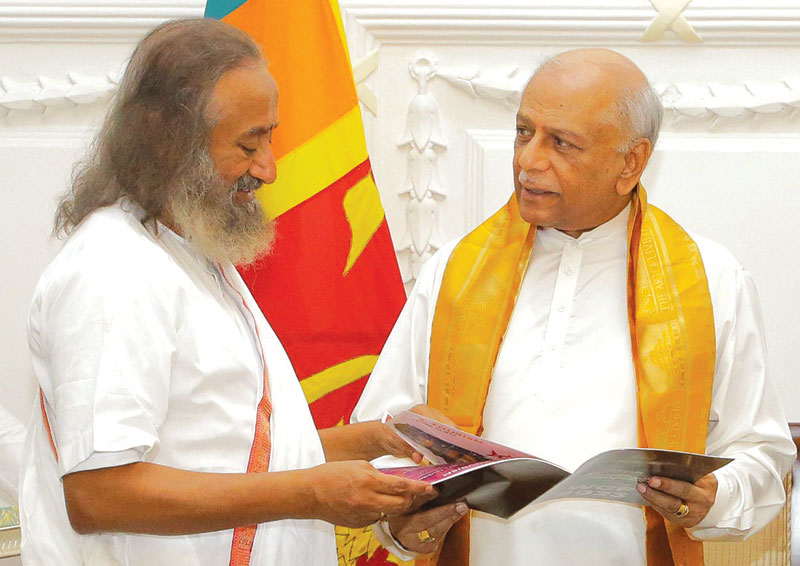
Visit of Sri Gurudev to Sri Lanka
Humanitarian, spiritual leader and Global Ambassador of Peace Gurudev Sri Sri Ravi Shankar (Sri Gurudev) was in Sri Lanka on a three day tour on the invitation of the Prime Minister of Sri Lanka Dinesh Gunewardene. Gurudev who inspired a wave of volunteerism and service to moot one of the largest volunteer-based organisations in the world – The Art of Living – visited the various projects under the aegis of the foundation and launched twelve vocational and technical centers around the island. He was accompanied by thousands of followers from Sri Lanka and around the world.
Gurudev who visited Sri Lanka for the sixth time also had a first day cover launched in honour of his visit. He is a strong proponent of spreading happiness, using the unique Sudarshan Kriya, yoga, meditation and practical wisdom to unite people, empower individuals and transform communities. His programmes provide techniques and tools to live a deeper, more joyous life, while his non-profit organisations recognize the human identity beyond the boundaries of gender, race, nationality and religion.
The Art of Living which has more than 30,000 teachers and over one million volunteers across 180 countries has touched in excess of five hundred million people around the world. CNN called it “Life Changing” and The Washington Post headlined it, “Fresh air to millions”.
In Trincomalee, Gurudev met with war victims and had a heartwarming engagement with the children from the children’s homes run by the Foundation. He also visited the Koneswara Temple in Trincomalee and graced the Kumbhabhishekam at Seetha ecogPnize the human identity beyond the boundaries of gender, race, nationality and religion. Amman temple at Nuwara Eliya. He held discussions with the trustees on the progress of the foundation’s social service projects, while also holding a special event – Ekamuthuwa – attended by a large number of dignitaries and his devotees from around the world.
His time with the Prime Minister was spent discussing the prospects of unity in diversity and uniting Sri Lanka by adding happiness into the formula of living. In addition he had discussions with the Speaker of the Parliament of Sri Lanka Mahinda Yapa Abeywardena, prominent business stewards and civil society leaders.
by Zanita Careem
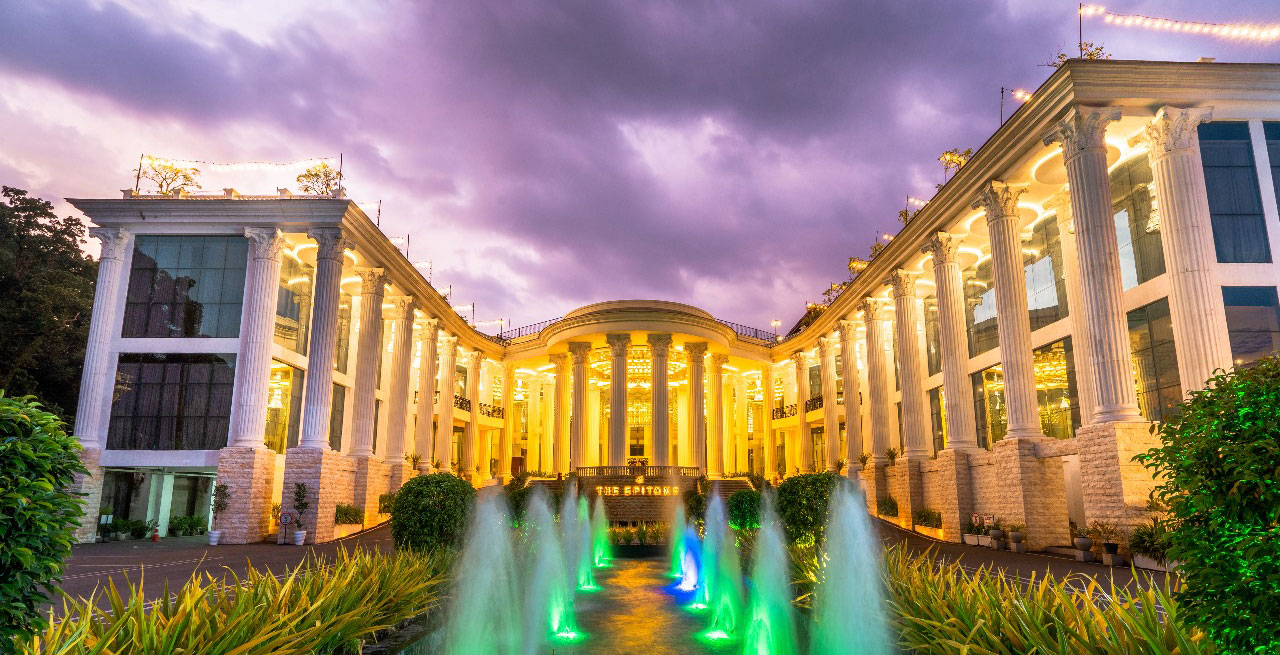
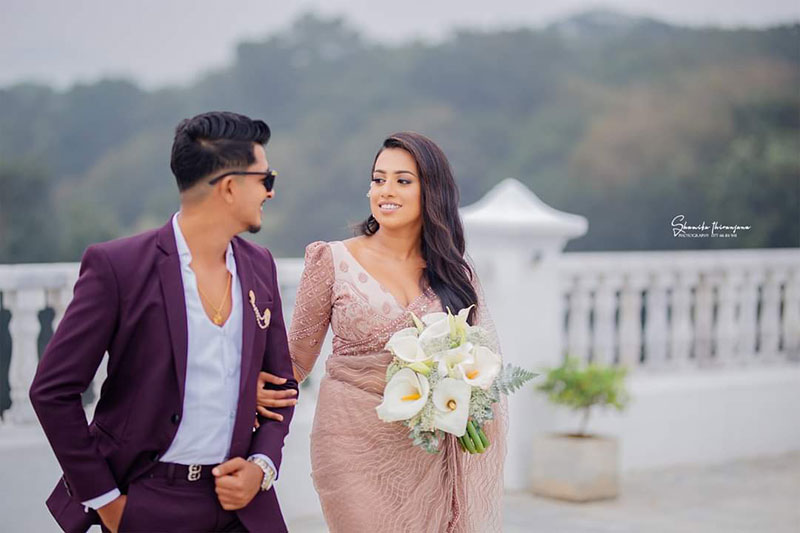
Envison your dream wedding day come to life at the Epitome Hotel, a prestigious city hotel in Kurunegala offering an unrivalled luxury rendors experience for weddings.
The venue is designed to embody opulence and luxury from all quarters for a spectacular wedding in kurunegala,Thier ballroom is the largest banquet facility in Sri Lanka It can be divided into six luxurious pillarless wedding halls on the ground floor and 25pax smaller banquet halls.
It can be easily named as a five star heaven in the heart of the city contributing to a myriad of immense experiences tailored to inspire and delight wedding experiences.
From opulent décor set up to exquisite table decor, lavish food, every detail is meticulously curated to spark your imagination and ignite creativity for a perfect wedding. The previous prestigious wedding shows season one and season two attracted large crowds
were unique events which gave the wedding vendors and potential clients had an opportunity to connect and interact with each other. Beyond being a showcase it was a chance for the wedding vendors to unite and contribute to the vibrancy of the wedding industry. The wedding show covered all area of the bridal industry providing a comprehensive variety of bridal supplies from Sri lanka and became the most popular bridal exhibitions in Kurunegala.This bridal exhibitions allowed brides and grooms to experience first hand the products and services available from suppliers in Sri Lanka
These wedding shows held at The Epitome created a benchmark and gave an opportunity for vendors to create connections to the utmost satisfaction said Harshan Lakshita Executive Director. of the magnificent Hotel
Our wedding shows featured experts and professionals in every field‘ It covered all areas of the bridal industry provided a comprehensive variety of bridal supplies from Sri lanka and became most popular bridal exhibition in this region.We are always open to everyone to join us at our wedding shows in the future. It is an opportunity to discover the incredible talent within our local wedding and bridal vendors to make meaningful relationships and plan thier special day at our breathtaking hotel The Epitome said General Manager Kavinda Caldera
The Epitome Hotel’s bridal show which will be held end of June will buzz with great ideas,advice and inspiration for all those who plan thier dream wedding
…….
The Hotel Epitome’s Wedding Season 3 will marked excellence, celebration and inspiration for those in the wedding industry. The exhibition halls will resonate with ideas on exquisite bridal wear to decor, florists , photography etc and showshowcase the rich tapestry of talent within the local wedding industry. .





US sports envoys to Lanka to champion youth development

Rahuman questions sudden cancellation of leave of CEB employees


