Features
Underlying themes of class disparity, capitalism, love and family

By Tharishi Hewavithanagamage
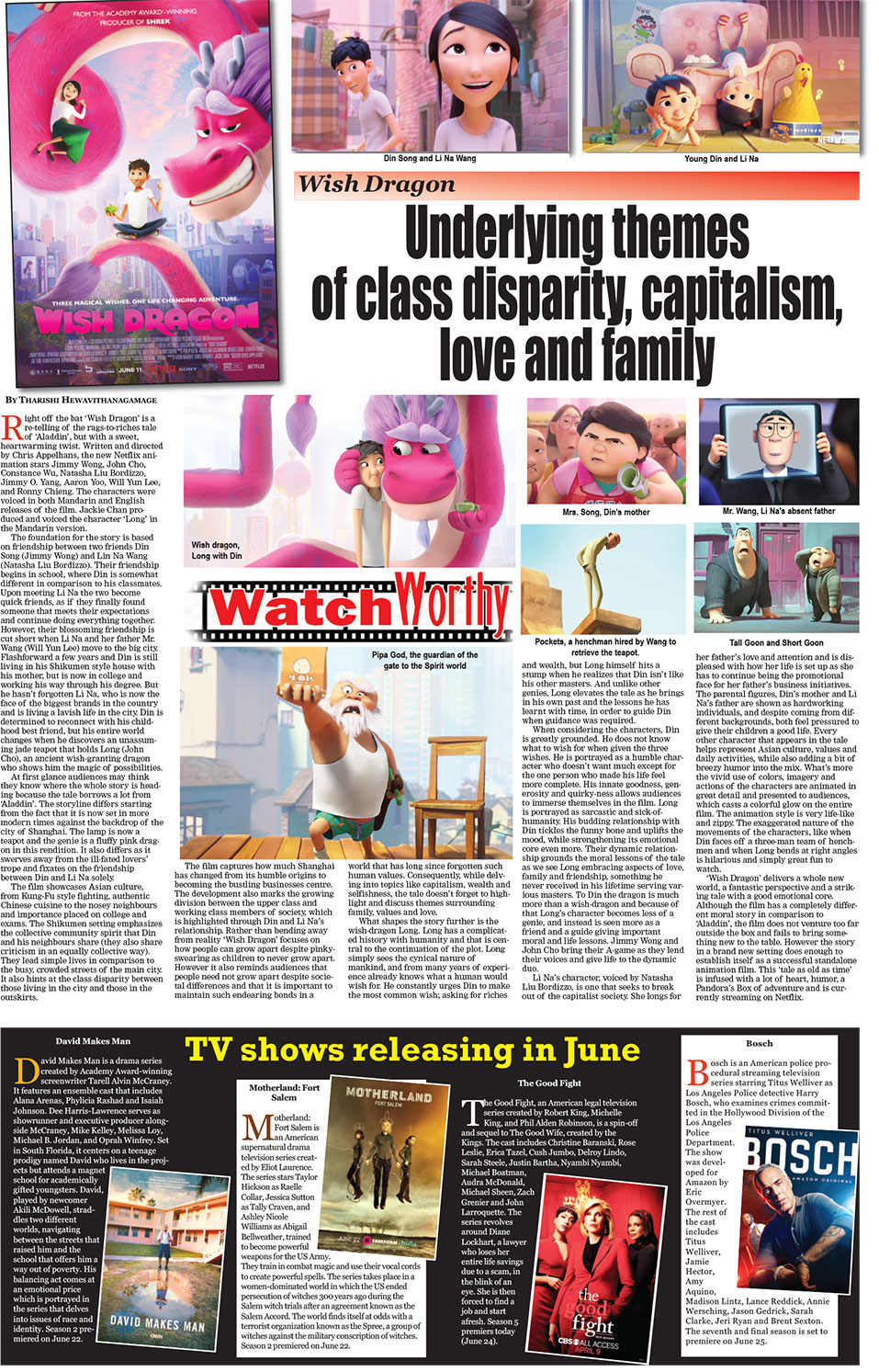
Right off the bat ‘Wish Dragon’ is a re-telling of the rags-to-riches tale of ‘Aladdin’, but with a sweet, heartwarming twist. Written and directed by Chris Appelhans, the new Netflix animation stars Jimmy Wong, John Cho, Constance Wu, Natasha Liu Bordizzo, Jimmy O. Yang, Aaron Yoo, Will Yun Lee, and Ronny Chieng. The characters were voiced in both Mandarin and English releases of the film. Jackie Chan produced and voiced the character ‘Long’ in the Mandarin version.
The foundation for the story is based on friendship between two friends Din Song (Jimmy Wong) and Lin Na Wang (Natasha Liu Bordizzo). Their friendship begins in school, where Din is somewhat different in comparison to his classmates. Upon meeting Li Na the two become quick friends, as if they finally found someone that meets their expectations and continue doing everything together. However, their blossoming friendship is cut short when Li Na and her father Mr. Wang (Will Yun Lee) move to the big city. Flashforward a few years and Din is still living in his Shikumen style house with his mother, but is now in college and working his way through his degree. But he hasn’t forgotten Li Na, who is now the face of the biggest brands in the country and is living a lavish life in the city. Din is determined to reconnect with his childhood best friend, but his entire world changes when he discovers an unassuming jade teapot that holds Long (John Cho), an ancient wish-granting dragon who shows him the magic of possibilities.
At first glance audiences may think they know where the whole story is heading because the tale borrows a lot from ‘Aladdin’. The storyline differs starting from the fact that it is now set in more modern times against the backdrop of the city of Shanghai. The lamp is now a teapot and the genie is a fluffy pink dragon in this rendition. It also differs as it swerves away from the ill-fated lovers’ trope and fixates on the friendship between Din and Li Na solely.
The film showcases Asian culture, from Kung-Fu style fighting, authentic Chinese cuisine to the nosey neighbours and importance placed on college and exams. The Shikumen setting emphasizes the collective community spirit that Din and his neighbours share (they also share criticism in an equally collective way). They lead simple lives in comparison to the busy, crowded streets of the main city. It also hints at the class disparity between those living in the city and those in the outskirts.
The film captures how much Shanghai has changed from its humble origins to becoming the bustling businesses centre. The development also marks the growing division between the upper class and working class members of society, which is highlighted through Din and Li Na’s relationship. Rather than bending away from reality ‘Wish Dragon’ focuses on how people can grow apart despite pinky-swearing as children to never grow apart. However it also reminds audiences that people need not grow apart despite societal differences and that it is important to maintain such endearing bonds in a world that has long since forgotten such human values. Consequently, while delving into topics like capitalism, wealth and selfishness, the tale doesn’t forget to highlight and discuss themes surrounding family, values and love.
What shapes the story further is the wish-dragon Long. Long has a complicated history with humanity and that is central to the continuation of the plot. Long simply sees the cynical nature of mankind, and from many years of experience already knows what a human would wish for. He constantly urges Din to make the most common wish; asking for riches and wealth, but Long himself hits a stump when he realizes that Din isn’t like his other masters. And unlike other genies, Long elevates the tale as he brings in his own past and the lessons he has learnt with time, in order to guide Din when guidance was required.
When considering the characters, Din is greatly grounded. He does not know what to wish for when given the three wishes. He is portrayed as a humble character who doesn’t want much except for the one person who made his life feel more complete. His innate goodness, generosity and quirky-ness allows audiences to immerse themselves in the film. Long is portrayed as sarcastic and sick-of-humanity. His budding relationship with Din tickles the funny bone and uplifts the mood, while strengthening its emotional core even more. Their dynamic relationship grounds the moral lessons of the tale as we see Long embracing aspects of love, family and friendship, something he never received in his lifetime serving various masters. To Din the dragon is much more than a wish-dragon and because of that Long’s character becomes less of a genie, and instead is seen more as a friend and a guide giving important moral and life lessons. Jimmy Wong and John Cho bring their A-game as they lend their voices and give life to the dynamic duo.
Li Na’s character, voiced by Natasha Liu Bordizzo, is one that seeks to break out of the capitalist society. She longs for her father’s love and attention and is displeased with how her life is set up as she has to continue being the promotional face for her father’s business initiatives. The parental figures, Din’s mother and Li Na’s father are shown as hardworking individuals, and despite coming from different backgrounds, both feel pressured to give their children a good life. Every other character that appears in the tale helps represent Asian culture, values and daily activities, while also adding a bit of breezy humor into the mix. What’s more the vivid use of colors, imagery and actions of the characters are animated in great detail and presented to audiences, which casts a colorful glow on the entire film. The animation style is very life-like and zippy. The exaggerated nature of the movements of the characters, like when Din faces off a three-man team of henchmen and when Long bends at right angles is hilarious and simply great fun to watch.
‘Wish Dragon’ delivers a whole new world, a fantastic perspective and a striking tale with a good emotional core. Although the film has a completely different moral story in comparison to ‘Aladdin’, the film does not venture too far outside the box and fails to bring something new to the table. However the story in a brand new setting does enough to establish itself as a successful standalone animation film. This ‘tale as old as time’ is infused with a lot of heart, humor, a Pandora’s Box of adventure and is currently streaming on Netflix.