Features
Turning 30

By Uditha Devapriya
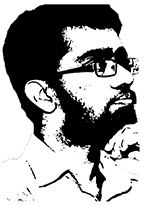
“When I am thirty, she will be forty-five. When I am sixty, she will be seventy-five.” “Candida”, George Bernard Shaw
Last week I turned 30. This is not as important as it may sound. But it is important for me. Thirty years is not a long time, though it is not a short time either. Yet my generation has lived through, endured, and changed in the face of so many things. It is difficult to compress all of them, or to reflect on them with any equanimity. There is, after all, nothing harder than taking stock of the past, than using it as a basis for the future. This is especially so because, to paraphrase Santayana, we are forever condemned to repeat it, and to commit the same errors. We don’t seem to learn from the past. We only wallow in it. And in doing so, we have attached ourselves to a never-ending cycle, an eternal recurrence.
I belong to a rather transitionary period. When I was born, we didn’t have mobile phones, only walkie-talkies that almost passed for concrete slabs. Yet five or six years later the government privatised Telecom and, for better or worse, unleashed a communications revolution which we are still digesting. That came in the midst of a dotcom boom, which Sri Lanka was slow to catch up on, and still has not caught up properly. I also remember hours-long power-cuts, a draft constitution being burnt in parliament, the tsunami, the ceasefire, the end of that ceasefire, the end of a war. I remember the narratives we were fed about the latter, and I recall seeing through those narratives.
In short, I remember accepting something as the truth, and later realising it was all lies. That has been the history of this country, and in a way, part of my growing up.
I am what is generally called a millennial. I occupy the best and I suppose the worst of both worlds. I was 21 when we installed Wi-Fi at my home and 26 when I shifted to online banking. I grew up on Encarta, moved over to Wikipedia, and became disillusioned enough with the amount of misinformation on the web to return to paperbacks and hardbacks. In our time we don’t buy DVDs, we stream online. In my time we didn’t buy DVDs, we rented them, just like we would rent or borrow books at a library.
Computers amounted to little when I was small, though computer games were a different matter altogether. Television, though restricted, occupied a more important place. And in the late 1990s and early 2000s there was much to see on it. The dullness and predictability of the 1980s had by then given way to a more diverse, colourful array of programmes. Jackson Anthony fired my interest in history with Maha Sinhale Vamsakathawa, while Chamuditha Samarawickrama got me hooked on to politics with Jana Handa.
Since this was long before the advent of mega-serials, almost all the mini series I saw stayed in my mind. They were important for my growing up, though some of them could strike a didactic and moralistic tone. It was these serials, moreover – and I had a favourite from them, Jayantha Chandrasiri’s Akala Sandya – that first shaped my conceptions of art.
I was shielded from much of what was happening out there, the result being that like so many from my generation I came to accept what we were told by those at the top. There was hardly any alternative media, or social media. When we logged into these platforms, we began to see beyond official narratives, though they soon became breeding grounds for misinformation on their own. Though we have yet to realise this fully, I think our awakening here helped us appreciate the line between knowledge and wisdom: over the decades we have been bombarded with information, yet as a country, I do not think we have matured. What is true of this country is true of my growing up: the internet churns out an exfoliating, staggering mass of data, but that has not made us, or me, any wiser.
If I am being pessimistic here, it is because my generation has seen too many opportunities slip through our fingers. When the war ended in 2009, we felt it would provide the basis for a permanent peace. Yet this was not to be. From losing our diplomatic battles to brandishing the most hideously chauvinist and majoritarian rhetoric against other collectives, we have refused to learn from the past, and have instead moored ourselves in the mistakes of that past.
We keep latching ourselves on to the same solutions – none more persistent, I would say, than our habit of going to the IMF with a begging bowl every time our foreign reserves run dry – without searching for alternatives. We pay our policymakers to prescribe the same thing again and again, and to say no to anything else.
And yet, I remain hopeful. Idiotically so perhaps, but hopeful nevertheless. It’s easy to laud the idealism of the young and hold it up against the cynicism of the old. But over the years I have associated with, and gathered, several youngsters whose vision for the country are, if romantic and utopian, certainly radical and progressive. This is not to say they are correct on everything.
Yet who are we to judge? Have we been correct on everything? Do we hold the moral high ground? I think not. Last year’s protests and their subsequent demise tell us that more needs to be done to effect real change. The more I talk with the young, the more I am convinced they need to be at the forefront of that change. Not because our time has gone, but because theirs has come. And that ties in with the biggest takeaway I have had in the last 30 years: that the more I grow, the less I seem to know.
The writer is an international relations analyst, independent researcher, and freelance columnist who can be reached at udakdev1@gmail.com.