
Features
Trends in the Indian Electoral Scene

by Kumar David
There have been a couple of interesting developments in India, a new star in the Lok Sabha and recent State elections, which I am sure will interest my readers. A meteor detonated in the in any case rumbustious chamber of the Indian Parliament and it has for a change been a woman. State Elections have been a moderate, but only moderate setback for Modi and the BJP but since there is no sign of an alliance that can be cobbled together to form an alternative government, on current trends India is heading for an inclusive result in 2024.
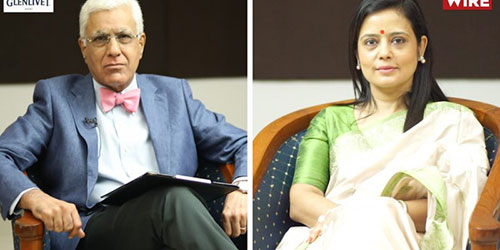
By any measure Mahua Moitra (MM) is a firebrand; a first-timer elected to the Lok Sabha in 2019 whose three Lok Sabha speeches have taken the country by storm; the lady is the talk of the town. She is not fire and guts alone but her discourses, however passionately delivered are also well informed, intelligently researched, and blood-and-guts delivery. The second and third links below will take you to two of her parliamentary assaults on the Modi Government. The first is to a frank and fascinating chat with one of India’s top interviewers Karan Thapar which shows a person so different from Lanka’s bogus MPs. Readers of this column will, if not benefit, at least greatly enjoy the freshness of the three videos.
MM read economics and mathematics at Mount Holyoke, a women’s university in Massachusetts, USA. After graduating she worked as an investment banker for JPMorgan Chase in New York and London. She quit her position as vice-president in 2009 to enter politics and joined the youth wing of Congress and was close to Rahul Gandhi. Soon she moved to Mama Banerjee’s Trinamool Congress and she took to grass roots politics.
MM refers to a poster “Early Warning Signs of Fascism”. The display site she mentions is incorrect but the poster is relevant and I reproduce it below since the first seven items are relevant to Lanka. A chap called Lawrence Britt produced this list after researching Hitler’s Nazi Germany, Mussolini’s Italy, Franco’s Spain, Salazar’s Portugal, Papadopoulos’ Greece, Pinochet’s Chile and Suharto’s Indonesia
* Powerful and continuing nationalism
* Disdain for human rights
* Religion and government intertwined
* Rampant cronyism
* Supremacy of the mili tary
* Obsession with national security
* Controlled mass media
* Identification of enemies as a unifying cause
* Disdain for intellectuals and the arts
* Rampant sexism
* Corporate power
* Protected labour power
* Obsession with crime and punishment
* Corrupt fraudulent elec tions
MM unabashedly confronts bogus nationalism; a disease that has pushed this country into the dark ages since 1956. Personally what I resent the most is that while upper strata Sinhala and Tamil bogus nationalists denied exposure to English and a modern ethos to the best and brightest of rural and village students, they sent off the fruits of their own loins to Oxford, LSE or to second rate institutions in Europe and the USA. Among my own students the best (Sreetharan, Dayawansa and a few others) were too good for bogus nationalism to trample, but many others did suffer. Now a days I see 15 to 25 year old men and women with tears in their eyes because they have been denied simple English familiarity to follow instructions on a computer screen or a design handbook or to read magazines except in the 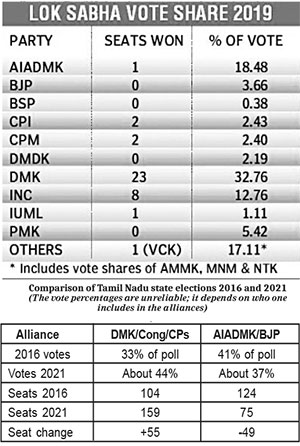 vernacular. Isolation in a linguistic ghetto serves only xenophobes and semi-educated politicians who fear that the masses will outshine them. Or worse it is the best way they can obstruct integration of communities and incite racial disharmony. Pity Ms Moitra is instinctively anti-left – she lived through the failure of Communist state governments in West Bengal and her class and educational background are not conducive to leftism. However I live in hope that as with Engels and Harini (Amarasuriya) she too will one day turn traitor to her class!
Five Indian state elections
First a quick summary of the results of the five state elections last week.
West Bengal
: Mamata Baerjee’s Trinamool Congress won 213 seats and the BJB 77 in the Assembly. No other party, including the once mighty Bengal CPI (M) and CPI, won a single seat. How the mighty have fallen! The BJP though it lost, made an impressive gain of 44 seats at the cost of Congress and the Communists.
Tamil Nadu
: The DMK, led by Stalin son of old fox Karunannidhi won, capturing 133 seats (up 33) and the late Jayalalitha’s ANADMK took 66 seats (down 58), Congress 18, the BJP 4 (up from zero) and a regional caste-based party Pattali Makkal Katchi took five. The total numbers for both alliances are shown in a Table. The musical chairs circus between the DMK and ANADMK continues.
Kerala
: CPI (M) won 62, Congress 21, CPI 17, Muslim League 15 and Kerala Congress five seats. The change in party positions is very small.
Assam
: This was the bright spot for the BJP, it took 60 seats, down three; Congress 29, up seven; the Democratic Front 16 up two and smaller parties took 13 seats in all.
Pondicherry
: A tiny region adjacent to Tamil Nadu. The NR Congress (NR being the leaders initials!) won 10 seats, the BJP six (up five), DMK six (up one) and Congress just two seats (down nine).
What are the summary comments I can make? The BJP has done okay; it held Assam, made large gains in West Bengal and small gains in Tamil Nadu and Pondicherry. It failed to secure a single seat in Kerala. Hindu nationalism, the BJP trade mark, has weathered the storm and the media forecast for the Indian general election which must be held before May 2024 is that the BJP and the Hindutva curse will hang on to power. After the 2019 election the BJP has 300 seats and its right-wing allies 47 in the 543-member Lok Sabha. Congress has a mere 52 seats and the once proud CPs was reduced to three or four in all! On its erstwhile home turf West Bengal in 2019, the two CPs failed to win a single seat while their vote share plunged to seven percent from 23% in 2014. CPI (M) managed just one seat in Kerala in 2019 though it polled 32% – the Indian electoral system is first-past-the-post (FPTP). Tamil Nadu is particularly significant for Sri Lanka. In the 2019 General Election the DMK led United Progressive Alliance won 38 of 39 Tamil Nadu Lok Sabha seats while in 2014 this alliance got just one seat. It seems from the results of the 2021 State Elections that the current DMK advantage will hold in the 2024 FPTP General Election as well. This is not good news for the Double-(Raja) Paksas.
The massacre of the left in India in 2019 reflects the fate that Sri Lankan left parties belonging to the 1970-1975 coalition suffered in the 1977. The reasons were similar; when class collaborationist governments die the uncritical left partner is buried deepest. When the Rajapaksa government falls the Dead-Left will be obliterated in perpetuity. The moral of the story is this: The left, globally, should have well learned it by now. Cross-class alliances are indeed needed and at times imperative such as in 2015 to keep a third-term Rajapaksa out of office but forming class-collaborationist governments and assuming cabinet posts is another matter. In circumstances of bourgeois state power the left does best when it keeps out of government and engages in a constructive critical role as a people’s tribune. In a bourgeois state that is its hallowed role, except in extreme and exceptional circumstances such as the 1945-1951 Clement Atlee Labour government in the UK and Alexis Tsipras’ Syriaz led coalition which was in power from 2015 to 2019. All society in the UK was shattered at the end of the war and there was a total collapse of the Greek economy in the wake of ruin brought on by debt. Both fit the description extreme and exceptional.
I will sign off by drawing attention to a conundrum. Modi seems to be less unpopular than the Double-Paksas despite a huge covid setback (even after allowing for scale), worse than Lanka; semi-fascist trends in Modi’s case mainly against Muslims are rampant (in India violations are reality, in Sri Lanka more a threat); and a near uprising by farmers. How come? One possibility is that those of us who see a collapse of the SL regime’s popularity are mistaken. The next Provincial Council elections, if ever, will settle that issue. Another possibility is that Hindutva communalism which stands behind Modi is deeper than Sinhala-Buddhist zealotry. I incline to reject this view since the bold Indian intelligentsia is sturdier than its effete Lankan middle class counterpart. My bet is something else; the Indian economy is doing ok; the growth rate is fairly good, India is not drowning in debt and people hope things will get better under a Modi government. Maybe that’s why Modi, though he did not win big four out of the five States, held his ground all round..



by Dr Gotabhya Ranasinghe
Senior Consultant Cardiologist
National Hospital Sri Lanka
When we sought a meeting with Hon Dr. Ramesh Pathirana, Minister of Health, he graciously cleared his busy schedule to accommodate us. Renowned for his attentive listening and deep understanding, Minister Pathirana is dedicated to advancing the health sector. His openness and transparency exemplify the qualities of an exemplary politician and minister.
Dr. Palitha Mahipala, the current Health Secretary, demonstrates both commendable enthusiasm and unwavering support. This combination of attributes makes him a highly compatible colleague for the esteemed Minister of Health.
Our discussion centered on a project that has been in the works for the past 30 years, one that no other minister had managed to advance.
Minister Pathirana, however, recognized the project’s significance and its potential to revolutionize care for heart patients.
The project involves the construction of a state-of-the-art facility at the premises of the National Hospital Colombo. The project’s location within the premises of the National Hospital underscores its importance and relevance to the healthcare infrastructure of the nation.
This facility will include a cardiology building and a tertiary care center, equipped with the latest technology to handle and treat all types of heart-related conditions and surgeries.
Securing funding was a major milestone for this initiative. Minister Pathirana successfully obtained approval for a $40 billion loan from the Asian Development Bank. With the funding in place, the foundation stone is scheduled to be laid in September this year, and construction will begin in January 2025.
This project guarantees a consistent and uninterrupted supply of stents and related medications for heart patients. As a result, patients will have timely access to essential medical supplies during their treatment and recovery. By securing these critical resources, the project aims to enhance patient outcomes, minimize treatment delays, and maintain the highest standards of cardiac care.
Upon its fruition, this monumental building will serve as a beacon of hope and healing, symbolizing the unwavering dedication to improving patient outcomes and fostering a healthier society.We anticipate a future marked by significant progress and positive outcomes in Sri Lanka’s cardiovascular treatment landscape within the foreseeable timeframe.

by Fr. Emmanuel Fernando, OMI
Jesuit Fr. Aloysius Pieris (affectionately called Fr. Aloy) celebrated his 90th birthday on April 9, 2024 and I, as the editor of our Oblate Journal, THE MISSIONARY OBLATE had gone to press by that time. Immediately I decided to publish an article, appreciating the untiring selfless services he continues to offer for inter-Faith dialogue, the renewal of the Catholic Church, his concern for the poor and the suffering Sri Lankan masses and to me, the present writer.
It was in 1988, when I was appointed Director of the Oblate Scholastics at Ampitiya by the then Oblate Provincial Fr. Anselm Silva, that I came to know Fr. Aloy more closely. Knowing well his expertise in matters spiritual, theological, Indological and pastoral, and with the collaborative spirit of my companion-formators, our Oblate Scholastics were sent to Tulana, the Research and Encounter Centre, Kelaniya, of which he is the Founder-Director, for ‘exposure-programmes’ on matters spiritual, biblical, theological and pastoral. Some of these dimensions according to my view and that of my companion-formators, were not available at the National Seminary, Ampitiya.
Ever since that time, our Oblate formators/ accompaniers at the Oblate Scholasticate, Ampitiya , have continued to send our Oblate Scholastics to Tulana Centre for deepening their insights and convictions regarding matters needed to serve the people in today’s context. Fr. Aloy also had tried very enthusiastically with the Oblate team headed by Frs. Oswald Firth and Clement Waidyasekara to begin a Theologate, directed by the Religious Congregations in Sri Lanka, for the contextual formation/ accompaniment of their members. It should very well be a desired goal of the Leaders / Provincials of the Religious Congregations.
Besides being a formator/accompanier at the Oblate Scholasticate, I was entrusted also with the task of editing and publishing our Oblate journal, ‘The Missionary Oblate’. To maintain the quality of the journal I continue to depend on Fr. Aloy for his thought-provoking and stimulating articles on Biblical Spirituality, Biblical Theology and Ecclesiology. I am very grateful to him for his generous assistance. Of late, his writings on renewal of the Church, initiated by Pope St. John XX111 and continued by Pope Francis through the Synodal path, published in our Oblate journal, enable our readers to focus their attention also on the needed renewal in the Catholic Church in Sri Lanka. Fr. Aloy appreciated very much the Synodal path adopted by the Jesuit Pope Francis for the renewal of the Church, rooted very much on prayerful discernment. In my Religious and presbyteral life, Fr.Aloy continues to be my spiritual animator / guide and ongoing formator / acccompanier.
Fr. Aloysius Pieris, BA Hons (Lond), LPh (SHC, India), STL (PFT, Naples), PhD (SLU/VC), ThD (Tilburg), D.Ltt (KU), has been one of the eminent Asian theologians well recognized internationally and one who has lectured and held visiting chairs in many universities both in the West and in the East. Many members of Religious Congregations from Asian countries have benefited from his lectures and guidance in the East Asian Pastoral Institute (EAPI) in Manila, Philippines. He had been a Theologian consulted by the Federation of Asian Bishops’ Conferences for many years. During his professorship at the Gregorian University in Rome, he was called to be a member of a special group of advisers on other religions consulted by Pope Paul VI.
Fr. Aloy is the author of more than 30 books and well over 500 Research Papers. Some of his books and articles have been translated and published in several countries. Among those books, one can find the following: 1) The Genesis of an Asian Theology of Liberation (An Autobiographical Excursus on the Art of Theologising in Asia, 2) An Asian Theology of Liberation, 3) Providential Timeliness of Vatican 11 (a long-overdue halt to a scandalous millennium, 4) Give Vatican 11 a chance, 5) Leadership in the Church, 6) Relishing our faith in working for justice (Themes for study and discussion), 7) A Message meant mainly, not exclusively for Jesuits (Background information necessary for helping Francis renew the Church), 8) Lent in Lanka (Reflections and Resolutions, 9) Love meets wisdom (A Christian Experience of Buddhism, 10) Fire and Water 11) God’s Reign for God’s poor, 12) Our Unhiddden Agenda (How we Jesuits work, pray and form our men). He is also the Editor of two journals, Vagdevi, Journal of Religious Reflection and Dialogue, New Series.
Fr. Aloy has a BA in Pali and Sanskrit from the University of London and a Ph.D in Buddhist Philosophy from the University of Sri Lankan, Vidyodaya Campus. On Nov. 23, 2019, he was awarded the prestigious honorary Doctorate of Literature (D.Litt) by the Chancellor of the University of Kelaniya, the Most Venerable Welamitiyawe Dharmakirthi Sri Kusala Dhamma Thera.
Fr. Aloy continues to be a promoter of Gospel values and virtues. Justice as a constitutive dimension of love and social concern for the downtrodden masses are very much noted in his life and work. He had very much appreciated the commitment of the late Fr. Joseph (Joe) Fernando, the National Director of the Social and Economic Centre (SEDEC) for the poor.
In Sri Lanka, a few religious Congregations – the Good Shepherd Sisters, the Christian Brothers, the Marist Brothers and the Oblates – have invited him to animate their members especially during their Provincial Congresses, Chapters and International Conferences. The mainline Christian Churches also have sought his advice and followed his seminars. I, for one, regret very much, that the Sri Lankan authorities of the Catholic Church –today’s Hierarchy—- have not sought Fr.
Aloy’s expertise for the renewal of the Catholic Church in Sri Lanka and thus have not benefited from the immense store of wisdom and insight that he can offer to our local Church while the Sri Lankan bishops who governed the Catholic church in the immediate aftermath of the Second Vatican Council (Edmund Fernando OMI, Anthony de Saram, Leo Nanayakkara OSB, Frank Marcus Fernando, Paul Perera,) visited him and consulted him on many matters. Among the Tamil Bishops, Bishop Rayappu Joseph was keeping close contact with him and Bishop J. Deogupillai hosted him and his team visiting him after the horrible Black July massacre of Tamils.
Sri Lanka-Singapore Free Trade Agreement
By Gomi Senadhira
senadhiragomi@gmail.com
“You might tell fairy tales, but the progress of a country cannot be achieved through such narratives. A country cannot be developed by making false promises. The country moved backward because of the electoral promises made by political parties throughout time. We have witnessed that the ultimate result of this is the country becoming bankrupt. Unfortunately, many segments of the population have not come to realize this yet.” – President Ranil Wickremesinghe, 2024 Budget speech
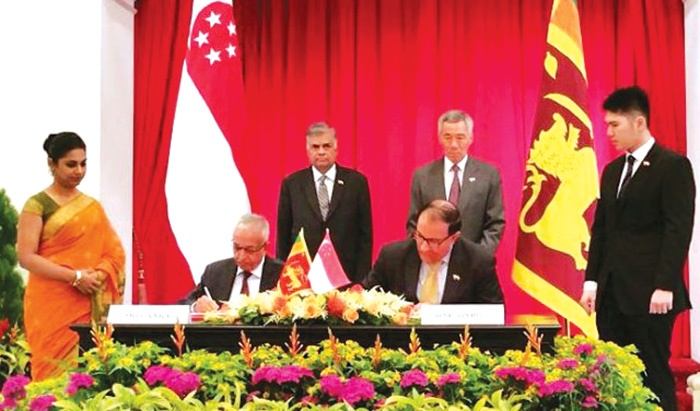
Any Sri Lankan would agree with the above words of President Wickremesinghe on the false promises our politicians and officials make and the fairy tales they narrate which bankrupted this country. So, to understand this, let’s look at one such fairy tale with lots of false promises; Ranil Wickremesinghe’s greatest achievement in the area of international trade and investment promotion during the Yahapalana period, Sri Lanka-Singapore Free Trade Agreement (SLSFTA).
It is appropriate and timely to do it now as Finance Minister Wickremesinghe has just presented to parliament a bill on the National Policy on Economic Transformation which includes the establishment of an Office for International Trade and the Sri Lanka Institute of Economics and International Trade.
Was SLSFTA a “Cleverly negotiated Free Trade Agreement” as stated by the (former) Minister of Development Strategies and International Trade Malik Samarawickrama during the Parliamentary Debate on the SLSFTA in July 2018, or a colossal blunder covered up with lies, false promises, and fairy tales? After SLSFTA was signed there were a number of fairy tales published on this agreement by the Ministry of Development Strategies and International, Institute of Policy Studies, and others.
However, for this article, I would like to limit my comments to the speech by Minister Samarawickrama during the Parliamentary Debate, and the two most important areas in the agreement which were covered up with lies, fairy tales, and false promises, namely: revenue loss for Sri Lanka and Investment from Singapore. On the other important area, “Waste products dumping” I do not want to comment here as I have written extensively on the issue.
1. The revenue loss
During the Parliamentary Debate in July 2018, Minister Samarawickrama stated “…. let me reiterate that this FTA with Singapore has been very cleverly negotiated by us…. The liberalisation programme under this FTA has been carefully designed to have the least impact on domestic industry and revenue collection. We have included all revenue sensitive items in the negative list of items which will not be subject to removal of tariff. Therefore, 97.8% revenue from Customs duty is protected. Our tariff liberalisation will take place over a period of 12-15 years! In fact, the revenue earned through tariffs on goods imported from Singapore last year was Rs. 35 billion.
The revenue loss for over the next 15 years due to the FTA is only Rs. 733 million– which when annualised, on average, is just Rs. 51 million. That is just 0.14% per year! So anyone who claims the Singapore FTA causes revenue loss to the Government cannot do basic arithmetic! Mr. Speaker, in conclusion, I call on my fellow members of this House – don’t mislead the public with baseless criticism that is not grounded in facts. Don’t look at petty politics and use these issues for your own political survival.”
I was surprised to read the minister’s speech because an article published in January 2018 in “The Straits Times“, based on information released by the Singaporean Negotiators stated, “…. With the FTA, tariff savings for Singapore exports are estimated to hit $10 million annually“.
As the annual tariff savings (that is the revenue loss for Sri Lanka) calculated by the Singaporean Negotiators, Singaporean $ 10 million (Sri Lankan rupees 1,200 million in 2018) was way above the rupees’ 733 million revenue loss for 15 years estimated by the Sri Lankan negotiators, it was clear to any observer that one of the parties to the agreement had not done the basic arithmetic!
Six years later, according to a report published by “The Morning” newspaper, speaking at the Committee on Public Finance (COPF) on 7th May 2024, Mr Samarawickrama’s chief trade negotiator K.J. Weerasinghehad had admitted “…. that forecasted revenue loss for the Government of Sri Lanka through the Singapore FTA is Rs. 450 million in 2023 and Rs. 1.3 billion in 2024.”
If these numbers are correct, as tariff liberalisation under the SLSFTA has just started, we will pass Rs 2 billion very soon. Then, the question is how Sri Lanka’s trade negotiators made such a colossal blunder. Didn’t they do their basic arithmetic? If they didn’t know how to do basic arithmetic they should have at least done their basic readings. For example, the headline of the article published in The Straits Times in January 2018 was “Singapore, Sri Lanka sign FTA, annual savings of $10m expected”.
Anyway, as Sri Lanka’s chief negotiator reiterated at the COPF meeting that “…. since 99% of the tariffs in Singapore have zero rates of duty, Sri Lanka has agreed on 80% tariff liberalisation over a period of 15 years while expecting Singapore investments to address the imbalance in trade,” let’s turn towards investment.
Investment from Singapore
In July 2018, speaking during the Parliamentary Debate on the FTA this is what Minister Malik Samarawickrama stated on investment from Singapore, “Already, thanks to this FTA, in just the past two-and-a-half months since the agreement came into effect we have received a proposal from Singapore for investment amounting to $ 14.8 billion in an oil refinery for export of petroleum products. In addition, we have proposals for a steel manufacturing plant for exports ($ 1 billion investment), flour milling plant ($ 50 million), sugar refinery ($ 200 million). This adds up to more than $ 16.05 billion in the pipeline on these projects alone.
And all of these projects will create thousands of more jobs for our people. In principle approval has already been granted by the BOI and the investors are awaiting the release of land the environmental approvals to commence the project.
I request the Opposition and those with vested interests to change their narrow-minded thinking and join us to develop our country. We must always look at what is best for the whole community, not just the few who may oppose. We owe it to our people to courageously take decisions that will change their lives for the better.”
According to the media report I quoted earlier, speaking at the Committee on Public Finance (COPF) Chief Negotiator Weerasinghe has admitted that Sri Lanka was not happy with overall Singapore investments that have come in the past few years in return for the trade liberalisation under the Singapore-Sri Lanka Free Trade Agreement. He has added that between 2021 and 2023 the total investment from Singapore had been around $162 million!
What happened to those projects worth $16 billion negotiated, thanks to the SLSFTA, in just the two-and-a-half months after the agreement came into effect and approved by the BOI? I do not know about the steel manufacturing plant for exports ($ 1 billion investment), flour milling plant ($ 50 million) and sugar refinery ($ 200 million).
However, story of the multibillion-dollar investment in the Petroleum Refinery unfolded in a manner that would qualify it as the best fairy tale with false promises presented by our politicians and the officials, prior to 2019 elections.
Though many Sri Lankans got to know, through the media which repeatedly highlighted a plethora of issues surrounding the project and the questionable credentials of the Singaporean investor, the construction work on the Mirrijiwela Oil Refinery along with the cement factory began on the24th of March 2019 with a bang and Minister Ranil Wickremesinghe and his ministers along with the foreign and local dignitaries laid the foundation stones.
That was few months before the 2019 Presidential elections. Inaugurating the construction work Prime Minister Ranil Wickremesinghe said the projects will create thousands of job opportunities in the area and surrounding districts.
The oil refinery, which was to be built over 200 acres of land, with the capacity to refine 200,000 barrels of crude oil per day, was to generate US$7 billion of exports and create 1,500 direct and 3,000 indirect jobs. The construction of the refinery was to be completed in 44 months. Four years later, in August 2023 the Cabinet of Ministers approved the proposal presented by President Ranil Wickremesinghe to cancel the agreement with the investors of the refinery as the project has not been implemented! Can they explain to the country how much money was wasted to produce that fairy tale?
It is obvious that the President, ministers, and officials had made huge blunders and had deliberately misled the public and the parliament on the revenue loss and potential investment from SLSFTA with fairy tales and false promises.
As the president himself said, a country cannot be developed by making false promises or with fairy tales and these false promises and fairy tales had bankrupted the country. “Unfortunately, many segments of the population have not come to realize this yet”.
(The writer, a specialist and an activist on trade and development issues . )



US sports envoys to Lanka to champion youth development

Rahuman questions sudden cancellation of leave of CEB employees


