
Life style
Time to end Santa’s ‘naughty list’?

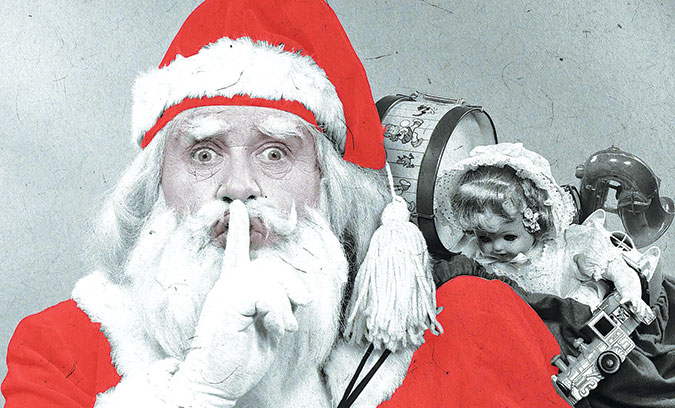
Many of us have magical memories of Santa secretly bringing gifts and joy to our childhood homes – but is there a darker side to the beloved Christmas tradition?
“You better watch out, you better not cry, you better not pout, I’m telling you why, Santa Claus is coming to town.”
And don’t I know it! This is the first year that my three-year-old daughter has fully immersed herself in the mythology of Santa. As she tells me just how Old Saint Nick is going to fit down our chimney, I can see a glint of pure wonder in her eyes that immediately transports me back to my own childhood Christmases.
I was – and I’m happy to admit it – a full-blown believer. I absolutely loved the magic of Christmas, especially Santa Claus, and my parents went, let’s say, above and beyond to encourage it. On Christmas morning I would tiptoe downstairs to find the fireguard ajar, the remnants of a hurriedly-eaten mince pie on a plate, a reindeer-chewed carrot and a tissue with a red smudge where Santa had clearly polished Rudolph’s nose (definitely not my Mum’s lipstick). The evidence was, as far as I was concerned, insurmountable.
However, as I begin to construct my own Santa Claus myth for my daughter I can’t help but feel pangs of guilt. Could fuelling her belief in all this festive magic in some way undermine her trust? In moments of exasperation, I can hear myself invoke the threat of the “naughty list” and I see a sudden flash of fear across her face. It’s made me wonder what kind of Santa I want to create for my daughter and, to be honest, whether I should be doing it at all.
Fascinatingly, although the modern world feels like it has been stripped of so much of its magic, belief in Santa Claus has remained remarkably consistent. Back in 1978, a study published in the American Journal of Orthopsychiatry found that 85% of four-year-olds said they believed in Santa. More than a quarter of a century later, in 2011, research published in the Journal of Cognition and Development found that a very similar 83% of 5-year-olds claimed to be true believers. And that is despite Google Trends showing that the search term “is Santa real” spikes every December.
I guess it’s not all that surprising. The cultural evidence we create as a society for the existence of Santa certainly stacks up. He features in every Christmas TV show and movie, he’s camped out in strange little sheds in every shopping centre we visit. Each year the North American Aerospace Defence Command (NORAD) allows you to track Santa’s journey on Christmas Eve. To reassure children during the pandemic in 2020, the World Health Organisation issued a tongue-in-cheek statement declaring that Santa was “immune” from Covid 19. To be honest, there’s more evidence for Santa’s existence out there than my own, which is almost enough to trigger a mild existential crisis.
And it’s precisely this effort on behalf of parents, and society in general, to create such seemingly overwhelming evidence for the existence of Santa Claus that David Kyle Johnson, a professor of philosophy at King’s College in Pennsylvania, describes as “The Santa Lie” in his book The Myths That Stole Christmas.
“When I say ‘The Santa Lie’, I am not referring to the entire mythos of Santa Claus, I am referring to a particular practice within that myth: Parents tricking their children into believing that Santa Claus is literally real,” says Johnson. He highlights how we don’t simply ask children to imagine Santa, but rather to actually believe in him. It’s this emphasis on belief over imagination that Johnson sees as harmful.
“I definitely think it can erode trust between a parent and a child, but I think the biggest danger is the anti-critical thinking lessons that they are teaching,” says Johnson. “Parents who are especially dedicated to ‘The Santa Lie’ will perform feats of insanity to ensure their children keep believing.”
This brings a flash back to my childhood, where at eight-years-old I wrote a letter to Santa probing the logistics of his yearly mission, only for my Dad to write back in his best “olden times” handwriting, covering the reply in sooty fingerprints (probably whilst gnawing on a raw carrot). My colleague Rob shared that his Mum apparently found the carrot a particularly disgusting part of the Christmas Eve ritual.
For Johnson, it is this creation of false evidence and convincing kids that bad evidence is in fact good evidence that undermines the kind of critical thinking we should be encouraging in children in this era of fake news, conspiracy theories and science denial. “The ‘Santa lie’ is part of a parenting practice that encourages people to believe what they want to believe, simply because of the psychological reward,” says Johnson. “That’s really bad for society in general.”
When magic is no longer the answer, children start to gather evidence – Cyndy Scheibe
Interestingly, there are some experts, however, who argue that believing in Santa Claus can actually encourage critical thinking in children. It hinges on how parents support them in the process of eventually discovering and accepting the truth. Cyndy Scheibe, professor of psychology at Ithaca College in New York, and an expert in media literacy, has been researching children’s belief in Santa Claus since the 1980s. She has conducted research in three different time periods and found surprisingly consistent results each time.
“Kids start to ask questions around four or five, and then really start to have doubts around the age of six,” says Scheibe. Each time she conducted her research Schiebe found the same thing, that the average age children stop believing in Santa was between seven and eight. However, it is very rarely a sudden thing. “I found that that process seemed to take about two years for kids to navigate through.”
Scheibe explains that this transition period, of between seven and nine years old, makes sense because it aligns with the ages when children go from being so-called “pre-operational thinkers” to “concrete operational thinkers”. Swiss psychologist Jean Piaget developed these terms to explain how children gradually build up their understanding and knowledge of the world. At the pre-operational stage, a child’s idea of the world is mainly shaped by how things appear, rather than by deeper logical reasoning. But that changes as children begin to probe and question the things they see or hear. “A concrete operational thinker wants evidence,” Scheibe says. “They begin to mature cognitively, where the story doesn’t make logical sense and magic is no longer the answer. Then they start to gather evidence.”
And it is at this stage that Scheibe says parents need to be led by their children, in order to help them develop their critical thinking skills. “They function as little scientists, testing out hypotheses and gathering data to figure out what’s true and what’s not,” Schiebe says. This is something parents can encourage through asking careful questions. “In media literacy it’s all about asking questions. What do you think? How could we really find out? Why do you think people do that?” Scheibe explains.
My colleague Amy told me about the evidence that triggered the end of her belief in Santa Claus when she was around seven: “I recognised my mum’s handwriting on the label and was totally shocked!”. However, Amy said she doesn’t remember feeling hurt or betrayed by the discovery. Rather, “it made me feel like a grown-up and that I understood something about the world”.
Amy’s experience tallies with research published in Child Psychology and Human Development that found children generally discovered the truth about Santa on their own at the age of seven and reported “predominantly positive” reactions to discovering this. However, the study showed parents, on the other hand, fared less well, describing themselves as “predominantly sad” in reaction to their child’s discovery.
And herein lies the major issue for both Johnson and Schiebe: It’s not so much children but rather their parents who refuse to let go of Santa Claus.
Schiebe describes how throughout her decades of research the only times she saw belief in Santa become “problematic” was when parents continued to perpetuate the belief beyond the time the child was ready for the truth. “I think that one problem is kids are ready to hear the truth, but you’re not ready to let go of the truth, and you’ve got to let go of the truth,” Scheibe says.
As a father I can understand the draw of keeping hold of the Santa mythology for as long as possible. On the one hand it feels like it’s a way of stopping them growing up too fast, of protecting an element of their innocence somehow. On the other hand, Santa has, for many parents – and I include myself in this – become a quick-fix for managing behaviour with his infamous “naughty list”.
The idea that Santa is watching all of the time can be quite a frightening concept for children – Rachel Andrew
It’s always been the part of the Santa Claus myth that I have found the most uncomfortable. His presence as a sort of festive Big Brother, an all-seeing eye constantly judging your behaviour as either “naughty” or “nice”. And recently this element of the mythos has gained a whole new lease of life, with Elf on the Shelf – described on its own website as “Santa’s scout elf” – supposedly reporting behaviour back to Santa, and even fake CCTV “Santa cams” that parents can install to hammer home the message that you are never not being watched. In many ways it feels Santa has become a working model for Foucault’s panopticism – a form of internalised surveillance and self-monitoring that no longer requires external enforcement.
“For a lot of children Santa can be quite a scary figure. That idea that he is watching all of the time can be quite a frightening concept,” says Rachel Andrew, a clinical psychologist specialising in child and family psychology. Andrew believes using Santa’s “naughty list” as a behaviour management tool is flawed in numerous ways. “Having children believe they are on an imaginary naughty list for behaviour they have done over, what, an entire year? Three or four months? It’s so far against what we know is likely to encourage positive behaviour in our children,” Andrew says.
For Andrew, the way parents use Santa for discipline is too vague for children to really understand what we are asking of them, and the time frames are often so broad it is unattainable.
“One of the issues might be that the discipline is not coming from you as a parent. You’re giving it away to somebody who is outside of your own family home,” says Andrew. This can open up the potential that your child doesn’t see you as the person they need to change or monitor their behaviour for. Also, Andrew sees the age-old threat of Santa not delivering toys to naughty children as realistically unenforceable. “It’s not proportionate to any behaviour that a child is going to do, that they might lose all their Christmas gifts. And I haven’t met a child yet who’s not had any gifts due to their behaviour. It’s unlikely any parent is going to follow it through, so it is also an empty threat.”
There’s another uncomfortable by-product of Santa making a list and checking it twice to find out who’s been naughty or nice: it builds an idea that gifts are a measurement of their moral worth.
“We have so many ways that we perpetuate the idea that people get what they deserve,” says Philip N Cohen, professor of sociology at the University of Maryland, College Park. “You’re telling [children] that the presents they get are a function of the quality of their goodness, which just seems a harsh lesson in a world with so much inequality.”
Cohen wonders what happens when children’s belief in Santa intersects with their increasing awareness of the inequality around them, especially at an age when they may be looking for explanations for that inequality. “Do you have seven-year-old kids who can see inequality all around them who still believe that Santa gives you presents based on your moral worth?” Cohen asks. “That would be teaching well-off children that they’re getting what they deserve, because they’re good, and the poor children are getting what they deserve, because they’re not good. That just seems like a corrosive lesson for them.”
As the cost of living crisis bites this Christmas, this feels a more relevant issue than ever. Scheibe believes that one way to combat this is to share out Santa’s gift giving responsibilities. “There are some families in which all the gifts come from Santa. Personally I think that’s a mistake,” Scheibe says. She argues that children should be more involved in the process of gift giving at Christmas. “Have Santa Claus be a piece, but also it’s about more than that, it’s about giving and receiving and you can get kids involved in that pretty early.”
So, as my daughter sits down to watch another episode of The Santa Clauses, what kind of Santa is it that I want to create for her?
I think I definitely want to be careful that I don’t try to stray too far from playful imagination into literal belief. I certainly want to burn the “naughty list” – I’d like her Santa to be more Gandalf, less all-seeing Eye of Sauron. And as she gets older I hope I am prepared to let go of the truth when she is ready for me to, and to encourage her in that journey of discovery. Although I don’t believe that means letting Santa go, but rather just initiating a new Santa to the club.
A perfect example of this is what Schiebe told me happened when her own daughter stopped believing: “I said: ‘So now that you know the truth, you get to be Santa Claus, and you know what that means? You can get up in the middle of the night put things in people’s stockings, but you’ve got to make sure nobody sees you, and it’s got to be something you know they want. So then, the next Christmas morning, when I woke up, there were things in my stocking that I hadn’t gotten. The look on her face of how excited she was that she had been able to be Santa Claus, that was just spectacular.”
(Guardian)



Institute of Hospitality Sri Lanka
 The 32nd Annual General Meeting (AGM) of the UK-based Institute of Hospitality’s Sri Lanka Chapter was held recently at the Ramada Hotel Colombo,.The event provided an evening of camaraderie , reflection of the past and present achievements,setting new benchmarks for the future
The AGM had the presence of two distinguished guests, the Chief Guest Opposition Leader Sajith Premadasa, and the Guest of Honour British High Commissioner to Sri Lanka, Andrew Patrick. Their inspiring speeches were lauded by all hoteliers who were present at the occasion
A special thanks was extended to Robert Richardson, CEO of the Institute of Hospitality UK, along with his team, sponsors, committee members, and all attendees for making the event memorable.
Dr. Harsha Jayasingh, Past President of the Institute of Hospitality (UK) Sri Lanka Chapter, emphasised the Institute’s longstanding history and the strength of its Sri Lankan branch. “The Institute of Hospitality (IH) UK has a history of 86 years, and we are proud to be the Sri Lanka Branch. IH Sri Lanka is much stronger now with many members from all areas of the hospitality industry,” he stated.
Dr. Jayasingh highlighted the significant role of tourism in Sri Lanka’s economy,. He said tourism it is the third-largest source of revenue for the country. “Tourism accounts for about 13.3% of total foreign exchange earnings and employs 450,000 people directly and indirectly. The hospitality industry in this island of pearl holds tremendous potential for economic growth, job creations, and cultural exchange,” he added.
He also pointed out more women should be attracted to the industry and advocated for the use of technology in hospitality sector to attract the younger generation.
The newly appointed Chairman Ramesh Dassanayake spoke about the challenges faced by the industry, including the reluctance of youth to join the sector. . Dassanayake expressed concerns over the migration of staff between hotels and the overall ‘brain drain’ in the sector. ” We must maintain high standards in the hotel We must try to attract tourists to Sri Lanka, we must have with many facilities Hence, hotel schools and other professional institutions involved in skills development mustincrease their intakes,” he pointed out.
Chief Guest Sajith Premadasa emphasised the importance of eco tourism and said “We need to have an environmental policy related to tourism in place,” . .
The 32nd AGM of the Institute of Hospitality UK, Sri Lanka Chapter, was a testament to the strength and potential of Sri Lanka’s hospitality industry. The insights and commitments shared during the event set a new benchmark for the future.(ZC)


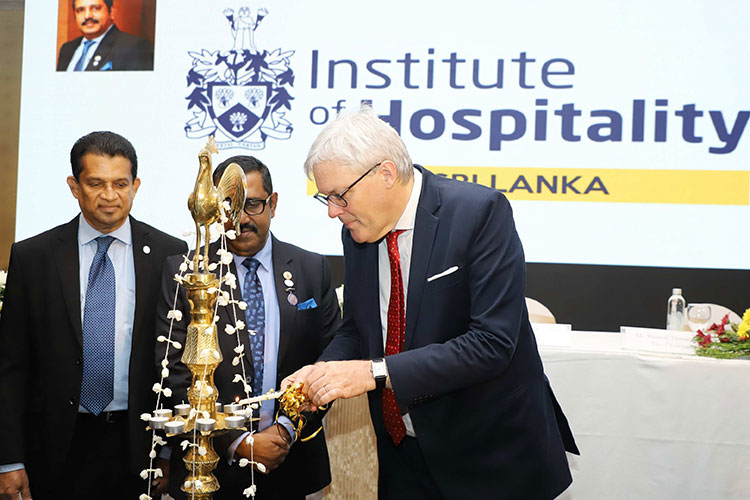


Pix by Thushara Attapathu
Life style
He recognizes human identity beyond boundaries of gender, race, nationality and religion.
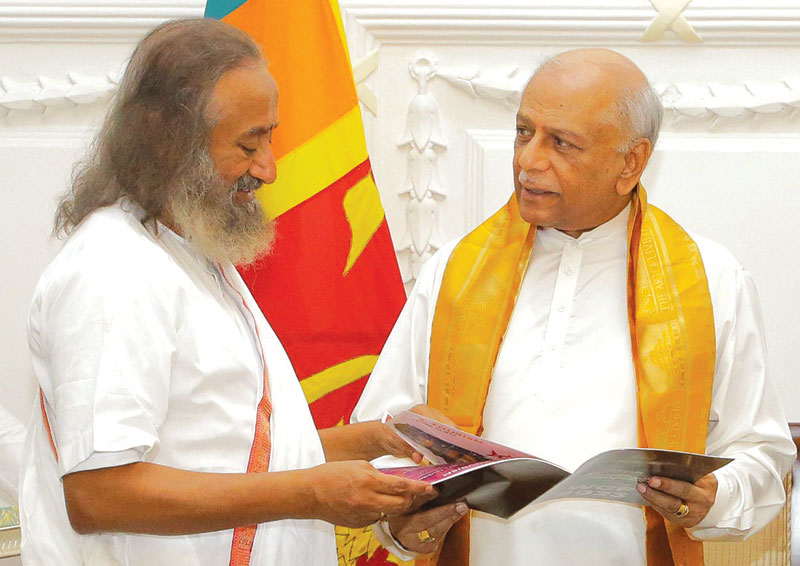
Visit of Sri Gurudev to Sri Lanka
Humanitarian, spiritual leader and Global Ambassador of Peace Gurudev Sri Sri Ravi Shankar (Sri Gurudev) was in Sri Lanka on a three day tour on the invitation of the Prime Minister of Sri Lanka Dinesh Gunewardene. Gurudev who inspired a wave of volunteerism and service to moot one of the largest volunteer-based organisations in the world – The Art of Living – visited the various projects under the aegis of the foundation and launched twelve vocational and technical centers around the island. He was accompanied by thousands of followers from Sri Lanka and around the world.
Gurudev who visited Sri Lanka for the sixth time also had a first day cover launched in honour of his visit. He is a strong proponent of spreading happiness, using the unique Sudarshan Kriya, yoga, meditation and practical wisdom to unite people, empower individuals and transform communities. His programmes provide techniques and tools to live a deeper, more joyous life, while his non-profit organisations recognize the human identity beyond the boundaries of gender, race, nationality and religion.
The Art of Living which has more than 30,000 teachers and over one million volunteers across 180 countries has touched in excess of five hundred million people around the world. CNN called it “Life Changing” and The Washington Post headlined it, “Fresh air to millions”.
In Trincomalee, Gurudev met with war victims and had a heartwarming engagement with the children from the children’s homes run by the Foundation. He also visited the Koneswara Temple in Trincomalee and graced the Kumbhabhishekam at Seetha ecogPnize the human identity beyond the boundaries of gender, race, nationality and religion. Amman temple at Nuwara Eliya. He held discussions with the trustees on the progress of the foundation’s social service projects, while also holding a special event – Ekamuthuwa – attended by a large number of dignitaries and his devotees from around the world.
His time with the Prime Minister was spent discussing the prospects of unity in diversity and uniting Sri Lanka by adding happiness into the formula of living. In addition he had discussions with the Speaker of the Parliament of Sri Lanka Mahinda Yapa Abeywardena, prominent business stewards and civil society leaders.

by Zanita Careem
Envison your dream wedding day come to life at the Epitome Hotel, a prestigious city hotel in Kurunegala offering an unrivalled luxury rendors experience for weddings.
The venue is designed to embody opulence and luxury from all quarters for a spectacular wedding in kurunegala,Thier ballroom is the largest banquet facility in Sri Lanka It can be divided into six luxurious pillarless wedding halls on the ground floor and 25pax smaller banquet halls.
It can be easily named as a five star heaven in the heart of the city contributing to a myriad of immense experiences tailored to inspire and delight wedding experiences.
From opulent décor set up to exquisite table decor, lavish food, every detail is meticulously curated to spark your imagination and ignite creativity for a perfect wedding. The previous prestigious wedding shows season one and season two attracted large crowds
were unique events which gave the wedding vendors and potential clients had an opportunity to connect and interact with each other. Beyond being a showcase it was a chance for the wedding vendors to unite and contribute to the vibrancy of the wedding industry. The wedding show covered all area of the bridal industry providing a comprehensive variety of bridal supplies from Sri lanka and became the most popular bridal exhibitions in Kurunegala.This bridal exhibitions allowed brides and grooms to experience first hand the products and services available from suppliers in Sri Lanka
These wedding shows held at The Epitome created a benchmark and gave an opportunity for vendors to create connections to the utmost satisfaction said Harshan Lakshita Executive Director. of the magnificent Hotel
Our wedding shows featured experts and professionals in every field‘ It covered all areas of the bridal industry provided a comprehensive variety of bridal supplies from Sri lanka and became most popular bridal exhibition in this region.We are always open to everyone to join us at our wedding shows in the future. It is an opportunity to discover the incredible talent within our local wedding and bridal vendors to make meaningful relationships and plan thier special day at our breathtaking hotel The Epitome said General Manager Kavinda Caldera
The Epitome Hotel’s bridal show which will be held end of June will buzz with great ideas,advice and inspiration for all those who plan thier dream wedding
…….
The Hotel Epitome’s Wedding Season 3 will marked excellence, celebration and inspiration for those in the wedding industry. The exhibition halls will resonate with ideas on exquisite bridal wear to decor, florists , photography etc and showshowcase the rich tapestry of talent within the local wedding industry. .







US sports envoys to Lanka to champion youth development

Rahuman questions sudden cancellation of leave of CEB employees


