
Life style
The world”s Surprising fried chicken capital

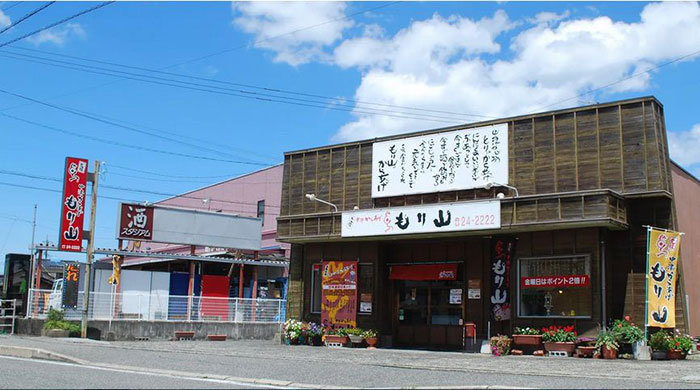
Why is the small town of Nakatsu – with its nearly 50 “karaage” shops – considered to have the best fried chicken in Japan, and quite possibly the world?e little karaage, one of the most popular snacks in Japan, is a delicate and intricate version of fried chicken that is a staple across the country.
This delightfully crunchy treat is so beloved that every year, hundreds of thousands of people vote in a country-wide competition to determine which karaage shop serves the best ones. While shops from massive metropolises like Tokyo, Kyoto and Osaka’s The Karaage Grand Prix is the annual competition in Japan whose winner gets to boast that they have the crispiest, juiciest, most flavourful fried chicken, and nearly 1,000 shops enter to compete. Up until 2022, this contest was based entirely on popularity, with common denizens getting to vote on their favourite places. But in 2023, the rules are changed Why does any of this matter? And why is this small town of Nakatsu considered to have the best fried chicken in Japan, and quite possibly the world?
With the added scrutiny and official tasters coming into play, Nakatsu City karaage shops have more to lose and more to prove than your average shop across the country. The city’s entire reputation as the karaage capital of Japan is now on the line and hundreds of years of cultural culinary history is at stake.
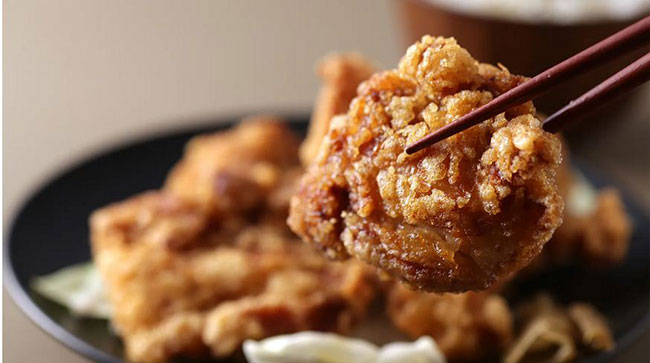
First, a definition of karaage (pronounced like “karate”, except you substitute a hard “g” for the “t”): it’s a type of fried chicken that’s famous in Japan for both its simplicity of execution and complexity of flavours. It’s a lightly battered bird, mainly using potato starch as a coating, that crisply covers nugget-sized pieces of chicken thighs, breasts, necks and wings that have been marinated in mixtures of soy sauce, ginger, salt, garlic, fruits and other highly secretive ingredients that gives off a taste explosion that dribbles down your chin with every bite.First, a definition of karaage (pronounced like “karate”, except you substitute a hard “g” for the “t”): it’s a type of fried chicken that’s famous in Japan for both its simplicity of execution and complexity of flavours. It’s a lightly battered bird, mainly using potato starch as a coating, that crisply covers nugget-sized pieces of chicken thighs, breasts, necks and wings that have been marinated in mixtures of soy sauce, ginger, salt, garlic, fruits and other highly secretive ingredients that gives off a taste explosion that dribbles down your chin with every bite.The Karaage Grand Prix is an annual competition for the best fried chicken in Japan (Credit: Karaage festival ExCo)
People line up around the block for their favourites and even the late Anthony Bourdain obsessed over them: “I’m addicted to these deep-fried chicken cutlets… It’s a guilty pleasure. I know exactly where to find a Lawson in Narita International Airport, and I never get on the plane without loading up on these bad boys.” There’s even a karaage movie produced by the Japan Karaage Association dubbing the savoury snack as the “ultimate national food”.
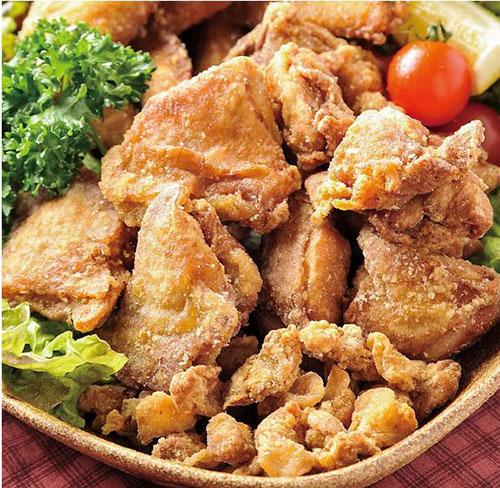
But fundamentally, karaage is the final result of a multi-generational history that spans continents, the age of exploration, cross-cultural pollination, famine and world wars. It’s a fried chicken unlike any other and it’s considered the soul food of Nakatsu.
The origins of karaage can be traced to the 16th Century when Portuguese missionaries arrived on Japanese shores of Kyushu Island through the port at Nagasaki and brought their fried cooking methods with them. Slowly, Japanese denizens began to adopt some of these Western ways into what today would be considered tempura. At the time, however, the Japanese diet was mainly pescatarian, which could be attributed to their Buddhist beliefs.
Eating chicken didn’t come into the picture until tragedy struck the island nation. During the Ky?h? era (1716-1736), a widespread famine practically wiped out the rice crop on the island of Kyushu and killed tens of thousands of people. According to Livestock Production in Kyushu (in Japanese), in order to restore finances, farmers were encouraged to do more poultry farming to sell more eggs and eventually people began to eat chicken once their egg-laying birds had passed their prime.
The next major Japanese dietary jump began in 1868, when the new Emperor of Japan embarked on a drastic reformation of society, adopting a cavalcade of Western ideas when it came to industrialisation, military technology and even people’s diets. Emperor Meiji opened the country’s borders and allowed more culinary influences from China and the West to permeate the culture – and that meant eating more meat.enkatori is run by Yasuhiro Fukuda, the son of the original owner of the first karaage shop in Kyushu
But it wasn’t until after World War two that fried chicken, and in particular karaage, became the touchstone that it is today. After the war, Japan was decimated, food shortages were rampant, and with a lack of rice, the Japanese diet dramatically changed. The United States was responsible for importing food and brought in wheat which led to more noodle-based dishes (like ramen), as well as broiler chickens, which are chickens raised for their meat and were easier and faster to raise than cows or pigs. The island of Kyushu had already become known as a poultry centre (today more than half of all broiler chickens come from Kyushu) and new methods of cooking meat quickly took off and helped nourish a starving country.
Karaage itself can trace its roots to a Chinese restaurant named Rairaiken in Nakatsu City’s next-door neighbour, Usa City. It was here in the late 1950s that the establishment began serving deep-fried chicken karaage as part of a set menu. From there, it jumped across the street to a small izakaya (tavern) named Shosuke, which learned the frying methods from Rairaiken. The owner of Shosuke was originally buying chickens from local farmers and selling them to butchers while his wife served karaage and sake to eager customers. But he had a problem: his karaage customers were primarily rice farmers who could only pay for his food and drinks when the rice harvest came in, so he was constantly scrambling for money and barely surviving as a business. At the same time, bigger farms started industrialising broiler chickens and his chicken-peddling business was becoming less profitable.
“Shosuke quit the izakaya and started the first take-out restaurant serving only karaage. He also switched his target to housewives who paid cash up front, instead of husbands who paid late and drank [too much] sake,” said Usa Karaage’s US president, Yuko Yoshitake.
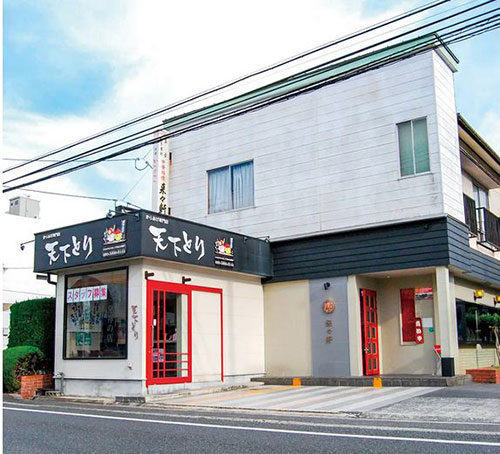
This pivot to only serving karaage became a major hit as residents of Usa immediately embraced this cheap, fast and delicious source of protein. Today, Usa boasts more than 40 karaage shops and is one of the hubs of this perfectly crisped fried delight. But its move to neighbouring Nakatsu is what gave this fried chicken its national and subsequent international reputation.
Two chefs, Arata Hosokawa and Shoji Moriyama were both obsessed with karaage, and both felt they could bring out more flavour from the fried food. According to Yoshitake, in 1970, each man opened his own karaage shop in Nakatsu where they refined the marinating process, adding pieces of apple, and brining the bird for a longer period to bring out more flavour in the chicken itself. The shops were instant hits and inspired a bevy of copycats that helped define Nakatsu as the heart and soul of karaage.Moriyama was the first ever champion of the Karaage Grand Prix
Today, chefs in Nakatsu have taken their karaage to the next level. A healthy competition between the nearly 50 shops has inspired chefs to tinker with everything from cooking times and batters to a variety of soy- and salt-based marinades. Nearly every shop in Nakatsu has a secret ingredient that they’re not willing to share and which separates their karaage from the rest.
Take Torishin, a shop run by Nakatsu’s resident karaage shokunin (master) Shinichi Sumi, a five-time Grand Gold Award winner at the Karaage Grand Prix. Sumi spent 15 years perfecting his karaage recipe. Today, he cooks every part of the chicken at separate temperatures and his karaage is consistently rated the best in Nakatsu.
Karaage Crawl
For the perfect Kyushu Karaage Crawl, start out in Usa at Tenkatori run by Yasuhiro Fukuda who is the son of the original owner of Rairaiken – the first karaage shop in Kyushu. From there, check out Chiemi, a woman-run shop helmed by Yoshimi Kanbara who has been making it out of her home for 43 years and only uses fresh oil. From there, head to Nakatsu and eat at Torishin for a foodie’s version, then check out Genkiya who specializes in chicken breasts, and finally make your way to Kokko-ya for a uniquely marinated bird that might just be the best of all.
Then there’s Takae Tateishi, one of the rare female karaage shop owners whose spot, Kokko-ya, is arguably the most unique in the city with her salt-rice-malt marinade and desire to do everything from scratch. “What I can say with confidence is that I carefully remove the extra fat from the chicken. I’m absolutely confident in how I prepare the meat,” said Tateishi, whose chicken has a softer texture and spicier flavour that fires up your mouth.
And then there’s Kouji Moriyama, whose shop Moriyama was the first ever champion of the Karaage Grand Prix and is the nephew of Nakatsu karaage’s founding father, Shoji Moriyama. He makes a salt-based crispy karaage that erupts with juices from every bite and has a mix of undisclosed fruits that infuses his chicken with exceptional flavours.
But karaage isn’t just something to eat in Nakatsu, it’s an entire identity. Every autumn, there’s Karafes, a karaage festival which attracts upwards of 50,000 people from around Japan and the world, and nearly every shop participates to drum up popularity for the city. The town also holds a Guinness World Record for the largest serving of fried chicken topping out at 1,667.301kg (3,675lb, 12oz) that was set in 2019.
Of those 40-plus shops in Nakatsu, everyone in the city has their personal favourite. It reminds them of their childhood. It’s a food that rose out of poverty, fed a starving island and became a savoury symbol that can now be found at weddings, birthdays and major celebrations including Christmas when millions of Japanese eat fried chicken. And the Karaage Grand Prix is their way to prove that this lineage makes their city the beating heart of fried chicken in Japan.
The Karaage Grand Prix started in Tokyo in 2010 as a national competition to rank karaage and promote the tasty treat around the country. Up until 2022, voting was entirely online and the most popular karaage shops typically won all the awards. According to Kouichiro Yagi of the Japan Karaage Association, “[in 2023] a taste test by the judges will be included to further improve the value of the awards.”
The judges will base their decisions on the frying colour, the batter, the harmony between the meat and the batter, the juiciness, the flavour, the cost effectiveness (how much you get for the price), and the temperature level (too much heat can cause burns).When you talk to the shop owners in Nakatsu, they’re borderline dismissive of the past competitions. But you could tell they all felt that this year was different. Shinichi Sumi of Torishin said, “The next one is real. I want the challenge and I’m going to try to win.”
The CEO of the Nakatsu Karaage Association, Masahiko Inoue, looks at the 2023 Grand Prix along with Nakatsu’s place in the karaage world in an existential way. “The next competition is important because people will know which shop is really number one. But ultimately, I want everyone to know that Nakatsu karaage is special. And that it is branded. The same way certain wagyu beef is branded. It’s like a seal of approval that it comes from Nakatsu.”
Karaage represents perseverance, it shows ingenuity, and it’s a reminder of how Japan overcame adversity. And for the residents of Nakatsu, it’s the soul food that simply feels like home. Karaage is fried chicken that has been lightly battered and marinated, judges are being brought in to taste test, and the true crown for the best karaage will ultimately be rewarded.
Why does any of this matter? And why is this small town of Nakatsu considered to have the best fried chicken in Japan, and quite possibly the world?
– BBC



Institute of Hospitality Sri Lanka
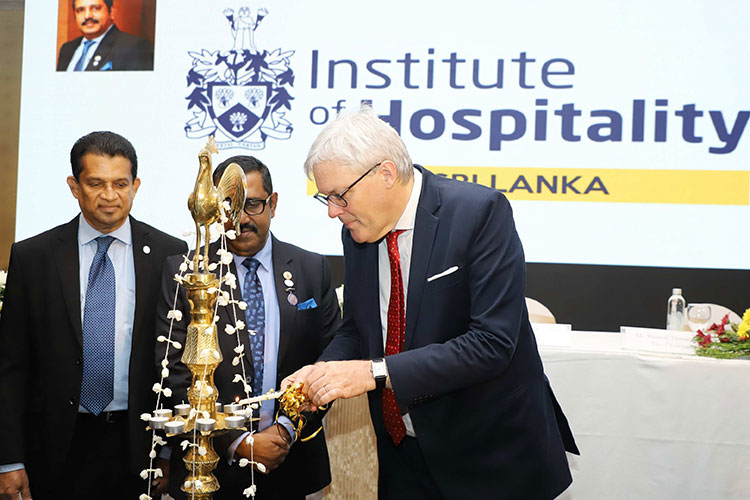
 The 32nd Annual General Meeting (AGM) of the UK-based Institute of Hospitality’s Sri Lanka Chapter was held recently at the Ramada Hotel Colombo,.The event provided an evening of camaraderie , reflection of the past and present achievements,setting new benchmarks for the future
The AGM had the presence of two distinguished guests, the Chief Guest Opposition Leader Sajith Premadasa, and the Guest of Honour British High Commissioner to Sri Lanka, Andrew Patrick. Their inspiring speeches were lauded by all hoteliers who were present at the occasion
A special thanks was extended to Robert Richardson, CEO of the Institute of Hospitality UK, along with his team, sponsors, committee members, and all attendees for making the event memorable.
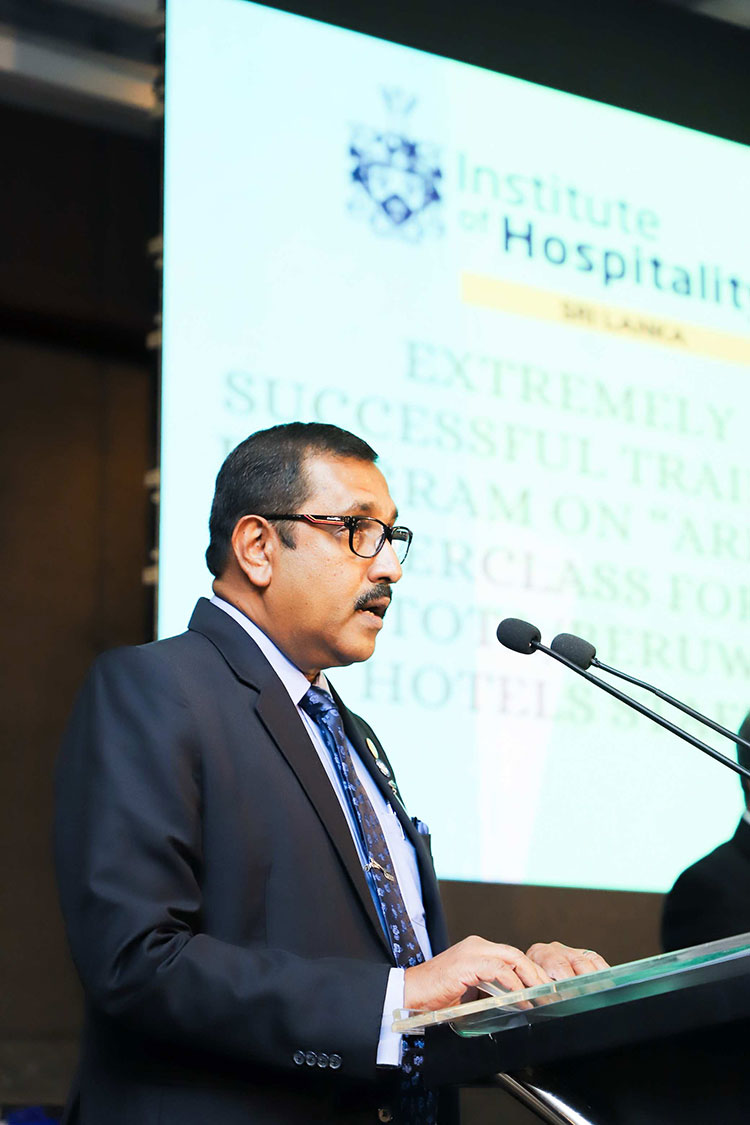
Dr. Harsha Jayasingh, Past President of the Institute of Hospitality (UK) Sri Lanka Chapter, emphasised the Institute’s longstanding history and the strength of its Sri Lankan branch. “The Institute of Hospitality (IH) UK has a history of 86 years, and we are proud to be the Sri Lanka Branch. IH Sri Lanka is much stronger now with many members from all areas of the hospitality industry,” he stated.
Dr. Jayasingh highlighted the significant role of tourism in Sri Lanka’s economy,. He said tourism it is the third-largest source of revenue for the country. “Tourism accounts for about 13.3% of total foreign exchange earnings and employs 450,000 people directly and indirectly. The hospitality industry in this island of pearl holds tremendous potential for economic growth, job creations, and cultural exchange,” he added.
He also pointed out more women should be attracted to the industry and advocated for the use of technology in hospitality sector to attract the younger generation.
The newly appointed Chairman Ramesh Dassanayake spoke about the challenges faced by the industry, including the reluctance of youth to join the sector. . Dassanayake expressed concerns over the migration of staff between hotels and the overall ‘brain drain’ in the sector. ” We must maintain high standards in the hotel We must try to attract tourists to Sri Lanka, we must have with many facilities Hence, hotel schools and other professional institutions involved in skills development mustincrease their intakes,” he pointed out.
Chief Guest Sajith Premadasa emphasised the importance of eco tourism and said “We need to have an environmental policy related to tourism in place,” . .
The 32nd AGM of the Institute of Hospitality UK, Sri Lanka Chapter, was a testament to the strength and potential of Sri Lanka’s hospitality industry. The insights and commitments shared during the event set a new benchmark for the future.(ZC)



Pix by Thushara Attapathu
Life style
He recognizes human identity beyond boundaries of gender, race, nationality and religion.
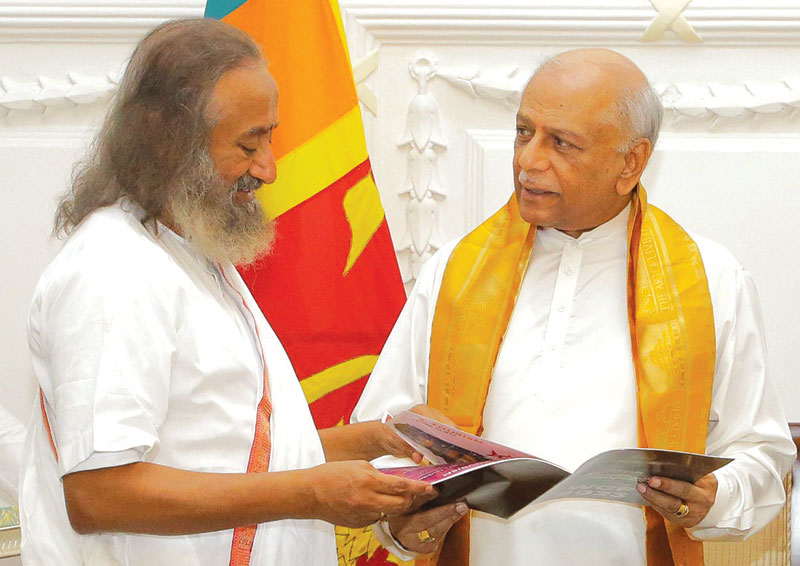
Visit of Sri Gurudev to Sri Lanka
Humanitarian, spiritual leader and Global Ambassador of Peace Gurudev Sri Sri Ravi Shankar (Sri Gurudev) was in Sri Lanka on a three day tour on the invitation of the Prime Minister of Sri Lanka Dinesh Gunewardene. Gurudev who inspired a wave of volunteerism and service to moot one of the largest volunteer-based organisations in the world – The Art of Living – visited the various projects under the aegis of the foundation and launched twelve vocational and technical centers around the island. He was accompanied by thousands of followers from Sri Lanka and around the world.
Gurudev who visited Sri Lanka for the sixth time also had a first day cover launched in honour of his visit. He is a strong proponent of spreading happiness, using the unique Sudarshan Kriya, yoga, meditation and practical wisdom to unite people, empower individuals and transform communities. His programmes provide techniques and tools to live a deeper, more joyous life, while his non-profit organisations recognize the human identity beyond the boundaries of gender, race, nationality and religion.
The Art of Living which has more than 30,000 teachers and over one million volunteers across 180 countries has touched in excess of five hundred million people around the world. CNN called it “Life Changing” and The Washington Post headlined it, “Fresh air to millions”.
In Trincomalee, Gurudev met with war victims and had a heartwarming engagement with the children from the children’s homes run by the Foundation. He also visited the Koneswara Temple in Trincomalee and graced the Kumbhabhishekam at Seetha ecogPnize the human identity beyond the boundaries of gender, race, nationality and religion. Amman temple at Nuwara Eliya. He held discussions with the trustees on the progress of the foundation’s social service projects, while also holding a special event – Ekamuthuwa – attended by a large number of dignitaries and his devotees from around the world.
His time with the Prime Minister was spent discussing the prospects of unity in diversity and uniting Sri Lanka by adding happiness into the formula of living. In addition he had discussions with the Speaker of the Parliament of Sri Lanka Mahinda Yapa Abeywardena, prominent business stewards and civil society leaders.
by Zanita Careem
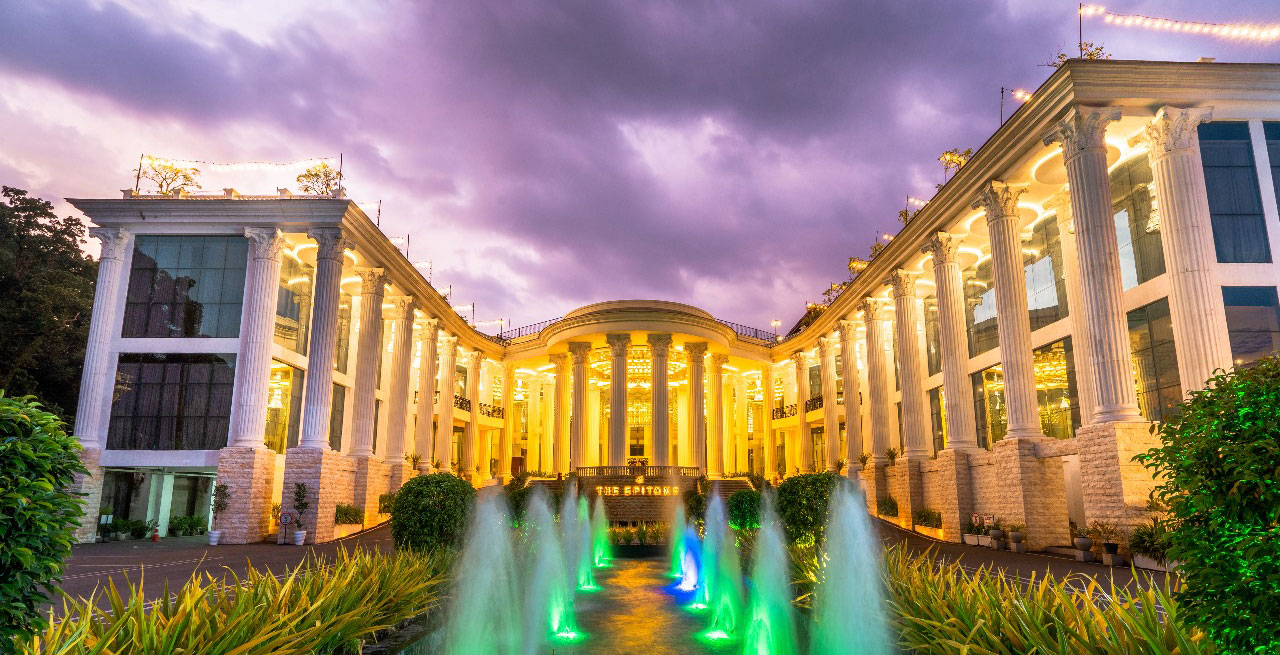
Envison your dream wedding day come to life at the Epitome Hotel, a prestigious city hotel in Kurunegala offering an unrivalled luxury rendors experience for weddings.
The venue is designed to embody opulence and luxury from all quarters for a spectacular wedding in kurunegala,Thier ballroom is the largest banquet facility in Sri Lanka It can be divided into six luxurious pillarless wedding halls on the ground floor and 25pax smaller banquet halls.
It can be easily named as a five star heaven in the heart of the city contributing to a myriad of immense experiences tailored to inspire and delight wedding experiences.
From opulent décor set up to exquisite table decor, lavish food, every detail is meticulously curated to spark your imagination and ignite creativity for a perfect wedding. The previous prestigious wedding shows season one and season two attracted large crowds
were unique events which gave the wedding vendors and potential clients had an opportunity to connect and interact with each other. Beyond being a showcase it was a chance for the wedding vendors to unite and contribute to the vibrancy of the wedding industry. The wedding show covered all area of the bridal industry providing a comprehensive variety of bridal supplies from Sri lanka and became the most popular bridal exhibitions in Kurunegala.This bridal exhibitions allowed brides and grooms to experience first hand the products and services available from suppliers in Sri Lanka
These wedding shows held at The Epitome created a benchmark and gave an opportunity for vendors to create connections to the utmost satisfaction said Harshan Lakshita Executive Director. of the magnificent Hotel
Our wedding shows featured experts and professionals in every field‘ It covered all areas of the bridal industry provided a comprehensive variety of bridal supplies from Sri lanka and became most popular bridal exhibition in this region.We are always open to everyone to join us at our wedding shows in the future. It is an opportunity to discover the incredible talent within our local wedding and bridal vendors to make meaningful relationships and plan thier special day at our breathtaking hotel The Epitome said General Manager Kavinda Caldera
The Epitome Hotel’s bridal show which will be held end of June will buzz with great ideas,advice and inspiration for all those who plan thier dream wedding
…….
The Hotel Epitome’s Wedding Season 3 will marked excellence, celebration and inspiration for those in the wedding industry. The exhibition halls will resonate with ideas on exquisite bridal wear to decor, florists , photography etc and showshowcase the rich tapestry of talent within the local wedding industry. .





US sports envoys to Lanka to champion youth development

Rahuman questions sudden cancellation of leave of CEB employees


