
Features
THE WORLD HERITAGE SITES OF SRI LANKA

THE CENTRAL HIGHLANDS
By EVERYMAN
It was on July 31, 2010 that UNESCO inscribed The Central Highlands of Sri Lanka comprising Horton Plains, Knuckles Conservation Forest and the Peak Wilderness- Protected Area, as a World Heritage Site. In fact this site was one of the two which were classified by UNESCO as ‘Natural Sites’ the other being Sinharaja Forest Reserve(1988).
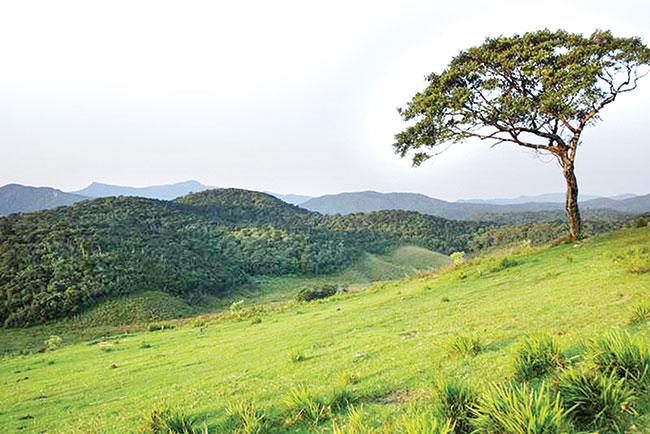
Horton Plains which is a Wonderland of Nature is undoubtedly the most popular of the three places described under the Central Highlands.
Under the shadows of Sri Lanka’s second and third highest mountains, Kirigalpoththa ( 7,854 feet ) and Thotupola ( 7,733 feet ) and at an elevation ranging from 6,900 feet to 7,500 feet lies this chilly, mist covered, 12.2 sq mile undulating plateau which was named in honor of a former colonial governor, Sir Robert Wilmot Horton (1831- 1837) A more descriptive name was given by our own people – Maha Eliya Thenna’ meaning the great open plains because here will be seen montane grasslands or high altitude grasslands and cloud forest which due to the abundant layers of mosses is also called a mossy forest.
Its awesome remoteness and varied biodiversity will make you forget the tumultuous world which you would have left behind before starting on this trip. It is a strange, silent, world that you have entered and prompts the writer to adapt a line from Gray’s Elegy, for here in the Plains you will be –
‘Far from the madding, crowd’s
ignoble strife, With only the sound of silence and
endemic life. Your plodding footsteps passing
gurgling streams And whistling winds like in your dreams’
Its high elevation, the sudden sharp showers, the incessantly blowing ice cold wind, makes it necessary that you wear woolen clothing and over this a leather jerkin with a hood /cap attached covering your ears would be the best. As you will realise it’s your ears that are most sensitive to the cold.
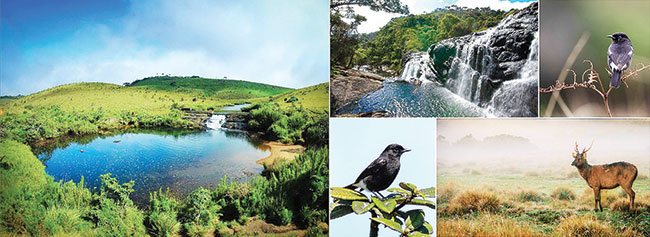 Of the alternate routes to the Plains the one from N’Eliya to Pattipola is the most enjoyable. Driving at a leisurely pace you can admire one of the most picturesque areas in Sri Lanka, like the sprawling Kande Eliya tank, vast meadows of shrubbery and montane forests with their characteristically conically shaped trees, the rich green pastureland of Ambewela farm and then on to Pattipola.
This little town has set a record of being the highest in the entire railway network in our island. From here to the entrance of Horton Plains will take you just a few minutes. The best time to start your exploration of the Plains is at least by 6.30 in the morning. As the sun begins to rise, a vast blanket of mist descends on the entire area, preventing you from enjoying the attractions which nature has to offer you. What is worse is that you may lose your way, walking aimlessly while stumbling over the slippery stones and precipitous pathways.
Here in the Plains are the headwaters of three main rivers which wind their way through the country and then pour out into the sea at different coastal towns. Mahaweli, which is Sri Lanka’s longest river (at Trincomalee ), Kelani ( at Colombo ) and Walawe ( at Ambalantota ) . The Plains also feed the Belihul Oya, Agra Oya, Kiriketi Oya, Uma Oya and Bogawantalawa Oya. Horton Plains it must be noted is one of the most important catchment areas in the island. Like a sponge it soaks up the water from the heavy rains which frequently fall and then from this high elevation, the water gradually seeps its way through the soil into streams, rivers and even into wells, located at lower elevations.
But it’s ‘World’s End’ which is the main attraction of Horton Plains. This is a sheer precipice. A drop of 4,000 feet, which is three quarters of a mile. As you stand at the edge of this steep massif which is in the Central Province and look right down below without getting a bout of acrophobia, you will be seeing the green foliage of trees of the Sabaragamuwa Province. Gazing a little farther you will see like tiny specks, the silvery, glinting, roof tops of plantation factories, hamlets and meadows.
And as you gaze still farther, you will be able to see 50 miles to the South, the hazy blue of the sky meet the shimmering blue of the sea. There are no protective railings at the edge of this escarpment, so forget about ‘selfies’ while standing here. In November 2018 a German tourist fell to her death while taking a selfie. It took the Sri Lanka Army, Sri Lanka Police and a group of volunteers, six hours to find her body which was in Non Pareil Estate located in the Sabaragamuwa Province. So the tragic and ironic fact is that she fell from one Province into another.
Passing on from this spectacular cliff there is another enchanting attraction. This is Baker’s Falls. Located on a tributary of the Belihul Oya it was formerly called ‘Gongala Falls.’ Here again the original Sinhala name was discarded and renamed in 1845 after Sir Samuel Baker who it has been claimed discovered it. Then, one may ask how was it that perhaps centuries before Sir Samuel Baker even stepped onto the shores of this island, our people knew about these falls and gave it its name? Also make note that this ‘eminent’ colonialist had the dubious distincti on of killing over 50 elephants right here on the Plains!
But never mind the name. It’s the sight that matters. It is 66 feet high and the icy cold water splashes in cascades at multiple levels before crashing into the 40 feet deep pool down below. Other than being the widest water falls in the country it is also claimed to be the most spectacular.
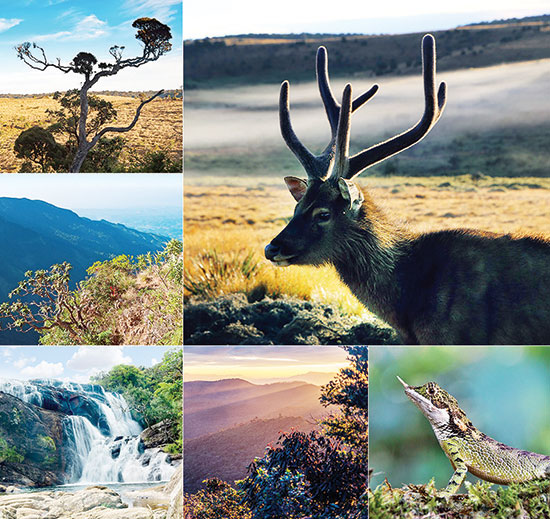
But that is certainly not all that the Plains has to offer. As you continue to plod your way, look around and observe the abundance of flora. Amongst the high altitude shrubland referred to as ‘pathana’ in Sinhala you cannot but fail to see the evergreen forests like coniferous and eucalyptus. The coniferous trees can be identified by the fact that they sprout long pointed green needles instead of leaves and cones instead of flowers. Amongst the tall trees there is Calophyllum walkeri called ‘ Kina’ in Sinhala. Its hard, durable, reddish, wood with dark streaks is used for making door frames, beams and rafters.
Another tall tree is Syzygium rotunifolium which grows to a height of over 30 feet and is commonly called ‘batapath damba.’ Amongst the smaller trees are evergreen bamboos (Indocalmus ) which grow up to about six feet. Cinnamon, Cinnamomum Zeylanicum are plentiful. Myrtaceae which belongs to the myrtle family is a shrub and one such is Syzgium aromaticum which produces cloves. Decorating the trunks of many of these trees are ferns, lichens and orchids. Sixteen of these orchids are endemic in Sri Lanka .
Here amongst the trunks of trees, you must peer closely and search for a species that looks like the tangled, unkempt beard of a lazy old man. This is Clematis Vitalba and its alternate name is ‘Old Man’s Beard’. Walking carefully by the water logged swamps and slow moving streams you will notice a variety of aquatic plants such as macrophytes which have large flowers with white petals and a yellow center. Search closely for another most interesting plant species which are the carnivorous bladderworts – Utricularia. They have a bladder– like trap which ensnares water fleas, nematodes ( tiny microscopic worms ), mosquito larvae and even tadpoles. Two renowned botanists, Peter Taylor Francis and Ernest Lloyd have stated that the vacuum driven bladders in these plants are the most sophisticated carnivorous trapping mechanisms to be found anywhere in the plant kingdom.
The fauna found here is much more fascinating. Do not be deceived by the silence for there is plenty of activity around, for you to listen and perchance to see. If you attune your ears you will be able to pick up the distant, muffled grunts and squeaks of monkeys such the as the Toque macaques, ‘Rilawa.’ In Sinhala, which has a whorl of hair on top of its head very much like a skull cap and the purple faced leaf monkey, called ‘kalu rilawa’ in Sinhala. You may even be able to hear the faint sawing of the Sri Lanka leopard which is endemic in Sri Lanka.
But if you are specially observant you might spot their faeces along the path on which you are walking. Take it as a warning that they are around. Similarly you would be able to see some freshly made patches on the ground. These have been made by wild boars when they dig the soil in search of worms and grubs. And if by chance you hear a barking noise that will be the Indian muntjacs, a species of deer which makes this peculiar noise when it is frightened specially when it sights a predator like the leopard.
Also living on the Plains is the Rusty Spotted Cat which is the smallest of the cat species, called in Sinhala ‘balal diviya.’
Then there is the Fishing Cat called the ‘kola diviya’ or ‘handun diviya’ in Sinhala which can not only swim but can even dive under water to catch fish. Looking up at the branches, it is hoped that you will be able to spot the Rhino Horned Lizard as it lies as if in deep meditation, with an occasional nodding of its head. It is a type of chameleon having a small white horn on its forehead, like the legendary Unicorn.
If you wish to see and indeed you must, a species listed as a global conservation priority and found only in Sri Lanka then
endure the shivering cold of the night and be rewarded with the sight of the big eyed, shy, Red Slender Loris which sleeps
by day and ever so stealthily gets active at night. Do not be concerned about snakes. There are only two types, both being non-venomous. One is the Rough Sided Snake called ‘dalawa medilla’ in Sinhala. It burrows into the earth and its cylindrical body shape facilitates this manoeuvre ever so easily. The other type of snake is the docile rat sna
ke, called in Sinhala ‘garendiya’.
However even if you fail to see any one of the species mentioned, it is most likely that you will see the her
ds of sambhur which roam about proudly displaying their large antlers which adorn their heads. They seem to be inv
iting you to video/ photograph them in all their majesty. So why disappoint them ?

Of bird life, it has been recorded that in Horton Plains there are 21 species, which can be found only in Sri Lanka and of these three can be found only in Horton Plains. For this reason Horton plains has been classified as an Important Bird Area ( IBA ). This classification was done by the BirdLife International which is an NGO having worldwide partnerships.
It is interesting to note that seven of these species have been honoured by being featured on postage stamps. They are the Dull Blue Flycatcher- ‘anduru nil masimara’, the Sri Lanka White Eye – ‘Lanka sithasiya, the Sri Lanka Wood Pigeon – ‘manil goya, the Sri Lanka Blue Magpie- ‘kehi bella.’ This species is quite different from the magpies you see in your home gardens. This one’s conspicuous colour is bright blue and as an added attraction has a reddish brown head. Then there is the Sri Lanka Spur Fowl – ‘haban kukula,’ the Yellow Fronted Barbet – ‘rath nalal kottoruwa’ the Orange Billed Babbler – ‘rathu demalichcha,’. But the most attractive of all the bird species found on the Plains is the Sri Lanka Jungle Fowl- ‘wali kukula’ A much deserved honour was bestowed on the Jungle Fowl when it was classified as the National Bird of Sri Lanka.
But these are not the only species of birds found in Horton Plains. There is a group of seasonal migratory birds which perform a two way marathon testing their endurance to the very maximum. Getting away from the bitterly cold winter countries of the Northern Hemisphere they arrive here to the pleasant climes of Sri Lanka in August/September and leave around May/ April. Here they find in abundance the food they require and more importantly the most suitable breeding places. It must be remembered that Sri Lanka is the farthest point away from South India with no land mass until the South Pole is reached.
Amongst these migratory birds are the Swiflets. This species make their nests entirely with saliva. Do not feel nauseated. Because these nests form the basis of that delicacy called ‘bird’s nest soup.’ Then there are the Alpine Swifts which spend as long as six months on the wing and remarkably, sleeps and – hold your breath, even mates while flying. The Mountain Hawk Eagle which is referred to as an opportunist predator, because it ambushes its prey of which it has a wide range from small birds to squirrels. Then there is the Black- Winged Kite. The male of the species has the habit of establishing ‘territories’ for themselves and defends such territories by fighting any intruder. After a noisy courtship the female obligingly enters the male’s territory. The writer wonders whether there can be a better example of female obedience!
Finally there is the Peregrine Falcon which is reckoned to be the fastest bird in the world with a speed of 240 mph as it swoops to grab it’s prey. These species are associated with falconry whereby such a bird is trained by a handler to catch and bring back small animals such as rabbits. It has been reported that Falconry (it was called a sport ) began in Mesopotamia around 2,000 BC. Fortunately, it never caught on in sports loving Sri Lanka and hopefully will never.
This being the Olympic Year or to be accurate the postponed Olympic Year, here is something to take note of. The world record for long distance flying is held by the Artic Tern which flies 12,430 miles from the Artic in the North Pole to the Antarctic in the South Pole and then back again doing another lap of 12,430 miles. Researchers have claimed that each year it sees more daylight hours than any other creature on the planet . And here is another world record for migratory birds, with a wingspan of 10 feet and a weight of 33 lbs, the Andean Condor is the largest flying bird in the world. Anyway neither of these record holders visit Horton Plains. So let’s hope that at least our athletes will break a record or two at the Tokyo Olympic Games if and when it is held.







by Dr Gotabhya Ranasinghe
Senior Consultant Cardiologist
National Hospital Sri Lanka
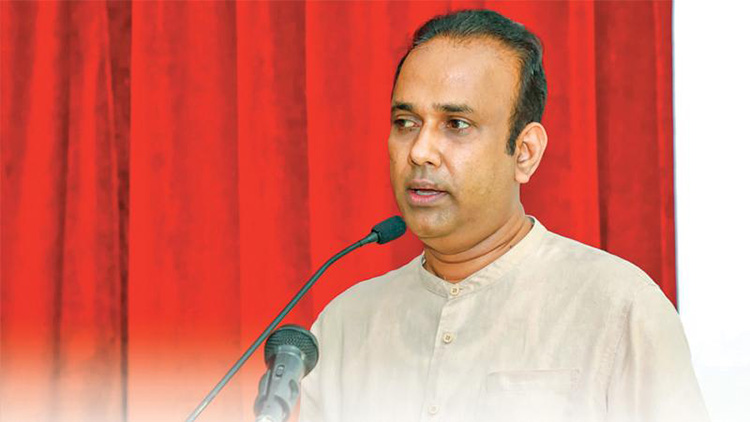
When we sought a meeting with Hon Dr. Ramesh Pathirana, Minister of Health, he graciously cleared his busy schedule to accommodate us. Renowned for his attentive listening and deep understanding, Minister Pathirana is dedicated to advancing the health sector. His openness and transparency exemplify the qualities of an exemplary politician and minister.
Dr. Palitha Mahipala, the current Health Secretary, demonstrates both commendable enthusiasm and unwavering support. This combination of attributes makes him a highly compatible colleague for the esteemed Minister of Health.
Our discussion centered on a project that has been in the works for the past 30 years, one that no other minister had managed to advance.
Minister Pathirana, however, recognized the project’s significance and its potential to revolutionize care for heart patients.
The project involves the construction of a state-of-the-art facility at the premises of the National Hospital Colombo. The project’s location within the premises of the National Hospital underscores its importance and relevance to the healthcare infrastructure of the nation.
This facility will include a cardiology building and a tertiary care center, equipped with the latest technology to handle and treat all types of heart-related conditions and surgeries.
Securing funding was a major milestone for this initiative. Minister Pathirana successfully obtained approval for a $40 billion loan from the Asian Development Bank. With the funding in place, the foundation stone is scheduled to be laid in September this year, and construction will begin in January 2025.
This project guarantees a consistent and uninterrupted supply of stents and related medications for heart patients. As a result, patients will have timely access to essential medical supplies during their treatment and recovery. By securing these critical resources, the project aims to enhance patient outcomes, minimize treatment delays, and maintain the highest standards of cardiac care.
Upon its fruition, this monumental building will serve as a beacon of hope and healing, symbolizing the unwavering dedication to improving patient outcomes and fostering a healthier society.We anticipate a future marked by significant progress and positive outcomes in Sri Lanka’s cardiovascular treatment landscape within the foreseeable timeframe.

by Fr. Emmanuel Fernando, OMI
Jesuit Fr. Aloysius Pieris (affectionately called Fr. Aloy) celebrated his 90th birthday on April 9, 2024 and I, as the editor of our Oblate Journal, THE MISSIONARY OBLATE had gone to press by that time. Immediately I decided to publish an article, appreciating the untiring selfless services he continues to offer for inter-Faith dialogue, the renewal of the Catholic Church, his concern for the poor and the suffering Sri Lankan masses and to me, the present writer.
It was in 1988, when I was appointed Director of the Oblate Scholastics at Ampitiya by the then Oblate Provincial Fr. Anselm Silva, that I came to know Fr. Aloy more closely. Knowing well his expertise in matters spiritual, theological, Indological and pastoral, and with the collaborative spirit of my companion-formators, our Oblate Scholastics were sent to Tulana, the Research and Encounter Centre, Kelaniya, of which he is the Founder-Director, for ‘exposure-programmes’ on matters spiritual, biblical, theological and pastoral. Some of these dimensions according to my view and that of my companion-formators, were not available at the National Seminary, Ampitiya.
Ever since that time, our Oblate formators/ accompaniers at the Oblate Scholasticate, Ampitiya , have continued to send our Oblate Scholastics to Tulana Centre for deepening their insights and convictions regarding matters needed to serve the people in today’s context. Fr. Aloy also had tried very enthusiastically with the Oblate team headed by Frs. Oswald Firth and Clement Waidyasekara to begin a Theologate, directed by the Religious Congregations in Sri Lanka, for the contextual formation/ accompaniment of their members. It should very well be a desired goal of the Leaders / Provincials of the Religious Congregations.
Besides being a formator/accompanier at the Oblate Scholasticate, I was entrusted also with the task of editing and publishing our Oblate journal, ‘The Missionary Oblate’. To maintain the quality of the journal I continue to depend on Fr. Aloy for his thought-provoking and stimulating articles on Biblical Spirituality, Biblical Theology and Ecclesiology. I am very grateful to him for his generous assistance. Of late, his writings on renewal of the Church, initiated by Pope St. John XX111 and continued by Pope Francis through the Synodal path, published in our Oblate journal, enable our readers to focus their attention also on the needed renewal in the Catholic Church in Sri Lanka. Fr. Aloy appreciated very much the Synodal path adopted by the Jesuit Pope Francis for the renewal of the Church, rooted very much on prayerful discernment. In my Religious and presbyteral life, Fr.Aloy continues to be my spiritual animator / guide and ongoing formator / acccompanier.
Fr. Aloysius Pieris, BA Hons (Lond), LPh (SHC, India), STL (PFT, Naples), PhD (SLU/VC), ThD (Tilburg), D.Ltt (KU), has been one of the eminent Asian theologians well recognized internationally and one who has lectured and held visiting chairs in many universities both in the West and in the East. Many members of Religious Congregations from Asian countries have benefited from his lectures and guidance in the East Asian Pastoral Institute (EAPI) in Manila, Philippines. He had been a Theologian consulted by the Federation of Asian Bishops’ Conferences for many years. During his professorship at the Gregorian University in Rome, he was called to be a member of a special group of advisers on other religions consulted by Pope Paul VI.
Fr. Aloy is the author of more than 30 books and well over 500 Research Papers. Some of his books and articles have been translated and published in several countries. Among those books, one can find the following: 1) The Genesis of an Asian Theology of Liberation (An Autobiographical Excursus on the Art of Theologising in Asia, 2) An Asian Theology of Liberation, 3) Providential Timeliness of Vatican 11 (a long-overdue halt to a scandalous millennium, 4) Give Vatican 11 a chance, 5) Leadership in the Church, 6) Relishing our faith in working for justice (Themes for study and discussion), 7) A Message meant mainly, not exclusively for Jesuits (Background information necessary for helping Francis renew the Church), 8) Lent in Lanka (Reflections and Resolutions, 9) Love meets wisdom (A Christian Experience of Buddhism, 10) Fire and Water 11) God’s Reign for God’s poor, 12) Our Unhiddden Agenda (How we Jesuits work, pray and form our men). He is also the Editor of two journals, Vagdevi, Journal of Religious Reflection and Dialogue, New Series.
Fr. Aloy has a BA in Pali and Sanskrit from the University of London and a Ph.D in Buddhist Philosophy from the University of Sri Lankan, Vidyodaya Campus. On Nov. 23, 2019, he was awarded the prestigious honorary Doctorate of Literature (D.Litt) by the Chancellor of the University of Kelaniya, the Most Venerable Welamitiyawe Dharmakirthi Sri Kusala Dhamma Thera.
Fr. Aloy continues to be a promoter of Gospel values and virtues. Justice as a constitutive dimension of love and social concern for the downtrodden masses are very much noted in his life and work. He had very much appreciated the commitment of the late Fr. Joseph (Joe) Fernando, the National Director of the Social and Economic Centre (SEDEC) for the poor.
In Sri Lanka, a few religious Congregations – the Good Shepherd Sisters, the Christian Brothers, the Marist Brothers and the Oblates – have invited him to animate their members especially during their Provincial Congresses, Chapters and International Conferences. The mainline Christian Churches also have sought his advice and followed his seminars. I, for one, regret very much, that the Sri Lankan authorities of the Catholic Church –today’s Hierarchy—- have not sought Fr.
Aloy’s expertise for the renewal of the Catholic Church in Sri Lanka and thus have not benefited from the immense store of wisdom and insight that he can offer to our local Church while the Sri Lankan bishops who governed the Catholic church in the immediate aftermath of the Second Vatican Council (Edmund Fernando OMI, Anthony de Saram, Leo Nanayakkara OSB, Frank Marcus Fernando, Paul Perera,) visited him and consulted him on many matters. Among the Tamil Bishops, Bishop Rayappu Joseph was keeping close contact with him and Bishop J. Deogupillai hosted him and his team visiting him after the horrible Black July massacre of Tamils.
Sri Lanka-Singapore Free Trade Agreement
By Gomi Senadhira
senadhiragomi@gmail.com
“You might tell fairy tales, but the progress of a country cannot be achieved through such narratives. A country cannot be developed by making false promises. The country moved backward because of the electoral promises made by political parties throughout time. We have witnessed that the ultimate result of this is the country becoming bankrupt. Unfortunately, many segments of the population have not come to realize this yet.” – President Ranil Wickremesinghe, 2024 Budget speech
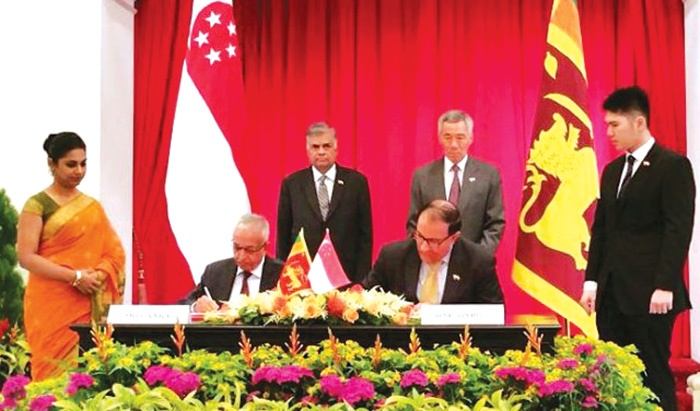
Any Sri Lankan would agree with the above words of President Wickremesinghe on the false promises our politicians and officials make and the fairy tales they narrate which bankrupted this country. So, to understand this, let’s look at one such fairy tale with lots of false promises; Ranil Wickremesinghe’s greatest achievement in the area of international trade and investment promotion during the Yahapalana period, Sri Lanka-Singapore Free Trade Agreement (SLSFTA).
It is appropriate and timely to do it now as Finance Minister Wickremesinghe has just presented to parliament a bill on the National Policy on Economic Transformation which includes the establishment of an Office for International Trade and the Sri Lanka Institute of Economics and International Trade.
Was SLSFTA a “Cleverly negotiated Free Trade Agreement” as stated by the (former) Minister of Development Strategies and International Trade Malik Samarawickrama during the Parliamentary Debate on the SLSFTA in July 2018, or a colossal blunder covered up with lies, false promises, and fairy tales? After SLSFTA was signed there were a number of fairy tales published on this agreement by the Ministry of Development Strategies and International, Institute of Policy Studies, and others.
However, for this article, I would like to limit my comments to the speech by Minister Samarawickrama during the Parliamentary Debate, and the two most important areas in the agreement which were covered up with lies, fairy tales, and false promises, namely: revenue loss for Sri Lanka and Investment from Singapore. On the other important area, “Waste products dumping” I do not want to comment here as I have written extensively on the issue.
1. The revenue loss
During the Parliamentary Debate in July 2018, Minister Samarawickrama stated “…. let me reiterate that this FTA with Singapore has been very cleverly negotiated by us…. The liberalisation programme under this FTA has been carefully designed to have the least impact on domestic industry and revenue collection. We have included all revenue sensitive items in the negative list of items which will not be subject to removal of tariff. Therefore, 97.8% revenue from Customs duty is protected. Our tariff liberalisation will take place over a period of 12-15 years! In fact, the revenue earned through tariffs on goods imported from Singapore last year was Rs. 35 billion.
The revenue loss for over the next 15 years due to the FTA is only Rs. 733 million– which when annualised, on average, is just Rs. 51 million. That is just 0.14% per year! So anyone who claims the Singapore FTA causes revenue loss to the Government cannot do basic arithmetic! Mr. Speaker, in conclusion, I call on my fellow members of this House – don’t mislead the public with baseless criticism that is not grounded in facts. Don’t look at petty politics and use these issues for your own political survival.”
I was surprised to read the minister’s speech because an article published in January 2018 in “The Straits Times“, based on information released by the Singaporean Negotiators stated, “…. With the FTA, tariff savings for Singapore exports are estimated to hit $10 million annually“.
As the annual tariff savings (that is the revenue loss for Sri Lanka) calculated by the Singaporean Negotiators, Singaporean $ 10 million (Sri Lankan rupees 1,200 million in 2018) was way above the rupees’ 733 million revenue loss for 15 years estimated by the Sri Lankan negotiators, it was clear to any observer that one of the parties to the agreement had not done the basic arithmetic!
Six years later, according to a report published by “The Morning” newspaper, speaking at the Committee on Public Finance (COPF) on 7th May 2024, Mr Samarawickrama’s chief trade negotiator K.J. Weerasinghehad had admitted “…. that forecasted revenue loss for the Government of Sri Lanka through the Singapore FTA is Rs. 450 million in 2023 and Rs. 1.3 billion in 2024.”
If these numbers are correct, as tariff liberalisation under the SLSFTA has just started, we will pass Rs 2 billion very soon. Then, the question is how Sri Lanka’s trade negotiators made such a colossal blunder. Didn’t they do their basic arithmetic? If they didn’t know how to do basic arithmetic they should have at least done their basic readings. For example, the headline of the article published in The Straits Times in January 2018 was “Singapore, Sri Lanka sign FTA, annual savings of $10m expected”.
Anyway, as Sri Lanka’s chief negotiator reiterated at the COPF meeting that “…. since 99% of the tariffs in Singapore have zero rates of duty, Sri Lanka has agreed on 80% tariff liberalisation over a period of 15 years while expecting Singapore investments to address the imbalance in trade,” let’s turn towards investment.
Investment from Singapore
In July 2018, speaking during the Parliamentary Debate on the FTA this is what Minister Malik Samarawickrama stated on investment from Singapore, “Already, thanks to this FTA, in just the past two-and-a-half months since the agreement came into effect we have received a proposal from Singapore for investment amounting to $ 14.8 billion in an oil refinery for export of petroleum products. In addition, we have proposals for a steel manufacturing plant for exports ($ 1 billion investment), flour milling plant ($ 50 million), sugar refinery ($ 200 million). This adds up to more than $ 16.05 billion in the pipeline on these projects alone.
And all of these projects will create thousands of more jobs for our people. In principle approval has already been granted by the BOI and the investors are awaiting the release of land the environmental approvals to commence the project.
I request the Opposition and those with vested interests to change their narrow-minded thinking and join us to develop our country. We must always look at what is best for the whole community, not just the few who may oppose. We owe it to our people to courageously take decisions that will change their lives for the better.”
According to the media report I quoted earlier, speaking at the Committee on Public Finance (COPF) Chief Negotiator Weerasinghe has admitted that Sri Lanka was not happy with overall Singapore investments that have come in the past few years in return for the trade liberalisation under the Singapore-Sri Lanka Free Trade Agreement. He has added that between 2021 and 2023 the total investment from Singapore had been around $162 million!
What happened to those projects worth $16 billion negotiated, thanks to the SLSFTA, in just the two-and-a-half months after the agreement came into effect and approved by the BOI? I do not know about the steel manufacturing plant for exports ($ 1 billion investment), flour milling plant ($ 50 million) and sugar refinery ($ 200 million).
However, story of the multibillion-dollar investment in the Petroleum Refinery unfolded in a manner that would qualify it as the best fairy tale with false promises presented by our politicians and the officials, prior to 2019 elections.
Though many Sri Lankans got to know, through the media which repeatedly highlighted a plethora of issues surrounding the project and the questionable credentials of the Singaporean investor, the construction work on the Mirrijiwela Oil Refinery along with the cement factory began on the24th of March 2019 with a bang and Minister Ranil Wickremesinghe and his ministers along with the foreign and local dignitaries laid the foundation stones.
That was few months before the 2019 Presidential elections. Inaugurating the construction work Prime Minister Ranil Wickremesinghe said the projects will create thousands of job opportunities in the area and surrounding districts.
The oil refinery, which was to be built over 200 acres of land, with the capacity to refine 200,000 barrels of crude oil per day, was to generate US$7 billion of exports and create 1,500 direct and 3,000 indirect jobs. The construction of the refinery was to be completed in 44 months. Four years later, in August 2023 the Cabinet of Ministers approved the proposal presented by President Ranil Wickremesinghe to cancel the agreement with the investors of the refinery as the project has not been implemented! Can they explain to the country how much money was wasted to produce that fairy tale?
It is obvious that the President, ministers, and officials had made huge blunders and had deliberately misled the public and the parliament on the revenue loss and potential investment from SLSFTA with fairy tales and false promises.
As the president himself said, a country cannot be developed by making false promises or with fairy tales and these false promises and fairy tales had bankrupted the country. “Unfortunately, many segments of the population have not come to realize this yet”.
(The writer, a specialist and an activist on trade and development issues . )



US sports envoys to Lanka to champion youth development

Rahuman questions sudden cancellation of leave of CEB employees


