
Features
The Wellawaya attack – on April 4 one day before D-day

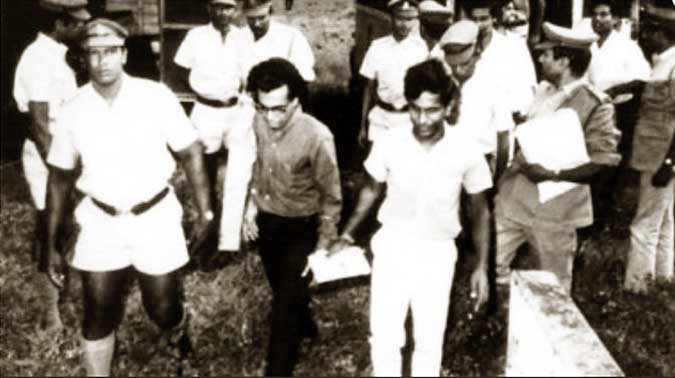
A personal story as recalled by Capt F.R.A.B. Musafer 4th Regt SLA (Retd)
(Continued from last week)
There were other instances where we found persons with very old unlicensed shotguns and unauthorized women in their company. There was always an excuse to explain their presence.On one occasion we were led to a unused well in the Amaduwa area which borders the Yala sanctuary in which was concealed a large consignment of old tins for the explicit purpose of making bombs. The police took a young man into custody and charged him. A few days later I bumped into him near the Hambantota town where he told me the Magistrate had just discharged him as it was no offence to store old cans. Justice well served in the context of the law as at that time!
On another occasion we were taken to a house inhabited by two youths allegedly involved in the movement. The father of the boys appeared and told us that he did not know the whereabouts of his sons and had no trust in them. He took us into the verandah of his house and showed us a coffin stored across some beams of the roof. This, he said is because “I don’t trust them and don’t expect my sons will even bury me. So please believe me.”
By day we were very conspicuous and made our presence felt as we traveled extensively across the towns and villages in the Hambantota district causing concern to regimental headquarters that our fuel consumption was excessive. During the nights we used to patrol along the main roads and stop by the wayside and monitor the movements of people and vehicles. Whilst there was hardly any night time traffic we were intrigued by groups of cyclists traveling further south at night on a daily basis. They maintained that they were practising for the National cycling championships and carried nothing on themselves. Our suspicions were that they were couriers conveying messages but there was nothing we could do about it.
Ground Realities
On most occasions when we stopped at the police stations and chatted with the reserve constable over cups of plain sugarless tea, we were told of threats received via the post. It was common knowledge among the police that they were to be attacked and most likely at night. These threats were not taken seriously.
Being the son of a police officer who had served in that region renowned for its high crime rate I was aware that the reserve PC on duty was always by himself, in some instances with only a kerosene lamp for light. He would always be an easy target of any attack and the key to acquiring weapons. With due credit to the police it provided a 24-hour service to the community in the remotest of areas. Perhaps the police was safe as they commanded some respect and trust among the locals.
Based on the information provided on an informal basis, I realized that if any attack was to take place it would be at night to exploit the element of surprise. My mind raced back to an article I read in the Readers Digest of the methods used in Latin and South America in the 1960’s where guerrilla groups in addition to robbing banks blew up electricity pylons, cut lines of communications and also stormed police and military outposts to secure their supply of weapons all done under the cover of darkness. The likelihood that insurgents would attack in waves to overrun their objectives with sheer numbers as done by the Vietcong was also well documented.
On one of my daily briefings with the GA I drew this to his attention. The GA being a very thoughtful person showed some serious concern and asked me what I intended to do about it. I suggested that we send a signal (wireless message) to Temple Trees requesting flares and equipment as an aid for night fighting. At that time we did not even have any army issue battery operated torches.
The GA had a direct Army wireless link to Temple Trees the official residence and command centre of the Prime Minister. He agreed and a signal was sent to Temple Trees requesting flares to light up the sky in the dark in the event of likely night attacks on the police stations. There was no response to the signal sent.
Some months later I was told by Capt Samaratunga, one of a few of the trusted and handpicked officers on duty at Temple Trees, that some of the other officers at Temple Trees had virtually laughed and ridiculed me on the signal sent by me and had said that I had got the jitters and was afraid. About a week later there was panic at Temple Trees when news of the Wellawaya attack that had taken place at night was received. He said it was no laughing matter then and all hell broke loose when news of a number of police stations fell into the hands of the insurgents that night and in the subsequent nights.
Meanwhile we continued to work with the police by day but at night patrolled the roads ourselves. During this period we never arrested anyone. Our only suspicions were on the cyclists. Inspector Arthanayake, the OIC at Tissamaharama police station, filled me in with information that parents had reported certain young family members had gone missing. Some had said that their children had gone to Diyatalawa for training.
He had arrested a youth who had been to such a camp and was trained to assemble and dismantle weapons. The matter had been referred to the CID but nothing had eventuated. There were mixed messages that there was something in the air but no intelligence to pin point any real threat on How, When and Where?
The poster campaigns
One of the effective ways the JVP conveyed their propaganda was by way of posters and slogans written on the walls of private and public buildings. They were everywhere and with a bit of boredom creeping up I thought I should exercise some initiative and embarked on a cleanup operation that got me into trouble. I got my men and some bystanders around the Hambantota bus stand to tear down the posters and obliterate the messages written on the walls.
This did not go on for long as I was soon summoned by the GA Mr Sonny Goonewardene who in no uncertain terms asked me as to who gave me permission to carry out the cleanup operation. He was very angry and upset as among the people whom I had asked to participate in the clean up was a senior employee of his staff. He very politely but sternly told me that in future he would provide me with the labour I needed. I realized that I had erred in my judgment and apologized to the GA.
I had a lot of respect for the GA not only as a superior official but for his calmness and insight and wisdom he imparted on me. The message was simple, loud and clear I did not have the license to do as I pleased in a military uniform even under the state of Emergency that prevailed.
The poster campaign was not confined to the JVP. I came across one that was amusing and said ” Do not write or urinate on my wall, socialism doesn’t begin here”.
Whilst we roamed the length and breath of the Hambantota district there was nothing eventful that happened except that my wife turned up on April 2 and announced that she was at the Hambantota rest house. I had not been in communication with her since mid March. Capt Ratnasabapathy had arranged accommodation at a discounted rate (I think it was Rs 50 per day) and assured her that it was safe, which prompted her to hitch a lift in a Browns Group car coming to their hotel at Amaduwa. She based herself at the rest house and was busy visiting friends and relatives at Hambantota which had a fair sized Malay community.
On April 4 evening she point blank refused to stay at the rest house saying that there had been some strange bearded and unshaven characters drinking and lurking around at the rest house during the day. This compelled me to put her up at Weerawila in Army style accommodation, making her sleep on the floor on a mat.
April 5 morning when it all began
On April 5, 1971 I had to go to Matara to drop a few of my men going on leave which included Gunner Brohier who had lost his brother in a snake bite accident. My wife too was in the vehicle (unauthorized) when as usual we encountered a herd of wild elephants near the salt pans, which was a frightful real life experience for her.
At the Matara Railway station I met Capt Naleem, Adjutant of 3V Gemunu Watch Regiment who was going to Colombo to attend a conference at Army Headquarters. He told me the Army was expecting trouble and plans were afoot to deploy more troops to most parts of the island.
Whilst returning from Matara I was stopped opposite the Hambantota Police station and was informed that the Wellawaya police station had been attacked and that I was to return to Wirawila immediately and contact my regiment. At Weerawila I got on to the wireless set and got in touch with the adjutant, Capt Samarakoon, who told me that the police station at Wellawaya had been attacked and there were casualties but details were sketchy as all communications had been cut off.
I was ordered to proceed to Wellawaya immediately and report back on the situation. I quickly gathered some soldiers, a wireless set and headed for Wellawaya post haste in a jeep and a truck. When I approached the police station the area around it was like a battlefield littered with spent shotgun cartridges, empty tins and items of clothing and footwear. The police station had taken a battering, the telephone and power lines were cut.
Eye witnesses had confirmed that a large group of insurgents some dressed in blue uniforms had carried out the attack. To this day I regret that I did not have a camera (they were hard to come by during that period) to capture the scene before my eyes. It was unbelievable that such an outrageous raid had been conducted against the state and was certainly a critical moment in history.
There was the body of the reserve police constable lying at the entrance of the police station. The police were dumbfounded and in a state of shock after their ordeal. Some expressed that they were lucky to be alive. There had been another policeman who had been shot and had died in hospital. We were told that a few policemen had just returned from a patrol and as customary the arms and ammunition were locked up in the strong room by the reserve PC on duty. He had then ventured out to the verandah to have a smoke when a group of Che Guveras who had surrounded the police station opened fire killing him.
With the police station under fire and no access to any firearms there was very little the police could do until a brave policeman to crawled up to the dead constable and retrieved the keys enabling them to retaliate and return fire. After a few hours the attack was repulsed and with the break of dawn the insurgents retreated taking with them their dead and injured leaving behind fired and unspent shotgun cartridges. It was strange that the insurgents with their numbers did not storm the police station during the lull, perhaps they lacked decisive leadership..
Whilst walking around the compound of the police station I was alerted to the fact that there was a dead insurgent. A closer look revealed he had a huge exit wound in the back of his chest as a result of a bullet fired from a rifle and had lost a lot of blood. Someone noticed a slight twitch in his body and shouted that he was alive. No sooner was this said a rifle was raised by a policeman to smash his skull; this was thwarted by one of the soldiers who pushed him off balance.
The policeman had a point in saying that there was no point in letting him live. It may have been improbable that he could have survived anyway. However it was not a question of pity but one of anger and hurt on the part of the policeman who reacted that way. This was quite understandable considering what they had gone through that he reacted in this manner. We despatched the injured man in the army truck to hospital but he was confirmed as dead on arrival.
Although we as “Gunners” were the first Army personnel on the scene there was nothing further we could do but report back on the situation. To do this I was in a dilemma as radio transmission and reception on my set was impossible and there was no way I could contact my Headquarters. I was told that I could go to Moneragala as the GA there was in direct contact with Temple Trees. Wellawaya in fact came under the jurisdiction of the GA Moneragala. I decided to race back to Weerawila leaving the soldiers and the truck behind.
I reported back to regimental headquarters as to what I had seen and heard about the attack. I asked for instructions and if it was necessary for me to pursue the insurgents who had retreated to the jungles. Permission was refused. I was told that two platoons of reinforcements from the 1st battalion Gemunu Watch based at Diyatalawa was being sent and that a helicopter would be arriving at the location with senior Army and Police officials. On arrival of the platoons from Diyatalawa I was to return to Weerawila.
Having raced back to Wellawaya I awaited the arrival of the chopper which landed shortly. There was Maj Gratiaen Silva, DIG Rudra Rajasingham, The GA Moneragala, Mr Fernando, and the Magistrate. Soon after the helicopter had landed the two platoons of the first battalion Gemunu Watch under the command of Captain Lalin Fernando and Lt Gibbrey Muthalib arrived at the scene.
Lt Muthalib was subsequently seriously wounded and suffered serious head injuries and had to be airlifted to Colombo. He survived and retired as a Major General as did Capt Lalin Fernando.
Whilst the inquiries were being conducted in the police station premises I accompanied the two Airforce pilots, Flight Lieutenants Rahim and Manoharan, and was showing them around when I heard some movement in a bush nearby and drew my revolver on instinct. suddenly two youths ran out putting their hands up and pleading not to shoot them as they had come only yesterday. ” Vedi thiyanna epa, eeyay apu gaman”. Capt Lalin had also drawn his revolver and raced towards the youths and managed to get hold of one of them by his collar, the other made no attempt to escape.
They were both subjected to a good beating by some of the policemen who took them into custody. They were very young and clad in shirt and sarong and what they had in their possession was a bag with two home made bombs (Molotov cocktails ) but no matches to light the bombs. I felt sorry for them as they may have hidden in the bushes in fear during the attack with all the gunfire and bombs exploding and had left it till too late to escape. If perhaps they had waited for another hour or so they may have made their escape under the cover of darkness. Being there without food and water throughout the day in the intense heat may have been too much to bear. To this date I wonder what their fate was?
A few years ago I met Flt Lt Rahim in Canada. He retired as a Group Captain and when reminiscing on this incident recalled that the helicopter could not get back to Katunayake but forced to land at Ratmalana as they were running out of fuel. He mentioned that they had to undertake a perilous journey to make their way back to Katunayake passing through a multitude of road blocks manned by very jittery armed police and servicemen.
The insurgents had planned to carry out their attacks under the cover of darkness and stage simultaneous attacks on as many police stations islandwide on the night of April 5. Whilst the army was deployed as a proactive strategy to deter an uprising there were no plans set in place to counter simultaneous night attacks on all police stations. In fact there was a total lack of intelligence of any planned night attacks at all. It was ironical that the insurgents had themselves conveyed their intentions by way of postcards to some of the police stations. The premature and bungled date of the attack on Wellawaya took that element of surprise away.
In my opinion it was a godsend that saved the government from humiliation. Had simultaneous attacks taken place on a single night and the police stations overrun, the weapons and ground lost to the insurgents would have contributed to a more protracted and bloody conflict.
As it was late in the day and with the platoons from GW in place I headed back to Weerawila. On my drive back I was contemplating what course of action I should take? Back at camp there was no specific orders or instructions for me. There were radio broadcasts that a 24-hour curfew had been imposed as a result of the attack on the Wellawaya police station, there were no reports of any other police stations being attacked at this point of time. The news report would have certainly caused great concern to the family members about the platoon’s safety in the absence of any means of communication.
The April 5 night Weerawila was partially abandoned. On the strength of what was witnessed I made the decision to partially abandon Weerawila. It was of no strategic importance to the insurgents who would be reluctant to take on the Army. It was thought best that we visit as many police stations as possible rather than be holed up at Weerawila protecting no one. I left behind two soldiers with the wireless equipment and hit the road with all the transport at my disposal. It was a risk we had to take as we could not abandon the camp totally.
The large number of vehicles created an impression of a sizeable force although in effect there were less than 20 men. That night we stuck to the coastal belt Hambantota, Hungama Ambalantota and spent some time at these stations and left much to the disappointment of the police
With a curfew in place the roads were deserted and the night was pitch dark as we finally made our way to the Tissamaharama Police station around midnight. They were glad to see us as they were expecting an attack, in fact every police station was fearing one.. We took up positions around the police station premises which was flanked by the road in front and a small paddy field on the side.
A Light Machine gun was positioned to cover this open area as there were houses to the rear and the other side which restricted the use of this weapon, the rest of the area was covered by armed soldiers. It was a long night and a tiring one. The soldiers were struggling to stay awake when all of a sudden there was a huge crackling sound and the streetlights went off. Simultaneously the LMG also opened fire and moment later a rifle or two.
Being dark there was nothing we could see but from time to time shots were fired by a soldier or two at imaginary movements that kept the rest of the troops awake. There were no shots fired towards the police station. Daybreak was indeed a relief. It was later revealed that chains had been thrown over the power lines to short circuit the electricity network.


by Dr Gotabhya Ranasinghe
Senior Consultant Cardiologist
National Hospital Sri Lanka
When we sought a meeting with Hon Dr. Ramesh Pathirana, Minister of Health, he graciously cleared his busy schedule to accommodate us. Renowned for his attentive listening and deep understanding, Minister Pathirana is dedicated to advancing the health sector. His openness and transparency exemplify the qualities of an exemplary politician and minister.
Dr. Palitha Mahipala, the current Health Secretary, demonstrates both commendable enthusiasm and unwavering support. This combination of attributes makes him a highly compatible colleague for the esteemed Minister of Health.
Our discussion centered on a project that has been in the works for the past 30 years, one that no other minister had managed to advance.
Minister Pathirana, however, recognized the project’s significance and its potential to revolutionize care for heart patients.
The project involves the construction of a state-of-the-art facility at the premises of the National Hospital Colombo. The project’s location within the premises of the National Hospital underscores its importance and relevance to the healthcare infrastructure of the nation.
This facility will include a cardiology building and a tertiary care center, equipped with the latest technology to handle and treat all types of heart-related conditions and surgeries.
Securing funding was a major milestone for this initiative. Minister Pathirana successfully obtained approval for a $40 billion loan from the Asian Development Bank. With the funding in place, the foundation stone is scheduled to be laid in September this year, and construction will begin in January 2025.
This project guarantees a consistent and uninterrupted supply of stents and related medications for heart patients. As a result, patients will have timely access to essential medical supplies during their treatment and recovery. By securing these critical resources, the project aims to enhance patient outcomes, minimize treatment delays, and maintain the highest standards of cardiac care.
Upon its fruition, this monumental building will serve as a beacon of hope and healing, symbolizing the unwavering dedication to improving patient outcomes and fostering a healthier society.We anticipate a future marked by significant progress and positive outcomes in Sri Lanka’s cardiovascular treatment landscape within the foreseeable timeframe.

by Fr. Emmanuel Fernando, OMI
Jesuit Fr. Aloysius Pieris (affectionately called Fr. Aloy) celebrated his 90th birthday on April 9, 2024 and I, as the editor of our Oblate Journal, THE MISSIONARY OBLATE had gone to press by that time. Immediately I decided to publish an article, appreciating the untiring selfless services he continues to offer for inter-Faith dialogue, the renewal of the Catholic Church, his concern for the poor and the suffering Sri Lankan masses and to me, the present writer.
It was in 1988, when I was appointed Director of the Oblate Scholastics at Ampitiya by the then Oblate Provincial Fr. Anselm Silva, that I came to know Fr. Aloy more closely. Knowing well his expertise in matters spiritual, theological, Indological and pastoral, and with the collaborative spirit of my companion-formators, our Oblate Scholastics were sent to Tulana, the Research and Encounter Centre, Kelaniya, of which he is the Founder-Director, for ‘exposure-programmes’ on matters spiritual, biblical, theological and pastoral. Some of these dimensions according to my view and that of my companion-formators, were not available at the National Seminary, Ampitiya.
Ever since that time, our Oblate formators/ accompaniers at the Oblate Scholasticate, Ampitiya , have continued to send our Oblate Scholastics to Tulana Centre for deepening their insights and convictions regarding matters needed to serve the people in today’s context. Fr. Aloy also had tried very enthusiastically with the Oblate team headed by Frs. Oswald Firth and Clement Waidyasekara to begin a Theologate, directed by the Religious Congregations in Sri Lanka, for the contextual formation/ accompaniment of their members. It should very well be a desired goal of the Leaders / Provincials of the Religious Congregations.
Besides being a formator/accompanier at the Oblate Scholasticate, I was entrusted also with the task of editing and publishing our Oblate journal, ‘The Missionary Oblate’. To maintain the quality of the journal I continue to depend on Fr. Aloy for his thought-provoking and stimulating articles on Biblical Spirituality, Biblical Theology and Ecclesiology. I am very grateful to him for his generous assistance. Of late, his writings on renewal of the Church, initiated by Pope St. John XX111 and continued by Pope Francis through the Synodal path, published in our Oblate journal, enable our readers to focus their attention also on the needed renewal in the Catholic Church in Sri Lanka. Fr. Aloy appreciated very much the Synodal path adopted by the Jesuit Pope Francis for the renewal of the Church, rooted very much on prayerful discernment. In my Religious and presbyteral life, Fr.Aloy continues to be my spiritual animator / guide and ongoing formator / acccompanier.
Fr. Aloysius Pieris, BA Hons (Lond), LPh (SHC, India), STL (PFT, Naples), PhD (SLU/VC), ThD (Tilburg), D.Ltt (KU), has been one of the eminent Asian theologians well recognized internationally and one who has lectured and held visiting chairs in many universities both in the West and in the East. Many members of Religious Congregations from Asian countries have benefited from his lectures and guidance in the East Asian Pastoral Institute (EAPI) in Manila, Philippines. He had been a Theologian consulted by the Federation of Asian Bishops’ Conferences for many years. During his professorship at the Gregorian University in Rome, he was called to be a member of a special group of advisers on other religions consulted by Pope Paul VI.
Fr. Aloy is the author of more than 30 books and well over 500 Research Papers. Some of his books and articles have been translated and published in several countries. Among those books, one can find the following: 1) The Genesis of an Asian Theology of Liberation (An Autobiographical Excursus on the Art of Theologising in Asia, 2) An Asian Theology of Liberation, 3) Providential Timeliness of Vatican 11 (a long-overdue halt to a scandalous millennium, 4) Give Vatican 11 a chance, 5) Leadership in the Church, 6) Relishing our faith in working for justice (Themes for study and discussion), 7) A Message meant mainly, not exclusively for Jesuits (Background information necessary for helping Francis renew the Church), 8) Lent in Lanka (Reflections and Resolutions, 9) Love meets wisdom (A Christian Experience of Buddhism, 10) Fire and Water 11) God’s Reign for God’s poor, 12) Our Unhiddden Agenda (How we Jesuits work, pray and form our men). He is also the Editor of two journals, Vagdevi, Journal of Religious Reflection and Dialogue, New Series.
Fr. Aloy has a BA in Pali and Sanskrit from the University of London and a Ph.D in Buddhist Philosophy from the University of Sri Lankan, Vidyodaya Campus. On Nov. 23, 2019, he was awarded the prestigious honorary Doctorate of Literature (D.Litt) by the Chancellor of the University of Kelaniya, the Most Venerable Welamitiyawe Dharmakirthi Sri Kusala Dhamma Thera.
Fr. Aloy continues to be a promoter of Gospel values and virtues. Justice as a constitutive dimension of love and social concern for the downtrodden masses are very much noted in his life and work. He had very much appreciated the commitment of the late Fr. Joseph (Joe) Fernando, the National Director of the Social and Economic Centre (SEDEC) for the poor.
In Sri Lanka, a few religious Congregations – the Good Shepherd Sisters, the Christian Brothers, the Marist Brothers and the Oblates – have invited him to animate their members especially during their Provincial Congresses, Chapters and International Conferences. The mainline Christian Churches also have sought his advice and followed his seminars. I, for one, regret very much, that the Sri Lankan authorities of the Catholic Church –today’s Hierarchy—- have not sought Fr.
Aloy’s expertise for the renewal of the Catholic Church in Sri Lanka and thus have not benefited from the immense store of wisdom and insight that he can offer to our local Church while the Sri Lankan bishops who governed the Catholic church in the immediate aftermath of the Second Vatican Council (Edmund Fernando OMI, Anthony de Saram, Leo Nanayakkara OSB, Frank Marcus Fernando, Paul Perera,) visited him and consulted him on many matters. Among the Tamil Bishops, Bishop Rayappu Joseph was keeping close contact with him and Bishop J. Deogupillai hosted him and his team visiting him after the horrible Black July massacre of Tamils.
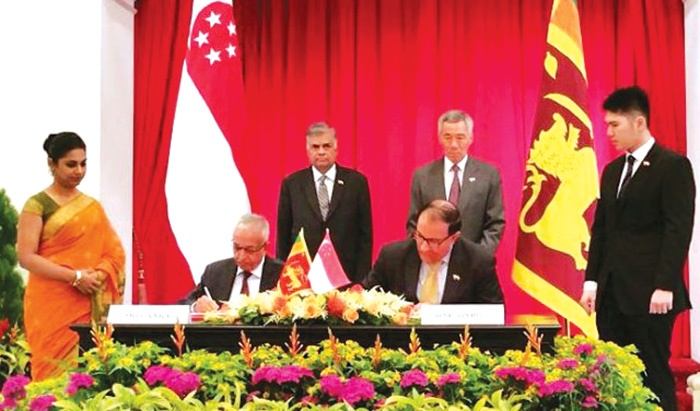
Sri Lanka-Singapore Free Trade Agreement
By Gomi Senadhira
senadhiragomi@gmail.com
“You might tell fairy tales, but the progress of a country cannot be achieved through such narratives. A country cannot be developed by making false promises. The country moved backward because of the electoral promises made by political parties throughout time. We have witnessed that the ultimate result of this is the country becoming bankrupt. Unfortunately, many segments of the population have not come to realize this yet.” – President Ranil Wickremesinghe, 2024 Budget speech
Any Sri Lankan would agree with the above words of President Wickremesinghe on the false promises our politicians and officials make and the fairy tales they narrate which bankrupted this country. So, to understand this, let’s look at one such fairy tale with lots of false promises; Ranil Wickremesinghe’s greatest achievement in the area of international trade and investment promotion during the Yahapalana period, Sri Lanka-Singapore Free Trade Agreement (SLSFTA).
It is appropriate and timely to do it now as Finance Minister Wickremesinghe has just presented to parliament a bill on the National Policy on Economic Transformation which includes the establishment of an Office for International Trade and the Sri Lanka Institute of Economics and International Trade.
Was SLSFTA a “Cleverly negotiated Free Trade Agreement” as stated by the (former) Minister of Development Strategies and International Trade Malik Samarawickrama during the Parliamentary Debate on the SLSFTA in July 2018, or a colossal blunder covered up with lies, false promises, and fairy tales? After SLSFTA was signed there were a number of fairy tales published on this agreement by the Ministry of Development Strategies and International, Institute of Policy Studies, and others.
However, for this article, I would like to limit my comments to the speech by Minister Samarawickrama during the Parliamentary Debate, and the two most important areas in the agreement which were covered up with lies, fairy tales, and false promises, namely: revenue loss for Sri Lanka and Investment from Singapore. On the other important area, “Waste products dumping” I do not want to comment here as I have written extensively on the issue.
1. The revenue loss
During the Parliamentary Debate in July 2018, Minister Samarawickrama stated “…. let me reiterate that this FTA with Singapore has been very cleverly negotiated by us…. The liberalisation programme under this FTA has been carefully designed to have the least impact on domestic industry and revenue collection. We have included all revenue sensitive items in the negative list of items which will not be subject to removal of tariff. Therefore, 97.8% revenue from Customs duty is protected. Our tariff liberalisation will take place over a period of 12-15 years! In fact, the revenue earned through tariffs on goods imported from Singapore last year was Rs. 35 billion.
The revenue loss for over the next 15 years due to the FTA is only Rs. 733 million– which when annualised, on average, is just Rs. 51 million. That is just 0.14% per year! So anyone who claims the Singapore FTA causes revenue loss to the Government cannot do basic arithmetic! Mr. Speaker, in conclusion, I call on my fellow members of this House – don’t mislead the public with baseless criticism that is not grounded in facts. Don’t look at petty politics and use these issues for your own political survival.”
I was surprised to read the minister’s speech because an article published in January 2018 in “The Straits Times“, based on information released by the Singaporean Negotiators stated, “…. With the FTA, tariff savings for Singapore exports are estimated to hit $10 million annually“.
As the annual tariff savings (that is the revenue loss for Sri Lanka) calculated by the Singaporean Negotiators, Singaporean $ 10 million (Sri Lankan rupees 1,200 million in 2018) was way above the rupees’ 733 million revenue loss for 15 years estimated by the Sri Lankan negotiators, it was clear to any observer that one of the parties to the agreement had not done the basic arithmetic!
Six years later, according to a report published by “The Morning” newspaper, speaking at the Committee on Public Finance (COPF) on 7th May 2024, Mr Samarawickrama’s chief trade negotiator K.J. Weerasinghehad had admitted “…. that forecasted revenue loss for the Government of Sri Lanka through the Singapore FTA is Rs. 450 million in 2023 and Rs. 1.3 billion in 2024.”
If these numbers are correct, as tariff liberalisation under the SLSFTA has just started, we will pass Rs 2 billion very soon. Then, the question is how Sri Lanka’s trade negotiators made such a colossal blunder. Didn’t they do their basic arithmetic? If they didn’t know how to do basic arithmetic they should have at least done their basic readings. For example, the headline of the article published in The Straits Times in January 2018 was “Singapore, Sri Lanka sign FTA, annual savings of $10m expected”.
Anyway, as Sri Lanka’s chief negotiator reiterated at the COPF meeting that “…. since 99% of the tariffs in Singapore have zero rates of duty, Sri Lanka has agreed on 80% tariff liberalisation over a period of 15 years while expecting Singapore investments to address the imbalance in trade,” let’s turn towards investment.
Investment from Singapore
In July 2018, speaking during the Parliamentary Debate on the FTA this is what Minister Malik Samarawickrama stated on investment from Singapore, “Already, thanks to this FTA, in just the past two-and-a-half months since the agreement came into effect we have received a proposal from Singapore for investment amounting to $ 14.8 billion in an oil refinery for export of petroleum products. In addition, we have proposals for a steel manufacturing plant for exports ($ 1 billion investment), flour milling plant ($ 50 million), sugar refinery ($ 200 million). This adds up to more than $ 16.05 billion in the pipeline on these projects alone.
And all of these projects will create thousands of more jobs for our people. In principle approval has already been granted by the BOI and the investors are awaiting the release of land the environmental approvals to commence the project.
I request the Opposition and those with vested interests to change their narrow-minded thinking and join us to develop our country. We must always look at what is best for the whole community, not just the few who may oppose. We owe it to our people to courageously take decisions that will change their lives for the better.”
According to the media report I quoted earlier, speaking at the Committee on Public Finance (COPF) Chief Negotiator Weerasinghe has admitted that Sri Lanka was not happy with overall Singapore investments that have come in the past few years in return for the trade liberalisation under the Singapore-Sri Lanka Free Trade Agreement. He has added that between 2021 and 2023 the total investment from Singapore had been around $162 million!
What happened to those projects worth $16 billion negotiated, thanks to the SLSFTA, in just the two-and-a-half months after the agreement came into effect and approved by the BOI? I do not know about the steel manufacturing plant for exports ($ 1 billion investment), flour milling plant ($ 50 million) and sugar refinery ($ 200 million).
However, story of the multibillion-dollar investment in the Petroleum Refinery unfolded in a manner that would qualify it as the best fairy tale with false promises presented by our politicians and the officials, prior to 2019 elections.
Though many Sri Lankans got to know, through the media which repeatedly highlighted a plethora of issues surrounding the project and the questionable credentials of the Singaporean investor, the construction work on the Mirrijiwela Oil Refinery along with the cement factory began on the24th of March 2019 with a bang and Minister Ranil Wickremesinghe and his ministers along with the foreign and local dignitaries laid the foundation stones.
That was few months before the 2019 Presidential elections. Inaugurating the construction work Prime Minister Ranil Wickremesinghe said the projects will create thousands of job opportunities in the area and surrounding districts.
The oil refinery, which was to be built over 200 acres of land, with the capacity to refine 200,000 barrels of crude oil per day, was to generate US$7 billion of exports and create 1,500 direct and 3,000 indirect jobs. The construction of the refinery was to be completed in 44 months. Four years later, in August 2023 the Cabinet of Ministers approved the proposal presented by President Ranil Wickremesinghe to cancel the agreement with the investors of the refinery as the project has not been implemented! Can they explain to the country how much money was wasted to produce that fairy tale?
It is obvious that the President, ministers, and officials had made huge blunders and had deliberately misled the public and the parliament on the revenue loss and potential investment from SLSFTA with fairy tales and false promises.
As the president himself said, a country cannot be developed by making false promises or with fairy tales and these false promises and fairy tales had bankrupted the country. “Unfortunately, many segments of the population have not come to realize this yet”.
(The writer, a specialist and an activist on trade and development issues . )



US sports envoys to Lanka to champion youth development

Rahuman questions sudden cancellation of leave of CEB employees


