Features
The Sri Lankan Woman in the 21st Century – who is she?

Susan George Pulimood memorial oration 2023
By Chandrika N Wijeyaratne
I am greatly honoured and deeply humbled on being the 32nd orator of this prestigous annual event that enables us to pay homage to the succession of principals and teachers without whom no Visakhian would be playing or have played specific societal roles in niche settings through WISDOM and RIGHT UNDERSTANDING .
Visakha Vidyalaya, was established in 1917 to give Buddhist girls access to English education and gain its present status, due to the dedicated services of women leaders of the caliber of Susan George Pulimood. As our principal she had vision and zeal, with the added flavor of hailing from a strong Christian upbringing, to help elevate the leading state Buddhist Girls’ school to remain high in the league table of girls’ education. She was an unmatched visionary leader, teacher, and exemplary role model for any woman of any era.
Her birth anniversary is commemorated globally by Visakhians who recall, reflect, and revere this memorable personality, with an annual memorial oration, to perpetuate her legacy and sustain her expressed expectations made over seven decades ago. Born 116 years ago in Kerala, South India, she grew, matured and graduated with a Master’s in Botany and chose the teaching profession in Sri Lanka from 1941.
She was a magnificent teacher of English literature, botany and mathematics, a rare combination, and helped groom girls who aspired higher education. As the second Asian Principal from 1945, Mrs Pulimood was renowned for her selfless dedication as an educationist, who introduced the science stream, and upgraded Visakha to an ‘A’ Grade school and subsequently as a Super Grade school by 1957. She was a true beacon of light for the provision of holistic education for generations of women from every nook and cranny of our beloved country.
Etched in my memories of the past six decades are the highs and lows of Sri Lankan Society. that makes me wonder, had a few more women leaders groomed by the likes of Pulimood, been able to contribute to the executive, legislature, and judiciary as effective public intellectuals, whether Sri Lanka would have been spared of its many sorrows, travesties of justice, lamentations, and multiple missed opportunities to be the truly prosperous and stable society we still await. It is only natural that we pause and explore how Mrs Pulimood might have viewed and opined on the role of 21st-century women in Sri Lanka.
Permit me to explore the acquisition of social consciousness underpinned by education that can be garnered through women’s empowerment to impact whole of society. Ironically events that unfolded soon after July 23, 1983 taints our country’s history, which Mrs Pulimood possibly followed with desolation from her native India, of the many sad experiences resulting from human error, political misjudgment, and societal failure.
Our unified and collective commitment to never permit such diabolic occurrences to repeat themselves in any place on this planet is the true art of tolerance and restraint from misdeeds. Indeed, since then women of our beloved island’s North and South built bridges to share their grief over the loss of sons and daughters of Mother Lanka.
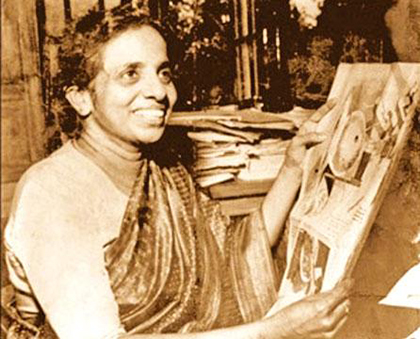
Susan George Pulimood
‘A Textbook of Botany’ co-authored with her sister Anna K. Joshua, inspired so many young girls to appreciate the science of Sri Lankan flora. I have met many Visakhians, now leading and respected academics in this very field, who recall how this book encouraged them to the amazing and delightful world of Plant Sciences. In the words of a contemporary Neurologist “Every life matters.
Be like Mother Nature and love everyone without judging” possibly depicts how women of Mrs Pulimood’s calibre viewed our rich biodiversity and were doubly blessed for inculcating among the young a love for nature and its preservation. Her professionalism with feminine grace remains etched in our autobiographical memory!
Had such visionaries been sustained to lead Sri Lanka’s educational systems, I am firmly convinced that our beautiful and luscious land would have been food secure and economically stable today through a cohort of women leaders who respect their environment and guide our society, community, and families to appreciate adopting a pragmatic approach to the time appropriate prerequisites of agriculture, plant sciences and post-harvest crop preservation with effective distribution of food subsidies to those in real need.
In parallel, I recall with reverence the engaging sermons by the most Venerable Narada Thero and his introduction to our young minds about the meaning of the five precepts and mindfulness meditation, which was undoubtedly a reflection of Mrs. Pulimood’s priorities for primary school-based education, to adopt sound civic-minded attitudes and practices from our formative days.I also recall and pay homage to the numerous teachers who were past pupils of Pulimood, and their individual roles in fashioning us to be well-rounded and upright Visakhians. Mrs. Pulimood, as the undisputed architect of our school, worked painstakingly to envision every young Visakhian could reach her full potential in a holistic manner, both academically and in extra-curricular activities, thus enabling a solid framework to optimize their social intelligence.
My fervent wish is that the Sri Lankan woman of the 21st century, matches the expectations of what was envisioned by this wise and pragmatic educationist who was undeniably futuristic. In my salutations to this great lady, I shall share with you a series of case-based scenarios that I have encountered in my career path through service, teaching, and research in and around women’s health and as the academic leader in the pioneer university of our higher educational system, that depict the highs and lows of the 21st Century Sri Lankan Woman.
I seek your due attention to address the gaps and how we could mitigate the impact of key problems our contemporary women face and thereby enable the Pulimood legacy to be truly fulfilled. I beg your indulgence to recall real-life encounters and anecdotes that highlight the underlying principles as a data-driven exercise and thereby personifying key take-home messages.
The positive aspects and challenges faced by the 21st century Sri Lankan Woman are depicted by the ‘4Rs’:
Re-prioritization of values, which determine societal attitudes and behaviour
Resourcefulness
Resilience
Respect Work-Life Balance
while being a fulfilled and contented daughter, wife, mother, professional lead, entrepreneur, skilled worker, or business partner, who always upholds the truth.The KEY AREA of addressing these issues require a review of our value systems in parenting, education, and societal supports.
My research interests, based on the clinical needs of women, opened my eyes to the vast lacunae that exist in their life cycle, that stems from a lack of holistic education and broad outlook.
Adolescent girls stressed from excessive pressure to study for the GCE Ordinary Level Examination experience much mental stress and lack of sleep that in turn contribute to an unhealthy lifestyle and weight gain. Excess body fat leads to disordered menstruation, distressing cosmetic issues of excess facial hair, acne and weight stigma related to the commonest hormonal disturbance afflicting nearly one in 10 girls and young women, called the polycystic ovary syndrome (PCOS).
In our community research we witnessed adolescents and young women with PCOS as sad victims of cultural restrictions with prescriptive parenting, insensitive school environments and negative societal values. The many young girls who cannot discuss issues around their menstrual patterns, cosmetic issues such as hirsutism and head hair loss, body image, and lifestyle in terms of diet and physical activity are commonly encountered by the likes of us in our clinical practice. Quite often these problems that seem unsurmountable to mother and daughter have simple solutions.
They have not been able to seek the correct scientific information and take remedial measures to solve them. A combination of factors prevents the development of self-reliance to comprehend and identify their biopsychosocial needs. Had such girls and women been enabled to seek help from an expanded system of support and be appropriately encouraged to choose their own life options and plans, they would be far more confident and happier individuals.
When leading the University of Colombo as the first female medic, I perceived the multiple challenges faced by women workers and students, be they teachers, support staff or unskilled workers. Although many are resourceful and resilient, they encounter multiple impediments by the established value systems and societal expectations that impacts on their freedom to choose their preferred areas of expertise and careers. I have most sadly encountered a few learners who did not portray attaining some simple basic values and life skills although being high achievers, while the great majority were excellent and a pleasure to recall.
My experience as a senior clinician in a women’s health caregiving setting is of mixed emotions. While the great majority of health care providers are the epitome of the Hippocratic Oath and the Nightingale philosophy, there are deficiencies in today’s clinical care. Simple tasks that need compassion and insight to provide tender loving care are unconsciously overlooked.
High achievers in the Humanities and Social Sciences opt to become Learners in Education, a very noble profession, with the assurance of a government job. Nevertheless, their capability in effective public speaking, communication, creativity, and lateral thinking are sub-optimal. The numerous inappropriate job aspirants in terms of their acquired expertise being a mismatch for a job advertised also highlights these deficiencies, where the attitudes and behaviours encouraged is “Monawa vunath Job ekak”, and not job satisfaction.
There was a clear need for a good mix of learning the Humanities and STEM courses, and I am glad to learn of the recent emphasis on STEM education. The paucity of emphasis on developing entrepreneurship skills rather than seeking public sector employment needs due attention in career guidance with experiential learning encouraged towards self-reliance in micro-small and medium enterprises (MSME).
In terms of unfulfilled expectations among our young graduates, who realize their individual capabilities rather late is most disturbing. This problem when encountered by young women, given the large numbers of women qualifying for university entrance can gravely impact them and their families. Despite a greater number of women in most study fields, with Engineering, Technology and Computer Sciences being the exception, is also worth reflecting upon.
The role played by schools and educational institutes to address personal choices, work life balance, work norms and basic ethics is possibly insufficient. We need to ponder on how well we fashion our school outputs on becoming better human beings. Such important aspects are overlooked by the precedence given to achieving high grades at examinations through a highly competitive milieu that is tuition-driven with rote learning being encouraged.
Achieving health and wellbeing also needs addressing along with open discussions on gender-based violence and inculcate a zero tolerance to any form of violence, ragging or bullying. Developing social consciousness – highlights the importance of empathy, inculcating non-self from early childhood with a strong conviction of one’s civic responsibilities and a truly dedicated view of patriotism to sustain national development (COUNTRY AND SOCIETY FIRST BEFORE SELF).
What gladdens us seniors is to encounter a truly caring, dedicated, and selfless high-end educational achiever who would place the poorest of the poor with life-threatening diseases as a priority – and treat such patients like royalty! If the work outputs highlight basic ethics and respect for the needy whose very survival and well-being should be our fulfillment, is something we cannot demand from young and upcoming professionals, as this has to come naturally!
Sri Lanka’s Maternal and Child Health (MCH) program is a world-class phenomenon and a sustainable feather in our health cap. Women’s Right to reproductive health from family planning to antenatal care (nutrition, safe motherhood, breastfeeding, and the role of the midwife) – is a shining example of collective efforts by stakeholders by achieving stability through our highs and lows.
However, there is a paradox of childcare support for the young career mothers of Sri Lanka. Such a paucity of social support for working women leads to an unhappy trend of modern professionals limiting their family size to one, and in highlighting the unreliable home-based care supports that drive working mothers to have medically unexplained symptoms that is caused by anxiety and worry.
Sri Lanka’s sad status of still relying on the foreign revenue earned via housemaids working in the Middle Eastern countries is personified when we observe the trail of social destruction among the families of migrant female workers, in their quest to keep the home fires burning.
Policymakers in education need to address alternative job opportunities by supporting and encouraging vocational training in “safe” working environments for women. Every girl need not enter university or a college and should be encouraged to make her choice of the best-fit model, in parallel with economic and computer literacy with self-reliance. Such an approach will support national development while retaining socio-psychological stability among individuals, families, and communities.
I wish to highlight the vulnerable groups of women whose sad status is socially determined, which leads to their marginalization. Women with chronic mental disease, in remand prison for drug offenses perpetuated by their partners, and as commercial sex workers are chief among them. Undoubtedly a greater social awareness can enable the more fortunate women and girls in supporting such unfortunate women and girls with a view to rehabilitation.
I recall with sadness the migrant worker with major mental disease who returned to Sri Lanka pregnant on two consecutive occasions, when she abandoned both the children as she had no social support. Such gaps impact on us health care providers who have to encounter these scenarios with a sense of helplessness. My sincere appreciation is extended to Dr. Jayan Mendis, who as a clinician-administrator had the vision to open a special mother-baby facility for pregnant women with mental health disorders at Mulleriyawa and rehabilitate women with chronic mental disease and institutionalized long-term, for them to get back into society with self-respect. I recall with gratitude the Zonta Club 1 of Colombo who helped nurture future leaders of Golden Zs from among university students since 2004 todate through volunteerism and selfless dedication by trying to solve such social problems through specific projects to empower these special groups of women.
Madam Principal, I suggest exploring opportunities for past pupils in university to inspire the current schoolgirls through such community outreach projects and help fashion them to face the real world. I am certain that even the teachers would perceive the big picture rather than examinations alone. Such activities would also help emphasize that diversity is strength. The need to provide the modern era girl-child and young woman the necessary space to develop her own identity, career choice, marriage, and life plans and develop a global outlook is a priority.
Breaking the stigma of marriage and divorce rather than maintaining a culture of silence that leads to chronic stress and suffering also needs addressing. There is a crying need for our societies to develop unbiased non-judgmental attitudes and address gender issues with an open mind. A rational approach towards Religion and Science, Rituals and Defilements need to be addressed in the home, classroom, and community. To engage in public advocacy and address these issues in a responsible manner for the betterment of fellow human beings would be proactive. The current inertia by the media in enhancing public-spirited expressions of concern of the key issues and their root causes, rather than reporting sensational news of horrible outcomes, needs a meaningful change.
The creation of a fair and balanced learning environment with social consciousness is in want, which the likes of Mrs Pulimood would have had the courage to address. Our state-funded services were instituted in the post-independence era in terms of health and education with an emphasis on a strong social outreach, but sadly this has not been completely fulfilled as a return on investment, particularly through the empowerment of women. This gap is brings into focus the 21st century aspirations of women, as professionals, technocrats and effective contributors to the private and corporate sectors and home makers that requires a parallel shift in educational outlook.
In summary Sri Lanka needs to refashion her educational landscape, particularly for women and girls, with Visakha Vidyalaya being in the forefront as a Pulimood legacy. The key areas towards a positive change include
- enable holistic school education for girls with appropriate openness to encourage self-confidence with an emphasis on physical health, reproductive health, relationships, economic literacy, self-reliance, and as our future entrepreneurs
- consider a diversion from the current-day exam-oriented cramming towards choosing a prototype career pathway with poor return
- overcoming syllabus-driven tutoring that encourages rote “learning”
- mitigate preset societal values in career choice
- support national developmental-driven through multidisciplinary vocations that aim for value-addition in agriculture, sustainable energy, environmental consciousness, e-governance, and AI solutions through entrepreneurship, to mention a few.
- the need to align educational outcomes with the UN Sustainable Development Goals
- to retain and respect Home Science teaching and Mindfulness Meditation in the 21st century in girls’ education