
Features
The Sri Lankan Woman in the 21st Century – who is she?

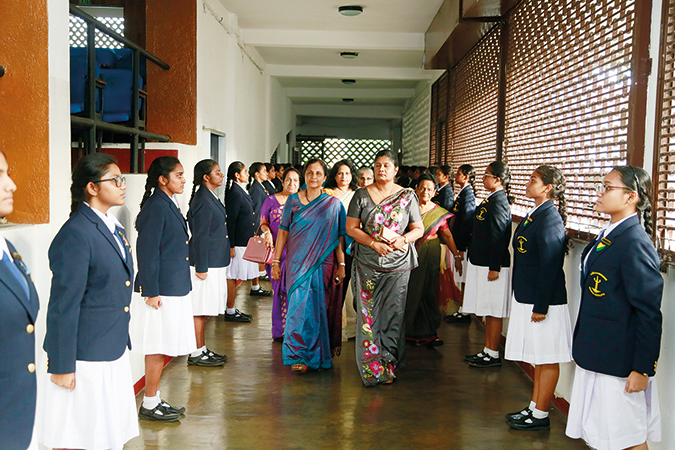
Susan George Pulimood memorial oration 2023
By Chandrika N Wijeyaratne
I am greatly honoured and deeply humbled on being the 32nd orator of this prestigous annual event that enables us to pay homage to the succession of principals and teachers without whom no Visakhian would be playing or have played specific societal roles in niche settings through WISDOM and RIGHT UNDERSTANDING .
Visakha Vidyalaya, was established in 1917 to give Buddhist girls access to English education and gain its present status, due to the dedicated services of women leaders of the caliber of Susan George Pulimood. As our principal she had vision and zeal, with the added flavor of hailing from a strong Christian upbringing, to help elevate the leading state Buddhist Girls’ school to remain high in the league table of girls’ education. She was an unmatched visionary leader, teacher, and exemplary role model for any woman of any era.
Her birth anniversary is commemorated globally by Visakhians who recall, reflect, and revere this memorable personality, with an annual memorial oration, to perpetuate her legacy and sustain her expressed expectations made over seven decades ago. Born 116 years ago in Kerala, South India, she grew, matured and graduated with a Master’s in Botany and chose the teaching profession in Sri Lanka from 1941.
She was a magnificent teacher of English literature, botany and mathematics, a rare combination, and helped groom girls who aspired higher education. As the second Asian Principal from 1945, Mrs Pulimood was renowned for her selfless dedication as an educationist, who introduced the science stream, and upgraded Visakha to an ‘A’ Grade school and subsequently as a Super Grade school by 1957. She was a true beacon of light for the provision of holistic education for generations of women from every nook and cranny of our beloved country.
Etched in my memories of the past six decades are the highs and lows of Sri Lankan Society. that makes me wonder, had a few more women leaders groomed by the likes of Pulimood, been able to contribute to the executive, legislature, and judiciary as effective public intellectuals, whether Sri Lanka would have been spared of its many sorrows, travesties of justice, lamentations, and multiple missed opportunities to be the truly prosperous and stable society we still await. It is only natural that we pause and explore how Mrs Pulimood might have viewed and opined on the role of 21st-century women in Sri Lanka.
Permit me to explore the acquisition of social consciousness underpinned by education that can be garnered through women’s empowerment to impact whole of society. Ironically events that unfolded soon after July 23, 1983 taints our country’s history, which Mrs Pulimood possibly followed with desolation from her native India, of the many sad experiences resulting from human error, political misjudgment, and societal failure.
Our unified and collective commitment to never permit such diabolic occurrences to repeat themselves in any place on this planet is the true art of tolerance and restraint from misdeeds. Indeed, since then women of our beloved island’s North and South built bridges to share their grief over the loss of sons and daughters of Mother Lanka.
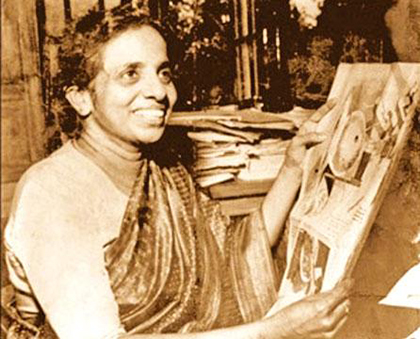
Susan George Pulimood
‘A Textbook of Botany’ co-authored with her sister Anna K. Joshua, inspired so many young girls to appreciate the science of Sri Lankan flora. I have met many Visakhians, now leading and respected academics in this very field, who recall how this book encouraged them to the amazing and delightful world of Plant Sciences. In the words of a contemporary Neurologist “Every life matters.
Be like Mother Nature and love everyone without judging” possibly depicts how women of Mrs Pulimood’s calibre viewed our rich biodiversity and were doubly blessed for inculcating among the young a love for nature and its preservation. Her professionalism with feminine grace remains etched in our autobiographical memory!
Had such visionaries been sustained to lead Sri Lanka’s educational systems, I am firmly convinced that our beautiful and luscious land would have been food secure and economically stable today through a cohort of women leaders who respect their environment and guide our society, community, and families to appreciate adopting a pragmatic approach to the time appropriate prerequisites of agriculture, plant sciences and post-harvest crop preservation with effective distribution of food subsidies to those in real need.
In parallel, I recall with reverence the engaging sermons by the most Venerable Narada Thero and his introduction to our young minds about the meaning of the five precepts and mindfulness meditation, which was undoubtedly a reflection of Mrs. Pulimood’s priorities for primary school-based education, to adopt sound civic-minded attitudes and practices from our formative days.I also recall and pay homage to the numerous teachers who were past pupils of Pulimood, and their individual roles in fashioning us to be well-rounded and upright Visakhians. Mrs. Pulimood, as the undisputed architect of our school, worked painstakingly to envision every young Visakhian could reach her full potential in a holistic manner, both academically and in extra-curricular activities, thus enabling a solid framework to optimize their social intelligence.
My fervent wish is that the Sri Lankan woman of the 21st century, matches the expectations of what was envisioned by this wise and pragmatic educationist who was undeniably futuristic. In my salutations to this great lady, I shall share with you a series of case-based scenarios that I have encountered in my career path through service, teaching, and research in and around women’s health and as the academic leader in the pioneer university of our higher educational system, that depict the highs and lows of the 21st Century Sri Lankan Woman.
I seek your due attention to address the gaps and how we could mitigate the impact of key problems our contemporary women face and thereby enable the Pulimood legacy to be truly fulfilled. I beg your indulgence to recall real-life encounters and anecdotes that highlight the underlying principles as a data-driven exercise and thereby personifying key take-home messages.
The positive aspects and challenges faced by the 21st century Sri Lankan Woman are depicted by the ‘4Rs’:
Re-prioritization of values, which determine societal attitudes and behaviour
Resourcefulness
Resilience
Respect Work-Life Balance
while being a fulfilled and contented daughter, wife, mother, professional lead, entrepreneur, skilled worker, or business partner, who always upholds the truth.The KEY AREA of addressing these issues require a review of our value systems in parenting, education, and societal supports.
My research interests, based on the clinical needs of women, opened my eyes to the vast lacunae that exist in their life cycle, that stems from a lack of holistic education and broad outlook.
Adolescent girls stressed from excessive pressure to study for the GCE Ordinary Level Examination experience much mental stress and lack of sleep that in turn contribute to an unhealthy lifestyle and weight gain. Excess body fat leads to disordered menstruation, distressing cosmetic issues of excess facial hair, acne and weight stigma related to the commonest hormonal disturbance afflicting nearly one in 10 girls and young women, called the polycystic ovary syndrome (PCOS).
In our community research we witnessed adolescents and young women with PCOS as sad victims of cultural restrictions with prescriptive parenting, insensitive school environments and negative societal values. The many young girls who cannot discuss issues around their menstrual patterns, cosmetic issues such as hirsutism and head hair loss, body image, and lifestyle in terms of diet and physical activity are commonly encountered by the likes of us in our clinical practice. Quite often these problems that seem unsurmountable to mother and daughter have simple solutions.
They have not been able to seek the correct scientific information and take remedial measures to solve them. A combination of factors prevents the development of self-reliance to comprehend and identify their biopsychosocial needs. Had such girls and women been enabled to seek help from an expanded system of support and be appropriately encouraged to choose their own life options and plans, they would be far more confident and happier individuals.
When leading the University of Colombo as the first female medic, I perceived the multiple challenges faced by women workers and students, be they teachers, support staff or unskilled workers. Although many are resourceful and resilient, they encounter multiple impediments by the established value systems and societal expectations that impacts on their freedom to choose their preferred areas of expertise and careers. I have most sadly encountered a few learners who did not portray attaining some simple basic values and life skills although being high achievers, while the great majority were excellent and a pleasure to recall.
My experience as a senior clinician in a women’s health caregiving setting is of mixed emotions. While the great majority of health care providers are the epitome of the Hippocratic Oath and the Nightingale philosophy, there are deficiencies in today’s clinical care. Simple tasks that need compassion and insight to provide tender loving care are unconsciously overlooked.
High achievers in the Humanities and Social Sciences opt to become Learners in Education, a very noble profession, with the assurance of a government job. Nevertheless, their capability in effective public speaking, communication, creativity, and lateral thinking are sub-optimal. The numerous inappropriate job aspirants in terms of their acquired expertise being a mismatch for a job advertised also highlights these deficiencies, where the attitudes and behaviours encouraged is “Monawa vunath Job ekak”, and not job satisfaction.
There was a clear need for a good mix of learning the Humanities and STEM courses, and I am glad to learn of the recent emphasis on STEM education. The paucity of emphasis on developing entrepreneurship skills rather than seeking public sector employment needs due attention in career guidance with experiential learning encouraged towards self-reliance in micro-small and medium enterprises (MSME).
In terms of unfulfilled expectations among our young graduates, who realize their individual capabilities rather late is most disturbing. This problem when encountered by young women, given the large numbers of women qualifying for university entrance can gravely impact them and their families. Despite a greater number of women in most study fields, with Engineering, Technology and Computer Sciences being the exception, is also worth reflecting upon.
The role played by schools and educational institutes to address personal choices, work life balance, work norms and basic ethics is possibly insufficient. We need to ponder on how well we fashion our school outputs on becoming better human beings. Such important aspects are overlooked by the precedence given to achieving high grades at examinations through a highly competitive milieu that is tuition-driven with rote learning being encouraged.
Achieving health and wellbeing also needs addressing along with open discussions on gender-based violence and inculcate a zero tolerance to any form of violence, ragging or bullying. Developing social consciousness – highlights the importance of empathy, inculcating non-self from early childhood with a strong conviction of one’s civic responsibilities and a truly dedicated view of patriotism to sustain national development (COUNTRY AND SOCIETY FIRST BEFORE SELF).
What gladdens us seniors is to encounter a truly caring, dedicated, and selfless high-end educational achiever who would place the poorest of the poor with life-threatening diseases as a priority – and treat such patients like royalty! If the work outputs highlight basic ethics and respect for the needy whose very survival and well-being should be our fulfillment, is something we cannot demand from young and upcoming professionals, as this has to come naturally!
Sri Lanka’s Maternal and Child Health (MCH) program is a world-class phenomenon and a sustainable feather in our health cap. Women’s Right to reproductive health from family planning to antenatal care (nutrition, safe motherhood, breastfeeding, and the role of the midwife) – is a shining example of collective efforts by stakeholders by achieving stability through our highs and lows.
However, there is a paradox of childcare support for the young career mothers of Sri Lanka. Such a paucity of social support for working women leads to an unhappy trend of modern professionals limiting their family size to one, and in highlighting the unreliable home-based care supports that drive working mothers to have medically unexplained symptoms that is caused by anxiety and worry.
Sri Lanka’s sad status of still relying on the foreign revenue earned via housemaids working in the Middle Eastern countries is personified when we observe the trail of social destruction among the families of migrant female workers, in their quest to keep the home fires burning.
Policymakers in education need to address alternative job opportunities by supporting and encouraging vocational training in “safe” working environments for women. Every girl need not enter university or a college and should be encouraged to make her choice of the best-fit model, in parallel with economic and computer literacy with self-reliance. Such an approach will support national development while retaining socio-psychological stability among individuals, families, and communities.
I wish to highlight the vulnerable groups of women whose sad status is socially determined, which leads to their marginalization. Women with chronic mental disease, in remand prison for drug offenses perpetuated by their partners, and as commercial sex workers are chief among them. Undoubtedly a greater social awareness can enable the more fortunate women and girls in supporting such unfortunate women and girls with a view to rehabilitation.
I recall with sadness the migrant worker with major mental disease who returned to Sri Lanka pregnant on two consecutive occasions, when she abandoned both the children as she had no social support. Such gaps impact on us health care providers who have to encounter these scenarios with a sense of helplessness. My sincere appreciation is extended to Dr. Jayan Mendis, who as a clinician-administrator had the vision to open a special mother-baby facility for pregnant women with mental health disorders at Mulleriyawa and rehabilitate women with chronic mental disease and institutionalized long-term, for them to get back into society with self-respect. I recall with gratitude the Zonta Club 1 of Colombo who helped nurture future leaders of Golden Zs from among university students since 2004 todate through volunteerism and selfless dedication by trying to solve such social problems through specific projects to empower these special groups of women.
Madam Principal, I suggest exploring opportunities for past pupils in university to inspire the current schoolgirls through such community outreach projects and help fashion them to face the real world. I am certain that even the teachers would perceive the big picture rather than examinations alone. Such activities would also help emphasize that diversity is strength. The need to provide the modern era girl-child and young woman the necessary space to develop her own identity, career choice, marriage, and life plans and develop a global outlook is a priority.
Breaking the stigma of marriage and divorce rather than maintaining a culture of silence that leads to chronic stress and suffering also needs addressing. There is a crying need for our societies to develop unbiased non-judgmental attitudes and address gender issues with an open mind. A rational approach towards Religion and Science, Rituals and Defilements need to be addressed in the home, classroom, and community. To engage in public advocacy and address these issues in a responsible manner for the betterment of fellow human beings would be proactive. The current inertia by the media in enhancing public-spirited expressions of concern of the key issues and their root causes, rather than reporting sensational news of horrible outcomes, needs a meaningful change.
The creation of a fair and balanced learning environment with social consciousness is in want, which the likes of Mrs Pulimood would have had the courage to address. Our state-funded services were instituted in the post-independence era in terms of health and education with an emphasis on a strong social outreach, but sadly this has not been completely fulfilled as a return on investment, particularly through the empowerment of women. This gap is brings into focus the 21st century aspirations of women, as professionals, technocrats and effective contributors to the private and corporate sectors and home makers that requires a parallel shift in educational outlook.
In summary Sri Lanka needs to refashion her educational landscape, particularly for women and girls, with Visakha Vidyalaya being in the forefront as a Pulimood legacy. The key areas towards a positive change include
- enable holistic school education for girls with appropriate openness to encourage self-confidence with an emphasis on physical health, reproductive health, relationships, economic literacy, self-reliance, and as our future entrepreneurs
- consider a diversion from the current-day exam-oriented cramming towards choosing a prototype career pathway with poor return
- overcoming syllabus-driven tutoring that encourages rote “learning”
- mitigate preset societal values in career choice
- support national developmental-driven through multidisciplinary vocations that aim for value-addition in agriculture, sustainable energy, environmental consciousness, e-governance, and AI solutions through entrepreneurship, to mention a few.
- the need to align educational outcomes with the UN Sustainable Development Goals
- to retain and respect Home Science teaching and Mindfulness Meditation in the 21st century in girls’ education


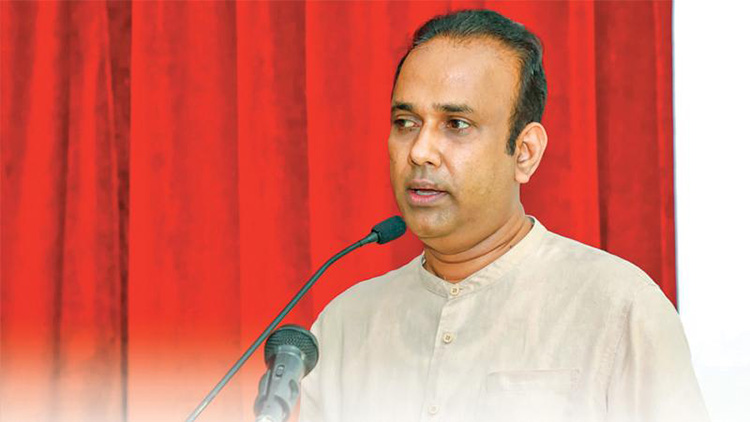
by Dr Gotabhya Ranasinghe
Senior Consultant Cardiologist
National Hospital Sri Lanka
When we sought a meeting with Hon Dr. Ramesh Pathirana, Minister of Health, he graciously cleared his busy schedule to accommodate us. Renowned for his attentive listening and deep understanding, Minister Pathirana is dedicated to advancing the health sector. His openness and transparency exemplify the qualities of an exemplary politician and minister.
Dr. Palitha Mahipala, the current Health Secretary, demonstrates both commendable enthusiasm and unwavering support. This combination of attributes makes him a highly compatible colleague for the esteemed Minister of Health.
Our discussion centered on a project that has been in the works for the past 30 years, one that no other minister had managed to advance.
Minister Pathirana, however, recognized the project’s significance and its potential to revolutionize care for heart patients.
The project involves the construction of a state-of-the-art facility at the premises of the National Hospital Colombo. The project’s location within the premises of the National Hospital underscores its importance and relevance to the healthcare infrastructure of the nation.
This facility will include a cardiology building and a tertiary care center, equipped with the latest technology to handle and treat all types of heart-related conditions and surgeries.
Securing funding was a major milestone for this initiative. Minister Pathirana successfully obtained approval for a $40 billion loan from the Asian Development Bank. With the funding in place, the foundation stone is scheduled to be laid in September this year, and construction will begin in January 2025.
This project guarantees a consistent and uninterrupted supply of stents and related medications for heart patients. As a result, patients will have timely access to essential medical supplies during their treatment and recovery. By securing these critical resources, the project aims to enhance patient outcomes, minimize treatment delays, and maintain the highest standards of cardiac care.
Upon its fruition, this monumental building will serve as a beacon of hope and healing, symbolizing the unwavering dedication to improving patient outcomes and fostering a healthier society.We anticipate a future marked by significant progress and positive outcomes in Sri Lanka’s cardiovascular treatment landscape within the foreseeable timeframe.

by Fr. Emmanuel Fernando, OMI
Jesuit Fr. Aloysius Pieris (affectionately called Fr. Aloy) celebrated his 90th birthday on April 9, 2024 and I, as the editor of our Oblate Journal, THE MISSIONARY OBLATE had gone to press by that time. Immediately I decided to publish an article, appreciating the untiring selfless services he continues to offer for inter-Faith dialogue, the renewal of the Catholic Church, his concern for the poor and the suffering Sri Lankan masses and to me, the present writer.
It was in 1988, when I was appointed Director of the Oblate Scholastics at Ampitiya by the then Oblate Provincial Fr. Anselm Silva, that I came to know Fr. Aloy more closely. Knowing well his expertise in matters spiritual, theological, Indological and pastoral, and with the collaborative spirit of my companion-formators, our Oblate Scholastics were sent to Tulana, the Research and Encounter Centre, Kelaniya, of which he is the Founder-Director, for ‘exposure-programmes’ on matters spiritual, biblical, theological and pastoral. Some of these dimensions according to my view and that of my companion-formators, were not available at the National Seminary, Ampitiya.
Ever since that time, our Oblate formators/ accompaniers at the Oblate Scholasticate, Ampitiya , have continued to send our Oblate Scholastics to Tulana Centre for deepening their insights and convictions regarding matters needed to serve the people in today’s context. Fr. Aloy also had tried very enthusiastically with the Oblate team headed by Frs. Oswald Firth and Clement Waidyasekara to begin a Theologate, directed by the Religious Congregations in Sri Lanka, for the contextual formation/ accompaniment of their members. It should very well be a desired goal of the Leaders / Provincials of the Religious Congregations.
Besides being a formator/accompanier at the Oblate Scholasticate, I was entrusted also with the task of editing and publishing our Oblate journal, ‘The Missionary Oblate’. To maintain the quality of the journal I continue to depend on Fr. Aloy for his thought-provoking and stimulating articles on Biblical Spirituality, Biblical Theology and Ecclesiology. I am very grateful to him for his generous assistance. Of late, his writings on renewal of the Church, initiated by Pope St. John XX111 and continued by Pope Francis through the Synodal path, published in our Oblate journal, enable our readers to focus their attention also on the needed renewal in the Catholic Church in Sri Lanka. Fr. Aloy appreciated very much the Synodal path adopted by the Jesuit Pope Francis for the renewal of the Church, rooted very much on prayerful discernment. In my Religious and presbyteral life, Fr.Aloy continues to be my spiritual animator / guide and ongoing formator / acccompanier.
Fr. Aloysius Pieris, BA Hons (Lond), LPh (SHC, India), STL (PFT, Naples), PhD (SLU/VC), ThD (Tilburg), D.Ltt (KU), has been one of the eminent Asian theologians well recognized internationally and one who has lectured and held visiting chairs in many universities both in the West and in the East. Many members of Religious Congregations from Asian countries have benefited from his lectures and guidance in the East Asian Pastoral Institute (EAPI) in Manila, Philippines. He had been a Theologian consulted by the Federation of Asian Bishops’ Conferences for many years. During his professorship at the Gregorian University in Rome, he was called to be a member of a special group of advisers on other religions consulted by Pope Paul VI.
Fr. Aloy is the author of more than 30 books and well over 500 Research Papers. Some of his books and articles have been translated and published in several countries. Among those books, one can find the following: 1) The Genesis of an Asian Theology of Liberation (An Autobiographical Excursus on the Art of Theologising in Asia, 2) An Asian Theology of Liberation, 3) Providential Timeliness of Vatican 11 (a long-overdue halt to a scandalous millennium, 4) Give Vatican 11 a chance, 5) Leadership in the Church, 6) Relishing our faith in working for justice (Themes for study and discussion), 7) A Message meant mainly, not exclusively for Jesuits (Background information necessary for helping Francis renew the Church), 8) Lent in Lanka (Reflections and Resolutions, 9) Love meets wisdom (A Christian Experience of Buddhism, 10) Fire and Water 11) God’s Reign for God’s poor, 12) Our Unhiddden Agenda (How we Jesuits work, pray and form our men). He is also the Editor of two journals, Vagdevi, Journal of Religious Reflection and Dialogue, New Series.
Fr. Aloy has a BA in Pali and Sanskrit from the University of London and a Ph.D in Buddhist Philosophy from the University of Sri Lankan, Vidyodaya Campus. On Nov. 23, 2019, he was awarded the prestigious honorary Doctorate of Literature (D.Litt) by the Chancellor of the University of Kelaniya, the Most Venerable Welamitiyawe Dharmakirthi Sri Kusala Dhamma Thera.
Fr. Aloy continues to be a promoter of Gospel values and virtues. Justice as a constitutive dimension of love and social concern for the downtrodden masses are very much noted in his life and work. He had very much appreciated the commitment of the late Fr. Joseph (Joe) Fernando, the National Director of the Social and Economic Centre (SEDEC) for the poor.
In Sri Lanka, a few religious Congregations – the Good Shepherd Sisters, the Christian Brothers, the Marist Brothers and the Oblates – have invited him to animate their members especially during their Provincial Congresses, Chapters and International Conferences. The mainline Christian Churches also have sought his advice and followed his seminars. I, for one, regret very much, that the Sri Lankan authorities of the Catholic Church –today’s Hierarchy—- have not sought Fr.
Aloy’s expertise for the renewal of the Catholic Church in Sri Lanka and thus have not benefited from the immense store of wisdom and insight that he can offer to our local Church while the Sri Lankan bishops who governed the Catholic church in the immediate aftermath of the Second Vatican Council (Edmund Fernando OMI, Anthony de Saram, Leo Nanayakkara OSB, Frank Marcus Fernando, Paul Perera,) visited him and consulted him on many matters. Among the Tamil Bishops, Bishop Rayappu Joseph was keeping close contact with him and Bishop J. Deogupillai hosted him and his team visiting him after the horrible Black July massacre of Tamils.
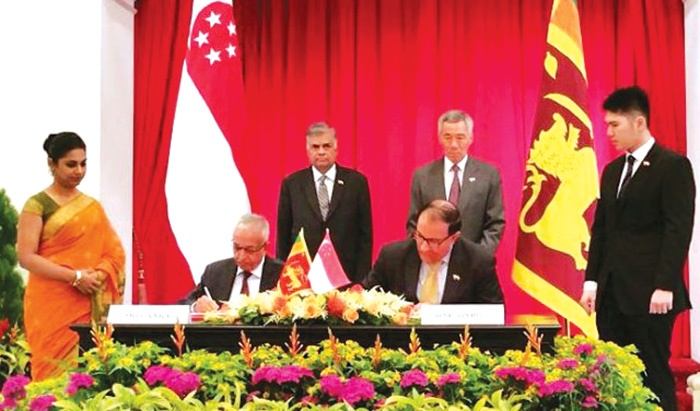
Sri Lanka-Singapore Free Trade Agreement
By Gomi Senadhira
senadhiragomi@gmail.com
“You might tell fairy tales, but the progress of a country cannot be achieved through such narratives. A country cannot be developed by making false promises. The country moved backward because of the electoral promises made by political parties throughout time. We have witnessed that the ultimate result of this is the country becoming bankrupt. Unfortunately, many segments of the population have not come to realize this yet.” – President Ranil Wickremesinghe, 2024 Budget speech
Any Sri Lankan would agree with the above words of President Wickremesinghe on the false promises our politicians and officials make and the fairy tales they narrate which bankrupted this country. So, to understand this, let’s look at one such fairy tale with lots of false promises; Ranil Wickremesinghe’s greatest achievement in the area of international trade and investment promotion during the Yahapalana period, Sri Lanka-Singapore Free Trade Agreement (SLSFTA).
It is appropriate and timely to do it now as Finance Minister Wickremesinghe has just presented to parliament a bill on the National Policy on Economic Transformation which includes the establishment of an Office for International Trade and the Sri Lanka Institute of Economics and International Trade.
Was SLSFTA a “Cleverly negotiated Free Trade Agreement” as stated by the (former) Minister of Development Strategies and International Trade Malik Samarawickrama during the Parliamentary Debate on the SLSFTA in July 2018, or a colossal blunder covered up with lies, false promises, and fairy tales? After SLSFTA was signed there were a number of fairy tales published on this agreement by the Ministry of Development Strategies and International, Institute of Policy Studies, and others.
However, for this article, I would like to limit my comments to the speech by Minister Samarawickrama during the Parliamentary Debate, and the two most important areas in the agreement which were covered up with lies, fairy tales, and false promises, namely: revenue loss for Sri Lanka and Investment from Singapore. On the other important area, “Waste products dumping” I do not want to comment here as I have written extensively on the issue.
1. The revenue loss
During the Parliamentary Debate in July 2018, Minister Samarawickrama stated “…. let me reiterate that this FTA with Singapore has been very cleverly negotiated by us…. The liberalisation programme under this FTA has been carefully designed to have the least impact on domestic industry and revenue collection. We have included all revenue sensitive items in the negative list of items which will not be subject to removal of tariff. Therefore, 97.8% revenue from Customs duty is protected. Our tariff liberalisation will take place over a period of 12-15 years! In fact, the revenue earned through tariffs on goods imported from Singapore last year was Rs. 35 billion.
The revenue loss for over the next 15 years due to the FTA is only Rs. 733 million– which when annualised, on average, is just Rs. 51 million. That is just 0.14% per year! So anyone who claims the Singapore FTA causes revenue loss to the Government cannot do basic arithmetic! Mr. Speaker, in conclusion, I call on my fellow members of this House – don’t mislead the public with baseless criticism that is not grounded in facts. Don’t look at petty politics and use these issues for your own political survival.”
I was surprised to read the minister’s speech because an article published in January 2018 in “The Straits Times“, based on information released by the Singaporean Negotiators stated, “…. With the FTA, tariff savings for Singapore exports are estimated to hit $10 million annually“.
As the annual tariff savings (that is the revenue loss for Sri Lanka) calculated by the Singaporean Negotiators, Singaporean $ 10 million (Sri Lankan rupees 1,200 million in 2018) was way above the rupees’ 733 million revenue loss for 15 years estimated by the Sri Lankan negotiators, it was clear to any observer that one of the parties to the agreement had not done the basic arithmetic!
Six years later, according to a report published by “The Morning” newspaper, speaking at the Committee on Public Finance (COPF) on 7th May 2024, Mr Samarawickrama’s chief trade negotiator K.J. Weerasinghehad had admitted “…. that forecasted revenue loss for the Government of Sri Lanka through the Singapore FTA is Rs. 450 million in 2023 and Rs. 1.3 billion in 2024.”
If these numbers are correct, as tariff liberalisation under the SLSFTA has just started, we will pass Rs 2 billion very soon. Then, the question is how Sri Lanka’s trade negotiators made such a colossal blunder. Didn’t they do their basic arithmetic? If they didn’t know how to do basic arithmetic they should have at least done their basic readings. For example, the headline of the article published in The Straits Times in January 2018 was “Singapore, Sri Lanka sign FTA, annual savings of $10m expected”.
Anyway, as Sri Lanka’s chief negotiator reiterated at the COPF meeting that “…. since 99% of the tariffs in Singapore have zero rates of duty, Sri Lanka has agreed on 80% tariff liberalisation over a period of 15 years while expecting Singapore investments to address the imbalance in trade,” let’s turn towards investment.
Investment from Singapore
In July 2018, speaking during the Parliamentary Debate on the FTA this is what Minister Malik Samarawickrama stated on investment from Singapore, “Already, thanks to this FTA, in just the past two-and-a-half months since the agreement came into effect we have received a proposal from Singapore for investment amounting to $ 14.8 billion in an oil refinery for export of petroleum products. In addition, we have proposals for a steel manufacturing plant for exports ($ 1 billion investment), flour milling plant ($ 50 million), sugar refinery ($ 200 million). This adds up to more than $ 16.05 billion in the pipeline on these projects alone.
And all of these projects will create thousands of more jobs for our people. In principle approval has already been granted by the BOI and the investors are awaiting the release of land the environmental approvals to commence the project.
I request the Opposition and those with vested interests to change their narrow-minded thinking and join us to develop our country. We must always look at what is best for the whole community, not just the few who may oppose. We owe it to our people to courageously take decisions that will change their lives for the better.”
According to the media report I quoted earlier, speaking at the Committee on Public Finance (COPF) Chief Negotiator Weerasinghe has admitted that Sri Lanka was not happy with overall Singapore investments that have come in the past few years in return for the trade liberalisation under the Singapore-Sri Lanka Free Trade Agreement. He has added that between 2021 and 2023 the total investment from Singapore had been around $162 million!
What happened to those projects worth $16 billion negotiated, thanks to the SLSFTA, in just the two-and-a-half months after the agreement came into effect and approved by the BOI? I do not know about the steel manufacturing plant for exports ($ 1 billion investment), flour milling plant ($ 50 million) and sugar refinery ($ 200 million).
However, story of the multibillion-dollar investment in the Petroleum Refinery unfolded in a manner that would qualify it as the best fairy tale with false promises presented by our politicians and the officials, prior to 2019 elections.
Though many Sri Lankans got to know, through the media which repeatedly highlighted a plethora of issues surrounding the project and the questionable credentials of the Singaporean investor, the construction work on the Mirrijiwela Oil Refinery along with the cement factory began on the24th of March 2019 with a bang and Minister Ranil Wickremesinghe and his ministers along with the foreign and local dignitaries laid the foundation stones.
That was few months before the 2019 Presidential elections. Inaugurating the construction work Prime Minister Ranil Wickremesinghe said the projects will create thousands of job opportunities in the area and surrounding districts.
The oil refinery, which was to be built over 200 acres of land, with the capacity to refine 200,000 barrels of crude oil per day, was to generate US$7 billion of exports and create 1,500 direct and 3,000 indirect jobs. The construction of the refinery was to be completed in 44 months. Four years later, in August 2023 the Cabinet of Ministers approved the proposal presented by President Ranil Wickremesinghe to cancel the agreement with the investors of the refinery as the project has not been implemented! Can they explain to the country how much money was wasted to produce that fairy tale?
It is obvious that the President, ministers, and officials had made huge blunders and had deliberately misled the public and the parliament on the revenue loss and potential investment from SLSFTA with fairy tales and false promises.
As the president himself said, a country cannot be developed by making false promises or with fairy tales and these false promises and fairy tales had bankrupted the country. “Unfortunately, many segments of the population have not come to realize this yet”.
(The writer, a specialist and an activist on trade and development issues . )



US sports envoys to Lanka to champion youth development

Rahuman questions sudden cancellation of leave of CEB employees


