
Life style
The sinking of SLNS Weeraya and Jagatha

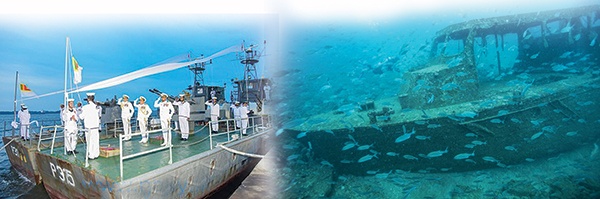
After decades-long tour of duty on the waters, Weeraya and Jagatha – two ships of the 3rd Fast Gun Boat Squadron of the SL Navy, have now found their new home on the seabed off the port of Trincomalee. While they continue to prove their mettle enriching the deep waters as fish breeding grounds and shipwreck diving sites, those who manned them recollect fond memories on board.
by Randima Attygalle
Weeraya and Jagatha translate into ‘hero’ and ‘conqueror’. These ships of the 3rd Fast Gun Boat Squadron of the SL Navy lived up to their names ensuring the security of the Sri Lankan waters during wartime. Weeraya joined the fleet in 1972 when Rear Admiral D.V Hunter was at the helm of the Royal Ceylon Navy and Jagatha in 1980 during Rear Admiral A.W.H Perera’s tenure as Commander.
 During the 30-year war, these ships were in the frontline fighting arms smuggling and terrorist activities in the seas off the Karainagar Island. Having played their part, Weeraya and Jagatha bid goodbye to the men above the waters, settling down on ‘Davy Jones’ Locker’ off Rocky Point in Trincomalee a few weeks ago. They were both soon to turn 60.
The ceremonial decommissioning of the two vessels at the Naval Dockyard in Trincomalee a few weeks ago was presided over by the Navy Commander, Vice Admiral Nishantha Ulugetenna. In keeping with naval custom, the decommissioning was carried out with the seal of approval of the President. The decommissioning ceremony ended with the paying off pennants (long pennants equivalent to the lengths of each ship) ceremonially scissored into equal parts and the individual pieces distributed as souvernirs among the ships’ crew in the time-honored naval traditions. The decommissioning ceremony was also attended by Rear Admiral (Retd) J.T.G. Sundaram (as a guest of honour) who commanded Weeraya from January 1, 1980 to January 25, 1981 as its sixth Commanding Officer.
Manufactured in 1961 in China, Weeraya was one of the first of two gunboats (FGBs) to be added to the fleet of the then Ceylon Navy in 1972 as one of Her Majesty’s Ceylon Ships (HMCyS). Until the arrival of this vessel, the Navy had only one ship- a Frigate called Gajabahu and many unarmed small boats,
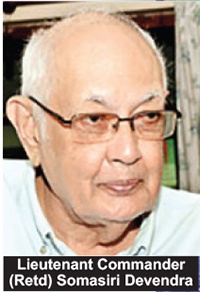
Lieutenant Commander (Retd) Somasiri Devendra, an authority on maritime archaeology, says: “When the Insurgency of 1971 erupted we were without any seaward defenses and had to call upon Indian and Pakistani ships to patrol our waters and throw a cordon around us. The Chinese offer of two reconditioned FGBs- (Sooraya and Weeraya as they were renamed later) was welcome.”
The ships gifted by China in early 1972 were commissioned a few months later. Commissioning, as Devendra explains, is the act of empowering a vessel to act as a self-sufficient unit of the Navy under a Commanding Officer. The ships were launched by the Prime Minister who was the then head of the government and the country’s chief executive. Devendra who was in Kochchikade when the Sooraya and Weeraya arrived as deck cargo on a Chinese merchant vessel recollects his first glimpse of them wrapped in bamboo matting. “They were a class of ships designed for use in rivers – those rivers were much bigger than anything we have. At sea, their buoyancy would have increased. They had several engines and were heavily armed. They were tested as seagoing craft by us and several problems encountered were put right with our inputs.”
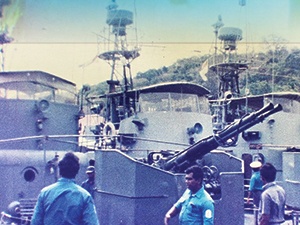 Soon, Sooraya and Weeraya were joined by three more Chinese counterparts. “When these three arrived, a ‘nationalist’ minded officer decided to pander to then Prime Minister, Sirimavo Bandaranaike by suggesting that the five FGBs have names starting with S,W,R,D and B. This resulted in the names Sooraya, Weeraya, Ranakami, Dakshaya and Balawatha!” says Devendra. The Chinese teams accompanying the ships remained here for several weeks after the handover.
“All the manuals, signage, etc. on board was in Chinese only. The first local crew made use of their stay to get all of them translated as the Chinese team had very good Sinhala speaking interpreters who had learned the language at one of our state universities.”
After the ships started patrolling it was found that given the tight Navy Vote, it was very expensive to run them at maximum capacity. Nevertheless, some of them did undertake cruises to the Maldives, notes Devendra.
The decommissioning ceremony of the Weeraya and Jagatha, Rear Admiral (Retd) J.T.G. Sundaram who commanded Weeraya as its sixth Commanding Officer, says was the “first ceremony of such scale and pageantry.” This senior officer who graced the occasion as a guest of honour lauds it as a fitting tribute to the two pioneer vessels. “Before the onset of the conflict, the role of the Navy was largely that of surveillance which gradually shifted to an operational one. Weeraya and Jagatha were among the vessels which had to adapt to this transformation.”
Light House Relief Operations servicing the Little and Great Basses Lighthouses in the South and patrolling in the Northern seas were some of the notable surveillance exercises for which the Weeraya was responsible before she took on operational duties, says Sundaram.
Jagatha in the mid-80s, was a notable platform for cadet sea training, Sundaram, who was also a training commander on board said. “Both these vessels underwent mid-life refit in the mid-1980s for which Chinese personnel arrived here.” Before a ship is decommissioned, the exercise known as ‘de-storing’ takes place explains the Senior officer. “All weapons, engines, propellers, shafts, electronic and electrical equipment, fuel and lubricants are removed in this process.” Once de-storing is complete, scuttling of the ship begins by allowing water to flow into the hull.
 “Sailing during South West monsoon along the southern seas especially along the stretch between Hambantota and Tangalle passing Great Basses and Little Basses were the acid tests that a junior rating or a cadet had to prove his sea legs,” recollects a top-ranking retired naval officer. Fondly looking back on his days spent in the Gun Room of Jagatha as a young cadet in 1985, he adds, “the kitchen (galley) was using diesel fuel and the food had an eternal diesel flavour! The single toilet was not sufficient to cater to the larger crew; hence a Thunder Box was installed at the stern of Jagatha!”
The Shanghai class ships – Jagatha and Weeraya were the “best teeth the navy had to bite in late 70s and 80s”, reflects the senior officers who adds with a chuckle that today cadets will certainly make a mockery out of seven- point gun drill what was a ritual prior to a gun being fired. “It was ‘The Gun’ that the LTTE most feared tangling with,” he adds.
Out of the Jagatha’s four engines, two were in the forward engine room and used only when high speed was required. Their roar at high RPM was not at all ear-friendly, he recounts. “The Crow’s Nest was a cage like contraption on the top of the lattice mast and slacking cadets or those caught for being too smart were banished up there as punishment
“Sailing through the Karainagar channel into the Elara naval base at Karainagar, passing Fort Hammenhiel without running aground, was a skill mastered by the then commanding officers and Master-at-Arms who were at the rudder of the vessel, he notes.
The Dumping Permit Regulations made under the Marine Pollution Prevention Act require the sanction of the Marine Environment Pollution Authority (MEPA) for any decommissioning of a vessel and this was obtained prior to the sinking.
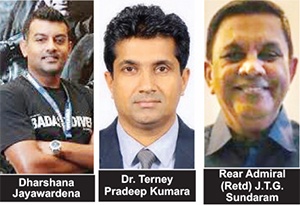
“True to MEPA’s vision of realizing a healthy coastal and ocean environment for future generations, we welcome shipwrecks which promote fish breeding places and shipwreck diving which spurs awareness and future interventions in terms of sustainability. We are conscious that such wrecks are not detrimental to the marine life,” remarks Dr. Terney Pradeep Kumara, General Manager of MEPA. Any decommissioning of a ship, he explains, should be authorized by MEPA. “A dumping permit is issued for sinking of any vessel once the authorities are satisfied that all pollutant-agents such as oil, lubricants and non-degradable material is removed from it.”
The open gangways of a shipwreck are a haven for both the fish and the diver alike says the Marine Ecologist. “While wrassers, groupers, larger snappers and morays thrive in these places, they also enable divers to swin through these passages.”
Ship wrecks as the Tec-Diver and underwater explorer, Dharshana Jayawardena explains, could be a boon to fisheries and tourism. “From a fisheries perspective, the correct location and depth is important. The currents in the location will determine how well-nourished the wreck will be with coral larvae floating in water that will settle to make an artificial reef; also once it is a reef, how much nutrients will be available for its sustenance will also count. The least pollutants in the location, the better the reef will turn out to be.”
Wrecks also act as safe havens for shoaling fish to hide during day time. It is important that these locations can be easily accessed by recreational divers. “If not its value for tourism won’t be as much. In addition, the location should have good water clarity most of the time,” notes the technically precise diver with a wealth of experience diving into decommissioned ships both locally and overseas. The two decommissioned gunboats lying close together in the Trincomalee Harbour, the Chevron glass gunboat off the shores of Moratuwa, the wreck of We Ling that was sunk with several bullet-proof VIP cars onboard in Negombo and several decommissioned vessels in the Maldives sunk for the purpose of creating artificial reefs for the Maldivian tourism industry are among such diving pursuits of his.
A few kilometers away from the Jagatha and Weeraya’s resting place in Rocky Point, off Trincomalee, lie remains of several aircraft, decommissioned navy gun boats and also one of the largest wrecks in the world – the Admiralty Floating Dock 23. But marine tourists are not allowed to access these as they are within the harbour environs, says Jayawardena.
A ship sold for scrap will yield a one-time, short-term dividend, a ship sunk as an artificial reef will provide dividends for over 100 years as an abundant fishing ground and also give back millions of dollars in foreign revenue to the country from the tourist divers who come to visit the wreck, notes the explorer.



Institute of Hospitality Sri Lanka
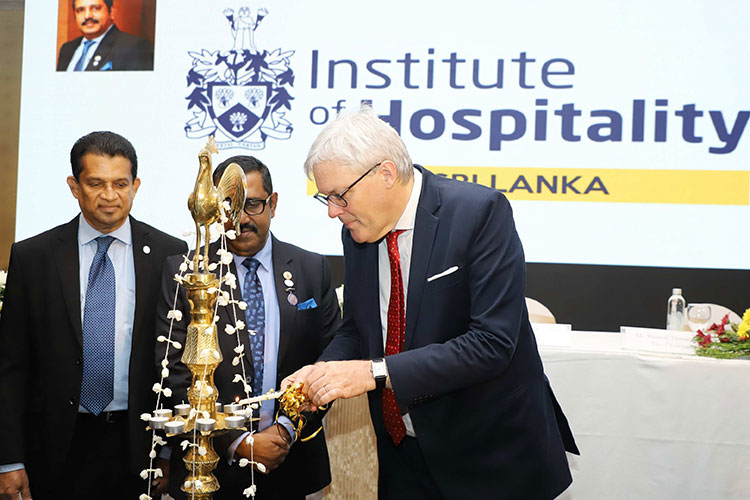
 The 32nd Annual General Meeting (AGM) of the UK-based Institute of Hospitality’s Sri Lanka Chapter was held recently at the Ramada Hotel Colombo,.The event provided an evening of camaraderie , reflection of the past and present achievements,setting new benchmarks for the future
The AGM had the presence of two distinguished guests, the Chief Guest Opposition Leader Sajith Premadasa, and the Guest of Honour British High Commissioner to Sri Lanka, Andrew Patrick. Their inspiring speeches were lauded by all hoteliers who were present at the occasion
A special thanks was extended to Robert Richardson, CEO of the Institute of Hospitality UK, along with his team, sponsors, committee members, and all attendees for making the event memorable.
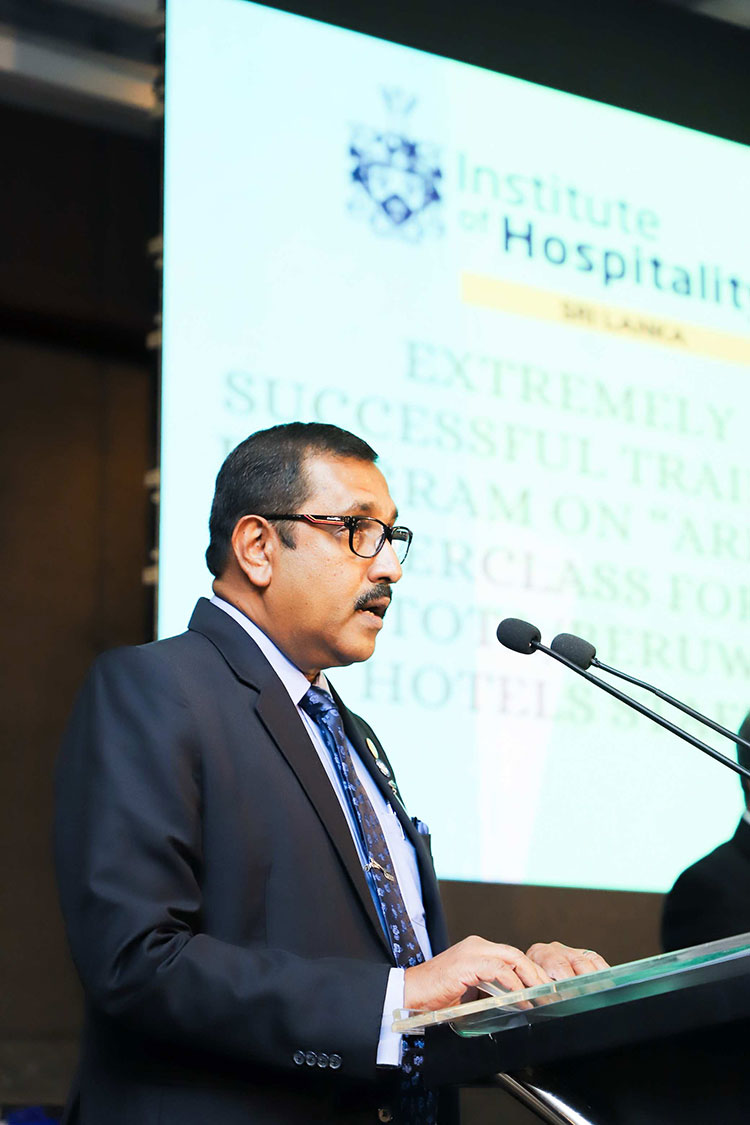
Dr. Harsha Jayasingh, Past President of the Institute of Hospitality (UK) Sri Lanka Chapter, emphasised the Institute’s longstanding history and the strength of its Sri Lankan branch. “The Institute of Hospitality (IH) UK has a history of 86 years, and we are proud to be the Sri Lanka Branch. IH Sri Lanka is much stronger now with many members from all areas of the hospitality industry,” he stated.
Dr. Jayasingh highlighted the significant role of tourism in Sri Lanka’s economy,. He said tourism it is the third-largest source of revenue for the country. “Tourism accounts for about 13.3% of total foreign exchange earnings and employs 450,000 people directly and indirectly. The hospitality industry in this island of pearl holds tremendous potential for economic growth, job creations, and cultural exchange,” he added.
He also pointed out more women should be attracted to the industry and advocated for the use of technology in hospitality sector to attract the younger generation.
The newly appointed Chairman Ramesh Dassanayake spoke about the challenges faced by the industry, including the reluctance of youth to join the sector. . Dassanayake expressed concerns over the migration of staff between hotels and the overall ‘brain drain’ in the sector. ” We must maintain high standards in the hotel We must try to attract tourists to Sri Lanka, we must have with many facilities Hence, hotel schools and other professional institutions involved in skills development mustincrease their intakes,” he pointed out.
Chief Guest Sajith Premadasa emphasised the importance of eco tourism and said “We need to have an environmental policy related to tourism in place,” . .
The 32nd AGM of the Institute of Hospitality UK, Sri Lanka Chapter, was a testament to the strength and potential of Sri Lanka’s hospitality industry. The insights and commitments shared during the event set a new benchmark for the future.(ZC)



Pix by Thushara Attapathu
Life style
He recognizes human identity beyond boundaries of gender, race, nationality and religion.

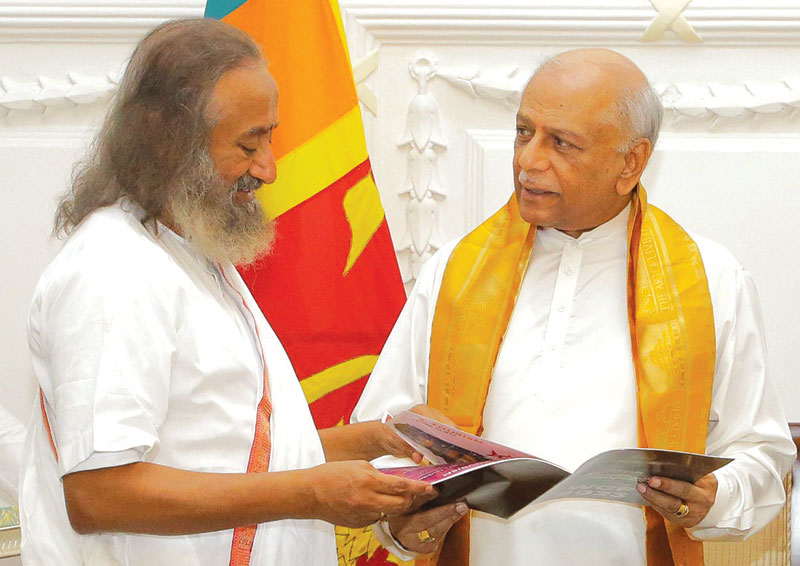
Visit of Sri Gurudev to Sri Lanka
Humanitarian, spiritual leader and Global Ambassador of Peace Gurudev Sri Sri Ravi Shankar (Sri Gurudev) was in Sri Lanka on a three day tour on the invitation of the Prime Minister of Sri Lanka Dinesh Gunewardene. Gurudev who inspired a wave of volunteerism and service to moot one of the largest volunteer-based organisations in the world – The Art of Living – visited the various projects under the aegis of the foundation and launched twelve vocational and technical centers around the island. He was accompanied by thousands of followers from Sri Lanka and around the world.
Gurudev who visited Sri Lanka for the sixth time also had a first day cover launched in honour of his visit. He is a strong proponent of spreading happiness, using the unique Sudarshan Kriya, yoga, meditation and practical wisdom to unite people, empower individuals and transform communities. His programmes provide techniques and tools to live a deeper, more joyous life, while his non-profit organisations recognize the human identity beyond the boundaries of gender, race, nationality and religion.
The Art of Living which has more than 30,000 teachers and over one million volunteers across 180 countries has touched in excess of five hundred million people around the world. CNN called it “Life Changing” and The Washington Post headlined it, “Fresh air to millions”.
In Trincomalee, Gurudev met with war victims and had a heartwarming engagement with the children from the children’s homes run by the Foundation. He also visited the Koneswara Temple in Trincomalee and graced the Kumbhabhishekam at Seetha ecogPnize the human identity beyond the boundaries of gender, race, nationality and religion. Amman temple at Nuwara Eliya. He held discussions with the trustees on the progress of the foundation’s social service projects, while also holding a special event – Ekamuthuwa – attended by a large number of dignitaries and his devotees from around the world.
His time with the Prime Minister was spent discussing the prospects of unity in diversity and uniting Sri Lanka by adding happiness into the formula of living. In addition he had discussions with the Speaker of the Parliament of Sri Lanka Mahinda Yapa Abeywardena, prominent business stewards and civil society leaders.
by Zanita Careem
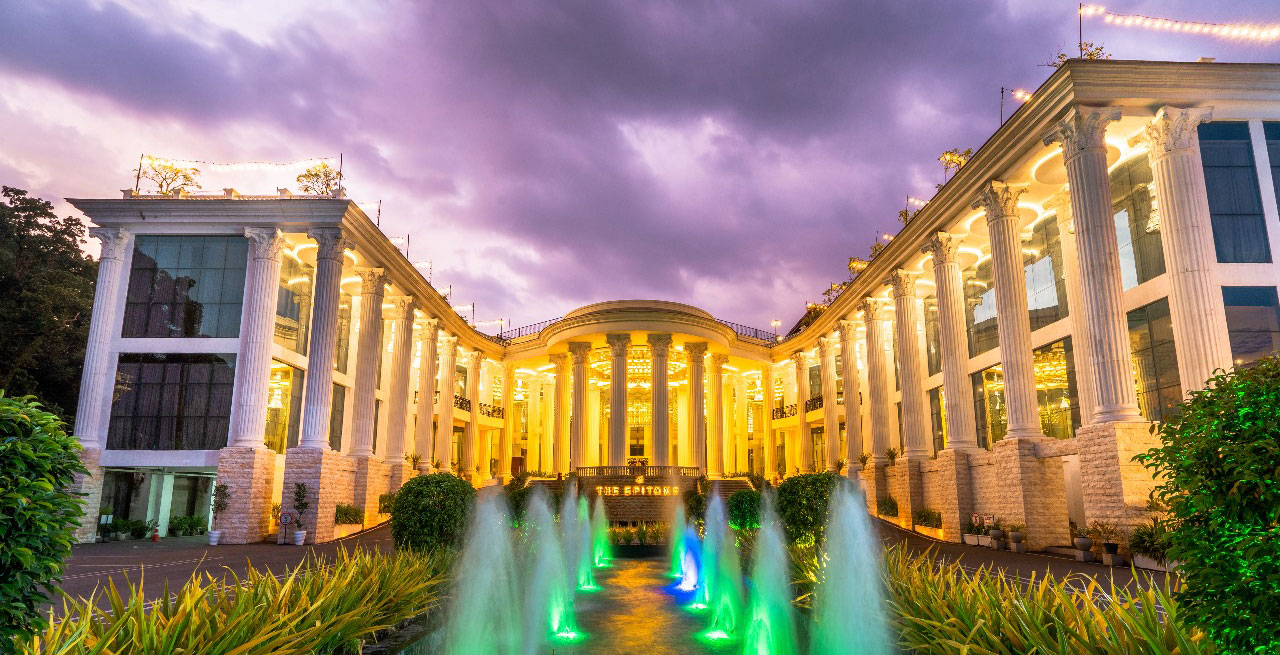
Envison your dream wedding day come to life at the Epitome Hotel, a prestigious city hotel in Kurunegala offering an unrivalled luxury rendors experience for weddings.
The venue is designed to embody opulence and luxury from all quarters for a spectacular wedding in kurunegala,Thier ballroom is the largest banquet facility in Sri Lanka It can be divided into six luxurious pillarless wedding halls on the ground floor and 25pax smaller banquet halls.
It can be easily named as a five star heaven in the heart of the city contributing to a myriad of immense experiences tailored to inspire and delight wedding experiences.
From opulent décor set up to exquisite table decor, lavish food, every detail is meticulously curated to spark your imagination and ignite creativity for a perfect wedding. The previous prestigious wedding shows season one and season two attracted large crowds
were unique events which gave the wedding vendors and potential clients had an opportunity to connect and interact with each other. Beyond being a showcase it was a chance for the wedding vendors to unite and contribute to the vibrancy of the wedding industry. The wedding show covered all area of the bridal industry providing a comprehensive variety of bridal supplies from Sri lanka and became the most popular bridal exhibitions in Kurunegala.This bridal exhibitions allowed brides and grooms to experience first hand the products and services available from suppliers in Sri Lanka
These wedding shows held at The Epitome created a benchmark and gave an opportunity for vendors to create connections to the utmost satisfaction said Harshan Lakshita Executive Director. of the magnificent Hotel
Our wedding shows featured experts and professionals in every field‘ It covered all areas of the bridal industry provided a comprehensive variety of bridal supplies from Sri lanka and became most popular bridal exhibition in this region.We are always open to everyone to join us at our wedding shows in the future. It is an opportunity to discover the incredible talent within our local wedding and bridal vendors to make meaningful relationships and plan thier special day at our breathtaking hotel The Epitome said General Manager Kavinda Caldera
The Epitome Hotel’s bridal show which will be held end of June will buzz with great ideas,advice and inspiration for all those who plan thier dream wedding
…….
The Hotel Epitome’s Wedding Season 3 will marked excellence, celebration and inspiration for those in the wedding industry. The exhibition halls will resonate with ideas on exquisite bridal wear to decor, florists , photography etc and showshowcase the rich tapestry of talent within the local wedding industry. .





US sports envoys to Lanka to champion youth development

Rahuman questions sudden cancellation of leave of CEB employees


