
Features
The problems of life


(from Venerable Nārada Mahāther’s THE BUDDHA AND HIS TEACHINGS)
Who? Whence? Whither? Why? What? are some important problems that affect all humanity.
1) Who is man? is our first question.
Let us proceed with what is self-evident and perceptible to all.
Man possesses a body which is seen either by our senses or by means of apparatus. This material body consists of forces and qualities which are in a state of constant flux.
Scientists find it difficult to define what matter is. Certain philosophers define “matter as that in which proceed the changes called motion, and motion as those changes which proceed in matter.”
The Pāli term for matter is Rūpa. It is explained as that which changes or disintegrates. That which manifests itself is also another explanation.
According to Buddhism there are four fundamental material elements. They are Pathavi, Āpo, Tejo, and Vāyo
Pathavi means the element of extension, the substratum of matter. Without it, objects cannot occupy space. The qualities of hardness and softness which are purely relative are two conditions of this element. This element of extension is present in earth, water, fire and air. For instance, the water above is supported by water below. It is this element of extension in conjunction with the element of motion (Vāyo) that produces the upward pressure. Heat or cold is the Tejo element, while fluidity is the Āpo element.
Āpo
is the element of cohesion. Unlike Pathavi it is intangible. It is this element which enables the scattered atoms of matter to cohere and thus gives us the idea of body.
Tejo
is the element of heat. Cold is also a form of Tejo. Both heat and cold are included in Tejo because they possess the power of maturing bodies, or, in other words, the vitalising energy. Preservation and decay are due to this element.
Vāyo
is the element of motion. The movements are caused by this element. Motion is regarded as the force or the generator of heat. Both motion and heat in the material realm correspond respectively to consciousness and Kamma in the mental.
These four powerful forces are inseparable and interrelated, but one element may preponderate over another, as, for instance, the element of extension preponderates in earth; cohesion, in water; heat, in fire; and motion, in air.
Thus, matter consists of forces and qualities which constantly change, not remaining the same even for two consecutive moments. According to Buddhism, matter endures only for 17 thought-moments. [2]
At the moment of birth, according to biology, man inherits from his parents an infinitesimally minute cell 30 millionth part of an inch across. “In the course of nine months this speck grows to a living bulk 15,000 million times greater than it was at outset. [3] This tiny chemico-physical cell is the physical foundation of man.
According to Buddhism sex is also determined at the moment of conception.
Combined with matter there is another important factor in this complex machinery of man. It is the mind. As such it pleases some learned writers to say that man is not Mind plus Body, but is a Mind-Body. Scientists declare that life emerges from matter and mind from life. But they do not give us a satisfactory explanation with regard to the development of the mind
Unlike the material body immaterial mind is invisible, but it could be sensed directly. An old couplet runs:-
“What is mind? No matter.What is matter? Never mind.”
We are aware of our thoughts and feelings and so forth by direct sensation, and we infer their existence in others by analogy.
There are several Pāli terms for mind. Mana, Citta, Vijgana the most noteworthy of them. Compare the Pāli root man, to think, with the English word man and the Pāli word Manussa which means he who has a developed consciousness.
In Buddhism no distinction is made between mind and consciousness. Both are used as synonymous terms. Mind may be defined as simply the awareness of an object since there is no agent or a soul that directs all activities. It consists of fleeting mental states which constantly arise and perish with lightning rapidity. “With birth for its source and death for its mouth it persistently flows on like a river receiving from the tributary streams of sense constant accretions to its flood.” Each momentary consciousness of this ever-changing life-stream, on passing away, transmits its whole energy, all the indelibly recorded impressions, to its successor. Every fresh consciousness therefore consists of the potentialities of its predecessors and something more. As all impressions are indelibly recorded in this ever-changing palimpsest-like mind, and as all potentialities are transmitted from life to life, irrespective of temporary physical disintegrations, reminiscence of past births or past incidents becomes a possibility. If memory depends solely on brain cells, it becomes an impossibility.
Like electricity mind is both a constructive and destructive powerful force. It is like a double-edged weapon that can equally be used either for good or evil. One single thought that arises in this invisible mind can even save or destroy the world. One such thought can either populate or depopulate a whole country. It is mind that creates one’s heaven. It is mind that creates one’s hell.
Ouspensky writes: “Concerning the latent energy contained in the phenomena of consciousness, i.e. in thoughts, feelings, desires, we discover that its potentiality is even more immeasurable, more boundless. From personal experience, from observation, from history, we know that ideas, feelings, desires, manifesting themselves, can liberate enormous quantities of energy, and create infinite series of phenomena. An idea can act for centuries and millennia and only grow and deepen, evoking ever new series of phenomena, liberating ever fresh energy. We know that thoughts continue to live and act when even the very name of the man who created them has been converted into a myth, like the names of the founders of ancient religions, the creators of the immortal poetical works of antiquity, heroes, leaders, and prophets. Their words are repeated by innumerable lips, their ideas are studied and commented upon.
“Undoubtedly each thought of a poet contains enormous potential force, like the power confined in a piece of coal or in a living cell, but infinitely more subtle, imponderable and potent. [4]”
Observe, for instance, the potential force that lies in the following significant words of the Buddha:
— Mano-pubbangāma dhammā ? mano – setthā – manomayā.Mind fore-runs deeds; mind is chief, and mind-made are they.
Mind or consciousness, according to Buddhism, arises at the very moment of conception, together with matter. Consciousness is therefore present in the foetus. This initial consciousness, technically known as rebirth-consciousness or relinking-consciousness (Patisandhi vijnna), is conditioned by past kamma of the person concerned. The subtle mental, intellectual, and moral differences that exist amongst mankind are due to this Kamma conditioned consciousness, the second factor of man.
To complete the trio that constitutes man there is a third factor, the phenomenon of life that vitalises both mind and matter. Due to the presence of life reproduction becomes possible. Life manifests itself both in physical and mental phenomena. In Pāli the two forms of life are termed Nāma jivitindriya and Rūpa jivitindriya — psychic and physical life.
Matter, mind, and life are therefore the three distinct factors that constitute man. With their combination a powerful force known as man with inconceivable possibilities comes into being. He becomes his own creator and destroyer. In him are found a rubbish-heap of evil and a storehouse of virtue. In him are found the worm, the brute, the man, the superman, the deva, the Brahma. Both criminal tendencies and saintly characteristics are dormant in him. He may either be a blessing or a curse to himself and others. In fact, man is a world by himself.
2) Whence? is our second question. How did man originate’?
Either there must be a beginning for man or there cannot be a beginning. Those who belong to the first school postulate a first cause, whether as a cosmic force or as an Almighty Being. Those who belong to the second school deny a first cause for, in common experience, the cause ever becomes the effect and the effect becomes the cause. In a circle of cause and effect a first cause is inconceivable. According to the former life has had a beginning; while according to the latter it is beginningless. In the opinion of some the conception of a first cause is as ridiculous as a round triangle.
According to the scientific standpoint, man is the direct product of the sperm and ovum cells provided by his parents. Scientists while asserting “Omne vivum ex vivo”--all life from life, maintain, that mind and life evolved from the lifeless.
Now, from the scientific standpoint, man is absolutely parent-born. As such life precedes life. With regard to the origin of the first protoplasm of life, or “colloid” (whichever we please to call it), scientists plead ignorance.
According to Buddhism, man is born from the matrix of action (kammayoni). Parents merely provide man with a material layer. As such being precedes being. At the moment of conception, it is Kamma that conditions the initial consciousness that vitalizes the foetus. It is this invisible Kammic energy generated from the past birth that produces mental phenomena and the phenomenon of life in an already extant physical phenomenon, to complete the trio that constitutes man.
Dealing with the conception of beings the Buddha states:
“Where three are found in combination, there a germ of life is planted. If mother and father come together, but it is not the mother’s period, and the ‘being-to-be born’ (gandhabba) is not present, then no germ of life is planted. If mother and father come together, and it is the mother’s period, but the ‘being-to-be-born’ is not present, then again, no germ of life is planted. If mother and father come together, and it is the mother’s period, and the ‘being-to-bc-born’ is also present, then, by the combination of these three, a germ of life is there planted.”
Here Gandhabba (= gantabba) refers to a suitable being ready to be born in that particular womb. This term is used only in this particular connection, and must not be mistaken for a permanent soul.
For a being to be born here a being must die somewhere. The birth of a being corresponds to the death of a being in a past life; just as, in conventional terms, the rising of the sun in one place means the setting of the sun in another place.
The Buddha states: “a first beginning of beings who, obstructed by ignorance and fettered by craving, wander and fare on, is not to be perceived.”
This life-stream flows ad infinitum as long as it is fed with the muddy waters of ignorance and craving. When these two are completely cut off, then only does the life-stream cease to flow; rebirth ends as in the case of Buddhas and Arahants. An ultimate beginning of this life-stream cannot be determined, as a stage cannot be perceived when this life force was not fraught with ignorance and craving.
The Buddha has here referred merely to the beginning of the life-stream of living beings. It is left to scientists to speculate on the origin and the evolution of the universe.
3) Whither? is our third question.
Where goes man?
According to ancient materialism which, in Pāli and Samskrit, is known as Lokāyata, man is annihilated after death, leaving behind him any force generated by him. “Man is composed of four elements. When man dies the earthy element returns and relapses into the earth; the watery element returns into the water; the fiery element returns into the fire; the airy element returns into the air, the senses pass into space.
Wise and fools alike, when the body dissolves. are cut off, perish, do not exist any longer. There is no other world. Death is the end of all. This present world alone is real.
The so-called eternal heaven and hell are the inventions of imposters.
Materialists believe only in what is cognizable by the senses. As such matter alone is real. The ultimate principles are the four elements — earth, water, fire and air. The self-conscious life mysteriously springs forth from them, just as the genie makes its appearance when Aladdin rubs his lamp. The brain secretes thought just as liver secretes bile.
In the view of materialists the belief in the other world, as Sri Radhakrishna states, “is a sign of mendaciousness, feminism, weakness, cowardice and dishonesty.”
According to Christianity there is no past for man. The present is only a preparation for two eternities of heaven and hell. Whether they are viewed as places or states man has for his future endless felicity in heaven or endless suffering in hell. Man is therefore not annihilated after death, but his essence goes to eternity.
“Whoever,” as Schopenhaeur says, “regards himself as having become out of nothing must also think that he will again become nothing; or that an eternity has passed before he was, and then a second eternity had begun, through which he will never cease to be, is a monstrous thought.”
The adherents of Hinduism who believe in a past and present do not state that man is annihilated after death. Nor do they say that man is eternalized after death. They believe in an endless series of past and future births. In their opinion the life-stream of man flows ad infinitum as long as it is propelled by the force of Kamma, one’s actions. In due course the essence of man may be reabsorbed into Ultimate Reality (Paramātma) from which his soul emanated.
Buddhism believes in the present. With the present as the basis it argues the past and future. Just as an electric light is the outward manifestation of invisible electric energy even so man is merely the outward manifestation of an invisible energy known as Kamma. The bulb may break, and the light may be extinguished, but the current remains and the light may be reproduced in another bulb. In the same way the Kammic force remains undisturbed by the disintegration of the physical body, and the passing away of the present consciousness leads to the arising of a fresh one in another birth. Here the electric current is like the Kammic force, and the bulb may be compared to the egg-cell provided by the parents.
Past Kamma conditions the present birth; and present Kamma, in combination with past Kamma, conditions the future. The present is the offspring of the past, and becomes in turn the parent of the future.
Death is therefore not the complete annihilation of man, for though that particular life span ended, the force which hitherto actuated it is not destroyed.
After death the life-flux of man continues ad infinitum as long as it is fed with the waters of ignorance and craving. In conventional terms man need not necessarily be born as a man because humans are not the only living beings. Moreover, earth, an almost insignificant speck in the universe, is not the only place in which he will seek rebirth. He may be born in other habitable planes as well. [6]
If man wishes to put and end to this repeated series of births, he can do so as the Buddha and Arahants have done by realizing Nibbāna, the complete cessation of all forms of craving.
Where does man go? He can go wherever he wills or likes if he is fit for it. If, with no particular wish, he leaves his path to be prepared by the course of events, he will go to the place or state he fully deserves in accordance with his Kamma.
4) Why? is our last question.
Why is man? Is there a purpose in life? This is rather a controversial question.
What is the materialistic standpoint? Scientists answer:
“Has life purpose? What, or where, or when?Out of space came Universe, came Sun,Came Earth, came Life, came Man, and more must come.But as to Purpose: whose or whence? Why, None.”
As materialists confine themselves purely to sense-data and the present material welfare ignoring all spiritual values, they hold a view diametrically opposite to that of moralists. In their opinion there is no purposer — hence there cannot be a purpose. Non-theists, to which category belong Buddhists as well, do not believe in a creative purposer.
“Who colours wonderfully the peacocks, or who makes the cuckoos coo so well?” This is one of the chief arguments of the materialists to attribute everything to the natural order of things.
“Eat, drink, and be merry, for death comes to all, closing our lives,” appears to be the ethical ideal of their system. In their opinion, as Sri Radhakrishna writes: “Virtue is a delusion and enjoyment is the only reality. Death is the end of life. Religion is a foolish aberration, a mental disease. There was a distrust of everything good, high, pure, and compassionate. The theory stands for sensualism and selfishness and the gross affirmation of the loud will. There is no need to control passion and instinct, since they are nature’s legacy to men. “
Sarvadarsana Sangraha says:
“While life is yours, live joyously,None can escape Death’s searching eye;When once this frame of ours they burn,How shall it e’er again return? [8]”
“While life remains let a man live happily, let him feed on ghee even though he runs in debt.”
Now let us turn towards science to get a solution to the question “why.”
It should be noted that “science is a study of things, a study of what is and that religion is a study of ideals, a study of what should be.”
Sir J. Arthur Thompson maintains that science is incomplete because it cannot answer the question why.
Dealing with cosmic Purpose, Bertrand Russell states three kinds of views — theistic, pantheistic, and emergent. “The first”, he writes, “holds that God created the world and decreed the laws of nature because he foresaw that in time some good would be evolved. In this view purpose exists consciously in the mind of the Creator, who remains external to His creation.
“In the ‘pantheistic’ form, God is not external to the universe, but is merely the universe considered as a whole. There cannot therefore be an act of creation, but there is a kind of creative force in the universe, which causes it to develop according to a plan which this creative force may be said to have had in mind throughout the process.
“In the ’emergent’ form the purpose is more blind. At an earlier stage, nothing in the universe foresees a later stage, but a kind of blind impulsion leads to those changes which bring more developed forms into existence, so that, in some rather obscure sense, the end is implicit in the beginning. [9]”
We offer no comments. These are merely the views of different religionists and great thinkers.
Whether there is a cosmic purpose or not a question arises as to the usefulness of the tapeworm, snakes, mosquitoes and so forth, and for the existence of rabies. How does one account for the problem of evil? Are earthquakes, floods, pestilences, and wars designed?
Expressing his own view about Cosmic Purpose, Russell boldly declares: “Why in any case, this glorification of man? How about lions and tigers? They destroy fewer animals or human lives than we do, and they are much more beautiful than we are. How about ants? They manage the Corporate State much better than any Fascist. Would not a world of nightingales and larks and deer be better than our human world of cruelty and injustice and war?
The believers in cosmic purpose make much of our supposed intelligence, but their writings make one doubt it. If I were granted omnipotence, and millions of years to experiment in, I should not think Man much to boast of as the final result of all my efforts. “
What is the purpose of life according to different religions?
According to Hinduism the purpose of life is “to be one with Brahma” or “to be re-absorbed in the Divine Essence from which his soul emanated.”
According to Judaism, Christianity and Islam, it is “to glorify God and to enjoy Him forever.”
Will an average person of any religion be prepared to give up his earthly life, to which he tenaciously clings, for immortality in their ultimate havens of peace?
Very doubtful, indeed!
* * *
Now, how does Buddhism answer the question “why?”
Buddhism denies the existence of a Creator. As such from a Buddhist standpoint there cannot be a fore-ordained purpose. Nor does Buddhism advocate fatalism, determinism, or pre-destination which controls man’s future independent of his free actions. In such a case freewill becomes an absolute farce and life becomes purely mechanistic.
To a large extent man’s actions are more or less mechanistic, being influenced by his own doings, upbringing, environment and so forth. But to a certain extent man can exercise his freewill. A person, for instance, falling from a cliff will be attracted to the ground just as an inanimate stone would. In this case he cannot use his freewill although he has a mind unlike the stone. If he were to climb a cliff, he could certainly use his freewill and act as he likes. A stone, on the contrary, is not free to do so of its own accord. Man has the power to choose between right and wrong, good and bad. Man can either be hostile or friendly to himself and others. It all depends on his mind and its development.
Although there is no specific purpose in man’s existence, yet man is free to have some purpose in life.
What, therefore, is the purpose of life?
Ouspensky writes “Some say that the meaning of life is in service, in the surrender of self, in self-sacrifice, in the sacrifice of everything, even life itself. Others declare that the meaning of life is in the delight of it, relieved against ‘the expectation of the final horror of death.’ Some say that the meaning of life is in perfection, and the creation of a better future beyond the grave, or in future life for ourselves. Others say that the meaning of life is in the approach to non-existence; still others, that the meaning of life is in the perfection of the race, in the organization of life on earth; while there are those who deny the possibility of even attempting to know its meaning.”
Criticising all these views the learned writer says:–“The fault of all these explanations consists in the fact that they all attempt to discover the meaning of life outside of itself, either in the nature of humanity, or in some problematical existence beyond the grave, or again in the evolution of the Ego throughout many successive incarnations — always in something outside of the present life of man. But if instead of thus speculating about it, men would simply look within themselves, then they would see that in reality the meaning of life is not after all so obscure. It consists in knowledge. “
In the opinion of a Buddhist, the purpose of life is Supreme Enlightenment (Sambodhi), i.e. understanding of oneself as one really is. This may be achieved through sublime conduct, mental culture, and penetrative insight; or in other words, through service and perfection.
In service are included boundless loving-kindness, compassion, and absolute selflessness which prompt man to be of service to others. Perfection embraces absolute purity and absolute wisdom.



by Dr Gotabhya Ranasinghe
Senior Consultant Cardiologist
National Hospital Sri Lanka
When we sought a meeting with Hon Dr. Ramesh Pathirana, Minister of Health, he graciously cleared his busy schedule to accommodate us. Renowned for his attentive listening and deep understanding, Minister Pathirana is dedicated to advancing the health sector. His openness and transparency exemplify the qualities of an exemplary politician and minister.
Dr. Palitha Mahipala, the current Health Secretary, demonstrates both commendable enthusiasm and unwavering support. This combination of attributes makes him a highly compatible colleague for the esteemed Minister of Health.
Our discussion centered on a project that has been in the works for the past 30 years, one that no other minister had managed to advance.
Minister Pathirana, however, recognized the project’s significance and its potential to revolutionize care for heart patients.
The project involves the construction of a state-of-the-art facility at the premises of the National Hospital Colombo. The project’s location within the premises of the National Hospital underscores its importance and relevance to the healthcare infrastructure of the nation.
This facility will include a cardiology building and a tertiary care center, equipped with the latest technology to handle and treat all types of heart-related conditions and surgeries.
Securing funding was a major milestone for this initiative. Minister Pathirana successfully obtained approval for a $40 billion loan from the Asian Development Bank. With the funding in place, the foundation stone is scheduled to be laid in September this year, and construction will begin in January 2025.
This project guarantees a consistent and uninterrupted supply of stents and related medications for heart patients. As a result, patients will have timely access to essential medical supplies during their treatment and recovery. By securing these critical resources, the project aims to enhance patient outcomes, minimize treatment delays, and maintain the highest standards of cardiac care.
Upon its fruition, this monumental building will serve as a beacon of hope and healing, symbolizing the unwavering dedication to improving patient outcomes and fostering a healthier society.We anticipate a future marked by significant progress and positive outcomes in Sri Lanka’s cardiovascular treatment landscape within the foreseeable timeframe.

by Fr. Emmanuel Fernando, OMI
Jesuit Fr. Aloysius Pieris (affectionately called Fr. Aloy) celebrated his 90th birthday on April 9, 2024 and I, as the editor of our Oblate Journal, THE MISSIONARY OBLATE had gone to press by that time. Immediately I decided to publish an article, appreciating the untiring selfless services he continues to offer for inter-Faith dialogue, the renewal of the Catholic Church, his concern for the poor and the suffering Sri Lankan masses and to me, the present writer.
It was in 1988, when I was appointed Director of the Oblate Scholastics at Ampitiya by the then Oblate Provincial Fr. Anselm Silva, that I came to know Fr. Aloy more closely. Knowing well his expertise in matters spiritual, theological, Indological and pastoral, and with the collaborative spirit of my companion-formators, our Oblate Scholastics were sent to Tulana, the Research and Encounter Centre, Kelaniya, of which he is the Founder-Director, for ‘exposure-programmes’ on matters spiritual, biblical, theological and pastoral. Some of these dimensions according to my view and that of my companion-formators, were not available at the National Seminary, Ampitiya.
Ever since that time, our Oblate formators/ accompaniers at the Oblate Scholasticate, Ampitiya , have continued to send our Oblate Scholastics to Tulana Centre for deepening their insights and convictions regarding matters needed to serve the people in today’s context. Fr. Aloy also had tried very enthusiastically with the Oblate team headed by Frs. Oswald Firth and Clement Waidyasekara to begin a Theologate, directed by the Religious Congregations in Sri Lanka, for the contextual formation/ accompaniment of their members. It should very well be a desired goal of the Leaders / Provincials of the Religious Congregations.
Besides being a formator/accompanier at the Oblate Scholasticate, I was entrusted also with the task of editing and publishing our Oblate journal, ‘The Missionary Oblate’. To maintain the quality of the journal I continue to depend on Fr. Aloy for his thought-provoking and stimulating articles on Biblical Spirituality, Biblical Theology and Ecclesiology. I am very grateful to him for his generous assistance. Of late, his writings on renewal of the Church, initiated by Pope St. John XX111 and continued by Pope Francis through the Synodal path, published in our Oblate journal, enable our readers to focus their attention also on the needed renewal in the Catholic Church in Sri Lanka. Fr. Aloy appreciated very much the Synodal path adopted by the Jesuit Pope Francis for the renewal of the Church, rooted very much on prayerful discernment. In my Religious and presbyteral life, Fr.Aloy continues to be my spiritual animator / guide and ongoing formator / acccompanier.
Fr. Aloysius Pieris, BA Hons (Lond), LPh (SHC, India), STL (PFT, Naples), PhD (SLU/VC), ThD (Tilburg), D.Ltt (KU), has been one of the eminent Asian theologians well recognized internationally and one who has lectured and held visiting chairs in many universities both in the West and in the East. Many members of Religious Congregations from Asian countries have benefited from his lectures and guidance in the East Asian Pastoral Institute (EAPI) in Manila, Philippines. He had been a Theologian consulted by the Federation of Asian Bishops’ Conferences for many years. During his professorship at the Gregorian University in Rome, he was called to be a member of a special group of advisers on other religions consulted by Pope Paul VI.
Fr. Aloy is the author of more than 30 books and well over 500 Research Papers. Some of his books and articles have been translated and published in several countries. Among those books, one can find the following: 1) The Genesis of an Asian Theology of Liberation (An Autobiographical Excursus on the Art of Theologising in Asia, 2) An Asian Theology of Liberation, 3) Providential Timeliness of Vatican 11 (a long-overdue halt to a scandalous millennium, 4) Give Vatican 11 a chance, 5) Leadership in the Church, 6) Relishing our faith in working for justice (Themes for study and discussion), 7) A Message meant mainly, not exclusively for Jesuits (Background information necessary for helping Francis renew the Church), 8) Lent in Lanka (Reflections and Resolutions, 9) Love meets wisdom (A Christian Experience of Buddhism, 10) Fire and Water 11) God’s Reign for God’s poor, 12) Our Unhiddden Agenda (How we Jesuits work, pray and form our men). He is also the Editor of two journals, Vagdevi, Journal of Religious Reflection and Dialogue, New Series.
Fr. Aloy has a BA in Pali and Sanskrit from the University of London and a Ph.D in Buddhist Philosophy from the University of Sri Lankan, Vidyodaya Campus. On Nov. 23, 2019, he was awarded the prestigious honorary Doctorate of Literature (D.Litt) by the Chancellor of the University of Kelaniya, the Most Venerable Welamitiyawe Dharmakirthi Sri Kusala Dhamma Thera.
Fr. Aloy continues to be a promoter of Gospel values and virtues. Justice as a constitutive dimension of love and social concern for the downtrodden masses are very much noted in his life and work. He had very much appreciated the commitment of the late Fr. Joseph (Joe) Fernando, the National Director of the Social and Economic Centre (SEDEC) for the poor.
In Sri Lanka, a few religious Congregations – the Good Shepherd Sisters, the Christian Brothers, the Marist Brothers and the Oblates – have invited him to animate their members especially during their Provincial Congresses, Chapters and International Conferences. The mainline Christian Churches also have sought his advice and followed his seminars. I, for one, regret very much, that the Sri Lankan authorities of the Catholic Church –today’s Hierarchy—- have not sought Fr.
Aloy’s expertise for the renewal of the Catholic Church in Sri Lanka and thus have not benefited from the immense store of wisdom and insight that he can offer to our local Church while the Sri Lankan bishops who governed the Catholic church in the immediate aftermath of the Second Vatican Council (Edmund Fernando OMI, Anthony de Saram, Leo Nanayakkara OSB, Frank Marcus Fernando, Paul Perera,) visited him and consulted him on many matters. Among the Tamil Bishops, Bishop Rayappu Joseph was keeping close contact with him and Bishop J. Deogupillai hosted him and his team visiting him after the horrible Black July massacre of Tamils.
Sri Lanka-Singapore Free Trade Agreement
By Gomi Senadhira
senadhiragomi@gmail.com
“You might tell fairy tales, but the progress of a country cannot be achieved through such narratives. A country cannot be developed by making false promises. The country moved backward because of the electoral promises made by political parties throughout time. We have witnessed that the ultimate result of this is the country becoming bankrupt. Unfortunately, many segments of the population have not come to realize this yet.” – President Ranil Wickremesinghe, 2024 Budget speech
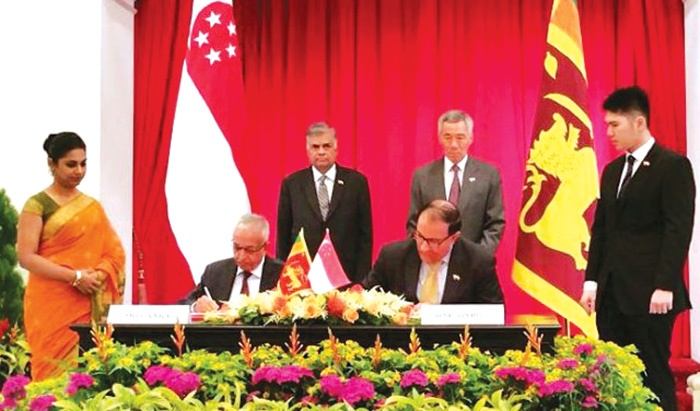
Any Sri Lankan would agree with the above words of President Wickremesinghe on the false promises our politicians and officials make and the fairy tales they narrate which bankrupted this country. So, to understand this, let’s look at one such fairy tale with lots of false promises; Ranil Wickremesinghe’s greatest achievement in the area of international trade and investment promotion during the Yahapalana period, Sri Lanka-Singapore Free Trade Agreement (SLSFTA).
It is appropriate and timely to do it now as Finance Minister Wickremesinghe has just presented to parliament a bill on the National Policy on Economic Transformation which includes the establishment of an Office for International Trade and the Sri Lanka Institute of Economics and International Trade.
Was SLSFTA a “Cleverly negotiated Free Trade Agreement” as stated by the (former) Minister of Development Strategies and International Trade Malik Samarawickrama during the Parliamentary Debate on the SLSFTA in July 2018, or a colossal blunder covered up with lies, false promises, and fairy tales? After SLSFTA was signed there were a number of fairy tales published on this agreement by the Ministry of Development Strategies and International, Institute of Policy Studies, and others.
However, for this article, I would like to limit my comments to the speech by Minister Samarawickrama during the Parliamentary Debate, and the two most important areas in the agreement which were covered up with lies, fairy tales, and false promises, namely: revenue loss for Sri Lanka and Investment from Singapore. On the other important area, “Waste products dumping” I do not want to comment here as I have written extensively on the issue.
1. The revenue loss
During the Parliamentary Debate in July 2018, Minister Samarawickrama stated “…. let me reiterate that this FTA with Singapore has been very cleverly negotiated by us…. The liberalisation programme under this FTA has been carefully designed to have the least impact on domestic industry and revenue collection. We have included all revenue sensitive items in the negative list of items which will not be subject to removal of tariff. Therefore, 97.8% revenue from Customs duty is protected. Our tariff liberalisation will take place over a period of 12-15 years! In fact, the revenue earned through tariffs on goods imported from Singapore last year was Rs. 35 billion.
The revenue loss for over the next 15 years due to the FTA is only Rs. 733 million– which when annualised, on average, is just Rs. 51 million. That is just 0.14% per year! So anyone who claims the Singapore FTA causes revenue loss to the Government cannot do basic arithmetic! Mr. Speaker, in conclusion, I call on my fellow members of this House – don’t mislead the public with baseless criticism that is not grounded in facts. Don’t look at petty politics and use these issues for your own political survival.”
I was surprised to read the minister’s speech because an article published in January 2018 in “The Straits Times“, based on information released by the Singaporean Negotiators stated, “…. With the FTA, tariff savings for Singapore exports are estimated to hit $10 million annually“.
As the annual tariff savings (that is the revenue loss for Sri Lanka) calculated by the Singaporean Negotiators, Singaporean $ 10 million (Sri Lankan rupees 1,200 million in 2018) was way above the rupees’ 733 million revenue loss for 15 years estimated by the Sri Lankan negotiators, it was clear to any observer that one of the parties to the agreement had not done the basic arithmetic!
Six years later, according to a report published by “The Morning” newspaper, speaking at the Committee on Public Finance (COPF) on 7th May 2024, Mr Samarawickrama’s chief trade negotiator K.J. Weerasinghehad had admitted “…. that forecasted revenue loss for the Government of Sri Lanka through the Singapore FTA is Rs. 450 million in 2023 and Rs. 1.3 billion in 2024.”
If these numbers are correct, as tariff liberalisation under the SLSFTA has just started, we will pass Rs 2 billion very soon. Then, the question is how Sri Lanka’s trade negotiators made such a colossal blunder. Didn’t they do their basic arithmetic? If they didn’t know how to do basic arithmetic they should have at least done their basic readings. For example, the headline of the article published in The Straits Times in January 2018 was “Singapore, Sri Lanka sign FTA, annual savings of $10m expected”.
Anyway, as Sri Lanka’s chief negotiator reiterated at the COPF meeting that “…. since 99% of the tariffs in Singapore have zero rates of duty, Sri Lanka has agreed on 80% tariff liberalisation over a period of 15 years while expecting Singapore investments to address the imbalance in trade,” let’s turn towards investment.
Investment from Singapore
In July 2018, speaking during the Parliamentary Debate on the FTA this is what Minister Malik Samarawickrama stated on investment from Singapore, “Already, thanks to this FTA, in just the past two-and-a-half months since the agreement came into effect we have received a proposal from Singapore for investment amounting to $ 14.8 billion in an oil refinery for export of petroleum products. In addition, we have proposals for a steel manufacturing plant for exports ($ 1 billion investment), flour milling plant ($ 50 million), sugar refinery ($ 200 million). This adds up to more than $ 16.05 billion in the pipeline on these projects alone.
And all of these projects will create thousands of more jobs for our people. In principle approval has already been granted by the BOI and the investors are awaiting the release of land the environmental approvals to commence the project.
I request the Opposition and those with vested interests to change their narrow-minded thinking and join us to develop our country. We must always look at what is best for the whole community, not just the few who may oppose. We owe it to our people to courageously take decisions that will change their lives for the better.”
According to the media report I quoted earlier, speaking at the Committee on Public Finance (COPF) Chief Negotiator Weerasinghe has admitted that Sri Lanka was not happy with overall Singapore investments that have come in the past few years in return for the trade liberalisation under the Singapore-Sri Lanka Free Trade Agreement. He has added that between 2021 and 2023 the total investment from Singapore had been around $162 million!
What happened to those projects worth $16 billion negotiated, thanks to the SLSFTA, in just the two-and-a-half months after the agreement came into effect and approved by the BOI? I do not know about the steel manufacturing plant for exports ($ 1 billion investment), flour milling plant ($ 50 million) and sugar refinery ($ 200 million).
However, story of the multibillion-dollar investment in the Petroleum Refinery unfolded in a manner that would qualify it as the best fairy tale with false promises presented by our politicians and the officials, prior to 2019 elections.
Though many Sri Lankans got to know, through the media which repeatedly highlighted a plethora of issues surrounding the project and the questionable credentials of the Singaporean investor, the construction work on the Mirrijiwela Oil Refinery along with the cement factory began on the24th of March 2019 with a bang and Minister Ranil Wickremesinghe and his ministers along with the foreign and local dignitaries laid the foundation stones.
That was few months before the 2019 Presidential elections. Inaugurating the construction work Prime Minister Ranil Wickremesinghe said the projects will create thousands of job opportunities in the area and surrounding districts.
The oil refinery, which was to be built over 200 acres of land, with the capacity to refine 200,000 barrels of crude oil per day, was to generate US$7 billion of exports and create 1,500 direct and 3,000 indirect jobs. The construction of the refinery was to be completed in 44 months. Four years later, in August 2023 the Cabinet of Ministers approved the proposal presented by President Ranil Wickremesinghe to cancel the agreement with the investors of the refinery as the project has not been implemented! Can they explain to the country how much money was wasted to produce that fairy tale?
It is obvious that the President, ministers, and officials had made huge blunders and had deliberately misled the public and the parliament on the revenue loss and potential investment from SLSFTA with fairy tales and false promises.
As the president himself said, a country cannot be developed by making false promises or with fairy tales and these false promises and fairy tales had bankrupted the country. “Unfortunately, many segments of the population have not come to realize this yet”.
(The writer, a specialist and an activist on trade and development issues . )



US sports envoys to Lanka to champion youth development

Rahuman questions sudden cancellation of leave of CEB employees


