
Life style
The Place of the Physician in Sri Lanka’s Society

“The Best Physician is also a Philosopher”
Galen of Pergamon (c.129 – 216 AD )
An institution, a learned society and a body of practitioners, the Ceylon College of Physicians stands at the apex of medical learning and practice in Sri Lanka. For over half a century, the College has fulfilled an integral role in medical education and the maintenance of professional standards. As an institution, it has played a valuable part in the building of our nation. As a scholar, a historian and a Sri Lankan, it is a privilege and an honour to address its 52nd assembly.
In a thought provoking conclusion to the 50th Anniversary Commemorative Volume, Dr Panduka Karunanayake, President Elect for 2017, explores new horizons. In an increasingly technological age, he underlines the great need to master the human and social aspects of healing. A profession that truly cares for its patients in every sense of the word, must seek to understand and shape the future. This demands that the physician not only advise patients but that he guide society. If as Dr. Karunanayake suggests, the physician is to shape the future, he must endeavor to understand the human being, his society and his environment.
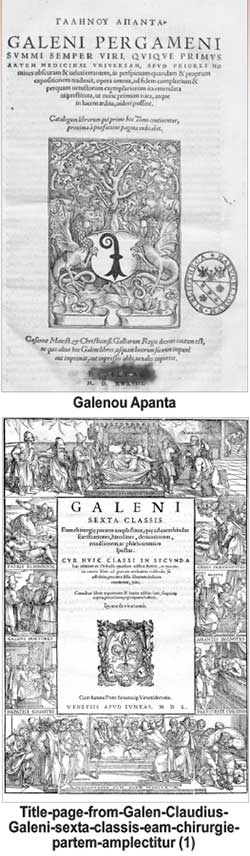 This was a philosophy which was articulated by one of the fathers of western medicine Aelius Galenus better known as Galen of Pergamon. The most celebrated medical authority of the Roman empire, Galen was one of the greatest physicians and surgeons of the ancient world. He has authored more books still in existence than any other ancient Greek. With the exception of Aristotle and Plato, he ranks as one most influential intellectuals in the classical west.
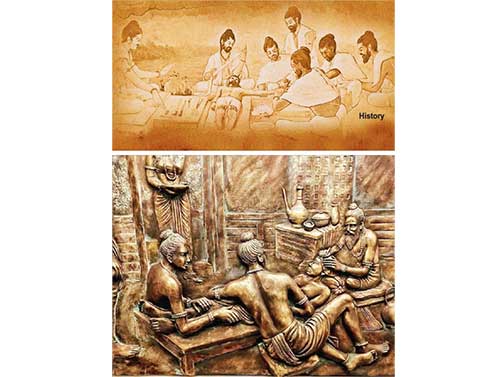
Born into the intellectual and social elite, Galen was son of a wealthy architect with scholarly interests and he received an excellent education. He travelled and studied widely, spending several years at Alexandria in Egypt, the greatest medical centre of the age. Returning home he spent four years tending a troupe of gladiators, eventually become the personal physician to a succession of Roman emperors.
Described by the Emperor Marcus Aurelius as “First among doctors and unique among philosophers,” Galen strongly believed that science and medicine must be practised in the context of human desires and needs. For him, medicine was an interdisciplinary field where science, ethics and the arts were all interwoven He saw himself as both a physician and a philosopher and believed that the study of philosophy would make for a better scientist, hence his short treatise The Best Physician is also a Philosopher.
In an eerie evocation of a contemporary dilemma Galen attacks the medical culture of his day which
“…encourages people to value wealth over virtue. For, “it is impossible to pursue financial gain at the same time as training oneself in so great an art as medicine; someone who is really enthusiastic about one of these aims, money or medicine, will inevitably despise the other.”
Galen advocated the study of arts and letters as an essential component of scientific study. In another work An Exhortation to Study the Arts, he warns against specialized isolation and lists several arts which he categorizes as divine gifts because they are useful to life. Alongside natural science and medicine, he also lists poetry, music, and philosophy. This underlines his belief that physicians must be specialists who were not only technically competent but also humane and morally responsible. According to Galen, proper, precise scientific inquiry was indeed ‘useful for life’. However, it could not be accomplished by scientists who were not properly trained in the other arts, because they would not then possess the humanity, the sensitivity, to do that science properly.
There does not appear to be a great distance between Galen’s creed and the requirements of contemporary medicine. A modern day physician like a philosopher is trained to think, to inquire and to ask questions. It is perhaps one of the foundations of his long and rigorous education. A good physician, like a good philosopher is always asking questions. It is by asking the best possible questions that he can make conclusions and diagnose.
A real philosopher is always open to question. This is even more the case with medicine. The danger is that answers shut down questions. Therefore the physician must always be open to question. As it is a question of wellbeing, of life and death, these questions are always shifting, changing with the time and the moment. If as a physician one must come to a conclusion, one can only do that by becoming a philosopher. To do that the physician must be able to listen, to observe, to think and to question. He must have time and make time. Time to listen, time to ponder, time to think, to analyze and evaluate.
It is a dilemma which still lies at the core of modern medicine. In an age where the internet and artificial intelligence have made vast inroads into the credibility of the physician, what makes him special is that although modern technology can make diagnoses, it cannot take a judgement call. That judgement call still rests on the human element, the physician’s understanding of the social context- on factors such as belief, culture, environment, sustainability and cost. This will determine the success of the cure. As Dr. Karunanayake foresees, if the physician is to play a role in the future, he must endeavor to understand the human being, his society and his setting.
The history of medicine reveals that physicians have occupied a special role in many parts of the world. Classical scholars have always regarded the ancient Greeks as the fathers of western medicine. However recent research suggests that the ancient Egyptians practised medicine long before the Greeks. The Edwin Smith Papyrus, an Egyptian surgical treatise dating from 1600 BC suggests that medical practice was well established in Egypt 1,000 years before Hippocrates. This documents 48 injuries which were described, diagnosed and treated rationally through observation and examination. It is thought to be a copy of a much earlier work dating from the 3rd millenium BC by the Egyptian polymath Imhotep. Chief Minister to the pharaoh, a priest, a sage and an architect, over the ages Imhotep was gradually glorified and became a god of healing.
 His counterpart in the Greek world was Asklepios, the son of Apollo. The legend goes that Asclepius become so skilled that Zeus, the king of the gods, feared that he might render men immortal. To prevent this Zeus slew him with a thunderbolt and over time like Imhotep, he too became a God. His shrine at the sanctuary of Epidaurus became known as the Asklepieion and it grew into the most important centre of healing in the Greek world. The legacy of Asklepios looms large in the Greek tradition of healing. Hippocrates formal name was Hippocrates Asclepiades, “the “descendant of Asclepios.” Galen too, we are told was not destined to become a physician and only took up medicine after the God Asklepios appeared to his father in a dream.
In Ayurveda, the system of medicine and lifestyle developed in Ancient India, the pre- eminent figures are Sushruta and Charuka. Sushruta is thought to have lived near Varanisi during the 6th-7th century BC. Regarded as the father of Indian medicine, he was the main author of the Sushruta Samhita, one of the most important surviving ancient treatises on medicine. The other medical text to have survived from ancient India, the Charaka Samhita, was authored by Charaka, who is thought to have practised throughout the Punjab between the 2nd -3rd century BC.
One of the oldest medical systems in the world is traditional Chinese medicine. This tradition has produced many leading figures. In the 5th century BC Bian Que (Pien Ch’iao) was the first to rely primarily on pulse and physical examination for the diagnosis of disease. He was followed by Hua Tuo (Yuanhua) the greatest surgeon in Chinese history. In 2nd century AD he became the first person in China to use anesthesia during surgery.
Throughout the ancient world the practice of medicine was associated with learning and skill, over time it become a divine gift. The physician was the incarnation of Imhotep, Asklepios, Hippocrates, Galen; he was a god, a seer, a sage, a skilled and deeply learned practitioner, a guide and a philosopher. Only in Sri Lanka however, was the physician a king.
The place of the physician in Sri Lanka’s society is documented in the island’s great historical chronicle, the Mahavamsa. Compiled in Pali by Buddhist monks, the Mahāvaṃsa and its successor, the Cūlavaṃsa, charts the history of Lanka from the 5th century BC to the 18th century AD. It is a remarkably accurate record, of seminal value for the history of India and Sri Lanka.
King Buddhadasa reigned between 341 – 370 AD. The Culavamsa recounts how he diagnosed, treated and cured patients from all walks of life. The chronicle devotes several whole sections to the practice and establishment of medicine and documents at least seven detailed case studies. This suggests that the physician had a very special place in this society and that his story was as important as the great warriors, builders, saints and the monks who shaped the history of Lanka. Each of these case studies tells us different things. Each concerns a different situation and elicits a deeply and carefully thought out remedy, based on reasoned analysis and evaluation.
In one case, it tells of how a man drinking water swallowed the eggs of a watersnake. The egg gradually grew into a snake. As it grew sucked at the man’s intestines, torturing the victim with pain. The man sought out the king, who questioned him. When he described the pain and related what had happened the king realized that a reptile must have formed inside the man. However as the reptile was lodged deep inside the intestines, the king refrained from cutting it out.
Instead he made the man fast for a week, starving the reptile within him. He then had the patient, bathed and rubbed with oil. This calmed and soothed him and he eventually fell asleep. The king knew that when he was asleep that his mouth would open. He tied a piece of meat to a string and dangled it over his mouth. Lured by the smell and driven by hunger, the watersnake reached for the meat. The king however, held the string fast and drew on it, gradually pulling the reptile out.
Another case concerned a Bhikku or Buddhist priest, the most venerated member of society. The bhikku had gone begging for alms and was given milk which had worms in it. The worms grew and fed on his bowels, causing agonizing pain. The king then asked leading questions. At what meal did the pain arise? What kind of meal was it and what was the nature of the pain? When the bhikku told him that it was a meal that he took with milk, the king recognized the symptoms.
Taking the blood from a horse, he gave it to the monk to drink. He then waited until he had drunk it all. Then he told him that was horse’s blood. The reaction was what he had anticipated. On hearing that he had drunk the blood of a horse, the monk vomited, spitting out the blood. The worms which had caused him such pain, came up with the blood.
Compassion and feeling made up an essential part of the King’s healing skills. There is a deep feeling for life in all its forms. This applied even to the most dangerous animals. Galen had concluded that even dumb animals are not entirely devoid of reason. In Buddhadasa’s most wellknown case, the king cobra, one of Sri Lanka’s most venomous reptiles, becomes a willing patient. As the king passed by, the cobra turned over onto his back to expose his underbelly so that the king could see the tumour growing on it. After observing the growth, the king reasoned with the reptile. Although he understood its pain, he dared not touch it. Understanding the king’s dilemma, the snake stuck his whole neck into anthill so that he could not hurt the king. Whilst the cobra was immobilized, the king slit open his belly, removed the diseased growth and applied a healing remedy.
This episode suggest a high level of surgical skill. It is underlined by another. A young man had drunk water which was full of frog’s eggs. Through his nostrils an egg had penetrated into his skull and evolved into a frog. As the monsoon approached the frog became more and more agitated, causing unbearable headaches. In this case the king appears to have resorted to immediate surgery. Performing a complicated and dangerous operation, he split the skull and removed the frog and then put the parts of the skull back together.
Ancient Indic society was dominated by caste and social taboos. Despite this and ignoring own his royal status, Buddhadasa cut across every social barrier and boundary to serve the suffering. In Indian society the lowest and most menial of tasks were performed by the Caṇḍālas, outcastes who worked as sweepers and scavengers. A Candala woman who had already had seven children, became pregnant for the eighth time. This time however, her unborn child was facing the wrong way in the womb. When Buddhadasa learned that this, he intervened to save the woman’s life. In the ancient world, birth and reproduction were the preserve of women and midwives. Socially this is a unique case. It is also a complex gynecological procedure.
The understanding of the human mind is an integral part of the physician’s craft. More often than not it holds the key to the patient’s condition and his recovery. In ancient times leprosy was a common condition. Lepers were shunned and regarded with horror and leprosy deemed a curse of the Gods.
The king noticed a leper, who upon seeing him, became enraged, striking the ground with his staff. In a previous birth the king had been the leper’s slave, it maddened him to see him riding his elephant and all he wanted to do was to kill him. Learning of this, Buddhadasa set his mind to winning him over. He sent one of his men to befriend the leper and share his anger. Pretending that he too was against the king, he invited the leper to stay at his house and help him destroy his enemy. The leper was bathed, fed and given beautiful clothes and a comfortable bed to sleep. One day, when he had become happy, contented and calm, Buddhadasa’s man served him food and drink, saying, “This is the gift from the king.” At first the leper refused and then refused again. Finally he accepted. Reaching out to the most diseased and most deeply troubled member of his community, the king was able to heal his mind. It is a clear demonstration of the power of empathy, feeling for and feeling with. It is from empathy that re assurance comes. So much of healing is in the mind. If the physician can take the time and make the effort, he has the power to do great good.
All these cases make one point. The physician truly cares and feels for all his patients, no matter who they are or where they are from. In his posthumous work Galen and Galenism (2002) the Spanish historian and Physician, Luis García Ballester (1936-2000) quotes Galen as saying: “In order to diagnose, one must observe and reason.” This is the dictum which King Buddhadasa embodies. He observes closely, listens carefully and questions keenly, making every attempt to form a picture of the condition. It is then he makes his diagnosis and decides on course of action. A demonstration of the power of the mind, sustained thought and inquiry, it is characterized by understanding and feeling.
The Cūlavaṃsa praises King Buddhadasa as a “Mine of Virtue and a Sea of jewels.” This perception is based on the king’s understanding of the human and social aspects of healing, his ability to care and feel. It is probably this tradition which lies at the roots of the well known Sri Lankan saying “If you cannot be a king, become a healer.”
This is the challenge which western science and learning faces in one of the world’s oldest living cultures. This context demands that the physician be conscious of the rhythms of a society, whose needs, values and way of life are often quite distinct from western norms and practices, often very much older. If as an invited guest, I can make one suggestion, it is that Sri Lanka’s physicians begin to study their past. For it is through comparative traditions that we learn deeply about ourselves.
If he is to truly guide as well as “Cure, Relieve And Comfort,” the Physician must also strive be a Philosopher.
He must not only ask the best possible questions, most of all like King Buddhadasa, he must care, be concerned and compassionate. For that he must have time.
TITLE; SINHARAJA/ APRIL 4



Institute of Hospitality Sri Lanka
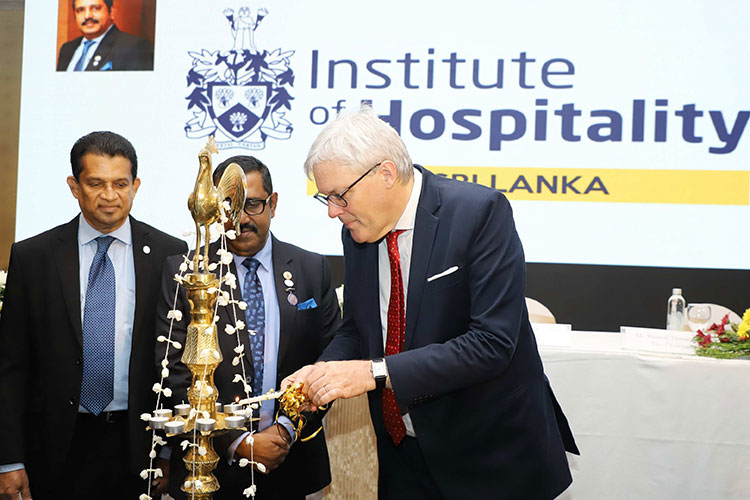
 The 32nd Annual General Meeting (AGM) of the UK-based Institute of Hospitality’s Sri Lanka Chapter was held recently at the Ramada Hotel Colombo,.The event provided an evening of camaraderie , reflection of the past and present achievements,setting new benchmarks for the future
The AGM had the presence of two distinguished guests, the Chief Guest Opposition Leader Sajith Premadasa, and the Guest of Honour British High Commissioner to Sri Lanka, Andrew Patrick. Their inspiring speeches were lauded by all hoteliers who were present at the occasion
A special thanks was extended to Robert Richardson, CEO of the Institute of Hospitality UK, along with his team, sponsors, committee members, and all attendees for making the event memorable.
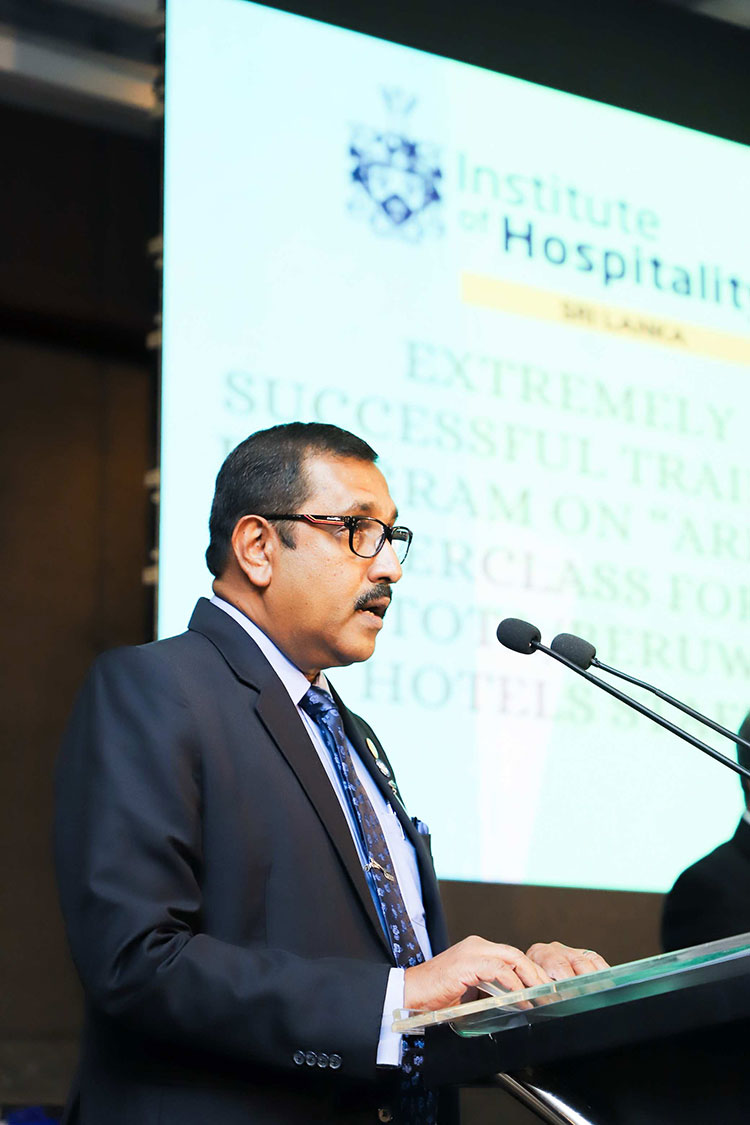
Dr. Harsha Jayasingh, Past President of the Institute of Hospitality (UK) Sri Lanka Chapter, emphasised the Institute’s longstanding history and the strength of its Sri Lankan branch. “The Institute of Hospitality (IH) UK has a history of 86 years, and we are proud to be the Sri Lanka Branch. IH Sri Lanka is much stronger now with many members from all areas of the hospitality industry,” he stated.
Dr. Jayasingh highlighted the significant role of tourism in Sri Lanka’s economy,. He said tourism it is the third-largest source of revenue for the country. “Tourism accounts for about 13.3% of total foreign exchange earnings and employs 450,000 people directly and indirectly. The hospitality industry in this island of pearl holds tremendous potential for economic growth, job creations, and cultural exchange,” he added.
He also pointed out more women should be attracted to the industry and advocated for the use of technology in hospitality sector to attract the younger generation.
The newly appointed Chairman Ramesh Dassanayake spoke about the challenges faced by the industry, including the reluctance of youth to join the sector. . Dassanayake expressed concerns over the migration of staff between hotels and the overall ‘brain drain’ in the sector. ” We must maintain high standards in the hotel We must try to attract tourists to Sri Lanka, we must have with many facilities Hence, hotel schools and other professional institutions involved in skills development mustincrease their intakes,” he pointed out.
Chief Guest Sajith Premadasa emphasised the importance of eco tourism and said “We need to have an environmental policy related to tourism in place,” . .
The 32nd AGM of the Institute of Hospitality UK, Sri Lanka Chapter, was a testament to the strength and potential of Sri Lanka’s hospitality industry. The insights and commitments shared during the event set a new benchmark for the future.(ZC)



Pix by Thushara Attapathu
Life style
He recognizes human identity beyond boundaries of gender, race, nationality and religion.

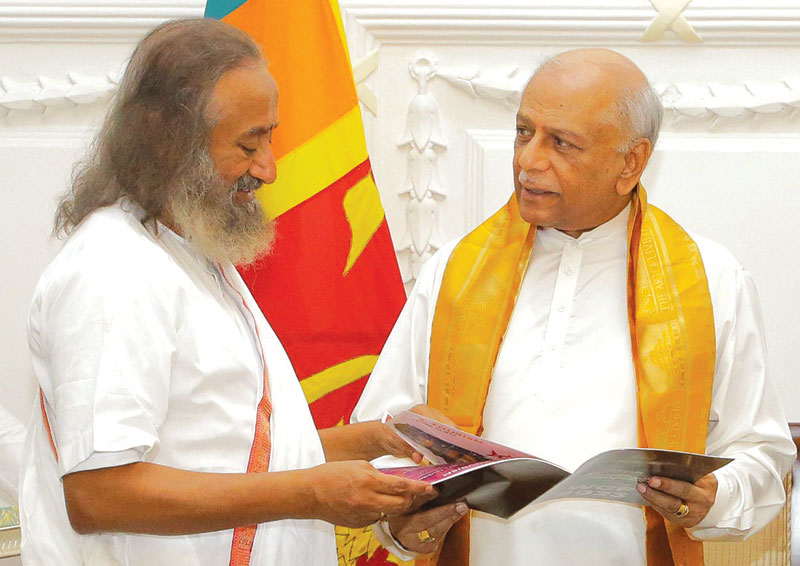
Visit of Sri Gurudev to Sri Lanka
Humanitarian, spiritual leader and Global Ambassador of Peace Gurudev Sri Sri Ravi Shankar (Sri Gurudev) was in Sri Lanka on a three day tour on the invitation of the Prime Minister of Sri Lanka Dinesh Gunewardene. Gurudev who inspired a wave of volunteerism and service to moot one of the largest volunteer-based organisations in the world – The Art of Living – visited the various projects under the aegis of the foundation and launched twelve vocational and technical centers around the island. He was accompanied by thousands of followers from Sri Lanka and around the world.
Gurudev who visited Sri Lanka for the sixth time also had a first day cover launched in honour of his visit. He is a strong proponent of spreading happiness, using the unique Sudarshan Kriya, yoga, meditation and practical wisdom to unite people, empower individuals and transform communities. His programmes provide techniques and tools to live a deeper, more joyous life, while his non-profit organisations recognize the human identity beyond the boundaries of gender, race, nationality and religion.
The Art of Living which has more than 30,000 teachers and over one million volunteers across 180 countries has touched in excess of five hundred million people around the world. CNN called it “Life Changing” and The Washington Post headlined it, “Fresh air to millions”.
In Trincomalee, Gurudev met with war victims and had a heartwarming engagement with the children from the children’s homes run by the Foundation. He also visited the Koneswara Temple in Trincomalee and graced the Kumbhabhishekam at Seetha ecogPnize the human identity beyond the boundaries of gender, race, nationality and religion. Amman temple at Nuwara Eliya. He held discussions with the trustees on the progress of the foundation’s social service projects, while also holding a special event – Ekamuthuwa – attended by a large number of dignitaries and his devotees from around the world.
His time with the Prime Minister was spent discussing the prospects of unity in diversity and uniting Sri Lanka by adding happiness into the formula of living. In addition he had discussions with the Speaker of the Parliament of Sri Lanka Mahinda Yapa Abeywardena, prominent business stewards and civil society leaders.
by Zanita Careem
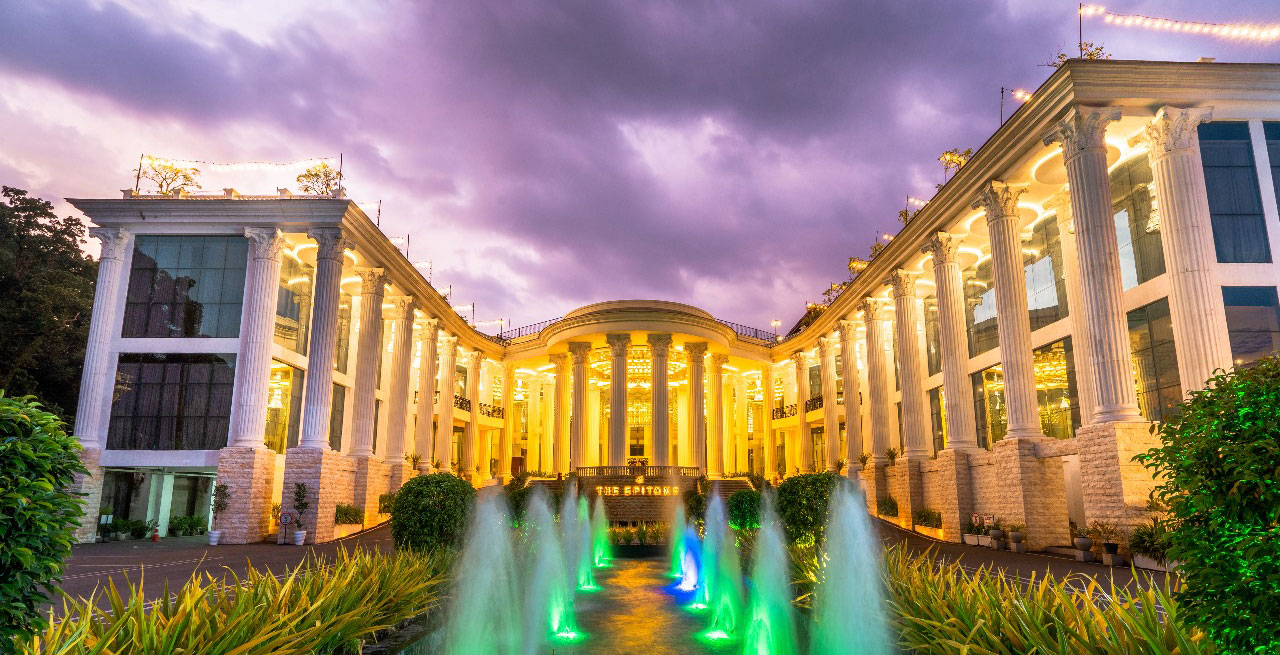
Envison your dream wedding day come to life at the Epitome Hotel, a prestigious city hotel in Kurunegala offering an unrivalled luxury rendors experience for weddings.
The venue is designed to embody opulence and luxury from all quarters for a spectacular wedding in kurunegala,Thier ballroom is the largest banquet facility in Sri Lanka It can be divided into six luxurious pillarless wedding halls on the ground floor and 25pax smaller banquet halls.
It can be easily named as a five star heaven in the heart of the city contributing to a myriad of immense experiences tailored to inspire and delight wedding experiences.
From opulent décor set up to exquisite table decor, lavish food, every detail is meticulously curated to spark your imagination and ignite creativity for a perfect wedding. The previous prestigious wedding shows season one and season two attracted large crowds
were unique events which gave the wedding vendors and potential clients had an opportunity to connect and interact with each other. Beyond being a showcase it was a chance for the wedding vendors to unite and contribute to the vibrancy of the wedding industry. The wedding show covered all area of the bridal industry providing a comprehensive variety of bridal supplies from Sri lanka and became the most popular bridal exhibitions in Kurunegala.This bridal exhibitions allowed brides and grooms to experience first hand the products and services available from suppliers in Sri Lanka
These wedding shows held at The Epitome created a benchmark and gave an opportunity for vendors to create connections to the utmost satisfaction said Harshan Lakshita Executive Director. of the magnificent Hotel
Our wedding shows featured experts and professionals in every field‘ It covered all areas of the bridal industry provided a comprehensive variety of bridal supplies from Sri lanka and became most popular bridal exhibition in this region.We are always open to everyone to join us at our wedding shows in the future. It is an opportunity to discover the incredible talent within our local wedding and bridal vendors to make meaningful relationships and plan thier special day at our breathtaking hotel The Epitome said General Manager Kavinda Caldera
The Epitome Hotel’s bridal show which will be held end of June will buzz with great ideas,advice and inspiration for all those who plan thier dream wedding
…….
The Hotel Epitome’s Wedding Season 3 will marked excellence, celebration and inspiration for those in the wedding industry. The exhibition halls will resonate with ideas on exquisite bridal wear to decor, florists , photography etc and showshowcase the rich tapestry of talent within the local wedding industry. .







US sports envoys to Lanka to champion youth development

Rahuman questions sudden cancellation of leave of CEB employees


