Features
The Odyssey and Living Legacy of sieur de La Nérolle

By Uditha Devapriya
Review of Yasmin Rajapakse’s The Odyssey and Living Legacy of sieur de La Nérolle: The French Lieutenant of the Expedition Escadre de Perse to Ceylon in 1672.
Neptune Publications,
98 pages, Rs. 2,000.
Europe’s imperial forays into the East were shaped by a long line of events, dating back to the Reconquista of 1492. These events sealed the fate of one part of the world: limited until then to occasional encounters with the West, Africa and Asia eventually turned into colonial outposts. That, in turn, had a profound impact on the course of politics in Europe; rocked by economic changes and religious tensions, it became a hotbed of conflict.
These developments did not escape Sri Lanka. Conquered by succeeding waves of South Indian dynasties, the country had its first taste of European colonialism in the mid-16th century. With its logic of exploitation and proselytisation, Portuguese rule lasted for more than half a century. Its inception coincided with the inception of the Kandyan kingdom, its collapse with the onset of the Dutch-Portuguese War. Taking advantage of these shifts and developments, Kandyan rulers sought Dutch support to overthrow the Portuguese. The ruse worked, though not entirely to the satisfaction of the Kandyans.
In November 1656, Dutch forces forced Rajasinghe II away from Colombo, contrary to the terms of an agreement that had pledged to cede the capital to Kandy. With the surrender of Portuguese forces in Jaffna on June 24, 1658, the Dutch established their rule in the country. We are told that five months later, on November 20, officials passed a resolution praising God for helping them evict their foes. Paul E. Pieris observes that while these celebrations were taking place, “[a] Jesuit was beheaded and 11 others were hanged, their bodies being left to rot on the gibbets.” These were obviously spoils of war.


Yasmin Rajapakse’s book is about one of these officials. At once lucid and accessible, it is rich in sources and packed with details. As she notes at the very beginning, though much has been written about the subject of her work, very little has been verified. What Rajapakse’s account attempts to do, then, is make sense of the man behind the legend, deconstructing one of the more intriguing periods in our history.
The subject of several apocryphal and anecdotal accounts, sieur de La Nérolle’s life has never been seriously examined until now. While a number of essays, articles, and even books have been written about him, none of them has attempted to place his story in the context of his times. This is what Yasmin Rajapakse tries to do in her book. Guided by her intense passion for French and Sri Lankan history, she traces de La Nérolle’s trysts with the island to certain political developments in 17th century Europe.
Rajapakse begins her account, understandably enough, with the land of La Nérolle’s birth. France in the 16th century, she notes, was different to the country it would later become. With an abundance of resources, officials did not feel the need to expand into other regions, especially in the East, as the Portuguese, Dutch, and British were doing. All that changed in the second half of the century, in particular after the establishment of the French East Indies Company. Hemmed in for so long by rival European powers, it realised that to contend with them, it had to go out and explore. To that end, under Louis XIV, the “Sun God”, the French STate began to build up a strong naval force, to pursue trade in the East Indies.
At the time France was witnessing not just economic change, but social upheaval. Religious tensions had become the order of the day, with schisms between Catholics and Protestants spilling over to the country’s political life. One of the more prominent officials of the French East Indies Company was François Caron, a Protestant-Huguenot refugee born in Flanders. Caron’s career resembles that of many petty officials who went on to hold high positions in the Orient: working as a kitchen assistant at the age of 19 in the Dutch East Indies Company, he mastered Japanese and became the President of the Company and Admiral of the Dutch Fleet. Falling out with the Company, he later switched allegiances to the French.
Caron’s first task was to establish trade in the East Indies. Louis XIV’s Minister of State, Jean-Baptiste Colbert, had envisioned a series of reforms that would help France stand on par with the rest of Europe. To this end, Caron’s proposal, that the French Navy go beyond the Pacific and into the Indian Ocean, was well received.
Having been involved in the Dutch capture of Negombo from the Portuguese in 1644, Caron soon realised that Ceylon figured in his scheme of things, and communicated as much with Colbert. In 1669 he despatched a letter to Rajasinghe II, informing him of France’s intention to “forge a lasting friendship” with his Court. A year later Colbert summoned a naval force, baptising it Escadre de Perse, or “Squadron of Persia”, and sailing from La Rochelle in March 1670 to the coast of Koddiyar, or Trincomalee, in March 1672.
All these details seem superfluous, but they are vital to Rajapakse’s narrative. We are told that Rajasinghe II received the first two diplomats sent by the French mission to Kandy well. We are told that he agreed with their proposal to counter the Dutch. Yet Dutch designs on the island and on Kandy being what they were, they could not prevail for long against their competitors. The upsurge of war between Holland and France in 1671 did not help resolve these confrontations, and in the end, barely a year after settling in the East of the island, the French fleet, or what was left of it, evacuated and abandoned Trincomalee.
Yasmin Rajapakse reflects on the reasons for these failures, noting not just the logistical problems that French soldiers had to face, but also the capability of the French fleet tasked with securing conveniences across the Indo-Pacific. This is where she gets to the subject of her study. Before setting sail back home, French officials despatched yet another mission to Kandy. The man chosen to head this mission, who would remain in Kandy despite his wishes and plans, was a young lieutenant attached to the fleet, the sieur de la Nérolle.


The Kandyan kingdom of the 17th and 18th centuries, as countless historians have pointed out, was a flourishing cosmopolitan enclave. Open to a great many foreign influences, it occupied a world of its own. Sinhalese kings had made contacts with Catholic refugees, Protestant priests, Muslim traders, Hindu swamis, and European diplomats. Rajasinghe II’s fascination with the latter endeared him to Westerners.
These policies were maintained by his successors, two of which Sieur de La Nérolle served: Wimaladharmasuriya II and Vira Parakrama Narendrasinghe. De La Nérolle went on to endear himself so well to the Kandyan Court that, in 1723, he was not just permitted to marry a woman from a prominent noble family, but also conferred with the title of Mudiyanse.
A beneficiary of Kandyan largesse, de La Nérolle found himself enjoying a status few others did. Though there were obvious strategic motives to their decision to tolerate and reward foreign officials, the Sinhalese kings went out of their way to ensure that the Europeans in their realm were taken care of. Often they took them into their confidence, granting them access. For their part, European emissaries remained respectful of local customs, especially the King’s patronage of Buddhism. This did not, however, mean that they abandoned their way of life: writing of de La Nérolle, for instance, Rajapakse tells us very clearly and candidly that he “was known to be vehemently anti-catholic.”
It was the Frenchman’s rigid anti-Catholicism, in fact, which compelled him to denounce Joseph Vaz as a spy to Wimaladharmasuriya II. The latter at once ordered his men to seize the priest, yet upon realising that he was “a harmless Catholic ascetic”, he let him go. This by no means resolved tensions between the Huguenot and the Papist: Rajapakse relates a particularly lively debate between de La Nérolle and a later Catholic ascetic frequenting the Kandyan kingdom, Jacombe Gonçalves, played out in front of Narendrasinghe over matters of faith such as the relevance of saints and idols to the Church.
In what can be taken as a testament to the influence of the Portuguese Church in Sri Lanka, the avowedly Sinhalese Buddhist king sided with Gonçalves, convinced by his defence of the worship of idols. Though Rajapakse does not mention it, it is possible that the king’s own partiality to “idol-worshipping” made him favour the Catholic priest, a fact which may explain his patronage of not just Gonçalves, but also other priests. Gonçalves for his part conspired to convert de La Nérolle’s closest aide, Pedro Gascon of “Daskon” fame, a ruse that eventually succeeded. Meanwhile, having sided with the Catholic priest, the ever sharp and intrepid Narendrasinghe threatened to hand sieur de La Nérolle over to Catholic adversaries unless he “cease his rant” against their Church.
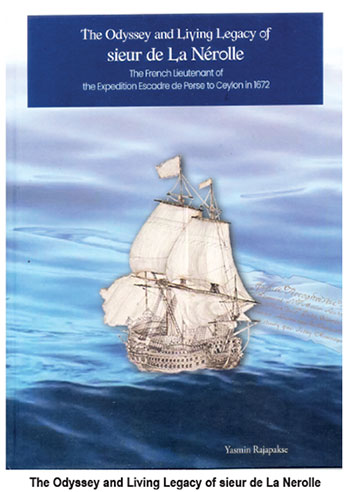

The Odyssey and Living Legacy of sieur de La Nérolle is unabashedly a labour of love. Well researched and well sourced, it is replete with enough references to qualify it as a first-rate work. The only discernible error, on page nine, is a misdating of a letter sent by Caron to Rajasinghe II. What makes it stand out well in other respects is the author’s love for French culture and Sri Lankan history. A Francophone and, I daresay, Francophile, Yasmin Rajapakse first came to us onboard Bonsoir. Though not a professional historian, her account of sieur de La Nérolle puts her above many professionals in the country, whose abandonment of the most basic principles of scholarship is to be deeply regretted. At the end of it all, this is what distinguishes Rajapakse’s work, and what distinguishes her.
The writer can be reached at udakdev1@gmail.com