
Features
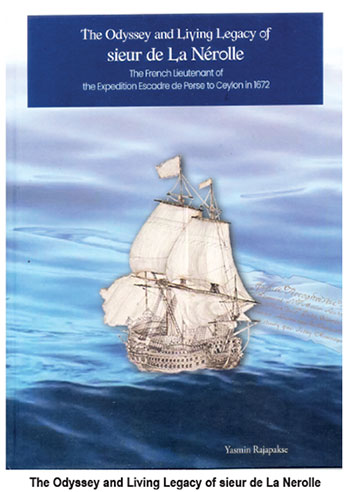
The Odyssey and Living Legacy of sieur de La Nérolle


By Uditha Devapriya
Review of Yasmin Rajapakse’s The Odyssey and Living Legacy of sieur de La Nérolle: The French Lieutenant of the Expedition Escadre de Perse to Ceylon in 1672.
Neptune Publications,
98 pages, Rs. 2,000.
Europe’s imperial forays into the East were shaped by a long line of events, dating back to the Reconquista of 1492. These events sealed the fate of one part of the world: limited until then to occasional encounters with the West, Africa and Asia eventually turned into colonial outposts. That, in turn, had a profound impact on the course of politics in Europe; rocked by economic changes and religious tensions, it became a hotbed of conflict.
These developments did not escape Sri Lanka. Conquered by succeeding waves of South Indian dynasties, the country had its first taste of European colonialism in the mid-16th century. With its logic of exploitation and proselytisation, Portuguese rule lasted for more than half a century. Its inception coincided with the inception of the Kandyan kingdom, its collapse with the onset of the Dutch-Portuguese War. Taking advantage of these shifts and developments, Kandyan rulers sought Dutch support to overthrow the Portuguese. The ruse worked, though not entirely to the satisfaction of the Kandyans.
In November 1656, Dutch forces forced Rajasinghe II away from Colombo, contrary to the terms of an agreement that had pledged to cede the capital to Kandy. With the surrender of Portuguese forces in Jaffna on June 24, 1658, the Dutch established their rule in the country. We are told that five months later, on November 20, officials passed a resolution praising God for helping them evict their foes. Paul E. Pieris observes that while these celebrations were taking place, “[a] Jesuit was beheaded and 11 others were hanged, their bodies being left to rot on the gibbets.” These were obviously spoils of war.
 One of the most idiosyncratic of the Sinhalese kings, Rajasinghe II was arguably the most tempestuous. We are told that he acted “like a caged tiger.” One day he would vent his fury against the Dutch, and the very next he would tell them that he appreciated their services. Anxious to secure his goodwill, the Hollanders for their part humoured him by sending him gifts, missives, entreaties, and ambassadors. At the peak of his reign, Paul E. Pieris notes, he had collected a large and perfect menagerie of foreigners and diplomats; perhaps the most well known of these was Robert Knox, taken prisoner in 1660.
Yasmin Rajapakse’s book is about one of these officials. At once lucid and accessible, it is rich in sources and packed with details. As she notes at the very beginning, though much has been written about the subject of her work, very little has been verified. What Rajapakse’s account attempts to do, then, is make sense of the man behind the legend, deconstructing one of the more intriguing periods in our history.
The subject of several apocryphal and anecdotal accounts, sieur de La Nérolle’s life has never been seriously examined until now. While a number of essays, articles, and even books have been written about him, none of them has attempted to place his story in the context of his times. This is what Yasmin Rajapakse tries to do in her book. Guided by her intense passion for French and Sri Lankan history, she traces de La Nérolle’s trysts with the island to certain political developments in 17th century Europe.
Rajapakse begins her account, understandably enough, with the land of La Nérolle’s birth. France in the 16th century, she notes, was different to the country it would later become. With an abundance of resources, officials did not feel the need to expand into other regions, especially in the East, as the Portuguese, Dutch, and British were doing. All that changed in the second half of the century, in particular after the establishment of the French East Indies Company. Hemmed in for so long by rival European powers, it realised that to contend with them, it had to go out and explore. To that end, under Louis XIV, the “Sun God”, the French STate began to build up a strong naval force, to pursue trade in the East Indies.
At the time France was witnessing not just economic change, but social upheaval. Religious tensions had become the order of the day, with schisms between Catholics and Protestants spilling over to the country’s political life. One of the more prominent officials of the French East Indies Company was François Caron, a Protestant-Huguenot refugee born in Flanders. Caron’s career resembles that of many petty officials who went on to hold high positions in the Orient: working as a kitchen assistant at the age of 19 in the Dutch East Indies Company, he mastered Japanese and became the President of the Company and Admiral of the Dutch Fleet. Falling out with the Company, he later switched allegiances to the French.
Caron’s first task was to establish trade in the East Indies. Louis XIV’s Minister of State, Jean-Baptiste Colbert, had envisioned a series of reforms that would help France stand on par with the rest of Europe. To this end, Caron’s proposal, that the French Navy go beyond the Pacific and into the Indian Ocean, was well received.
Having been involved in the Dutch capture of Negombo from the Portuguese in 1644, Caron soon realised that Ceylon figured in his scheme of things, and communicated as much with Colbert. In 1669 he despatched a letter to Rajasinghe II, informing him of France’s intention to “forge a lasting friendship” with his Court. A year later Colbert summoned a naval force, baptising it Escadre de Perse, or “Squadron of Persia”, and sailing from La Rochelle in March 1670 to the coast of Koddiyar, or Trincomalee, in March 1672.
All these details seem superfluous, but they are vital to Rajapakse’s narrative. We are told that Rajasinghe II received the first two diplomats sent by the French mission to Kandy well. We are told that he agreed with their proposal to counter the Dutch. Yet Dutch designs on the island and on Kandy being what they were, they could not prevail for long against their competitors. The upsurge of war between Holland and France in 1671 did not help resolve these confrontations, and in the end, barely a year after settling in the East of the island, the French fleet, or what was left of it, evacuated and abandoned Trincomalee.
Yasmin Rajapakse reflects on the reasons for these failures, noting not just the logistical problems that French soldiers had to face, but also the capability of the French fleet tasked with securing conveniences across the Indo-Pacific. This is where she gets to the subject of her study. Before setting sail back home, French officials despatched yet another mission to Kandy. The man chosen to head this mission, who would remain in Kandy despite his wishes and plans, was a young lieutenant attached to the fleet, the sieur de la Nérolle.
 Who were the de La Nérolles? Rajapakse traces them to a family of military officials from the village of Charante. Today, of course, there are many De Lanerolles in Sri Lanka, with a separate but related line bearing the name Lenora. In France the de La Nérolles faced the brunt of the country’s official religious policy, converting from the Protestantism of their youth to Catholicism after Louis XIV cut their privileges. This, no doubt, made Lieutenant de La Nérolle, stranded in Kandy, the sole Protestant or Huguenot from his family. As Rajapakse makes it clear in her account, that had a profound impact on his relations with not only the Sinhalese kings, but also the many foreign emissaries at the Kandyan court.
The Kandyan kingdom of the 17th and 18th centuries, as countless historians have pointed out, was a flourishing cosmopolitan enclave. Open to a great many foreign influences, it occupied a world of its own. Sinhalese kings had made contacts with Catholic refugees, Protestant priests, Muslim traders, Hindu swamis, and European diplomats. Rajasinghe II’s fascination with the latter endeared him to Westerners.
These policies were maintained by his successors, two of which Sieur de La Nérolle served: Wimaladharmasuriya II and Vira Parakrama Narendrasinghe. De La Nérolle went on to endear himself so well to the Kandyan Court that, in 1723, he was not just permitted to marry a woman from a prominent noble family, but also conferred with the title of Mudiyanse.
A beneficiary of Kandyan largesse, de La Nérolle found himself enjoying a status few others did. Though there were obvious strategic motives to their decision to tolerate and reward foreign officials, the Sinhalese kings went out of their way to ensure that the Europeans in their realm were taken care of. Often they took them into their confidence, granting them access. For their part, European emissaries remained respectful of local customs, especially the King’s patronage of Buddhism. This did not, however, mean that they abandoned their way of life: writing of de La Nérolle, for instance, Rajapakse tells us very clearly and candidly that he “was known to be vehemently anti-catholic.”
It was the Frenchman’s rigid anti-Catholicism, in fact, which compelled him to denounce Joseph Vaz as a spy to Wimaladharmasuriya II. The latter at once ordered his men to seize the priest, yet upon realising that he was “a harmless Catholic ascetic”, he let him go. This by no means resolved tensions between the Huguenot and the Papist: Rajapakse relates a particularly lively debate between de La Nérolle and a later Catholic ascetic frequenting the Kandyan kingdom, Jacombe Gonçalves, played out in front of Narendrasinghe over matters of faith such as the relevance of saints and idols to the Church.
In what can be taken as a testament to the influence of the Portuguese Church in Sri Lanka, the avowedly Sinhalese Buddhist king sided with Gonçalves, convinced by his defence of the worship of idols. Though Rajapakse does not mention it, it is possible that the king’s own partiality to “idol-worshipping” made him favour the Catholic priest, a fact which may explain his patronage of not just Gonçalves, but also other priests. Gonçalves for his part conspired to convert de La Nérolle’s closest aide, Pedro Gascon of “Daskon” fame, a ruse that eventually succeeded. Meanwhile, having sided with the Catholic priest, the ever sharp and intrepid Narendrasinghe threatened to hand sieur de La Nérolle over to Catholic adversaries unless he “cease his rant” against their Church.
 All this changed with the advent of the Nayakkars. A Telugu dynasty from South India, the Nayakkars found themselves in the midst of a swirling mass of conspiracy at the Kandyan Court. Though commanding the loyalty of Sinhalese nobles and Buddhist priests, they had to prove their allegiance to Sinhalese culture and Buddhist practices. Unlike their predecessors, they had to be more public about their patronage of those practices. This obviously meant shedding off all foreign accretions, not just within their family, but also within the kingdom. Faced with the “atmosphere of uncertainly and insecurity” that followed this, the La Nérolle courtiers in Kandyan Court felt compelled to leave. With their exit, Rajapakse concludes, the family line shifted from the hill country to the Dutch-controlled South.
The Odyssey and Living Legacy of sieur de La Nérolle is unabashedly a labour of love. Well researched and well sourced, it is replete with enough references to qualify it as a first-rate work. The only discernible error, on page nine, is a misdating of a letter sent by Caron to Rajasinghe II. What makes it stand out well in other respects is the author’s love for French culture and Sri Lankan history. A Francophone and, I daresay, Francophile, Yasmin Rajapakse first came to us onboard Bonsoir. Though not a professional historian, her account of sieur de La Nérolle puts her above many professionals in the country, whose abandonment of the most basic principles of scholarship is to be deeply regretted. At the end of it all, this is what distinguishes Rajapakse’s work, and what distinguishes her.
The writer can be reached at udakdev1@gmail.com



by Dr Gotabhya Ranasinghe
Senior Consultant Cardiologist
National Hospital Sri Lanka
When we sought a meeting with Hon Dr. Ramesh Pathirana, Minister of Health, he graciously cleared his busy schedule to accommodate us. Renowned for his attentive listening and deep understanding, Minister Pathirana is dedicated to advancing the health sector. His openness and transparency exemplify the qualities of an exemplary politician and minister.
Dr. Palitha Mahipala, the current Health Secretary, demonstrates both commendable enthusiasm and unwavering support. This combination of attributes makes him a highly compatible colleague for the esteemed Minister of Health.
Our discussion centered on a project that has been in the works for the past 30 years, one that no other minister had managed to advance.
Minister Pathirana, however, recognized the project’s significance and its potential to revolutionize care for heart patients.
The project involves the construction of a state-of-the-art facility at the premises of the National Hospital Colombo. The project’s location within the premises of the National Hospital underscores its importance and relevance to the healthcare infrastructure of the nation.
This facility will include a cardiology building and a tertiary care center, equipped with the latest technology to handle and treat all types of heart-related conditions and surgeries.
Securing funding was a major milestone for this initiative. Minister Pathirana successfully obtained approval for a $40 billion loan from the Asian Development Bank. With the funding in place, the foundation stone is scheduled to be laid in September this year, and construction will begin in January 2025.
This project guarantees a consistent and uninterrupted supply of stents and related medications for heart patients. As a result, patients will have timely access to essential medical supplies during their treatment and recovery. By securing these critical resources, the project aims to enhance patient outcomes, minimize treatment delays, and maintain the highest standards of cardiac care.
Upon its fruition, this monumental building will serve as a beacon of hope and healing, symbolizing the unwavering dedication to improving patient outcomes and fostering a healthier society.We anticipate a future marked by significant progress and positive outcomes in Sri Lanka’s cardiovascular treatment landscape within the foreseeable timeframe.

by Fr. Emmanuel Fernando, OMI
Jesuit Fr. Aloysius Pieris (affectionately called Fr. Aloy) celebrated his 90th birthday on April 9, 2024 and I, as the editor of our Oblate Journal, THE MISSIONARY OBLATE had gone to press by that time. Immediately I decided to publish an article, appreciating the untiring selfless services he continues to offer for inter-Faith dialogue, the renewal of the Catholic Church, his concern for the poor and the suffering Sri Lankan masses and to me, the present writer.
It was in 1988, when I was appointed Director of the Oblate Scholastics at Ampitiya by the then Oblate Provincial Fr. Anselm Silva, that I came to know Fr. Aloy more closely. Knowing well his expertise in matters spiritual, theological, Indological and pastoral, and with the collaborative spirit of my companion-formators, our Oblate Scholastics were sent to Tulana, the Research and Encounter Centre, Kelaniya, of which he is the Founder-Director, for ‘exposure-programmes’ on matters spiritual, biblical, theological and pastoral. Some of these dimensions according to my view and that of my companion-formators, were not available at the National Seminary, Ampitiya.
Ever since that time, our Oblate formators/ accompaniers at the Oblate Scholasticate, Ampitiya , have continued to send our Oblate Scholastics to Tulana Centre for deepening their insights and convictions regarding matters needed to serve the people in today’s context. Fr. Aloy also had tried very enthusiastically with the Oblate team headed by Frs. Oswald Firth and Clement Waidyasekara to begin a Theologate, directed by the Religious Congregations in Sri Lanka, for the contextual formation/ accompaniment of their members. It should very well be a desired goal of the Leaders / Provincials of the Religious Congregations.
Besides being a formator/accompanier at the Oblate Scholasticate, I was entrusted also with the task of editing and publishing our Oblate journal, ‘The Missionary Oblate’. To maintain the quality of the journal I continue to depend on Fr. Aloy for his thought-provoking and stimulating articles on Biblical Spirituality, Biblical Theology and Ecclesiology. I am very grateful to him for his generous assistance. Of late, his writings on renewal of the Church, initiated by Pope St. John XX111 and continued by Pope Francis through the Synodal path, published in our Oblate journal, enable our readers to focus their attention also on the needed renewal in the Catholic Church in Sri Lanka. Fr. Aloy appreciated very much the Synodal path adopted by the Jesuit Pope Francis for the renewal of the Church, rooted very much on prayerful discernment. In my Religious and presbyteral life, Fr.Aloy continues to be my spiritual animator / guide and ongoing formator / acccompanier.
Fr. Aloysius Pieris, BA Hons (Lond), LPh (SHC, India), STL (PFT, Naples), PhD (SLU/VC), ThD (Tilburg), D.Ltt (KU), has been one of the eminent Asian theologians well recognized internationally and one who has lectured and held visiting chairs in many universities both in the West and in the East. Many members of Religious Congregations from Asian countries have benefited from his lectures and guidance in the East Asian Pastoral Institute (EAPI) in Manila, Philippines. He had been a Theologian consulted by the Federation of Asian Bishops’ Conferences for many years. During his professorship at the Gregorian University in Rome, he was called to be a member of a special group of advisers on other religions consulted by Pope Paul VI.
Fr. Aloy is the author of more than 30 books and well over 500 Research Papers. Some of his books and articles have been translated and published in several countries. Among those books, one can find the following: 1) The Genesis of an Asian Theology of Liberation (An Autobiographical Excursus on the Art of Theologising in Asia, 2) An Asian Theology of Liberation, 3) Providential Timeliness of Vatican 11 (a long-overdue halt to a scandalous millennium, 4) Give Vatican 11 a chance, 5) Leadership in the Church, 6) Relishing our faith in working for justice (Themes for study and discussion), 7) A Message meant mainly, not exclusively for Jesuits (Background information necessary for helping Francis renew the Church), 8) Lent in Lanka (Reflections and Resolutions, 9) Love meets wisdom (A Christian Experience of Buddhism, 10) Fire and Water 11) God’s Reign for God’s poor, 12) Our Unhiddden Agenda (How we Jesuits work, pray and form our men). He is also the Editor of two journals, Vagdevi, Journal of Religious Reflection and Dialogue, New Series.
Fr. Aloy has a BA in Pali and Sanskrit from the University of London and a Ph.D in Buddhist Philosophy from the University of Sri Lankan, Vidyodaya Campus. On Nov. 23, 2019, he was awarded the prestigious honorary Doctorate of Literature (D.Litt) by the Chancellor of the University of Kelaniya, the Most Venerable Welamitiyawe Dharmakirthi Sri Kusala Dhamma Thera.
Fr. Aloy continues to be a promoter of Gospel values and virtues. Justice as a constitutive dimension of love and social concern for the downtrodden masses are very much noted in his life and work. He had very much appreciated the commitment of the late Fr. Joseph (Joe) Fernando, the National Director of the Social and Economic Centre (SEDEC) for the poor.
In Sri Lanka, a few religious Congregations – the Good Shepherd Sisters, the Christian Brothers, the Marist Brothers and the Oblates – have invited him to animate their members especially during their Provincial Congresses, Chapters and International Conferences. The mainline Christian Churches also have sought his advice and followed his seminars. I, for one, regret very much, that the Sri Lankan authorities of the Catholic Church –today’s Hierarchy—- have not sought Fr.
Aloy’s expertise for the renewal of the Catholic Church in Sri Lanka and thus have not benefited from the immense store of wisdom and insight that he can offer to our local Church while the Sri Lankan bishops who governed the Catholic church in the immediate aftermath of the Second Vatican Council (Edmund Fernando OMI, Anthony de Saram, Leo Nanayakkara OSB, Frank Marcus Fernando, Paul Perera,) visited him and consulted him on many matters. Among the Tamil Bishops, Bishop Rayappu Joseph was keeping close contact with him and Bishop J. Deogupillai hosted him and his team visiting him after the horrible Black July massacre of Tamils.
Sri Lanka-Singapore Free Trade Agreement
By Gomi Senadhira
senadhiragomi@gmail.com
“You might tell fairy tales, but the progress of a country cannot be achieved through such narratives. A country cannot be developed by making false promises. The country moved backward because of the electoral promises made by political parties throughout time. We have witnessed that the ultimate result of this is the country becoming bankrupt. Unfortunately, many segments of the population have not come to realize this yet.” – President Ranil Wickremesinghe, 2024 Budget speech
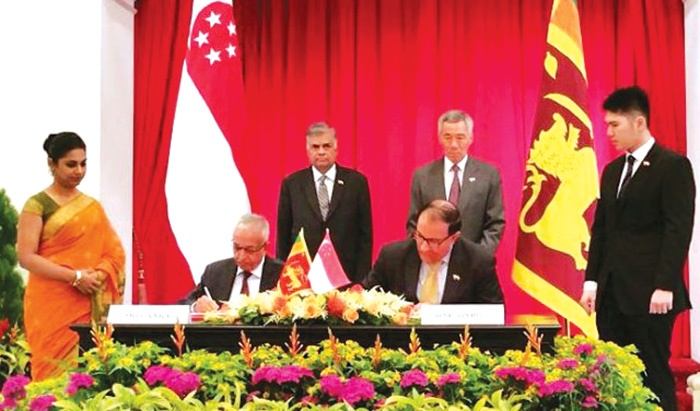
Any Sri Lankan would agree with the above words of President Wickremesinghe on the false promises our politicians and officials make and the fairy tales they narrate which bankrupted this country. So, to understand this, let’s look at one such fairy tale with lots of false promises; Ranil Wickremesinghe’s greatest achievement in the area of international trade and investment promotion during the Yahapalana period, Sri Lanka-Singapore Free Trade Agreement (SLSFTA).
It is appropriate and timely to do it now as Finance Minister Wickremesinghe has just presented to parliament a bill on the National Policy on Economic Transformation which includes the establishment of an Office for International Trade and the Sri Lanka Institute of Economics and International Trade.
Was SLSFTA a “Cleverly negotiated Free Trade Agreement” as stated by the (former) Minister of Development Strategies and International Trade Malik Samarawickrama during the Parliamentary Debate on the SLSFTA in July 2018, or a colossal blunder covered up with lies, false promises, and fairy tales? After SLSFTA was signed there were a number of fairy tales published on this agreement by the Ministry of Development Strategies and International, Institute of Policy Studies, and others.
However, for this article, I would like to limit my comments to the speech by Minister Samarawickrama during the Parliamentary Debate, and the two most important areas in the agreement which were covered up with lies, fairy tales, and false promises, namely: revenue loss for Sri Lanka and Investment from Singapore. On the other important area, “Waste products dumping” I do not want to comment here as I have written extensively on the issue.
1. The revenue loss
During the Parliamentary Debate in July 2018, Minister Samarawickrama stated “…. let me reiterate that this FTA with Singapore has been very cleverly negotiated by us…. The liberalisation programme under this FTA has been carefully designed to have the least impact on domestic industry and revenue collection. We have included all revenue sensitive items in the negative list of items which will not be subject to removal of tariff. Therefore, 97.8% revenue from Customs duty is protected. Our tariff liberalisation will take place over a period of 12-15 years! In fact, the revenue earned through tariffs on goods imported from Singapore last year was Rs. 35 billion.
The revenue loss for over the next 15 years due to the FTA is only Rs. 733 million– which when annualised, on average, is just Rs. 51 million. That is just 0.14% per year! So anyone who claims the Singapore FTA causes revenue loss to the Government cannot do basic arithmetic! Mr. Speaker, in conclusion, I call on my fellow members of this House – don’t mislead the public with baseless criticism that is not grounded in facts. Don’t look at petty politics and use these issues for your own political survival.”
I was surprised to read the minister’s speech because an article published in January 2018 in “The Straits Times“, based on information released by the Singaporean Negotiators stated, “…. With the FTA, tariff savings for Singapore exports are estimated to hit $10 million annually“.
As the annual tariff savings (that is the revenue loss for Sri Lanka) calculated by the Singaporean Negotiators, Singaporean $ 10 million (Sri Lankan rupees 1,200 million in 2018) was way above the rupees’ 733 million revenue loss for 15 years estimated by the Sri Lankan negotiators, it was clear to any observer that one of the parties to the agreement had not done the basic arithmetic!
Six years later, according to a report published by “The Morning” newspaper, speaking at the Committee on Public Finance (COPF) on 7th May 2024, Mr Samarawickrama’s chief trade negotiator K.J. Weerasinghehad had admitted “…. that forecasted revenue loss for the Government of Sri Lanka through the Singapore FTA is Rs. 450 million in 2023 and Rs. 1.3 billion in 2024.”
If these numbers are correct, as tariff liberalisation under the SLSFTA has just started, we will pass Rs 2 billion very soon. Then, the question is how Sri Lanka’s trade negotiators made such a colossal blunder. Didn’t they do their basic arithmetic? If they didn’t know how to do basic arithmetic they should have at least done their basic readings. For example, the headline of the article published in The Straits Times in January 2018 was “Singapore, Sri Lanka sign FTA, annual savings of $10m expected”.
Anyway, as Sri Lanka’s chief negotiator reiterated at the COPF meeting that “…. since 99% of the tariffs in Singapore have zero rates of duty, Sri Lanka has agreed on 80% tariff liberalisation over a period of 15 years while expecting Singapore investments to address the imbalance in trade,” let’s turn towards investment.
Investment from Singapore
In July 2018, speaking during the Parliamentary Debate on the FTA this is what Minister Malik Samarawickrama stated on investment from Singapore, “Already, thanks to this FTA, in just the past two-and-a-half months since the agreement came into effect we have received a proposal from Singapore for investment amounting to $ 14.8 billion in an oil refinery for export of petroleum products. In addition, we have proposals for a steel manufacturing plant for exports ($ 1 billion investment), flour milling plant ($ 50 million), sugar refinery ($ 200 million). This adds up to more than $ 16.05 billion in the pipeline on these projects alone.
And all of these projects will create thousands of more jobs for our people. In principle approval has already been granted by the BOI and the investors are awaiting the release of land the environmental approvals to commence the project.
I request the Opposition and those with vested interests to change their narrow-minded thinking and join us to develop our country. We must always look at what is best for the whole community, not just the few who may oppose. We owe it to our people to courageously take decisions that will change their lives for the better.”
According to the media report I quoted earlier, speaking at the Committee on Public Finance (COPF) Chief Negotiator Weerasinghe has admitted that Sri Lanka was not happy with overall Singapore investments that have come in the past few years in return for the trade liberalisation under the Singapore-Sri Lanka Free Trade Agreement. He has added that between 2021 and 2023 the total investment from Singapore had been around $162 million!
What happened to those projects worth $16 billion negotiated, thanks to the SLSFTA, in just the two-and-a-half months after the agreement came into effect and approved by the BOI? I do not know about the steel manufacturing plant for exports ($ 1 billion investment), flour milling plant ($ 50 million) and sugar refinery ($ 200 million).
However, story of the multibillion-dollar investment in the Petroleum Refinery unfolded in a manner that would qualify it as the best fairy tale with false promises presented by our politicians and the officials, prior to 2019 elections.
Though many Sri Lankans got to know, through the media which repeatedly highlighted a plethora of issues surrounding the project and the questionable credentials of the Singaporean investor, the construction work on the Mirrijiwela Oil Refinery along with the cement factory began on the24th of March 2019 with a bang and Minister Ranil Wickremesinghe and his ministers along with the foreign and local dignitaries laid the foundation stones.
That was few months before the 2019 Presidential elections. Inaugurating the construction work Prime Minister Ranil Wickremesinghe said the projects will create thousands of job opportunities in the area and surrounding districts.
The oil refinery, which was to be built over 200 acres of land, with the capacity to refine 200,000 barrels of crude oil per day, was to generate US$7 billion of exports and create 1,500 direct and 3,000 indirect jobs. The construction of the refinery was to be completed in 44 months. Four years later, in August 2023 the Cabinet of Ministers approved the proposal presented by President Ranil Wickremesinghe to cancel the agreement with the investors of the refinery as the project has not been implemented! Can they explain to the country how much money was wasted to produce that fairy tale?
It is obvious that the President, ministers, and officials had made huge blunders and had deliberately misled the public and the parliament on the revenue loss and potential investment from SLSFTA with fairy tales and false promises.
As the president himself said, a country cannot be developed by making false promises or with fairy tales and these false promises and fairy tales had bankrupted the country. “Unfortunately, many segments of the population have not come to realize this yet”.
(The writer, a specialist and an activist on trade and development issues . )



US sports envoys to Lanka to champion youth development

Rahuman questions sudden cancellation of leave of CEB employees


