Features
The Milk Powder Formula – making of Anchor

by Sumi Moonesinghe narrated to Savitri Rodrigo
Now began the process of picking up the pieces (after the July 1983 riots). In 1984, Killi transferred the staff from Berec, the battery company, to Jones Overseas. We had already drawn up plans to begin the import and distribution of Anchor Milk Powder from New Zealand. Killi recruited an excellent marketing director from India, Jojo Kanjirath, who was a highly-experienced marketer and advertising whiz-kid from J Walter Thompson, and I recruited Metha Abeygunewardene, a well-trained sales manager from Unilever, to be my Sales Director.
I knew my team was powerful and had sufficient strength to compete against Nespray, which was produced by Nestle, the world’s largest Swiss-based company with very deep pockets, I might add. It was a well-established brand, having been in Sri Lanka for over 100 years and thus gaining not just brand loyalty but becoming a generic household name for powdered milk.
This entire idea was a very bold move. We were taking on the world’s largest dairy company and even the New Zealand Dairy Board heads were sceptical of our plans. I still recall the breakfast meeting I had with the Regional Managing Director of NZDB’s subsidiary in Singapore, Alistair Betts, and Global Marketing Director of NZDB in Wellington. “How are you going to take on Nestle?” they asked me and I could hear doubt in their voices. Never in any of the NZDB markets, had anyone been audacious enough to take Nestle head-on.

When I met Alistair initially, I was struck not just by his enthusiasm and personality, but by his work ethic, talent and dynamism. He was always attuned to what was going on and willing to change with the times and it was undoubtedly these traits that saw him spearhead the expansion of NZDB’s markets in South-East Asia. I was saddened by his death in 2005 and it was fitting that he was honoured posthumously in the Queen’s New Year honours list, becoming a companion of the Queen’s Service Order.
In an appreciation written by the Chairman of NZDB Sir Dryden Spring when Alistair passed away, Sir Dryden called him a legend and the face of NZDB, and “the first to crack those (South-East Asian) markets and get New Zealand dairy industry brands into Sri Lanka, Malaysia and Taiwan. Many of those brands are still the strongest we have today.”
I negotiated with the Bank of Ceylon for a line of credit to meet our working capital requirements. We then set up a packing plant in an abandoned garment factory in Ratmalana, on the outskirts of Colombo city, owned by Killi’s dear friend Nari Sabnani. While the hardware was being established aligned with our plan, our biggest challenge emerged with the sales agents. Nespray remained No 1 in their minds, and persuading them to place even just 10 packs of Anchor on the shelves was an uphill task. They were fearful of losing the Nespray distribution rights, which was technically their bread and butter. They didn’t want to put their businesses on the line for this newcomer that no one had heard of.
But we had a trump card —our strong marketing team, picked from the best among the best. We rounded up that expert marketing knowledge and began to pull rabbits out of the hat. Our marketing strategies proved to be the winner. Our brand hyped the concept of Anchor Milk Powder being from New Zealand — the fact that the milk was imported was our first scoring point because the Sri Lankan mindset of ‘imported goods being superior’ was yet a strong thread.
Our packaging and marketing collateral evoked the clean pure air of New Zealand with cows grazing on green grass on pristine plains, adding the innuendo that the cows did not have artificial feed but only consumed natural grass. This subtle canvas was our second scoring point. Our third was reiterating that mothers trusted Anchor because Anchor was pure wholesome milk powder.
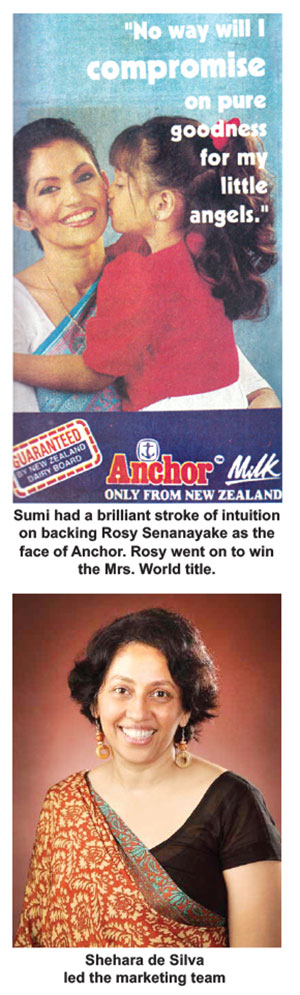
And we had more! The mother we espoused needed to have a face. We picked Rosy Senanayake as the face of Anchor. She was a young mother who, before getting married, had represented Sri Lanka at beauty pageants. She had just the right blend of beauty and that young motherly disposition which fitted in well with the pristinely pure marketing strategy we were portraying. In hindsight, Rosy was a great pick as she continued to be associated with Anchor throughout her career, even after she won the Mrs. World title.
Our strategies worked and our sales began growing exponentially. In just 12 years, my very dedicated team, whom I liked to call my Anchor A Team (named after the famous TV series, the A-Team) and were truly like my family, had gained more than 70% market share. Beating the world’s No. 1 food corporation into second place was one of the biggest highlights of my business career.
I could never have done all this without Maha and Killi, and of course Susil, who was always there with a strong shoulder to cry on after major arguments with principals and suppliers. While Killi and Maha were always positioned together as the brothers running the Maharaja Group, they were diametrically opposing personalities. I knew Killi from our days in Singapore when he would visit us, but my first meeting with Maha was in their office at Bankshall Street, when I had been appointed Managing Director of the newly incorporated Jones Overseas Limited.
Maha, the older of the two, possessed a calm and collected personality, while Killi was very visionary, daring, outgoing and equipped with the courage to be different. But they got on extremely well, sharing company responsibilities with Killi’s personality fitting in well to travel the world to rally business for the company and Maha, managing the finances and controlling expenses.
Now that we had beaten Nespray and we were well entrenched in the milk powder market, it was time for another challenge. I wanted to tackle the milk tea segment, which was dominated by Lakspray, a cheaper product with only 26% fat. NZDB refused to supply us an equivalent to Lakspray as their thought process was that it would affect Anchor’s positioning. But on the ground, we were very aware of the market sentiment and so I arranged a meeting with the Directors of the UK Milk Marketing Board at the Savoy in London. My friend Baba Vairasinghe, who was the local agent for the UK Milk Marketing Board, arranged the meeting and accompanied me to it.
Some tough negotiations later, I left London with a signed contract for the supply of milk powder and payment arranged via a Letter of Credit. Not long after, two container loads of milk powder from the UK Milk Marketing Board arrived in Colombo – one went to Lanka Milk Foods, the producers of Lakspray, and the other to Jones Overseas for our new brand. This was a tough call for me and in fact, put to test the relationship and trust that had been built with NZDB. I knew Anchor was strong and the new brand didn’t pose any competition to Anchor. Eventually I was proved right and that little smudge in our relationship was obliterated.
My very able marketing team, headed by Shehara de Silva who created the brand name Ratthi, which in the Sinhala language means calf, was working overtime literally to make sure we continued our winning streak. We went into the market with a real clarion call and Ratthi didn’t disappoint. The calf was on a winning streak.
But our victories were not without some pain. It goes without saying that the world of business is one of ups and downs, but the challenge we faced in 1986 felt like an abyss and I was falling right into it. It was alleged that I was responsible for a consignment of contaminated weevil-infested full cream milk powder, which had been shipped to a semi-government entity under the Ministry of Trade, from the New Zealand Dairy Board.
The story made headlines in major newspapers with my name splashed across the front pages, even though I was only an indenting agent. I was devastated as I had nothing to do with it. This entity then sent a Letter of Demand for USD 1 million to NZDB and blacklisted the world’s largest exporter of dairy products, from supplying to Sri Lanka. The entire episode was impacting my company’s business very badly.
With the situation in dire straits, NZDB sent a technical team to Sri Lanka for an investigation. It was finally confirmed that this consignment of milk powder had been unloaded into a go-down which previously held rice. The importer had not fumigated the go-down prior to the milk powder being unloaded into it. The technical team then spent months sorting out our bags of milk powder. Even with these findings, the ban remained and our business reputation was suffering badly.
Finally, I couldn’t take the stress anymore and decided to meet my friend Lalith Athulathmudali who was the Minister of Trade. The best time to meet Lalith was when he was at breakfast because we could sit and chat undisturbed. I dealt a lot with him as Minister of Trade, due to the nature of my business. I told him what had happened, the findings of the technical team, and asked him to intervene in lifting the blacklist as the fault was not ours. It had already been proven that we had nothing to do with the unclean go-down.
“I can’t deal with this man,” I told Lalith exasperated, referring to the head of the semi-government entity, and not without a touch of anger. Lalith took one look at me, smiled and said, “Sumi, there’s no man you can’t deal with!” but assured me that he will sort things out, which he did. Looking back, this has been a pattern in my life. Just when I seem to be thrown into challenges that have taken me to the end of my tether sometimes, I seem to find the right person to pull me away from the edge of that precipice.
When it came to the intricacies of business, I was fundamentally self-taught. I had been thrown into the deep end and learned the ropes of commerce and industry on the run, but inherent wisdom told me that some professional value addition in business management would be helpful if I was to conquer the heights I had set for the company. In 1988, I had taken a short course in portfolio management and financial analysis in Geneva. This was a very exciting trip for me as Susil and I had travelled many times to Switzerland and revisiting some of the sites he and I went to, like Mont Blanc and the Matterhorn, gave me much joy. My fellow students and I would study during the week, and on weekends, put our studies aside and take a break doing these tourist runs.
In my quest for upskilling my business acumen, in 1992, I attended a course for chief executives at Wharton Business School at the University of Pennsylvania. This was a great opportunity for me to benchmark my knowledge and business skills with the other course attendees who turned out to be a Who’s Who of global business. I remember the CEOs of ASEA Brown Boveri (ABB) – a Swedish-Swiss MNC, Hewlett-Packard, Procter & Gamble, and ATT being among the participants. Besides learning from an honour roll of erudite economists and financial gurus from the USA, one of the biggest advantages I gained at Wharton was being taught speed reading.
With all the success our milk powder business was having, it was time for us to expand to a new office and factory complex. We obtained a loan of Rs. 600 million from BOC (for the construction of a state-of-the-art milk packing plant, liquid milk processing plant and an office complex. The entire complex was in Biyagama and was designed by Architect Navin Gooneratne. The complex was constructed by Mitsui and Sanken Lanka, which was headed by Ranjith Gunathilake. It housed some of the best dairy processing equipment imported from Holland, Denmark and Germany.
I was completely involved in the project from its very genesis. Both Navin and Ranjith were used to me poring over the designs and asking hundreds of questions, so I could visualise what the end-complex would be like. I knew the measurement of every wall, every angle and every area. I would make frequent visits to the site to keep tabs on progress except when I went on a six-week holiday to Europe with Susil, Anarkali and Aushi. When I returned, my first stop was in Biyagama.
As I drove in I was horrified. There were 16 giant concrete columns running the entire height of the facade of this five storey tall building. I knew this was not a design feature I had approved and immediately called Navin. “What are these monstrous columns doing in the front of my building?” I asked. “I want to make this a green building,” explained Navin patiently. “Those concrete columns are pergolas where plants can be grown. No one will see the concrete building as a result, only green, which will be very pleasing.”
However, I was not pleased. I turned to Ranjith who was privy to this conversation and asked him to remove the 16 columns immediately. “I don’t want to see even a trace of it. You’ll have to saw it off from ground level,” I told him. Ranjith was appalled and Navin was upset. Both tried to talk me out of it but to no avail. I had made up my mind.
The 16 columns disappeared, I was happy and Navin named himself the draftsman of the complex and me, the architect. The rest of the construction period was uneventful and went according to plan.
As Managing Director of Jones Overseas, I had the task of making a speech at the inauguration of the complex. In my address, I said, “I am 51 years old and have worked in this company now for over two decades. The time has come for me to hand over the reins of Managing Director to a younger person.”
No one expected this announcement but in my heart, I knew it was time. We were doing exceptionally well and judging by Sri Lanka’s corporate results, we were only second to Ceylon Tobacco Company in turnover. It’s always good to quit, while at the top!
After the ceremony, while we were returning from Biyagama, the Managing Director of NZDB Warren Larsen who listened to my speech at the inauguration asked me, “Sumi, are you willing to sell the business?” I didn’t think twice and quipped, “If the price is right, we will, but the final decision lies with Killi.”
Warren was determined to pursue the conversation. I had apprised Killi of the inquiry and when Killi hosted the NZDB team to lunch at his home, the subject of the sale of the company came up for discussion. Killi, who was always astute when it came to business deals, gave Warren the sale price based on future earnings. Then began a spate of lengthy negotiations with the finance director of the Maharaja Group entrusted with the task of number crunching. An agreement was reached.
The sale was completed in September 1996 and the same year in December, I resigned as Managing Director. And that was how we sold Jones Overseas to the New Zealand Dairy Board. With the sale of the company, I was considerably ‘well off’ as they say in Sri Lanka, having made sufficient money to enjoy life without running the rat race I had been used to for so long. I looked inwards and said to myself, “It is time to retire, spend time with our girls and travel the world.” And that is exactly what I did.
But I did keep abreast of news of my milk powder baby and was very happy when I learned eventually that Ratthi had got into the No. 1 position in the milk powder market, beating even Anchor, although a little part of me was sad that Anchor had lost that premier spot which we had built quite painstakingly.
However, while everything was looking good at this moment, during the time of the construction of new factory and office complex, I suffered a setback in my health.
I had become very stressed at work with this construction, travelling to Biyagama and back nearly every day, while ensuring our daily operations were on track, and helping Susil with his political affairs as he was now Chief Minister of the Western Province. The pressure was taking its toll on me.
I had a nagging pain in my spine which became quite debilitating. I consulted Prof. Henry Nanayakkara who referred me to Dr. Wijenaike. I was immediately hospitalised at Nawaloka Hospital and an ECG plus a plethora of other tests done.
Every test result came back negative but the debilitating pain persisted. I then flew to London and got myself admitted to Cromwell Hospital. A battery of tests later, every result was negative once again. There was nothing physically wrong with me. However, the doctor at Cromwell Hospital went a step further and referred me to a psychiatrist. A few sessions later, I was told that the pain was induced by stress. I was on the verge of a breakdown.
Killi was continually in touch with me and when I told him the diagnosis, he read the gravity of the situation and checked me into the Givenchy Spa at Trianon Palace Hotel in Versailles. I was placed on a special diet, received daily treatments with injections to my neck, had an exercise regime, revelled in massages and cycled in the evenings on the luscious 250-acre gardens. It was a total ten days of complete R&R and absolute bliss. One of the rules though was having no contact with the outside world, not even with family. The treatment, which I found out later that Killi had paid for in its entirety, worked.
Through these ten days, Susil was tasked with looking after Anarkali and Aushi. They went off on holiday to Yala with our lifelong friend Navin Gooneratne and his family. Ten days later, I returned to Sri Lanka – with no back pain – refreshed, rejuvenated and having regained my strength. I was ready to complete one of the biggest projects I had taken on – the construction of the new factory and office complex.
Just like everything in my life, I needed to be in control, even when it came to my illness. Through my bouts in hospitals, tests and spa treatment, I would absorb the details of the medical information by listening to doctors, scouring the reports and conducting my own extensive research. Susil himself had various medical issues – from cardiac, to cataract to kidney stones to septicaemia and everything else in-between, and I learned early on that I needed to be as well informed as the medical professionals, to be able to ask the relevant questions. Now I had added to my medical information arsenal and was becoming quite adept at dishing out medical advice, acquiring the title of having an honorary MBBS!
While this was generally a subject that prompted some mirth at dinner conversations, the arsenal I had collated did come in handy. When Anarkali developed a spine ache similar to mine while she was at Merrill Lynch, I knew exactly what to do. Her job was stressful, had long hours and gave her no free time. I organised a treatment regimen for her, similar to what I had at the Givenchy Spa, but at her apartment at Kensington Green, which was a gated community and close to Cromwell Hospital. Ten days later, Anarkali’s back pain disappeared and she was free from pain.
(Extracted from Sumi Moonesinghe’s Memoirs)