Life style
The many faces of betel leaf

by Randima Attygalle
A motif of prosperity, new beginnings and goodwill, the betel leaf interlaces the multi-cultural Sri Lankan society. Bulath in Sinhalese and Vettilai in Tamil, this glossy heart-shaped leaf of cultural and religious connotations, is an ‘evergreen presence’ at many a moment of Lankan lives. Among the 40 leaves of the standard betel sheaf or bulath hurulla lie a sense of welcome, reverence, renewed family ties, forgiveness and blessings.


Legend has it that the betel leaf originated in the mythical land of nagas and was brought to the world of humans by a cobra or a nagaya holding the leaf by its tip. This belief renders it the name nagavalli or snake creeper in Telegu. Interestingly, betel chewers discard the tip and the stalk of the leaf before they chew it. This evergreen climber is believed to have been introduced to us and other South Asian countries by the Chinese and Arab merchants who brought it from Malaysia and the surrounding East Asian region.
Apart from its significance in religious canon including jataka stories, betel is mentioned in historical sources such as Mahabharatha, Mahavansa and Ramayana, says Senarath Wickramasinghe, Deputy Director (Cultural), Department of National Museums. Stone inscription in Mihintale, according to Wickramasinghe, is one of the earliest historical sources of ours which alludes to betel by its reference to deheth offered to the priests. “Sharing of betel and its accompanying condiments of dried tobacco, slake lime or chunam and arecanut for a chew remains a cultural expression of friendship and brotherhood in traditional Sri Lankan social life,” says Wickramasinghe. A carefully arranged betel tray along with these condiments in the open verandah of a village home is an invitation to any visitor to have a chew. Today it is a diminishing sight and the other essentials once associated with betel chewing have become things of the past.
The betel bags (bulath malu), chunam boxes (hunu killotaya), betel tray (hepppuwa) and arecanut slicer (giraya) were elaborately designed reflecting the skill of the ancient Sri Lankan artisan. “While chunam boxes from Anuradhapura and Polonnaruwa periods have been found, the oldest betel bags intricately embroidered, date back to the Kandyan period,” says the Museum official who goes onto note that while the nobility used betel trays cast in bronze or brass, the ordinary folk used a tray made out of reed called ‘kooru adiya.’ The chunam boxes found either in copper or brass were also ornamented. The giraya often made in brass was embellished with native fauna and flora patterns. Its head was designed in various shapes including that of a woman in a greeting position.
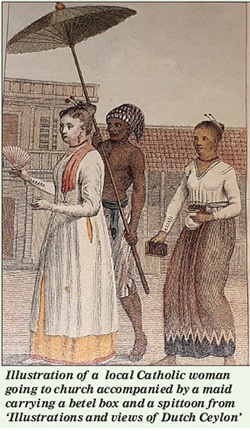
The royals and aristocrats had their attendants carrying their betel related paraphernalia including the spittoon (padikkama) and the betel pounder or bulath wangediya. The colonial historians too record this local indulgence in their work. The water colour painting of the betel leaf by the Dutch painter Jan Brandes in his work, The World of Jan Brandes 1743-1808 and the illustration of a local Catholic woman going to church accompanied by a maid carrying a betel box and a spittoon in Illustrations and views of Dutch Ceylon 1602-1796 are among these records.
More than an indulgence, betel is today one of our major exports, Pakistan being the largest importer. Middle East, Canada, USA, Japan, UK, Australia, Norway and Germany are among the other leading importers. The other major betel growing countries are India, Thailand and Bangladesh.
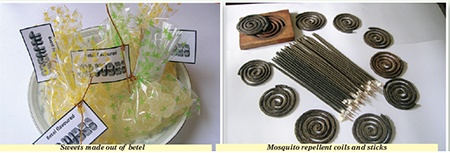

While betel is grown across the island, the export quality crop of thick dark green known as Kalu bulath is found in Kurunegala, Gampaha, Kegalle, Kalutara and Colombo districts. Different cultivars are grown by farmers including Mahamaneru, Kudamaneru, Ratadalu, Galdalu and Gatathodu. For commercial purposes, Mahamaneru and Ratadalu are the most commonly grown. The Inter-cropping and Betel Research Station of the DEA, through a series of plant breeding programmes, had released two high yielding varieties with high quality parameters named Naram mali and Naram rathi.
Betel Leaf Blight (BLB) disease is the most feared in betel cultivation. “This could destroy an entire cultivation within a few weeks,” explains Subasinghe who notes that research is in progress to evaluate different traditional treatments used by farmers to fight the disease.

Betel is also rich in medicinal properties. The potential for betel-based anti-diabetic and gastro protective drugs are many says the scientist. “Anti-fungal, anti-bacterial and anti-protozoan properties of betel can kill or inhibit some bacteria which cause diseases such as typhoid, cholera and tuberculosis. Its antioxidant properties have a cancer preventive effect. Research has also revealed that betel oil is rich in healing properties. Betel leaves can also prevent indigestion, bronchitis, constipation, congestion, coughs and asthma.”
(Pic credit Department of Export Agriculture and Department of National Museums)