
Features
The JRJ Personal and how he ran the show

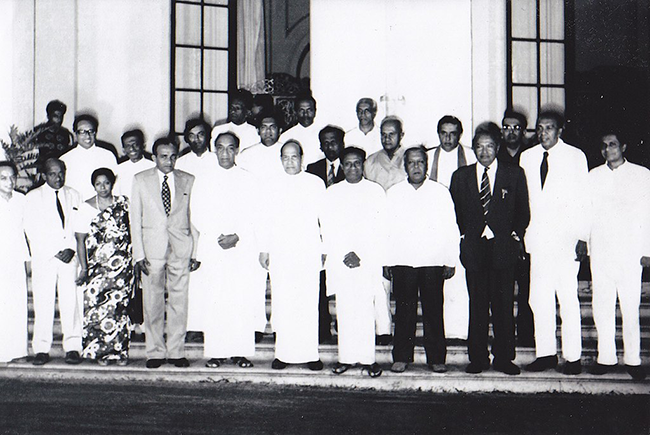
by Sarath Amunugama
In the early Ceylon National Congress of which he and Dudley became joint Secretaries, JRJ was a committed rationalist while Dudley was typically less sure and a person who sometimes succumbed to his father’s admonitions. Largely to target Bandaranaike and his vacillating members of the Sinhala Maha Sabha which included Dudley and Sir John, JRJ sponsored a motion in the Ceylon National Congress that its members could not concurrently be members of other political formations.
This was opposed not only by Bandaranaike but also DS. Of all the young politicians it was only JRJ who categorically refused to join the Sinhla Maha Sabha. JRJ believed in the superiority of rationality and unflinching will. His heroes were Napoleon and Disraeli, both of whom rose to leadership because of their tactical skills and tenacity. He and his brother Harry would boast that they had read every book written about these two personalities.
Of all our Presidents it was JRJ who had a scholar’s interest in history. He had read widely and was well informed of the history of Buddhism and Sri Lanka. He once told me that he used to visit historical sites with Archeological Commissioner Senerat Paranavitana. His speeches were full of allusions to Buddhist and Sinhalese history. It is my interpretation that he looked on the Executive Presidency not only through western eyes but also as a form of leadership which had evolved through Sinhala kingship.
To him the President was the equivalent of the Sinhala ruler in his powers as well as benevolence and concern for the public good. Like the Sinhala ruler he wanted to be ‘A father to his people’ He told his listeners, including President Ronald Reagan, that he came from a long line of Sinhala rulers who wielded power for 2,500 years. It must be stated here however that this was exactly what the opposition was worried about. As NM Perera and Colvin R de Silva had said on many occasions, they could not agree to a concept of an omnipotent President, just as much as they had criticized the pre-modern social structures of feudalism and kingship.
Not surprisingly this was the same criticism levelled by French critics of the Gaullist constitution as creating “Le roi De Gaulle” – De Gaulle the King. In many ways De Gaulle and JRJ shared common characteristics. The sense of history, the idea that previous attempts at governance had failed, the need for a strong leader who was tried and tested who put the national interest above all, a leader who distanced himself from the ‘hoi poloi’ and instilled fear in his own ranks were common to both leaders.
They were both thought to be aloof but committed to the glory of a nation with a sublime history. Both said “trust me and not the institutions” which have failed. Ironically both men ran into organized oppositions which were ruthless and unsparing and had to unhappily retire to their personal homes and away from the hurly burly of politics which had been their fifes mission.
Nayaka Thuma
Political parties have evolved modes of addressing their leaders. The left called their leaders ‘comrades’ which was translated into Sinhala as `sahodarayas’ [brothers]. It led to cultural misunderstandings when sons and daughters of leaders began to address their parents as `sahodarayas’ at public meetings leading to peals of laughter of disbelief from the party faithful. Both DS and Bandaranaike were called ‘Lokka’ by their followers, usually out of their hearing. Mrs. B was universally and respectfully addressed as `Methiniya’.
But JRJ preferred to be addressed as ‘Nayaka Thuma’ which is the closest approximation to undisputed leader or ‘Der Fuhrer’. In his watch there could be only one leader and `Nayaka Thuma’ made sure that all, including the ambitious Premadasa who was a great wordsmith himself, got the message. After JRJ other UNP leaders used the same appellation but with less and less acceptance by the rank and file till under Ranil it became a word of abuse.
It was with supreme confidence that JRJ adapted Napoleon’s phrase to say that he ‘had rolled up the electoral map of Sri Lanka’. Even when he addressed President Reagan and his guests at a White House dinner, JRJ claimed that as Head of State he was in a line with an uninterrupted leadership of over 2,500 years. He did not say that USA had only just celebrated its bi-centennial.
JRJ always crafted his speeches. They were short and full of memorable phrases. He was the earliest to end his speeches with quotations from the Buddha’s teachings. Bandaranaike, like JRJ a convert to Buddhism from Anglican Christianity, never resorted to the use of Buddhist stanzas and imagery. He was at home with Western classics. Once JRJ told me that if you cannot convey your message in ten minutes, even an hour of speech time would be of no use.
He had no time for the Bandaranaike type of oratory. On several occasions when he addressed small groups, like corporation workers, he would effortlessly speak in English and I would translate it to Sinhala. He was a much better speaker in English than in Sinhala, though with his usual thoroughness he had taken Sinhala lessons early in his political career. We were amused when he continued to use Sinhala phrases of the thirties but were now out of vogue.
JRJ believed that the leader should be exemplary. Whether he believed in the concept of the Nietzschean superman or not, he elevated the role of the National leader who in his life style and political acumen dominates society He was an admirer of Gandhi and in his heroic period as Leader of the Opposition he tried to use Gandhian tactics such as Satyagraha, long marches and pujas in Temples and Kovils. But, also like Gandhi, he did not encourage obscurantism.
While accommodating political forays into religion he had contempt for superstition and rituals. One of his oft related stories was about how he was sworn in as President. In 1977, he said, he took oaths as Prime Minister as soon as possible as he did not want any disruption by SLFPers and leftists. He had no time to consult astrologers. In 1983 it was different. Menikdiwela had consulted the best astrologers and he took his oaths at the appointed time. The first term was trouble free, he said, but the astrologically ordained second term was a disaster.
So much for astrology. His Buddhism, which he studied diligently, was of the intellectual type based on the translations of the Pali Text Society which some social anthropologists have called ‘Euro Buddhism’. But he is the only leader I know who had donated extensive personal properties to the Sangha [an exception is Wijepala Mendis who donated his lands to the Sangha in memory of his son who committed suicide.]
Under JR’s watch no priest was allowed to contest for seats from the UNP. When senior monks came to discuss ethnic relations with him, he asked them to mind their own business just as he did not advise them on Sangha matters. It was the concept of ‘the national leader’ that animated his drive to abolish the 1972 Constitution and establish a new Constitution with wide powers of the Executive President. The Executive Presidency had flourished ever since, in spite of the monotonous pledge of every Presidential aspirant to abolish it. The ‘Chintanaya’ introduced by him facilitating an Open Economy remains the same under different catchy phrases in the manifestos of all would be Executive Presidents. The Executive Presidency itself still remains with added powers.
Two years after his death a newspaper asked me to reminisce about JRJ’s personality. I wrote the following article entitled `Thinking of JRJ’:
“Before 1983, even the casual caller at ‘Braemar’ in Ward Place was likely to find the door being opened for him by President Jayewardene himself. Then calling his big black dog to heel he would lead you with that characteristic shuffle of his feet to a little front office with a ‘swing door’.
“The first things that struck you about JRJ was his simplicity and neatness. Everything about him was unpretentious but neatly and methodically arranged. It stood in stark contrast to the vulgar displays of many of his ‘nouveau riche’ parliamentary colleagues. There is a saying that ‘old money never shows’. This was very true of JRJ. Visitors were taken aback when JRJ after politely inquiring whether you wanted tea or a cool drink would a little later shuffle towards you to serve the drink himself From time to time he would take his confidantes out onto his spacious garden where they would be served a choice whisky or a brandy.
“As President he would invite his close friends for dinner at his table in Queen’s House and linger over brandy and cigars reminiscing about great political figures. He admired D.S. Senanayake and would regale his young devotees with stories about the Old Man’s political acumen. One of his favourite stories was about how he and the young Turks of the Ceylon National Congress including Dudley, went to issue an ultimatum to Sir Don Baron Jayatillake at his residence and was so moved by the kindly old leader and his fatherly advice that they hastily aborted their plans.
“The ‘Wap Magula’ was one of JRJ’s brain waves which he drew from his readings of the ancient lore of Sri Lanka — another of his intellectual pursuits. During Dudley Senanayake’s first premiership, he arranged a ‘Wap Magula’ at which Sir Oliver Goonetillake, who was usually dressed in Saville Row clothes, was forced to step into a paddy field with a China silk sarong tucked between his legs. This naturally caused much mirth among the poor village farmers of Akmeemana where the ceremony was held. Sir Oliver had to endure the barbs of satirists like Tarzie Vittachi for the rest of his life for his unfamiliar sartorial transformation.
“The JRJ sponsored Wap Magula’ at Panduwasnuwara in 1978 was not much better. The Agriculture Minister EL Senanayake turned up in a sarong, banian, Nike tennis shoes and Gucci sunglasses. As soon as he set foot in the paddy field he sank up to his knees. There was pandemonium as ministers jostled to appear with JRJ in the news photos. They did not have a clue about ploughing and were thrashing about. The President however confidently handled the plough even though he was warned that the buffaloes might bolt because of the huge klieg lights flashed on them by the Government Film Unit.
“A week later a documentary film made of that ceremony was screened at ‘Braemar’ for the President’s friends. JRJ was mightily pleased when all agreed that he, at 73, had the best figure among the politicians who had stripped down to their loin cloths for the ‘Wap Magula’.
“One of JRJ’s great characteristics was that he was never excited or overawed by anything. Once he made up his mind he would go to the bitter end, come what may. He used to relate how an inner clique had tried to isolate him in the Dudley Senanayake cabinet. This group would meet beforehand and plan to humiliate him at Cabinet meetings. He was stripped of some of the departments in his ministry – particularly control of the media, as someone had carried tales that he was trying to build himself up in the public eye.
“Unperturbed JRJ had taken the ‘Time’ magazine to cabinet and was busy reading it while his ministerial colleagues waited in vain for him to speak, to begin their attack. When Lalith and Gamini left the Premadasa Cabinet he recalled this episode and advised them to remain within the government. They ignored his advice and faced many difficulties later.
“After the historic signing of the Indo – Sri Lanka Accord JRJ shuffled up to the microphone and looking Rajiv Gandhi straight in the eye said “We can forgive but we cannot forget”. But the trust that was soon built up between the two leaders was so strong that Rajiv threw caution to the winds and came to JRJ’s rescue by inducting Indian troops to the North and East thereby releasing Sri Lankan security forces to fight the JVP in the South.
“It is one of the supreme ironies of modern times in our country that had Rajiv not come to Sri Lanka and had he not been subjected to an attack by a JVP indoctrinated naval rating, India may not have intervened, and certainly not so swiftly, and thereby caught the JVP on the wrong foot. The JVP rating made a costly mistake. The JVP by turning to violence opened the door to Indian intervention which JRJ meant to be only an action of the last resort. A section of the UNP that stabbed JRJ in the back, after the Indo-lanka agreement was signed were also responsible for encouraging the JVP. During those days the President was at his stubborn best resolutely refusing to yield to communalism and going back on a pledge given to a neighboring country.
“Coming from a distinguished legal family one of his failings was that he looked on most problems in legal terms. This is a common failing of lawyers in Parliaments all over the world. Since they spend a lifetime preparing, presenting, and defending bits and pieces of legislation they think that changes and additions to the statute book solves all problems.
“Life is rarely like that. But the over dependence on the law and cynical interpretations of legal provisions led JRJ and his supporters to many undemocratic acts and to violations of human rights. Amendments to the constitution to solve parochial political issues led to the debasement of the Constitution and the Presidency. The cynical manipulation of power to harass Vijaya Kumaratunga and his hypocritical persecution of the left, including the JVP after the April disturbances, were examples of the abuse of executive authority. He also condoned the abuses of the army under ‘Bull’ Weeratunga in the north against the Tamil youth which hastened the militarization of the conflict and added to the bitterness of the combatants.
“One always sensed that ‘Papa knows best’ type of feeling when JRJ discussed constitutional issues. He knew that so called legal eagles and human rights activists who confronted him were his intellectual inferiors. ‘This was one aspect of his ego which was assiduously massaged by acolytes like Lalith and Gamini. This legal ambience in the cabinet was galling to Premadasa who was a realist brought up in the school of hard knocks. He too then went about saying “I also know the law”, since he was brought up in Hulftsdorp. Later he gave free rein to the military and para-military formations who battled the LTTE and the JVP.
“President Jayewardene’s death removes from the scene a dominant personality of post-independence Sri Lanka. He was a political giant in every way”.
Cabinet
It would be fair to say that JRJ had the most competent Cabinet of Ministers of modern times. As usual the new Prime Minster had been very thorough in his decision making. He first accommodated all the seniors who were Cabinet ministers in previous UNP governments. Premadasa, M.D.H. Jayawardene, Monty Jayawickreme, E.L. Senanayake, Mohamed and Hurulle were all thus accommodated. He also brought in party seniors who had helped him like Mathew, Hameed, Festus Perera, Jayasuriya and Wijetunga.
Having secured that flank he chose two technocrats Ronnie de Mel and Nissanka Wijeratne, both ex-CCS, to man key ministries-Finance for de Mel and Education for Wijeyaratne. Last, he inducted two young stars of the party, Gamini Dissanayake and Lalith Athulathmudali. They too were given plum portfolios. Everybody could see the logic of the leader’s decisions and there was little of the heartburn that usually follows the selection of cabinet ministers.
Another key factor was that JRJ was clearly ‘Primus inter pares’. While he acknowledged that the victory was a combined effort, ministers knew that he was supreme, having brought the UNP to a historic and unprecedented win which would have been unthinkable under the Senanayakes. He also made it known that he would not brook any underhand maneuvering which had been a regular feature of Sri Lankan party politics.
Later on, we will see that there was some dissatisfaction among his senior colleagues -M.D.H. Jayawardana, Gamini Jayasuriya and E.L. Senanayake. JRJ showed no mercy to them in asking for their resignation from their ministerial positions when disagreements came to the surface. But both sides stuck to the rules and the transitions took place in a civilized manner with JRJ writing to them to thank them for services rendered.
While the cabinet ministers were able and willing, several of them were highly ambitious and had no doubts about their fitness to succeed the Old Man who in his own words had “climbed to the top of the greasy pole” at the ripe age of 72. He was fighting fit and unfailingly followed every morning, a rigorous exercise regime tailored for the Canadian Air Force, but that did not prevent several of his Ministers nursing ambitions of succeeding him one day.
Their hopes were raised even before the 1977 election when JRJ, with no warning, held a straw poll to form a 10-man committee to manage the election campaign. Premadasa came first by a small margin. The surprise was Gamini Dissanayake’s performance coming a strong second, thus fueling his already vaulting ambition. Ronnie de Mel and Lalith Athulathmudali also made it to the group. It sent a clear signal to Premadasa and the party seniors that they would not have a cakewalk to the top. It also created a sense of competition among the front runners which simmered right through JRJ’s two terms and blew the party apart after Premadasa donned the mantle.
While this competition helped in running an efficient administration it must be recognized that it exacerbated tensions among the front runners. JRJ gave ear to them all and while not discouraging them did not overtly back any one of them either. He was a master at giving each of them hope, while not showing his hand in any way. To complicate matters there were two others outside this ring who believed that they had JRJ’s blessings to go to the top. One was Anandatissa de Alwis, a party grandee who managed both the political and personal entanglements of Sir John Kotelawala.
He was the kingpin of the UNP youth league in the early days and had been recruited by JRJ as his Permanent Secretary in the 1965 Dudley led administration. They were close friends and the leader’s unilateral decision to make him Speaker of the House did not please Ananda who wanted to be a Minister, preferably in charge of the old ministry in which he was Permanent Secretary. The other was Upali Wijewardene, JRJ’s cousin who had emerged as a clever and ambitious business magnate.
He wrapped himself in the mantle of a hero of the south because his mother and the source of his wealth came from a prominent family in the southern heartland. This was a direct affront to Ronnie de Mel, who also was burnishing his southern credentials as the representative for Devinuwara, the abode of Vishnu- the guardian god of the South. Vishnu is believed to be the only god who did not run away when the Buddha was threatened-by Mara.








by Dr Gotabhya Ranasinghe
Senior Consultant Cardiologist
National Hospital Sri Lanka
When we sought a meeting with Hon Dr. Ramesh Pathirana, Minister of Health, he graciously cleared his busy schedule to accommodate us. Renowned for his attentive listening and deep understanding, Minister Pathirana is dedicated to advancing the health sector. His openness and transparency exemplify the qualities of an exemplary politician and minister.
Dr. Palitha Mahipala, the current Health Secretary, demonstrates both commendable enthusiasm and unwavering support. This combination of attributes makes him a highly compatible colleague for the esteemed Minister of Health.
Our discussion centered on a project that has been in the works for the past 30 years, one that no other minister had managed to advance.
Minister Pathirana, however, recognized the project’s significance and its potential to revolutionize care for heart patients.
The project involves the construction of a state-of-the-art facility at the premises of the National Hospital Colombo. The project’s location within the premises of the National Hospital underscores its importance and relevance to the healthcare infrastructure of the nation.
This facility will include a cardiology building and a tertiary care center, equipped with the latest technology to handle and treat all types of heart-related conditions and surgeries.
Securing funding was a major milestone for this initiative. Minister Pathirana successfully obtained approval for a $40 billion loan from the Asian Development Bank. With the funding in place, the foundation stone is scheduled to be laid in September this year, and construction will begin in January 2025.
This project guarantees a consistent and uninterrupted supply of stents and related medications for heart patients. As a result, patients will have timely access to essential medical supplies during their treatment and recovery. By securing these critical resources, the project aims to enhance patient outcomes, minimize treatment delays, and maintain the highest standards of cardiac care.
Upon its fruition, this monumental building will serve as a beacon of hope and healing, symbolizing the unwavering dedication to improving patient outcomes and fostering a healthier society.We anticipate a future marked by significant progress and positive outcomes in Sri Lanka’s cardiovascular treatment landscape within the foreseeable timeframe.

by Fr. Emmanuel Fernando, OMI
Jesuit Fr. Aloysius Pieris (affectionately called Fr. Aloy) celebrated his 90th birthday on April 9, 2024 and I, as the editor of our Oblate Journal, THE MISSIONARY OBLATE had gone to press by that time. Immediately I decided to publish an article, appreciating the untiring selfless services he continues to offer for inter-Faith dialogue, the renewal of the Catholic Church, his concern for the poor and the suffering Sri Lankan masses and to me, the present writer.
It was in 1988, when I was appointed Director of the Oblate Scholastics at Ampitiya by the then Oblate Provincial Fr. Anselm Silva, that I came to know Fr. Aloy more closely. Knowing well his expertise in matters spiritual, theological, Indological and pastoral, and with the collaborative spirit of my companion-formators, our Oblate Scholastics were sent to Tulana, the Research and Encounter Centre, Kelaniya, of which he is the Founder-Director, for ‘exposure-programmes’ on matters spiritual, biblical, theological and pastoral. Some of these dimensions according to my view and that of my companion-formators, were not available at the National Seminary, Ampitiya.
Ever since that time, our Oblate formators/ accompaniers at the Oblate Scholasticate, Ampitiya , have continued to send our Oblate Scholastics to Tulana Centre for deepening their insights and convictions regarding matters needed to serve the people in today’s context. Fr. Aloy also had tried very enthusiastically with the Oblate team headed by Frs. Oswald Firth and Clement Waidyasekara to begin a Theologate, directed by the Religious Congregations in Sri Lanka, for the contextual formation/ accompaniment of their members. It should very well be a desired goal of the Leaders / Provincials of the Religious Congregations.
Besides being a formator/accompanier at the Oblate Scholasticate, I was entrusted also with the task of editing and publishing our Oblate journal, ‘The Missionary Oblate’. To maintain the quality of the journal I continue to depend on Fr. Aloy for his thought-provoking and stimulating articles on Biblical Spirituality, Biblical Theology and Ecclesiology. I am very grateful to him for his generous assistance. Of late, his writings on renewal of the Church, initiated by Pope St. John XX111 and continued by Pope Francis through the Synodal path, published in our Oblate journal, enable our readers to focus their attention also on the needed renewal in the Catholic Church in Sri Lanka. Fr. Aloy appreciated very much the Synodal path adopted by the Jesuit Pope Francis for the renewal of the Church, rooted very much on prayerful discernment. In my Religious and presbyteral life, Fr.Aloy continues to be my spiritual animator / guide and ongoing formator / acccompanier.
Fr. Aloysius Pieris, BA Hons (Lond), LPh (SHC, India), STL (PFT, Naples), PhD (SLU/VC), ThD (Tilburg), D.Ltt (KU), has been one of the eminent Asian theologians well recognized internationally and one who has lectured and held visiting chairs in many universities both in the West and in the East. Many members of Religious Congregations from Asian countries have benefited from his lectures and guidance in the East Asian Pastoral Institute (EAPI) in Manila, Philippines. He had been a Theologian consulted by the Federation of Asian Bishops’ Conferences for many years. During his professorship at the Gregorian University in Rome, he was called to be a member of a special group of advisers on other religions consulted by Pope Paul VI.
Fr. Aloy is the author of more than 30 books and well over 500 Research Papers. Some of his books and articles have been translated and published in several countries. Among those books, one can find the following: 1) The Genesis of an Asian Theology of Liberation (An Autobiographical Excursus on the Art of Theologising in Asia, 2) An Asian Theology of Liberation, 3) Providential Timeliness of Vatican 11 (a long-overdue halt to a scandalous millennium, 4) Give Vatican 11 a chance, 5) Leadership in the Church, 6) Relishing our faith in working for justice (Themes for study and discussion), 7) A Message meant mainly, not exclusively for Jesuits (Background information necessary for helping Francis renew the Church), 8) Lent in Lanka (Reflections and Resolutions, 9) Love meets wisdom (A Christian Experience of Buddhism, 10) Fire and Water 11) God’s Reign for God’s poor, 12) Our Unhiddden Agenda (How we Jesuits work, pray and form our men). He is also the Editor of two journals, Vagdevi, Journal of Religious Reflection and Dialogue, New Series.
Fr. Aloy has a BA in Pali and Sanskrit from the University of London and a Ph.D in Buddhist Philosophy from the University of Sri Lankan, Vidyodaya Campus. On Nov. 23, 2019, he was awarded the prestigious honorary Doctorate of Literature (D.Litt) by the Chancellor of the University of Kelaniya, the Most Venerable Welamitiyawe Dharmakirthi Sri Kusala Dhamma Thera.
Fr. Aloy continues to be a promoter of Gospel values and virtues. Justice as a constitutive dimension of love and social concern for the downtrodden masses are very much noted in his life and work. He had very much appreciated the commitment of the late Fr. Joseph (Joe) Fernando, the National Director of the Social and Economic Centre (SEDEC) for the poor.
In Sri Lanka, a few religious Congregations – the Good Shepherd Sisters, the Christian Brothers, the Marist Brothers and the Oblates – have invited him to animate their members especially during their Provincial Congresses, Chapters and International Conferences. The mainline Christian Churches also have sought his advice and followed his seminars. I, for one, regret very much, that the Sri Lankan authorities of the Catholic Church –today’s Hierarchy—- have not sought Fr.
Aloy’s expertise for the renewal of the Catholic Church in Sri Lanka and thus have not benefited from the immense store of wisdom and insight that he can offer to our local Church while the Sri Lankan bishops who governed the Catholic church in the immediate aftermath of the Second Vatican Council (Edmund Fernando OMI, Anthony de Saram, Leo Nanayakkara OSB, Frank Marcus Fernando, Paul Perera,) visited him and consulted him on many matters. Among the Tamil Bishops, Bishop Rayappu Joseph was keeping close contact with him and Bishop J. Deogupillai hosted him and his team visiting him after the horrible Black July massacre of Tamils.
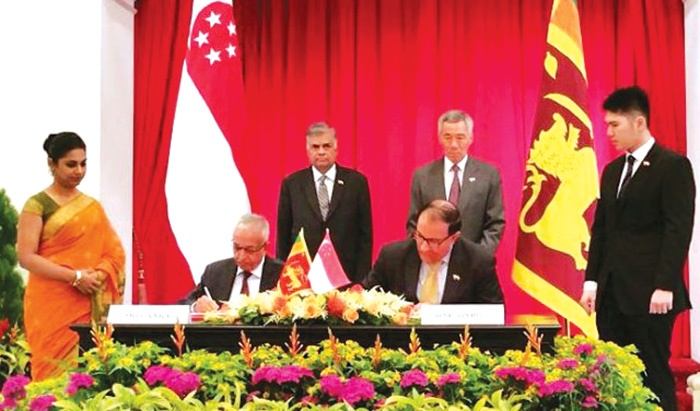
Sri Lanka-Singapore Free Trade Agreement
By Gomi Senadhira
senadhiragomi@gmail.com
“You might tell fairy tales, but the progress of a country cannot be achieved through such narratives. A country cannot be developed by making false promises. The country moved backward because of the electoral promises made by political parties throughout time. We have witnessed that the ultimate result of this is the country becoming bankrupt. Unfortunately, many segments of the population have not come to realize this yet.” – President Ranil Wickremesinghe, 2024 Budget speech
Any Sri Lankan would agree with the above words of President Wickremesinghe on the false promises our politicians and officials make and the fairy tales they narrate which bankrupted this country. So, to understand this, let’s look at one such fairy tale with lots of false promises; Ranil Wickremesinghe’s greatest achievement in the area of international trade and investment promotion during the Yahapalana period, Sri Lanka-Singapore Free Trade Agreement (SLSFTA).
It is appropriate and timely to do it now as Finance Minister Wickremesinghe has just presented to parliament a bill on the National Policy on Economic Transformation which includes the establishment of an Office for International Trade and the Sri Lanka Institute of Economics and International Trade.
Was SLSFTA a “Cleverly negotiated Free Trade Agreement” as stated by the (former) Minister of Development Strategies and International Trade Malik Samarawickrama during the Parliamentary Debate on the SLSFTA in July 2018, or a colossal blunder covered up with lies, false promises, and fairy tales? After SLSFTA was signed there were a number of fairy tales published on this agreement by the Ministry of Development Strategies and International, Institute of Policy Studies, and others.
However, for this article, I would like to limit my comments to the speech by Minister Samarawickrama during the Parliamentary Debate, and the two most important areas in the agreement which were covered up with lies, fairy tales, and false promises, namely: revenue loss for Sri Lanka and Investment from Singapore. On the other important area, “Waste products dumping” I do not want to comment here as I have written extensively on the issue.
1. The revenue loss
During the Parliamentary Debate in July 2018, Minister Samarawickrama stated “…. let me reiterate that this FTA with Singapore has been very cleverly negotiated by us…. The liberalisation programme under this FTA has been carefully designed to have the least impact on domestic industry and revenue collection. We have included all revenue sensitive items in the negative list of items which will not be subject to removal of tariff. Therefore, 97.8% revenue from Customs duty is protected. Our tariff liberalisation will take place over a period of 12-15 years! In fact, the revenue earned through tariffs on goods imported from Singapore last year was Rs. 35 billion.
The revenue loss for over the next 15 years due to the FTA is only Rs. 733 million– which when annualised, on average, is just Rs. 51 million. That is just 0.14% per year! So anyone who claims the Singapore FTA causes revenue loss to the Government cannot do basic arithmetic! Mr. Speaker, in conclusion, I call on my fellow members of this House – don’t mislead the public with baseless criticism that is not grounded in facts. Don’t look at petty politics and use these issues for your own political survival.”
I was surprised to read the minister’s speech because an article published in January 2018 in “The Straits Times“, based on information released by the Singaporean Negotiators stated, “…. With the FTA, tariff savings for Singapore exports are estimated to hit $10 million annually“.
As the annual tariff savings (that is the revenue loss for Sri Lanka) calculated by the Singaporean Negotiators, Singaporean $ 10 million (Sri Lankan rupees 1,200 million in 2018) was way above the rupees’ 733 million revenue loss for 15 years estimated by the Sri Lankan negotiators, it was clear to any observer that one of the parties to the agreement had not done the basic arithmetic!
Six years later, according to a report published by “The Morning” newspaper, speaking at the Committee on Public Finance (COPF) on 7th May 2024, Mr Samarawickrama’s chief trade negotiator K.J. Weerasinghehad had admitted “…. that forecasted revenue loss for the Government of Sri Lanka through the Singapore FTA is Rs. 450 million in 2023 and Rs. 1.3 billion in 2024.”
If these numbers are correct, as tariff liberalisation under the SLSFTA has just started, we will pass Rs 2 billion very soon. Then, the question is how Sri Lanka’s trade negotiators made such a colossal blunder. Didn’t they do their basic arithmetic? If they didn’t know how to do basic arithmetic they should have at least done their basic readings. For example, the headline of the article published in The Straits Times in January 2018 was “Singapore, Sri Lanka sign FTA, annual savings of $10m expected”.
Anyway, as Sri Lanka’s chief negotiator reiterated at the COPF meeting that “…. since 99% of the tariffs in Singapore have zero rates of duty, Sri Lanka has agreed on 80% tariff liberalisation over a period of 15 years while expecting Singapore investments to address the imbalance in trade,” let’s turn towards investment.
Investment from Singapore
In July 2018, speaking during the Parliamentary Debate on the FTA this is what Minister Malik Samarawickrama stated on investment from Singapore, “Already, thanks to this FTA, in just the past two-and-a-half months since the agreement came into effect we have received a proposal from Singapore for investment amounting to $ 14.8 billion in an oil refinery for export of petroleum products. In addition, we have proposals for a steel manufacturing plant for exports ($ 1 billion investment), flour milling plant ($ 50 million), sugar refinery ($ 200 million). This adds up to more than $ 16.05 billion in the pipeline on these projects alone.
And all of these projects will create thousands of more jobs for our people. In principle approval has already been granted by the BOI and the investors are awaiting the release of land the environmental approvals to commence the project.
I request the Opposition and those with vested interests to change their narrow-minded thinking and join us to develop our country. We must always look at what is best for the whole community, not just the few who may oppose. We owe it to our people to courageously take decisions that will change their lives for the better.”
According to the media report I quoted earlier, speaking at the Committee on Public Finance (COPF) Chief Negotiator Weerasinghe has admitted that Sri Lanka was not happy with overall Singapore investments that have come in the past few years in return for the trade liberalisation under the Singapore-Sri Lanka Free Trade Agreement. He has added that between 2021 and 2023 the total investment from Singapore had been around $162 million!
What happened to those projects worth $16 billion negotiated, thanks to the SLSFTA, in just the two-and-a-half months after the agreement came into effect and approved by the BOI? I do not know about the steel manufacturing plant for exports ($ 1 billion investment), flour milling plant ($ 50 million) and sugar refinery ($ 200 million).
However, story of the multibillion-dollar investment in the Petroleum Refinery unfolded in a manner that would qualify it as the best fairy tale with false promises presented by our politicians and the officials, prior to 2019 elections.
Though many Sri Lankans got to know, through the media which repeatedly highlighted a plethora of issues surrounding the project and the questionable credentials of the Singaporean investor, the construction work on the Mirrijiwela Oil Refinery along with the cement factory began on the24th of March 2019 with a bang and Minister Ranil Wickremesinghe and his ministers along with the foreign and local dignitaries laid the foundation stones.
That was few months before the 2019 Presidential elections. Inaugurating the construction work Prime Minister Ranil Wickremesinghe said the projects will create thousands of job opportunities in the area and surrounding districts.
The oil refinery, which was to be built over 200 acres of land, with the capacity to refine 200,000 barrels of crude oil per day, was to generate US$7 billion of exports and create 1,500 direct and 3,000 indirect jobs. The construction of the refinery was to be completed in 44 months. Four years later, in August 2023 the Cabinet of Ministers approved the proposal presented by President Ranil Wickremesinghe to cancel the agreement with the investors of the refinery as the project has not been implemented! Can they explain to the country how much money was wasted to produce that fairy tale?
It is obvious that the President, ministers, and officials had made huge blunders and had deliberately misled the public and the parliament on the revenue loss and potential investment from SLSFTA with fairy tales and false promises.
As the president himself said, a country cannot be developed by making false promises or with fairy tales and these false promises and fairy tales had bankrupted the country. “Unfortunately, many segments of the population have not come to realize this yet”.
(The writer, a specialist and an activist on trade and development issues . )



US sports envoys to Lanka to champion youth development

Rahuman questions sudden cancellation of leave of CEB employees


