Features
The Jackson of all trades: A tribute to Jackson Anthony

By Uditha Devapriya

The passing of Jackson Anthony two weeks ago was not greeted with the numb disbelief that usually accompanies the deaths of stars and icons in Sri Lanka. This may be because the country had resigned itself to his passing since his accident last year. But people are grieving, they are writing tributes, and they are in despair. Like Sunil Perera, who was 68 when he succumbed to Covid-19 two years ago, Anthony had a great many years ahead of him. He had unveiled his potential, but he also had much more to give.
My parents grew up seeing Jackson on film and television. My generation encountered his transition from those fields to singer, presenter, traveller, writer, and ultimately director. Anthony was a very colourful man, and he never pretended to be otherwise in any of his work. Yet in the films he acted in, even at the peak of his career, he preferred to reveal the underside to his characters without going overboard. As Elara in Maharaja Gemunu, for instance, he displayed a hunger, not for power, but for recognition. Much earlier, in his most celebrated role as Gregory Muhandiram in Guerilla Marketing, he embodied the character so brilliantly, without any artifice, that we never even noticed him.
Jackson’s forte, in that sense, was his ability to underplay, and ironically because of his colourful personality he could use this to his advantage. In Sumitra Peries’s Loku Duwa, for instance, he plays a lover who is not who he seems. He is all smiles and all pleasantries: he seems too good to be true. Yet towards the end, when he returns to the girl he abandons, we realise he’s not the villain we thought him to be either: he had his motives, but despite his misdeeds we realise that he truly, passionately loves the heroine.
In this and Guerilla Marketing he acts opposite Kamal Addaraarachchi, and you at once notice the contrast. In both films Kamal succumbs to his rage. Jackson, on the other hand, restrains himself. It is perhaps this that Malinda Seneviratne, in a moving tribute to the man, reflected on when he noted a “similarity in the way he [Jackson] portrayed the characters in Agnidahaya, Guerilla Marketing, Address Nae, and Gharasarpa.”
Given his eclecticism, it’s easy to assume that he was self-taught, a Jack of all trades. In reality, however, and like Jayalath Manoratne, Jackson came from an academic background. It is easy to ignore this, since Sri Lankan actors are not generally known for their academic prowess. Jackson’s first degree was in Sinhala, and his second in Mass Media.
His grounding in these subjects helped him expand to other fields, in particular history. He discovered his niche in the latter in the late 1990s, when the work of organisations like the Central Cultural Fund and the National Trust revived interest in subjects like archaeology.
At this point, long before social media and in the midst of a dotcom boom, Jackson redefined himself as a connoisseur of history on television. With a band of historians that included the late Mendis Rohanadeera, he launched the most popular series of its kind to be made in Sri Lanka,
Maha Sinhale Vanshakathawa. Jackson was aided in this by his presentation skills, and with a voice that was at once friendly and authoritative.His entry to television could not have been better timed. As Ajith Samaranayake noted in a tribute to Malini Fonseka, mass media has the unfortunate effect of denuding stars of their stardom. Jackson’s acting skills clearly cast him as a successor to the likes of Joe, Vijaya, Ravindra, one could say even Gamini. But this era belonged to television, and in shifting to the new medium so successfully, he made that era truly his.
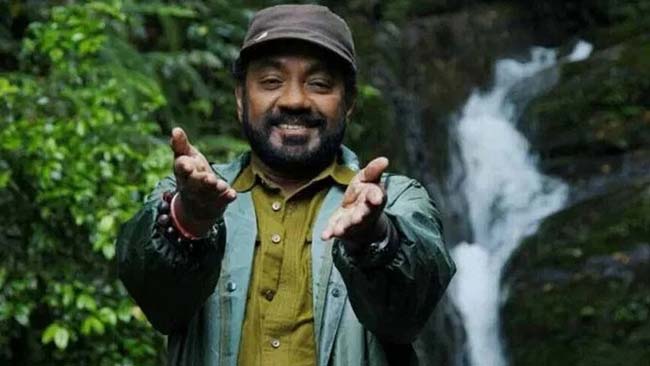
Jackson
He never let go of acting, however. During these years he associated closely with Jayantha Chandrasiri. The two had first collaborated in Weda Hamine in 1990, and from there until Ghara Sarapa in 2018, they rekindled their association. He became a part of Chandrasiri’s repertory, together with Kamal Addaraarachchi and Sriyantha Mendis. Along the way he encountered other directors, each as distinct as the other: Bennett Rathnayake, Dharmasiri Bandaranayake, Udayakantha Warnasuriya, Sunil Ariyaratne, and so on.
It was only a matter of time before he would embark on his own career. This phase, which began with Aba, culminated in Daskon. The latter, a more ambitious production than Aba, called for research of the sort Jackson had gained a reputation for.
Jackson’s biggest contribution, his legacy, in that sense, was that he brought history to the Sinhala speaking masses, especially the youth, through mass media. A product of 1956 – he was born two years after Bandaranaike’s election victory – he symbolised the exuberance that had seeped into the revolution of that year. Simply put, he popularised history a time when interest in it was growing massively. This was no mean feat, given that he was working long before social media and YouTube democratised everything.
Regarding his acting in theatre and his talents as a dancer and singer, I am ill-equipped to comment. These preceded his film and television work, and were somewhat outside the experience of my generation. As for his politics, which we did encounter, what can we say, other than the fact that actors can never free themselves of such affiliations?
What is tragic about his death, ultimately, is that it need not have happened. He could have lived for longer. Having enriched three generations, he could well have enriched a fourth, just as Joe, Gamini, Tony, and Ravindra did. Malinda Seneviratne’s take on the man, in that sense, sums up our feelings of him and his work, and of his loss.
He was a colossus. And he was humble. That’s all I know of Jackson Anthony.
He was these things, yes, and he was much more.
The writer is an international relations analyst, independent researcher, and freelance columnist who can be reached at udakdev1@gmail.com.