
Politics
The IMF and the middle-class

By Uditha Devapriya
Sri Lanka will enter into negotiations with the International Monetary Fund next week. Led by Ali Sabry, the country’s Finance Minister, and Nandalal Weerasinghe, the Governor of the Central Bank, the delegation will leave for Washington tomorrow. Speaking to Bloomberg, Mr Sabry admitted that Sri Lanka will need USD 3 to 4 billion for the rest of the year. Now that the country has defaulted on sovereign debt worth USD 51 billion, it is in a position to exclude debt servicing from its calculations, at least for the next eight months. While this is hardly cause for celebration, many consider it better than the alternative.
What was the alternative? Mr Sabry has more or less criticised Ajith Nivard Cabral and former Treasury Secretary S. R. Attygalle for resisting calls to go to the IMF. EconomyNext depicts the latter two as proponents of what it calls Modern Monetary Theory, which it defines as “an extreme form of Keynesian stimulus.” Given how much it’s associated with Mr Cabral’s personality, MMT has become a byword for money printing, which in turn is associated with increasing inflation. The consensus of the neoliberal right, in other words, is that Sri Lankamoney supply was growing unsustainably and now needs to brake a little.
The neoliberal right considers going to the IMF as a foregone contingency that we should neither question nor reject. It’s no small irony that commentators who, barely a year ago, were criticising the government’s economic policies, have backtracked, praising Ministers and officials for toeing their line. It’s also no small irony that economists and pundits who once urged the country to seek IMF support, arguing that it would bring much needed relief to people, are now adding the caveat that it will come at a price: austerity for the masses, ostensibly for the upper classes, but also for the middle-classes.
As Dayan Jayatilleka noted in his Daily FT column last week, these are all highly convenient narratives. But myths need demystifying. The conventional view that IMF reforms will shield the poor and gnaw at the very rich breaks down when you consider that most Sri Lankans can’t be classifiable as very poor or very rich: they belong to an insecure middle-class that has come to define Sri Lanka’s economic situation well. As Dr Jayatillake rightly asks, at what point does the bitter medicine administered to this class by the IMF turn into poison? At what point will this class rebel and refuse to take the medicine?
Sri Lanka’s middle-class is unique, a sui generis category that cannot be defined in relation to middle-classes elsewhere. Its problems need to be dissected and analysed, properly. All one can say, looking at it, is that it is upward-aspiring and dependent on State patronage. This is a curious enough dichotomy, but it has come to define perhaps the most intriguing social group to emerge from post-independence Sri Lanka. What it means, simply put, is that while clamouring for more agency, access, and freedom, the middle-class is also restricted by State patronage, whether in the form of subsidies or public services, specifically services like health, education, public utilities, and local government.
The irony of the middle-class is that the country’s economic situation has not enabled them to resolve this contradiction, which is essentially between their aspirations and their needs. They have always aspired upward and have tried to free themselves of State overreach, but they have also become heavily dependent on State support, particularly through our public services and welfare state. Moreover, we are a country that runs on imports, a country that has yet not transformed into a production economy. Against such a backdrop, the middle-class has had no choice but to entrench themselves in import-dependent industries: even the IT sector, a mainstay for our educated youth, suffers from this anomaly. In other words, lacking a sustainable base, the middle-class operates on rather shaky ground.
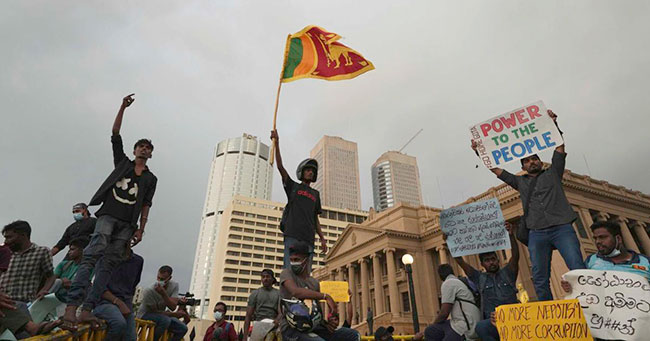
In terms of their social composition, the protests that sprang a little over a week ago at Galle Face are unprecedented. While middle-class protests have unfolded and taken place here, even under British rule, middle-class agitation has been something of an oddity in the post-independence period. What agitation that sprang up among them essentially focused on privations imposed by the State, as in the outpouring of anti-government sentiment in the last few years of the 1970-1977 regime. As Dayan Jayatilleka has observed in Long War, Cold Peace, Sri Lankans will not tolerate a regime that imposes such privations. This is a fact that the Sirimavo Bandaranaike administration only belatedly learnt to its cost.
On the other hand, radical agitation, of the sort that the J. R. Jayewardene government encountered in its first few years, did not involve the middle-classes. That sort of agitation was left to the lower classes, particularly workers and peasants, to take up. While the UNP government followed a Thatcherite line in suppressing working class agitation in the early 1980s, its authoritarian tendencies sparked off a peasant uprising in the latter part of the decade, an insurrection helped in no small part by the government’s proscription of the JVP. Middle-class agitation at this juncture, if it figured in at all, was limited to civil society outfits brave enough to take on the Jayewardene administration.
never really suffered in this period, because the policies enacted by the UNP government, such as public sector divestment and privatisation, did not, if at all, affect them adversely. As Steven Kemper suggests in his study of advertising in Sri Lanka, the middle-classes actually benefited from the culture of neoliberal globalisation that the UNP unleashed. Though following an IMF and World Bank line, the Jayewardene and Premadasa governments ensured enough support for these groups. The situation was more or less the same under the Chandrika Kumaratunga administration.
Under the Rajapaksas the dynamics changed, significantly. Hailing from a rather different political order, the Rajapaksas peddled populist welfare measures and dynastic politics, both of which ensured continuity for themselves. They were able to mobilise rural and working class support, but it was by tapping into middle-class support that they were able to propel themselves into power. This was especially true of Gotabaya Rajapaksa: from the southern heartland to Colombo suburbs, the lower and upper middle classes voted en masse for him. Yet the Rajapaksas’ brand of dynastic politics could not cohere with middle-class ambitions. This is the dialectic that governs their opposition to the First Family today.
Unfortunately for them, however, whether they are aware of it or not, Sri Lanka’s political culture is a pale reflection of its economic system. This is a country where corruption has swept into every other sphere and area, a country where what you want to do is all too often determined by who you know. In the absence of an industrial production base, it is likely that the few at the top will continue to forage for everything they can get a hold of, leaving the scraps for everyone below them. That is why, until we address the elephant in the room that is Sri Lanka’s economic system, we can’t hope for proper reforms. Yet this is precisely what IMF discourses of neoliberal restructuring sideline.
I will not get into whether the protests have suffered or progressed because of these developments, except to say that leaderless as they are, they remain invigorated by an educated and professional middle-class. Contrary to what media outlets are saying, this is not a youth-dominated movement. Yet it is very much led by a youth, particularly a middle-class youth that finds its hopes for the future clashing with the political set-up. They have been hemmed in by import restrictions on the one hand and inflation on the other, while the economic model that sustained them for so long has collapsed. They now feel they have nothing to lose by standing up until the Rajapaksas stand down.
It is this, more or less, that has fuelled their agitation today. Incensed by the excesses of the Rajapaksas, they have come out to the streets and called for a new political order. Along the way, not a few of them peddle the IMF line, convinced that the country’s ills can be solved by neoliberal restructuring. What is ironic, if not tragic, if not farcical, is that such solutions may give them breathing space in the short run, but will almost certainly administer a bitter medicine in the long term. Whether this medicine will turn into poison is anyone’s guess: it all depends on what Mr Sabry’s delegation negotiates. For the sake of the country, one can only hope that they will negotiate a better deal, not a bitter one.
The writer can be reached at udakdev1@gmail.com



By Uditha Devapriya
 With elections coming up in a few months’ time – notwithstanding Palitha Range Bandara’s outrageous remarks, to which Saliya Pieris, the former President of the Bar Association, responded thoughtfully – new coalitions and alliances are cropping up. These have pulled together the unlikeliest MPs and ideologues, who you’d never put together in the same room but who have, in the aftermath of the 2022 crisis, have unified around certain issues. Outside of the government, the consensus seems to be that we have yet to see a proper Opposition. This is the selling promise of these new coalitions: they tout themselves as that proper Opposition, the only political groups that matter.
The most recent of these coalitions is the Sarvajana Balaya. Led by Dilith Jayaweera, it houses a galaxy of parties, representing diverse, often disparate, interests, including Wimal Weerawansa’s National Freedom Front, Udaya Gammanpila’s Pivithuru Hela Urumaya, the Democratic Left Front, the Communist Front, and a breakaway faction from the SLPP and government called the Independent MPs’ forum. There are other groups as well, and other personalities, including attorneys and former Chief Justices. They have colourful pasts, and they have given the new formation a very colourful platform.
Rhetoric and political statements aside, however, the Sarvajana Balaya is essentially a gathering of ex-Gotabaya Rajapaksa ideologues. Many of them, like Weerawansa and Gammanpila, resigned early on from the Rajapaksa administration, before the crisis in 2022. Others, like Gevindu Cumaratunga and Channa Jayasumana, broke ranks with that regime during the crisis. The Communist Party went beyond these formations by calling for reforms and directly taking part in the aragalaya at Galle Face. When goons attached to Mahinda Rajapaksa attacked Gotagogama in May, the CPSL’s chairman, Dr G. Weerasinghe, convened a press conference condemning Rajapaksa and asking him to resign.
Dilith Jayaweera is, of course, the ultimate ex-Rajapaksist, perhaps in the same way Ignazio Silone and Whittaker Chambers were the ultimate ex-Stalinists. When the government announced 10 plus hour power-cuts and hastily imposed a curfew after the confrontation at Mirihana on March 31, Jayaweera tussled with Namal Rajapaksa on Twitter. This led to perhaps the most significant political breach for the Rajapaksa government, since Jayaweera had, since at least 2018, spearheaded Gotabaya’s campaign from the sidelines. That he has refused to come full circle, and remains critical of Rajapaksa, is intriguing. At one level, one could call him sincerer than the SLPP, three-quarters of which slung mud at the UNP in 2019 but are now content being at its beck and call every day.
Jayaweera’s party, the Mawbima Janatha Pakshaya, is an enigma. It pontificates on the need for an alternative politics. It is high on protecting national assets, and straddles between transforming Sri Lanka “into a state of unparalleled dynamism” and “drawing inspiration from our rich culture and values rooted in our ancient civilisation.” At one level, its ideology bears analogies with the East Asian brand of developmentalist nationalism.
This is not to say Jayaweera is a Mahathir in the making, though I think he is more deserving of such epithets than Gotabaya Rajapaksa, who evoked comparisons with Vladimir Putin. In any case, kingmakers are deal-clinchers. Jayaweera’s party has the money and outreach, and is tapping into both. Against that backdrop, it makes sense for the party to enter agreements and pacts with other parties. In that regard, the Sarvajana Balaya has reached a consensus with two formations: the Old Left and the ex-Rajapaksa nationalists. For the Old Left, this marks a return to form. Last year, it spoke loftily about carving a different political space, but it has now reverted to its age-old strategy of aligning with nationalist forces. Since at least 1970, that seems to have been their preferred path to socialism.
I am being harsh on the Communist Party. But I am also being fair. Such strategies once had a purpose and logic. The geopolitics of the Cold War being what they were, the Left could make a cogent case for joining Sirimavo Bandaranaike’s coalition. The Left could make as cogent a case against it, but that’s another story. The point is that Bandaranaike represented a wave of anti-imperialist socialist leaders in the Third World, who the Left thought could be nurtured and pushed towards the Left. In this, however, the Left both overestimated and undermined the force of nationalism: it believed that nationalism would eventually wither away in the face of socialism, and saw nothing wrong in compromising on its animus against petty bourgeois ideologies if they could help foment a revolution.
The great lesson of the 1960s and 1970s, not just in Sri Lanka, but also in India, Algeria, and Egypt, was that nationalism could never lay the groundwork for a socialist society. It could only overtake it. The two, put simply, could never become one: there were just too many incompatibilities and incongruences. To give perhaps the best example, when Sirimavo Bandaranaike forced the LSSP and Communist Party out of her coalition, she shored up the right-wing of the SLFP, the Felix Dias flank. And when her brand of nepotism became too strong for even her MPs, the country witnessed a mass defection to the UNP, leading from an internal shift to the right (the SLFP) to an external, and far more consequential, shift to the right (from the Senanayake to the Jayewardene chapter in the UNP).
Yet, even with all this, it was possible to justify the Left’s forays into nationalist territory. As Vinod Moonesinghe has noted in a rebuttal to Nathan Sivasambu, not even the Left could ignore the electorate and the reality of “bourgeois democracy”, which had been granted to Sri Lanka long before other colonies and territories. 1956 marked a crucial turnaround in electoral politics. It led to the bifurcation of the Sinhala Buddhist right between the SLFP and the UNP. The choice for the Left seemed hard to make here, and for a while, controversial as it was, the LSSP and CPSL joined the the SLFP. That they soon embraced, almost uncritically, the SLFP’s descent into chauvinism (“Dudleyge badey masala vadai) is certainly unfortunate, even deplorable. But politically, it was felt necessary.
Half a century on, has the Old Left revamped its strategies? From its press conferences last year, one would have assumed so. At one point there was even speculation that the Old Left and New Left – the NPP – would band together, doing away with decades of sectarianism. This, however, was not meant to be. Instead, the Communist Party and the Democratic Left Front seem to have preferred joining Jayaweera, perhaps seeing the likes of Weerawansa, Gammanpila, and Cumaratunga as comrades who will lead them to that kalunika of Sinhala politics, the congruence of nationalism and developmentalism.
This is, of course, a mirage. But it underlies a tectonic shift in local politics.
Over the last few decades, we have seen a diminution of the Old Left and, ironically, the Mahinda Rajapaksist brand of nationalism. I have contended in my articles on Jathika Chintanaya that this reflects a broader shift within Sinhala Buddhist nationalism itself. The history of the Republican Party, some would say, boils down to the descent from Richard Nixon to Ronald Reagan to Donald Trump. Likewise, the history of Sinhala nationalism has been the descent from Gunadasa Amarasekara and Nalin de Silva to the hundred or so dilettantes who claim to be their descendants but are anything but. In that scheme, the likes of Weerawansa and Gammanpila have become the proverbial last of the lot, spouting a nationalist discourse which has become predictable and passé.
Why passé? Because Gotabaya Rajapaksa, promoted as the security-sovereignty candidate, facilitated the conjunction of nationalist and neoliberal forces. This dislodged the more populist sections of the nationalist camp – which Weerawansa epitomised – empowering a political class that wields nationalist, even communalist, rhetoric within a neoliberalised economic and social space. That could of course not have been possible without the Ranil Wickremesinghe presidency, but it would not have come to pass without his predecessor’s catastrophic failures. And no matter what Gotabaya may think, it was not, as the title of his book would have us believe, a conspiracy. It was stark, clear, obvious, from day one. Neither he nor his advisors can deny their culpability there.
Jayaweera’s developmentalist-nationalist vision shares more with the paternalistic right than the democratic left, notwithstanding his embracing a party which calls itself the Democratic Left Front. What is ironic is how ideologues attached to the Communist Party see it fit to attack the NPP, but see nothing wrong in joining forces with nationalist formations that have run their course and have given way to the most nefarious political conjuncture in Sri Lanka’s post-independence history: the SLPP-UNP pact. These parties are as complicit in that conjuncture as the parties that are in power. Not all the rosy words or mea culpas in the world can absolve them, or their accomplices, of this.
Uditha Devapriya is a writer, researcher, and analyst based in Sri Lanka who contributes to a number of publications on topics such as history, art and culture, politics, and foreign policy. He can be reached at udakdev1@gmail.com.
1: Feeding the 225
2: Don’t wait for the state; let’s act on our own
by Kumar David
This has been the most rainy and squally Vesak that I can recall in my eight decades on this planet and it has made me grumpy. The depression in the Bay of Bengal has prepared all of for the couch of some psycho-quack conning folks with fictious talk of depressions.
This essay is in two separate parts unconnected with each other; a) Feeding the 225 and b) people taking the initiative into their hands and not relying on the state.
Feeding the 225
Jesus fed 5,000 with two fishes and five loaves (Mathew 14:13-21) and you may reckon that to be a great achievement but he did it only once. Our people in Sri Lanka have to keep feeding the 225 day-in-day-out every day of their lives. And where does it all go? Into political pockets! Import permits for luxury cars, insurance cover for wives, mistresses and sons and of course plain rip-off.
A sharp middle-aged lady mounting the steps of the Dehiwala-Galkissa Municipal Council alerted me. “Why madam do you look unhappy?” I foolishly asked only to be told-off in pristine Sinhala: “Aiyo, 225-ta kanda dena oone ne” (We have to fed the 225, don’t we). Only then did the penny drop. Bribes to left of us, bribes to right of us! The 225 themselves, their catchers and hangers-on (petrol allowances, salaries for aides and drivers), liquor shop permits and Gamage-type rackets that the SJP pretends it knows nothing about). In total the 225 may be cashing in a few million rupees per MP per annum. How many MPs in the current parliament are clean of such nefarious behaviour? I think less than a dozen.
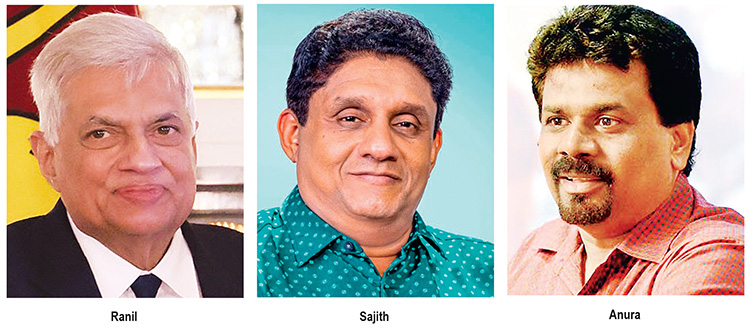
Now that I am about it, a little more politics. I was, I think, the first person who more than a year ago said very firmly that the presidential election would come down to a race between RW and Anura; and it has. Sajith is wailing in the wilderness and the SLFP and SLPP are weighing the prospects of whether to line-up in the RW or Anura camps. Neither SLFP nor SLPP dare put forward a candidate of their own for fear of being wiped out and polling a miniscule number of votes. It seems increasingly likely that both will plonk into the RW camp.
Buffalo Lal Kantha’s pronouncements have made this more likely. He has in addition claimed that only the JVP and the Udaya Gammanpila party took a stand against the Tamils, opposed any form devolution and supported the military in the war against the Tigers. The import of his words is this. The JVP-NPP is going to be identified at the polls as a Sinhala party and this will have consequences. Will it draw the already radicalised Sinhala-Buddhist youth in larger numbers into the JVP camp or will it damage the JVP’s image? Time will show.
The upper and business classes and the city middle classes are cheering for Ranil. They are hooked on the idea he will be able to deliver economic growth. The Economic Transformation Bill and the Public Financial Management Bill tabled in Parliament on 22 May are intended to reassure the IMF that the road to reform that the Fund has demanded will be diligently implemented. The Fund will then unlock billions of dollars now blocked and also expedite deals with Sovereign Wealth Funds deemed necessary it is claimed to reassure the IMF and international capital. The Governor of the Central Bank is singing the same tune and has joined Ranil’s choral group. It is likely that the duo will float the rupee open-up the economy and privatise galore in the coming period. This will have political consequences.
Let me make a summary of the principal tasks facing the nation.
1. It is conventionally opined that debt restructuring, unlocking billions of dollars in IMF Funds and reaching agreement with Sovereign Bond Holders (profit seeking finance companies) is sine qua non.
2. Increasing earnings from foreign trade, meaning increasing earnings from export (including remittances and tourism) and limiting imports (except production machinery and raw materials for production), is considered vitally important.
3. Frugality in consumption (to the extent feasible with poverty ravaged masses) is desirable.
4. These three steps will it is hoped attract foreign investment into productive sectors.
None of this is new, it is all the subject of interminably long and boring newspaper columns. (When will our columnists learn that brevity is the soul of wit?)
RW is singing along to this tune and his confidence in saying NO to parliamentary elections before or simultaneously with the presidential poll shows that he believes he is playing from a strong hand. He is indulging in populist measures like issuing free-hold land title-deeds to landless Tamils in the Kilinochchi area, making attractive promises about enhancing facilities at the Jaffna Hospital, and insisting that plantation companies honour his pledge to workers of a minimum wage of Rs 1,700 per day. RW is gaming that in a presidential election well over one and a half million Ceylon Tamils, Upcountry Tamils, Muslims and Catholics will vote for him and tip the scales in his favour. (See note below). In the parliamentary elections that will inevitably follow the winner of the presidency will carry the day.
A racist alliance called the Sarvajana Balaya has, in the meantime, raised its head, led by Weerawansa and Gammanpila. It has attracted bankrupt ex-leftists of the Communist Party and ageing Vasudeva. This too will play right into RW’S hand.
Act independently
An ever-increasing number of organisations have taken matters into their own hands and launched initiatives because the government is flat-footed. Let me give you a few examples. Fed up with the inability of successive governments to do anything to combat communal violence, or to be more accurate because of the aggravation of communalism by governments beginning with the denial of citizenship to Tamil plantation workers by D. S. Senanayake, the father of the nation (sic!), through SWRD’s communal politics and JR’s loathing of Tamils, to Chandrika playing politics, a bunch of Buddhist monks took the initiative into their own hands.
The monks went on an expedition to Europe and the US, sought out Tamil links such as the Global Tamil Forum and others and initiated a dialogue. The initiative is now in motion and grass-roots activities are in full swing. Important figures like Karu Jayasuriya (former Speaker), Austin Fernando, Sarvodaya, Jehan Perera’s National Peace Council and Pakiasothy Saravanamuttu’s CPA are involved. Branches have been established in many localities and an active movement is in swing. If communal violence is to be halted and if the state and government are, quite literally, worse than useless, a grass roots people’s movement is needed. It has ben launched ; its name is National Movement for Social Justice.
A second example is the need to foster English language competence in all children as a link language between communities and more important because English is the linguafranca of the world today. (Sounds a bit contradictory, doesn’t it? Wonder what the French feel about the juxtaposition?). Seriously though, English is not just the language of modern technology and business. No, it is in all its pronunciations and accents it has become the 21st Century’s world language essential for everyone. State and government have simply and literally messed up English in Sri Lanka’s schools. So well-intentioned voluntary organisations, often women’s groups, have stepped into the breach.
Two more quick examples and I will stop. Microfinance is now the domain of groups, often women’s societies that have filled the gap since the banking sector has failed to support small and medium enterprises. And finally, cooperatives are providing marketing and investment openings for fishermen. I personally know of one such successful assembly of such entities in Jaffna.
The subject of this part of the essay however is in what ways can the people themselves, organised in various voluntary bodies, do to overcome or replace a sluggish state. To what extent can, for example a popular Peoples’ Planning Council, replace the hiatus created by the absence of a State Planning Agency in Sri Lanka. I think a popular public initiative of this nature can achieve quite a bit.
NOTE: The absolute core Sinhala vote in the country is the infamous “69 lakhs”; maybe 70 now by natural increase. I reckon that the minorities – Ceylon Tamils, Upcountry Tamils, Muslims and Catholics – are about one third of the core Sinhala vote. That is (1/3) x70 about 23 lakhs. This is why I reckon that RW is making a play for a clear majority of this 23-lakhs in the presidential poll.
By Dr. Kingsley Wickremasuriya
Preface
Sri Lanka Police Service is the premier law enforcement agency on the Island and one of its oldest government establishments counting over one and half centuries of existence. During this long history, 36 Inspectors-General of Police – 11 of them from the Colonial Administration, and the rest thereafter – were in charge.
Their periods of office were characterized by riots, coups, insurrections, terrorism, political violence, trade union action, mass protests, and worst of all, the politicization of the institution. The vicissitudes the police had to face were many.
The thrust of this essay is to show how once a force that worked according to the rule of law during the colonial administration turned partial and eventually became an apparatus serving political interests rather than those of the common man. Party politics crept into the picture with the progressive introduction of constitutional reforms. To substantiate his thesis, the writer will draw selectively from material available on various websites and other archival material including Police Commission Reports.
The Portuguese – Dutch Period
The Maritime Provinces of Ceylon were under the Portuguese after their invasion in the 15th Century. The Dutch, who arrived in Sri Lanka in 1602, were able to bring the Maritime Provinces and the Jaffna Peninsula under their rule by 1658. Although they controlled certain areas of the maritime provinces, they did not carry out any serious changes to the existing system of civil administration of the country. The concept of policing in Sri Lanka however, started with the Dutch who saddled the military with the responsibility of policing the City of Colombo.
In 1659, the Colombo Municipal Council (under the Dutch) adopted a resolution to appoint paid guards to protect the city by night. Accordingly, a few soldiers were appointed to patrol the city at night.
They initially opened three police stations, one at the northern entrance to the Fort, a second at the causeway connecting the Fort and Pettah, and a third at Kayman’s Gate in the Pettah. In addition to these, ‘Maduwa’ or the office of Dissawa of Colombo who was a Dutch official at Hulftsdorp, also served as a police station for these suburbs. Thus, it was the Dutch who established the earliest police stations and thus became the forerunners of the police in the country.
The British Period
The Dutch surrendered to the British on February 16, 1796. After the occupation of Colombo by the British, law and order were, for some time, maintained by the military. In 1797 the office of fiscal, which had been abolished was re-created. Governor Fredrick North, having found that the fiscal was over-burdened with the additional duty of supervising the police, obtained the concurrence of the Chief Justice and entrusted the Magistrates and Police Judges with the task of supervising the police.
In 1805 police functions came to be clearly defined. Apart from matters connected with the safety, comfort, and convenience of the people, these also came to be connected with preventing and detecting crime and maintaining law and order. The rank of police constable (PC) was created and it came to be associated with all types of police work. By Act No. 14 of 1806, Colombo was divided into 15 divisions, and PCs were appointed to supervise the divisions.
First Superintendent of Police
Mr. Thomas Oswin, Secretary to the Chief Justice, was appointed the first Superintendent of Police of Colombo. Mr. Lokubanda Dunuwila, who was the Dissawa of Uva, was appointed as the Superintendent of Police for Kandy. He goes into history as the very first Lankan to be a Superintendent of Police.
In 1847 the ranks of Assistant Superintendent of Police and Sub Inspector of Police were created. Inspector De La Harpe was promoted as the first Assistant Superintendent of Police.
The National Police
Robert Campbell, KCMG, was the first Inspector General of Police of British Ceylon. The Governor, who was looking for a dynamic person to reorganize the police on the island, turned to India to obtain the services of a capable officer. The Governor of Bombay recommended Mr. G. W. R. Campbell, who was in charge of the “Ratnagiri Rangers” of the Bombay Police, to shoulder this onerous responsibility.
After serving as chief of police in the Indian province of Ratnagiri, Campbell was appointed by Governor Frederick North on September 3, 1866, as Chief Superintendent of Police in Ceylon, in charge of the police force and assumed duties on September 3, 1866. This date is thus reckoned as the beginning of the Sri Lanka Police Service.
Campbell is credited with shaping the force into an efficient organization and giving it a distinct identity. He brought the whole island under his purview and the police became a national rather than a local force. In 1867, by an amendment to the Police Ordinance No. 16 of 1865, the designation of the Head of the Police Force was changed from Chief Superintendent to Inspector-General of Police. In 1887 he was awarded the CMG. On his retirement, he received a knighthood for his service.
Apart from Campbell, 35 others were in charge of the Police Force in Sri Lanka. They performed to different degrees of standards contributing to the development or the decline of the police service in Sri Lanka. Cyril Longdon, the sixth Inspector-General was instrumental in establishing a Police Training School for recruits and a Criminal Investigation Department.
Ivor Edward David was the seventh British colonial Inspector-General of Police in Ceylon (1910-1913). During his tenure, David was noted for establishing the POLICE SPORTS GROUNDS in Bambalapitiya in 1912. Dowbiggin succeeded him as Inspector-General of Police.
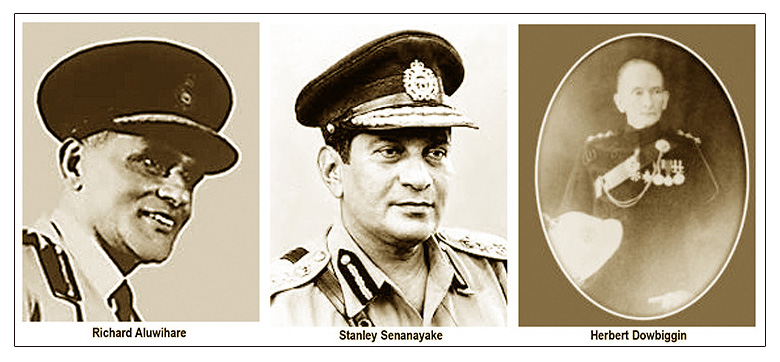
Sir Herbert Layard Dowbiggin, CMG, was the eighth British colonial Inspector General of Police of Ceylon from 1913 to 1937, the longest tenure of office of an Inspector General of Police. He was called the ‘Father of the Colonial Police’. Dowbiggin joined the Ceylon Police Force in 1901 and became Inspector General in 1913.
During his tenure, the strength of the force was enhanced considerably with the posts of two deputy inspectors general were created. He oversaw an expansion of the force: the number of police stations increased so that by 1916 there were 138 all over the island. He also modernized the force, introducing new techniques of investigation such as fingerprinting and photography; improving the telecommunications network for the police as well as increasing the mobility of the force. The analysis of crime reports became more systematic. He purchased the land on Havelock Road, Colombo, on which the Field Force Headquarters and the ‘Police Park’ playing fields are located. He was knighted in 1931.
Osmund de Silva
First Sri Lankan Inspector General
Beginning with Sir Richard Aluwihare, KCMG, CBE, JP, CCS, 25 others served as IGPs thereafter. Sir Richard was a Sri Lankan civil servant and the first Ceylonese IGP who later served as Ceylon’s High Commissioner to India. The Police Department, which was under the Home Ministry, was brought under the purview of the Defense Ministry during his tenure.
Sir Richard faced the unenviable responsibility of transforming the police from its colonial outlook to a national police with the gaining of independence in 1948. To this end, he introduced a large number of innovative measures embracing the welfare of the men, investigation, prevention, and detection of crime, the women police, crime prevention societies, rural volunteers, police kennels, public relations, new methods of training and improvement of conditions of service.
He transformed what was a Police Force into a Police Service. Its role was narrowly defined and restricted to the maintenance of law and order and the prevention and detection of crime. In 1948 he established the Police Training School in Kalutara.
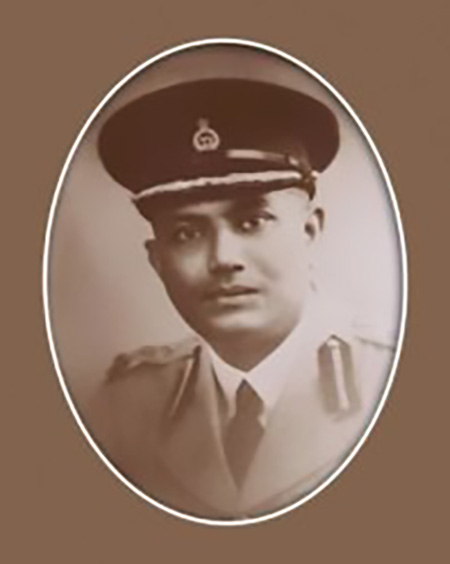
He retired from the civil service as IGP and was succeeded by his son-in-law Osmund de Silva. Santiago Wilson Osmund de Silva, OBE was the 13th and the first Ceylonese career police officer to become Inspector-General of Police (1955–1959). In 1955 he succeeded his father-in-law, Sir Richard Aluwihare to be appointed IGP. He became the first IGP appointed from within the police force and the first Buddhist. He introduced community policing to the country, a vision not shared by his successors.
The Great Betrayals
It was during his tenure that Prime Minster Bandaranaike is reported to have exhorted IGP Osmund de Silva that the police should have that ’extra bit of loyalty’ to the government. The response to this by the IGP was an exhortation to his officers that what they should uphold is the Rule of Law. He said this knowing that he would be falling out of favour with the premier and that it would affect his tenure. This assertion by the IGP came when there was no Bill of Rights in the Parliament or no Republican Constitution with Fundamental Rights to fall back on.
Thereafter, when the Prime Minister, S. W. R. D. Bandaranaike requested that the police intervene against trade union action occurring at Colombo Port. De Silva declined to do the PM’s bidding on the basis that he believed the request was unlawful. On April 24, 1959, de Silva was compulsorily retired from the police force with M. Walter F. Abeykoon, a senior public servant, appointed in his place.
This was the first betrayal by the head of government ignoring an entrenched police norm held sacrosanct through almost a century by the colonial administrators. It eventually led to a near mutiny by the police top brass and later even to more serious consequences of a coup the government managed to avoid by a stroke of luck.
Morawakkorakoralege Walter Fonseka Abeykoon served IGP between 1959 and 1963. He was appointed to this position May 1, 1959 by his personal friend and bridge partner, Prime Minister S. W. R. D. Bandaranaike. The appointment was highly controversial as the PM appointed Abeykoon from outside the service by-passing several senior career police officers, on the basis that Abeykoon was a Sinhala Buddhist.
Senior police officers protested and DIG C. C. Dissanayake tendered his resignation, which was later withdrawn. The senior police officers, who were predominantly Christian, fearing a calamity, met to consider their options. They considered whether the entire police executive resigned on masse, although they decided against this as they thought it had the potential to cause the entire police service to collapse. Alternatively, they surveyed the Executive Corps for the senior- most officer among them who was a Buddhist and could find only young SP Stanley Senanayake.
They resolved to make representations to the Prime Minister that they were prepared to work under Stanley who was junior to all of them rather than having to work under an outsider with no experience who knew nothing of Police or the Police Ordinance. Bandaranaike however ignored their representations and appointed Abeykoon. In 1962, when a coup d’état was attempted by senior officers of the military and police, Abeykoon was caught off guard. Early warning from one of the conspirators, however, allowed the government to respond in time. Ironically, Stanley Senanayake was the whistle blower and the information was conveyed to IGP Abeykoon by P. de S. Kularatne, Senanayake’s father-in-law.
Thereafter, Benjamin Lakdasa ‘Lucky’ Victor de Silva Kodituwakku was appointed as the Inspector General of Police on September 1, 1998 by President Chandrika Kumaratunga following the retirement of Wickremasinghe Rajaguru on August 31, 1998 . This was a controversial appointment, his being selected over five other DIGs with greater seniority. Allegedly this appointment was influenced by the ruling party.
Kodituwakku, while in charge of the Kelaniya Police Division as SP, received transfer orders to go into charge of the Jaffna Police Division. He tried his best to get the transfer canceled but the department stood firm on its policy decision that every police officer needed to serve Jaffna for one year during the LTTE threat.
He opted to leave the service in 1984 resigning his post when he failed to circumvent the transfer. Following his resignation, he worked as a security consultant in a private company and was out of the Police Service for over one-and-a-half decades.
However, following the election of the People’s Alliance government at the 1994 parliamentary elections the new government enabled public servants who had faced alleged “political victimization” to appeal for reinstatement and back wages. Making use of this opportunity Kodituwakku re-joined the service and on October 1, 1997, was promoted to DIGl and Senior DIG rank on August 2, 1998 (a double promotion, from the rank of SSP ignoring the fact that he refused to go on transfer to Jaffna and resigned defying a mandatory policy decision taken by the Department that applied to every servicing police officer.
Kodituwakku was the Inspector-General at the time the Waymaba Provincial Council Elections took place. He was blamed for the violence and the election malpractices that took place during the elections. The 17th Amendment to the Constitution was the result of a political initiative launched by Members of Parliament in the Opposition led by the United National Party in 2001 as a response to the Wayamba Election Episode.
This was the second betrayal by a Head of State- President Chandrika Kumaratunga- when she decided to appoint Lucky Kodituwakku the 26th IGP ignoring so many other seniors over him just because of the special position he enjoyed as the Personal Security officer (PSO) of a VVIP that gave him an advantage over his seniors to canvass for the post. Wayamba- election- bungling and the 17th Amendment to the Constitution was the result.
These precedents led to yet other betrayals last of which was when Deshabndu Tennakoon came to be appointed by the current President Ranil Wickremasinghe as the 36th IGP even though the Supreme Court held that Deshabandu was guilty of human rights violations.
Tennakoon Mudiyanselage Wanshalankara Deshabandu Tennakoon (born 3 July 1971), known as Deshabandu Tennakoon is the current Inspector General of the Sri Lankan Police.
On 14 December 2023, a three-judge bench of the Supreme Court of Sri Lanka ruled that Tennakoon and two of his subordinates were guilty of torturing Weheragedara Ranjith Sumangala of Kindelpitiya for alleged theft and thereby violating his fundamental rights when the men were in uniform attached to the Nugegoda Police Division in 2010.
The Fundamental Rights Application (SC/FR 107/2011) was filled by Sumangala in the Supreme Court in March 2011, against the then Superintendent of Police, M.W.D. Tennakoone, Inspector of Police Bhathiya Jayasinghe, then OIC (Emergency Unit) Mirihana, Police Officer Bandara, former Sergeant Major Ajith Wanasundera of Padukka, and several others in the police department. The three bench panel consisting of Justices S. Thurairaja, Kumudini Wickremasinghe, and Priyantha Fernando, directed the National Police Commission and other relevant authorities to take disciplinary action against Tennakoon and two of his subordinates.
On 29 November 2023, President Ranil Wickremesinghe however, appointed Tennakoon as acting Inspector General of Police. He was appointed as the permanent Inspector General of Police on 26 February 2024.
The same day that he was appointed to the post of Inspector General of Police, Leader of the Opposition Sajith Premadasa claimed that the Constitutional Council, which oversees high-level appointments, saw only four votes cast in favor of Tennakoon. In comparison, two votes were cast against and there were two abstentions. Speaker Mahinda Yapa Abeywardena, counting the abstentions as votes against exercised his casting vote to break the tie in Tennekoon’s favour. This matter is currently being canvassed in the Supreme Court.
(To be continued)
kingsley.wickremasuriya@gmail.com



US sports envoys to Lanka to champion youth development

Rahuman questions sudden cancellation of leave of CEB employees


