Sat Mag
The history of a hostel; the sociology of a school

By Uditha Devapriya
With input from Uthpala Wijesooriya, Pasinadu Nimsara, and Keshan Themira
Archive images courtesy of the J. R. Jayewardene Centre
On July 7, the Hostel of Royal College, Colombo, will be unveiling its annual Day. Organised after seven long years, the Hostel Day will incorporate a number of aesthetic, cultural, and sports events. Many of them have been held over the last two months and a few are yet to be finalised. In the face of an unprecedented economic crisis, it has been a challenge and a triumph to have held them at all. For the residents of the Hostel, it has also been a baptism of fire, no less than a continuation of a long, unbroken tradition.
The Royal College Hostel has not had an unbroken and continuous history. Unlike most public-school boarding establishments, it has been shut down and re-opened. Over the last few decades, it has also witnessed much change. From a historical-sociological perspective, its story provides a unique insight into certain social transformations.
Established on the recommendation of the Colebrooke-Cameron Commission, the first avatar of Royal College, the Colombo Academy, did not open a boarding establishment for its first 30 years. Official records tell us that its first boarding establishment was founded somewhere in the mid-1860s by the then Principal, Barcroft Boake. Considered the leading tutor of his day, Dr Boake felt the need to provide a separate residence “for the sons of planters and Ratemahattayas.” Since the latter crowd made up much of the population in the school, it made sense to open a separate lodging for them.
Boake took an active interest in the boarders. He would join them for breakfast and dinner, sitting at the head of the table. Yet despite his efforts, the number of boarders “never exceeded 36.” Under two subsequent heads of the establishment, George Hawkins and Ashley Walker, it reduced to 10. This was despite a prestigious award at the Academy, the Lorenz Prize, stipulating residence at the boarding as one of its conditions.
In 1881 the Colombo Academy became the Royal College. Much earlier it had anchored at San Sebastian Hill, near the Beira Lake. We are told that around 1905, because of an illness brought on by its proximity to the Lake, the boarding was indefinitely shut down. Six years later, the school shifted to Thurstan Road, in Colombo 7. Official records inform us that past pupils lobbied for the construction of a hostel there. Yet the government of the day, led by several highly conservative officials, rejected their requests. Having spent Rs 250,000 for the shift to the new location, they were in no mood to spend more on a hostel.
In 1931, the country held its first State Council election. Signalling the shift to universal franchise, the first and second State Councils appointed a Board of Ministers who chaired a number of Executive Committees, in various areas of specialisation. Appointed as Minister of Education, C. W. W. Kannangara became the voice of reform in his domain. In 1939, on the eve of World War II, the Royal College Union advanced Rs 1,000 for a new boarding. For this Kannangara gave his approval and blessings. The official roll of the new Hostel that year lists 26 boarders. When it shifted to Bandarawela, in 1941, the number rose to 48. It would increase to 50, five years later, when the school moved back to Colombo.
These were deeply transformative years. Both Royal College and the Hostel felt their impact. In 1939, Kannangara convened a Special Committee on Education. Four years later, it tabled a Report. Among its recommendations was a free education scheme for all children, from school to university. Though opposed by certain groups, Kannangara’s scheme became the cornerstone of the country’s education system. Most significantly, it led to the entry of non-elite groups to leading and elite institutions, including public schools.
Following the War, both Royal College and the Hostel were compelled to accommodate these developments. In 1951, the Minister of Education, E. A. Nugawela, noted that since Kannangara’s proposals, “the Royal College is no more a school for the rich and privileged classes.” Observing that 317 of 519 parents worked as “peons, labourers, chauffeurs, and so on”, he concluded that the school had opened its gates to “the lower-middle class.” Such a trend could not be averted, much less reversed. It accompanied another, more significant transition: the “indigenisation” of colonial institutions.
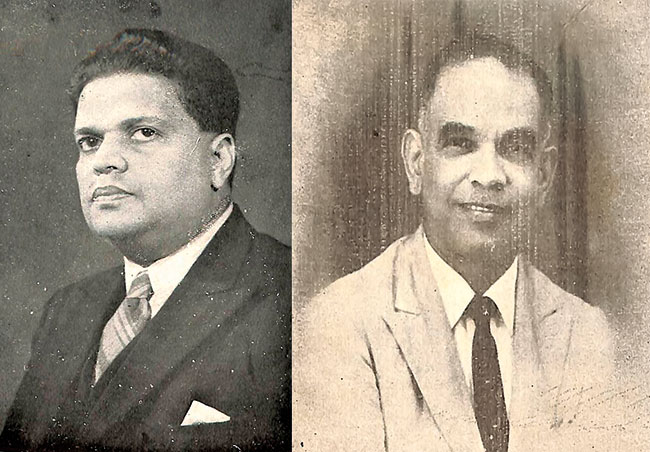
In 1946, Royal College appointed its first Ceylonese Principal, J. C. A. Corea, who took over from E. L. Bradby. That year it also appointed Bernard Anghie as the Hostel Warden. The records tell us that Anghie breathed new life to the Hostel. His successor, Cecil Belleth, saw through his changes. By the time Belleth retired, in March, 1966, the Hostel had inaugurated various clubs, including Debating Societies and Literary Associations, and recorded several advances and improvements. Fitting enough, today it is so associated with these individuals that the four Hostel houses – Bradby, Corea, Anghie, Belleth – bear their names.
The result of these developments was a rise in the number of Hostellers. In 1961 there were 93 boarders. In 1967, the Hostel was closed, on the orders of the Education Ministry, to be reopened in 1971. Two years later, the number of boarders had increased to 140. By 1979, it had risen to 250, shooting up to 252 in 1986 and 300 in 1992.

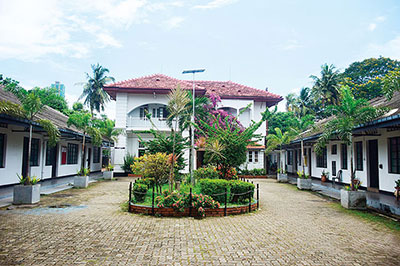
The Hostel, as it stands today, consists of about 27 buildings. These include 10 dormitories, with separate quarters for Grade 10 and Grade 11 boarders; a Senior Prefects’ Room; a Library; and a Smart Classroom. Over the last year, a number of these units, including the Music Room and the Bathrooms, have been renovated. Prefects are selected from three batches, numbering 20 in total, of which five are currently in Grade 13. Every student is governed by certain rules and regulations, extending to lunch and sleeping hours. Led by a dedicated staff, including its Warden, Janaka Jayasinghe, they try to keep the place going, adhering to schedules and routines which devolve responsibility on everyone.
As with almost every educational establishment, the Hostel has been forced to keep up with growing demand. As mentioned before, it encountered its biggest spurt between 1977 and 1995. These were years of expansion in the education system, epitomised by the Grade V Scholarship Exam: from 3,629 in 1977, the number of scholarship awards shot up to 22,000 in 1992. Since most, if not all, the Hostellers are Grade V Scholars, the Hostel has effectively become a symbol of mobility, particularly for those whose children obtain the highest scores for the Exam. This is perhaps the most significant development yet.
How does one explain such trends? The shift from colonial to dominion status, and later to republican statehood, in Sri Lanka, was accompanied by a transition in the country’s elite institutions. Yet it remains a paradox – a paradox identified by social scientists – that while power has moved away from the colonial bourgeoisie, the latter’s place has been taken over, not by the poor, but by an intermediate, Sinhala and Tamil speaking class. This has arguably been most evident in elite schools, like Royal College.
Surveying Europe’s education system, the French sociologist Agnès van Zanten has noted the contradiction between the elite background of these schools and the changes they have undergone due to various external pressures. The contradiction here has to do with what she calls the “charters” or “mandates” of these institutions, which have changed with the expectations of dominant groups. As van Zanten correctly notes, these groups have, over the last few decades, radically evolved and transformed.

This is as applicable to Sri Lanka as it is to Europe. Since independence, the country’s elite schools have witnessed a shift from bourgeois and aristocratic ideals to a middle bourgeois ethic, emphasising not family background, but academic merit. Not surprisingly, exams like the Grade V Scholarship have had a say in these developments.
The history of the Royal College Hostel, in that sense, bears testimony to the sociology of Royal College and other secondary schools. From an enclave for “the sons of planters and Ratemahattayas”, it has become a second home for the sons of an upward aspiring, rural middle bourgeoisie. This represents a shift in social, cultural, even political power, not just in the country’s secondary schools, but also in the country itself. Yet for some reason, this is an area that is yet to be examined by social scientists. It should be, especially since it provides a unique and fascinating insight, into the changing face of Sri Lankan society.
(Uditha Devapriya is an international relations analyst, researcher, and columnist who can be reached at udakdev1@gmail.com. Uthpala Wijesooriya [wijesuriyau6@gmail.com], Pasindu Nimsara [pasinim19@gmail.com], and Keshan Themira [themirak35@gmail.com] are members of the Royal College Hostel Prefects’ Council of 2022)