
Features
The genius of we lost Karunaratna Abeysekara, forever 40 years ago

By Dr Upul Wijayawardhana
Forty years ago, on 20th April 1983, we lost for ever the genius of the Sinhala wordsmith extraordinaire, whose life was cut short suddenly and prematurely at age of only 52 years. It is said that those with creativity, like him, reach their maximum potential in their fifties but, sadly, it was not to be although the legacy he left behind makes us feel as if he lived a century!
Considering his prodigious productivity in a span lasting less than four decades, it is hard even to imagine what he would have achieved had he lived at least a decade more, as he requested. Interestingly, in a moving poem printed in Kalpana in October 1982 six months before his death giving the impression that he had a premonition, titled ‘Ayachanayak’ (Request), he makes an appeal to the ‘Life-giver’ for an extension of 10 years, so that he may see his son grow up and can contribute to Sinhala literature in many ways, writing for the unity of the nation. It is not without humour either, as he states that all he wants is the extension and does not care even if it makes him look aged!
He is a wordsmith extraordinaire indeed, as he excelled in both the written and the spoken word; a rare achievement. He showed his talents in the written word by being among the great poets of the ‘Colombo Era,’ a sought-after scriptwriter for Sinhala cinema and, most importantly, a lyricist of lasting influence; perhaps, the greatest we ever had. He demonstrated his prowess of the spoken word as a newsreader, a presenter of programmes and concerts but he is best remembered for his unforgettable commentaries, the way he moved the entire nation to tears at SWRD’s funeral becoming part of broadcasting legend.
He was born in Ratmale, a little village south of Matara on June 3, 1930, the eldest of 10 children of Podiappuhami and Premawathi Abeysekara. The family moved to Colombo where his father started a small business but they moved back temporarily to their village during World War II which gave Karu the opportunity to study Sinhala, Pali, and Sanskrit under Venerable Ananda of Galkanda Vihara, which laid the foundation for the mastery with words.
On return to Colombo, he entered Nalanda College where his teacher was the poet U A S Perera, better known as “Siriayya” who conducted “Lama Pitiya” in Radio Ceylon, which was a life-changing event. This drew him to broadcasting, taking part in “Lama Pitiya” from the age of 12. He continued to study oriental languages under Venerable Dehigaspe Pannasara of Vidyodaya Pirivena whilst continuing his studies in English at Nalanda.
Karunaratna Abeysekara became a pioneer in many fields having faced the most crucial decision of his life in 1950, when he had to choose between admission to Peradeniya University, for a degree, or join Radio Ceylon as a relief announcer, earning seven rupees a day. He opted for the latter as he felt that was the only way he could support his younger siblings, his father’s business being not lucrative. This move not only allowed him to support his siblings admirably but also build a very successful broadcasting career.
He was a brilliant newsreader but outshone all others as a commentator. In the era before television, we were at the mercy of commentators to visualise any important event. Whereas others described what was happening, he painted the picture in our minds with his unmatched eloquence. I still remember listening to his commentary when Queen Elizabeth visited us in 1954 and painting the picture of the procession in my mind.
What has often been overlooked is the fact that it was Karunaratna Abeysekara who pioneered cricket commentary in Sinhala, the very first being a report on the Anada-Nalanda Big-match he gave on Saraswathi Mandapaya. He quickly switched to live commentary and is credited with coining many Sinhala cricket terms which are in current usage. No doubt the enthusiasm for and the popularity of cricket, the ‘coloniser’s game,’ in the villages is in no mean measure due to the commentaries in Sinhala which he pioneered in his inimitable style which enabled the listeners to visualize the game long before the advent of television.
Invariably, due to the inspiration from Siriayya, he was drawn to children’s programmes and Saraswathi Mandapaya, he hosted on Sunday evenings, became the star of children’s programmes and to me and my generation he became our beloved Karuayya. I had the fortune of participating regularly and helping Karuayya from 1957 to 1964, being introduced to him by his brother Daya and my good friend Buddhadasa Bodhinayaka. We would help by sorting out letters, writing features and reading scripts live etc. which gave us the grounding in broadcasting.
Karuayya
arrived about half an hour before the programme goes live on-air and penned a couple of songs, which were set to music by Master D D Denny to be sung by the children who became the leading musicians later. Saraswathi Mandapaya was the incubator for a generation of not only budding singers but also lyricists and script writers, far too many to mention by name. Just one example: Nanda Malini’s famous song “Budusadu, Budusadu, Sandun gasak wennam” written by Asoka Colombage with music by D D Danny, she sang first in Saraswathi Mandapaya.
He is rightly credited as the creator of the genre of Sinhala children’s songs and his compositions like Sarungale, Lenage pitameda iri tuna ende kauda mage amme, Dan nivadukale hinda ne iskole, Mamai Raja kale vihilu keru Andare, Surathal ape denila vana mal kele pipeela are perineal favourites. Some of his children’s songs have become so popular, adult singers have recoded them subsequently.
On retiring from the National Service, he joined the Commercial Service of Radio Ceylon where he revolutionised advertising by coining catchy slogans and introducing memorable jingles which are played even today. He was ethical to the core, ensuring that products he advertised stood to scrutiny, often visiting the manufacturers to make sure. This, unfortunately, is a practice unknown today, with celebrities selling their souls for cash, endorsing any product.
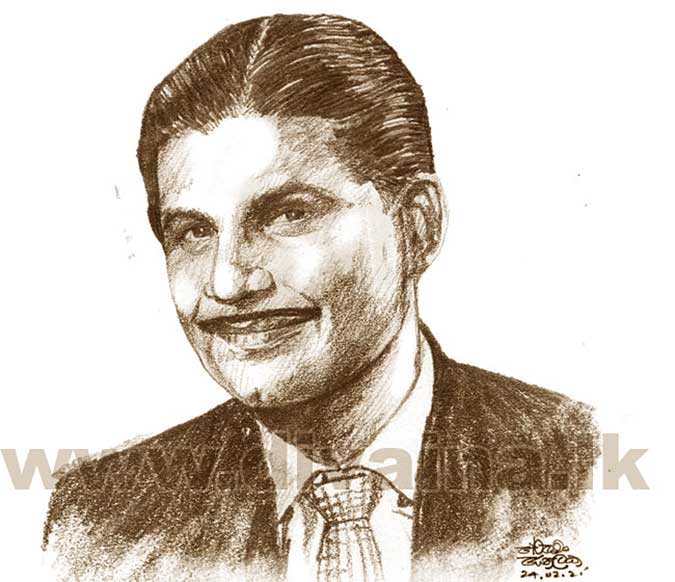
He was in great demand to present concerts and, in fact, many attended to see Karuayya as much as for the concert itself. When he commenced the proceedings, immaculately dressed with hair combed with Brylcream and a wide smile below the thin moustache, crowds roared with applause as he raised his hands and said “Ayubowan” His introductions were crisp and concise, describing a lot in a few words.
Of course, he is best remembered as a lyricist though he did not get universal acclaim. Some critics took objection to his style whilst others attempted to belittle him by saying he writes lyrics for Hindi tunes, disregarding the fact that often lyricists write words to a tune created by a musician and that doing this is more difficult than writing free lyrics. He had the remarkable ability to pen a song in a few minutes and the complimentary remarks, referring to this, made by Dharmadasa Walpola and Milton Perera in interviews, that he often wrote songs for them by the side of his car, on a piece of paper kept on the bonnet, were used by critics to belittle him. He disregarded them by saying: “I write my songs not for critical acclaim but for the sole purpose of the enjoyment of listeners, without them having to turn the pages of a dictionary!” Paradoxically now, 40 years after his death, critics are falling over each other to praise his lyrical style; simple though beautiful and musical words, arranged rhythmically to subtly convey, meanings often very deep, which brought about a sea change in Sinhala music for the masses!
He coined many new words and phrases but his genius was in the ability to transform even harsh words to be musical as illustrated by the Jothipala song “Sal Sapu Na Kumudu Saman Nilmahanel mal athare, Kidaram male pava suwanda digahere”. Leaving aside the simple but philosophical message conveyed later in the lyrics of this haunting song, the genius is in the introduction so beautifully to the lyric of Kidaram mala, the flower of the Stink Lily! The songs he penned still dominating the airwaves, despite the vast changes in the broadcast media since his death, stands testimony to his philosophy. The young, who have no idea whose compositions they are, join the old in singing his songs, made immortal by the vast number of talented Sinhala singers, most of whom he nurtured.
In my humble opinion, Karunaratna Abeysekara is the best lyricists Sri Lanka has ever had as his versatility is beyond compare. Even doubters would agree that his versatility remains unchallenged as he had the capability to suit the lyric to the singer’s style and even to suit the actor, for film songs. His lyrics could be anything from children to classical, funny to provocative but he was at his best when it came to romance, probably because of his own turbulent love affair with Raniakka before marriage. Erani Herath, like many millions in the country, had fallen in love with his voice initially which later blossomed into a romance, objected to by her elders who kept her a virtual prisoner. Her mother prevented her from listening to the radio first and then kept newspapers away from her, when she realized that he was communicating through poems in newspapers! One day, Tilakasiri Fernado has been waiting in studio 10 of Radio Ceylon for Karuayya as he was one song short for his programme the same evening. When the plight was explained, Karuayya vented the pent-up feelings by writing immediately ‘Enna mada nale, gos pawasanna duka mage; Yannata heki obata pamani sirageyata ege’ which has become a classic, wherein he requests the wind to convey his sadness and love to her as it is only the wind that can reach her prison uniterrupted!
In turn, Karuayya extended a helping hand to others in romantic difficulties too. When there were problems with Sanath Nadasiri’s romance with Malkanthi Pieris, he wrote the beautiful song “Ma hada asapuwa, kusumin sarasuwa, e Malbara dethai” Malbara hinting at Malkanthi! When Milton Perera had difficulty in expressing his love to Kalyani and appealed to Karuayya, he obliged with “Kalyaniye oba nasu kathawak kiyannam” with Milton declaring his love over the airwaves and thousands of lovers using it since to overcome their difficulties of romantic expression!
When Dileepa was born, after a gap of ten years, Karuayya was overjoyed and had been lying down on a mat between the two beds occupied by his wife and mother, when he got the sudden urge to pen a song. He got up and wrote “Dileepa podi puthu, saneepayata nidi, Mawage ukul yahane” which was printed in Silumina. Seeing this Clarence Wijewardene has approached Karuayya and had said he will pay anything for the song! In an interview Karuayya mentioned that this and “Enna mada nale” are his favourite songs. Shortly before his death, Karuayya had been listening to a radio programme where they had discussed “Enna mada nale” and Raniakka mentioned in an interview that Karuayya was very pleased and had commented “It is a haunting song.” It is a small mercy that he could listen to his favourite as the last.
No one knows how many songs Karunaratna Abeysekara wrote in his short but fruitful lifetime as he wrote songs for many including my wife, Primrose and even he did not keep a count. The figure of 2000 often quoted is a gross underestimate and may refer only to film songs as he wrote lyrics for over 300 films. Though he was paid for film songs, he never charged a cent from the multitude of artistes he wrote songs for. Almost every artiste of that era had the career launch or their breakout with a song penned by Karunaratna Abeysekara. He must have written thousands for radio musical programmes, Saraswathi Mandapaya and for recordings by artists which remain uncounted. Before the introduction of television, more than half the songs in SLBC library had been written by him.
Though the first song he composed for a film was “Kataragame Devige bime, Ruhunu janapade” screening of Sirisena Wimalaweera’s film Asoka was delayed, Varada Kageda being released ahead, two songs of which remain popular to this day: “Dalula prema gase” and “Piyalee kedila wetuna nebul Saman male” both sung by Mohideen Baig. It is said that seven other lyricists failed to satisfy Nimal Mendis for his composition for the film Kalu Diya Dahara but Karuayya succeeded with “Master Sir“
Some critics consider his best lyrics for a film are in Kurulu Bedda, with music by R Muthusamy and sterling performances by Punya Heendeniya and D R Nanayakkara, which include “Aruna Udaye” the first film song of Milton Perera, “Oya belma, oya kelma, nilupul nethe” by Lata and Dharmadasa Walpola. However, my personal choice is Daskama, the only film Edwin Samaradiwakara provided music for. “Ipida mere” sung by Amaradewa is a synopsis of Buddhism and has become a classic but there are many other beautiful songs too, masterfully crafted, and beautifully sung: “Honda Kala ada” by Mohideen Baig, “Goyam paseela kumbure” by Indrani Wijebandara, “Devlova devsepa” by Indrani Wijebandara and Mallika Kahavita, as well as GSB Rani Perera’s “Mada diye pipunata” and “Turu wadulu tule, sandalu thale, kekulu sele surathale; Mukulu obe, vikulu dange, lelena dalu palakale“, a song which demonstrates how simple words could be melodically threaded.
He excelled in writing about inanimate objects; perhaps, the only lyricist to do so. “Awile semada” is about a candle, “Basicale” is about the bicycle, “Sarungale” is about a kite and “Naga lovin gena apu Bulathatha” is about sheaf of Betel, a song that runs through all the associated rituals, reminding us about our old traditions. Often, he made use of life-events to pen a song. Whilst having dinner in a Chinese restaurant, the waiter has dropped a tray earning a public reprimand from the manager which prompted, the moment he got home, to write “Wedakarala ewara nometha deviyane – Mokotada ma duppathwe ipadune“
He wrote songs for artistes with widely varying styles with equal success, few eternal favourites being: “Kedelle ativu kirille wage demapiiyan sevane” for Mignone and Jetliners which has become the favourite at weddings, “Piyumehi peni bothi wanabambaru” for C T Fernando, “Mal yahanawaki loke, nave chandraloke” for M S Fernando, “Sulange pavee ee wetha yawee ma pathu pathum” and “Oruwaka pawena re ganaandure” for Milton Mallawarachchi, “Diya podak wemin thol wiyaluna pipaseta” for HR Jothipala, “Neela jalase rangana hansa kumari” for Sisira Senarathna, “Namal komali” for Indrani Wijebandara though she grabbed the limelight with the song “Hithannako aiye, denwath heddennnako aiye” from the film Suraya, also written by Karunaratna Abeysekara.
He was so proliferous, sometimes, had written different lyrics for the same tune. Having forgotten that he had written “Me bhavayedi mulu diya daye” for Narada Dissasekara, he had written “Tajmahalak thanawanna ne mata” for H R Jothipala, both becoming very popular and, interestingly, both artistes choosing each as their favourite song!
His younger brother, Gunaratna too was a reputed lyricist and one day Jothipala had come to their place to get a song on Anangaya (Cupid) written and as Karuayya was away, Gunaratna wrote him “Anangaya man” which became a hit. When Milton Perera approached Karuayya about this, he had written “Supemlove kusum sara malsara” highlighting the failures of Anangaya which resulted in a rebuttal from Gunaratna. When there were a few exchanges of songs, many began wondering whether there is a rivalry between Jothipala & Milton or Karunaratna & Gunaratna, the speculation being put to rest by the brothers co-writing “Api santhosen inne, Duka sokhaya ne danne, Aiyya malli wage” which was duetted by Jothipala and Milton!
During Vesak, from every Dansela to Pandal “Obe ragi mana kelambedo” sung by Mohideen Baig is heard, this being among many songs with Buddhist themes Karunaratna Abeysekara composed but it is often forgotten that he wrote on Jesus Christ too: “Bethlehem pure, Dilindu gawahale“. Mohideen Baig’s strong voice often amplified the message in songs like “Sinahawen ho kathawen be maninnata minisa” and “Ma oba wenuweni Bharatha menige pa sevane wedune” describes Baig’s life story.
Lata mentioned in an interview that wherever in the world, when she sang “Perdiga muthuetayai me, Loke sirideru Siri Lanka” the audience stood to attention, no surprise as it ends with: “Negisitiya heka eksathwi, Bedigiyoth rata yaye sunwee“. However, Karunaratna Abeysekara’s most opportune message from the grave comes from Mohideen Baig’s song “Giri hel mudune Manel nopipe, Hiru nonagi awaragirehe” which ends with:
“Dinu jathiya vatina Sinhale, Abhimanaya wu deya Sinhale
E niga sirithe galee, Ha noga endinu delee
Parasiritheni oba Hela meni, eida soketa heluwe”


by Dr Gotabhya Ranasinghe
Senior Consultant Cardiologist
National Hospital Sri Lanka
When we sought a meeting with Hon Dr. Ramesh Pathirana, Minister of Health, he graciously cleared his busy schedule to accommodate us. Renowned for his attentive listening and deep understanding, Minister Pathirana is dedicated to advancing the health sector. His openness and transparency exemplify the qualities of an exemplary politician and minister.
Dr. Palitha Mahipala, the current Health Secretary, demonstrates both commendable enthusiasm and unwavering support. This combination of attributes makes him a highly compatible colleague for the esteemed Minister of Health.
Our discussion centered on a project that has been in the works for the past 30 years, one that no other minister had managed to advance.
Minister Pathirana, however, recognized the project’s significance and its potential to revolutionize care for heart patients.
The project involves the construction of a state-of-the-art facility at the premises of the National Hospital Colombo. The project’s location within the premises of the National Hospital underscores its importance and relevance to the healthcare infrastructure of the nation.
This facility will include a cardiology building and a tertiary care center, equipped with the latest technology to handle and treat all types of heart-related conditions and surgeries.
Securing funding was a major milestone for this initiative. Minister Pathirana successfully obtained approval for a $40 billion loan from the Asian Development Bank. With the funding in place, the foundation stone is scheduled to be laid in September this year, and construction will begin in January 2025.
This project guarantees a consistent and uninterrupted supply of stents and related medications for heart patients. As a result, patients will have timely access to essential medical supplies during their treatment and recovery. By securing these critical resources, the project aims to enhance patient outcomes, minimize treatment delays, and maintain the highest standards of cardiac care.
Upon its fruition, this monumental building will serve as a beacon of hope and healing, symbolizing the unwavering dedication to improving patient outcomes and fostering a healthier society.We anticipate a future marked by significant progress and positive outcomes in Sri Lanka’s cardiovascular treatment landscape within the foreseeable timeframe.

by Fr. Emmanuel Fernando, OMI
Jesuit Fr. Aloysius Pieris (affectionately called Fr. Aloy) celebrated his 90th birthday on April 9, 2024 and I, as the editor of our Oblate Journal, THE MISSIONARY OBLATE had gone to press by that time. Immediately I decided to publish an article, appreciating the untiring selfless services he continues to offer for inter-Faith dialogue, the renewal of the Catholic Church, his concern for the poor and the suffering Sri Lankan masses and to me, the present writer.
It was in 1988, when I was appointed Director of the Oblate Scholastics at Ampitiya by the then Oblate Provincial Fr. Anselm Silva, that I came to know Fr. Aloy more closely. Knowing well his expertise in matters spiritual, theological, Indological and pastoral, and with the collaborative spirit of my companion-formators, our Oblate Scholastics were sent to Tulana, the Research and Encounter Centre, Kelaniya, of which he is the Founder-Director, for ‘exposure-programmes’ on matters spiritual, biblical, theological and pastoral. Some of these dimensions according to my view and that of my companion-formators, were not available at the National Seminary, Ampitiya.
Ever since that time, our Oblate formators/ accompaniers at the Oblate Scholasticate, Ampitiya , have continued to send our Oblate Scholastics to Tulana Centre for deepening their insights and convictions regarding matters needed to serve the people in today’s context. Fr. Aloy also had tried very enthusiastically with the Oblate team headed by Frs. Oswald Firth and Clement Waidyasekara to begin a Theologate, directed by the Religious Congregations in Sri Lanka, for the contextual formation/ accompaniment of their members. It should very well be a desired goal of the Leaders / Provincials of the Religious Congregations.
Besides being a formator/accompanier at the Oblate Scholasticate, I was entrusted also with the task of editing and publishing our Oblate journal, ‘The Missionary Oblate’. To maintain the quality of the journal I continue to depend on Fr. Aloy for his thought-provoking and stimulating articles on Biblical Spirituality, Biblical Theology and Ecclesiology. I am very grateful to him for his generous assistance. Of late, his writings on renewal of the Church, initiated by Pope St. John XX111 and continued by Pope Francis through the Synodal path, published in our Oblate journal, enable our readers to focus their attention also on the needed renewal in the Catholic Church in Sri Lanka. Fr. Aloy appreciated very much the Synodal path adopted by the Jesuit Pope Francis for the renewal of the Church, rooted very much on prayerful discernment. In my Religious and presbyteral life, Fr.Aloy continues to be my spiritual animator / guide and ongoing formator / acccompanier.
Fr. Aloysius Pieris, BA Hons (Lond), LPh (SHC, India), STL (PFT, Naples), PhD (SLU/VC), ThD (Tilburg), D.Ltt (KU), has been one of the eminent Asian theologians well recognized internationally and one who has lectured and held visiting chairs in many universities both in the West and in the East. Many members of Religious Congregations from Asian countries have benefited from his lectures and guidance in the East Asian Pastoral Institute (EAPI) in Manila, Philippines. He had been a Theologian consulted by the Federation of Asian Bishops’ Conferences for many years. During his professorship at the Gregorian University in Rome, he was called to be a member of a special group of advisers on other religions consulted by Pope Paul VI.
Fr. Aloy is the author of more than 30 books and well over 500 Research Papers. Some of his books and articles have been translated and published in several countries. Among those books, one can find the following: 1) The Genesis of an Asian Theology of Liberation (An Autobiographical Excursus on the Art of Theologising in Asia, 2) An Asian Theology of Liberation, 3) Providential Timeliness of Vatican 11 (a long-overdue halt to a scandalous millennium, 4) Give Vatican 11 a chance, 5) Leadership in the Church, 6) Relishing our faith in working for justice (Themes for study and discussion), 7) A Message meant mainly, not exclusively for Jesuits (Background information necessary for helping Francis renew the Church), 8) Lent in Lanka (Reflections and Resolutions, 9) Love meets wisdom (A Christian Experience of Buddhism, 10) Fire and Water 11) God’s Reign for God’s poor, 12) Our Unhiddden Agenda (How we Jesuits work, pray and form our men). He is also the Editor of two journals, Vagdevi, Journal of Religious Reflection and Dialogue, New Series.
Fr. Aloy has a BA in Pali and Sanskrit from the University of London and a Ph.D in Buddhist Philosophy from the University of Sri Lankan, Vidyodaya Campus. On Nov. 23, 2019, he was awarded the prestigious honorary Doctorate of Literature (D.Litt) by the Chancellor of the University of Kelaniya, the Most Venerable Welamitiyawe Dharmakirthi Sri Kusala Dhamma Thera.
Fr. Aloy continues to be a promoter of Gospel values and virtues. Justice as a constitutive dimension of love and social concern for the downtrodden masses are very much noted in his life and work. He had very much appreciated the commitment of the late Fr. Joseph (Joe) Fernando, the National Director of the Social and Economic Centre (SEDEC) for the poor.
In Sri Lanka, a few religious Congregations – the Good Shepherd Sisters, the Christian Brothers, the Marist Brothers and the Oblates – have invited him to animate their members especially during their Provincial Congresses, Chapters and International Conferences. The mainline Christian Churches also have sought his advice and followed his seminars. I, for one, regret very much, that the Sri Lankan authorities of the Catholic Church –today’s Hierarchy—- have not sought Fr.
Aloy’s expertise for the renewal of the Catholic Church in Sri Lanka and thus have not benefited from the immense store of wisdom and insight that he can offer to our local Church while the Sri Lankan bishops who governed the Catholic church in the immediate aftermath of the Second Vatican Council (Edmund Fernando OMI, Anthony de Saram, Leo Nanayakkara OSB, Frank Marcus Fernando, Paul Perera,) visited him and consulted him on many matters. Among the Tamil Bishops, Bishop Rayappu Joseph was keeping close contact with him and Bishop J. Deogupillai hosted him and his team visiting him after the horrible Black July massacre of Tamils.
Sri Lanka-Singapore Free Trade Agreement
By Gomi Senadhira
senadhiragomi@gmail.com
“You might tell fairy tales, but the progress of a country cannot be achieved through such narratives. A country cannot be developed by making false promises. The country moved backward because of the electoral promises made by political parties throughout time. We have witnessed that the ultimate result of this is the country becoming bankrupt. Unfortunately, many segments of the population have not come to realize this yet.” – President Ranil Wickremesinghe, 2024 Budget speech
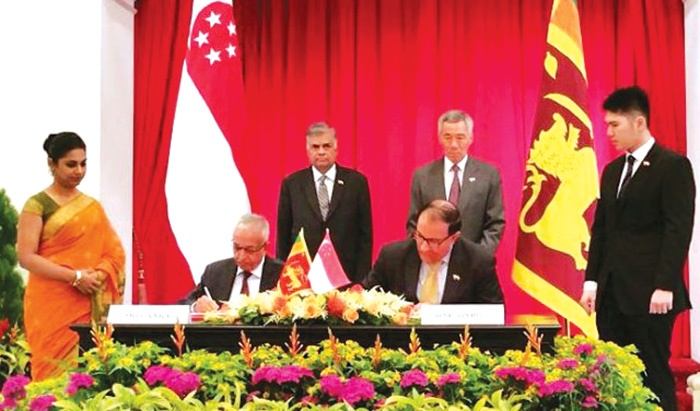
Any Sri Lankan would agree with the above words of President Wickremesinghe on the false promises our politicians and officials make and the fairy tales they narrate which bankrupted this country. So, to understand this, let’s look at one such fairy tale with lots of false promises; Ranil Wickremesinghe’s greatest achievement in the area of international trade and investment promotion during the Yahapalana period, Sri Lanka-Singapore Free Trade Agreement (SLSFTA).
It is appropriate and timely to do it now as Finance Minister Wickremesinghe has just presented to parliament a bill on the National Policy on Economic Transformation which includes the establishment of an Office for International Trade and the Sri Lanka Institute of Economics and International Trade.
Was SLSFTA a “Cleverly negotiated Free Trade Agreement” as stated by the (former) Minister of Development Strategies and International Trade Malik Samarawickrama during the Parliamentary Debate on the SLSFTA in July 2018, or a colossal blunder covered up with lies, false promises, and fairy tales? After SLSFTA was signed there were a number of fairy tales published on this agreement by the Ministry of Development Strategies and International, Institute of Policy Studies, and others.
However, for this article, I would like to limit my comments to the speech by Minister Samarawickrama during the Parliamentary Debate, and the two most important areas in the agreement which were covered up with lies, fairy tales, and false promises, namely: revenue loss for Sri Lanka and Investment from Singapore. On the other important area, “Waste products dumping” I do not want to comment here as I have written extensively on the issue.
1. The revenue loss
During the Parliamentary Debate in July 2018, Minister Samarawickrama stated “…. let me reiterate that this FTA with Singapore has been very cleverly negotiated by us…. The liberalisation programme under this FTA has been carefully designed to have the least impact on domestic industry and revenue collection. We have included all revenue sensitive items in the negative list of items which will not be subject to removal of tariff. Therefore, 97.8% revenue from Customs duty is protected. Our tariff liberalisation will take place over a period of 12-15 years! In fact, the revenue earned through tariffs on goods imported from Singapore last year was Rs. 35 billion.
The revenue loss for over the next 15 years due to the FTA is only Rs. 733 million– which when annualised, on average, is just Rs. 51 million. That is just 0.14% per year! So anyone who claims the Singapore FTA causes revenue loss to the Government cannot do basic arithmetic! Mr. Speaker, in conclusion, I call on my fellow members of this House – don’t mislead the public with baseless criticism that is not grounded in facts. Don’t look at petty politics and use these issues for your own political survival.”
I was surprised to read the minister’s speech because an article published in January 2018 in “The Straits Times“, based on information released by the Singaporean Negotiators stated, “…. With the FTA, tariff savings for Singapore exports are estimated to hit $10 million annually“.
As the annual tariff savings (that is the revenue loss for Sri Lanka) calculated by the Singaporean Negotiators, Singaporean $ 10 million (Sri Lankan rupees 1,200 million in 2018) was way above the rupees’ 733 million revenue loss for 15 years estimated by the Sri Lankan negotiators, it was clear to any observer that one of the parties to the agreement had not done the basic arithmetic!
Six years later, according to a report published by “The Morning” newspaper, speaking at the Committee on Public Finance (COPF) on 7th May 2024, Mr Samarawickrama’s chief trade negotiator K.J. Weerasinghehad had admitted “…. that forecasted revenue loss for the Government of Sri Lanka through the Singapore FTA is Rs. 450 million in 2023 and Rs. 1.3 billion in 2024.”
If these numbers are correct, as tariff liberalisation under the SLSFTA has just started, we will pass Rs 2 billion very soon. Then, the question is how Sri Lanka’s trade negotiators made such a colossal blunder. Didn’t they do their basic arithmetic? If they didn’t know how to do basic arithmetic they should have at least done their basic readings. For example, the headline of the article published in The Straits Times in January 2018 was “Singapore, Sri Lanka sign FTA, annual savings of $10m expected”.
Anyway, as Sri Lanka’s chief negotiator reiterated at the COPF meeting that “…. since 99% of the tariffs in Singapore have zero rates of duty, Sri Lanka has agreed on 80% tariff liberalisation over a period of 15 years while expecting Singapore investments to address the imbalance in trade,” let’s turn towards investment.
Investment from Singapore
In July 2018, speaking during the Parliamentary Debate on the FTA this is what Minister Malik Samarawickrama stated on investment from Singapore, “Already, thanks to this FTA, in just the past two-and-a-half months since the agreement came into effect we have received a proposal from Singapore for investment amounting to $ 14.8 billion in an oil refinery for export of petroleum products. In addition, we have proposals for a steel manufacturing plant for exports ($ 1 billion investment), flour milling plant ($ 50 million), sugar refinery ($ 200 million). This adds up to more than $ 16.05 billion in the pipeline on these projects alone.
And all of these projects will create thousands of more jobs for our people. In principle approval has already been granted by the BOI and the investors are awaiting the release of land the environmental approvals to commence the project.
I request the Opposition and those with vested interests to change their narrow-minded thinking and join us to develop our country. We must always look at what is best for the whole community, not just the few who may oppose. We owe it to our people to courageously take decisions that will change their lives for the better.”
According to the media report I quoted earlier, speaking at the Committee on Public Finance (COPF) Chief Negotiator Weerasinghe has admitted that Sri Lanka was not happy with overall Singapore investments that have come in the past few years in return for the trade liberalisation under the Singapore-Sri Lanka Free Trade Agreement. He has added that between 2021 and 2023 the total investment from Singapore had been around $162 million!
What happened to those projects worth $16 billion negotiated, thanks to the SLSFTA, in just the two-and-a-half months after the agreement came into effect and approved by the BOI? I do not know about the steel manufacturing plant for exports ($ 1 billion investment), flour milling plant ($ 50 million) and sugar refinery ($ 200 million).
However, story of the multibillion-dollar investment in the Petroleum Refinery unfolded in a manner that would qualify it as the best fairy tale with false promises presented by our politicians and the officials, prior to 2019 elections.
Though many Sri Lankans got to know, through the media which repeatedly highlighted a plethora of issues surrounding the project and the questionable credentials of the Singaporean investor, the construction work on the Mirrijiwela Oil Refinery along with the cement factory began on the24th of March 2019 with a bang and Minister Ranil Wickremesinghe and his ministers along with the foreign and local dignitaries laid the foundation stones.
That was few months before the 2019 Presidential elections. Inaugurating the construction work Prime Minister Ranil Wickremesinghe said the projects will create thousands of job opportunities in the area and surrounding districts.
The oil refinery, which was to be built over 200 acres of land, with the capacity to refine 200,000 barrels of crude oil per day, was to generate US$7 billion of exports and create 1,500 direct and 3,000 indirect jobs. The construction of the refinery was to be completed in 44 months. Four years later, in August 2023 the Cabinet of Ministers approved the proposal presented by President Ranil Wickremesinghe to cancel the agreement with the investors of the refinery as the project has not been implemented! Can they explain to the country how much money was wasted to produce that fairy tale?
It is obvious that the President, ministers, and officials had made huge blunders and had deliberately misled the public and the parliament on the revenue loss and potential investment from SLSFTA with fairy tales and false promises.
As the president himself said, a country cannot be developed by making false promises or with fairy tales and these false promises and fairy tales had bankrupted the country. “Unfortunately, many segments of the population have not come to realize this yet”.
(The writer, a specialist and an activist on trade and development issues . )



US sports envoys to Lanka to champion youth development

Rahuman questions sudden cancellation of leave of CEB employees


