Features
THE DEMONISATION OF AN ICON OF UDA WALAWE

by Rohan Wijesinha
Bullet (or Senadhi, which is his official name) was brought to the Elephant Transit Home (ETH) in Uda Walawe, in 1998, at the approximate age of six months. He was found in the Settikulam (Cheddikulam) area, north of the Wilpattu National Park, and was bequeathed his nickname as, even at that tender age, there was a bullet lodged near his jaw. He was released into the National Park in 2003, at approximately five years old. He was not seen between 2009 and 2015 but since reappearing, seems to have largely stayed within the confines of the Park apart from in one instance, about three years ago, when he strayed into an adjacent sugar cane plantation with punishing consequences. He suffered several gunshot wounds and had to be treated by the veterinarian staff of the Department of Wildlife Conservation (DWC).
Still growing, with a pair of tusks that reach almost to the ground, Bullet is truly a treasure of Uda Walawe and is one of the great successes of the ETH and its founding philosophy, that of rehabilitating orphaned baby elephants back into the wild, to live free of the shackles of servitude that would otherwise be placed on them.
A Human-created Problem
Despite frequently spaced sign boards along the electric fences bordering the Park asking people to refrain from feeding the elephants, they are largely ignored. The elephants who have been drawn here have now become conditioned to expecting food from people, even van loads of tourists, who stop to feed them. These creatures now associate people with food, human grown food, and they will begin to seek it from nearby cultivations too. This will exacerbate an already escalating human-elephant conflict (HEC) in the area, resulting in the deaths of both elephants and humans. One can hardly blame the elephants for seeking other sources of food as due to decades of mismanagement, the Park has become choked by invasive alien floral species which have destroyed the grasslands that once provided them with their staple diet.
Bullet, too, started seeking human handouts from approximately 2019 onward. Whenever he is by the fence, even more people stop by to admire his magnificent tusks, and crowd around to feed him. He, as do the others, now see humans as benefactors and expect food from any person, within and outside of the National Park, even when in the supposed safety of a jeep. Thus are monsters created, by ignorance and inadequate checks and controls. This human created problem is not confined to Uda Walawe but also to the Yala National Park, where the tuskers Gemunu and Nandimithra cause consternation to visitors, and along the Buttala Road too, where several males have turned highway robbers.
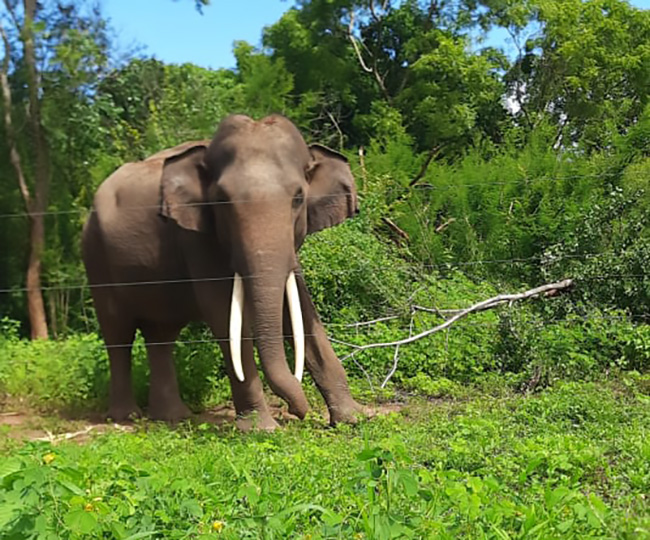
A maturing young elephant bull
Bullet is approximately 26 years old but still has a lot of growing to do. He will reach full sexual maturity in his early to mid-fifties. There were once many mature bulls in Uda Walawe who, as is the norm, would have kept him in check and influenced his behaviour. In fact, in mid-2023, he briefly came into musth but met up with a bigger bull who not only chastised him for his presumption, but also bit off a part of his tail. He soon lost his state of musth, and its associated aggression.
Such large, mature bulls are now few and far between in this Park and when, for the first time in February, Bullet attained a state of full musth, there was none around to put him in his place. Now unrestrained, and like any young male, he is giving vent to his hormone-induced aggression, against human and elephant, with no bigger to compete for the females currently in estrous.
An inconvenience to the DWC
Wild elephants have become an inconvenience to the hierarchy of the DWC. The ever increasing annual deaths of elephants (and of humans) due to HEC, the increasing loss of habitat due to invasive alien species and illegal encroachment, with little initiative from the department to take proactive action to stop it, spells disaster not just for the elephant but for all wildlife in Sri Lanka. Yet what would happen to places like Uda Walawe if its elephants disappeared, and to the human communities and economies that are dependent on them, and the Park?
Up to 25 years ago, Uda Walawe was a little collection of shops, with just one small guest house, and not even a petrol station in close proximity. Today, it boasts over 120 hotels and guest houses, restaurants, a variety of shops, and provides employment to hundreds, and more. Would tourists still come here if there were very few, or no, wild elephants in Uda Walawe? At one time, Uda Walawe could boast of being the one place in Asia where a wild elephant could be seen 24×7, at any hour of the day, on any day of the week. No more.
National Parks are sanctuaries for wildlife
National Parks are sanctuaries for wild animals. These are the last remaining places where they can behave naturally in pursuit of their instinctive search for food, water and procreation. Humans are privileged visitors into their domain and should remember that by observing and not intruding, by learning and not interacting, and above all by respecting and not harassing, they aid in their conservation. It is the responsibility of the DWC to see that this is practiced, and that strict disciplinary action is taken if it is not. The park authorities seem to have largely reneged on this responsibility.
At present, Bullet’s hormones confuse his view of humans; one-time benefactors have now become intruders into his domain. He is a bewildered young male, with none larger to put him in his place. Yet, he has every right to behave the way he does within the sanctuary of the Park. After all, it is his.
A Breach of Trust
Astonishingly, the DWC do not see it this way. They see Bullet, rather than the visitors, as the problem. Instead of advising the jeep drivers, who are all well aware of Bullet’s current condition, to observe him from a distance, they have taken to shooting him with rubber bullets, shooting in the air, or throwing thunder flashes at him. It is alleged that their reason for doing this is to protect tourists. Since when did the protection of tourists become a priority of the DWC over that of conservation? Herein lies the rub. The DWC has abandoned the very principles of its foundation. It has breached its trust to the people of this Nation, and to the wildlife it is supposed to safeguard.
The reality is that in a few weeks Bullet will drift out of musth and revert to being the placid young tusker he was before. The DWC’s actions, however, will ensure that he becomes even more aggressive, as have others who have been treated by them this same way. This will inevitably result in tragedy and Bullet will pay the price. And his Guardians, by Statute, well they will do what they have been doing all along, and take the easy way out.