
Features
The Chimerican Divorce:

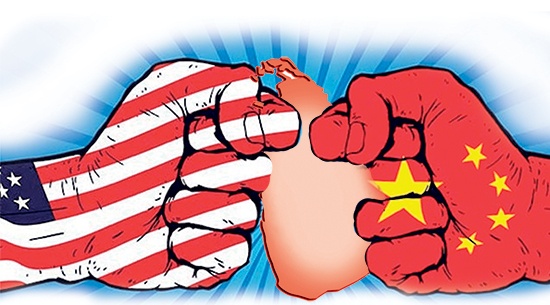
Is Sri Lanka truly ‘Non-Aligned’
by Kusum Wijetilleke
(kusumw@gmail.com)
and
Rienzie Wijetilleke
(rienzietwij@gmail.com)
Sino-Sri Lankan relations date back long before the much-acclaimed rubber rice pact of 1952. The Chinese Monk Faxian documented his visit to the island around the fourth century. King Alakeshvara, ruler of the Kingdom of Kotte, battled a Ming Dynasty fleet in the 1400s. His defeat and capture led to the ascension of King Parakramabahu VI, a known proponent for trade with the ancient Chinese empire. Chinese history has recorded that King Parakramabahu VI was nominated by the Yongle Emperor based on the advice of the Sinhalese present at the Ming Court and installed as King with the backing of Admiral Zheng He and his fleet.
The modern relationship gathered pace after Sri Lanka’s early recognition of the Peoples Republic of China, in 1957. Sri Lanka is also reliant on the United States, the world’s pre-eminent super power and recent comments made by the visiting Secretary of State, Mr. Mike Pompeo, reveal the very public divorce and necessitates a delicate balancing act on the part of Sri Lanka.
China’s economic success has been largely facilitated by the United States and other liberal democracies through multinational corporations operating within a free trade environment. “Chimerica”, a term introduced by Economist Moritz Schularick and Historian Niall Ferguson in 2006, is a term that describes the symbiotic economic relationship between the United States and China. This period of historic economic expansion, amid the booms and busts, is also broadly considered to be the height of the neo-liberal economic project. Chimerica allowed many long established American multinationals to continue their growth stories in the Far East, leading to a mass exodus of American manufacturing to China. In return, the world’s pre-eminent consumerist mecca swallowed up cheaper goods imported from the East. This seemed like a win-win situation; China would lift literally hundreds of millions out of poverty while the US satiated its hunger for cheap products and kept its hyper-consumerist economy trudging along. Yet by the time the 2008 financial crisis struck, China seemed the clear winner. American multinationals were creating extreme levels of wealth but with very little ‘trickle down’ to ordinary US citizens. Wages of the American middle class stagnated, and entire regions of the US, once proud cities built by the manufacturing industry, began collapsing.
Sri Lanka on the String of Pearls
In the meantime, the Chinese Communist Party (CCP) with its centralised structure of economic planning, had begun its next phase of development. The Belt and Road Initiative, had already taken root in Sri Lanka, well before its official launch by Chairman Xi Jinping in 2013. Starting in the 1970s, China had provided grants for infrastructure development to Sri Lanka, the most famous being the BMICH. However since the early 2000s, Chinese investments in Sri Lanka took the form of interest bearing loans and FDI. The Norocholai Power Station in 2006, the Hambantota Port Project in 2007, the Matala Airport and the Colombo Port City investment in 2010 are just some examples.
Sri Lanka was clearly of strategic importance to China and while the global economy ticked along there was little concern, the CCP had become a reliable development partner. The Chimerican project on the other hand, was running into trouble. Schularick and Ferguson note that even in the lead up to 2008, China had been building up its currency reserves and using these to buy more and more US securities. Essentially, China was saving while the US was over-spending. American over-spending was only possible due to cheap debt and cheap debt was always likely to lead to those troublesome economic “bubbles”.
In 2008, demand in the US plummeted and China had to fortify its own economy through an economic stimulus plan around the same time that the US treasury launched the American Troubled Asset Relief Program (TARP). The Chinese Central Bank, PBOC, lifted restrictions on commercial bank lending and the State Council invested somewhere in the region of 4 trillion Yuan, equivalent to USD 600 Bn, in infrastructure and welfare services between 2008 and 2010. A decade or so later and China has had to revisit a stimulus package by way of tax cuts and improving liquidity. China’s double digit GDP growth was always unlikely to last, the inevitable slow-down was managed by the CCP until the unforeseeable external headwinds of the Trump trade war and the pandemic. It is worth noting that the CCP did not publish an economic growth target for 2019, an unprecedented policy that continued through 2020. Despite a rebound in industrial output in the second half of 2020, official unemployment figures remain at around 6% while economists argue that the actual unemployment rate might be double this. Thus China, for all its incredible growth and financial might, is not infallible and must manage its risks and rewards like any other nation. Sri Lanka should take note, an endless Chinese appetite for Sri Lankan infrastructure lending is by no means guaranteed.
Cold War 2.0: The End of an Affair
The inevitable eastward shift of manufacturing, accelerated by neo-liberal trade policies and the automation and technological revolution, altered the lives of millions of working Americans. Many in these towns and cities took note when candidate Trump oversimplified the complex case of US international trade with a view of trade tariffs not shared by many economists. President Trump was always likely to accelerate the eventual divorce or evolution of the Chimerican relationship. The US Treasury department, having taken the historic step of labeling China a currency manipulator in August 2019, changed course a mere 5 months later as part of its Phase One trade deal. The US, UK and a few other European countries have taken steps to ban technology from Chinese telco giant Huawei in their 5G roll-out. These are all facets of the emerging Cold War 2.0. During the original Cold War, two major powers engaged in proxy wars, an arms race and the space race, in a battle for technological superiority. Cold War 2.0 might seem to be all about trade imbalances and intellectual property theft, yet the technological race is critical. China and the US are vying for superiority in various tech fields including semiconductors, quantum computing, 5G, artificial intelligence and data science.
The symbiotic economic relationship is at risk. What remains to be seen is whether Chimerica complete their divorce or arrive at an amicable compromise; an evolution of the relationship. The latter seems less contentious and will moderate short-term shocks to the global economy. However, the current signs seem to suggest the former, and Sri Lanka may find itself in the midst of a rather messy divorce.
Twin Alignment and Anti-Americanism
Secretary Pompeo’s visit and comments, certainly caused a stir. Sri Lanka has always had a strong center-left/ leftist political tradition and anti-Americanism comes with the territory.
The JVP began the festivities on the front page of a daily by stating the obvious: “Sri Lanka doesn’t need Foreign Interventions” (suffice to say, we actually do, we are inviting it in some quarters). The LSSP cautioned the government not to “fall into a trap”, Prof. Tissa Vitharana warning that signing agreements like the SOFA will lead to thousands of US forces utilizing the whole of Sri Lanka as a base. He stated, rather confusingly, that “even staying neutral is tacit approval” and urged the Sri Lankan Government to “take a non-aligned stance and support China”. Note the contradictions.
As much as Sri Lanka would prefer to be “non-aligned”, it remains very much aligned with the East Asian super power through borrowings, agreements and investments whilst performing an intricate balancing act with its number one export destination: the United States. The truth is that Sri Lanka is far from non-aligned, in fact one could argue that Sri Lanka has a ‘twin alignment’ with the two major economic and military powers in the world.
The United States is our top single-nation export destination by a considerable distance, and has also provided some $2.5 Bn in aid over the past several decades through various programmes and institutions. It also funds and thus holds considerable sway in many multilateral institutions such as the World Bank, Asian Development Bank and the IMF. Beyond its economic cooperation, the US also assisted Sri Lanka in some key aspects during the war on terrorism. Naval floating armories were tracked and destroyed using US intelligence, US naval blockades reduced the illegal arms trade in the Indian Ocean and supported the belated proscription of the LTTE in the post 9/11 world.
On the flipside, the US has also sponsored multiple resolutions against Sri Lanka in the United Nations Human Rights Council and even banned the current Army Commander. US backed INGOs and NGOs have long been perceived as assisting or being sympathetic towards the LTTE. Hand-wringing and fist shaking seem to have become the traditional Sri Lankan welcome for American officials visiting the country.
However, Sri Lankans should understand that regardless of the emotional reactions to western imperialism, the country’s economy cannot survive without its trading relationship with the United States.
A Belt around the Neck?
While the US has longstanding military and defense relationships with Sri Lanka, the escalation of hostilities with the LTTE led to restrictions in US military aid to Sri Lanka in 2007. China filled the gap providing direct military aid and equipment. China has since provided a range of modern armaments to the Sri Lankan military whilst also voting against the many US sponsored resolutions at the UNHRC. In return, Sri Lanka has steadfastly supported China at many diplomatic junctures including being one of 50 signatories defending its treatment of Uyghurs and Muslim Minorities in Xinjiang and most recently supporting China’s controversial National Security Law in Hong Kong.
Critics of Sri Lanka’s Sino-relations cite Chinese debt diplomacy and exhibit 1 is the Hambantota Port Debt/ Equity swap. Sri Lanka would appear to be a prime candidate for a potential Chinese debt trap, however the numbers on the surface do not support this claim. Analysts have shown that total debt to China is slightly above 10% of total debt and 60% of Chinese debt can be categorized as ‘concessionary’, though what constitutes ‘concessionary’ might be debated. Various commentators have stated that describing the deal as a debt/ equity swap is misleading. While Sri Lanka received just over USD 1 Bn from China for a 70% stake on a 99 year lease, the agreement did not involve the cancellation of loans from China. The Administration of the time used a small portion of this inflow to settle some short term debt unrelated to the construction of the Port and the remainder was used to bolster foreign exchange reserves.
It is inaccurate to claim that a Chinese debt trap is engulfing Sri Lanka, however non-concessionary debt as a percentage of total debt has been steadily increasing. The more you borrow, the higher your risk profile, the less concessionary future debt becomes. This is simply a natural law of debt and Chinese or not, Sri Lanka is falling into a debt trap. Balance of Payment deficits, budget deficits, investments in major projects without adequate planning, leading to under-performing assets and political manipulations of government revenue generation leads to a weakening of the nation’s credit worthiness. Government officials and ministers as well as members of the business community turn their noses up at conditional borrowings from institutions such as the IMF and view these conditions as suspicious. It is worth considering that these conditions may be better for the country’s long term financial stability.
As is often the case, this requires a trade off against short-term spending which complicates the political sphere. The facts are straight forward, successive Sri Lankan administrations have taken the easy route by simply borrowing to cover budget deficits and to shore up foreign exchange reserves without taking the painful steps required to bring some measure of financial discipline to government spending.
Another aspect of Chinese debt diplomacy that merits discussion are the projects themselves. In 2019, Pakistan cancelled a USD 2 Bn Chinese coal plant project as well as reducing their exposure to loans from Chinese entities. Myanmar scaled down a deep water port project from USD 7.3 Bn to USD 1.3 Bn having decided that debt levels were too high. A proposed Sino-Omani Industrial City that was proposed to cost USD 10 Bn has stalled completely. The Khorgos Gateway in Kazakhstan, 49% owned by China and meant to be the central ‘jewel’ of the modern silk road is basically an under-performing dry port surrounded by an empty 500 hectare field that was slated to become a special economic zone. Some of these projects should sound oddly familiar to anyone with knowledge of the Hambantota port project.
Lending for infrastructure projects require detailed viability studies to ensure the project is not only necessary but able to generate adequate revenue to operate whilst repaying loans. It seems that for many of these projects funded by Chinese banks, viability and revenue generation were not primary concerns for the lending institutions, another suspicious aspect of the BRI.
As a concept, the BRI raises many questions around the motives of the Chinese Communist Party. Sri Lanka had seemingly limited alternatives but to engage China as post war Sri Lanka needed significant investment and dependable partners. The CCP was really the only player and it just so happened that China already had very specific designs on Sri Lanka.
Neo-Imperialism
Politicians and the media, especially those on the center-left, are extremely suspicious about the MCC grant and the security agreements (SOFA and ACSA), accusing the US of using these agreements as tools establish military bases and take control of land assets amongst other nefarious motives. The idea that the US needs a grant of USD 500 Mn to exert influence on Sri Lanka seems farfetched. As noted before the US already has significant influence over Sri Lanka through its trading relationship with exports averaging USD 2.0 Bn annually, a tariff of a few percent would diminish Sri Lanka’s export revenue significantly.
The ACSA and SOFA may have different implications. Sri Lanka first signed a SOFA with the US in 1995 and if certain clauses in the renewal agreement are undesirable, for example those relating to protections and privileges for visiting American troops, these must be negotiated. Everything in Foreign Relations can be bargaining chip. The question to be asked is not whether Sri Lanka should sign the SOFA and ACSA, but what the government should ask for in return. A Foreign ministry official, as per Asia.Nikkei.com, stated that Sri Lanka did not want to seem too closely aligned with any nation and that signing a SOFA would lead to complications. Is Sri Lanka not already too closely aligned with China judging by this benchmark? There are other costs to bear in mind, namely the relationship with Sri Lanka’s immediate neighbor: India. The US has been forging ever closer relations with New Delhi, as part of the ‘American Pivot to Asia’ and India is the perfect foil for the US in the Cold War 2.0.
The over-arching narrative, driven by the exploitative and extractive effects of colonialism, is that the Western establishment spent the better part of the last few centuries exploiting the developing world. Modern day military invasions and interventions across the globe, political interference through international organizations and pressure brought by multinationals prove that the suspicion is warranted. More concerning is that many appear to view massive Chinese investment as purely transactional and any consequent cloud of imperialism as benign.
To believe in a benign form of imperialism is akin to the acceptance of a dictator as benevolent. Even if we ignore the 1989 massacre of Tiananmen Square and the hundreds of deaths, we must still contend with the power wielded by the CCP in Hong Kong, with student protestors now under arrest in the mainland. The Tibetan uprising led to over 85,000 deaths as per the CCP, Tibetans in exile claim the toll was much higher. Territorial disputes in the South China Sea with Indonesia, The Philippines, Malaysia and Vietnam and disputes in the East China Sea with Japan still linger. China would also prefer that its support for the Khmer Rouge is forgotten while the media highlights with the plight of the Uighur minority in the Xinjiang region.
It seems rational to turn a suspicious eye towards Chinese investment and deeper entanglement in view of the ever closer alignment. Sri Lankans will notice the increased numbers of Chinese workers in Sri Lanka and their effect on the local job market. There are multiple large scale government contracts being carried out by Chinese companies using Chinese labour and machinery that dilute the benefits to Sri Lanka. Why is there so much overt anti-Americanism when it is China that was able to maneuver itself in to a position from which to negotiate a long term lease of a port, a port that was funded by Chinese bank loans? There is already much speculation that the Colombo Port City will eventually become a Chinese addendum to Sri Lanka.
Sri Lanka has been a developing country for several decades since independence. The slow march towards the Sri Lankan promise continues. At this crucial juncture, with our economy in peril in the midst of global challenges and intrigue, can Sri Lanka afford anti-Americanism? Should the west not at least serve as a counterbalance to be used against the Chinese at the negotiating table? Certainly, Sri Lanka will have to continue to negotiate with the CCP, and must quickly become more effective at this negotiation to ensure the best possible bargain is struck, one that neither antagonizes the West nor betrays the East. The twin alignment remains in the balance.







by Dr Gotabhya Ranasinghe
Senior Consultant Cardiologist
National Hospital Sri Lanka
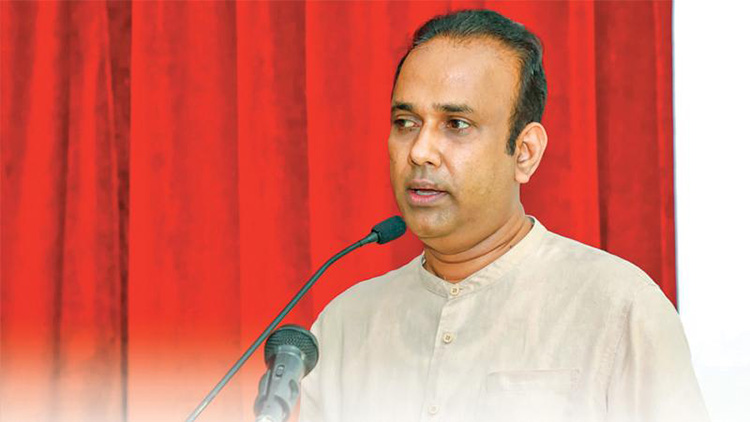
When we sought a meeting with Hon Dr. Ramesh Pathirana, Minister of Health, he graciously cleared his busy schedule to accommodate us. Renowned for his attentive listening and deep understanding, Minister Pathirana is dedicated to advancing the health sector. His openness and transparency exemplify the qualities of an exemplary politician and minister.
Dr. Palitha Mahipala, the current Health Secretary, demonstrates both commendable enthusiasm and unwavering support. This combination of attributes makes him a highly compatible colleague for the esteemed Minister of Health.
Our discussion centered on a project that has been in the works for the past 30 years, one that no other minister had managed to advance.
Minister Pathirana, however, recognized the project’s significance and its potential to revolutionize care for heart patients.
The project involves the construction of a state-of-the-art facility at the premises of the National Hospital Colombo. The project’s location within the premises of the National Hospital underscores its importance and relevance to the healthcare infrastructure of the nation.
This facility will include a cardiology building and a tertiary care center, equipped with the latest technology to handle and treat all types of heart-related conditions and surgeries.
Securing funding was a major milestone for this initiative. Minister Pathirana successfully obtained approval for a $40 billion loan from the Asian Development Bank. With the funding in place, the foundation stone is scheduled to be laid in September this year, and construction will begin in January 2025.
This project guarantees a consistent and uninterrupted supply of stents and related medications for heart patients. As a result, patients will have timely access to essential medical supplies during their treatment and recovery. By securing these critical resources, the project aims to enhance patient outcomes, minimize treatment delays, and maintain the highest standards of cardiac care.
Upon its fruition, this monumental building will serve as a beacon of hope and healing, symbolizing the unwavering dedication to improving patient outcomes and fostering a healthier society.We anticipate a future marked by significant progress and positive outcomes in Sri Lanka’s cardiovascular treatment landscape within the foreseeable timeframe.

by Fr. Emmanuel Fernando, OMI
Jesuit Fr. Aloysius Pieris (affectionately called Fr. Aloy) celebrated his 90th birthday on April 9, 2024 and I, as the editor of our Oblate Journal, THE MISSIONARY OBLATE had gone to press by that time. Immediately I decided to publish an article, appreciating the untiring selfless services he continues to offer for inter-Faith dialogue, the renewal of the Catholic Church, his concern for the poor and the suffering Sri Lankan masses and to me, the present writer.
It was in 1988, when I was appointed Director of the Oblate Scholastics at Ampitiya by the then Oblate Provincial Fr. Anselm Silva, that I came to know Fr. Aloy more closely. Knowing well his expertise in matters spiritual, theological, Indological and pastoral, and with the collaborative spirit of my companion-formators, our Oblate Scholastics were sent to Tulana, the Research and Encounter Centre, Kelaniya, of which he is the Founder-Director, for ‘exposure-programmes’ on matters spiritual, biblical, theological and pastoral. Some of these dimensions according to my view and that of my companion-formators, were not available at the National Seminary, Ampitiya.
Ever since that time, our Oblate formators/ accompaniers at the Oblate Scholasticate, Ampitiya , have continued to send our Oblate Scholastics to Tulana Centre for deepening their insights and convictions regarding matters needed to serve the people in today’s context. Fr. Aloy also had tried very enthusiastically with the Oblate team headed by Frs. Oswald Firth and Clement Waidyasekara to begin a Theologate, directed by the Religious Congregations in Sri Lanka, for the contextual formation/ accompaniment of their members. It should very well be a desired goal of the Leaders / Provincials of the Religious Congregations.
Besides being a formator/accompanier at the Oblate Scholasticate, I was entrusted also with the task of editing and publishing our Oblate journal, ‘The Missionary Oblate’. To maintain the quality of the journal I continue to depend on Fr. Aloy for his thought-provoking and stimulating articles on Biblical Spirituality, Biblical Theology and Ecclesiology. I am very grateful to him for his generous assistance. Of late, his writings on renewal of the Church, initiated by Pope St. John XX111 and continued by Pope Francis through the Synodal path, published in our Oblate journal, enable our readers to focus their attention also on the needed renewal in the Catholic Church in Sri Lanka. Fr. Aloy appreciated very much the Synodal path adopted by the Jesuit Pope Francis for the renewal of the Church, rooted very much on prayerful discernment. In my Religious and presbyteral life, Fr.Aloy continues to be my spiritual animator / guide and ongoing formator / acccompanier.
Fr. Aloysius Pieris, BA Hons (Lond), LPh (SHC, India), STL (PFT, Naples), PhD (SLU/VC), ThD (Tilburg), D.Ltt (KU), has been one of the eminent Asian theologians well recognized internationally and one who has lectured and held visiting chairs in many universities both in the West and in the East. Many members of Religious Congregations from Asian countries have benefited from his lectures and guidance in the East Asian Pastoral Institute (EAPI) in Manila, Philippines. He had been a Theologian consulted by the Federation of Asian Bishops’ Conferences for many years. During his professorship at the Gregorian University in Rome, he was called to be a member of a special group of advisers on other religions consulted by Pope Paul VI.
Fr. Aloy is the author of more than 30 books and well over 500 Research Papers. Some of his books and articles have been translated and published in several countries. Among those books, one can find the following: 1) The Genesis of an Asian Theology of Liberation (An Autobiographical Excursus on the Art of Theologising in Asia, 2) An Asian Theology of Liberation, 3) Providential Timeliness of Vatican 11 (a long-overdue halt to a scandalous millennium, 4) Give Vatican 11 a chance, 5) Leadership in the Church, 6) Relishing our faith in working for justice (Themes for study and discussion), 7) A Message meant mainly, not exclusively for Jesuits (Background information necessary for helping Francis renew the Church), 8) Lent in Lanka (Reflections and Resolutions, 9) Love meets wisdom (A Christian Experience of Buddhism, 10) Fire and Water 11) God’s Reign for God’s poor, 12) Our Unhiddden Agenda (How we Jesuits work, pray and form our men). He is also the Editor of two journals, Vagdevi, Journal of Religious Reflection and Dialogue, New Series.
Fr. Aloy has a BA in Pali and Sanskrit from the University of London and a Ph.D in Buddhist Philosophy from the University of Sri Lankan, Vidyodaya Campus. On Nov. 23, 2019, he was awarded the prestigious honorary Doctorate of Literature (D.Litt) by the Chancellor of the University of Kelaniya, the Most Venerable Welamitiyawe Dharmakirthi Sri Kusala Dhamma Thera.
Fr. Aloy continues to be a promoter of Gospel values and virtues. Justice as a constitutive dimension of love and social concern for the downtrodden masses are very much noted in his life and work. He had very much appreciated the commitment of the late Fr. Joseph (Joe) Fernando, the National Director of the Social and Economic Centre (SEDEC) for the poor.
In Sri Lanka, a few religious Congregations – the Good Shepherd Sisters, the Christian Brothers, the Marist Brothers and the Oblates – have invited him to animate their members especially during their Provincial Congresses, Chapters and International Conferences. The mainline Christian Churches also have sought his advice and followed his seminars. I, for one, regret very much, that the Sri Lankan authorities of the Catholic Church –today’s Hierarchy—- have not sought Fr.
Aloy’s expertise for the renewal of the Catholic Church in Sri Lanka and thus have not benefited from the immense store of wisdom and insight that he can offer to our local Church while the Sri Lankan bishops who governed the Catholic church in the immediate aftermath of the Second Vatican Council (Edmund Fernando OMI, Anthony de Saram, Leo Nanayakkara OSB, Frank Marcus Fernando, Paul Perera,) visited him and consulted him on many matters. Among the Tamil Bishops, Bishop Rayappu Joseph was keeping close contact with him and Bishop J. Deogupillai hosted him and his team visiting him after the horrible Black July massacre of Tamils.
Sri Lanka-Singapore Free Trade Agreement
By Gomi Senadhira
senadhiragomi@gmail.com
“You might tell fairy tales, but the progress of a country cannot be achieved through such narratives. A country cannot be developed by making false promises. The country moved backward because of the electoral promises made by political parties throughout time. We have witnessed that the ultimate result of this is the country becoming bankrupt. Unfortunately, many segments of the population have not come to realize this yet.” – President Ranil Wickremesinghe, 2024 Budget speech
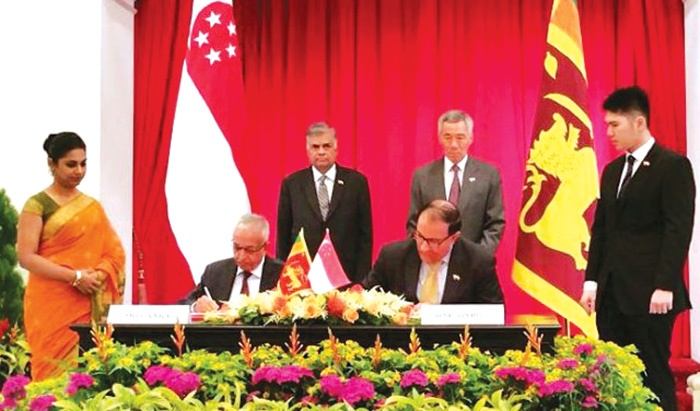
Any Sri Lankan would agree with the above words of President Wickremesinghe on the false promises our politicians and officials make and the fairy tales they narrate which bankrupted this country. So, to understand this, let’s look at one such fairy tale with lots of false promises; Ranil Wickremesinghe’s greatest achievement in the area of international trade and investment promotion during the Yahapalana period, Sri Lanka-Singapore Free Trade Agreement (SLSFTA).
It is appropriate and timely to do it now as Finance Minister Wickremesinghe has just presented to parliament a bill on the National Policy on Economic Transformation which includes the establishment of an Office for International Trade and the Sri Lanka Institute of Economics and International Trade.
Was SLSFTA a “Cleverly negotiated Free Trade Agreement” as stated by the (former) Minister of Development Strategies and International Trade Malik Samarawickrama during the Parliamentary Debate on the SLSFTA in July 2018, or a colossal blunder covered up with lies, false promises, and fairy tales? After SLSFTA was signed there were a number of fairy tales published on this agreement by the Ministry of Development Strategies and International, Institute of Policy Studies, and others.
However, for this article, I would like to limit my comments to the speech by Minister Samarawickrama during the Parliamentary Debate, and the two most important areas in the agreement which were covered up with lies, fairy tales, and false promises, namely: revenue loss for Sri Lanka and Investment from Singapore. On the other important area, “Waste products dumping” I do not want to comment here as I have written extensively on the issue.
1. The revenue loss
During the Parliamentary Debate in July 2018, Minister Samarawickrama stated “…. let me reiterate that this FTA with Singapore has been very cleverly negotiated by us…. The liberalisation programme under this FTA has been carefully designed to have the least impact on domestic industry and revenue collection. We have included all revenue sensitive items in the negative list of items which will not be subject to removal of tariff. Therefore, 97.8% revenue from Customs duty is protected. Our tariff liberalisation will take place over a period of 12-15 years! In fact, the revenue earned through tariffs on goods imported from Singapore last year was Rs. 35 billion.
The revenue loss for over the next 15 years due to the FTA is only Rs. 733 million– which when annualised, on average, is just Rs. 51 million. That is just 0.14% per year! So anyone who claims the Singapore FTA causes revenue loss to the Government cannot do basic arithmetic! Mr. Speaker, in conclusion, I call on my fellow members of this House – don’t mislead the public with baseless criticism that is not grounded in facts. Don’t look at petty politics and use these issues for your own political survival.”
I was surprised to read the minister’s speech because an article published in January 2018 in “The Straits Times“, based on information released by the Singaporean Negotiators stated, “…. With the FTA, tariff savings for Singapore exports are estimated to hit $10 million annually“.
As the annual tariff savings (that is the revenue loss for Sri Lanka) calculated by the Singaporean Negotiators, Singaporean $ 10 million (Sri Lankan rupees 1,200 million in 2018) was way above the rupees’ 733 million revenue loss for 15 years estimated by the Sri Lankan negotiators, it was clear to any observer that one of the parties to the agreement had not done the basic arithmetic!
Six years later, according to a report published by “The Morning” newspaper, speaking at the Committee on Public Finance (COPF) on 7th May 2024, Mr Samarawickrama’s chief trade negotiator K.J. Weerasinghehad had admitted “…. that forecasted revenue loss for the Government of Sri Lanka through the Singapore FTA is Rs. 450 million in 2023 and Rs. 1.3 billion in 2024.”
If these numbers are correct, as tariff liberalisation under the SLSFTA has just started, we will pass Rs 2 billion very soon. Then, the question is how Sri Lanka’s trade negotiators made such a colossal blunder. Didn’t they do their basic arithmetic? If they didn’t know how to do basic arithmetic they should have at least done their basic readings. For example, the headline of the article published in The Straits Times in January 2018 was “Singapore, Sri Lanka sign FTA, annual savings of $10m expected”.
Anyway, as Sri Lanka’s chief negotiator reiterated at the COPF meeting that “…. since 99% of the tariffs in Singapore have zero rates of duty, Sri Lanka has agreed on 80% tariff liberalisation over a period of 15 years while expecting Singapore investments to address the imbalance in trade,” let’s turn towards investment.
Investment from Singapore
In July 2018, speaking during the Parliamentary Debate on the FTA this is what Minister Malik Samarawickrama stated on investment from Singapore, “Already, thanks to this FTA, in just the past two-and-a-half months since the agreement came into effect we have received a proposal from Singapore for investment amounting to $ 14.8 billion in an oil refinery for export of petroleum products. In addition, we have proposals for a steel manufacturing plant for exports ($ 1 billion investment), flour milling plant ($ 50 million), sugar refinery ($ 200 million). This adds up to more than $ 16.05 billion in the pipeline on these projects alone.
And all of these projects will create thousands of more jobs for our people. In principle approval has already been granted by the BOI and the investors are awaiting the release of land the environmental approvals to commence the project.
I request the Opposition and those with vested interests to change their narrow-minded thinking and join us to develop our country. We must always look at what is best for the whole community, not just the few who may oppose. We owe it to our people to courageously take decisions that will change their lives for the better.”
According to the media report I quoted earlier, speaking at the Committee on Public Finance (COPF) Chief Negotiator Weerasinghe has admitted that Sri Lanka was not happy with overall Singapore investments that have come in the past few years in return for the trade liberalisation under the Singapore-Sri Lanka Free Trade Agreement. He has added that between 2021 and 2023 the total investment from Singapore had been around $162 million!
What happened to those projects worth $16 billion negotiated, thanks to the SLSFTA, in just the two-and-a-half months after the agreement came into effect and approved by the BOI? I do not know about the steel manufacturing plant for exports ($ 1 billion investment), flour milling plant ($ 50 million) and sugar refinery ($ 200 million).
However, story of the multibillion-dollar investment in the Petroleum Refinery unfolded in a manner that would qualify it as the best fairy tale with false promises presented by our politicians and the officials, prior to 2019 elections.
Though many Sri Lankans got to know, through the media which repeatedly highlighted a plethora of issues surrounding the project and the questionable credentials of the Singaporean investor, the construction work on the Mirrijiwela Oil Refinery along with the cement factory began on the24th of March 2019 with a bang and Minister Ranil Wickremesinghe and his ministers along with the foreign and local dignitaries laid the foundation stones.
That was few months before the 2019 Presidential elections. Inaugurating the construction work Prime Minister Ranil Wickremesinghe said the projects will create thousands of job opportunities in the area and surrounding districts.
The oil refinery, which was to be built over 200 acres of land, with the capacity to refine 200,000 barrels of crude oil per day, was to generate US$7 billion of exports and create 1,500 direct and 3,000 indirect jobs. The construction of the refinery was to be completed in 44 months. Four years later, in August 2023 the Cabinet of Ministers approved the proposal presented by President Ranil Wickremesinghe to cancel the agreement with the investors of the refinery as the project has not been implemented! Can they explain to the country how much money was wasted to produce that fairy tale?
It is obvious that the President, ministers, and officials had made huge blunders and had deliberately misled the public and the parliament on the revenue loss and potential investment from SLSFTA with fairy tales and false promises.
As the president himself said, a country cannot be developed by making false promises or with fairy tales and these false promises and fairy tales had bankrupted the country. “Unfortunately, many segments of the population have not come to realize this yet”.
(The writer, a specialist and an activist on trade and development issues . )



US sports envoys to Lanka to champion youth development

Rahuman questions sudden cancellation of leave of CEB employees


